Tshering Che Nga (Dzongkha: ཚེ་རིང་མཆེད་ལྔ་) means “five Tshering sisters” and refers to the most popular mountain spirits – the five Tsheringma sisters, who are revered as dharma protectors by the Kagyu and the Nyingma schools of Vajrayana Buddhism. They are also simply known as Tsheringma, which means “mother of longeivity”. There are many tall Himalayan peaks named after them, or are considered as their abodes.
Legend has it they once wandered around the Himalayas along Tibet-Nepal border, terrorising pilgrims and traders, before they were subdued by Guru Padmasambhava, and later by Milarepa, into becoming tutelary deities to watch over dharma seekers and devotees. Their main abode is considered to be the Mt. Gaurishankar at the India-Tibet border. In Bhutan both Tsherim Gang and Jumolhari are believed to be where they dwell.
Being worldly deities (འཇིག་རྟེན་པའི་ལྷ།), Tshering Chenga are invoked mainly for mundane problems and needs such good health, wealth, success, and even beauty instead of enlightenment or after-life journeys. And hence they are very popular across the Himalayan region because they are believed to be very responsive. They are propitiated in annual family rituals and community festivals. Many family homes also keep idols of Tsheringma on the altar with other divinities.
Paro is believed to host all the Tsheringma sisters, making it a prosperous valley. The sacred abodes of the sisters are Dzongdrakha (Tinghi Zhay Zangma – Deity of the East), Paro Gangtey Lhakhang (Talkar Dro Zangma – North), Drangoe Gonpa (Tashi Tsheringma – Centre), Tengchen Gonpa (Miyo Lang Zangma – South), and Ramna (Choepen Drin Zangma – West).
The cult of Tsheringma is not just Paro or in Bhutan but across many Himalayan cultures and communities. For example, Mount Everest, the Sherpas believe, is the abode of Miyo Langzangma – second eldest of the Tsheringma sisters. Thus, every Sherpa who climbs Mt. Everest prays to Miyo Lang Zangma, for safety and for protection.
While every Tsheringma sister is as good as the other in terms of bestowing protections and blessings, there are few subtle differences. If you want a long life, go to Drangoe Gonpa. If you want to ward off some health issues, Paro Gangtey is the place. If you want to ensure you don’t go hungry and want prosperity, head for Tengchen Gonpa. If you want offsprings and your clan to increase, Ramna is good. And lastly, if you are in dilemma over something – a new career, job, or business – in that you are unsure of what do, go to Dzongdrakha and roll the dice. This is just to simplify things for easy reference. What is as important, and as powerful, is your faith, devotion and mindset that should be attuned to ultimately use your health and wealth towards service to humanity and to dharma – and not to enrich yourself for hedonistic purposes.
Also while there’re no religious requirements, it is believed that if one visits all the Tsheringma sisters in Paro in one day, you receive the highest blessings and you will prosper.
Dzongdrakha
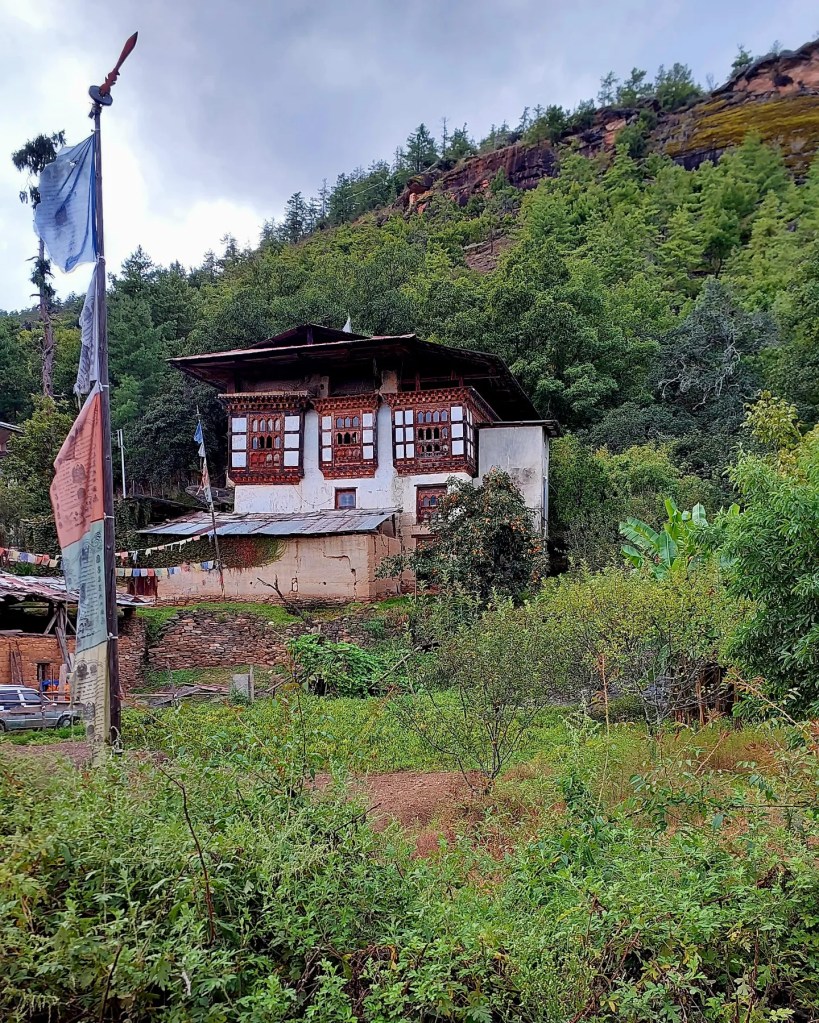
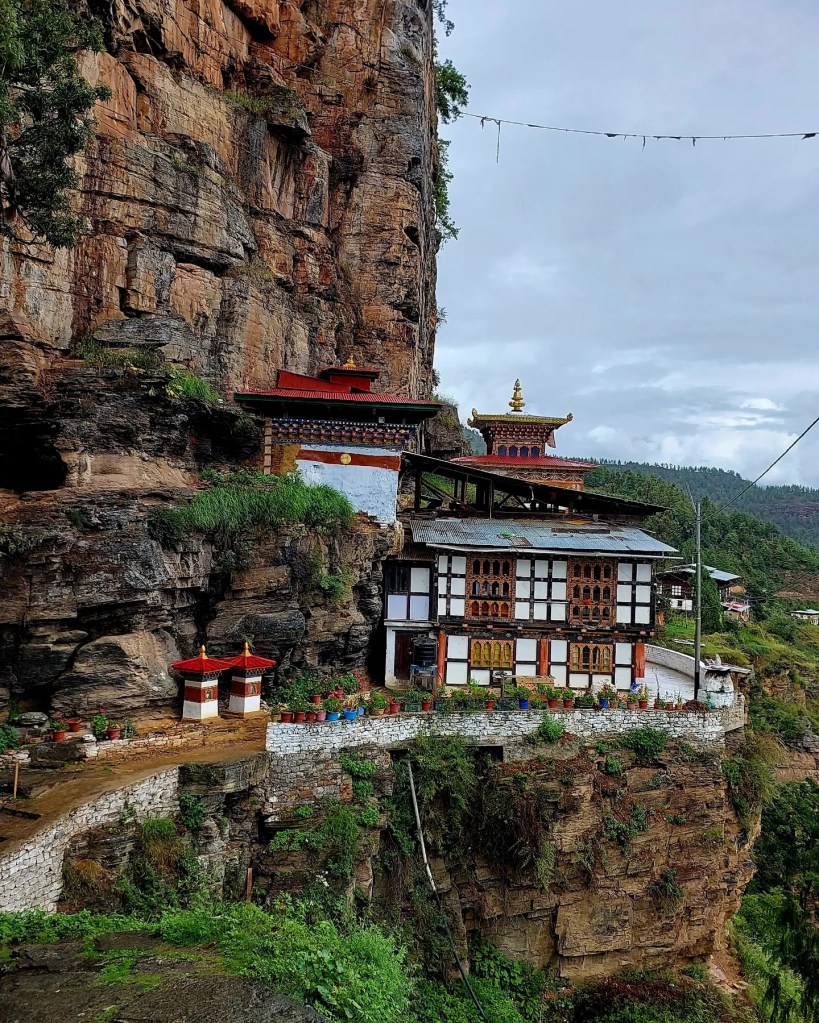
Dzongdrakha is in Lungyi gewog. From Wochu, take the highway to Haa. When you reach reach the plateau where Druk Seeds farm is located, you can see Dzongdrakha on the left mountain, pasted on a vertical cliff like Taktshang. The feeder road to Dzongdrakha starts at the end of the plateau.
In the 15th century, a Tibetan yogi, Drupthop Gyempo Dorji followed his master in search of a place called Zhungphug in Bhutan. When he reached the present day Wochu, a jackal appeared to show him the way to the rocky cliff.
Legend says that the Guru appeared in person and passed him a crystal sword, with which he struck the rockface. A crystal stupa and three egg-shaped relics of Sangye Yoesung (Buddha Kashyapa) were revealed. Two of the relics flew off. One was taken by the divinities, and one by the subterranean beings.
The half-stupa of Dzongdrakha
Drubthop Gyempo Dorji was leaving with the relic of Buddha Kashyapa when the people of Bongdey forced him to stay. He, therefore, called the village Bangdey (dominant village), which later became Bongdey.
He returned to Dzongdrakha and constructed a temple and installed the remaining relic and named the place as Dzongdrakha Goemba. His reincarnations started the Dzongdra Choeje lineage, who are still alive today.
The most prominent among his followers was the 17th century lama and the first Rinpung Lam Neten, Jangchu Zangpo. He renovated the main temple with Guru Padmasambhava as the centre piece.
He also built a chorten (stupa) to secure the relics that trembles during the auspicious days. The chorten is curiously only half-built as the top one-third is believed to be in the realm of gods and the base is in the subterrains of the nagas. Legend says one day it will either fly away or drown in there.
Dzongdrakha is also the starting and the end point of the famous Paro Tshechu. A 7-day festival was initiated in Dzongdrakha but was moved to Paro Rinpung to attract more devotees. However, one of the masks (used for the religious dance) became restless and wouldn’t stay still till a compromise was made. The first and last days were then brought back to Dzongdrakha while the remaining 5 days stayed in Paro Dzong.
The mask, a part of Raksha Lengu dance, is still visible in Tsheringma temple.
Tsheringma Temple
Dzongdrakha is the abode of Thinggi Shyal Zangma (མཐིང་གི་ཞལ་བཟང་མ་ ) where a separate temple is dedicated to her. One can wish for victory, charm and safe journeys. She holds a silver mirror, for divination, in her right and a banner of victory in her left hand. Her mount is a mare.
Lam Namgay of Dzongdrakha adds that Dzongdrakha is more than that. He says that ancient terma scriptures talk about Guru Dorji Drolo hiding the Tsheringma Ter (sacred relics) in Dzongdrakha. Furthermore, Dzongdrakha has a Ter statue of Tashi Tsheringma (བཀྲ་ཤིས་ཚེ་རིང་མ་), which they named as Dokar Jom and which was found in the fields below. This makes Dzongdrakha a very powerful abode of Tsheringma, to the extent that if one really cannot visit the other four sites, one can just visit here and make their wish.
Paro Gangtey Temple
Gangtey Temple is to the right at main gate of Hotel Gangtey Palace, facing Rinpung Dzong. From Taju take the feeder road towards Hotel Gangtey Palace.
The Gangtey Palace Temple is dedicated to the youngest of the Tshering Chhe Nga (The Five Sisters of Long Life), Talkar Dro Zangma. The temple faces the Paro Rinpung Dzong and it is believed that the paddy fields of Chang, which stands between these two important spiritual places, will always have a bounty harvest.
Talkar Dro Zangma (གཏལ་དཀར་འགྲོ་བཟང་མ་) is depicted holding durva grass (medicinal) in her right hand and a snake noose in her left hand to protect one from bad energy and sorcery. And so she helps fight off diseases, envy and sorcery. Her mount is a dragon.
Talkar Dro Zangma is the most beautiful of the five sisters, so says the caretaker, Pemba Tshering. She holds a bunch of the medicinal Durva grass on her right and a snake noose on her left. These signify that she has the power to cure diseases, if one earnestly have faith in her. Pemba says a mother bought a dying child who was given even by the doctors. A few months later, the child and the mother returned again. This time the child was unrecognizable, but cured and healthy. Pemba Tshering shares many other stories.
Talkar Dro Zangma with her snake noose also prevents malicious attacks both from humans as well as harmful nagas, losing one’s life force or fall sick. She counters natural disasters and epidemics, and so during the on-going pandemic more people have visited, as per Pemba.
The most interesting blessing is however the blessing of a child to childless couple. Pemba has many stories but there are two that are worth mentioning. First is a 46-year old woman who even at a such an advanced age didn’t give up the dream of motherhood. She became a mother. The second is a similar case but little more bitter sweet. The woman who wished for a child had a daughter but died few years later. The daughter who is now fully grown up considers Talkar Drozangma as her mother and visits here every month. Few more people do that too.
Drangoe Gonpa
Drangoe Gonpa is located above Olathang Hotel and Paro Hospital. When you reach Hotel gate, take the left feeder road without entering the hotel complex towards “Olathang School”. The Gonpa can be seen from Olathang School on the hill to the right.
Drangoe Gonpa was established by Barawa Lama Gyeltshen Pelzang in 1510. It was later turned over to Drukpa Kagyu with Jinpa Gyeltshen as the chief abbot. Tashi Tsheringma (བཀྲ་ཤིས་ཚེ་རིང་མ་), who is the eldest of the Tsheringma sisters, was the tutelary deity of the Barawa Kagyu, a subsect of the Upper Druk (Toe Druk) in Tibet. And Drangoe Gonpa was built in her honour. However, after the death of Barawa Lam, his disciples made the statue of the lama and the Kudung chorten as the centre piece of the temple. But for locals of the village by the same name, the place belongs to deity Tsheringma and in her they seek protection and prosperity.
The temple was offered to Zhabdrung Ngawang Namgyel who then appointed Namkha Gyeltshen as the first abbot from Zhung Dratshang.
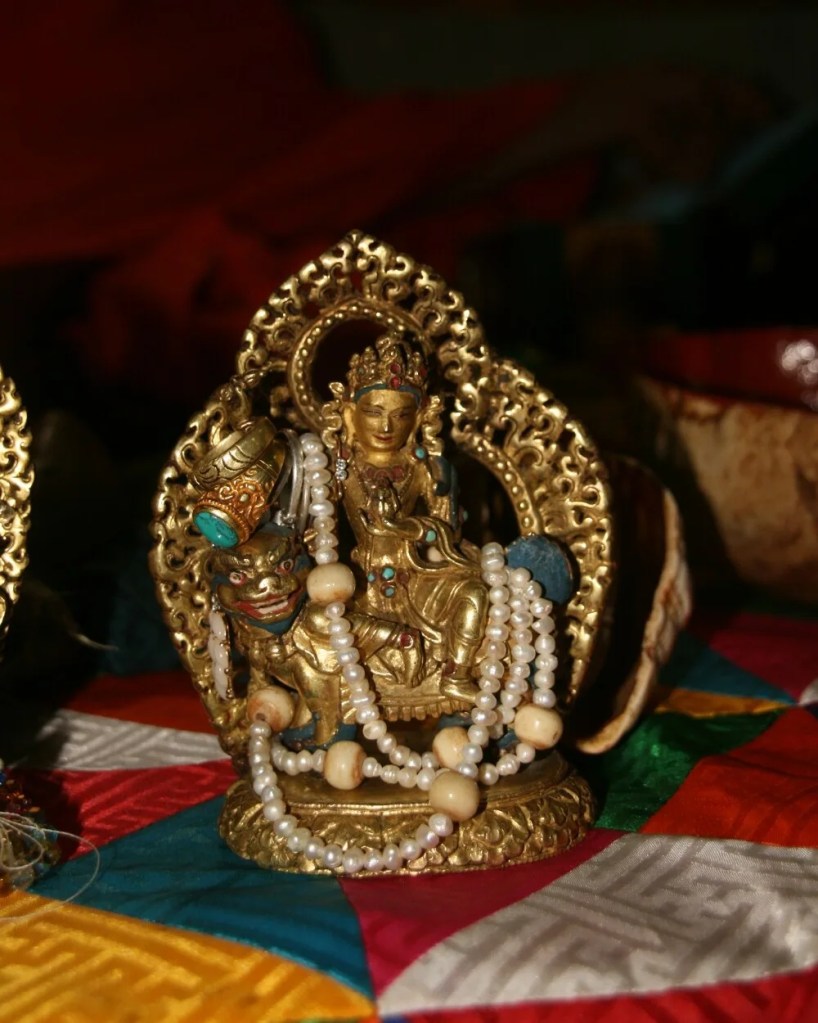
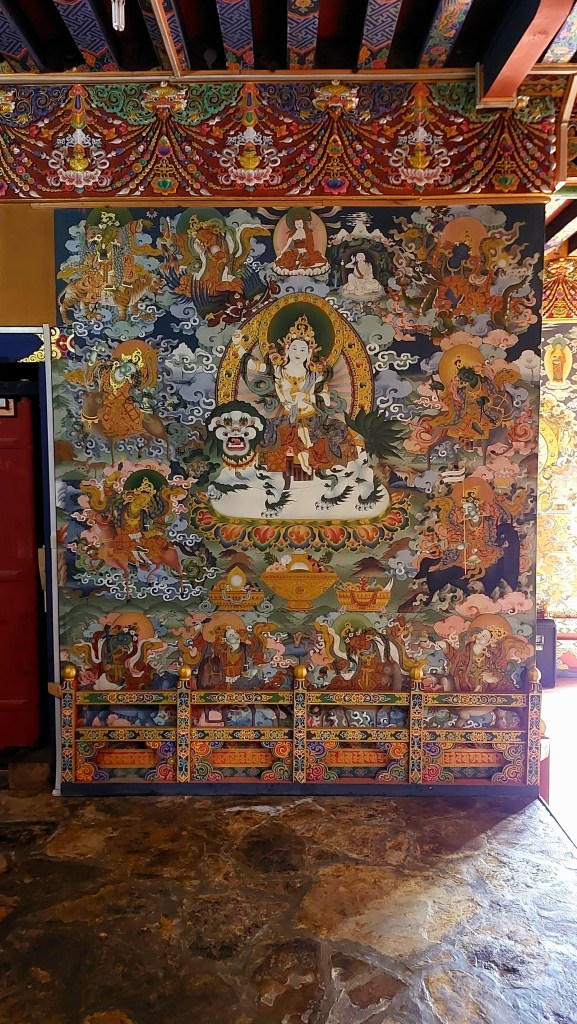
Tashi means “goodness” or “auspiciousness”. She hold on her left hand the vase of immortality and thus her main power is the granting a long life to devotees. On her right hand is the sacred vajra to repell all threats to life. Her mount is a snow lioness. Thus when one visits Drangoe Gonpa, one can wish for long life and commit to spread the Dharma.
According to Lam Kado, the abbot of the temple, if one pursues the pilgrimage to all the temples of the Five Tsheringma, one must either begin or end in Drangoe Gonpa, because Tashi Tsheringma is the eldest sister. He added that children born in Paro Hospital consider Tashi Tsheringma as their birth deity.
I would add that people hospitalised there could do well to seek the blessing for quick recovery to Tashi Tsheringma.
Tengchen Gonpa
Tengchen Gonpa is in Lango. From Paro town take the direction to Naktsel Resort. After a kilometer, take the feeder road marked “Tengchen Nunnery”.
Tengchen Gonpa is the abode of the second youngest of the Tshering Chhe Nga, Miyo Lang Zangma (མི་གཡོ་གླང་བཟང་མ་). She holds a bowl of rice on her left hand and a mongoose on her right that spits jewels. Her mount is a tiger. A devotion to Miyo Lang Zangma guarantees that you will never go hungry and will always bless you with a bountiful harvest and prosperity. The resident Lama, Thinley, says that Paro is the rice bowl of Bhutan because of the blessing of Miyo Lang Zangma.
The foundation for Tenchen Gonpa as the abode of Miyo Lang Zangma is attributed to Barawa Lama, Gyaltshen Pelzang, who had already established Drangoe Gonpa in the 14th century. It is believed that a small Densa (abode) was built by the Lama after which he invited the deity. Miyo Lang Zangma travelled from Tibet and when she reached Lango village, she spent a few days in a house helping the family to roast the wheat and grind the flour. The house still stands today. In fact the house has to host the religious procession statue of the annual deity ceremony on the eve of the Lomba – the local New Year of Paro.
Some four hundred years later, in the 19th century Sherub Gyaltshen, the 25th Je Khenpo of Bhutan, heard about the abode of Miyo Lang Zangma and wanted to verify the claim and possibly build a temple. He visited the place alone and was supposedly greeted by five beautiful girls. Je Sherub suspected that they were the deities and not ordinary humans, but pretended not to know and asked their names. One replied that they had only one name for all five, which was Mangala Rani (a Sanskrit term for deity). He then decided to build a temple and sent instructions to Rinpung Dzong to rally the people and resources. The gonpa was completed in 1849.
Miyo Lang Zangma vowed to protect people’s wealth and property – or help procure them. If you are financial luck is to be dim, maybe a visit to Tenchhen might help.
Ramna House
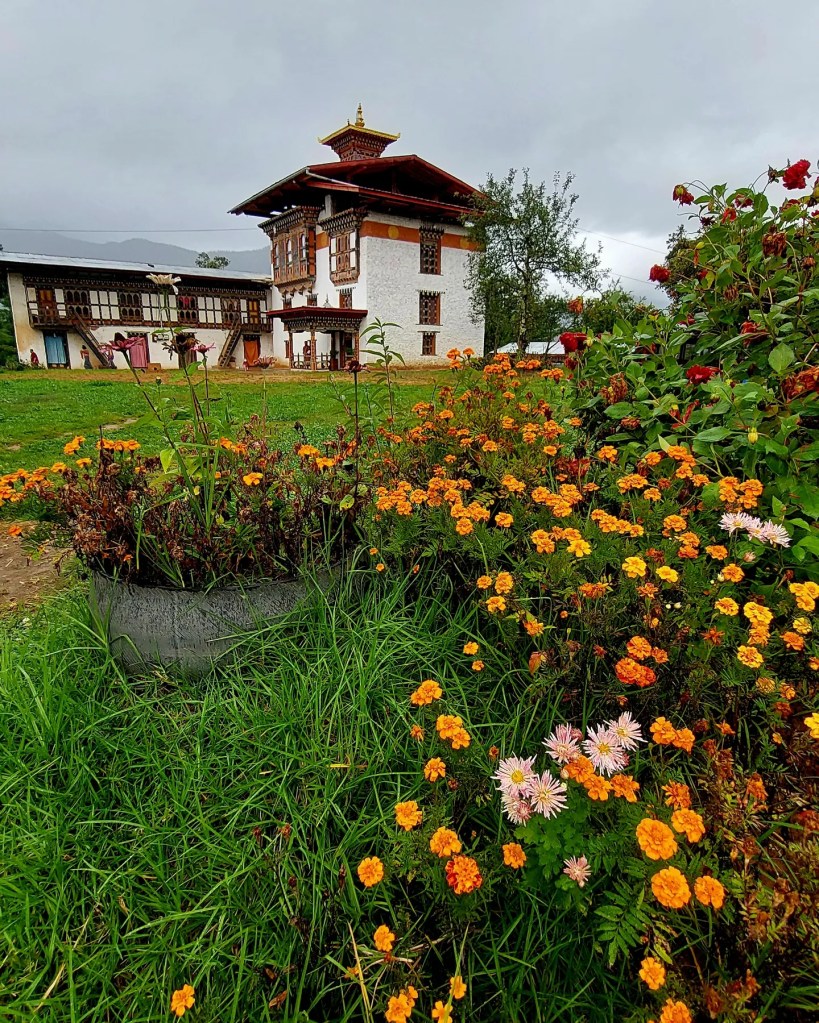
Ramna is not a temple but a private house in Dop Shari. From the town go towards Paro Dzong. At the second bridge, do not cross it but go straight. It is the second house on the left after 300 meters from the bridge.
Ramna House is where Chöpen Drin Zangma (ཅོད་པན་མགྲིན་བཟང་མ་) took residence. She is depicted holding a wish-fulfilling jewel in her right and a jewel encrusted casket in her left hand. Her mount is a doe. And thus she is believed to help with fulfilling any wish – be it for having offsprings or wealth.
According to former gup Dago, Choepen Dri Zangma, is the youngest of the five sisters and this is where the pilgrimage ends. “In some Internet sources Choepen Drizangma is associated to Dzongdrakha, which then leads to confusions of where to start and where to end the pilgrimage, “ he adds.
According to the family, there is no record as to when the deity landed in their house. They can trace to seven generations that have hosted the deity. What they know is that the five Tsheringma sisters first landed in Paro and met for one last time on a big boulder, near the house, before each of them parted ways. The big boulder is still visible today just before you reach the house. Choepen Dri Zangma heard that a woman in the house nearby needed help to deliver a baby and she offered to help. After that she made the house her abode.
Choepen Drinzangma is the all-purpose Tsheringma. If you have been having bad dreams, or omens, or if you are launching new projects, getting into marriage, having a baby or trying to have one, or have a new born child, she is the go-to Tsheringma – the wish-fulfilling one.
Recommended itinerary
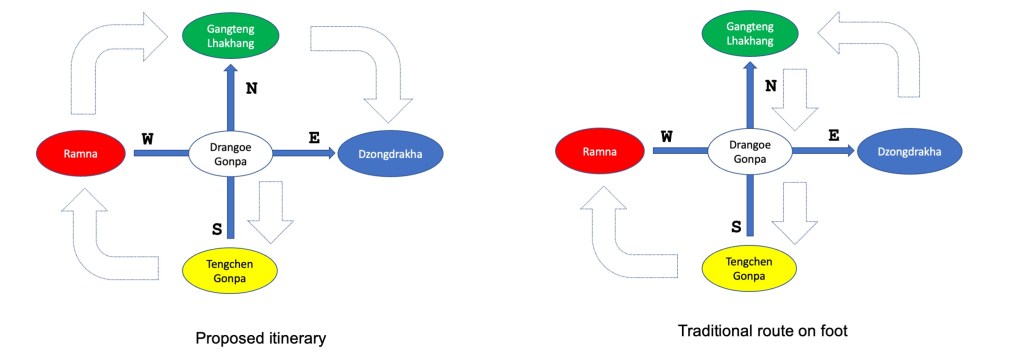
There are several versions as to where to start and where to end the pilgrimage. I conducted a detailed pilgrimage and some research to all the sites last year. My suggestion is, visit in this order: Drangoe Gonpa, Tengchen Gonpa, Ramna House, Paro Gangtey Lhakhang, and Dzongdrakha Lhakhang, so that we follow the traditional kar-ser-mar-jang pattern.
Or simply, just visit Dzongdrakha, which is believed to house the three aspects of devotion and reverance – Ter (relic), tehn (inner relic) and nye (sacred place).
Or if you are walking, follow the traditional itinerary, which starts from Dzongdrakha and ends in Ramna.


 Dorji Wangchuk