The sacred text known as the Satasahasrika Prajñaparamita, which is translated as the Perfection of Wisdom Sutra in One Hundred Thousand Lines (Skt. Śata-sāhasrikā Prajñāpāramitā; Tib. ཤེས་རབ་ཀྱི་ཕ་རོལ་ཏུ་ཕྱིན་པ་སྟོང་ཕྲག་བརྒྱ་པ།) is one of the principal texts in Buddhism. In Dzongkha it is simply referred to as bum (འབུམ་)—meaning ‘The Hundred ’Thousand’—referring to the 100,000 lines of the scripture.
Story has it that it is based on the teachings of Buddha that were delivered at the Vulture Park in Rajgir (India). Manjushri is supposed to have attended the teaching and dictated it to his disciple, who wrote it down. The sacred manuscript is attributed to Jinashri Jnana, a disciple of Manjushri, with Manjushri himself, the legend goes, writing the first three pages with his own index finger and dictating the rest.
The complete set of texts was believed to have been delivered for safekeeping to the Nagas in Kathmandu Valley by Manjushri with an instruction that a man would come in the distant future to retrieve them. That man would happen to be Nagarjuna—a brilliant second-century scholar from South India.
The Temple and the Ser Bum:
I had heard that the manuscripts were in a family temple in Kathmandu and that it was possible to see them. Or at least that was what my Nepali friends told me. Having written the essence of the Prajanaparamita in my PhD dissertation, I was fascinated by the prospects of even getting a glimpse of the original copy.
So, I decided to make a trip to Nepal.
After asking around, and based on a book by Keith Dowman, I traced the family temple to Vikramshila Mahavihar (aka Bhagwan Bahal or Tham Bahil) in Thamel. The local Newari people refer to the volumes as Ser Bum, while the proper Sanskrit name is Śata-sāhasrikā Prajñāpāramitā.
Tracing it in Kathmandu.
The Volume is taken out only on certain days – as deemed auspicious by the Newari calendar. There are no fixed days.
As instructed by another source, I went to the office to introduce myself and make a request. Having a local reference helps, but in my case, I was able to convince them that I was a serious scholar, and most importantly, I had to convince them that I was a devout Buddhist—and not part of any sinister group. You have to make the appointment at least a day in advance for them to probably do some background checks on us.
The Scriptures Appear:
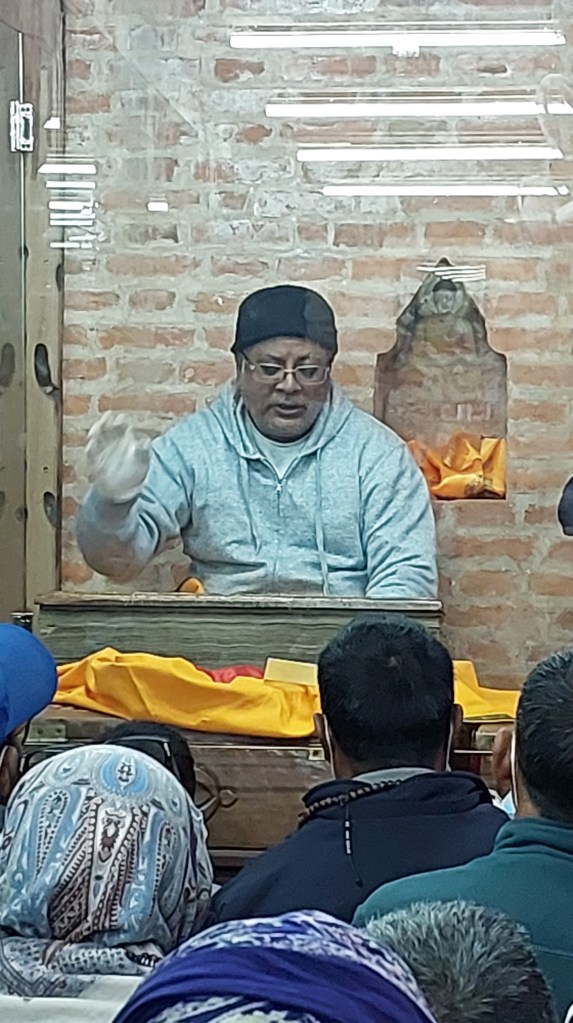
I got back to Tham Bahil on the day of the appointment and was led to a closed room, where I joined some 20 Ladakhi monks, lamas, and pilgrims, who had probably made the same request. After some 30 minutes of waiting, the four volumes of the scriptures were brought in and then solemnly opened by the Chief Custodian from behind a glass wall. He spoke and explained everything in Hindi since he assumed that we were all from Ladakh. He showed the first three pages, written by Manjushri with his own finger, and the rest of the pages written by his disciple, Jinashri Jnana. The noise from the courtyard outside was muffling his voice, and I felt sorry for the Ladakhis since they were mostly illiterate pilgrims and probably didn’t know much of the legend that was shared.
Tracing the Entrance to the Subterranean World:
According to another legend, Kathmandu was a huge lake surrounded by mountains. Eons before Shakyamuni Buddha, the Bodhisattva Kanakmuni is believed to have thrown a lotus seed in the lake. A big lotus with a thousand leaves and flowers blossomed out of that seed. On one of the flowers, a self-arising butter lamp burned miraculously.
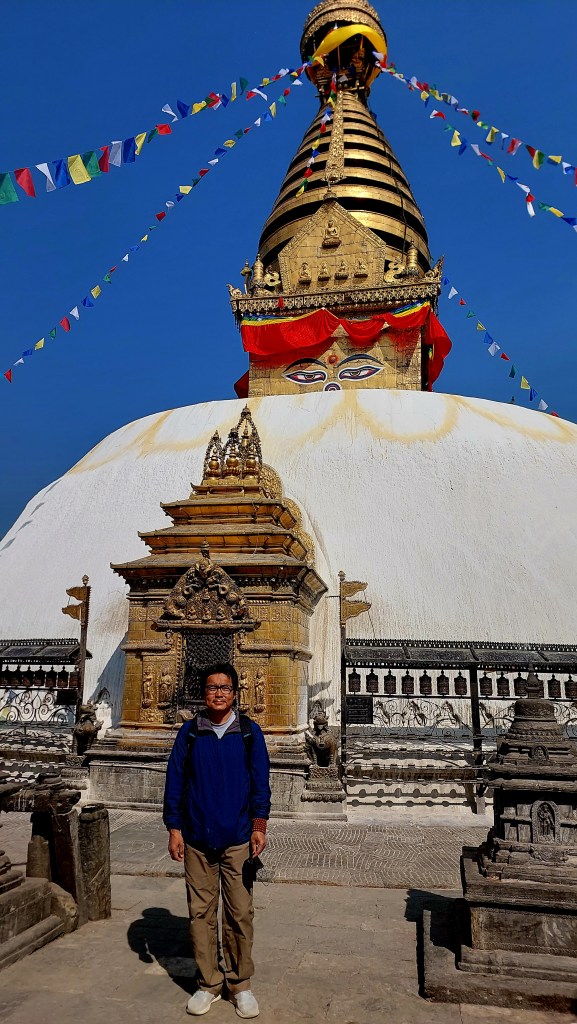
Manjushri is believed to have visited the place, and after meditating on Phulchoki mountain, he struck one end of the valley with his divine sword and drained the water from the lake. And as for that Eternal Butter Lamp, a hill rose on which now stands Soyambhunath (Phagpa Shingkun) Chorten. Just below the summit of Soyambhunath, I was told by the Chief Custodian of Tham Bahil that there is a place called Shantipur, where Nagarjuna is supposed to have entered and returned from the subterranean world of the Nagas with the scriptures.
I thanked him for this piece of information, got out of the temple, and got to the street, where I stopped a taxi. “Monkey temple, my friend,” I told the driver in Nepali. We dribbled through the traffic of Kathmandu and got to Soyambhu in 15 minutes.
After a tough climb up the long stairs to Soyambhu Chroten, I asked around and found the place called Shantipur. Here Nagarjuna (in the second century) is supposed to have entered the subterranean world on the invitation of the Naga King to come and teach the nagas the Buddha Dharma. And to reciprocate for the precious teaching, the Naga King offered the four volumes containing the Satasahasrika Prajnaparamita (the Ser Poti) to Nagarjuna.
What stands there today is a one-story building with a large, dark, ornamented door. That door is supposed to lead to another golden door, one priest told me, and to another door, with a total of five golden doors. That is the entrance to the World of the Nagas.
According to the same legend, the Naga King is still holding on to one more volume and waiting for Nagarjuna to come and give more teachings and offer him that last volume.
Leaving Soyambhu with a prayer:
I made a small offering through the door, rang the bell thrice as per the tradition, and made a silent prayer and a Moelam: that this story and the legend, whether true or not, never die and instead inspire thousands more like me, seeking both the knowledge and enlightenment—and that everyone who seeks them work towards the goodness of humanity and for the benefit of all sentient beings.
I climbed back to the Chorten and made 13 rounds of the Phagpa Shingkun (Soyambhu) and thanked the divinities, especially Manjushri, for this beautiful journey that I have undertaken—and requested him that I never get to my destination—and that there may be more of this wonderful mission.
✌️
✌️





 Dorji Wangchuk
Pingback: Ten must-visit sacred sites in Kathmandu – Dorji Wangchuk
How wonderful to hear your story of the visit to this family temple – it was as if I had visited there myself.
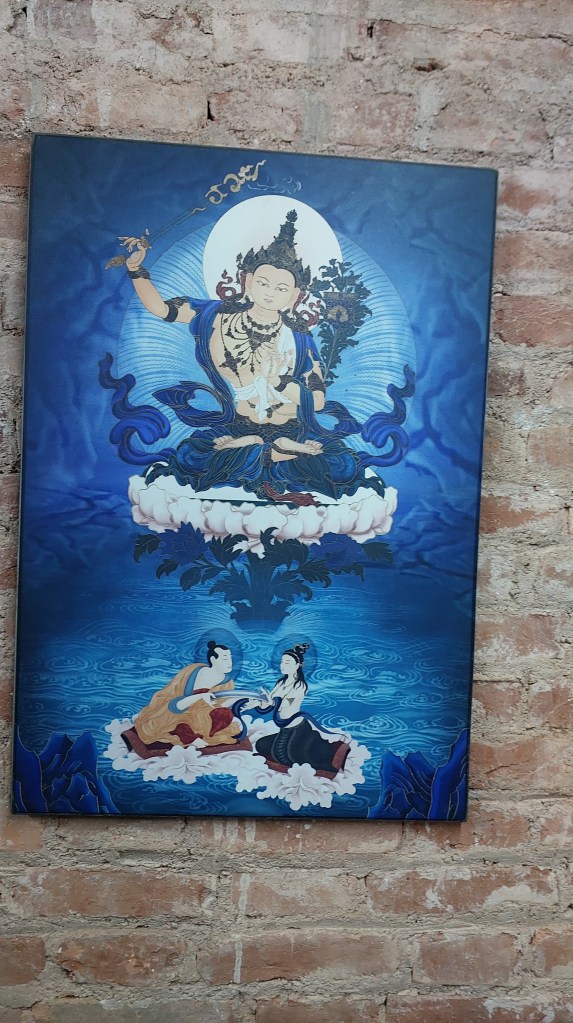
I loved seeing Robert Beer’s pictures of Nagarjuna and Manjushri in your photos. Amazing that they would be in such a place.
In case it is of interest I wrote a devotional piece on Prajnaparamita a while back – I hope it’s ok to share this? In case it’s of interest and use to your readers, who share this same devotion:
https://luminousemptiness.co.uk/devotion-to-prajnaparamita/
May all beings who hear the words of this sacred teaching, or see images of her embodiment as a deity be fully liberated!
LikeLike