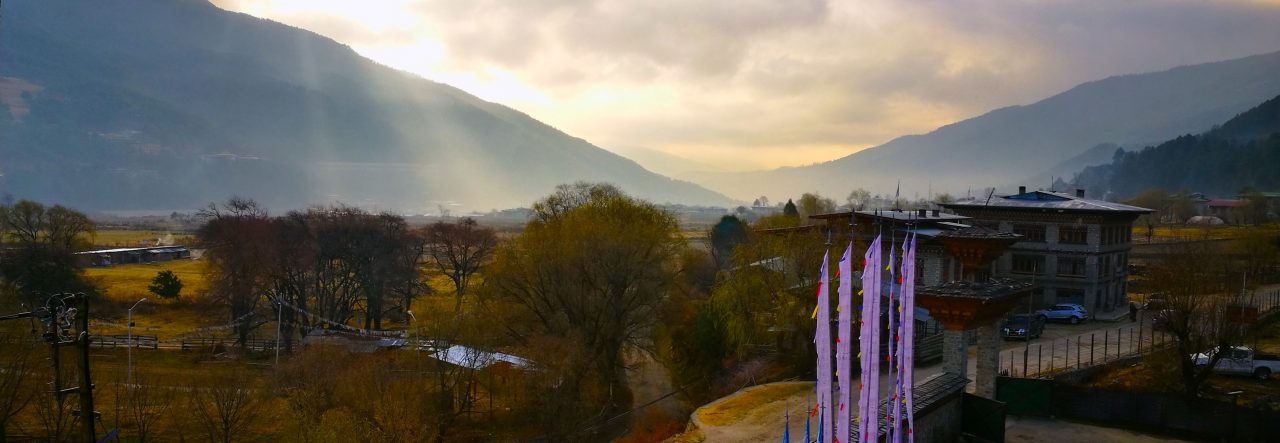
“There are ferocious dogs guarding the place. So, I must call the Lama to tie them”, Wangchuk, a work colleague, told me when I shared with him that I was going to Tsetok Gonpa. Going up I did on the auspicious Tara Day, and Wangchuk not only had called the lama on my behalf, but he must have also spiced up my credentials. The lama welcomed me and provided me a guided tour with marvellous stories. I was also served tea and zaw (roasted rice) and offered lunch.
I started my visit by offering a butter lamp, and thanking the deities and divinities for everything in life.
Lodey Gyatsho – the founder
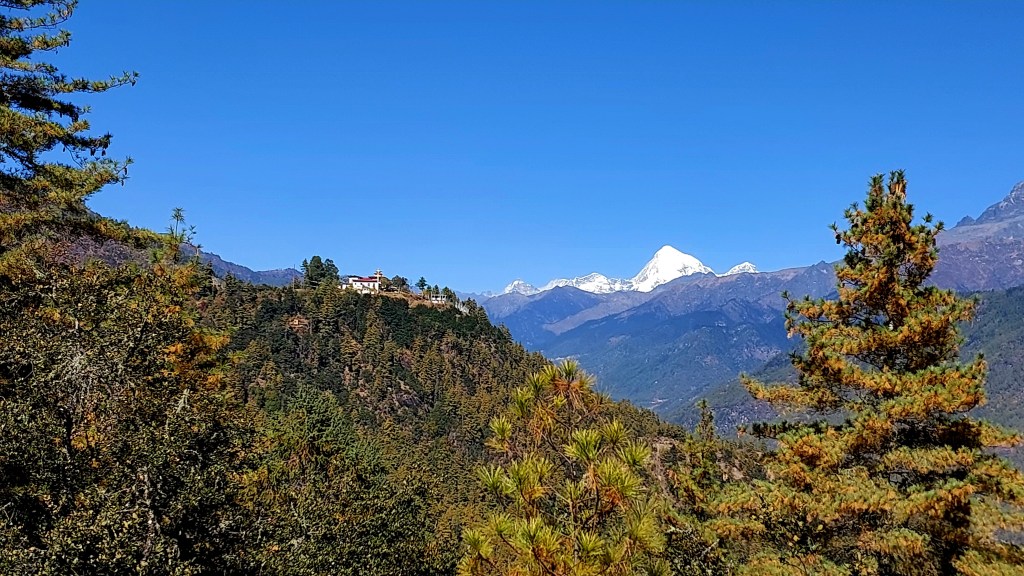
Tsetok gompa stands on the top of a mountain that is shaped like a vajra – an instrument used in Buddhist rituals. Tse means top in local languages, and hence Tsetok literally means “on top of the tse”. Gompa means “a meditation retreat hermitage”.
According to the resident Lama, Tashi Wangdi, Tsetok Gompa was established by lama Lodey Gyatsho – one of the six legendary students of Tshang Khenchen Pelden Gyatsho (1610-1684). All six are believed to have accomplished the highest level of tantric teachings. In fact, they were also referred to as drub-thob (The Accomplished One). Lodey Gyatsho was the youngest of the six Gyatshos. Many sources say they were all brothers.
Tshang Khenchen (literally meaning The Most Knowledgeable from Tshang) Pelden Gyatsho (1610 – 1684) was the biographer and a close friend of Zhabdrung Ngawang Namgyel (1594-1652).
Lam Tashi Wangdi adds that after their monastic education under Tshang Khenchen, the Gyatsho brothers were told to go out and fulfil their destiny of establishing seats of buddhist learning. Subsequently, Peljor Gyatsho established Geling Gonpa (which is now in Chukha Dzongkhag – opposite Chapcha), Sangnag Gyatsho established Thadra Gonpa in Thimphu – above Lungtenphu, Tsundru Gyatsho and Thinley Gyatsho built Tsundru Gompa and Phurdrub Gompa respectively – in Paro Dawakha, and Drakpa Gyatsho established the Jaba Jangchub Choling Gonpa in Jabana – also in Paro, on the way to Haa.
While the other Gyatshos immediately set off and fulfilled their destiny, Lodey Gyatsho, being the youngest, decided to take care of their ageing parents. However, as time went by he was increasingly drawn back to dharma and also felt repelled by the mundane farming life. He then returned to spiritual realm by entering into a serious retreat at Paro Taktshang Yoselgang and practiced the sacred Dorje Phurba (Vajrakilaya).
After twelve years of retreats and practices, Lodey Gyatsho saw in his vision the great Guru Padmasambhava who appeared to him and pointed to him the mountain facing Taktsang, and telling him that the Vajra-shaped mountain is the upper part of Thousand-spoked Wheel of Western Direction (nubcho khorlo tsib-tong) and that his destiny laid there.
Some mornings later, Lodey heard a loud knock on the door. This was strange because there were no temples and monasteries as we see them now. There were very few hermits and huts, and Yoselgang was the furthest spot of them all – and not even visited by birds or animals. When the lama opened the door he found a Vajrakilaya statue placed in front of his hermitage.
He took care of the statue, but one day he found that the statue went missing. Subsequently, he noticed a flickering light from the Vajra-shaped mountain, which he saw in his vision. After some days, he decided to hike to the mountain to see what that light was.
On reaching the peak of the mountain he found his Vajrakilaya statue on a flat stone in the middle of a small lake. He retrieved the statue and was planning to return to Taktsang Yoselgang when the local spirit, Genyen Bolap, approached him and asked him to stay there and build a temple – and that he would provide all the support.
Tsetok Gonpa was, thus, built.
The actual date of its establishment is lost in time. However, according to my calculation it must be around the mid of the 17th Century – just around the time when Zhabdrung Ngawang Namgyel had consolidated his place in Bhutan – because soon after Tshang Khenchen (The teacher of the six Gyatshos) was met with fierce opposition to his work in Tibet. Consequently, he was invited by Zhabdrung to move to Bhutan, which he did, and settled in, and built, the Menchuphu Gompa in Paro Shaba.
The sacred statues (ku-ten in Bhutanese)
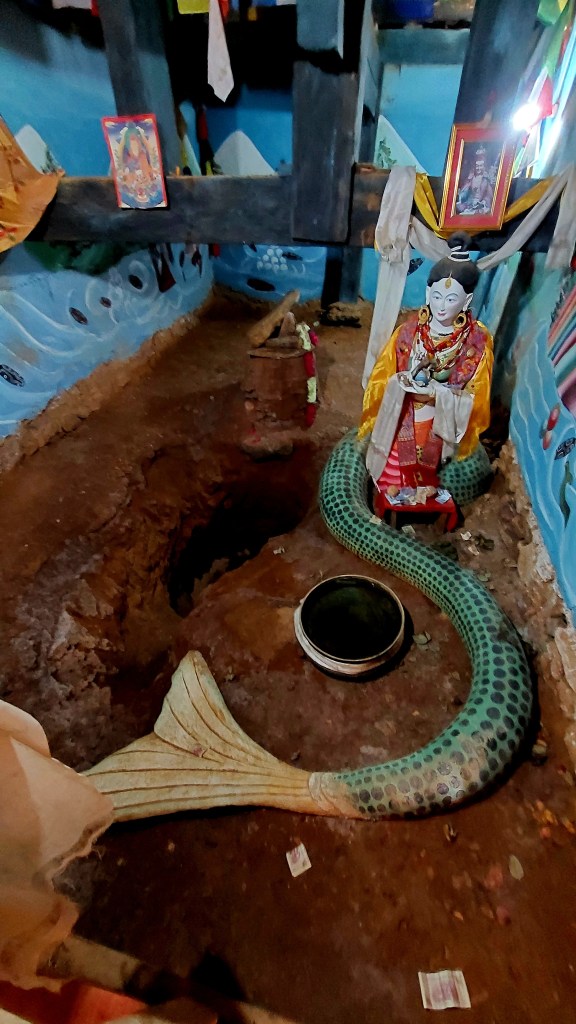
The temple has a statue of the Tshomen (mermaid) who was the guardian of the lake from where the Vajrakilaya statue was retrieved. The statue is on the ground floor and not for the faint-hearted since the Tshomen’s body looks like a giant snake. The lake is dried up because of the desecration works done by some delinquents.
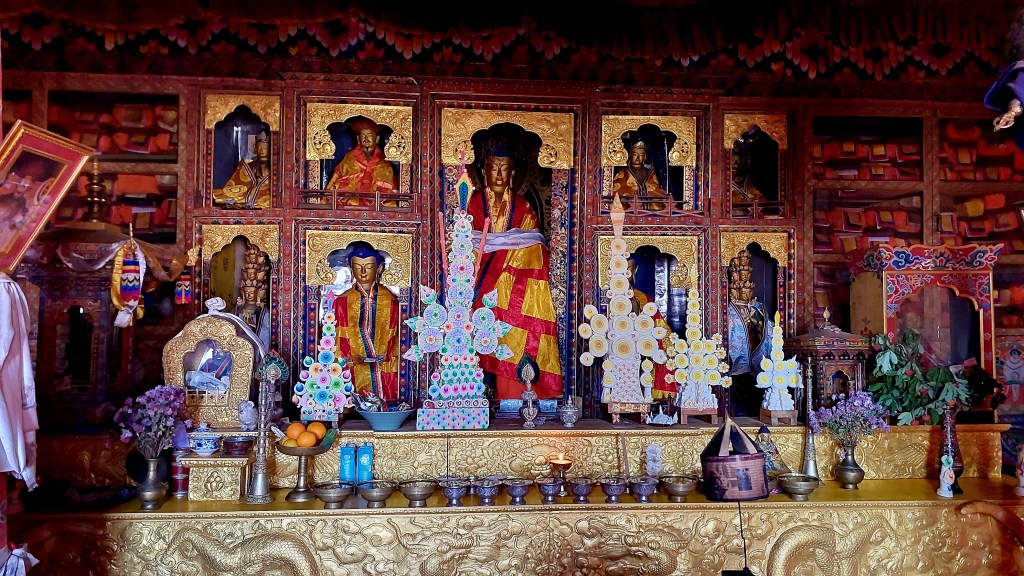
The main temple is on the first floor and depicts the Buddhas of Three Eons (Duesum Sangye) – Buddha Kashyapa (Sangye Yoesung), Buddha Shakyamuni (Sangye Sachathupa), and Buddha Maitreya (Gyalwa Jampa) – plus smaller statues of Guru Rimpoche, Zhabdrung Ngawang Namgyel and of the founder – Lodey Gyatsho.
The temple is adorned with medieaval swords and shields, and enquisite murals of pantheon of Vajrayana deities and divinities. The wooden flooring is over 200 years old and polished to perfection.
The sacred scriptures (sung-ten)
The temple has a rich collection of major scriptures and Buddhist canons such as Kanjur (words of Buddha) and Tenjur (commentaries), plus the sung-bum (speech teachings) of all the major masters of the past such as Tshang Khenchen, Zhabdrung Ngawang Namgyel, and others.
Lama Lodey Gyatsho was a renaissance man who not only perfected the Buddhist teachings and philosophy, he was also a master of all thirteen arts and crafts (zorig chusum) and also medicines (sowa rigpa) and astrology (tsi). In fact, the story goes that the blessed butter ointment (ngag-mar) made from his skull relic (kapala) is supposed to have cured a visiting tourist, who was suffering from an incurable chronic disease. This foreign visitor later donated a large sum of money and also rallied support to completely renovate the temple. His photo stands on the ritual stand (thri) of the caretaker-lama.
The sacred inner relics (nang-ten)
Set of Phurpa (ritual dagger). In the temple there is also a set of phurpas (ritual daggers) made out of wood, which used to be taken to the private houses during the rituals for the sick. Lodey Gyatsho meticolously carried out rituals and ceremonies for the seriously ill, and he made the phurpa set with the instruction that after his death, any lay monk can conduct the ritual with the phurpa set on the altar – and that the curative power and blessings would be the same as his. The phurpa set can be seen on the offering altar (sen-thri) of the main temple.
Vajrakilaya statue. The Vajrakilaya (Dorje Phurba in Bhutanese) statue is by far the most precious nang-ten of Tsetok Gonpa. The small statue – of five or six inches in height, is housed in a large amulet.
The Vajrakilaya practice represents the enlightened activities of all the Buddhas, and thus is powerful in removing obstacles in one’s journey towards realisation, destroying forces hostile to compassion, and purifying the spiritual pollution that is prevalent in these degenerative times.
As the lama blessed me, I recited my favourite mantra, which was the first prayer that my grandfather taught me.
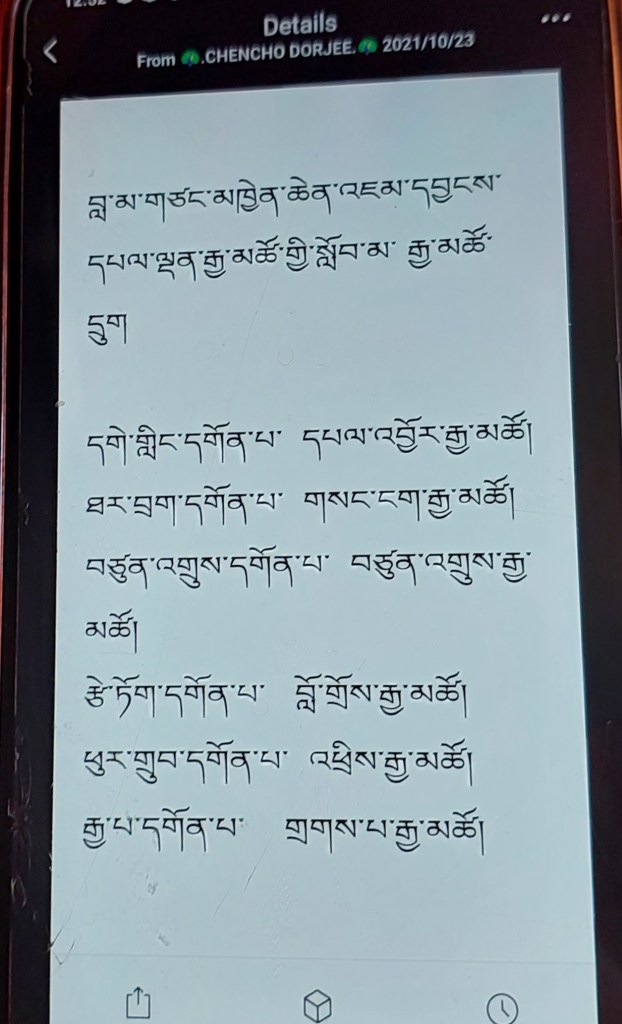
སངས་རྒྱས་ཆོས་དང་ཚོགས་ཀྱི་མཆོག་རྣམས་ལ། །
sangye chö dang tsok kyi chok nam la (In the Buddha, the Dharma and the Supreme Assembly)
བྱང་ཆུབ་བར་དུ་བདག་ནི་སྐྱབས་སུ་མཆི། །
changchub bardu dak ni kyab su chi (I take refuge until I attain enlightenment)
བདག་གིས་སྦྱིན་སོགས་བགྱིས་པའི་བསོད་ནམས་ཀྱིས། །
dak gi jinsok gyipé sönam kyi (Through the merit of practising generosity and so on)
འགྲོ་ལ་ཕན་ཕྱིར་སངས་རྒྱས་འགྲུབ་པར་ཤོག །
dro la pen chir sangye drubpar shok (May I attain buddhahood for the benefit of beings)
Tara and Manjushri Ter statues. There are also two beautiful ter statues of Tara (Jetsun Drolma) and Manjushri (Jetsun Jamyang). Ter statues are believed to be either antiques pieces, or of divine origins. Some are believed to have self-arisen and not made by humans. The Manjushri statue does not have the flaming sword, which I proposed to make one from a Sakya craftsman I know in Nepal, and offer it to the temple. The lama was very pleased with my offer.
The Wooden Mould. The temple also has a beautiful wooden mould to make miniature statues of animals and local deities. Legend has it that the mould contains all the animals living in the six realms. On close observation, some of the animals and figures looked like extraterrestrial beings – as depicted in Hollywood sci-fi movies.
The Kapala. An important and priced relic is the kapala (Sanskrit for skull) of Lodey Gyatsho that has been turned into a ritual cup – as customary in Tibetan Buddhism. The skull has self-arisen images of the Sun, Moon, and the Pleiades (Karma Mindruk), which appeared miraculously.
The skull is believed to have miraculous properties. For example, butter rubbed inside can be later used as ointment for any skin, muscle, or bone ailments. The water poured in and blessed is then distributed to devotees, which is believed to spare one from rebirth in the Lower Realms. It also claims to cure internal diseases with the digestive system, urinary tracks, lungs and heart.
The bell and vajra of the lama. The temple also has several personal effects of Lodey Gyatsho, chiefly his bell (drib) and the vajra (dorje). The bell is supposed to produce a sound, which when heard will release you from the rebirths in all lower realms.
The Annual Blessing and Bumday
Coinciding with the death anniversary of Lama Lodey Gyatsho on the Fifteenth Day of the Ninth Month of the lunar calendar, a week long rituals and ceremonies are conducted, during which it is advisable to visit this gompa to get access to all the relics to pray, and also make sponsorships and offerings.
Getting there
From Lango town, drive towards Tenzinling Tent City, and keep right at every major junction till you reach Dungse Thinley Norbu Kudrung Chorten.
The access road to Tsetok Gompa is marked here, but during monsoon the road is either bad or damaged. It takes 1.5 – 2 hours till the temple from here. 30 minutes if the access road is through.






 Dorji Wangchuk