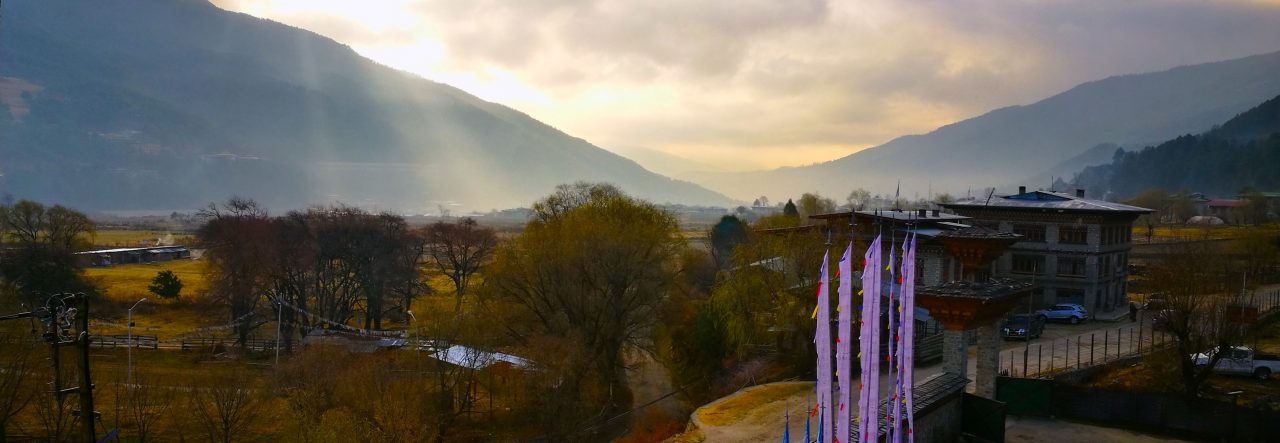
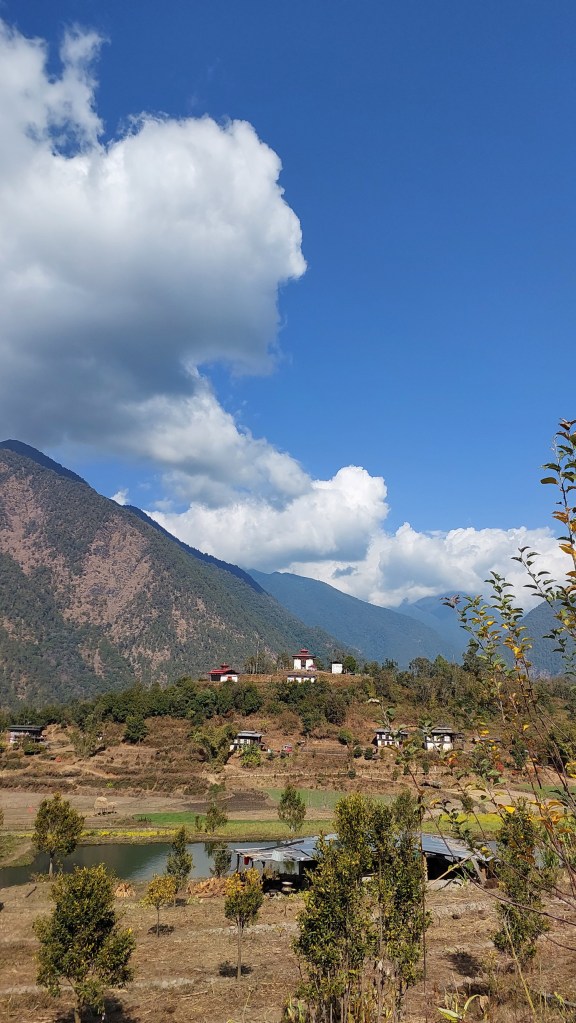
I closed my week-long New Year Pilgrimage with a visit to Athang Rukha – my adopted village for 18 years now. The village of Rukha is one of the few sacred abodes of Palden Lhamo – one of the three supreme protectors of Bhutan.
My association with Rukha.
For those of you who have not been following my work, I have been associated with that valley since 2007 when I went there for the very first time on a documentary mission. The remoteness of that place (it was two days of walking through the leech infested jungles) and the misery I came across shook me to the core that I decided then and there that whatever remained of my life would be dedicated to doing something for that village. The valley is now known for the Oleps – the last hunter-gatherers of Bhutan.
I subsequently volunteered for a foundation that went on to lift them out of abject poverty to a dignified life. When the project ended, the villagers and I had bonded so much that they wouldn’t let me leave. So, I stayed on and we built some temples together in a valley that didn’t even have a prayer flag when I first got there (they practised shamanism and nature-worship). I provided the funds using my own money (which ran out every now and then and the work stopped) and the people there did the hard work – extracting the timber, carrying the boulder, ramming the mud, etc.
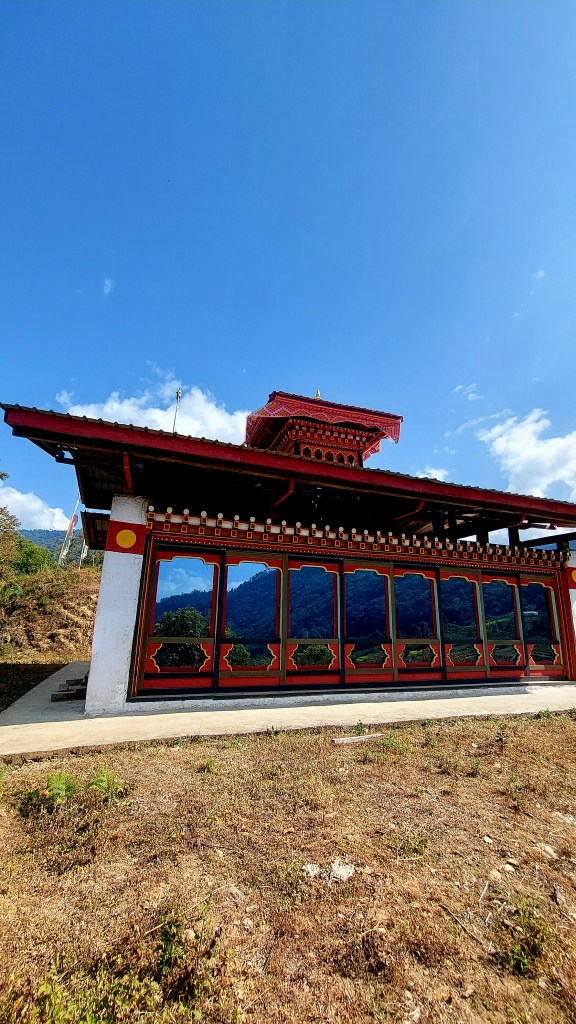
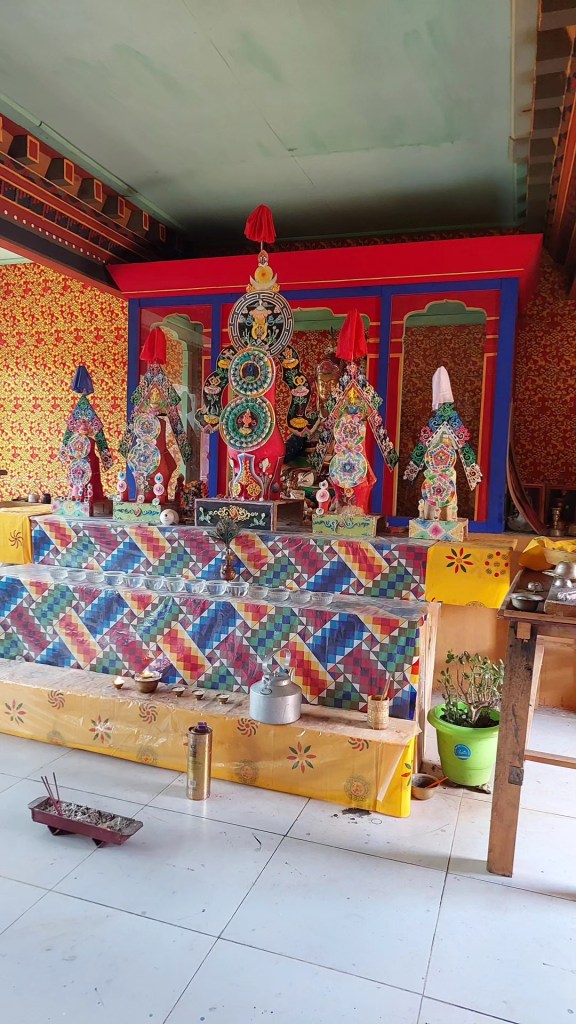
Fast forward to 2024, the third temple – a tshokhang (community hall) dedicated to Guru Padmasambhava – my birth deity, is getting the finishing touches of religious art on the ceiling – three mandalas of Tshela Namsum (Buddha Amitayus, Unisha Vijjaya and Tara). These mandalas when completed would throw down more blessings when anyone does ceremonies to Sangye Tshepamay, Namgyelma or Jetsun Drolma.
Abode of Palden Lhamo.
The place is believed to be the abode of Palden Lhamo and visited by both Guru Padmasambhava – on his way to Bumthang in the Eighth Century, and by Terton Pemalingpa in the Sixteenth Century on his way from Bumthang looking for a place that would eventually become Gangtey Gonpa.
A temple built in the mediaeval era stood there until it was completely destroyed in the early 1930s after the original inhabitants abandoned the valley because of the smallpox epidemic. Between 2009 and 2014, the Oleps, the new settlers of Rukha and I built the temple over the mud ruins of the original temple. Left untouched, the ruins can be seen on the ground floor. The carpenter, Chorten Tshering, was told in his dream by a girl not to destroy the mud ruins.
In 2014 when the former Tsugla lopen Samten Dorji consecrated the first temple, many old people from the valley heard the sounds of the religious instruments for the first time in their life. Furthermore, many young people, and every elder member, took the oath from Tsugla Lopen to refrain from hunting and killing wild animals – a skill and way of life they inherited from their forefathers. Now, a twice-monthly Lhamo Tsho-ja is conducted with households taking turns.
Traditionally the Oleps practiced shamanism and animism, and this continues in some forms till this day. And here, I have been very respectful not to force anyone into one or the other spiritual practices. As Buddha said, I can only show the way.
In 2020, when the pandemic hit and we were all stuck, the Rukha Lama, Ugyen Tshering, and I initiated another temple to be used as Tshokhang, so as to turn the first temple into a Neykhang (place for protector deities) and dedicate it solely to Palden Lhamo. I also built an altar with 21 Taras for my daughter and grandson whose birth deity is Tara. In 2022, the tshokhang was consecrated by Gangtey Rimpoche, who also presided over a three-day Tshechu with mask dances – the first one to be instituted in lower Sha region.
The blessings of Palden Lhamo and Tara are evident. Rukha has been receiving bountiful harvest, in general, and the families who were solidly behind the temple project are having a fulfilling time with their children doing well with their life.
And the story continues..
From going hungry to building a better life for themselves and their children, to temples and hosting the first Tshechu in the region, the Oleps have come a long way in less than two decades. It has been close to an economic and social miracle – a case study in development management. The credit fully goes to the people who believed in themselves and were ready to work hard.
Along the way the State also provided the valley with a power-tiller road (2011) upgraded to a farm road (2018), electricity (2019), and mobile phone network (2023). From a two-day treacherous hike the road to Rukha has been reduced to an hour-long pleasant drive from the Wangdue – Tsirang highway.
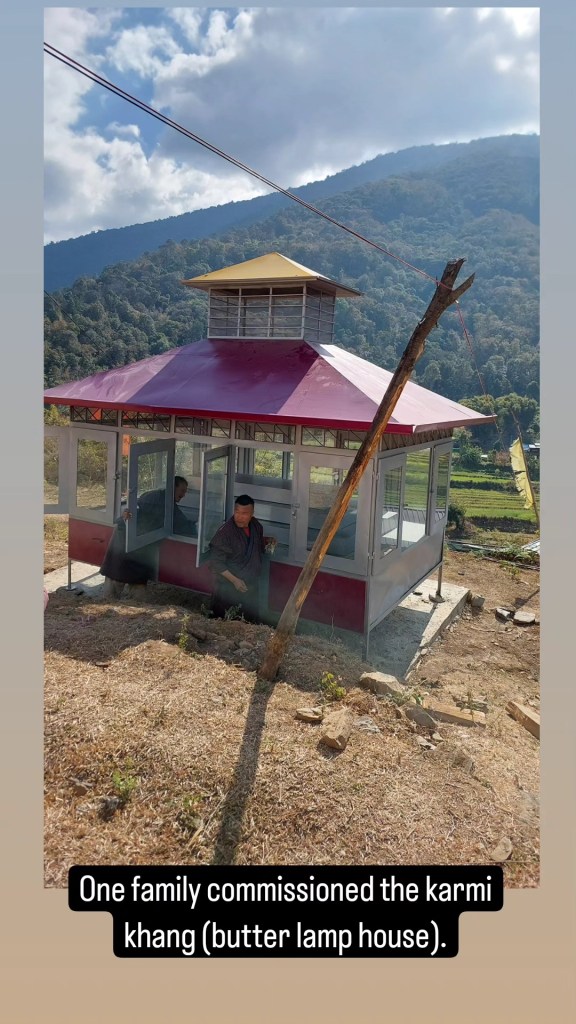
I offered three butter lamps in a new large Karmi Khang that a family from Rukha had bought in the memory of their father, who passed away a few months back. It arrived on the same day I landed there. I prayed that the people of Rukha continue on their path and be a part of this small great nation, as it moves confidently into the future.
They say you cannot take anything with you when you die. This is not true. You will carry with you the good and bad karma and the merits and retributions you accumulated. And more importantly, you will also leave behind the memories of you in people whose lives you made some difference.
So, as you breathe in the Dragon Year 2024, I invite you all to take a moment to reflect on a few questions. How many thoughts and prayers (moelam zangpo in Bhutanese) have you sent to others? How many smiles have you brought in someone else? How many lives have you touched through your small or big works?
As a Mahayana Buddhist, these should be the questions of your life – and the greater meaning of a pilgrimage.
(Itinerary of my pilgrimage – Semtokha Dzong (Thimphu), Dobji Dzong (Paro), Lhakhang Karpo (Haa), Punakha Dzong (Punakha), Mebar Tokchoe (Zhemgang), Lamga and Rukha (Wangdue)





 Dorji Wangchuk