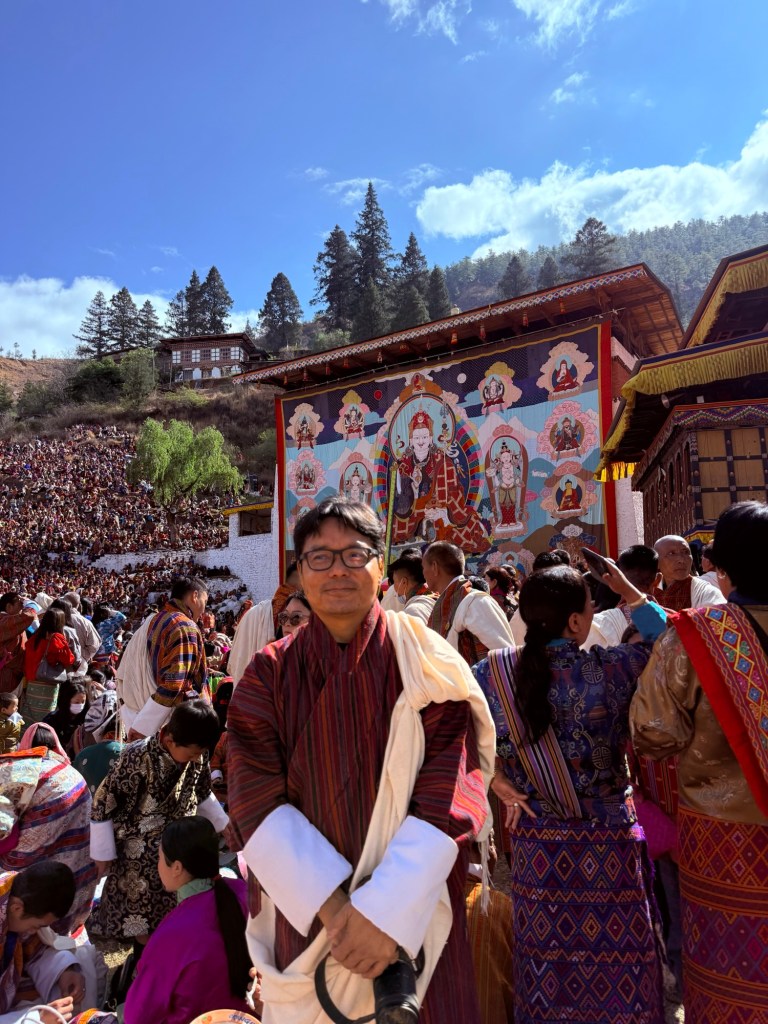
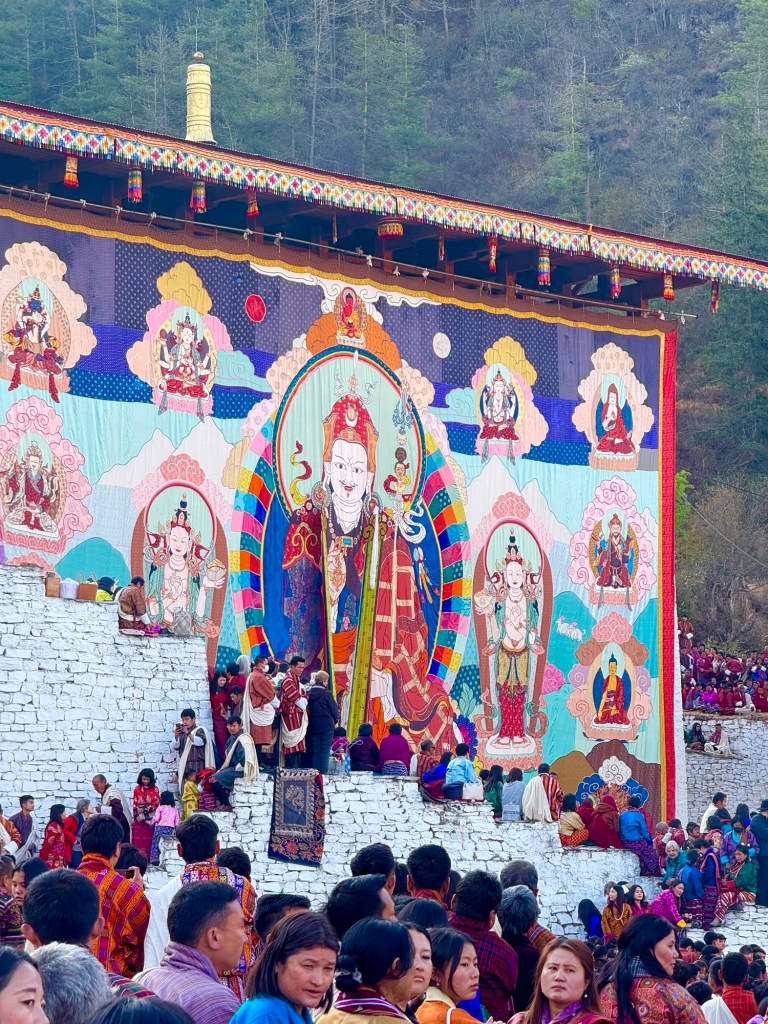
Thongdrel means “liberation upon seeing” and it refers to the giant holy scroll that devotees believe that the mere sight of it would liberate a sentient being from the three lower realms.
The Great Thongdrel of Paro is the most precious treasure of Paro Dzong. Its fame grew after it remained intact despite the whole Dzong (fortress) being destroyed by fire in 1906.
The Great Thongdrel of Paro was commissioned by the Second Paro Penlop, Ngawang Choeda, and was embroidered by master artist Lam Ngawang Rabgay around 1650. His portrait is depicted on the lower left to Guru – although some sources assume that as Desi Tenzin Rabgye. This is quite unlikely because there is a thirty-year gap between Penlop Ngawang Choeda and Desi Tenzin Rabgye.
Many legends surround this great scroll depicting Guru Padmasambhava and his eight manifestations. There are countless stories of how Lam Ngawang Rabgay made this masterpiece. The white silk brocade to make the face of Guru is believed to have been offered by two dakinis.
It always feels nice to receive its blessing when it is unfurled once a year on the last day of the Paro Festival. I try to put in my calendar to attend it as far as possible. As a great bonus His Majesty the King also graced the moment making it even more special.
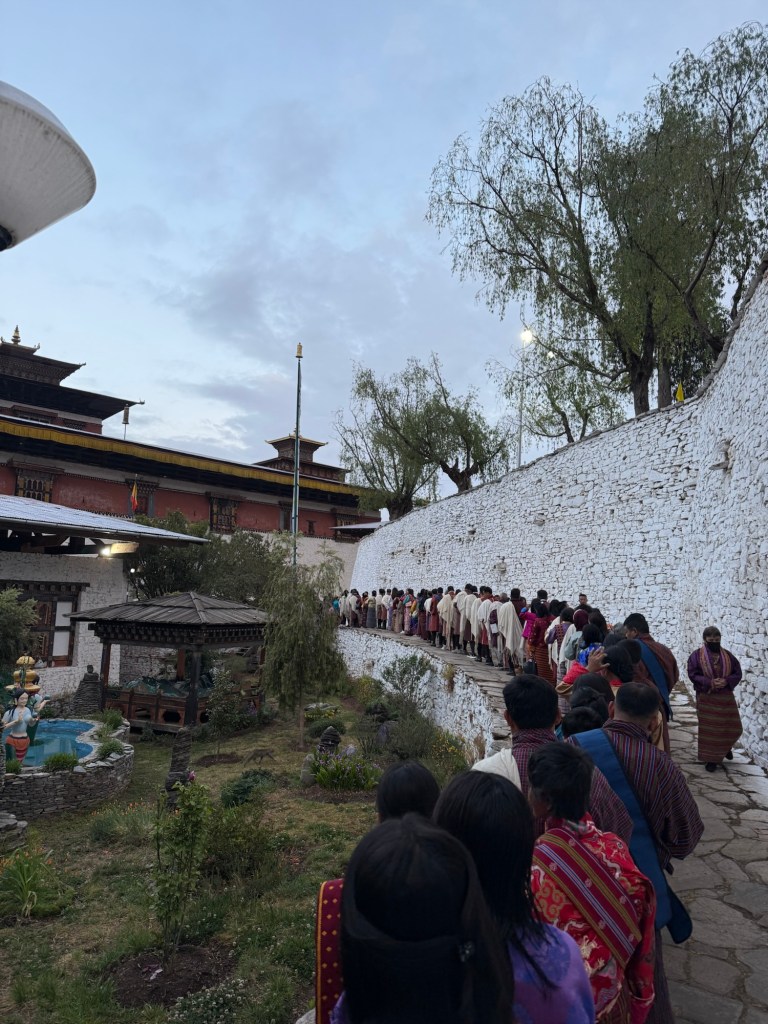
It takes lots of commitment to receive its blessing, although it is believed that the more you struggle to receive a blessing the greater is the blessing. You have to wake up early, or not go to sleep. The scroll is displayed right after midnight and rolled back before the Sun hits it.
This time we had to queue up for three hours, only for the queue to be run over. The usual stuff – people rushing and squeezing without much civility – and “fighting” to get a blessing. I was just hoping to see Desuups manage the crowd but they were too few and no channels were planned.
Anyway, everything is a blessing.
🤩🤩🤩
(Thank you, the people of Paro for keeping this great festival alive. Hope it is recognised as an Intangible Heritage by UNESCO)


 Dorji Wangchuk