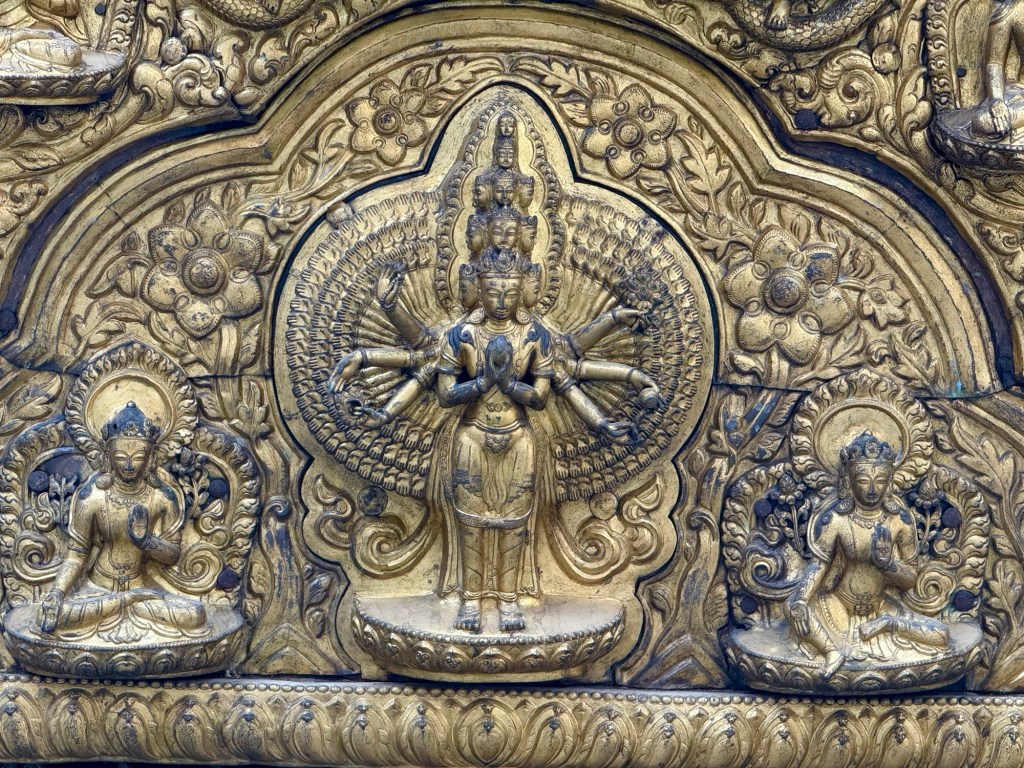
The Seto Machindranath (White Avalokiteshvara) is a statue in Jana Bahal Temple in Thamel, Kathmandu, which is revered by both Hindus and by Buddhists for two different reasons.
THE BUDDHIST STORY.
This White Chenrizig (others are of different colours) is one of the five Self-Arisen Avalokiteshvara Brothers (འཕགས་པ་རང་བྱོན་མཆེད་ལྔ) that emerged from one sandwood tree in Nepal. Three are located in Kathmandu Valley and two in Lhasa in Tibet.
The five Cherizig brothers, as it is known in the Buddhist world, are very important because they have set the stage for the propagation of Dharma in Nepal and in Tibet.
They are believed to have been hidden as treasures by Avalokiteshvara himself, but later retrieved by the envoy of King Songsen Gyempo, Akaramatishila, and placed in carefully chosen locations along the trade route from Nepal to Tibet.
Tibetan Buddhists believe that the miraculous arrival of these Avalokiteshvara statues in Tibet played an important role in the establishment of Dharma there.
One century later, Guru Padmasambhava further enhanced their sanctity at the request of King Trisong Detsen, and purposely stopped at each of these treasured statues to pay homage, infusing them with his blessings.
Therefore, the five statues are believed to be extremely charged with blessing.
The five sacred Avalokiteshvara statues are:
- Arya Vati Zangpo of Kyirong (in Mangyul)
- Arya Bukham of Patan
- Arya Jamali of Kathmandu
- Arya Lokeshvara in the Potala Palace (Lhasa)
- Arya Akham of Patan
THE HINDU VERSION.
Interestingly, this white Chenrizig is also revered by the Hindus, who have a different story to share.
Locally known as Seto Machindranath, it is Protector Deity of Kathmandu. Annually the city stops to celebrate a chariot procession that travels across the city.
It is believed that during the rule of King Yakshya Malla, people came to bath near Swambhunath and secured a place in heaven.
Yama, the King of Death, realising the power of Swambhunath, once made a trip to take a bath too. However, he was captured by King Yakshya Malla, who demanded as ransom the seed of immortality. So Yamraj sought Avalokiteshvara to come to his rescue and his prayer was heard.
Seto Machindranath then told the king to build a temple where the two rivers, Kalmati and Bagmati, met and to organize chariot procession so that the gods would visit the kingdom and bless them with happiness and long life.
MY TAKE
Although I am a Buddhist, and I may be inclined to believe it as one of the Chenrizig brothers, as a communication scholar I appreciate the Hindu version. This is because Seto Machindranath, as the deity of Kathmandu unites the Hindus, Buddhists and the Newars. It promises long life and happiness to all, thus bringing harmony to the city.
As a communication scholar and as a big proponent of the power of storytelling, the legend of Yamaraj being kidnapped and demanded the immortality for the King, is simply captivating. Such stories are powerful rhetoric of unifying forces, which I hope never dies in the age of omnipresent and omnipotent technological advances.
I wish the local people to forever tell this story. I hope, as the signboard at the main entrance says, “All religions are welcome inside the temple”.
🙏🏻🙏🏻🙏🏻
GETTING THERE
Jana Bahal is easily reachable in Thamel. It is better to walk from either Durbar Square or Kanti Marg, as the street is narrow for taxis. CLICK HERE




 Dorji Wangchuk