Reflections from the world around us, and us
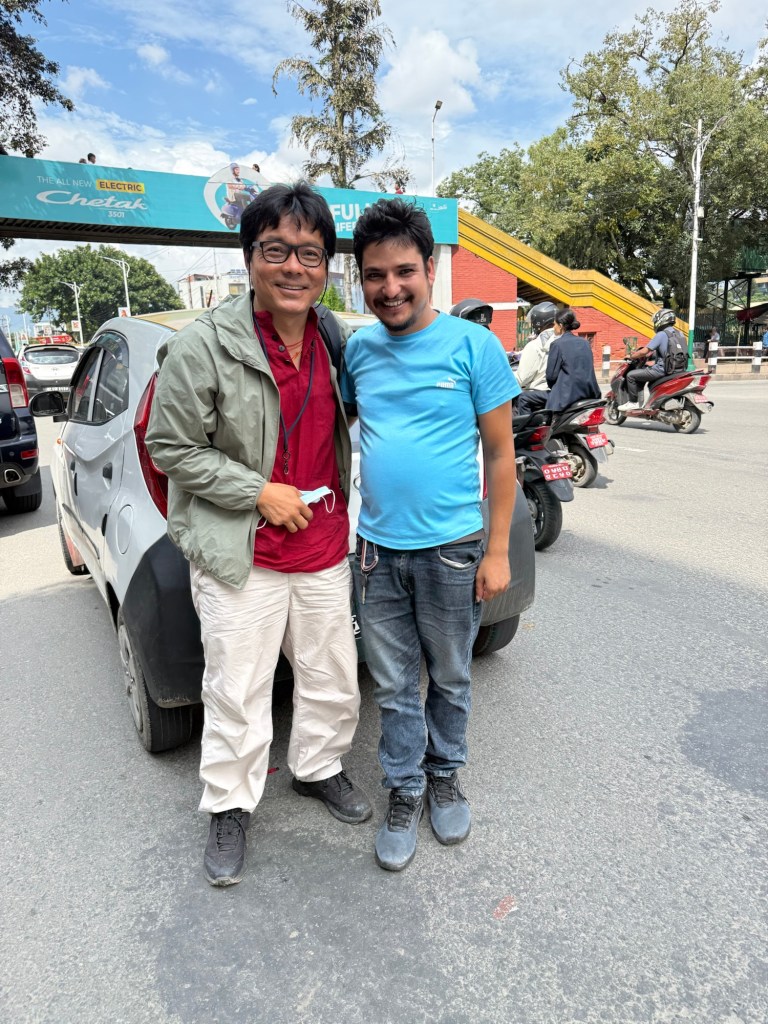
“Is the road this bad all the way to Daman?” I asked my driver, Suman, soon after we left the ring-road of Kathmandu Valley and hit the so-called district highway, which was just a dirt road.
“There are few stretches of tarred road, but it is very much like this,” he replied.
We are heading for Chumik Jangchub, the sacred site of holy waters, blessed by Guru Rimpoche which appears in the Barchel Lamsel prayers.
Since the drive was long – four hours to do 65 km, I struck a long conversation with him – on his life, the economic situation in Nepal, which all concluded with a sigh of total resignation from him. “You guys have your King. Here we have no one”, he told me.
In the following days, everyone I interacted with had the same thing to say. “You have a King. You guys are lucky”. The frustration and hopelessness have been there for more than a decade. In fact, this time, the first thing I asked when I landed – to a cabdriver I took from the airport – was, “I hope there is no strike this week, because I have to get back to work after this”.
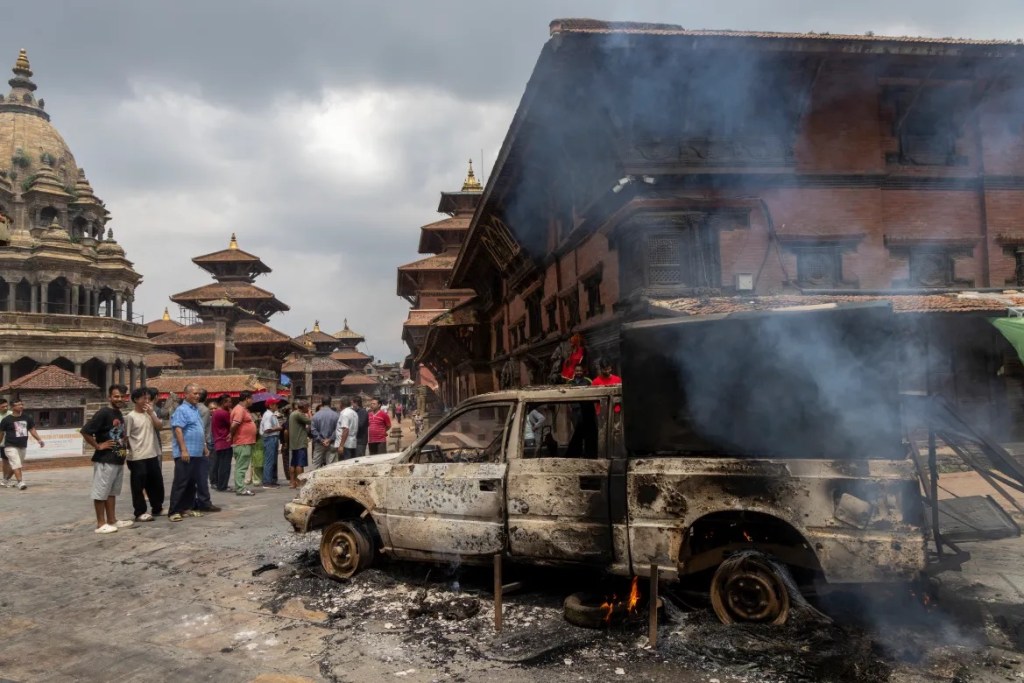
But the strike did happen. Less than one hour after I checked in at Kathmandu Airport, people started pouring into the streets, police started shooting at protesters, and then all hell broke loose, which was played out on social media all over the world. Government buildings were burnt, policemen were chased and beaten, ministers were stripped naked and stoned.
CORRUPTION IS OMNIPRESENT
Corruption is one word that keeps floating in the mass media as the reason for the popular uprising in Nepal, Bangladesh or Sri Lanka – the three countries in our neighbourhood. The perception of corruption is also felt by our own people here in Bhutan.
Now one basic truth about corruption is that it is everywhere. Only the type, level and sophistication of corruption vary. For instance, I have lived in advanced economies such as Japan and Italy for extended periods. They have corruption there too. However, one key difference is that they don’t fail in delivering public services, providing social security and a basic pension. In Bhutan I would say that the quality of services and infrastructure may not be up to the mark, but still we have systems and structures in place. This is not to say that we have to accept things as they are. We can always improve.
What is equally important, if not more, is the welfare of the people as the fundamental duty of the government. The exasperation and the anger in those countries may stem from the widespread corruption and nepotism, but it is made worse by the lack of empathy, care and selfless service among those in power. All the people I interacted with have told me that they had lost all hope. This is not only sad but dangerous.
Hence, we in Bhutan should not be too hard on ourselves. Things may not be perfect, but no one goes hungry or homeless. Hospitals treat you for free. There is goodness in many things around us. If some things are not ok, it falls on all of us to fix them, or call them out. More importantly, we still care for each other and look out for one another in times of distress. This is exemplified by a series of successful fundraising for people who have fallen in great financial difficulties while getting advanced medical treatments. The day we lose this will be the day we lose ourselves.
LESSONS AND SOLUTIONS
Notwithstanding our relatively good situation, there are a few key lessons that we can learn from what is happening in the world.
In this period of economic downturn with many youth leaving the country and are struggling, those who are doing well financially should not flaunt their wealth, power or success. What is seemingly a harmless Facebook or Instagram post of a new SUV or EV can be construed as a slap on someone’s face who is making his ends meet. Humility is the best policy.
Those who are elected to power, should be mindful of their words and actions. We should be balanced and broad minded in our decision-making. And informed on the broader ramifications of a public policy regardless of the good intent. And those who have influence through their social status should be reassuring in our positions on national issues, civil in our arguments, and constructive in our criticism.
As a more long term and sustainable solution, we need to formalise compassion, country, and contentment as a part of our education system. Until this generation, these soft skills and values came mainly from the parents and especially from the grandparents. In an era of smaller nuclear families there is a growing gap – a vacuum that needs to be filled.
Empathy is going extinct and compassion is on the decline in the name of rules, fairness and corruption-free goals. There is a windstorm blowing in the neighborhood and if there is really an antedote, it is compassion and community. These fundamental values will anchor us solidly on the ground. Imagine if our ministries and courts are compassionate in their dealings.
As an educator now I believe in the power of education to make lasting changes. The education system in the new era needs to include not just intellectual enhancement, but also social, emotional, and spiritual enrichment. It is time to put behind us the Industrial model of the education system that instills competition, which collaterally breeds pride, jealousy and greed – the three poisons in Buddhism.
WE HAVE OUR KING
As each of us witness the horrific and tragic images from our neighbourhood, we should not worry or lose our focus. As Bhutanese, we are fortunate to have our King. In fact we are in a much better place. We can even dream of a brighter future at a time when there is pessimism all over the world. For our neighbourhood, we must pray for leaders as benevolent, so that we can all dream together as a region.
I have also mentioned in some other posts that the King-People bond is sacred. It is the soul of the Bhutanese nation, which should never be compromised in any manner by anyone. No other institution, individual or an idea can even come close to what the Monarch can achieve in terms of bringing the country together towards a common goal and a shared dream. We saw that recently when over 7,000 people braved the heat of Gelephu to volunteer in the Gelephu Mindfulness City project for a week. There was genuine pride, joy and smile in every selfie from that week there.
And, as my taxi driver in Nepal said, we have our King in whom we can always be hopeful. When all of life’s options are exhausted, when systems fail us, when justice is not served, ‘there is always a place we can ultimately go to’ – to translate an old Bhutanese adage. And this is not a small thing. In fact, this is a huge privilege as Bhutanese.
There is a story of a carpenter in Paro who accidentally sliced all his right fingers. When asked by my friend who met him later as to what his initial thoughts were when that happened, he shared how he was going to feed his family. He also recounted that when he was heading for the hospital with his crying wife by his side, he comforted her by saying that should he be unable to work again they could always approach the King.
As long as we have our King, we have hope. And to quote one of my favourite films, The Shawshank Redemption, “Hope is a good thing, maybe the best of things, and no good thing ever dies”.

His Majesty with some volunteers in Gelephu

 Dorji Wangchuk