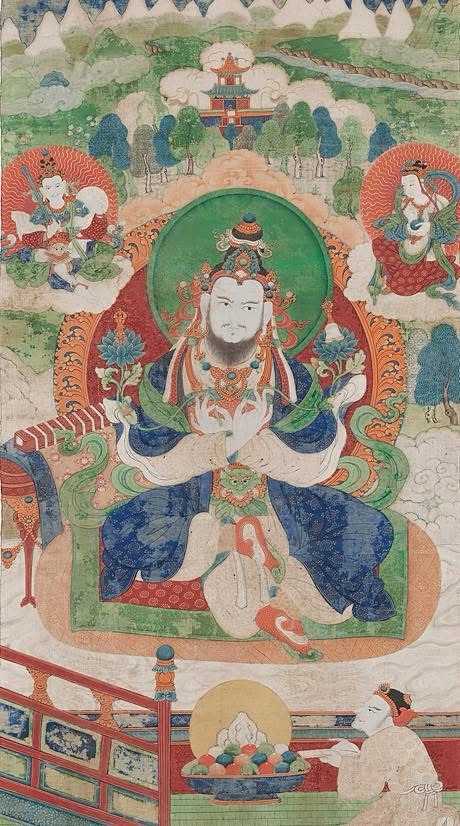
According to traditional faith history, a year after his enlightenment, Buddha Shakyamuni received a strange visit from King Suchandra (Dawa Zangpo in Dzongkha) from the mythical kingdom of Shambala (Some Buddhist scholars place this kingdom in modern-day Xinjiang region in China).
The King wanted a teaching from Buddha that guaranteed enlightenment in one lifetime, while also, without him having to renounce his throne. He argued that even as a King he could do many good things for sentient beings.
Buddha Shakyamuni is said to have yielded to the request, partly because he saw the pure intent of the King as well as seeing him as the emanation of Vajrapani. Buddha then conferred the Kalachakra (དུས་ཀྱི་འཁོར་ལོ།, Dueki Khorlo) teachings to King Suchanda.
The King wrote it down and spread it in his Kingdom. His successors maintained the tradition, and furthermore, the eighth Shambala king, Manjushrikirti (Jampel Dakpa) composed a shorter tantra of five chapters and initiate to some thirty million of his subjects and sentient beings. He was thereafter referred to as Kulika (Rigden in Dzongkha) – the One Who Held The Lineage. Legend has it that there will be 32 Shambala kings with each king appearing to save a degenerate world. The current king is Anirudha who ascended the throne in 1927 and would be king toll 2027. The last king Rudra Chakrin is believed to appear in the year 2424 to face a degenerate world and help fight it and cure it.
Kalachakra. What is it?
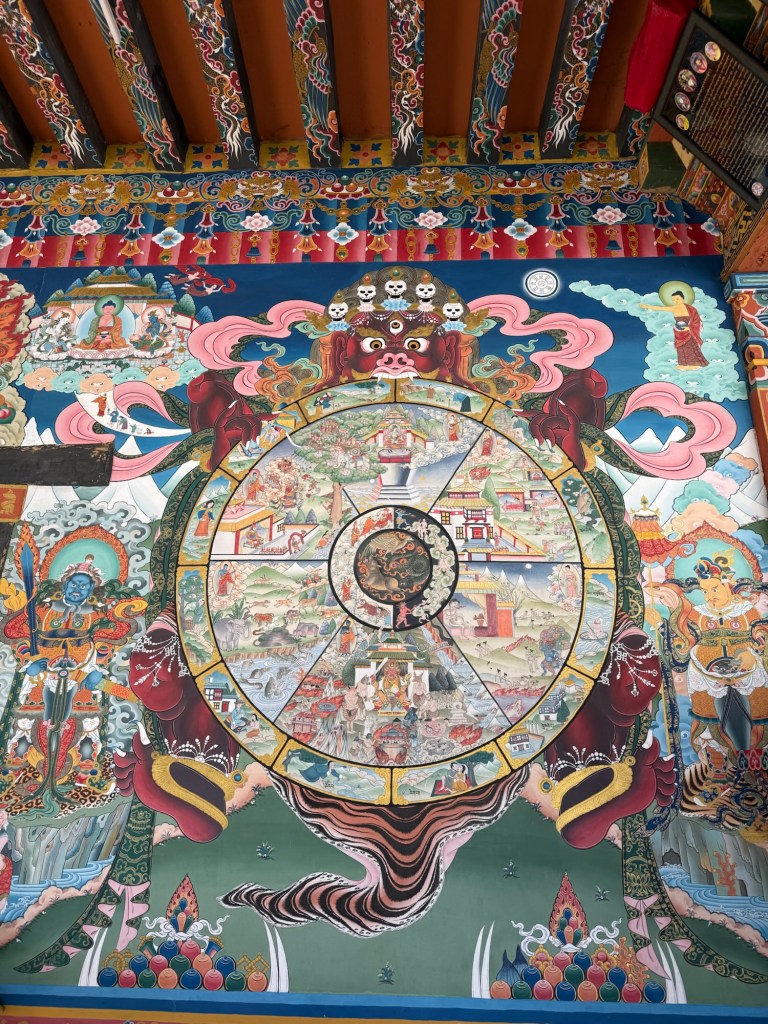
Literally meaning “Wheel of Time”, Kalachakra deepens the concept of interconnectedness between the Outer cycles of the universe (such as the cosmic time, planetary movements and seasons), and the Inner-individual cycles of human body (such as life, breath, heart beats, chakras, etc). It then proposes the Alternative cycle to move beyond the Inner and the Outer cycles to achieve a purified state of consciousness and end ones existence in samsara.
It posits that the external universe and our internal cycles are similar, if not identical. The same laws that govern the universe also govern at the subatomic level like our own body and our experiences of life. Being trapped in the cycle of Samsara is to remain within the two cycles without moving beyond or achieve the liberation from all suffering.
Why “Wheel of Time”?
At the core of the philosophical tenet of Kalachakra is how we view time. In Buddhism, time is understood as cyclical and not linear (which is western-scientific understanding). It is a continuum. For example, one year is the time that the Earth moves around the Sun, and a day is when the earth makes one complete rotation – and then the cycle repeats.
As is in the greater universe where the same pattern repeats in the cosmic-astronomical-astrological cycles, at an individual-internal level, our body also goes through physiological cycles, many of which bode mental and emotional cycles as well.
Furthermore, just as a universe forms, expands, contracts, explodes, and forms again, Buddhist beliefs posit that individual beings pass through a continuum of births and rebirths with repeated conception, growth, old age and death. However, because of our compulsive attachment to seeing everything as solid and permanent, we are reborn without any control in the cycle of Samsara.
Universes, civilizations and human life, will continually form and fall, and this is the truth of cyclical time, impermanence, and emptiness. This understanding constitutes the philosophical foundations of the Kalachakra teaching.
Kalachakra spreads to Himalayas.
It is believed that an Indian master, Chilupa, from Orissa travelled to Shambhala and returned with the scriptures in 966 CE. Subsequently in the early 11th century, another Indian scholar Somanatha introduced Kalachakra into Tibet, followed by many others.
Starting in the 13th century, as Buddhism saw decline in India, so did the Kalachakra tradition. However, it flourished in Tibet and from there two traditions spread across the Himalayan region.
The Kalachakratantra is composed of chapters on cosmology and astrology in how the universe is formed and falls – and tracks the movements of the planets and their effects on humans. For example, science has discovered recently that increased solar activity such as the geomagnetic storms may have impact on our mood causing anxiety and depression. The lunar cycle affecting the sea tides have long been established. All these were already written in the Kalachakra scriptures.
It also includes physiology – as in how a human body is made up of the natural elements and how it is a universe in itself – dependent on the wind, water, fire, and earth – both internally and externally. Interestingly, Kalachakra also sees society as a living microcosm and ecological system – a theory that has been only recognized in recent years in the modern academia.
Kalachakra and our Dharma Kings.
Because of the tradition of granting initiation en masse, Kalachakra has often conferred to unify people and nations and bring peace and harmony. Buddha Shakyamuni, for instance, is supposed to have bestowed to some 100 members of the Shambhala King Suchanda’s entourage. And so did King Manjushrikirti who initiated some 35 million of his subjects into the Kalachakra mandala.
It was thus appropriate to include the Kalachakra Cycle in the Global Peace Prayers – given what is happening in the world today. This Initiative was a massive undertaking and of great historical significance – in that it brought together all schools of Buddhism into one place and prayer for the first time in modern history.
The Bhutanese people in particular, and Vajrayana practitioners in the world in general, are fortunate that we have Dharma Kings in our monarchs – His Majesty the King and His Majesty the Fourth Druk Gyalpo, to bring together the greater humanity.
And of course, our own Living Buddha – the Purest of the Pure, His Holiness Je Khenpo Jigme Choedra, who initiated us into the Kalachakra Mandala together with our Dharma Kings. This is the greatest privilege for all of us.
May Vajrayana flourish under them for all time to come. May peace and prosperity prevail in our Land.
And above all, may the world remember our monarchs as the Dharma Kings.
🙏🏻🙏🏻🙏🏻
༈ བྱང་ཆུབ་སེམས་མཆོག་རིན་པོ་ཆེ། །
Bodhicitta, precious and sublime
མ་སྐྱེས་པ་རྣམས་སྐྱེས་པ་དང༌། །
May it rise in those in whom it has not arisen
སྐྱེས་པ་ཉམས་པ་མེད་པ་ཡང༌། །
And where it has arisen, may it never decline
གོང་ནས་གོང་དུ་འཕེལ་བར་ཤོག །
May it go on enhancing, further and further
Disclosure: This article is based on my conversation with Venerable Sonam Tobgye – the Abbot of Dodeydrak Monastic Institute.



 Dorji Wangchuk