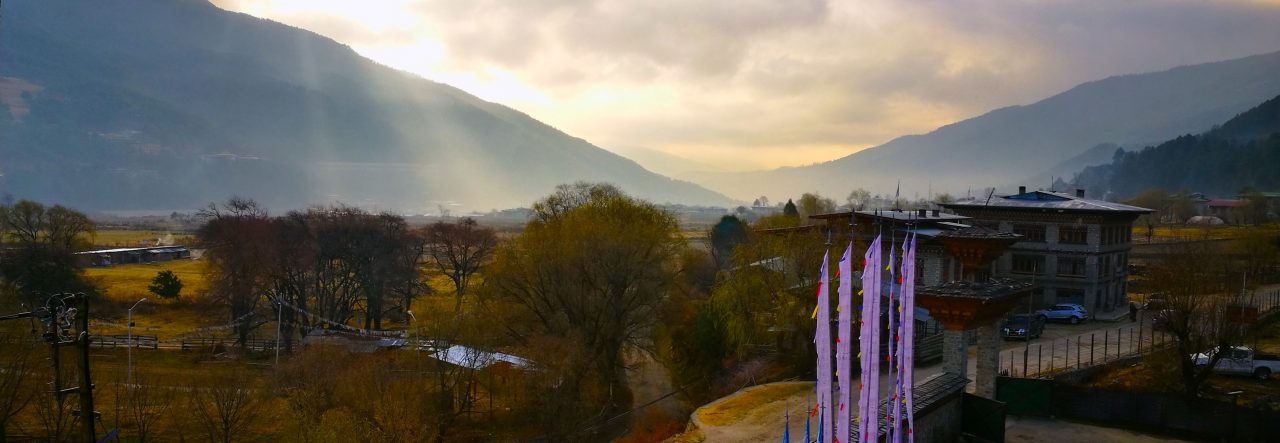
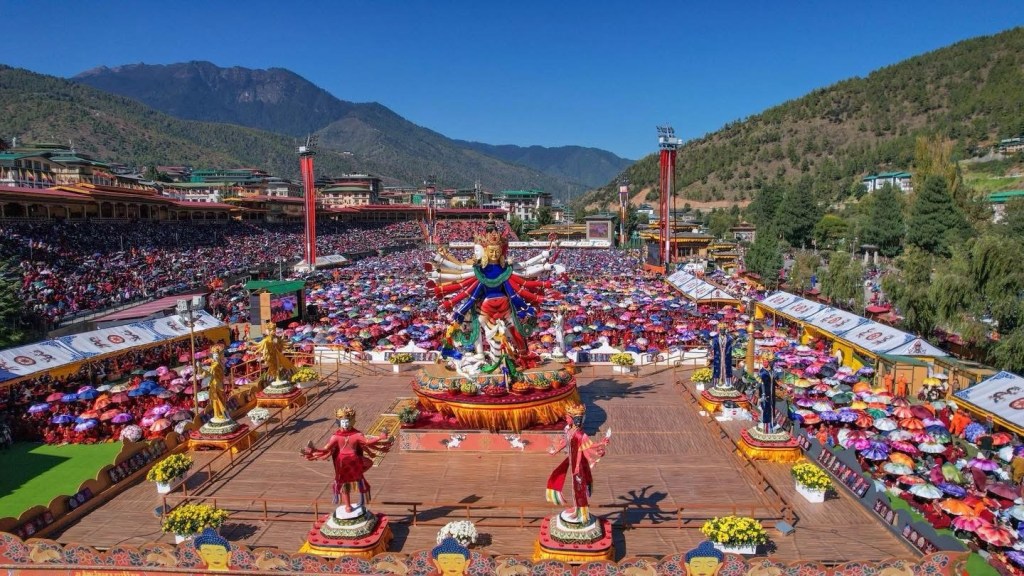
Moelam Chhenmo is one of the most popular prayer festivals in Vajrayana Buddhism. Every district in Bhutan has one conducted every year and every tradition of Tibetan Buddhism holds one big one in Bodhgaya every year. The recently-concluded Global Peace Prayer probably holds a historic first in bringing all schools of Buddhism together in this prayer, and to pray for a common goal: world peace.
And yet, the Bodhisattva that is invoked, Samantabadra (Dz: Kuntu Zangpo) – not to to be confused with Adi-Buddha Samantabadra (aka Kuntu Zangpo), is among the least known Bodhisattvas in Bhutanese Buddhism.
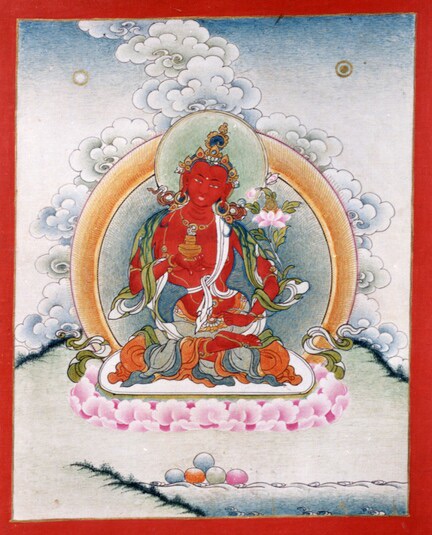
Bodhisattva Samantabadra.
Bodhisattva Samantabadra (ཀུན་ཏུ་བཟང་པོ་ Dz: Jangsem Kuntu Zangpo), whose name is often translated as “All Good” is one of the eight Bodhisattvas (བྱང་ཆུབ་སེམས་མ་བརྒྱད་, Jangchub sempa gyé) is an important figure in Mahayana Buddhism. The eight Bodhisattvas are Manjushri (Jampel Yang), Avalokiteshvara (Chenrizig), Vajrapani (Chana Dorje), Maitreya (Jampa), Samantabadra (Kuntu Zangpo), Akashagarbha (Namkhai Nyingpo), Ksitigharbha (Sayi Nyingpo), Sarvanivaranavishkambhin (Driba Namsel).
They are also known as Eight Great Sons (ཉེ་བའི་སྲས་བརྒྱད།) of Buddha Shakyamuni who have been assigned to be enlightened after him and spread Dharma. The next in line is Bodhisattva Maitreya. Samantabadra is also considered as the eldest of the eight Bodhisattvas. He also vowed to postpone his Buddhahood until the last sentient being is liberated from Samsara.
Zangcho Moelam.
The prayer that is recited at the Moelam Chhenmo is the Phakpa Zangpo Chöpé Mönlam gyi Gyalpo (འཕགས་པ་བཟང་པོ་སྤྱོད་པའི་སྨོན་ལམ་གྱི་རྒྱལ་པོ: ), which of often translated as The King of Aspiration Prayers: Samantabhadra’s “Aspiration to Good Actions”, or simply Zangchoe Moelam
In essence, the Zangchoe Moelam is a summary of Samantabhadra’s advice to his student Sudhana.
It comprises 63 succinct verses and expresses the entirety of the Buddhist path and the actions of a bodhisattva.
Samantabhadra challenges that wisdom is only beneficial if it is put into selfless practice for the benefit of all living beings. True enlightenment is not just about attaining wisdom, but about extending that wisdom through boundless compassionate actions.
The story of Sudhana and Samantabhadra serves as a powerful metaphor, where practice (Samantabhadra) must accompany wisdom (Manjushri) as essential components of the path to Buddhahood.
Recitation of this prayer generates tremendous merit, and inspires us to dedicate our lives to the benefit of all sentient beings.
Zangchoe moelam is often recited together to accumulate collective moelam (aspirations) such as global peace, harmony, and restoring health and happiness.
Chan (Zen) Buddhism.
Samantabadra is a very important bodhisattva in Chan (Chinese) Buddhism that one of the four holiest mountains in China, Emmei Mountain, is revered as his abode. He is often depicted riding a white elephant with six tusks.
In Vajrayana Buddhism, however, he never gained as much popularity as the other Bodhisattvas, and was not elevated as meditational deity. In some traditions, Samantabhadra is described as red in colour holding a vase in the right hand, and the symbol of the Sun atop a flower blossom held in the left hand. He mostly appears as part of the Eight Great Sons of Buddha.
One of the temples that depicts the eight bodhisattvas is Semtokha Dzong – all standing around main Buddha Shakyamuni.
🙏🏻🙏🏻🙏🏻
My favourite line is:
“May I ease the suffering in the lower realms and in the many directions and dimensions of the universe.
May I guide all wanderers in samsara to the pure bliss of awakening, and be of worldly benefit to them as well.”
The full text of the prayer is here.



 Dorji Wangchuk