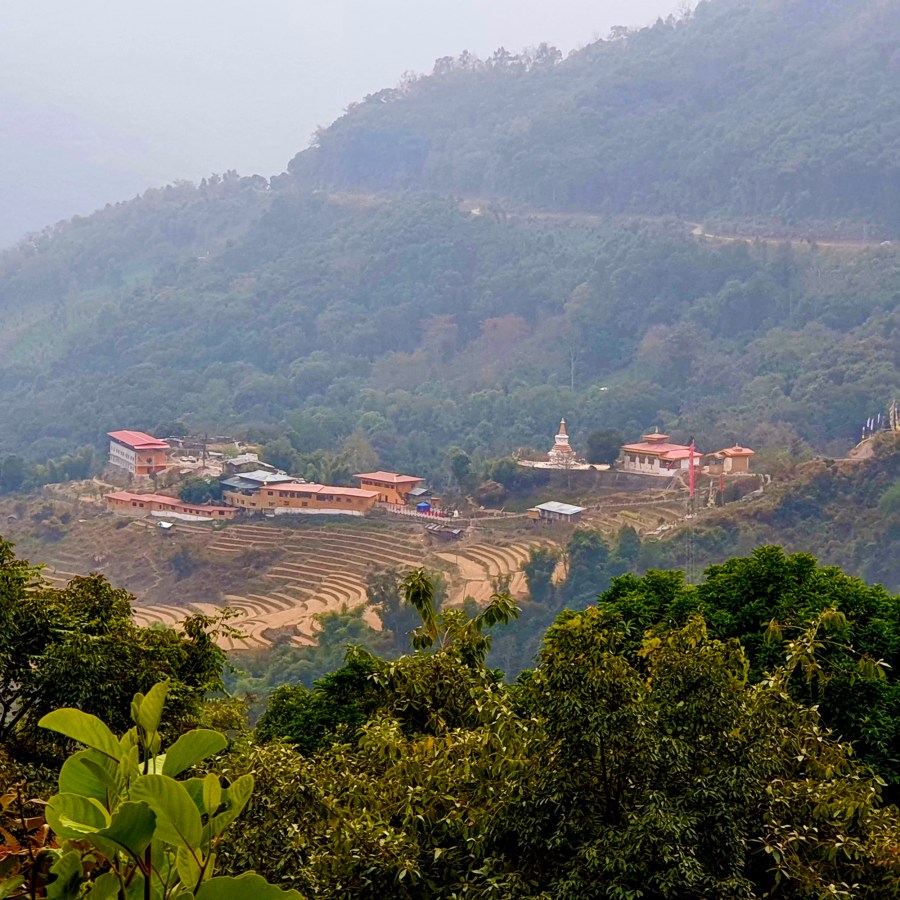
When one thinks about Zhemgang, one doesn’t associate this lost region in central Bhutan as a pilgrimage destination. And yet, Zhemgang has its own charm. The lower altitude means it is more pleasant in winter. And spiritually, the place is associated with Terton Pema Lingpa, Terton Dorji Lingpa, and Mebar Tashi Khyidron, besides the omnipotent Guru Padmasambhava.
Visiting my teacher
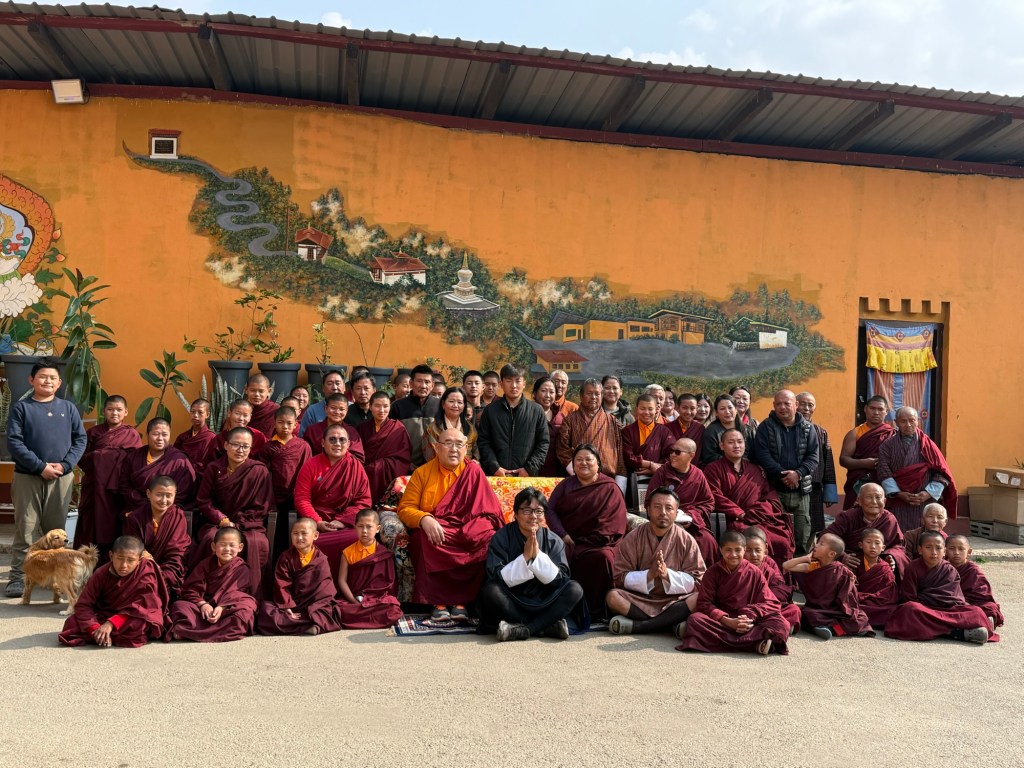
Pilgrimage is also a journey to renew one’s vow to one’s teachers. It is a new year—time for new hope, but time for the same old aspirations. Farchen Zangmo Rimpoche—the thirteenth emanation of Dorje Phagmo (Vajravarahi)—has her main Dharma center in Zhemgang in Nangkor gewog.
The center is built near the 8th-century Mebar Tokchoe temple established by Monmo Tashi Khyidron. It was built as the southern portal to keep off the demons obstructing the construction of Lhasa Samye in Tibet. It is thus a sacred site.
Phurpa (Vajrakilaya) Drubchen
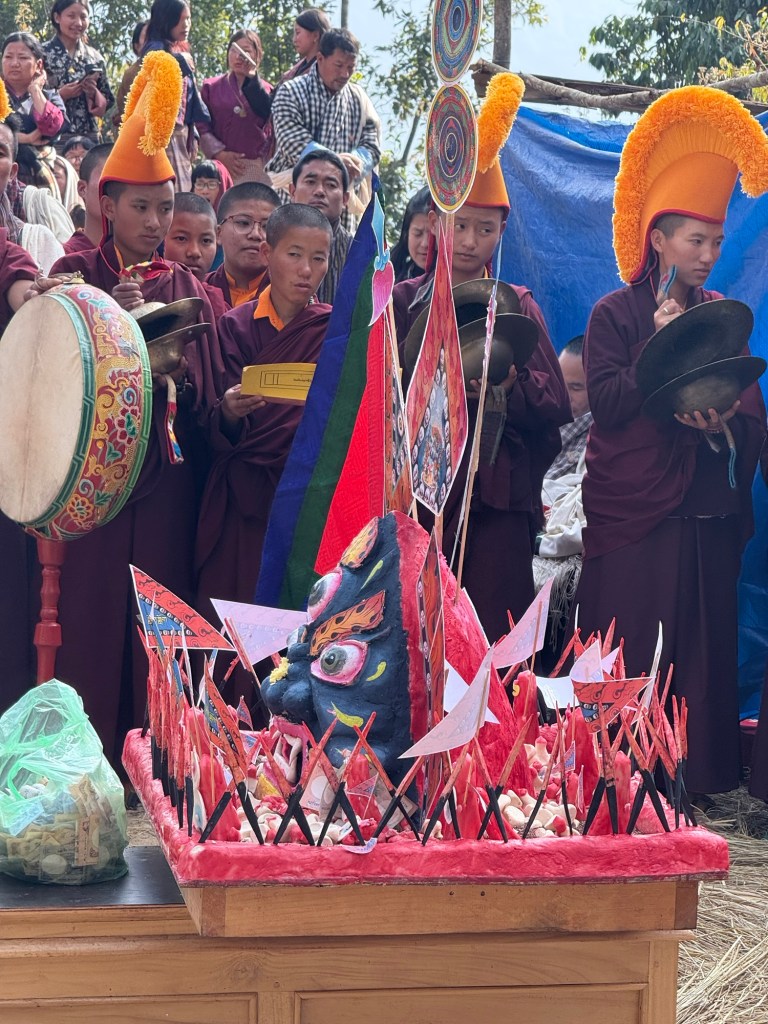
I made the pilgrimage to also attend the annual Phurpa Drubchen organized by Dorje Phagmo Rimpoche.
The Vajrakilaya Ritual is a very powerful purification ceremony, which is traditionally conducted as the lunar year ends. The ritual has the power to cleanse all accumulated negativities and defilements while also clearing obstacles and tragedies in the coming year.
Besides my usual dedications, I offered my prayers for the health and wellbeing of our King as we embark on ambitious national goals such as the Gelephu Mindfulness City project. Every prayer would help, I am sure.
Buli—the abode of Buli Monmo.
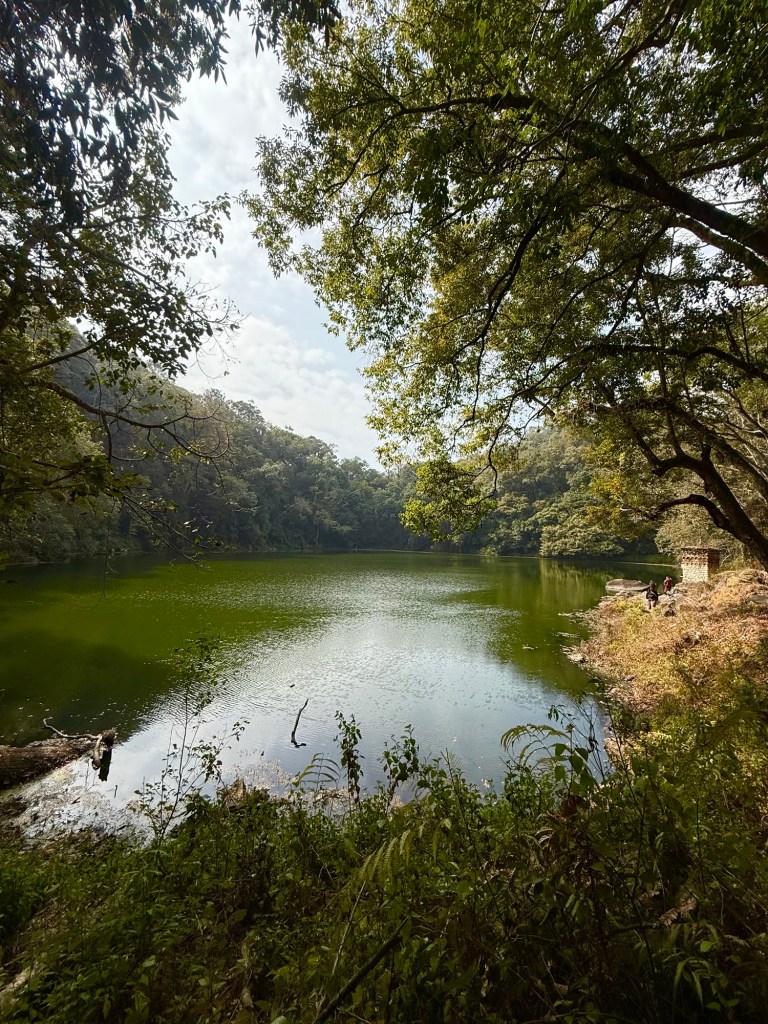
And of course, I made a visit to the beautiful village of BuBuli and paid respects to Monmo Kuntu Zangmo, the protector deity of Buli, with her abode in Buli Tsho (lake). When we arrived, the lake was all dirty with leaves littering the surface and dark in color. As we stayed and completed a few rounds of mantras and prayers, everything cleared up. It was, as always, magical.
I also traced her origins and the myth.
According to Phuntsho-la, who runs a homestay in Buli, Tshomen Kuntu Zangmo came from the mythical kingdom of Shambala and wandered through Tibet, then Kurtoe Dungkar in Lhuntse. She then travelled to Tang Kuenzang Drak and reached Chumey in Bumthang. From Chumey, she crossed Brektey La and descended into the region of Kheng Buli, where she resides now.
There is a house in Buli where she, disguised as an old woman, sought to spend the night. She told the grandmother not to disturb her for a few days. But the next morning, seeing the guest not waking up for breakfast even when the sun was up, the grandmother peeped through the gaps of the door and saw hundreds of snakes circling around a big serpent that was holding a ruby on its head. The grandmother was mortified and passed out—only to be woken up by the same old womwoman,o said,
“I told you not to disturb me.”
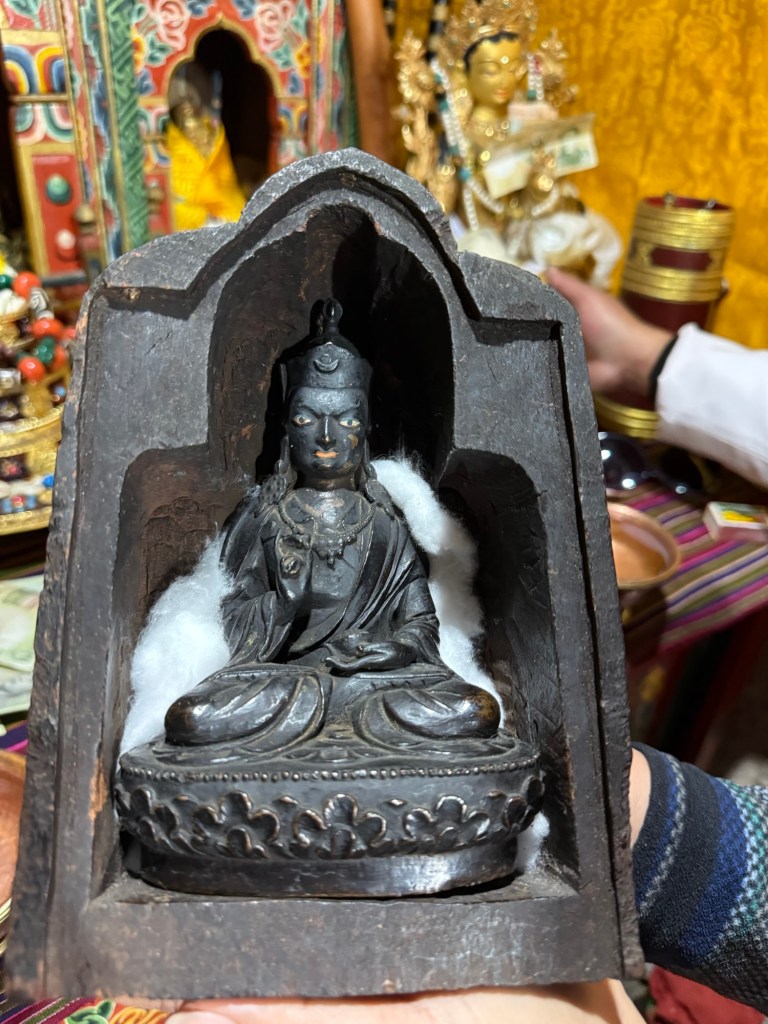
She then gave the old grandmother a conch and left the house. The conch is not there, but the story is still alive, and the place was later visited by Terton Pema Lingpa, who gifted an image of himself made with his own hands. The statue can be seen today (see picture).
Pema Lingpa (Khar) Lhakhang.
One of my mandatory stops in Buli is the Khar Lhakhang, built by Choedrak Lama Sonam Gyeltshen, who was a student of Drubthob Choying Rangdol, in honor of Terton Pema Lingpa. The place is also special because it is believed that Pema Lingpa is said to have visited the spot and met Guru Rimpoche there.
The temple’s main statue is Guru Padmasambhava, but the more sacred one is Guru Drakpo—the wrathful emanation of Guru. The statue is believed to have shed tears and blood from his right hand a few days before a dedicated caretaker passed away.
A mural painting in the temple depicts Pema Lingpa making a bumpa, tsetor, and pan. All these three items are in the possession of different families in Buli, and one can visit them. The place depicted in the painting is just below the temple—a small spot encircled by boulders.
Oral history tells the story of Pema Lingpa being visited by a gomchen (lay practitioner) in his camp and having a conversation. The gomchen later turned out to be Guru Padmasambhava. However, no one except the Terton saw the gomchen.
Sacred waters of Avalokiteshvara.
One of my favorite things to do in Buli is visiting and collecting a jerrycan full of the holy waters blessed by Chenrizig (Avalokiteshvara).
Unlike other sacred waters known as drubchu, which are believed to have been revealed to prove the achievement of someone’s practices (druba), the holy waters of Avalokiteshvara are a divine water blessed by the Bodhisattva of Compassion. Hence, it is more sacred.
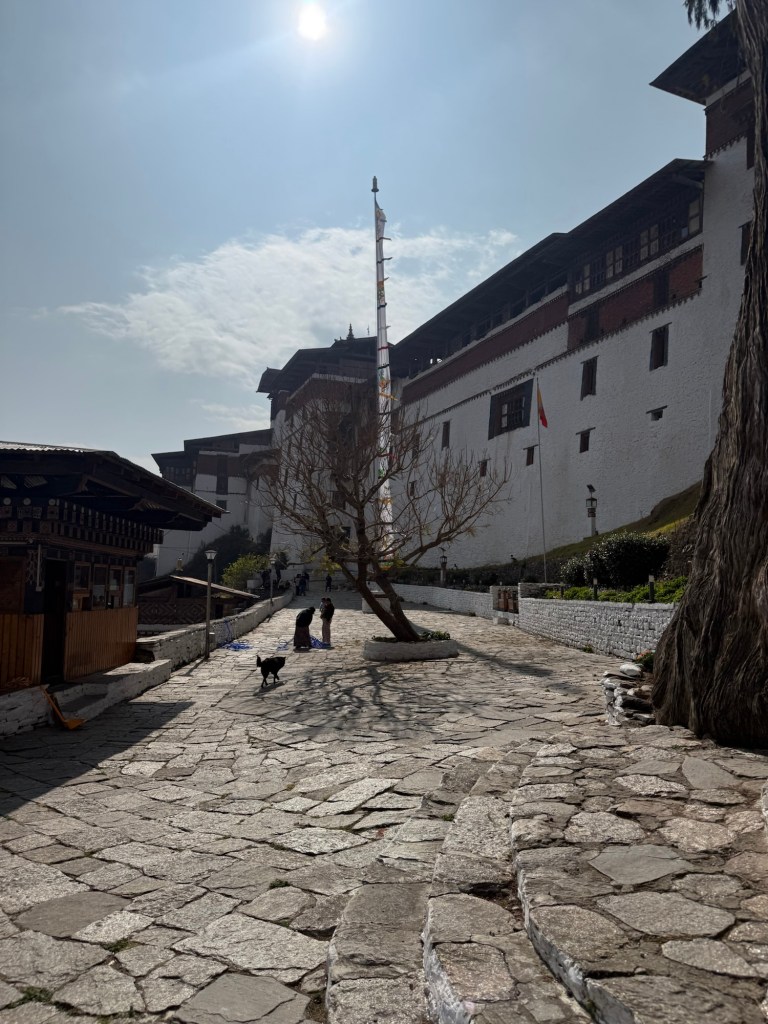
Trongsa Dzong.
I closed my pilgrimage in the magnificent Trongsa Dzong by visiting the nyekhang dedicated to local deity Gara Wangchuk (the same nyeb of Trashigang Dzong), the chambers of protector deity Palden Lhamo, and the amazing Buddha Maitreya.
Trongsa Dzong was originally a new village (Krong Sar) that popped up around a small temple built by Ngagi Wangchuk—the grandfather of Zhabdrung Ngawang Namgyel.
The site was chosen after he had the vision of Palden Lhamo. Later in the morning he saw the hoof mark of a donkey (Palden Lhamo’s mount) in the area. It can still be seen even today at the main door of the Dzong.
May my prayers bring blessings to the world as we begin the Fire Horse Year.
🙏🏻🙏🏻🙏🏻
(The fourth and last part of my pilgrimage is soon.)
 Dorji Wangchuk