Not doing well in life?

In this article, I will address the question for those who are not doing well with their career or business – whatever this means. Hopefully it will help unlock an unfavourable situation in life. 

First of all, we must understand that the state of human unsatisfactoriness (I prefer to use this word instead of suffering to mean Dukha in Sanskrit, Dugnel in Dzongkha) is very subjective. It is also very complex. So, I have no one-size-fits-all solution to this. No one actually has it.

Second, I don’t want to trivialise what each individual may be going through in life. So, I chose to say Tashi Delek to those who are excelling – like the male nurse in Australia, that ranger from Bumthang and that teacher in Samtse. It warms my heart to see our younger generation doing well. 

Third, needs and wants are subjective. Someone earning a couple of thousand ngultrums may be super happy, while for others, that sum may be nothing. On the other hand, I know few millionaires who have nearly committed suicide because they felt their life was meaningless, and few in the same financial situation who are happy and content.

Still, as someone who has done relatively well in life (I went barefoot and hungry as a child), I can share what worked for me, and others may have their ways too. Three simple things come to my mind, and this is applicable wherever you are.

1. Never say it is not my work. 

Humans have the attitude of avoiding jobs and tasks that they feel are below their dignity – or it is not within their purview or interest. Unless the work is illegal, no job or profession is below any human dignity. The moment you say, “This is not my work, you are giving a death sentence to your career”. Every job or task must be seen as an opportunity to learn, and to make new connections – and to launch you forward. 

Don’t let your ego precede success. Don’t let your attitude bury that hidden talent. You never know where your destiny lies. You don’t know what is written in your stars. Show up. Grab every opportunity to work, and run with it. When I was an engineer in BBS, I often went for news reporting too. I never said, “It is not my work”. Nobody wanted to look after the HR because it was messy and I took it as my additional charge. 

Today besides my main line of work, I volunteer in three civil society and religious organizations. It is hard to juggle many things, but very fulfilling. For a good number of years put your head down and work. Stop comparing yourself with others. Life is not a race. Compete with yourself – with your laziness, your pessimism, with your procrastination.

2. Keep learning. Keep reinventing.

One common mistake many make is considering a job as an end and not as a means to something greater – or further. One tends to take root in a place or a profession, and get possessive and defensive of the position and the organization – and never think of learning anything new. Forget about reinventing, there is no innovation either. Stagnation and status quo prevail till one is burnt out, or pushed out.

And yet, in a fast changing world and in a small economy and market, you will soon hit a wall, or go out of fashion. Bhutan is not Bangkok where you can survive your whole life running a single-menu noodle point. You have to keep learning new things. You have to keep reinventing yourself. You have to keep innovating. For example, I started out as an engineer, moved to documentary filmmaking and journalism. And at 47, I reinvented myself as a university professor. I went back to school at 49. And in six years I got a PhD, and started a new career as an academic and scholar. 

3. Don’t forget spirituality. 

To get, you must give. This is a line from Chatrel Sangye Dorje Rinpoche. Don’t forget “kencho” – as a saying goes in Bhutanese. Believe in whatever makes you feel good but don’t make everything about yourself. In my circle, those who balance life, community, and spirituality are not only happier, they are doing better than those who are only focused on themselves.

Generosity does not mean only giving money or making in-kind donations. One can be generous with time, with positivity, and with volunteering. Making these non-financial resources available for others selflessly will guarantee you returns in the form of instant karma. While this may sound religious and Buddhist in nature, it has been proven empirically in a study done by an American researcher. Anecdotally, I can attest this study. The more you give, the more you get.

And needlessly to say, being positive, humble and honest are basics to having a fulfilling life and career.

✌️✌️✌️

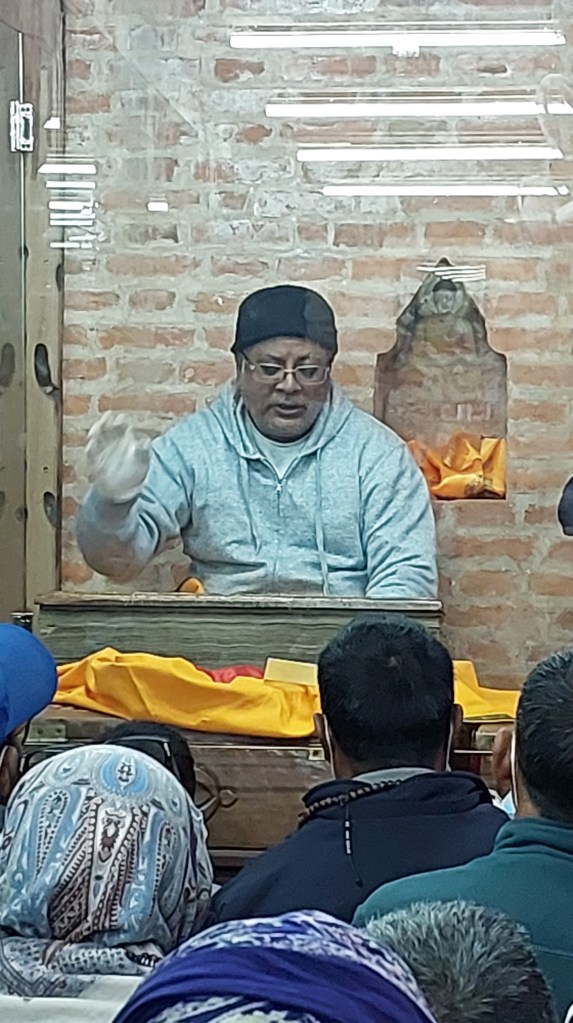
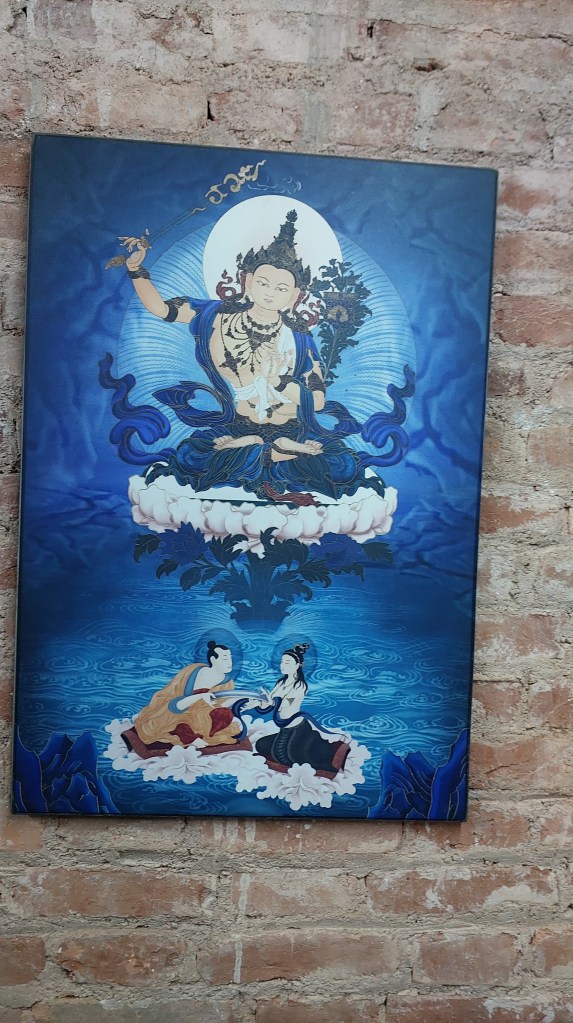
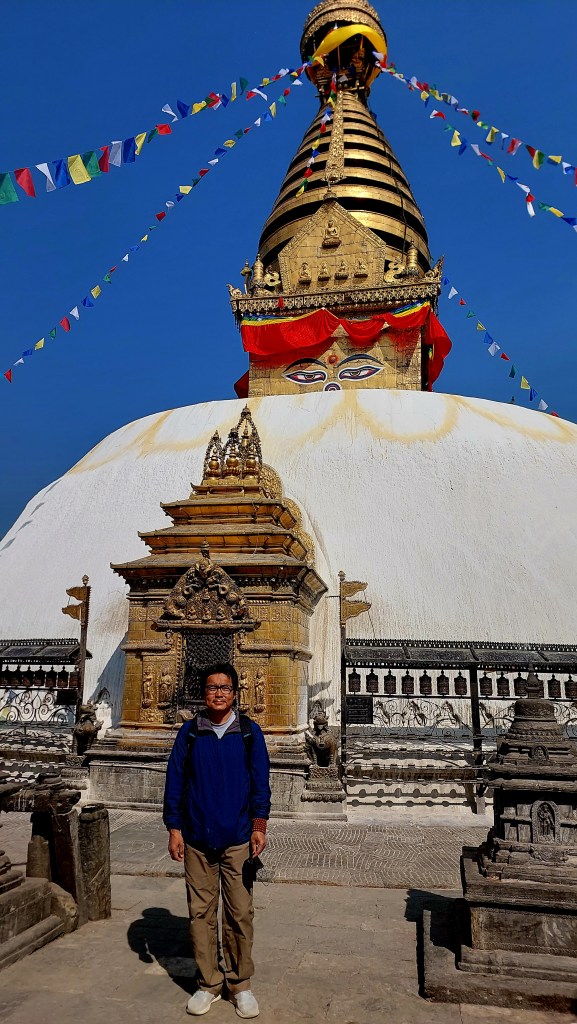
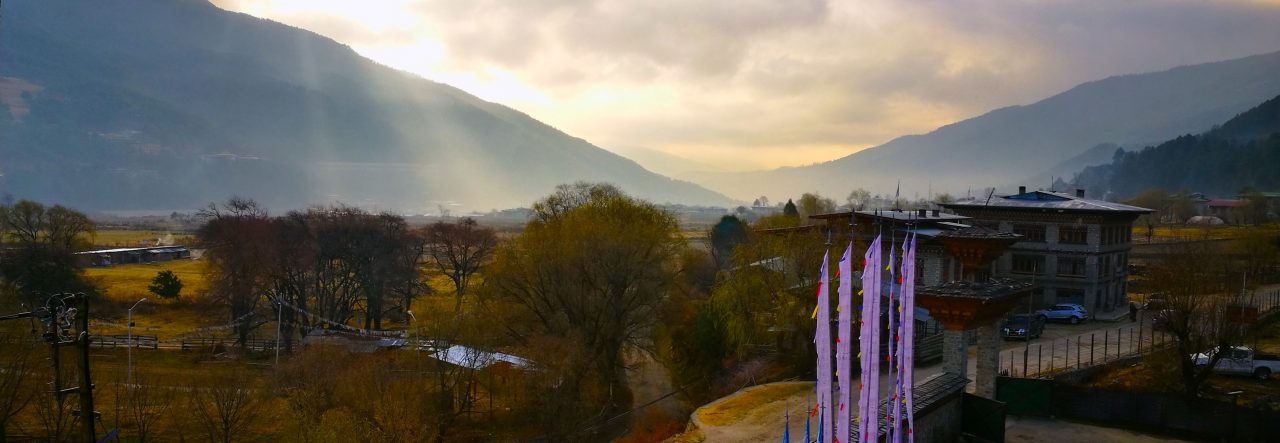
(Pictures are unrelated to the post, and are from my recent PD for the wonderful Dechencholing school faculty 🙏🏻🙏🏻🙏🏻)

It is Aum-Mo Chhu. Not Amochu.

The big river that passes Phuntsholing, which becomes Toorsa in India, is called Aum-Mo Chhu and not Amochu. Even Dzongkha speakers have anglicised the river, thus making it lose its meaning. The sacredness of the river is not even talked anywhere in the urban narrative.

And yet, Aum Mo Chhu is sacred. It originates from Chumbi valley in Tibet, where it is called Machhu. According to sources, the names of Chomo, Jomo, Chumbi are all of same origin – referring to the same deity – Jomo Tashi Tsheringma, whose abode is believed to be Mt. Jomolhari and a couple of other mountains in Sikkim, Tibet and Nepal (Mt. Gaurishankar).

Tashi Tsheringma is the eldest of the five Tsheringma sisters of longevity (Tshering Chhe-nga) and many mountains in the Himalayas are named after them. Mt. Everest – aka Chomolungma in Tibetan is believed to be the abode of one of the Tsheringma sisters – Miyo Lhangzangma.

Aum Mo is probably a shortened version of Aum Jomo Tsheringma. However, this Aum Jomo is different from Aum Jomo of Merak-Sakten. That one refers to Jomo Remati – an emanation of Aum Palden Lhamo.

The Aum-Mo Chhu is sacred to the inhabitants like the Lhops (derogatively known as Doyas) – one of the two earliest inhabitants of Bhutan, and to the people of Chumbi valley in Tibet.

Names of places and the origin stories should be recorded, retained and taught to younger generations. Inter generational transfer of values and traditions happen effectively through stories. They define who we are. They need to be told and retold because they hold our collective history, popular narratives and wisdom.

If the sacredness is gone, our essence will fade and slowly we will become like any other societies that sees nature as a source of exploitation. At a broader level, retaining that essence is good for cultural identity and sovereignty.

(Photo – BBS)

For more on Tshering Che-nga, you can click here.

Completing the Eight Manifestation of Guru project

July 28, 2025

On this most auspicious day in the Buddhist calendar, on the altar.

While I could have waited for the monsoon to pass and travel there, I decided to go despite the poor and dangerous road conditions. The reason: the village lost four members in two months – one in a tragic accident, and they were terrified by these deaths and requested me to help. Some asked me to invoke Deity Palden Lhamo (whose abode is there) on their behalf because they believe she listens to me.

So, while celebrating the achievement of completing the Guru Tshokhang, we also conducted Marmey Moelam and collectively mourned and prayed for those who left us. In happiness and in sorrows, we are in together.

I did ask Aum Pelden Lhamo to watch over them too. But what could be a bigger blessings and protection than our own Second Buddha – Guru Padmasambhava and the Eight Manifestations? I am sure now everyone will alright.

I also made a quick visit to another village in the valley – Lamga, to offer the silver butter lamp made from the bangles of my late mother. (See picture).

This village has a peculiar problem: only in rare cases, do people hits 60. At 59 people there drop dead like flies. Things improved after we initiated invoking Drolma (Tara). So, I promised them to initiate a Sangye Tshepamay (Buddha Amitayus) practice.

Thank you, all people of Rukha, Lawa and Lamga for the support, love and opportunity. I wish you all health, happiness and continued Dharma practice (there was none when I first landed there in 2007).

Needless to say, with all the support they received from different organisations and the government they were saved from abject poverty. Now they are thriving.

I feel truly blessed and fortunate to be able to do this. I remain inspired by the words and encouragements by three different Rimpoches who told me the same thing: everyone rushes to do and to be seen in places like Thimphu and Paro. There is no greater merit than leading people in such places out of spiritual void.

And lastly, thanks to my three friends, who sponsored three of the eight statues (my family sponsored the rest), and for being part of this spiritual journey in 2025.
😍
😍

Next stop: gold painting of statues in another temple.

*Guru statues set of 11 are:

  • Guru Nangsi Zillnoen (5 feet)
  • Khandro Yeshey Tshogyel
  • Khandro Mendharawa
  • Guru Tsoki Dorje
  • Guru Sakya Sengye
  • Guru Loden Choksey
  • Guru Nyima Oser
  • Guru Sengge Dradok
  • Guru Pema Sambhava
  • Guru Pema Gyalpo
  • Guru Dorje Drolo

(On this day, some 2600 years ago a man by the name of Gautama Buddha taught for the first time in Sarnath, India, on the universal truth on suffering and cessations of suffering)

Cake for Lama

My friends from Punakha once shared a story of when they were growing up in the 1980s.

Those days parents would say things like, “Today, we are going to the Dzong to see our lama” or “The astrologers have recommended offering a tshog to the lama”, or even “He is possessed by an evil spirit and needs to get the blessing of the lama”. However, they saw no lama on their trips to the Dzong, but just visits to a couple of temples including the sacred Machen.

It was only much later in life that they realised that the lama that their parents were referring to was the sacred Machen – the mortal remains of Zhabdrung Ngawang Namgyel, who the devout Bhutanese Buddhists believe is in deep meditation called thugdam for over 370 years.

As a communication scholar I found that fascinating. The popular use of the term, lama, to refer to the first Zhabdrung Ngawang Namgyel and to treat him as if he were “alive” is amazing in terms communication strategy and linguistic use. Of course, the belief and devotion would paid off in terms of getting rid of some evil spirits bothering them.

But, what a beautiful way to honour the founding father – to believe that he never left us. Sometimes, all you need is a simple use of a language.

As far as the locals of Punakha were concerned, the lama is still there. Now, whenever I go to Punakha I take a cake for our lama.

To my friends from Punakha, please keep using the term Lama to refer to the Machhen. This is preservation of culture.

This is the greatest honour we can render to a man who founded us, because by doing so you are keeping his spirit, power alive

🙏🏻🙏🏻🙏🏻

The Power of Being Proactive

Three months back I put out an open invitation for anyone who wanted to join me on a hike to Dodeydrak for the Full Moon celebration of Yarney. One lone guy, who was among the 200+ desuups I trained, showed up. Today he works with me part-time, and may fulfill his wish to send his mother on a pilgrimage to Nepal this winter.

In life opportunities come to everyone. Simply, for everyone! It is just that some people procrastinate, some miss them, some just don’t see, some want to be spoon-fed, and some are caught sleeping.

Opportunities also show up at different times, places, forms and shapes. At times they show up as challenges – as a difficulty – as some hard work. The thing is, nothing good in life comes easy, or comes on a silver platter. Yes, there are those who get that, but that is rare, and that is boring too.

At other times, real opportunities are not revealed at once. Like an onion it has many layers. Like a jigsaw puzzle, you see only the pieces at the first glance. It is only when you look back that you see the best of opportunities come from the most insignificant move you made.

Recently, I dragged myself to an academic workshop in Thimphu. It was after a tough week where I had caught a stomach flu too. But I went there and among many brilliant people, I also met a young researcher. This researcher and I got along and a week later he remembered me as a person to meet for a visiting VC of a big foreign university. This VC and I got into some amazing ideas too and laughters. Towards the end of our meeting he made an open job/collaboration offer. I may or may not take it, but the point is, had I felt lazy to go to that workshop in the first place, I would be still on Facebook complaining of lack of opportunities – and corruption and nepotism. 

These days Gelephu Mindfulness City is taking root – both in spirit as well in the structure. It is being given the foundations in every sense. Many still fail to see the huge potential and opportunities unpeeling as the city draws men and machines.

Volunteers works are organised. Our King is even there in person. A tree needs to be removed, a bush needs to be cleared, a snake needs to be relocated, and some areas need to be planted. All these are small steps to a grandeur vision. All these matter. All these are not insignificant. At the very least, one can say, “I moved a boulder” one day in a distant future.

To all those who have shown up and who are there, thank you for your sweats and selfies. I send my gratitude and appreciation. I am even inspired by some of my close friends who wouldn’t even wash the dishes who are there. For those who have not made it, please do so when the next opportunity shows up.

GMC is not just a city. It is a process. A process of reinvention – a message that was explicit in the royal address. GMC is an opportunity to unlearn old habits, and learn new attributes – one attribute being the art of being there – being proactive.

As you develop that proactive attitude, you will realise yourself showing up to every call. Eventually, you will surely be a winner. These are not random quotes from some distant social media influencer, or a billionaire. 

It comes from my own lived experience.

Follow me for more tips for success 

😎😎😎

✌️✌️✌️

Sengye Drak (Lion Cave), Paro

Sengye Drak (translated as Lion’s Cave) is located in Doteng gewog and is considered as the second Taktshang. The name, Sengye, is derived from khandro Seng Dhong Ma, a manifestation that the Guru turned into when he meditated here.

Thus the main temple has Guru as the central figure. According to the caretaker monk, Pema Dorji, there’re two legends surrounding this statue. First, when it was being made in Tibet and when the sculptor was preparing the clay, the head appeared on its own – and is believed that Guru placed his own head on the statue. Second, it was brought to Bhutan as one of the main relics for the newly-built Rinpung Dzong. However, the statue refused to be placed in Rinpung and instead directed the people to take it to Sengye Drak. The statue is, therefore, a very sacred piece. The smaller temple, glued to the cliff, has Seng Dhongma as the statue.

I closed my 6-day Tshering Che Nga pilgrimage/research trip, for this time, by paying gratitude to Guru Padmasambhava in Sengye Drak.

So, what remains of this journey for me?

Honestly, I am humbled. I am humbled by the fact that there is so much I don’t know of my own country. How many times have I not been to Paro. And I am humbled by the warmth of the caretakers, lamas, and ordinary people who are the true guardians of the sacred sites and relics.

One young monk offered to me, “Take my number. Call me if you’re in trouble. I’ll invoke the deity.” Aap Penjore in Ramna fed me and my friend as if we were a family. In Dongkala the abbot offered a place for me to stay there and write in peace. While still another lama blessed my research on nyes and deity-worship as a pure act of Dharma. All these people were people I was meeting for the first time.

From every place I visited I didn’t “leave with empty mouth” (a Bhutanese expression that I was offered free tea, snacks or a full meal). Everyone was kind and helpful and pulled out everything they had for us. 

I’d written before that we Bhutanese are basically king-loving, god-fearing and happy-go-lucky and hospitable people. In this trip I discovered another attribute. 

We are a deity-worshiping folks too.

😎😎😎

Ragoe Nye, Paro.

Ragoe gets its name from Ra, which means goat in Bhutanese; and goe that stands for vulture. Legend has it that the main statue at Ragoe, a Guru Sungjoen (speaking statue of Guru Rimpoche) was brought here by a goat and a vulture from Drelha Dzong.

The guru statue was built by the legendary statue maker, Pintsa Dewa, in Punakha Dzong. It was allocated for Goen Tshephu but the statue is supposed to have told that its rightful place of destiny was Paro Ragoe. The people of Punakha brought it till Drela, a mountain pass between Paro and Thimphu, and from there a vulture took possession and flew it till the base of Ragoe. Then a mountain goat found its way into the present location. 

Although the dates are not recorded well, it can be assumed to be mid-seventeenth century, when corroborated with other works of Pintsa Dewa. The sacred site was blessed by Guru in his second visit and was later confirmed and reopened by Drubthob Thangtong Gyalpo (1361 – 1485). 

Thangtong Gyalpo reached here following a vision of a mountain that resembled a sleeping tortoise, which was causing harm to the local village by sending incurable diseases. In fact, at the base of the Ragoe Nye there are several ancient ruins of houses that lost all their inhabitants. He meditated in Ragoe and contained the disease from spreading beyond the foot of the mountain.

As one climbs up after leaving the car, the sacred sites are all marked and the paths are well-preserved. The main temple of Guru Sungjoen is literally glued to the mountain and from there it takes some nerves to visit the Khandroma drupchu (sacred waters).

The second temple is some hundred meters above the main temple and is where a yogi from Tashi Yangtsi, Tshewang Tenzin (of Eighteenth Century) followed a vision and meditated here and met Guru in person. The altar has a statue of wish-fulfilling Guru Sampa Lendrupma.

Things to do:

Get your personal amulets (re)blessed by Guru Sunjoen. Believed to increase the spiritual power.

Getting there: 
From Paro town, head for Paro Dzong and at the second bridge in Shari, don’t cross. Shoot straight along left bank of the river for some 15 km. Then walk.

Prosperity with purpose? 🤔🤔🤔

I attended the first edition of the Happy Progress Forum brought together by RIGSS -and Stockholm School of Economics, it convened social scientists and academics from Sweden, US, UK, New Zealand, South Africa, India, Japan and Bhutan. Three of us – one from RUB and one from the National Council and I represented Bhutan.

It was a brain enriching experience to be among the brightest minds in social science, economics and technology, and have deep conversations around pursuit of growth versus the universal pursuit of happiness.

There were over 12 presentations from different countries – including one that tracked the Gross National Happiness in a few pilot countries using the big data.

One study that caught my attention was a study from analysing a large data set from some 45 countries – at various levels of development and growth that looked at the GDP and overall wellbeing.

Contrary to the conventional wisdom, the experience from every country studied showed that as the GDP of a country increased, the happiness and meaning of life dipped. (See the first picture).

What was even more alarming was the finding from several advanced economies that showed that as the GDP increased and living standards improved, it also took a toll on mental health – thus leading to higher suicide rates.

Of course, with access to more disposable income, life’s satisfaction is enhanced. But life satisfaction is not to be confused with deeper meaning of true happiness and greater purpose, which many pursue and but only a few seem to achieve.

This topic, I thought, was relevant because of our big Bhutanese diaspora having entered the competitive world of advanced economies. As their income sees an increase by manifold, initially they will experience some life’s satisfaction, but soon everything might flatten out, and in many cases it will see a decline as bigger questions in life begin to emerge. This will occur around the midlife.

Second, and more importantly, how can we in Bhutan prevent the parallel increase in GDP and toll in mental health from happening? Or can we? Can there be a more meaningful progress? This question is timely, now that we have started digging in Gelephu to build the world’s first mindfulness city.

I expressed my own view, with a question, do we really have a choice? Or do we really have to choose between the two? Are economic growth and meaning of life a dichotomy? From my own experience it is not.

However, if one only adopts the modern-western-capitalistic model of the society and economy where unwittingly we restrict our life to primarily ensuring physical comfort and financial security, the road may be bit bumpy. I subscribe to the school of thought that there are two other vital aspects of wellbeing – social and spiritual that are either missing or poorly represented – especially in developed economies, which lead to instability in the life of an individual as well as of the nation.

For example, the lack of social wellbeing and policies around it might have led to social inequalities thus leading to popular uprising – three of which happened in our neighborhood. On the other hand, the lack of spiritual wellbeing is drawing people to mindfulness retreats and to spiritual traditions like Buddhism – in droves to seek an answer to the timeless ontological question: Who am I? What is the meaning of life? Is that all in this thing called life?

It was therefore nice to see another presentation from a study from Harvard that proposed that for a person or a nation to experience a deep sense of fulfilment it has to achieve a delicate and difficult balance of four key aspects – physical, mental, social and spiritual healths.

And this is the essence or the goal of Gelephu Mindfulness City, which will attempt to seek economic prosperity without losing the greater meaning of life.

This is not to say that we have found the Holy Grail in the vision of the GMC, or that it would be anywhere easy. It is indeed an ambitious project that no country has embarked on – but it is a dream worth pursuing – and a vision that the world needs to see it accomplished.

In other words, there can be prosperity with meaning, as long profit is pursued with purpose.

There can be a Happy Progress.

Being proactive 😪😪😪


For the past week, my lama, Dorje Phagmo Rimpoche bestowed several empowerment besides the very powerful Drolma Jigchoma (Tara of Eight Fears) lung. She also gave the powerful Tandrim-Phagmo wang, which only few reincarnate beings hold the lineage. The Vajrayogini practice is the final key towards the Vajrayana equivalent of enlightenment.

The attendance, however, was low compared to the past edition at Memorial Chorten. Many expressed that they did not know, which is quite difficult to buy in this day and age where information comes on your palm.

DON’T PROCRASTINATE.

One general trend I see with many people is that they are so passive and indecisive when it comes to taking action. Whether it is to visit a relative or a religious gathering, or to attend a talk by eminent scholars, people procrastinate and later regret having missed it – after seeing the images of other people who were there.

Of course, it takes time and effort, and strength to beat laziness and be everywhere. But unless you are too old to walk you must jump at every opportunity. No dreams will ever be fulfilled if you are sleeping all the time, or watching TikTok videos.

BE THERE!

Every event, every occasion presents opportunities for growth. You meet people, you make new friends, you build new acquaintances who will then prove to be useful or helpful. It is a hard work, but if you want a fulfilling life, you must be proactive. Nothing falls on your lap – something that my Generation X realised early on as we walked to school and crossed oceans seeking knowledge.

In another post I mentioned that I made my career through enlarging my network of people and organisations. Once I even carried the luggage for a visiting ambassador, who then supported a large project proposal for BBS.

There is the Global Peace Prayer ceremony coming up where every contemporary Buddhist master from every tradtion is coming. It will be the largest such gathering of Rimpoche in recent history. There is the opening for the third batch of volunteers at Gelephu Mindfulness City. For easterners, Dzongsar Khyentse Rimpoche will give sacred teachings from Peling Tradition. Check what is going on in your town or community. Just go!

Today, after several days of teaching my own course and then attending the weeklong Tara Jigchoma Bumtshok, I dragged myself to the Happy Progress Forum brought by RIGSS and the Stockholm School of Economics. And I learnt lots of new stuff on what Big Data can do, how space shapes our body and mind, and progress and profit can co-exist (a perfect recipe for GMC).

Back to spirituality, one should not take life for granted – especially to get wang, lung and even thri. As they say, time and tide wait for no man.


✌️✌️✌️

Thruebab – the real significance

Thrue-bab duechhen (Descent of Sacred Water) is an important public holiday in Bhutan. It is day when people consider water as holy. In eastern Bhutan it is the start of the festive season.

There are several explanations as to its origin. According to Bhutanese astrologers, during this day and for few days after it, the sun shines on a star called Rishi (དྲང་སྲོང་). The star in turn shines on Earth and anything it touches is believed to purify, and bestow some healing power.

Hence, people put water in containers and place them outside to receive the light of the star. One must know when does the star shine from which date to which date from the astrologers.

Then the water is used to take bath. People also bath in open streams and ponds, since the entire water body on earth is believed to be blessed.

NOT BLESSED RAINY DAY


Contrary to the popular belief, the day has no religious or astrological relation to rain. The day neither marks the end of monsoon nor does it need to rain for the water to be sacred.

The sacredness is delivered by the light of the Rishi star on the water body. Depending on the year, and the position of our solar system Thruebab Duechen can even last for several days.

WHAT COMES DOWN THEN?

Why thruebab? Buddhist legends tell the story of a statue of Buddha Vairocana that was built by the devas and enlightened beings near Mount Meru.

At this time of the year, when the Rishi star shines on the crown of the statue for a week, drops of divine nectar are believed to trickle down as a result of the prayers of the enlightened beings and gods. These drops of nectar then fall on the earth making all water bodies sacred.

Thus, for a week people drink and bathe in the waters to clear any spiritual defilement and physical illnesses and disabilities.

THRUEBAB 2025

I had the good fortune to receive the water blessings from my teacher/lama Dorje Phagmo Rimpoche, who conducted a public blessing. She made the water even more sacred by mixing holy waters she collected from sacred sites in India, Nepal, Bhutan and China.

🙏🏻🙏🏻🙏🏻

NB
Thruebab was probably translated as “Blessed Rainy Day” in the early years of Bhutan’s development by someone who had no background knowledge or its significance. Now that we have the expertise we must change the translation and the narrative.

The same is translating Guru Tsen Gye (གུ་རུ་མཚན་བརྒྱད་, guru tsen gyé) as Eight Manifestations of Guru, which is totally wrong.