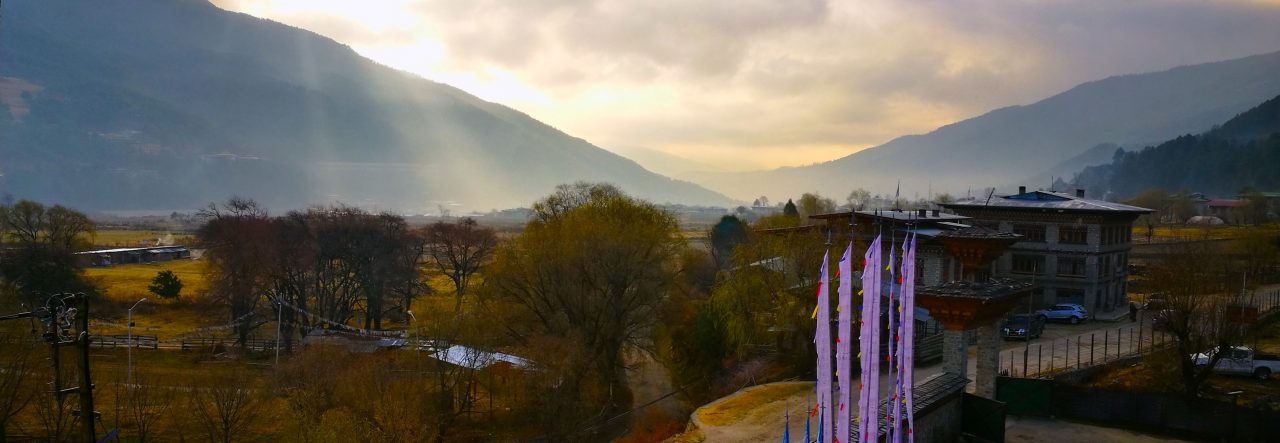
“Re-accommodating” in Bhutanese airlines

Flying, which used to be one of the most glamorous ways of travelling, is quite a nightmare these days. In the post-911 era, air travel has become a pain and nauseatingly complicated at times. At best the experience is dampened by airlines jamming more seats and packing us like sardines in tin boxes. And now we have this nightmarish video of a passenger, in the ‘greatest’ country on Earth: US of A, being dragged down the aisle like a mailbag._95586434_5ad21b7b-afb8-42b1-a60e-cb06b4ec985f

Honestly, I was very disturbed by what I saw – to the point of feeling like an idiot – because I have flown United Airlines. Maybe it was because they picked on an Asian-looking guy or maybe, this was the last straw on the loads of racist narratives coming out of the US these days. Anyway it was not just me but the whole world, especially this part of the globe, that is upset.

My father, who was a truck driver, took a better care of his loads of potatoes than how some big airlines from the ‘civilised’ countries – the US in particular, treat their human cargo. On a flight from New York to San Francisco in 2014, I was even made to pay for water.

Still, since flying is the best way to get around, let me share how we in Bhutan also ‘re-accomodate’ our passengers – and where flying is still fun and glamorous. And where passengers are not just payloads or figures on the balance sheets, but human beings.

Flight overbooking is a norm in airline business. But in Bhutan, we never overbook. Instead, we under-book our flights. That’s because the airport is at 7,500 feet above sea level – and engines, like humans, need a good level of oxygen to efficiently burn the jet fuel. And oxygen is bit in short supply at this altitude while the iron birds have to safely soar up the high mountains that encircle the Paro International Airport. The aircrafts are, therefore, handicapped from taking off at full capacity.  Also, our airlines don’t bump off passengers in favor of their employees. On most occasions, it is the other way around. Employees are kept on hold till all paying passengers are checked in.

1985 0827 [7] Druk Air Dornier at Paro airport (1)
Bhutan’s first aircraft was a Dornier that had one pilot, two props and 14 seats and nothing else. The flight left when the weather God smiled and when the only pilot didn’t call in sick.
Nevertheless, giving up seats on Bhutanese airlines happens all the time. But we don’t use computers. We use human beings. They look towards the cabin and identify the most-agreeable looking Bhutanese to give up the seat. It should be Bhutanese because all foreigners are guests in Bhutan. So twice, that person happened to be me. Once it was to hand over the seat of my three-year old daughter. I was asked to put her on my lap. “What’s happening?” I asked. The air-hostess replied that there was an emergency medical evacuation. As I lifted my daughter to take her seat and vacate mine, I jokingly asked, “OK! But what does Druk Air give me in return?” “Anything,” the air-hostess replied helping me to clear the seat. And seconds later I found a soldier who was wounded at the frontier – taking my seat. In Bhutan we rarely ask why we do good things. We just do it. And we don’t limit to offering just 800 bucks. Our airlines offer “anything”, which both parties later forget anyway.

The second time was in 2003 when I got my first chance to fly the business class – courtesy of my Japanese hosts who were paying for my trip. I had just settled on the spacious leather seat when a flight attendant leaned over to me and asked if I could go to the Economy section. “Why?” I asked. In Bhutan we don’t say, ‘I paid’, or protest. Money is not everything and passengers are not just PNR numbers. The flight attendant explained that they had a VIP travelling at last minute and I would be compensated for moving to the Economy. As we were negotiating – and as I was trying to cling to my rare chance to fly business, the chief steward, who was in kindergarten with me, rushed into the cabin. He didn’t even wish me. He instantly turned back to the exit door with, “Oh! It’s Dorji Wangchuk. No problem.” In Bhutan, we can still take our friends and family members for granted. No apologies and public statements are required. However, you can also hit back for being downgraded to the coach. When the lunch was served, I told the chief steward to serve me the food from the business class – and also to pack me some fruits, bread, wine, soft drinks and beer for my long transit time through Bangkok Airport – which he grudgingly obliged. Many flights later I also reclaimed my business class seat, for free, as I wasn’t feeling well that day. The crew members didn’t even ask for proof.
20160815_122309
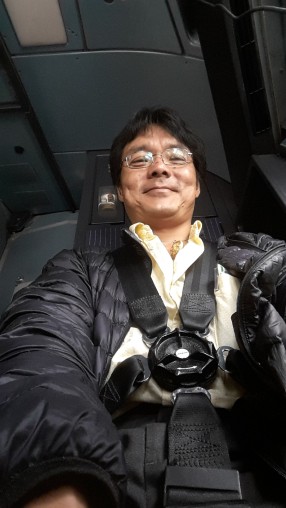
The jump seat reminded me of a dining chair in a Jesuit school I went. You sit upright all the time.

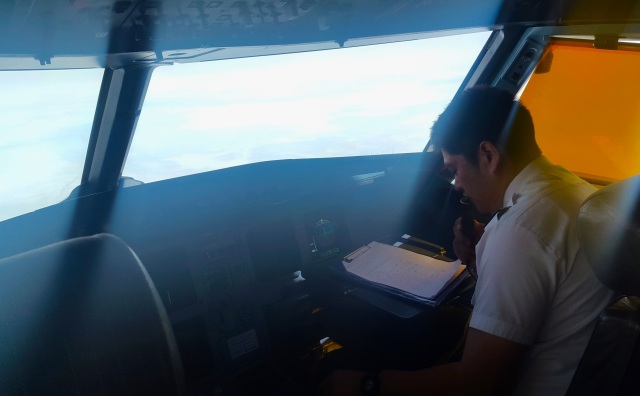
Another time, the captain was one of my good friends, whom I had not seen for a while. As soon as he saw me boarding the plane he said, “Drop your bags and come over. I know you like flying.” Moments later I was bolted on the jump seat behind him like a child with the seat belt crossing all over my body. The take-off was spectacular and the pit-stop landing in Kolkata was a walk in the park for our pilots used to the treacherous Paro International – considered the world’s most difficult airport. As more passengers joined in for onward flight to Bangkok, my pilot friend informed me, “Now you can’t go back to your seat. It is taken. We picked up one extra passenger here.” In Bhutan, if we have to release a seat, we can tie up someone in the cockpit. It is very uncomfortable in there for a 4-hour flight but the view is simply marvellous.

Of course, we are not perfect. Like, we rarely fly on time. The Bhutan Standard Time has been redubbed as Bhutan Stretchable Time. We are improving though – especially if we have to fly out. But when we fly into Bhutan we have our own definition of time. Few years ago, I met a Swiss couple who was visiting a common friend of ours in Thimphu. They missed their flight in Delhi and arrived a day later. “What happened? You guys overslept or got struck in the traffic?” I asked. They looked at each other and smiled and went, “Well, we actually got to the airport one and half hour before the flight.” “Then?” I asked – bit surprised. “We were informed that the flight was not on time. And that it just left.” “Left? Before time? Did you guys protest?” “Yes, we did. We were told very nicely that our ticket clearly reminds us that because of weather conditions in Paro, flights may not be on time. And that only westerners think that ‘not on time’ means delays. Not on time could also mean before the time.” A brief silence. Then we all bursted out laughing. And my friends continued, “We thought you guys are absolutely right. Why should not-on-time be always behind? It can also mean ahead of the stipulated time. We always learn a new thing every time we come to Bhutan”.

~~~~~~~~~~~~~~~~~~~~~~~~~~~~~~~~~~~

(PS. The whole of Bhutan has 6 airplanes and 2 helicopters. We are better off than John Travolta by the two helicopters.)
zzz
Bhutanese pilots are some of the best for, there are currently only a dozen in the world certified to land in Bhutan.
bhutan-airlines-2
Only on airlines in Bhutan cakes are served to passengers on royal birthdays of the Crown Prince or His Majesty the King.
YYYY
There is no inflight entertainment on Bhutanese airlines. If you are a foreigner expect a local seated next to you with “intrusive” questions like ‘where you are from’, ‘how old are you’, ‘how many brothers and sisters you have’, ‘are you married’, picture of your spouse please, etc. This is our way of being nice, which also helps beat the ‘boring’ flight.
IMG_6818
If you are on the left windows seats you get to see tall mountains such as Everest, Kanchenjunga and our own Jumolhari and Jichu Drake (in the pic). Many Bhutanese offer the window seats to uninformed tourists flying into Bhutan for the first time.
636b3630f779f82fe7094a5a5100b2b0
Meanwhile elsewhere in the world this is a regular scene at security checkpoints in the airports.
20170206_230746
And of course there are international airlines that operates a la Bhutanese. Last February Air Macau pulled me to business class after the flight went overbooked. So from the most-agreeable man I think I graduated to the most-decent looking. At least, on that one flight.

Failures, education and learning

Failures, education and learning are three different things. But the modern society has jumbled them into a perfect blend trapping thousands of young people into hopelessness.

First, it kills me that our young people cannot deal with failures and disappointments in life. Why is this happening? Who taught them that life is a smooth sail? Who is responsible for giving false hopes? How do we teach people to embrace failures and disappointments?

microMsg.1486028230896
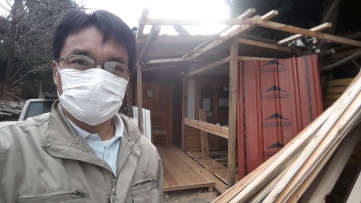
I suffer dust allergy but I love doing carpentry. Our people want job but not work.

A young Facebook friend wrote to me few days back (I get such requests very frequently from young people) asking me how he could help his friend to deal with a failure. Apparently his friend couldn’t qualify for college. I don’t know why people have to rush to college. I made my daughter work as a receptionist in Dorji Elements for 2 years before she figured out what to do and resumed her studies.

Anyway here is the advice I wrote to my facebook friend. I thought this might be relevant to many facing similar dilemma.

Dear…….. I have two suggestions and a word of caution for your friend.

1. Not being able to continue his studies is neither the end of the world nor the end of his learning life. I, myself, was interrupted three times in my life on my road to formal education. First, after I finished class X when the government insisted I joined the job market (1982 to 1983). Second, after I completed my diploma from Dewathang (1985 to 1988) and third, after all these years since I graduated in 1995 (this was, of course, my own doing). So the key to continuing his studies is not to keep banging his head of being a student at all cost but to take a diversion and to resume after some time – like I did.

2. He can take up some petty jobs – any job that would give him an honest income – and then he could take an evening BA course at the Royal Thimphu College. (And in 4 years he has his ‘dream’ paper. Not sure if it would be useful but there is a 46-year-old shopkeeper who is doing that, together with many younger students. They work the whole day and come to class in the evening. It is the same degree course).

The word of caution to your friend is never to look at formal education as the only way to success or to live. Education and learning are tools to help you become a better person, a good human being and a productive citizen. It should not be seen as an escape from poverty, as a piece to show off to others, or to pursue just because your classmates are also doing that. I hope these all make sense.”

Second, I hate that our society has created just one channel of thought, just one means to live and one way to be human – Get a college degree, or you are nothing. It is not just in Bhutan but everywhere. While I support formal education (otherwise I wouldn’t be writing here), what I strongly advocate is learning, and in fact lifelong learning. Education and learning for me are both useful tools to see, feel and experience the world fully – and differently. However, education and learning are altogether different. Education is a systematic learning and that’s it. But learning is a natural process that should not stop after a formal education.

10629420_10154514250720153_2879644047791424915_oEven without, or with less, formal education we can survive. When I was in the 7th grade (and I was just 12) I did house wirings in Tashigang town and in my village during school holidays and earned ‘tons’ of money. Two months and four houses = Nu. 800! Can you imagine? My father’s monthly salary was just Nu. 210. Other times, when I was growing up, I also worked as plumber and electrician and repaired sawmills and rice grinding machines. However, I wouldn’t have survived without learning. As as neonate I learnt to breathe and cry and feed myself. As a toddler, I learnt to walk, speak, tie my lace and say, kuzuzangpo. As I grew up I learnt many other skills besides what the education system gave me. As a matter of fact, from some of those skills I even launched very successful careers in documentary filmmaking, journalism, teaching and social work.

And my learning continues even to this day. But after my PhD, I might work as barista (I can serve free coffee to myself), bookseller (inspired by Bookseller of Kabul) or a builder (building stuff is in my blood) or as a teacher (wherever they want me. Would love to teach on the steppes of Mongolia). Now, am I wasting my time pursing PhD? Absolutely not. As I said, I am savouring the experience, the process and the different

2017-04-06 13.02.45
You are not suffering. You have suffering – Nagarjuna

worlds beyond the civil service, engineering, media, filmmaking and parenthood. I am in the world of philosophy (reading Aristotle, Confucius, Gebser, Foucault); the world of anthropology and socio-linguistics (works of Boas, Geertz, Labov); the world of Buddhism, which I thought I was in but realised I knew nothing (so reading Nagarjuna, Chandrakirti, Dzongsar Khyentse); and lastly, the fantastic realm of research and discovery – of old knowledge and new paradigms. This is actually what brought along this PhD thing. I started pursuing what I tentatively coined as middle path communication – a new theoretical framework for Bhutan in the age of social media. So PhD isn’t my goal but just a means.

To summarise, failures, education and learning are three different things. And then there is qualification – altogether a different animal, which together with titles and decorations, are things we are so addicted to. But I am also aware that it is not their fault. The modern society has jumbled all these into a perfect blend, which has trapped thousands of youth across the country, and millions worldwide. In Bhutan we do that:

  • Socially: We characterise education as an escape from poverty and also equate farming to hell. “If you don’t want to study, do you want to look after cows?” Bhutanese parents often tell their children. We also give shallow advice: Just get a degree and your life is made. We provide false hope: Study hard so that you don’t have to struggle later. And my all time favourite: Zaaai! You have graduated. Now you can enjoy the rest of your life.
  • Systematically: For the education system, you are just a number. If you hit 62.5, you have made it to heaven (welcome to Sherubtse College). 62.4? You can go to hell. We even use massacring words like “cut-off” points.

I could go on but let me stop here and post a TED talk video of this extraordinary guy, Sonam Wangchuk (no relation to me. He is an Indian from Ladakh) who returned to his community and has some great answers and solutions.

20170131_164556

20170204_123024
I paid two people 25,000 (one didn’t even know how to use the saw) just to help me build this – a counter for my Book Cafe (“grand” opening in 2018).
2016-02-27
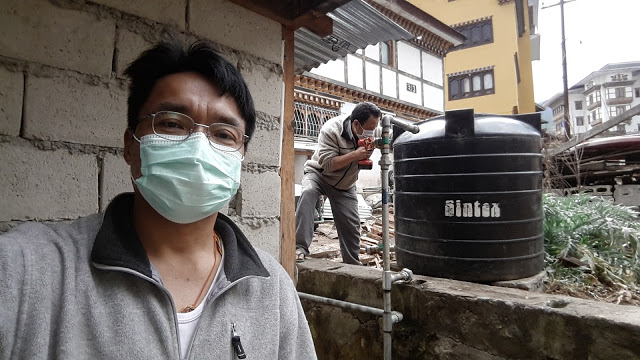
I do plumbing works at home. Now it is so easy that you don’t have to do threading works. My next plumbing project will be solar water heating system and rain water harvesting.


When a rock art saved me

It was late October 2002. I was with the Bhutan Broadcasting Service then.

With my cameraman, Sonam Loday, and soundman, Tshering Norbu, we were on the last day of our trek to Singye Dzong. After our lunch break we thought we had got closer to our destination and so we sent our guide ahead. We have been filming along the way, since we left our camp in Thangkarmo,  and we continued to do that day too – which actually slowed our progress.

_MG_8117
Journey starts through sub-tropical green area of Khoma

Then the Sun was almost at the horizon when we realized that we were nowhere near our destination. We packed our gear and zoomed off. I started worrying but managed to hide it from my two younger colleagues. The trail was never ending. Did we miss our path? We were told that at the intersection of Doksum, we should take the valley to the left, which we did. The one to the right would have taken us to another valley – Rongmateng.

Late afternoon turned into evening, which also gave way to the darkness. And still no sign of inhabitation or religious sites whatsoever. Usually they are marked with prayer flags or chortens. Nothing except dense jungle and total darkness made creepier by a furious sound of the river gushing below us. We kept going. My two colleagues followed me. They thought I knew the way. But I was already panicking. We were warned from Khoma not to undertake the journey for it was late autumn and the yak herders would have already left for lower valleys. In fact it was our second day that we had not met any soul. Did I push too far? Did I put the lives of others at risk? My heart started pounding even faster because of such thoughts. I was breathing faster and because of pantings and hyperventilation I was getting dizzy. My vision was getting blurry. We slowed down and I said to myself, “If we don’t get to our destination in another 10 minute I am as good as dead.”

Then as we turned around a corner I thought I head some prayer flags fluttering in the darkness. Was I hallucinating? I stopped and I pointed my flashlights. There besides a string of worn-out prayer a flag was a small rock carving of Guru Padma Sambhava and a marker, ‘Way to Singye Dzong’. “Yes!” I thought. “We are on the right track. Thanks, Man. You save my life” I silently told Guru. We stopped, dropped our loads and I took out my small towel from my bag and covered my face. Out of sheer joy and relief, I cried silently. It was dark and so we couldn’t see each other’s faces. We could only hear gasping for air from the brisk walk and from the very high altitude we were already at. With my energy recharged, literally, an hour later, at close to midnight, we reached our campsite.

During our week-long stay in that area we saw nothing but rocks and caves. There is actually no dzong in Singye Dzong. Dzong is a metaphor. Every ancient Dzongkha word, I was told, has three meanings – the outer, which we are all familiar with, the inner and the secret. It is called chi nang, saang. The nang meaning of dzong is “a peaceful place” – a sanctuary. In fact the place is so peaceful and exudes an energy that you can feel right to the core of your heart.

SingyeDzong
Singye Dzong valley. (Photo courtesy: Thuenlam.bt)

I am sharing this story in light of a recent news report that rock carvings of religious figures would be banned in Bhutan. I hope that people who make such decision will also read my story. Had it not been for that small rudimentary work of rock art, which are now being termed as religious desecration, I wouldn’t be alive or I would be telling a different story.

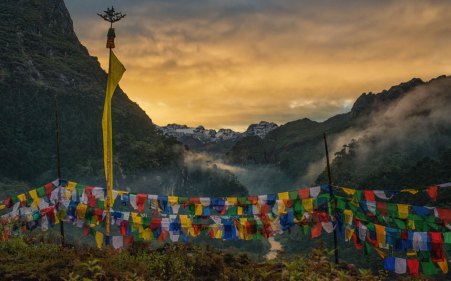
The presence of the sacred and the spiritual energy is found both outside and inside the temples. While others may not have such a dramatic story like mine, I have had friends who visited Bhutan and felt powerful the energy everywhere. The presence of a chorten here, a rock carving there, water-driven prayer wheels in a distance and prayer flags everywhere, exude energy like nowhere else. Hence, I am not sure how these things are sacrilegious. Do we really need to regulate them? Shouldn’t we be actually encouraging such religious pursuits?

Just asking.

DSC_0045
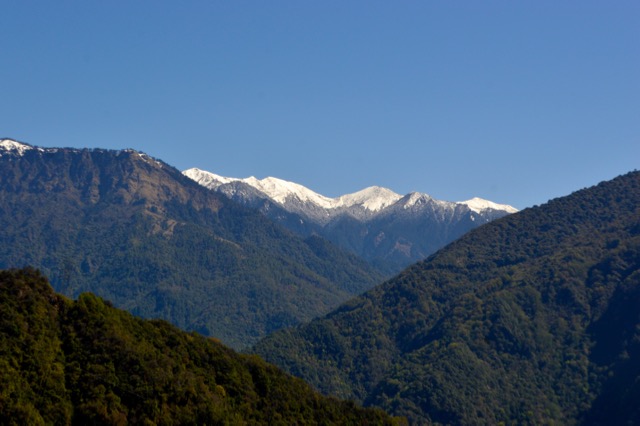
Never ending mountains before the abode


Joy in simple things

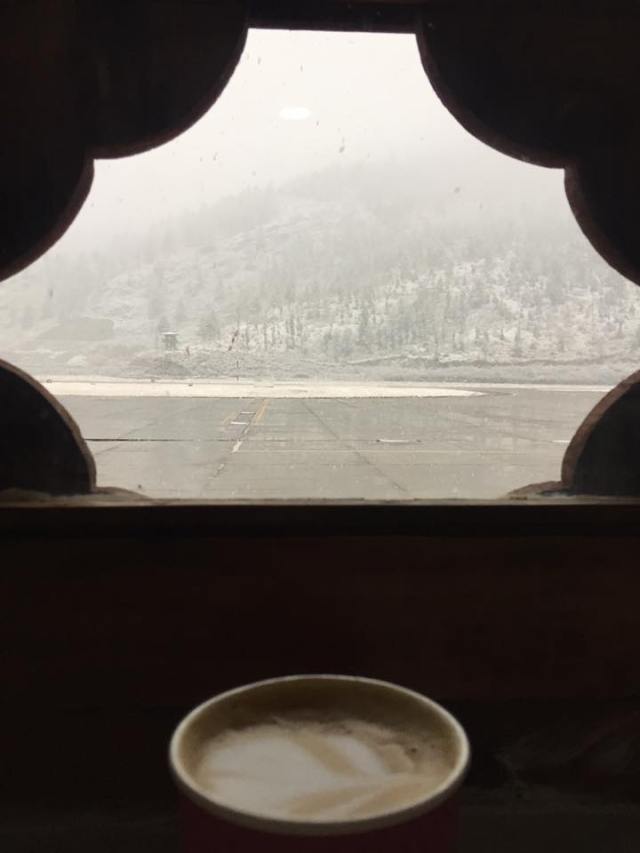
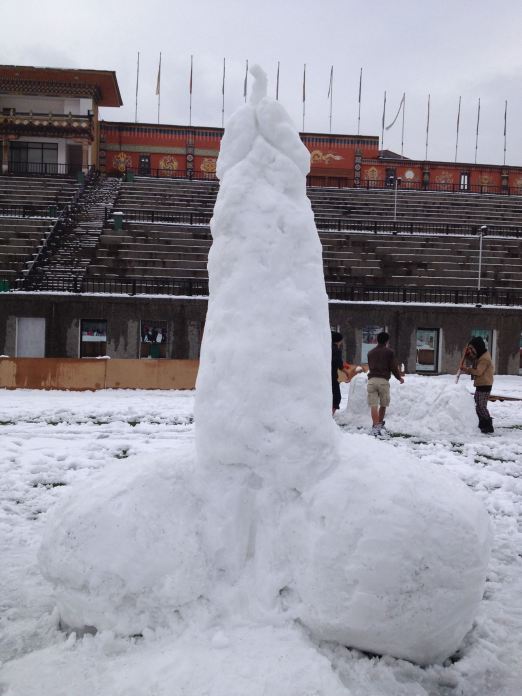
My Facebook timeline is flooded with pictures of the snowfall in Thimphu.

It is heartening to see people getting joy out of simple things like a snowfall. I have never understood this pleasant collective euphoria – and the disappointments in the past years when it didn’t snow.

It is heartening because if GNH means anything, it is the ability to find joy in those small things in life that give you togetherness and make you feel, share, forget and live your moment. It is finding happiness and contentment in what modern capitalism has long melted them away as things trivial.

I have taken the liberty to copy-paste some pictures out of the pages (mostly of my friends so that no one sues me for copyright. Need to be careful these days) and have given my own narrative and captions. Enjoy till it lasts. And, of course, to paraphrase an Indian teacher in remote Bhutan, Let them snow!

~~~

17103277_10155206787198623_8799484714561897711_n
It’s freezing to play dad. Still, duty calls….


17103593_10155037333931704_437298814972738500_n
Some people (like Dr. Dorji Penjore) had their flights cancelled. But didn’t mind..


17155330_1109321642547344_412959451278713505_n
Aku Pema (aka Tshering Dorji) is either sleep-cycling or is trying Swedish sauna.


17159023_985228341609385_5402000277904757846_o
Meanwhile Aku Pema’s partner has just started the engine..


17190543_10155215421058846_2021924256766227681_n
Some moms (Sonam Pem) are more excited than their children.


17190733_1276017009185877_3372133196762301944_n
Frezzing Buddha


17190964_1399404456765789_8260666253453264904_n
Bhutan Airline is snowstruck in Paro


17191330_1291387807576284_2161331246030434998_n
What remains from the Everest expedition (Karma Jimba)


17191375_1262471857140841_1417805294965173625_n
Some got spiritual even on a cold day


17191472_748321025326484_5656323675604059418_n
Snow Buddha (to add to Walking Buddha and Sitting Buddha)


17191736_1222058187892368_876620656499386279_o
Even policemen just wanna have fun


17201145_1248521628534899_444358756084837718_n
And some people waited for the snow for the annual alumni gathering


17201318_1262471817140845_3856049277891671322_n
What else you expect from Zorig Chusum students


17203010_1378941435482909_5527976960234960981_n
The Fattest of the year


17211899_10154452298287218_8526771766946293081_o
Spot the Trump


17212088_10202943965116737_2574507993329392585_o
His toilet chose this day to malfunction, I think


17240693_10158422615890327_7175106872322828689_o
Some (Kezang Wangchuk) waited for the snow for family photo


17264298_10155080448821703_2278999024365117023_n
Alas, not everyone was happy with the snow. The trade fair was ruined.


17201333_10154546792381849_8077167611215179859_n
But our desuups (Choki, Ugyen and Karma) were there.


17264547_10154578731985547_1801813758126565465_n
Small dogs leave big marks (Karma Choden’s Nuchu)


17159063_10155048451678905_4918068759415793311_o
Only in Bhutan


17264168_1276360185818226_645059710259011145_n
For some, life is still upside down


17201435_10154561706282869_3113750126853119632_n
Life is too short. Smile as often as you can. Better if you do always. And easier with a lager beer. Cheers to life


The Strength of the Rising Sun

On this day, many moons back, I was caught in the Great East Japan Earthquake. I was in Tokyo when that happened. Here is my story of those dramatic days.

March 11, 2011 – I was at a lunch in Akasaka (downtown Tokyo) with two of my friends, Sakitsu san from the NHK World and Ogawa san of Tokyo Broadcasting System (TBS). I was on an official visit to prepare for the State Visit of our King, which was to happen two months later.

As we were eating, chatting and sharing the old times, the building started shaking.  Mildly at first.  “It’s normal,” one of them reassured me.  But the quake only intensified and things started falling down around us.  Some people started screaming outside.  Sakitsu took out his phone and was rather shocked by what he saw on the mini-screen, “It is a big one. It hit off the coast of Fukushima. Tsunami alert along the Pacific Coast.” The emergency siren rang.  Immediately he excused himself and rushed off. Ogawa, seeing me little dazed, asked me to follow him to his office – the TBS building, which is probably one of the safest buildings in Tokyo. I followed him. In the streets people were running all over the place. Another shake. I felt like I was trying to walk down the aisle of an airplane midair under severe turbulence. A big earthquake had just hit Japan.

The 9.2 magnitude earthquake has released an energy that was equivalent to 30,000 times the power of the atomic bomb that was dropped over Hiroshima during the World War II.  But more than the earthquake (because Japan was prepared for it) it was the tsunami it triggered that devastated the north-eastern coast.Scenes of cities beings washed away, like in the movie Day After Tomorrow, were flashed on TV news over and over again. At the time of posting this article, over 3,000 people have been confirmed dead, as many were still missing and over quarter of a million have been left homeless or directly affected.

The response to the disaster was quick.  Over 1.2 million people were evacuated within minutes after the tsunami alarm went off along the Pacific Coast – from Hokkaido in the north to Kyushu islands in the South.  Relief and recovery teams went into action even before the first wave of Tsunami hit the Iwate prefecture (which was closest to the epicenter). Trains, airports and subways were suspended and elevators in every building in Japan were disabled with clockwork precision. The Self Defence Force (Japan’s army) was put into action and the Parliament suspended the debate and the session to allow the government to deal with the crisis.

But what really amazed me was not the Japanese efficiency at work.  Rather the courage and the dignity with which the people, even those who were directly affected, dealt with the tragedy. It is often said that the worst of times brings the best and the worst in us.  In the case of Japan, it brought only the best. Although left with nothing for themselves and for their family, people lined up in the usual orderly manner – to get some food, buy some supplies or to make telephone calls from public fixed lines. The sense of community was simply moving. For all their technological advancements the core value of Japanese society, the social harmony, was still strong. Usually emotions would run high and looting and riots would take place where desperation sets in. This has happened in recent tragedies and turmoils all over the World.  But not in the Land of Rising Sun.  I couldn’t help but admire my in-laws (my wife is a Japanese) more than ever before for their great courage and the highest sense of civility.

My journalistic instinct was to go to the affected area but back home everyone was worried for me. I was instructed to leave the country with the first flight that I could catch. It was an order I couldn’t refuse. However, the country had almost come to a halt. I spent the time glued to the TV, rescued by my sister in-law and in her house, getting every bit of information that was coming out from Narita Airport. The transport authorities had shut down everything to assess the damages and the safety -and there were no flights in and out of Tokyo. The radiation leak from Fukushima nuclear plant presented another bigger concern.

Finally on 13th March I made it to Narita and boarded a flight bound for Seoul. Life in Tokyo had almost come to normal after two days although the after-shocks and the threat from the Fukushima nuclear plant kept coming. I called up Ogawa, Sakitsu and my sister-in-law, Junko, for taking care of me aFujind sending me home safely.  As the flight took off from Narita airport, I bid goodbye, for this time, to this country that had given me so much but that was going through, what Prime Minister Kan described as, the worst crisis since the WW II.

As we climbed higher I looked out of the window and saw the earth moving away and clouds slowly covering my second homeland.  A deep sadness engulfed my heart. If there was one positive thing for me out of this incident, I realized how much my friends here and my in-laws cared for me and how much I have become closer to this country. I also realised how unpredictable life could be – even for a nation.

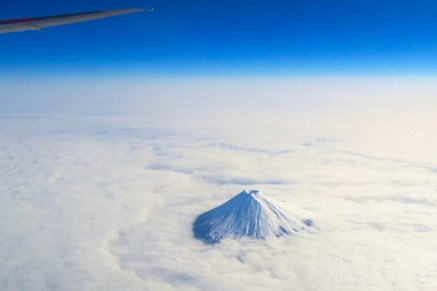
And as the aircraft veered right on its final trajectory towards Seoul, a bright light appeared in the horizon. It was Mount Fuji, beaming with the winter snow still covering its summit. Standing above a blanket of dark cloud that was now covering everything below us. I smiled tearfully at the sight and offered a little prayer. “Yes, Mount Fuji,” I thought, “You are the spirit of this Nation. Rising above all adversities.”

Whatever destruction or despair Mother Nature may have thrown on this Land, suddenly I felt confident that like Fuji san (as the Japanese refer to their favorite mountain) the people here would stand tall, rise above the situation to rebuild their nation and move on.  They have done that in the past.They will do it again.

That is the strength of the Land of the Rising Sun.

(The original version was posted on March 16, 2011 from Bangkok in http://www.dorjiwangchuk.blogspot.com


My life in 50 pictures – Part I

50 years is a great target for my generation. When we were growing up in the 70s we were given the country’s fact-sheet where our life expectancy was a miserable 35 years. So I remember praying to Buddha for a life way past that age.

So my generation has already lived 15 years more than what we “expected”. I achieved that on February 14, 2017 – on the so-called Valentines Day. In addition to the milestone of outliving the official life expectancy, I present here, in a five-part series, my life’s ups and downs in 50 pictures.

Part I : Early years and schooling

1967. Tongling. Radhi (Trashigang)

1900761_10155100167155153_1074666432679121199_o

I was born in a hut above this village. My family was driven out from our ancestral home in Tongling. This place is called Drung Gonpa. Drung as in Drungpa (sub-district governor) and gonpa means temple. There is a temple there, which was founded by my maternal great-great-grandfather, the Tongling drungpa, in the early 20th century. People called it Drungpa Gonpa because it belonged to him. I grew up with my grandfather, Khandola, who was a hereditary lay-lama, my great-grandmother, whom we addressed as Ashi, my mother and my elder sister. My father was away in a distant place and I rarely saw him. I later learnt that he was drafted into the army following the border clashes between India and China of 1962. So my grandfather took charge of me and I grew up as a young novice – learning how to make ritual cakes – hoping to one day succeed him as a lama. I grew up drinking goat milk and walking with grandpa to the villages of Chaling, Radhi, Khardung, Tshenkar, Jonla where he was invited to conduct rituals and religious sermons. He rarely accepted the gaybcha (offering to monks for the service). I don’t remember his reasoning.

………………………………

1972. Phuntsholing. Earliest photographic record.

1930524_85421170152_1507_n

When I was 5, my grandfather passed away. So my hereditary duty to become a lama also died with him. My father, who was working in Bhutan Government Transport Service (BGTS) as a driver, came to back to the village and took me to Phuntsholing.

There, he enrolled me in Phuntsholing Primary School in class Infant ‘C’. I aced the class that year. I and an Indian boy, whose father sold Murphy radios in Phuntsholing, were given double promotion. We were directly moved up to Infant ‘A’. In those days it was normal for good students to skip grades. The government was in a hurry to get students out of school and fill the newly established civil service. We were  basically fast forwarded to the job market. (How times have changed….)

……………………………………..

1974. Loyal Studio, Phuntsholing. (Photo. To my right is my father. To my left my uncle)

don-bosco-boys-ii-001Two years later I moved to Don Bosco Technical School in Kharbandi. My father rarely was home (he went on driving duty) and my mother had to be in Tongling to nurse my great-grandma. So I was packed off to a boarding school. I was only 7 and I remember Father Philip, the Selesian principal, refused to take me in. So my father, who had earlier worked as a royal chauffeur, got a kasho (royal edict) from HRH Ashi Dechen Wangmo Wangchuck (a real angel for many Bhutanese of my generation). The trip to Thimphu also coincided with the Coronation of the Fourth King Jigme Singye Wangchuck. At the celebration ground in Changlingmithang, I received my largest sum of money until then, Nu. 5, which lasted for good 3 months. On my return journey from Thimphu all I can remember is taking a detour to Dawakha over a scary Baily bridge over Chuzom – and vomiting all the way to Phuntsholing in his white BGTS International truck that had the map of Australia on the door (I would later learn that those American International trucks were a gift under the Colombo Plan. They were such powerful beasts).

………………………….

1980. Kharbandi, Phuntsholing (Siting, L-R – Thinley Dorji (CEO of Dagachu/Kurichu Power, Ugyen, me (always smiling), Ugyen Tashi. Standing L-R: Late Kesang Ragu (engineer, BBS), Brother Joy, Tenzin, Sonam Phuntsho (engineer, Bhutan Telecom), Brother Areng)
don-bosco-boysiv-version-2

Don Bosco Technical School was renamed as Kharbandi Technical School. Go Go hairstyle was the fashion and Levis blue jeans was our dream but we were all barefoot (see picture). I was 13. I was a good student but I was naughty and I rarely studied. I would be all over the place. Still, I loved science, history and geography and was a champ in general knowledge (GK). On the vocational side, I did carpentry, welding, plumbing and was majoring as an electrical technician (I still do all the carpentry and electrical works at home). I loved sports too but was fat and unfit to be really good at anything. More than that it was perhaps because I had a hobby – almost an addiction – movies. Dharmendra and Clint Eastwood were my favorite stars. I never missed any movie in Norgay Cinema and so I found myself slipping out of the dorm regularly at night – braving darkness, snakes, scorpions and very vigilant dorm councillors. When I got caught I was reprimanded with toilet cleaning jobs and watering the trees (my early contribution to green Bhutan). I was also beaten very badly, at times. The Selesians were not angels. Corporal punishments were a norm. My father even encouraged them. (So much for all the controversies on the issues these days.)

………………………………

1982 – Bhutan Photo Studio, Phuntsholing. (Photo: Front row: L-R. Kencho Tseten (Executive Engineer, His Majesty’s Secretariat), Nagphey Dukpa (Executive Engineer, Thimphu Thromde), Chencho Tshering (Joint Managing Director, Mangdechu). Standing: L-R. Thinley Wangchuk (Principal, Institute of Zorig Chusum, Tashi Yangtse), Kado Rinzin (Businessman, Gelephu), Yours Truly (in white pants, white shirt inspired by Bollywood star, Jitendra ☺)

don-bosco-boysiv

Although the school and the government provided everything we needed in school, we were always broke with no pocket money to buy other stuff. I had one set of cloth that I could dress up to go to town. We went around in Bata slippers and played football barefoot – all the time. So my friends and I were so excited to receive our second pair of canvas shoe on the eve of the annual sports day that we decided to take a photo. By the way, taking photo in a studio was also very expensive. That year I was also about to finish my matriculation (that was a term for school leaving certificate exam), which was one of the highest qualifications someone received in those years. Can you imagine the excitement in my family? It was as if I was getting the Nobel Prize. When I matriculated few months later, my father also bought me something I was nagging for years – leather top boot and Levis jeans pant. He paid a hefty sum of Nu. 50 just for the shoe. His salary was Nu. 150. (Today I never refuse anything that he asks. He sacrificed a lot for us.)
……………………………….
1982 – Phuntsholing, Study tour to BGTS Workshop.
Don Bosco boysIV - Version 7
In December 1982 I completed my matriculation. But as we were about to set off for the 14-day study tour to India (those days we had such privileges too) a bolt from the blue struck me. My paternal uncle, who was an engineer and whose education my father sponsored, and who was planning to reciprocate by sending me for pre-university (PU) studies to Shillong, was killed in an accident. I saw my life and dreams blown away in an instant. We were planning that I studied medicines and become a doctor. And there was no way that my father with his salary of a truck driver could afford to send me to Shillong. We were not accepted in Sherubtse because our school followed the Megalaya Board of Exams. During the entire 14-day trip to India where we visited Calcutta, Jamshedpur and Ranchi I cried almost every night. It was double blow. I lost my dearest uncle and I also saw my dreams fade away. Not being able to do PU also meant that I would never go to a university. I felt lost – completely thrown off from my path. I was just 15. Yes, life dealt me with a devastating blow at a very young age.
…………………………….
12193667_550518945095422_2768784153254341958_n
Dewathang gate. Photo: Gupta Studio, SJ
1983. Dewathang, Samdrup Jongkhar
After our India trip, we went to Thimphu where we had to report to the Manpower Directorate (that had just been renamed as the Royal Civil Service Commission) to take up jobs in the government. I was barely 16 and I wanted to continue my studies. Since Sherubtse was not possible the next best option was to head for Dewathang to study at the Royal Bhutan Polytechnic and become an engineer.
Life will often present you with a wall. If you cannot climb over it, don’t keep banging your head. Take a detour.
But at the Directorate of Manpower, a long stand-off with the employment officer (very cruel guy) began. I persisted and endured one week of Thimphu’s cold and hunger till a divine hand intervened. I was allowed to go to Dewathang. After borrowing Nu. 50 from a cousin I headed to the East. From that on, I never looked back.

My thoughts during Gyalsay’s birthday

Royal birthdays should be celebrated as a day of togetherness and as a reiteration of one’s commitment towards one’s country. The irreversible journey that we have undertaken in democracy will keep us divided more and more. It is only in the institution of monarchy that we will be united towards a common dream, goal and aspiration.

My father was one of Bhutan’s first drivers. In fact he had the License No. 4. He was a royal chauffeur for few years before he was sent to the newly established Bhutan Government Transport Service (BGTS) in 1966. In the seventies I spent my childhood school holidays taking free rides with him.

autowp-ru_mercedesbenz_lkw_l3500_1-1

Since his black-coloured BGTS truck was one of the very few vehicles plying on the “highway” (sometimes the only vehicle on the road that day), my father would stop for everyone seeking a ride. After a while the truck would be brimming beyond its capacity that some passengers would protest, “There is no space, driver sahib. Don’t stop!” My father would pull his head out of the driver’s cabin and shout back, “Let them on board, as we move ahead you will all fit in.”

No one dare challenge him. BGTS drivers were very powerful guys those days. As the new entrants climbed on board and before they could settle in properly my father would mischievously zoom off. People would tumble on each other. There would be laughter. There would be laments. There were screams. Someone has his legs trapped while another has lost his slippers. There would also be some discussions over some extra spaces someone is occupying. Everyone would cooperate and slowly things would settle down. The journey would continue.

The rides were long and hazardous. The roads were narrow and slippery. Sometimes landslides and boulders would have blocked the way. Men would jump out and start clearing them with bare hands. While they worked, women would pull out the lunch packs and ara and zow. An ad hoc picnic would be spread on the road itself. Everyone shared or would be invited to eat and drink. The journey would resume. The progress was always slow. Night fell midway into the journey. It was scary. My father would be more focused. To his aid, someone would start chanting a prayer. Everyone would join in. We always got to the end of the journey. Safe and sound, as a cliché goes.

chukkha
Chukha valley. The view from the air gave me a nostalgic memory of the countless free rides with my father

On 5th February we celebrated the first anniversary of the birth of HRH Gyalsay. I did onboard Bhutan Airlines bound for Bangkok. There was the inflight announcement wishing him “Happy Birthday”. Cakes were served. But for me such days, and birthdays in general, are also a time for serious reflection.

Our country has embarked on a journey – the journey of democracy. Notwithstanding the challenges, the ride has been relatively smooth so far. Other countries have gone through much rougher times.

Still, living abroad these days (I am doing my doctoral studies in Macau), I do catch up with my friends when I am back to Thimphu. Between some bar talks here and some whispers there, I am often confronted with laments and lauds, hopes and fear, screams and applauses.

The first defamation suit against a journalist has been withdrawn. A puzzling sigh of relief can be felt in the industry. Its impact will be there for long – or forever. A feature film has been denied certification. Those affected are screaming against invasion into their creativity and against curtailment to the freedom of expression. Some people claim that their feet have been stamped while others feel that their legs are trapped. Reactions are, far too often, knee-jerk.

For me, we are all going through a process – and a steep learning curve. As the truck of our democracy safely negotiate the muddy bends and shake a bit, everyone will ultimately find a space. However, we should never stop dreaming or working towards a better future or system – or prevent or scorn at someone who is doing that. No system is perfect and no laws are cast on stones. We should accept that they are created by imperfect human beings. There will always be room for improvement.

The mass is getting more vocal. New technological platforms are providing unlimited access to information and news to everyone. The so-called digital divide is now a passé. Even my illiterate sister is heavily on WeChat. Information is not a monopoly of the few. New political parties are in the offing. The overall progress is slow – but we are progressing nevertheless. The old power centres, such as the bureaucracy, are figuring out where they stand in the new era. Others who are too old to climb on to the truck will be left behind.

Where we really need to stop is to claim that the grass is green only on the other side. We can take inspirations and best practices from others. I don’t argue with that. But scrolling through facebook pictures of our compatriots standing in front of high-rise buildings and exotic shopping malls in foreign lands, many of us seem to fantasize that everything is messy in Bhutan while it is perfect ‘out there’. We give up too easily. Or we resign to any issue with a popular phrase, pha lay pha (meaning ‘out there in a foreign land’). We say (and some even claim without having been anywhere) that pha lay pha ghi people are better and brighter; and that, out there, the system is just and perfect and that societies are fair and equal. Maybe, in terms of public infrastructure, things are more convenient in some developed countries. But as a saying goes, the world is a just place and life is not fair anywhere. Out there, there are more countries with bad services and systems than there are with good ones. There are challenges everywhere. But, most importantly, in terms of people and sense of humanity, I feel, it is still a blessing to be a Bhutanese. I say, “still”, because we are also changing.

bhutan-airlines-2
Thanks to HRH Gyalsay’s birthday we are served with cakes onboard. A day when Bhutanese people come together

Democracy comes with more freedom and choices but also with more challenges and responsibilities. It is slippery, at times. In the confusions and confrontations brought about by the changing times, what we, as Bhutanese from all walks of life, must always remember is that We. Are. In. This. Together.

We are in the same truck – part of the same process. There is no ‘us’ or ‘they’. And no one should feel indispensable, indestructible or immortal. Personal interests or egos should not override our sacred duties or official positions.

If there are boulders blocking our system, we remove them. If there are disagreements we discuss and solve them. If we have extra resources we share. If there are criticisms we accept. If people are screaming we listen. We should never forget that on either side of the so-called rules, policies, systems and fancy designations, we have real human beings with faces and families. That’s why GNH is a human-centric development and governance approach.

150715_10154859839915153_8139859142476203115_n

And whatever happens, remember we have the good fortune of our Golden Throne that has steered us safely along the bumpy and winding road from the not-so-easy historical past. It is an institution that continues to work selflessly for the people. Where in the world do people have such luxury?

Therefore, as we come together to celebrate the first birth anniversary of our Gyalsay, who is a manifestation of our collective moelam, we can make the occasion more meaningful by inner introspection rather than outer displays of posters and advertisements. We can remind ourselves of who we are as people, reflect on how we are doing as a nation and work together towards our common destination as a country. This way our Gyalsay, and our children, will inherit a stronger Bhutan.

This is more than a celebration. It is our sacred duty as citizens.

~~~

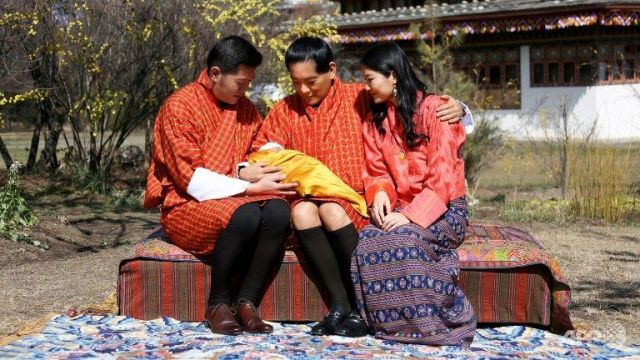
bhutan-baby
My belief in collective moelam grew after the birth of our Gyalsay
gyalsay2
Our Future.

~~~~~

(I have written an article, titled ‘2008 and Beyond’ in Bhutan Times in 2007, using the same metaphor)

Hema Hema – a Bhutanese Narrative

Using an unconventional method of storytelling Dzongsar Khyentse created hauntingly beautiful film where there is no hero or a villain; where the journey is undertaken from, and into, within. With heart screeching lines and poignant background score, you don’t watch Hema Hema, you become part of it.

I am glad that Hema Hema – the latest film by Dzongsar Khyentse, is not banned or barred, as it was reported in the social media but that the film is under review. Having watched it several times, I would like to share my analysis of the film here. I may add that I am not associated with the production of the film in any way. My sole intent is to offer a deeper reading into the film as a communication scholar while also providing a holistic view of the key messages.

Hema Hema is a film that deals with our mundane struggle with something called identity. While identity is socially constructed and determines one’s place in a society, it is also because of that same identity that one feels constricted in life. The film, thus, is an antithesis: how about a two-week getaway where your identity is concealed and where you could exult in the freedom of being unknown.

hemahemasingmeasongwhileiwait_01

A man known as ‘Expressionless’ (Tshering Dorji) makes it to such an event – convened once every 12 years by a god-like patriarch called Agay (Thinley Dorji). Expressionless is last to arrive at the secret venue where he joins few hundreds of other participants. Except for Agay, everyone wears a mask to hide his or her identity. They are also strictly prohibited from revealing themselves or trying to find out the identity of others. Punishments are severe and even inhuman.

As the festival rolls on, primal instincts and desires take over. Expressionless falls for ‘Red Wrathful’ (Sadon Lhamo) and thereafter things get out of control. He is thrown back into the worst of human confusions: fear, which leads him to commit a murder.

Hema Hema offers complex and coded meanings and messages that it is hard to decipher them all. Nonetheless, one key message is the rendering of bardo – a state where one is completely stripped of any identity. If having an identity is suffocating, losing it, or not having one, could be scary.

The film is also loaded with metaphors – and follows the dictum: show but don’t tell. Technological invasions into our lives and degradation of traditions are subtly portrayed. The film, however, does not take the high moral ground. Rather there is a silent scream of questions. As Expressionless goes back to the festival for the second time – twenty-four years later, he is betrayed by his cellphone. At the festival the mild and meditative sound is replaced with pungent techno music. The boedra dances have made way for hip-hop moves. The convener of the festival is a young and anonymous leader who speaks from behind a red curtain. Agay is old and frail. These are strong metaphors for what is going on around us these days.

The film, as Dzongsar Khyentse told in an interview, was inspired by our behaviors in the social media where we get a false sense of anonymity – and freedom. However, one can never be free from one’s conscience, which is the Ultimate Jury. In the final moments, Expressionless removes his masks and explodes in remorse for the crime he had committed and the deep regrets that he has been living with ever since. The resolution is simply beautiful: one has the choice to hide behind a mask, provided by the online world or by the real life, but one cannot hide anything from one’s conscience. It will always follow you and bug you.

In terms of production, Hema Hema is a celebration of Bhutanese ingenuity. While the writer-director had prior experience, all other key personnel were Bhutanese youth who have not been part of major projects before. And yet, Jigme Tenzing’s cinematography is mind blowing. Having sat as jury in international film festivals I can say that it is world-class. The performances by the lead actors, Tshering Dorji and Sadon Lhamo, are as good as they can get. One can feel the emotions, fear, desire, lust and even sadness. This was not an easy task with their real faces wrapped behind passive masks.

Everything in Hema Hema – the festival, dances and rituals, is fictional. Hence, to bring the audience to the present-day reality, the film starts and ends in a nightclub in Thimphu where a cocktail waitress (played by Zhao Xun) contemplates on her life. Symbols and semiotics are maximized. Every object, character, costume, music or landscape is masterfully chosen to blend with the overall message.

khyentse

Hema Hema is by far the best from Khyentse Norbu’s repertoire. It is a courageous film. Critics have often cited The Cup as the best. I would disagree. The Cup was, no doubt, an honest piece but it was more a film and less an art. It had a straightforward storyline and a number of obvious subplots. Hema Hema, on the other hand, is more an art and less a film – in that different viewers can deduce different meanings, as they uncover layers upon layers that are intricately woven like eastern Bhutanese textile.

My own experience of reading the film (I have watched it over ten times, as I am writing an academic paper) is that Hema Hema almost hypnotizes you. It is hauntingly beautiful. There is no hero or villain. The journey is undertaken from, and into, within – and for and against oneself. It grabs your soul and shakes it – with heart screeching lines and poignant background score. You don’t watch Hema Hema, you become part of it. This is what distinguishes this film.

This work, therefore, is a major breakthrough in, what I would term as, Bhutanese Narrative, which could be Bhutan’s contribution to the world cinema. Western and Euro-centric storytelling based on Hero’s Journey has long dominated the cine screen that any new or original style has been seen as a welcome respite – even in Hollywood. This happened with the New Iranian Cinema and later with the likes of Wang Kar Wai and Zhang Yimou. With adequate support and more engagements with film scholars and with other Bhutanese filmmakers emerging and perfecting the new narrative style there is an opportunity for Bhutan to spearhead another cinematic revolution that the world is eagerly yearning for.

This blog entry is the same version that was published in Kuensel, December 31, 2016


UPDATE. January 15, 2017

BICMA denied the certification of the film based on “inappropriate” use of the religious mask. The full report on Kuensel.

Teaching history. Talking history

There has been a great deal of discussion in Bhutan lately on changing the way we teach history in school – including a recommendation to resume teaching it in the national language, Dzongkha. The role of teaching history is not to improve the national language but to instil national pride and identity.

First of all, any debate is better than no debates at all. Although public discussions do not tantamount to much these days, for the sake of my own satisfaction and my duty as a citizen, let me share my views on this very important topic.

drugyel-dzong

For me, the essence of history goes beyond improving the national language or becoming a global citizen. Studying history should instil a sense of national pride and understanding of who we are as people and where we came from as a nation. Then as we read the world history we come together as humanity in mutual solidarity and learning from each other.

And hence, it doesn’t really matter whether it is taught in English or in Dzongkha. It should be taught in a language that best reaches the hearts and minds of the audience. More importantly, it should be taught by people who are passionate about history. There is no doubt that teaching in Dzongkha could provide a rich languaculture experience. But where is the capacity – let alone the passion or the motivation.

In any case, to be frank, the way it is done now, it is serving at nothing. And the fallout could be a declining sense of national pride and loss of the collective identity. Every man will start fending for himself.

I love history. When I was in Sherubtse I used to often sit in history class, which was taught by a superb Indian lecturer by the name of Somaranjan (whom they lost, by the way). I also conducted couple of guest lectures on the European Renaissance and the Advent of Modern Mass Media in Bhutan. I used to also spends long evenings talking with another history lecturer, and my good friend, Sumjay Tshering.

However, I am yet to meet one student who is passionate about the subject. That’s because learning history is reduced to memorising dates, names and places. As Einstein once said, what is the use of remembering something that you can find written somewhere? If I may requalify Mr. Einstein, in this day and age of Lord Google and Prophet Wikipedia, facts and figures are only important to us to the extent that we know where to look for them. Of greater importance should be to understand the question why than the question what.

The way history is taught is fundamentally wrong. The topic is treated as linear and isolated occurrences of events. Worse still, every event is viewed with a telescopic lens focusing on the specific event only. And hence, students of history can provide names of people and places and dates – in a chronological order – more or less.

But history is not linear. It is lateral. It is contextual. It doesn’t take place in isolation. Hence, when we teach or talk history we need to give the broader contexts.

Take for example the Treaty of Punakha 1912. If we look at the Treaty with a lens pointed at that event only, we might feel that we actually got a bad deal. How did we bind ourselves to the British – to advise us on foreign relations?

Now, broaden the horizon of that era. Look at what was happening around Bhutan. The British had been ruling India for over 200 years. They had colonized half of the Earth’s landmass. They had crushed without mercy every attempt of the Indian independence movement. Now shift your eyes towards the north. Again, there, the British had gunned down over 700 Tibetan ‘soldiers’ forcing their way to Lhasa. The Qing Emperor had issued new threats by claiming sovereignty over Nepal and Bhutan. They sent armies to Tibet to crush rebellions. The Great Game was still on. There was every chance that we could have been wiped out. And mind you, history has seen empires and kingdoms far greater than us vanish at the hands of colonial powers.

8x12-ancient-white-woman-with-white-husband-with-lots-of-bhutanese
While Bhutan enjoyed peace during the reign of King Jigme Wangchuck (1926-52), countries around were in turmoil. The World War II had reached the doorstep (Burma), and Britain was getting chased out of India. HMK2 must have been really stressed out, which could have affected his health.

If we give bigger geopolitical contexts to the Treaty, we then not only understand the event better, we also begin to appreciate our leaders more – in particular the masterstroke of Gongsar Ugyen Wangchuck. His foresight, statesmanship and wisdom have kept us safe and independent when all other more prosperous nations from that era  disappeared. We feel proud as Bhutanese. We feel grateful. The fact that we even managed to extract a treaty out of the British was an achievement in itself.

Take another example – and another dimension. The founder of Drukyul, Zhabdrung Ngawang Namgyel, promulgated the Chayig Chenmo (the Great Code of Law) in 1637. However, the year is just a ‘number’ unless we can bring some interesting context to it. What if we said that Chayig Chhenmo was ahead of the much-celebrated American Constitution by a good 150 years? To point out that we were ahead of the Americans? Now isn’t that a factually interesting comparison that would catch the ears of a listener? Wouldn’t our students, and people in general, take more interests in history?

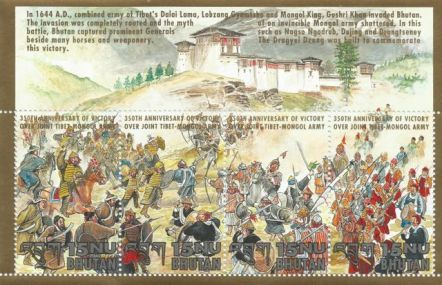
One more example. Everyone knows that Tibet invaded Bhutan in 1644. The Bhutanese repealed them and as a mark of victory Drukgyel Dzong was built. That’s it. However, the 1644 and 1648 military invasions were not as simple as that. They were meticulously planned, armed and launched by the Mongol warlord, Gushri Khan, who was a descendent of Genghis Khan. It was a formidable army of combined Tibetan-Mongol forces. And by the way, the Mongols, since the time of Genghis, had not lost a war and their empire once stretched from the Sea of Japan to western Europe. The 1648 mission was not just to capture Zhabdrung or to retrieve Ranjung Kharsapani but to occupy Bhutan – once and for all. In fact they entered in three different places – Paro, Punakha and Bumthang.

To cut the long story short, the Bhutanese forces led by Tenzin Drukdra launched a surprise attack in Paro, one night, and completely eliminated the invaders and captured their generals. The 1648 loss was perhaps one of the very few battles that the great Mongols ever lost in history. Tibet was also enjoying a period comparable to the times of the Yarlung dynasty.

But somehow we prevailed. Isn’t that music to our ears? Doesn’t this mean anything to you as Bhutanese? Wouldn’t you now look at Drugyel Dzong with a bigger pride?

By the way, the Treaty of Punakha was signed in 1910 and not in 1912. But I am sure you were really absorbed by the narratives here that you didn’t bother about that minute detail, right? That is the essence of learning history. The bigger picture is more important. I am not saying that you learn the facts wrong. What I mean is that one should internalise the meanings instead of memorising the numbers.

Our country’s prime resource is our people – to paraphrase His Majesty the King. What we learn, believe, have faith in or take pride for, will ultimately determine whether our country will reach for greater heights. And if the national pride is today missing or lacking, I would put the blame squarely on our inability to appreciate history. By “we” I include the society in general – and not just history teachers or curriculum designers.

As a result of history being taught badly no one takes interest in this subject these days. This is evident from the fact that it is never a part of our daily conversation or of any social gathering. There has not been one major conference or workshop on history as far as I can remember. We don’t even have a history Society that would serve as the authority on the subject.

As is life, so is a nation. It is only through knowing your past that you can cherish the present and move confidently into the future.

My prayers as we close the 109th National Day celebration is that we could resolve to take greater interest in our own history.

~~~~~~~~

elections-in-bhutan_1-530x261
We made history. We make history. We are living history

Sharchop ngew culture

In January of 2015, I took my family for a road trip across Bhutan – from Thimphu in the West to my native Tashigang in the East. The journey was “historic” for my two daughters, who were 17 and 12. They had never been to that region before. As we crossed the midpoint – the town of Bumthang in Central Bhutan, and entered into the eastern half of the country, I stopped the car frequently to greet my relatives.

10498211_10155100168265153_7961344896157624270_o
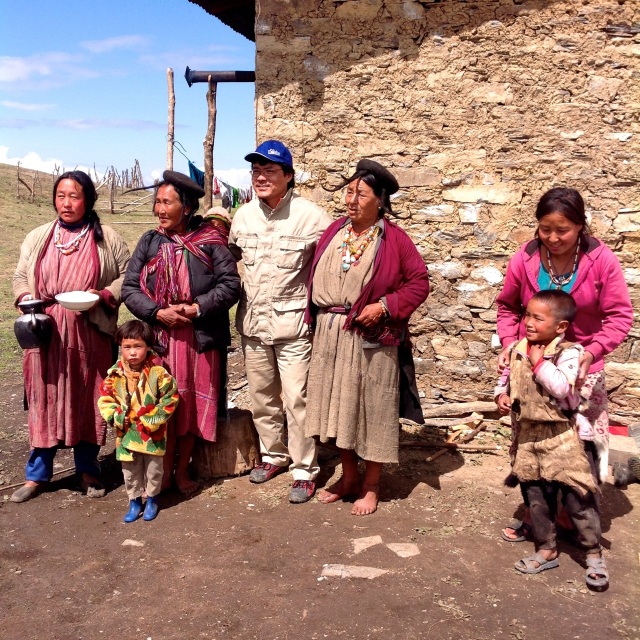
My maternal relatives are the simplest and the most genuine people on Earth. Truly humbling to be with them.

My cousins, nieces, nephews and even distant uncles and aunts presented themselves in droves – and invited us to their houses. “I am your cousin,” a distant niece told my daughters. “Your father and my mother are khotkin-mathang (cross cousins)”. My daughters were amused. My wife just smiled. She has been through that before – during our first visit in 1992.

“Your father and I are like siblings because we are aata and uusa (parallel cousins),” said another. Then one of my aunts went, “You look so much like your abee (grandmother),” she told my younger daughter and gave a big bear hug as tears rolled down her cheek. “You should have known your grandmother. We are cousins but more like sisters. I really miss her. I think you are her reincarnation,” she added. “Promise me that you will come to meet your abee (grand aunt) again.”

Wherever we went we were greeted with genuine excitements and hospitality. In Tongling it was as if 3 days were declared as holiday. No one went to work. They all came to see us – bearing simple and honest gifts of eggs, maize, ara, tengma, butter tea, etc. There was so much laughter, tears of joy, memories of my late mother and that of grandfather whom they said I personified in every respect. We sang, danced, ate, drank and cherished the moments that were so beautiful that no amount of money can even dream of buying.

10926194_10155094012025153_6382988427768066495_n
My daughters with ajang Kinga, who is my father’s father’s sister’s son. He hosted us in Tashigang

Perhaps more than any of Bhutan’s nineteen ethnic groups, the Tshanglas (also known as Sharchop in Dzongkha, the national language) of Eastern Bhutan celebrate large family networks. In fact there is a popular saying that “there is no end to how many ngew (relatives) a Sharchop will have.” That’s because relatives are acquired not only through bloodline but also through marriages of family members. For example, the village of my younger brother’s wife considers me as one of them. “You should have informed us earlier, we are sognu thur (one family),” said one villager in Kheni in Tashi Yangtse. I was visiting that area with my students when I was teaching in Sherubtse College. I was rather embarrassed that I forgot the norm.

10922761_10155100168815153_5911111378655654707_o
Tashi Lebay – A dance that wishes for another such day. Hope it really brings some more of such times

The ngew culture also demands that ‘family’ relations be maintained till the 7th degree although now the norm is till the 4th degree. One of my cousins once counted how big we were based on the 7th degree rule. He came up with a figure for me: 2,400 relatives from 10 ethnic groups in 20 districts and extending beyond the borders to 5 countries of the globe. Hilarious? Not at all. I instead find it extremely wonderful. After all, what is life or happiness if it is not about a shared life, community or togetherness. When I was teaching in Kanglung I used to visit one relative every weekend and share meals, get to know the younger members that I had never met before and return to campus filled with enough food supply for the coming week. Those were some of the sweetest moments of my life. To walk into a village and discover that everyone was related to me in one way or another, what can you ask for more from life?

At the core of this extraordinary ngew culture is the kinship address system. Tshangla-lo has over 30 terms to address your kith and kin. (See the kinship map below). That is almost double as compared to other languages or dialects. The rich vocabulary is indicative of the strong bonding culture.

Using a kinship term does not just serve a mere referential purpose. My research shows that in calling someone ajang or khotkin or kota, a deeper inter-personal relationship is established, an identity is created and a social cohesion is set into motion.

Conversely, one could also assume (and I still have to verified this) that the lack of its usage would drift families and communities apart. That is already happening as people migrate to urban areas, as family income rises and there is less inter-dependence, and, of course, as imported terms such as “uncle”, “aunty” and “Sir” are used more and more.

After a couple of days in my two villages of Pam and in Tongling, my daughters had lost the count of how many cousins they had. “I think we have more than 100,” said one of them. But they were both certainly moved by the whole experience – especially the words of from my maternal uncle, Lepo, 82, who told them, “You may be ashamed of our living conditions. But this is where your father belong to. Come back again and if I am still alive, I will tell you where we come from. Your ancestry. You will be really proud to know that.”

The whole experience left an indelible mark on my daughters because on their Japanese side there is huge vacuum. They don’t know even one single maternal cousin. Japan has almost completely lost that ngew culture.

Hopefully, Bhutan never will.

~~~~~~~~~~~

NB – This article has been adapted from a course assignment piece. Anyone interested in the ‘academic’ version may drop into the mail box in the CONTACT page.

10926443_10155087510265153_6292576818284517769_n
Eastern Bhutan is untouched by modernisation. People have still retained their innocence.

slide1

img_3259
My great-grandfather was once unjustly outlawed by the local governor and driven out of our ancestral home. These people in Merak protected and sheltered my family for a decade. They consider me as their sognu (clan)


10930783_10155100168090153_4156574099836277517_o
Inducting them into Bhutanese rural life which is a universe apart from Japan


10887271_10155100171085153_4910576048502249877_o
The million dollar view from my land. You can see Bidung, Radhi, Bartsam and Yangyer and as far as Thrumshingla. I agreed to losing an acre for the farm road to pass through to get to the village.


10410162_10155103954260153_521418374468348662_n
In front of our ancestral home in Pam – The Tsorgon Phai