Salary raise? umm….

BBBB

Headline on Kuensel, 19 May 2018

This headline might bring excitement in some people – and solace in others. A pay raise? Yes, of course, why not? It is about time. When was the last raise, anyway? With living standards increasing month by month – and not even by year-by-year, it is absolutely necessary. Right?

Well, think again.

Did the last pay revision leave us in a better position? I don’t think so. In fact, some of us might be in a worse situation than before. What guarantee is there then, that this time around, we would be able to solve our financial woes – once and for all? Are we not stuck in this vicious cycle of salary-increase-everything-increase zero sum game? Won’t it cause another increase in cost-push inflation of basic commodities in the market?

I say we, although I am no longer a civil servant now. But for much of my career spanning over 25 years I have been in the government or in a state-owned corporation. I won’t be surprised if the talk of pay raise in the government has already prompted some unscrupulous owners to increase the rent from next month. Jaigaon merchants would have acted on it for sure.

I started my career in 1986 in the civil service with Nu. 875 as my take-home salary. And with that, not only did I have a comfortable life, I used to also send money to help my parents educate my two younger siblings and my cousins. My last salary with allowances when I left the government in 2013 was Nu. 45,000. Honestly, let me say that I was relatively ‘poorer’ in 2013 than I used to be in 1986. Meaning, I had very little spare cash. I don’t deny that life now is more comfortable than it used to be in 1986. But the cost of living in Bhutan now is ridiculously high for the size of our economy that, at times, it can be very stressful for everyone. Hence, I am not sure if we are happier now.

Rich gets richer – and poor poorer

For some decades now, regardless of the pay revisions and promises of the so-called hydropower wealth, most of us are, in fact, stuck in the hand-to-mouth doldrums with no savings – and living under the illusion that we are better off than before, while in effect we are not. Instead, we unwittingly continue to fill the pockets of merchants and manufacturers from across the border – and the cash rooms of our banks. Offsetting the higher living cost through pay raise has, as a matter of fact, proven time and again, to be a complete failure.
Not only.

The gap between rich and poor is further widened with each raise. This is because of the flat-percentage pay raise, which sounds fair but is an illusion. Phrases like across-the-board are often used, which are a total eyewash. For example, 30% hike for a 5,000 basic salary is just 1,500. But a 30% of Nu. 50,000 comes to a whopping 15,000. The flat-percentage model is, therefore, seriously flawed. The new basic pay goes from 5,000 to 6,500 for lower rung, and from 50,000 to 65,000 for a dasho, thereby increasing the huge gap even further. Any surprises then that the rich are getting richer and the poor poorer? The grocery store will not, however, discriminate between the ‘servant’ and the ‘master’.

Furthermore, while the salary increase for many doesn’t even cover a week’s vegetable supply, for the high-income group it leaves a sizable disposable income. This additional liquidity triggers spending on imported goods and fuels massive foreign currency flights – especially on luxury items such as cars, iPhones, flatscreens and holidays and pilgrimage in foreign destinations. Ever heard of the Rupee crunch? Now you know one reason why it happened.

Meanwhile land prices in the urban areas of Thimphu has shot up by 10,000 times between 1986 and 2018.

A plot of land that I eyed in 1986 for Nu. 4,000 (which I didn’t have and so I didn’t buy) is now valued at 40 million or 4 crore (US$ 600,000). It is cheaper to buy an island off the coast of Fiji in the South Pacific than a plot in Norzin Lam. It is impossible for our salaried working-class to buy a house in Thimphu, or in any major urban areas with their monthly income. Hence, the mass exodus of educated Bhutanese people to Australia – especially from the teaching cadre.

Another point.

If the flat-percentage model creates disparity, a flat-sum-for-all, say Nu. 10,000 for everyone irrespective of grade, is not the solution either. It narrows the gap, no doubt. And if I have to advise, I would choose the flat-sum version. However, the cost-pull inflation will still be there, as traders and landlords will raise the prices anyway.

The solution

The answer to the rising cost of living is not another pay raise for civil servants.

The way to go about this is, first, to control inflation – especially the rents. Invest in a serious study to understand the root cause of high rents – and make adequate policies and enact stronger legislations. Start with a dialogue with the banks, building owners and builders. Experience from other countries have shown that if you control the housing rentals in an economy, everything will fall in place.

I am not a banker or a real estate dealer. But I did engineering in college and practised it for ten years, and dare I say that our construction techniques are outdated, and inefficient and the industry is ridden with wastes, thefts, corruption and arrogance. All these have huge bearing on the final cost of the buildings. It is not only the interest rates on the loans.

Second, is to subsidise some 10-12 essential items that people need to survive – fuel, electricity, rice, flour, milk, egg, oil, chilli, tea, soap, sugar etc. This way the basic needs for a decent life are secured for everyone – including the civil servants, and the benefits of the State resources are spread evenly across the whole nation – irrespective of whether you are a farmer, civil servant or a private sector employee. Once the prices of essential items are under control, the cost of other goods and services will stabilise on their own.
More importantly, a cheap, clean and reliable public transport system needs to be introduced so that people don’t have to own, or use, cars. Whether it is done in form of a state subsidy, tax breaks or through public-private partnerships, this ought to be done – lest the much-touted revenues from hydropower export are returned to the sender in entirety for the petroleum products that flow in from there.

Of course, such bold moves from the elected government will not necessarily translate into votes at the polling stations because it won’t be visible. Both the voters and politicians seek instant gratifications nowadays. Visibility is what we all care for – in this era of selfies and social media. Nonetheless, I have faith in my compatriots that there would be leaders someday who will dare to embrace this inclusive concept without caring much about polls or promotions – or for the civil servants caucus that determines whether your party wins or loses the general elections.

In proposing this, I am neither a genius nor crazy. The above ideas are tried-and-tested formulas in many countries. In the UK and France, milk is cheaper than bottled water. Farm products are highly subsidised there. In Italy, city buses and tram rides are almost free. In Macau every citizen receives an annual check from the government when there is a surplus budget or high inflation. Kuwait gives 75 litres of free petrol per month to every citizen.

Even in India, from where we get all our inspirations, the Food Corporation of India takes the role of providing essential food items at subsidised rates, while house rents there are strictly regulated by the Rental Act. Ever heard of the famous Ration Card?
Market controls won’t be a novelty in Bhutan either. Some of these were in place in the 1980s. Those days the Department of National Properties (DNP) would fix the rents of private houses after measuring the livable area. No private or government houses can be rented out without their approval. For instance, in 1987, my rent for a two-room hut in Kala Bazar was fixed at Nu. 120, which was one eighth of my gross salary. Yes, I lived in Kala Bazar.

Nowadays more than two third of your salary goes into house rent. What a sin? Why was the DNP system discontinued? Was it because the decision-makers were also the house owners?
Until the 1980s, our own FCB – Food Corporation of Bhutan, had below-the-MRP food and home items sold and advertised (see picture below). But again, I guess, somewhere along the way, someone must have come up with a brilliant idea that FCB should sustain on its own because it is a “corporation”. In Bhutan, there is no such thing as institutional memory. FCB was established to redistribute food and sell at subsidised rates – and not to compete with grocery stores or make profits. It is supposed to stock up food while buying surplus productions to stabilise the market prices – and release them during poor harvests or in case of natural or man-made calamities.

Recently I ran into the CEO of FCB and he did mention about reinstating those food schemes. Perhaps again, he must have lost out to the many cannot-do people that flood our government and bureaucracy.

Inequalities and consequences

The salary raise for 27,000 civil servants is funded mainly from the revenues of the hydro-power export. Firstly, isn’t the country’s wealth supposed to be distributed equitably as per the Constitution? How sustainable is it to spend 60% of our annual budget on 4% of our population? Is that not happening at the expense of other sectors such as culture or manufacturing? It is not enough for the government to fall back on free health and education while dishing out endless perks and privileges to a small section of the population, at the expense of the State funds. Little wonder then that there is a growing resentment against the system among the private sector.

The scarier thing is that values such as a sense of belonging to the nation, patriotism, ownership or social responsibility will decline once people don’t have physical place to call home. For Bhutanese, who are descendants of highlanders, farmers and forest dwellers, identity is a physical place. Distancing and alienation are already happening as more and more children of the Bhutanese diaspora make Australia and the US their home.

Secondly, our market is largely state-driven and hence the civil service, and whatever happens around it or in it, has huge bearing on the economy. This aspect is often underestimated, sidelined or not understood at all. We are then dismayed that the private sector is never taking off.

The thing to note is that human history has not been kind to large social inequalities, and glaring divisions between haves-and-have-nots.

This can be really dangerous for a nation. More so now when information and fake news travel from finger to finger without passing through the brain. That’s why in Japan, the ratio between the highest and the lowest salary is maintained at less than four. And that’s the reason you don’t hear about “poor Japanese people”. They don’t exist in a country of 130 million. So Japan will never face a social upheaval like in the UK with this Brexit thing – or like in the US with ongoing White Nationalism. Popular discontent will manifest in strange ways, mind you.

In Bhutan the salary ratio between the highest and the lowest salary used to be around 8 times in 1986 but has drastically gone up to 30 times with the last two salary hikes. As a consolation we are, of course, much better than the Americans whose top CEOs earn as high as 400 times compared to their lowest-earning employees. This is one single big reason why there is some much resentment in the US against the traditional political class.

The glaring social gap that I saw there (I was a visiting scholar in University of California at Berkeley in 2014) was the reason why I predicted that Donald Trump would win when he announced his nomination. Every polls and pundits were for Hillary Clinton.
In conclusion,

if we still decide to go ahead with the pay raise for civil servants, please do not forget to re-read this post after a decade (with few more raises by then) and ask yourself, if you are better off. I can bet anything that you won’t be – and lesser still will be those who are not in this rarefied and privileged world of civil service.
Conversely, how about that we all benefit equally? Maybe some of us will get lesser than anticipated but we can all be better. And above all, above all, the most important thing is that, we don’t have to take anybody’s drin (favour) as a nation.

**********

NB:

1. I have not mentioned the negative impact on the growth of the private sector by civil service pay rise each time. It might sound more as a sour grape but the fact is, the salary increase in the civil service has clipped the wings of the private sector. Ask anyone from BCCI.

2. Not to boast but when I handled the pay raise for BBS in the early 2000s (we had to do our own because we were SOE), we went for a flat rate and not on flat percentage. Low ranking staff in BBS, especially, still remember me for that even to this day. TA/DA for drivers were raised to the level of junior officers on the argument that drivers have the same human body and physiological needs.

FCB2

FCB price list. They did their job back then. Where did they lose the plot? (Photo : Kuensel page, 1987)
More than a highway

The massive investments in connectivity – of roads and air links, that the government has undertaken in recent years is perhaps the best thing that has happened in Bhutan in recent memory. I hope this continues to the next decade. Coming from an era when it took me once 13 days to reach Tashigang from Thimphu in 1982*, it gives me a chucklesome and nostalgic smile that now you could do it in a day. Not only.

With good and reliable air and land transport systems, trade, commerce, manufacturing, and movement of goods and services will ensue. If we can get these basic infrastructures right, people and businesses will organise themselves and progress on their own without the need for much hand-holding or dole-outs by the government. Malaysia boomed after they emptied their state coffer and put all their bet on the north-south highway in the late 1980s.

Complemented by the recently-launched RMA’s priority lending schemes, I can even foresee some decline in the rate of rural-Thimphu migration within the next few years – but only if we can keep this pace and wisdoms in action. The immediate aim of the national road network project should be make all dzongkhag centres within one-day driving time from the capital or from the country’s only international airport. This would not only enable access to the biggest market for local produces but also secure the country – and bring the nation closer.

The new highway

The construction of the newly-opened Gyeposhing-Nganglam highway itself was an impossible dream to begin with. The road will, firstly, benefit lower Mongar and Pema Gatsel of places such Kengkhar, Jurmey and especially Gongdue, Yangbari, Mikuri, which happens to be the poorest region of Bhutan. My immediate thought was, at least, the farmer I stayed in Gongdue Pam would now be able to sell his oranges which were rotting on the tree for lack of market. They can now dream a better life.

News reports, social media comments and vox populi have lauded the highway for the faster access through, and to India, for the three dzongkhags of Pema Gatsel, Mongar and Lhuentse. I would rather think that the bigger catch is that we are connecting the two districts of Pema Gatsel and Samdrup Jongkhar directly to Thimphu – inland. 

Isn’t it high time that our mindset is inward-looking and not outward-seeking?

More than the region

The Gyalposhing-Nganglam highway will not just benefit the people in the region but the whole kingdom if our people get little more innovative and dare to dream. For example, a closer look from the Google Earth suggests that the Kuri-Gongri is probably navigable between Yangbari and Panbang. It flows gently from East to West (see map above) in that stretch instead of rushing down from north to south.  Yangbari is flat and has enough space for a domestic airport. That region can truly develop as the winter getaway of Bhutan. Hopefully we can delve deeper and explore into the range of opportunities offered by the new dynamism that has just been created beyond the hydropower project planned there. This highway and the beautiful airport that was reopened at Yonphula few months back should excite people more than just as another front page news.

Gyelposhing – Nganglam highway, therefore, is not just another road.

It is a celebration of the impossible achieved and a consecration of the possibiles that are poised to emerge. I guess, the significance of the good things to come is best symbolised by His Majesty the King gracing the inauguration in person – and blessed by the universe with the magical and auspicious halo that appeared around the Sun on the day.

My homage to all those who worked, and are still working, to make these dreams a reality.

~~~

*  My fateful 13-day ordeal. Day 1 – Thimphu to Chukha (landslide near the bridge). Day 2 – Chukha to Sorchen then walk to Phuntsholing with the luggage. Day 3 – Phuntsholing (no bus ticket). Day 4-6 – Phuntsholing (Ticket yes but Assam strike. Highway closed). Day 7 – Phuntsholing to Barobisa and turned back (Wrong information. Strike still on). Day 8 (Phuntsholing. Driver didn’t want to go). Day 9 – Phuntsholing – Samdrup Jongkhar. Day 10 — Samdrup Jongkhar (no seat on the bus again). Day 11 – Samdrup Jongkhar to Narphung (traffic closed. Flooding near Moshi or Tshelingkhor). Day 12 – Narphung to Khaling (bus broke down). Day 13 – Khaling to Tashigang. Finally home

32207710_10156186976743260_900862690187018240_o

32169949_10156187023188260_8352898147252436992_o
His Majesty the King opens the highway. Behind HM is the Prime Minister, Dasho Tshering Tobgay (left) and the Minister for Works & Human Settlement Minister, Dasho Dorji Choden (right) (Photo courtesy – HM’s official Facebook page)
cropped-img_0127.jpg
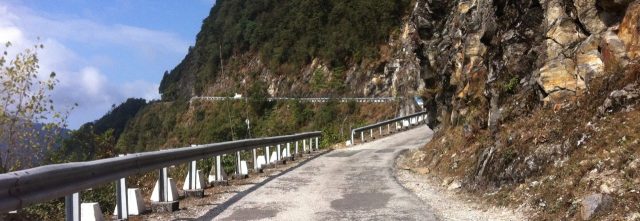
The dreadful Melong Bra (mirror mountain) between Tashigang – Samdrup Jongkhar highway


32543036_10156199990803260_731080588571705344_o.jpg

Red Red Rice

edf
My red rice that I carried all the way from Bhutan

My earlier two posts on food garnered a huge response. I am bit surprised because I thought that I was giving out obvious facts and information. In this article, I will delve into the red rice not only for its nutritional value but also for its broader sociological and national importance.

The red rice 

In terms of nutrients and minerals, red rice is way ahead of white rice. Among others, it is rich in antioxidant called anthocyanins, which gives it the red colour. Now antioxidants are important because our body produces toxic materials such as free radicals. Free radicals causes, among many serious health conditions, the most dreaded cancer, while also altering our DNA. So eating red rice could help in reducing such risks. Red rice is also a source of magnesium, which our body loses and we need to replenish. Magnesium helps in preventing migraine, blood pressure, muscle spasm and cardiac arrests. Magnesium also regulates the calcium in maintaining healthy bones and teeth, and prevents risks of arthritis and osteoporosis. Red rice has more fibre and so it goes easy with our digestive system. Eating red rice, therefore, is much healthier as compared to eating white rice or puri-roti.  

However, our rice production, and red rice in particular, is under threat from rapid urbanisation. Farmlands are going away at an exponential rate. In the best case scenario, we will still be producing, but a decreased quantity of red rice that will make this important resources inaccessible to the mass. Isn’t this bit crazy? Now against this background, it is imperative that our paddy fields in Paro, Punakha and Wangdue, the heartlands of red rice, are protected against so-called urban development.

Protecting our farmlands

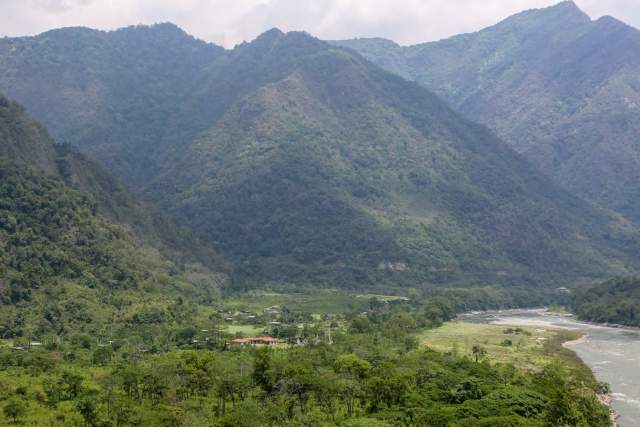
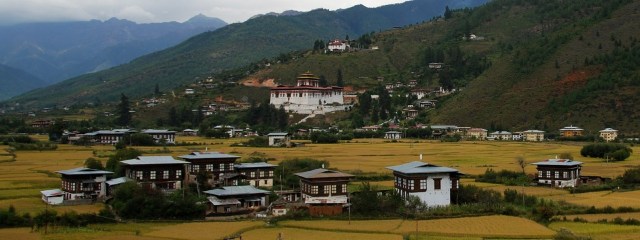
Now one might think of private owners as the defaulters when we talk of uncontrolled development. Well, that’s not always the case. In fact the biggest defaulter has been the government. Just look at Changjiji in Thimphu where thousands of acres of farmland were turned into public housing. Was it not possible to build those on the slopes above Samizingkha? Similar destructions were happened in Khuruthang (Punakha) and Bajothang (Wangdue). That may be in the past. Gone. But there is now an attempt to repeat the same blunder in Paro where a large area in Hungrel Gewog (the area in the picture) is declared as Thromde. Was there a real need or a political greeds here?

My own village, Pam, in Tashigang and my land in Rangjung went down to this urbanisation madness. My poor aunt was enticed by promising higher price for the land, unrestricted loan from the banks and water, drainage, bright street lights if our village became part of the township. “Merbu nangka rang cholay mo?” (do you want to stay in darkness?) was the argument given by the proponents from Dzongkhag administration.

How many valleys and villages do we want to destroy in the name of development? Is this development by any definition? What do we eat if we replace the rice fields with concrete jungles? Cement? Japan has 130 million people but since 1952, not an inch of paddy field has gone into so-called development. Rice fields are protected by law. Ours is protected too but it seems in Bhutan the government is above the law, which is weird. If the intent is to protect rice production, whether the defaulter is government or private, the damage is the same. In China, some farmlands in Yunan and Sichuam are protected as national heritage sites. Shouldn’t we too? Protect Paro and Punakha as natural-national heritage sites? 

The sociology of rice farming 

Loss of paddy fields will not only affect the production and the price. There is far greater consequences to these unscrupulous actions.

Asian societies are celebrated for cohesiveness, community and collectivism where we are all live, work and grow old together. There is a growing acceptance among sociologists that one factor that influenced our collective mindset is our culture of rice growing. Rice farming requires many hands to come together during plantation as well as in harvesting. This forces people to be in social harmony and avoid conflicts and confrontations – as far as possible. By and large, communities stick with one another – because of this interdependence nature of life.

Now imagine if all farmlands are gone. Not only we would suffer from food shortage, the essence of being Bhutanese, where life revolves around the concepts of mutual trust and dependence is gone. In any case how much can we depend on the cheap unhealthy imports? 

If we lose our sense of community, we will become like any other western nation – individualistic, capitalistic and profit-oriented where human relations will be purely transactional – and where every man is for himself.

I am not sure this is what we want. Or what GNH stands for.

Paro-Valley-and-Dzong
Imagine turning this into concrete jungle. What a sin! I would call for this to be protected as natural/national heritage site instead


rice
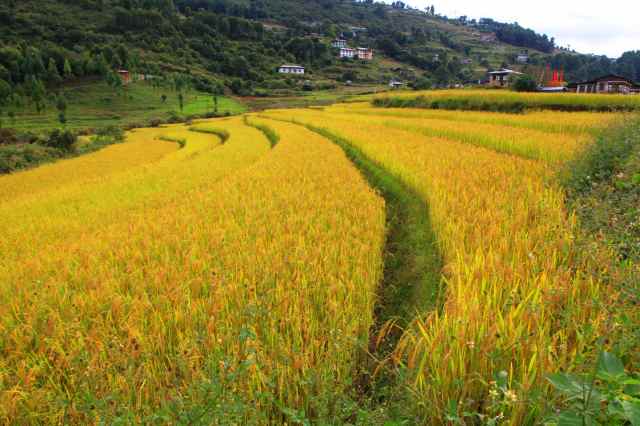
Rice field in Kanglung but not red rise


Back to Kharang

sdr
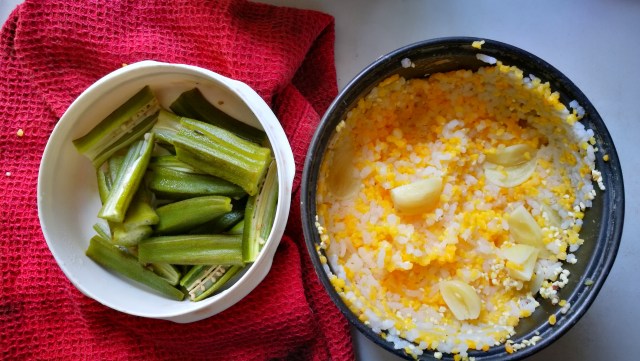
My lunch in Macau

Kharang (grained maize) was the traditional staple food in much of Eastern Bhutan until the recent decades. However, rice took over as we got “modernised” – so to stay. And the shift has been total. Because rice was eaten by the rich and affluent, everyone who moved to a better living condition hit the rice. 

For some time now, though, I have turned back to including some kharang in my diet. The initial decision was mainly to stay connected with my aunt back in my village. My aunt felt a great sense of joy when I asked her for some kharang supply on an annual basis. I also bought kharang from farmers along the highway in Mongar to support them.

Recently I stumbled across interesting facts and benefits of eating kharang on the Internet. First of all, kharang digests slowly as compared to rice and so you don’t feel hungry or the urge to eat again. So for someone past 40 this is good because you easily gain weight as your metabolism declines.

Kharang also releases sugar slowly into your bloodstream, thereby saving you from becoming diabetic. Of course this works only if you don’t eat in heavy amount. Then, kharang, has less calorie, which is a good news for weight watchers. It has all the minerals and vitamins and higher Vit C content. This will boost your immune system. Lastly, it has less carbohydrates (this is important because all excess carbs are turned into fats and sugar in your body).

Furthermore, I have some serious doubts on the imported rice in terms of heavy metal content and pesticides. Excessive and uncontrolled use of pesticides and insecticides by Indian farmers* is in the news and all over the Internet. You can google for them. So instead of getting slowly poisoned, I suggest that we slowly include our own safer kharang from Eastern Bhutan.

Besides the health benefits, our dependence on imported rice would decline as rice growing in the country is becoming increasingly difficult for farm labour shortage. Maybe then we will be bit closer to our national goal of food security. 

~~~~~
* This study claims that use of pesticides in India is double as compared to the US https://www.ncbi.nlm.nih.gov/pmc/articles/PMC2984095/
~~~~
bhutan-t
Beautiful picture of His Majesty with Gyalsay in a maize field in Eastern Bhutan
Maize-1
Anything yellow/golden means vitamin C and good for your immune system


Living in fear of khekpa

The rumour of khekpa* (head hunters and kidnappers), a myth I used to hear as a child, has again surfaced and caused panic in Eastern Bhutan. This is simply ridiculous, upsetting and unacceptable. In fact, whoever spread this rumour is criminal. The Royal Bhutan Police and the Department of Law and Order should investigate this thoroughly and put them to task – whatever might have been their reasons – and reassure the public once and for all. As western-educated adults we may laugh it off as a trivial but among the illiterate rural folks and children in boarding schools, the fear is real. Authorities must step in to restore the calm and peace.

With the country heading for another round of parliamentary elections later this year, the air should be cleaned of such nonsensical mood. We will have enough to worry or be fearful about in the second half of the year – where among many things I expect fear will again be a tactic used to sway votes.

Our perception of fear

Besides the unfounded rumours, our response to fear is something worth looking into. Why do we panic? Why do we go frenzy and irrational when we hear something that might threaten us? The answer is not simply that we are gullible. It is biological and evolutionary.

Fear is the time-tested tool that has been used by corporations, interest groups, political parties and those in power as modes of persuasion and to control the population. This is because our over-reaction to fear is biological. Our brain is composed of three main parts – the inner core, and the oldest part, is called the reptilian core, which provides us our survival instinct. Then there is the limbic layer that controls our emotion, motivation, memory and learning. The outer core is the neocortex layer, which was the last to appear as humans evolved from reptiles to apes to homo sapiens. Neocortex guides our cognitive abilities. To put it simple, the basic functions of the three parts of our brain are to regulate our fear, desire and logic.

When we see or hear any danger, our reptilian brain kicks off and takes control of the whole brain, shutting off the limbic and the neocortex cores. What happens is that we can neither feel or reason out at that instant. It is mother nature’s way to protect us from any threats to our survival. Say you are walking in the jungle and you hear a noice, your reaction is to fearbe the worst and protect yourself. If you are doing the same forest at night, every tree becomes a ghost and every twig looks like a snake.

This discovery of how our brain reacts was however used by politicians and public relations experts to further their own benefits. Nazism was built around the fear of jews, gypsies and the foreigners. The whole American gun industry is built on the “need to protect” yourself and your family from the enemy, which paradoxically includes the State and the government too. Edward Barney, the father of public relations industry, used female emancipation to be free to sell cigarette to women, which then simply doubled the number of smokers in the US. The whole capitalistic marketing campaigns are now either based on fear or desire.

Two examples are:

“Do you know that tuberculosis kills more than HIV/AIDS? Vaccine your child today”,

“Research shows that men are more attracted to fair-skinned women.  YYYYY guarantees you a super white skin in 14 days”.

These types of advertisements still rule our world. No TV commercial is based on logic or rationality.

Danger of living in fear

Prolonged exposure to fear, anxiety and distress over an extended period of time, however, will have severe negative effects and consequences. They stress our brain and leaves an indelible scar. The persistent doses of negative stimuli, in the long run, then could manifest in violence, cynicism or distrust of each other. The deaths from guns in the US can be explained by this theory. People easily get ticked off for nothing. What is happening in the brain, is that over such a period the reptilian brain is getting larger than the neocortex. By the way, our brain expands and contract from our birth till our death. It doesn’t stop growing like our other parts of our body but the growth of one layer often occur at the cost of the other layers.

With modern technology and lifestyle age-old myths are supposed to die. But it seems the  possibilities of sharing rumours on WeChat has proved otherwise. Hopefully we can put to rest such fear-inducing rumours.

*  NB – to parents and educators

1.  Khekpa, apparently is a mispronunciation of Khetpa, which means people from the village of Khet – a settlement in Tawang in Arunachal Pradesh. In ancient time the village, it is believed, was one of the most backward that practiced sorcery and robbed and killed Bhutanese traders. In other words, they we were barbaric. However, Bhutanese people exaggerated and also stereotyped them as child kidnappers and head hunters. Today the village is affluent with road, electricity, hospital, schools etc and welcomes Bhutanese. However, old myths are hard to die – especially those instilling fears.  

2.  Do not use fear tactics to discipline children. It does more harm than good – often leaving a childhood trauma. Besides, they will never respond well to, or respect, your demands and requirements. Aim for the neocortex brain by trying to reason out and explain the logic and consequences instead of emotional black mails and fear tactics. No child is to small to understand the consequences of their actions. 

poster3

Fear+Based+Advertising

lifeinsurance

Bhutanese media: From there to here to where?

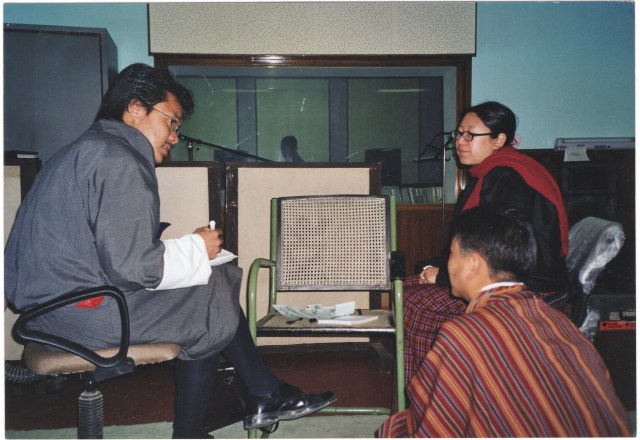
BBS Days 5.jpg
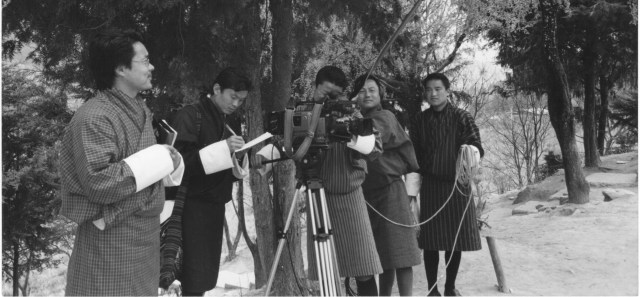
On location – March 2004, Thimphu with Rinchen, Sonam Loday, Late Sherub Dorji, Kunzang Thinley

May 3 is the World Press Freedom Day, whatever that means. As a former journalist-broadcaster I assume it is a day of celebration of the modern mass media. So, let me share some quick passing thoughts on this industry that has hosted me for over three decades.

Media then

The Bhutanese mass media in the pre-2008 era served a different purpose and thus, any comparison with today’s media is not even remotely possible. Although there was the move towards an autonomous media, which gained momentum after 1998, the development communication model still prevailed. The other comparison often made used to be between Kuensel and BBS that served different audiences with different levels of education and exposure.

What I can share, nevertheless, is what was it like to be a media person. Let me say that it was anything but glamorous. No one knew what the purpose of BBS was – other than to play songs and weather report of the day that was already gone. We also worked under a different kind of pressure from every corner of the officialdom – being a part of the government machinery. It was as if everyone had the license to scold us. To our credits, though, we did our jobs well and since people had to find faults anyway, even trivial mistakes like not getting titles or designations right were objects of ridicules and rebukes. I was even criticized officially for not wearing woven gho on TV (My passion for navy gho goes so far back in time).

While development journalism was the model we adopted in BBS, it was still journalism nevertheless and slowly we crawled into the area of truth-seeking and highlighting developmental issues. We worked hard, had fun, stood our ground when we were right and apologised when we made mistakes. And gradually we won the confidence of the government as people around the country started talking about same topics or singing the same song. Still, getting people to come on shows was more difficult than making your child take antibiotics. So the talk-show format, which is common these days, failed twice before it finally succeeded when we made a third attempt with Q&A with Dorji Wangchuk. The series ran for 112 episodes from 2003 to 2005. 

Sometimes we went hungry when we miscalculated our food stock on long production trips in rural areas. No mobile phones, no ATMs. Sometimes we walked out of office under the scorching Sun or a pouring rain to get a 30-second recorded statement and rushed back to the studio to meet the deadline. No enough cars, no complaints – only some childish sense of delights to hear yourself on the radio or bully your friends and family to watch you on TV. 

In the greater scheme of things, though, we played our part. The TV talk shows planted the seeds for political debates while Kuensel’s editorials and reportages set the culture of public discourse and scrutiny of public policies. The efforts of both the BBS and Kuensel – joined by new voices such as Bhutan Times and Bhutan Observer in 2006 laid the important democratic fundaments as we headed to the polls for the first time in 2008. Furthermore, radio, continued to bring the country together every evening for a round of news, public service announcements and programs ranging from new farming techniques to music request shows. In fact the slogan, which my friends and I coined for BBS back then, was Bringing the Nation Together. They changed it later to a less meaningful, The Bhutanese Expression. In the pre-cellphone era, radio requests went something like, “This request goes from Dorji in Thimphu to his parents in Minjay Kurtoe that he is coming by bus on 3 April and to send horses to pick him from the road head.” We did bring the country together.

Nation-building is a process whereby a society with diverse cultures, traditions, languages, ethnicities and religions come together towards a shared common goal and aspiration. Mass media, I always believed, is a great tool to help achieve it. In creating a shared experience of watching and listening to the same news, same songs and speaking the same language, we kept the nation glued together from Tendruk to Tashigang. Until then, I assume, everyone returned home when the Sun set – to their own lives, issues or ara bottles. And those who had a radio, listened to foreign broadcasts. In fact, as late as 1985, my last schooling year, we were listening to All India Radio and Radio Nepal and singing Bollywood songs – and had absolutely no idea of what was happening in Thimphu or elsewhere in the country. Looking back I feel proud to have been part of the team that turned that huge tide around – and thus helping to create a sense of nationhood and national identity. While BBS and Kuensel targeted different audiences, the key message was the same: we are a Bhutanese nation.

In my opinion, no other agency has done more than BBS to propagate Dzongkha, the national language. 

Media now

Media today plays the dual role of nation-building and creating a public space for meaningful debates and discussions within the overall process of democracy. The traditional Bhutanese media – radio, TV and newspapers, however, face a new set of challenges brought about by the changing time, contexts and circumstances. New emerging power centers may be exerting new kinds of pressure, while the existing powerful bureaucracy and its closed mind-set has primarily remained as it is. Then there is the discerning and more demanding public that has set an unrealistic benchmark by watching CNN or NDTV.

The increased demand is further aggravated by the fragmentation of the audience by the social media and mobile phones – making the traditional media look slow, irrelevant and outdated.

However, what the public and the government need to understand is that there is a huge difference between noise and information, and between information and message.

The social media is too much noice with very little information out there – let alone the message. For example, what is the message from all the Facebook updates and outpour of love and gratitude to teachers? What remains of the big celebration that we had yesterday in Changlingmithang, which through the marvel of technology, I could watch the livecast – some thousands of miles away, here in Macau. This is where the good old traditional media comes in. They provide the message and that is, that the voices of, and for, the teachers are finally being heard. Left to the social media, we would got only selfies without any substance.

Journalism is a profession and behind every profession there is either art or science. Journalism has both. It is a serious field.

Hence, one should not live under the illusion that Tweeter feeds, Facebook updates and Snapchat flashes suffice as information – lesser still as the message. If one does that, one is headed for a serious existence ridden with with superficiality and shallowness.

Finally, the audience should be careful with the basic difference between activism and journalism and between hate speech and free speech. These untoward behaviours have found a fertile ground in the social media. And under no circumstances the traditional media should dance to these tunes. 

The way forward

Good journalism remains an absolute necessity to create a vibrant mass media, which in turn, as a cliché goes, is an important element of a strong democracy. This is vital in this era of a pervasive and noisy social media and fake news. Local populations can be swayed by hostile foreign powers or corporations. Of all the countries, the US has learnt it the hard way in recent times. After a spell of euphoria of the new media and death-of-newspaper narrative, agencies like New York Times and Washington Post have registered a million plus new subscribers in the first year of the current administration. 

So much is being done in our country to build the necessary democratic institutions so that our experiment with this new system of governance succeeds. However, I don’t see a vibrant democracy happening with a weak media or an inexistent civil society or academia. Imagine a hypothetical situation where the government and the people are on polar opposites? It is not improbable. After all, as I pointed out on a FB update, ‘If you put two Bhutanese together these days, you will get three opinions.” There is the need to build a strong third voice to bring the two to the middle ground. Most importantly, in the era of post-truth and fake news, traditional mass media as a credible source of information should be further developed, sustained and celebrated as a national institution – and not scoffed at or scorned upon as business entities

There is a real threat to the harmony, security and sovereignty if the whole population gets its news, and form their opinions, from the social media. Not to mention the potential of mass manipulation campaign that can be conducted by foreign powers through Facebook and other SNSs – as it has happened in the US and UK.

Now, it is not nation-building anymore. It is national security.

Another issue that will never go away will be press freedom and censorship. Here, media persons in Bhutan should not assume that just because the Constitution guarantees freedom of press, that people will let them do their job. What is written on paper remains on, well, paper. One has to claim the space or keep asserting. It is like land records. Having the thram is only a necessary condition but not a sufficient one to own a land. If you don’t occupy your land, you will lose it – because someone will encroach in it.

Finally, media and democracy are a process. It is continuous journey and dynamic undertaking of contestation, negotiation and compromise. It will be in the hands of the new generation of media persons to forge the new purpose as per new societal demands and changing circumstances. It will be a difficult choice, though – between credibility and visibility, between depth and trivial and between social and substance. Old hands, like me, can only advice.

The Bhutanese mass media has, all said and done, come a very long way and has fulfilled its fair share in the overall process of nation-building, democracy and development communication. In the age of DTH channels, BBS TV continues to galvanise the country with programs such as Ngagay Drendur and Druk Superstar. Meanwhile Kuensel keeps playing the role of the nation’s conscience. 

There is every reason to celebrate this day.


(Disclaimer: Having grown professionally in the broadcasting world, my article could be more biased towards BBS. However, I am pleased to say that I am working on the roles and contributions of Kuensel and the film industry on the discursive construction and creation of national identity. More on the contribution of these agencies in future articles and academic papers)

~~~

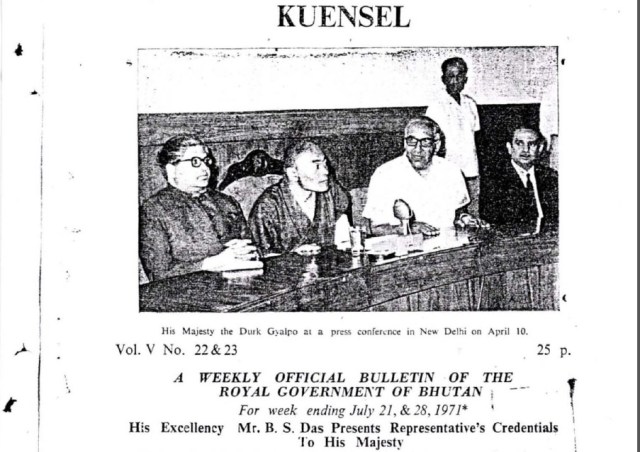
HMK3 Kuensel
Kuensel was the official bulletin until 1986


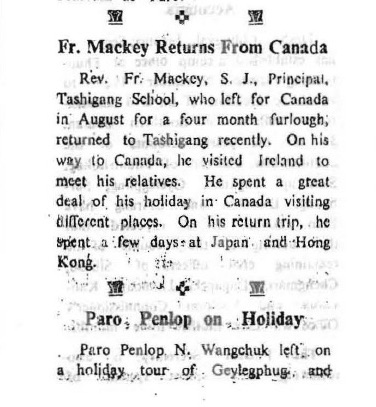
Kuensel news Father Mackey
Kuensel 1968 – Even Fr. Mackey’s leave was a news 🙂
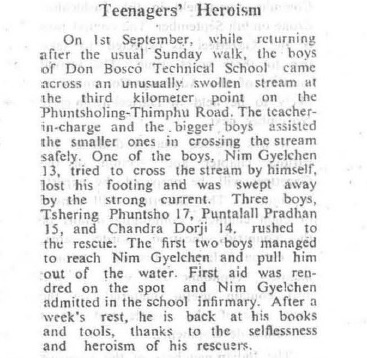
Kuensel 1968 Hero news
Kuensel 1968 – When we celebrated heroism


BBS Days 4
2004 – Production meeting with producer, Tshering Choden, and Cameraman-Editor, Nim Dorji
BBS Days 3
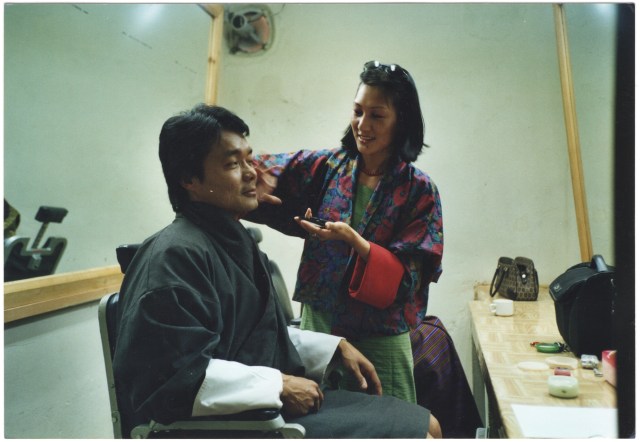
2005 – Tidying up before the studio shoot. Tashi (make-up artist) used to joke that there was a limit to how much she could make me more handsome.


The King of Humility

31760036_10160450423735714_6798472864908443648_n
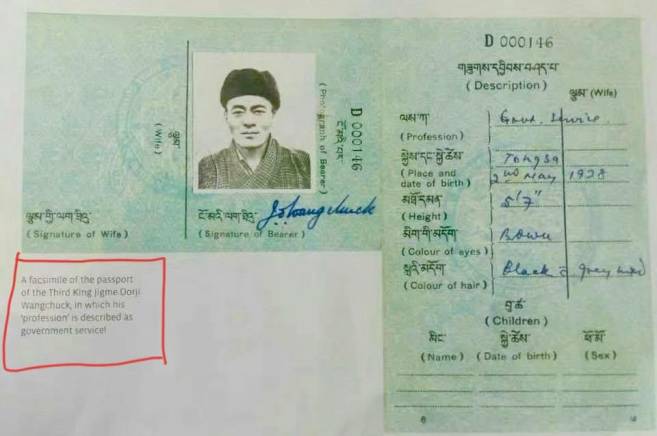
Passport of His Majesty the Third King

May 2, 2018 – Today is the birth anniversary of the Third King, Jigme Dorji Wangchuck, – the Architect of modern Bhutan. I never saw His Majesty – but heard countless and beautiful stories from my father – who briefly served as his chauffeur.

This one is my all-time favourite.

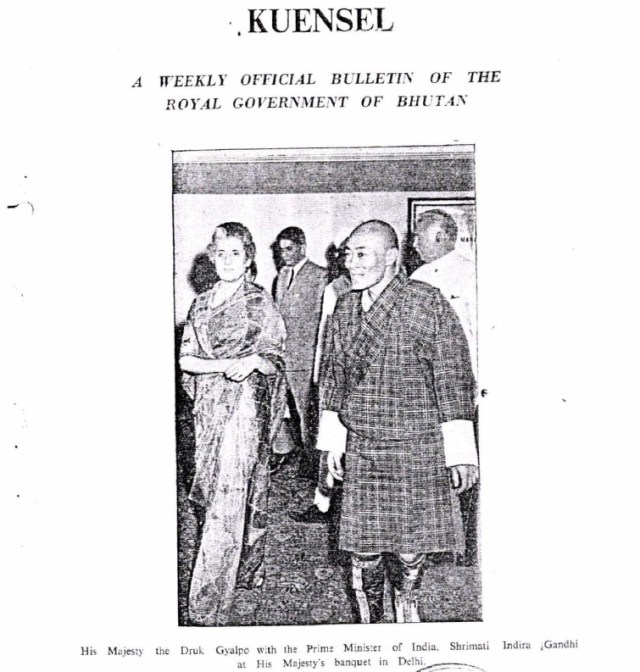
His Majesty the King wore mathra namza (red-patterned traditional wear) – most of the time. Apparently, he had very few of them, which he wore over and over again. He was never into pomp or personal property – preferring to live a very simple life in a cottage by the river near Tashichho Dzong in Thimphu.

On one of his State visits to India, the Indian minister-in-waiting noticed that he wore the same pattern of namza every day. So on the third day, the official remarked that the King must be really in love with the pattern. He asked the King how many of such ‘dresses’ the King had carried on that trip. The King replied that he had only one – the one he was wearing. The Indian official was shocked.

His Majesty’s humility and materialistic detachment were beyond that of a Bodhisattva. Another story that I uncovered, and have published before – pertains to the passport where His Majesty mentions his ‘profession’ as “government service” (picture above). This is a far cry from an argument that I overheard once at the Passport Office, where a young MP was gently demanding if his title, “dasho” or “honourable”, could be added to the passport. On many occasions when I was in the Bhutan Broadcasting Service, I was also thundered with angry telephone calls and visits by senior officials because the news did not mention their honorific titles.

As we celebrate the 90th Birth Anniversary of our Third King, Bhutanese people should reflect, at times, on their own demands and desires, which often are at the expense of the State treasury. There is so much craving for bigger pool vehicles, grander offices, lavish official dinners, foreign travels, etc. If His Majesty’s legacy and reputation are of any lesson to us, it is that such things don’t really matter in our performance. One’s humility and intents to genuinely serve might be able to generate legacies that are worth remembering. If the Late King’s lifestyle is history, look at our Fourth King. HM is here, in front of us, showing the way. Recently, I saw HM walking near Dechephu with no bodyguards, attendants or vehicles.

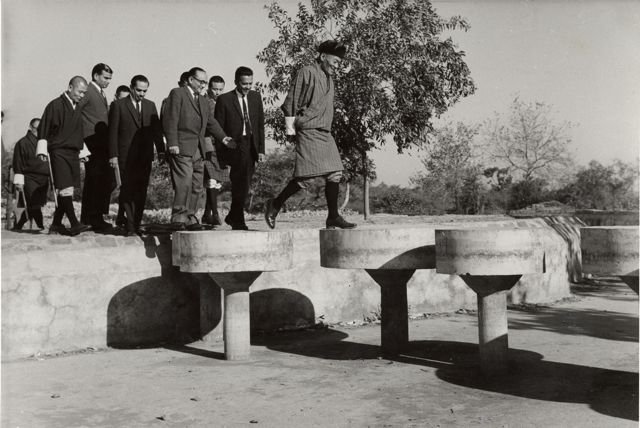
In the last photo below, the Late King is seen barefoot. According to Late Dasho Shingkar Lam, who worked as King’s Secretary, His Majesty when serving as Drongyer (Guest master) to Second King ate from the common mess with other retainers. He also took the blames and punishments on behalf of palace attendants who erred. His Majesty would tell then that it was better that He received them. He went about barefoot in the palace compound and vicinity – and, at night, slept on the hard doorsteps of the Second King’s chamber – with no blankets or carpets whatsoever to get some warmth. 

On this Teacher’s Day, my prayers and wishes are that our educators impart service and humility in their daily lessons and assignments – so that our next generation would be really humble, civil and simpler. Don’t just celebrate him. Emulate!

My generation, whether we like or not, is too old to learn new tricks.

Sorry.

*  (My father was a royal chauffeur for His Majesty – before he was commanded to drive for the Crown Prince and the Princesses. For the longest time he served HRH Ashi Sonam. He was later sent to BGTS by Ashi Sonam. My own entry into modern education happened as a result of a royal command that His Majesty passed to my father – “to put your children in school”. Otherwise I was headed and prophesied to be a monk)

Late King mathra gho
HM with mathra namza in Delhi, (source: Kuensel)
1916844_10150207173095153_2540428_n
HM at Gandhi Jayanti, Delhi, a must-stop for all State Visitors


1916844_10150207173090153_3661126_n
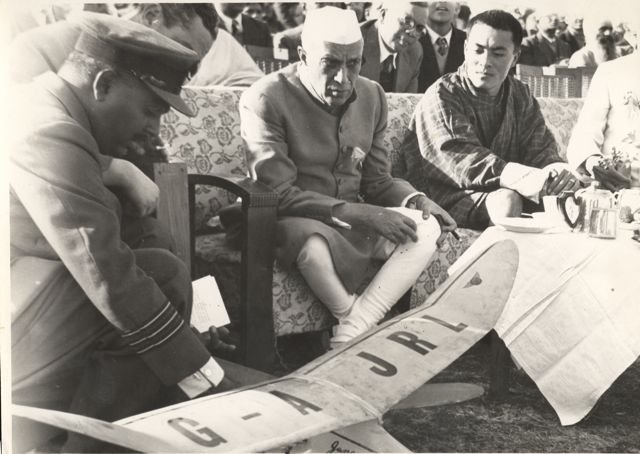
State Visit 1954, where HM is supposed to have invited PM Nehru to Bhutan
34219_10150209248665153_7715122_n
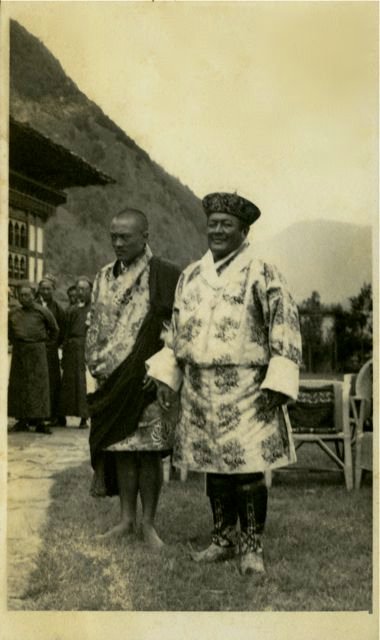
Notice that as other retainers he wore no shoes


Those naughty boys

(On the eve of the Teachers’ Day, I repost an article I wrote long time back to celebrate my life as a student, which brings back memories of my school, college and teachers who shaped me to who I am today.)

As a student in Dewathang Polytechnic in the early eighties, I was the eternal third in my class. One Indian lecturer who was very fond of me would keep repeating, “If only you gave up your sports and other distractions and be more regular with your attendance, you will come first! And you have to stop being naughty and stop going around with those naughty boys.” 

Naughty boys?

We may have been mischievous or naughty, no doubt, but we were never vicious, violent or crooks or criminals. We had fun – so much fun. It was part of growing up. But we never hurt others or ourselves – physically or emotionally. We were only adding colors and spices to the otherwise monochromatic life of Dewathang – that consisted of long and boring lessons of endless calculus and calculations, not-so-bad practical workshops (I liked them better) and an unpredictable weather (I hated this the most). In doing so, we kept everyone happy in our vicinity. We induced wholesome education on ourselves by organizing class picnics, archery matches, sports meets, chicken hunting, eating competitions, film nights and trekking expeditions. During annual concerts, we would entertain the whole town. Namgay Retty would be at the drums, Sonam Wangchuk was good with his guitar and Dorji Namgay and Phuntsho Wangdi (Kado) would croak some Beatles numbers and I always thought I was better than Kishore Kumar and Elvis put together. As we often rumbled the hostel room, Tshering Nidup, Deepak Kulung and Dawa Penjor would be our only audience clapping and joining in occasionally for the chorus. Then one by one the whole hostel would be in our room until the warden would come and issue another “last” warning at midnight. Our captain, Rinzin Namgay, would get reprimanded for not stopping us. We would appease him by promising to talk good things to a girl he was courting and who later became his wife. They are still married. 

We were all broke most of the time although we received a pocket money of Nu. 20 per month from the government. With that we would make the best use. Our night-outs would sometimes be walking 22 kilometres to Samdrup Jongkhar and then walking back after watching the night show. We felt a misplaced sense of achievement to be able the sneak out and sneak back unnoticed. You can never cage the youth. Their energy far outstrips any rules or regulations. It is biological – not about being illegal.

Being fit more than a fish 

And like all boys of our time, we were martial art enthusiasts and fans of Bruce Lee. We took to Karate from an Indian master with, of course, pathetic results – except for Dorji Wangdi, whom we still call Bolo (from the character in Enter the Dragon). He was good. But our Karate lessons got us out of our bed early. It helped boost our physique and self-confidence, especially with the opposite sex, and no one dared mess around with us. And me, once, pursued by an angry villager, after a routine raid on his orange orchard, I discovered that I could even run fast. So when the annual sports day came, I went on to set few short distance records to the amazement of the college cook who became my fan and served me with bigger portion of food. I was always starving back then.

Student_Dewathang_1985Dorji Namgay was the undisputed table-tennis and badminton champ and together with Sonam they made up the doubles team. He was also a good footballer and with Tshering, Deepak and I, we were probably the best defense the college football team had ever seen. Even teams from Assam feared us. Namgay was always in the first six of the volleyball squad and also played the spare goalie and did all the fights with the referee. Dawa was the top basket ball player – and never missed a lay-up – and a marathon champ.

We studied too

Of course we did attend classes too – to meet the attendance requirement. But we were more interested in things that would be more useful for us as practitioners in our professional life. And if there was something we really hated was what those so-called “good” students were good at – rote learning every lesson (at times without understanding the meaning). Those “good students” would never argue with teachers and would be submissive at all times. We couldn’t take that either. But our system, however, was on their side. Because they could reproduce ad verbatim what was being taught, they scored higher marks and were commended. They were often referred to as “tip top” students. Whereas we were classified as “the naughty boys”, because we often asked too many questions or pointed out too many calculation mistakes made by the lecturers on the blackboard. Later as a university student in Italy we were mandated to ask questions. In the West a questioning mind signified urge for knowledge and intellectual growth. It was a culture shock that I had to overcome – and I did.

When lessons got boring, Namgay, who was a gifted artist, would sketch the lecturer – instead of taking notes. He would pass around the khaini supply for the day. Dorji and I would blow up test tubes and create explosions in the chemistry lab to the point that one lab assistant was specifically deputed to keep an eye on us. But weren’t we told to “experiment” or to try out new things? And Deepak would always copy my test results that after a while I starting making two sets of lab notes: one for him and one for me.

When the day ended, Kado, Kumba, Kharka and Mukti often came to my room to revise the lessons. I would have understood what the lecturers taught. And in making them understand too, I realised much later, that it was better than studying alone. Those days I was only trying to help my fellow classmates. Good begets good. And not everyone learns at the same pace. As a return favour, they would support me by bunking the class en masse, when the teacher was not on time – even by a minute. The good students would sometimes try staying back but we would bully them out somehow.

Breaking the norms and conventions

While the good guys followed every norm, we questioned, gave suggestions and deviated from all conventional wisdoms. In fact when we made to the senior class we made sure to mingle with our juniors and to party together. We often skipped classes to go swimming and fishing by the river. We visited all the houses and temples in the college vicinity, trekked to far off villages like Orong and even hitch-hiked all the way to Shillong in India. We ventured into new territories and we made new friends (but not babies). Such experiences as students made us less cynical of other people as we grew older. Human management and public relations became our second nature. Our mental horizon was always open to accommodate more options, seek more opportunities and explore all possibilities. Finally when we got employed, we opted for jobs and careers that best suited our aptitudes and our strengths rather than yield to peer pressures. We were always ready to experiments – but without causing explosions this time.

Life, I guess, is like a video game. As years roll on, you move to the next level. As students we had our time. Then we moved on to the next phase. Those “good students” remained what they were – as good students. More than two decades and half later, most of those “good” students haven’t made anything much with their careers. The “naughty” boys instead faired little better. The world changes so fast these days. Existing conventions and solutions do not address emerging problems. You need to grow out of them – not try constricted inside.

Dorji Namgay went on to become one of Bhutan’s first hydropower engineers – leading and successfully building the Basochu Project phase II in a record time. He worked as the managing director of STCB and managed to turn around a company that was given for dead. Namgay went on to do masters in architecture in Australia and after completing his obligation with the government he has now become a “tip top” filmmaker, animator and consultant architect. He has received four national film awards including two times for the best director. Tshering is the district engineer in Monggar and Phuntsho a divisional manager in the BPC. Sonam made a name for himself by building Thimphu’s only sewage line. And Dawa Penjore became a successful businessman in Trongsa after a short stint in the government. We lost Deepak but I am sure wherever he is he would humming some Cliff Richard number.

Rolling stone gather more moss

As for me, I am the one who made more experiments with my career – as compared to others – from engineering to documentaries to journalism and to managing the media relations for His Majesty the King – and finally entering the world of teaching and research. 

They say ‘a rolling stone gather no moss’. But I say that a rolling stone gather more moss. Be that stone.

If I could relive my life, would I do all these again? You betcha!


The original article was published in Bhutan Times and was later posted on my previous blog in 2010 http://dorjiwangchuk.blogspot.com/2010/04/those-naughty-boys.html


Don Bosco boysIV copy
Bottom L-R – Kencho Tsheten (Executive Engineer, His Majesty’s Secretariat), Nagphey (Executive Engineer, Thimphu Thromde), Chencho Tshering (Joint Managing Director, Mangde Chu Power Authority), Standing L-R – Thinley Wangchuk (Principal of Zorig Chusum), Kado Rinzin (Businessman), Yours Truly (Wanderer of the Space)

Eastern Bhutanese wedding joke

University of Macau, April 2018 – The module is Qualitative Research Methods and the class is undergraduate studies in communication. One group, mainly composed of Chinese students from Macau, decided to choose the topic of Bhutanese wedding culture as their mid-term assignment, and so I put them in touch with their peers in Sherubtse College. Several emails back and forth and Facebook messengers later, the assignment is turned in – done very well, following all the steps and tools of the qualitative methods.

One of the findings reads:

“In Eastern Bhutanese, they only had a bottle of Ara with the couple and then finished the wedding, it was pretty simple.”

As an Eastern Bhutanese I couldn’t help laughing at my wedding culture, which is true. And I will laugh whenever this line comes to my mind

cof
This group is presenting on online dating apps – a comparative analysis
dav
Eastern Bhutanese in Macau 🙂

Of Sungkeys and security checks

IMG_20180427_142200_117

Sungkeys (literally meaning Protection Chord) are amulets, lockets, objects or simple chords and strings that are blessed by high lamas and are believed to protect you from danger, misfortunes, bad dreams, obstacles, envies, natural disasters or tragedies. You wear them around your neck.

The Guru sungkey (on the left) was given to me by late Khenpo Karpo after I helped him develop print leaflets – when he launched Oddiyana Foundation, way back in 2004. It came with a warning that it should not be touched by anyone who smoked – lest it loses its jinlap (blessings/power). The right one is obvious. I received it in Tangmachu in 2009 during the Royal Tour to Lhuentse. 

My sungkeys have travelled with me across the globe – unhindered and unquestioned. Not even when I was passing through Islamic countries such as Qatar or the Christian Orthodox city of Bucharest – or even in the Evangelical heartland of Dallas Texas, did anyone cast a doubt or raised questions about them. In Bangkok, one security guy even sought blessings on his head from the one with our King.

Ironically, in our Vajrayana Buddhist Kingdom of Bhutan, an airport personnel was almost grabbing them after the hand-held metal detector wand beeped while passsing over my chest. I instinctively slapped his hands away and pulled them out myself from behind my shirt to reveal what they were. More surprisingly the security went again, “What is this?”. I replied, “Whaaaat?” (In Dzongkha). I was totally speechless.

I have no idea whether it was the arrogance or ignorance that he was displaying. Someone said, it may be both. I thought mine was a stray incident and didn’t bother to even remember it until I saw another similar (mis)treatment that was posted on Instagram – thankfully by a Bhutanese and not by a foreigner. Apparently, he was asked to take them off and put them on a tray (even shoes go here) and run them through the X-ray machine.

Key takeaways:

1. Sungkeys are VERY personal items and can turn off people if you touch them or show any disrespect. Some sungkeys like tshenthups (I don’t have one) cannot be touched by others – other than the wearer. It is believed you cannot even go to toilet with them on.

2. If you don’t want to come across a clueless airport security and a potential desecration, I suggest removing them and putting them safely inside your bag before passing through the X-ray.

3. Be careful not to wear or carry animal parts such tiger fangs or ivories – or bullets, as sungkeys or as prayer beads, if you are flying out of Bhutan. These are prohibited items – and carry hefty fines and even jail sentences in some countries.

4. Our airport authority and law enforcement agencies may want to look into this incident and update their SOPs, if necessary. They should not relax the security, obviously, but they need not be draconian or illogical either. There are ways to do a good job. Sungkeys do not pose security threats. Their purpose is to achieve the opposite. That way, I found the police at Tashichho Dzong more civil.

5. And lastly, our people should be careful not to touch people’s bodies and personal items indiscriminately. Otherwise it won’t be long before a visiting tourist slaps a million-dollar lawsuit for (sexual) harassment and defame the whole country. The global #MeToo movement has made the ultra-sensitive westerners more sensitive now. 


Footnote:

– Please pass this message around. Hopefully my fellow parents will talk about this important traditional practice to the children. If you are a teacher, please share this with your students. Please do 😢😢😢

– My elder daughter recently complained of getting nightmares and bad dreams for days. I told her to wear the Yidam Tandrin sungkey which I had bought for her. She did and from then on she slept better. Coincidence? Maybe. But why be distrustful?

–  This issue might look trivial but there is no use of talking about big things such as cultural preservations or wholesome education if people don’t even gets these basics right


Bennett editorial cartoon

00BHUTAN3-master675

images (4)