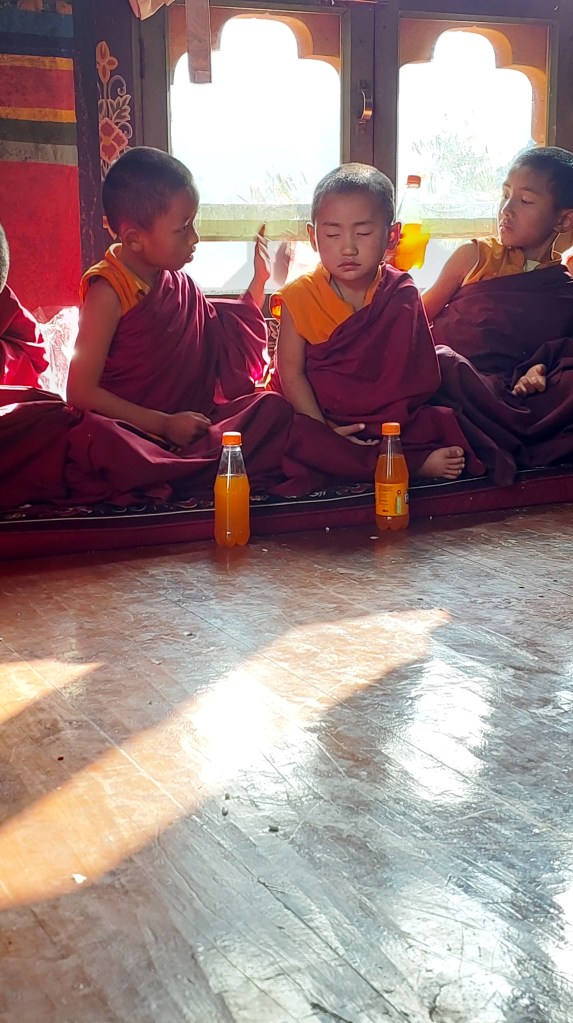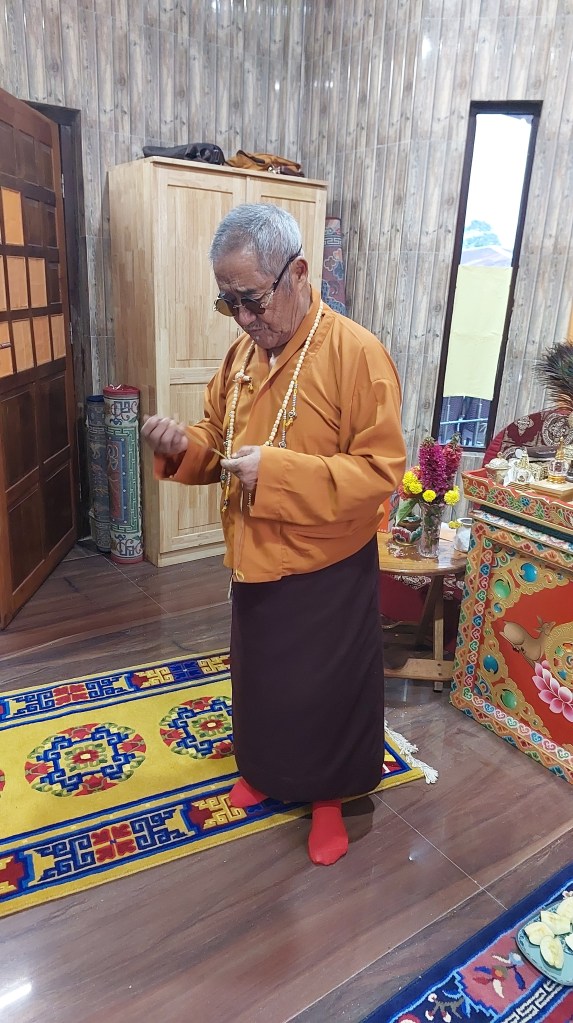
“Choeken Gyalpo (Yama – the Lord of Death) is calling me for a meeting,”. Togden Jigme Chogyel, popularly known as Rangshikhar Rimpoche, tells me with a mischievous smile.
“It seems Guru Rimpoche has submitted a complaint that I have been living off people’s wealth and hard work for far too long,” he adds.
“I think Guru has a point,” I tell him.
We laugh. He blesses me.
I have always loved being in the presence of this holiest of men, who is our family lama for four generations. The first time I met him was 40 years ago, freshly out of school. In between his classic humours, in all these years, he has taught me many things. Once he explained to me the meaning of OM AH HUNG. It took a whole afternoon. And I forgot most of the things he said.
Another time he elaborated on the word, Lama, after which I use this word more than “rimpoche” (Precious One) to address Buddhist masters I respect.
He has also been very precise with divinations. In 1983 he told me to be careful in the month of February. That month I fell off a speeding truck, only to miraculously remain clinging with one hand, and stay alive. My paternal uncle wasn’t as lucky, or he didn’t take seriously to the words of this lama. He died.
This time, with his joke on the Meeting Call by Yamaraj, I guess he is subtly reminding me, and everybody, to earn what we consume, and not to live on someone’s hard work. It is a strong Bhutanese belief that seems to be waning.
His jokes are always a words of wisdom, if one can care to take them seriously.
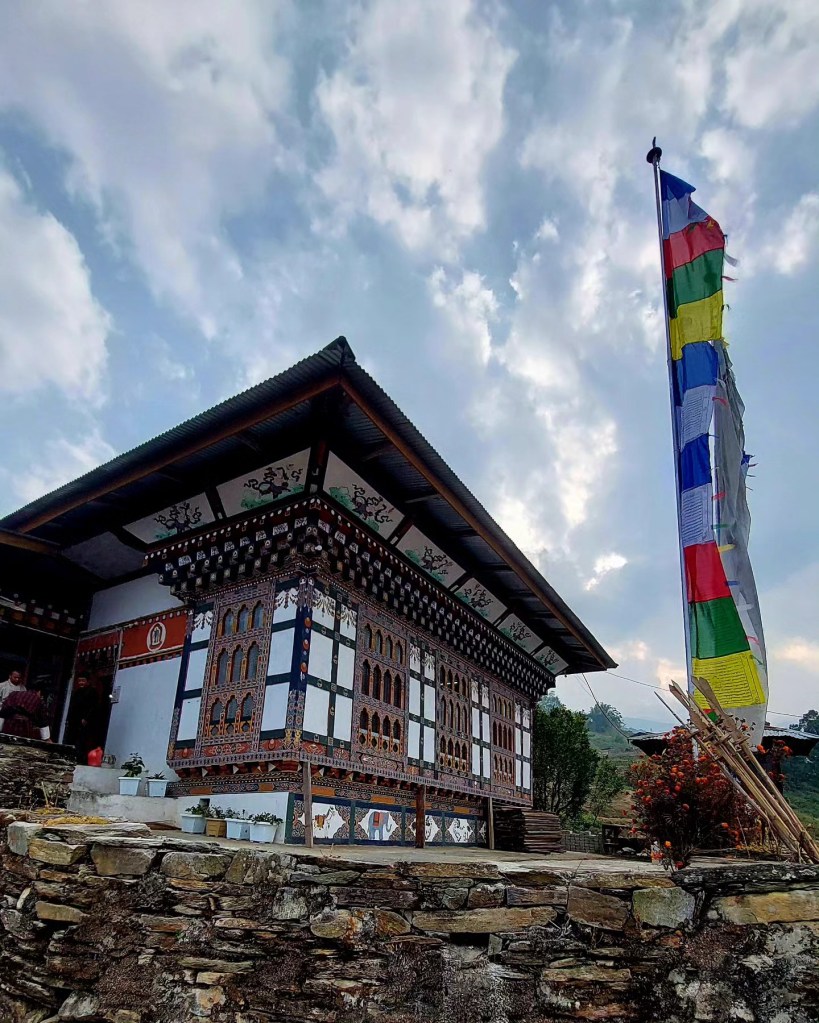
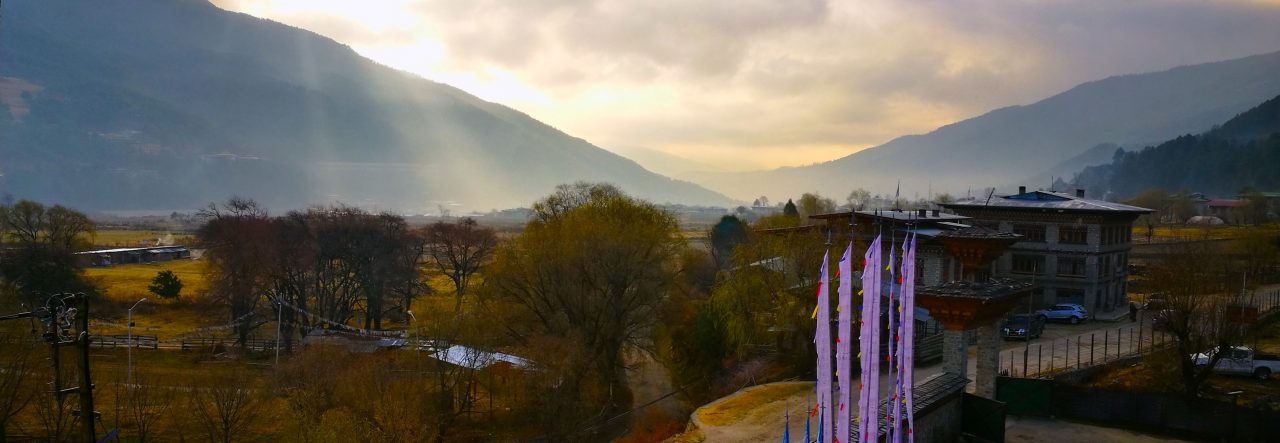
This unassuming temple, located right in the middle of Paro Town in Tshongdue, rarely gets a visitor. The caretaker was surprised I had come in. And yet, this place played an important part in Bhutan’s history. It hosted Zhabdrung Ngawang Namgyel when he first landed in present-day Bhutan in 1616.
While Zhabdrung was forced out of his ancestral estate in Ralung in present-day Tibet, Buddhist practitioners believe it was pre-destined. This is evidenced by the fact that for centuries preceeding him, his ancestors and lamas from the same school established seats of Drukpa Kagyu in Bhutan – thus preparing for his eventual arrival. The key figures among them were Lam Ngawang Chogyal, Kunga Penjor, Phajo Drugom and the divine madman, Drukpa Kinley.
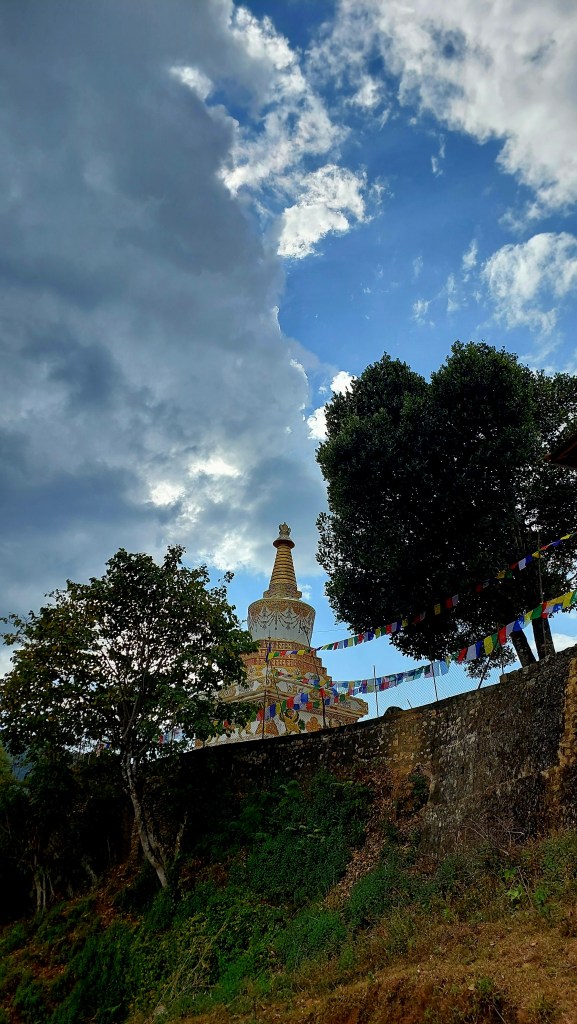
Druk Choeding was one such place, and it was established by Lam Ngawang Chogyel in 1525.
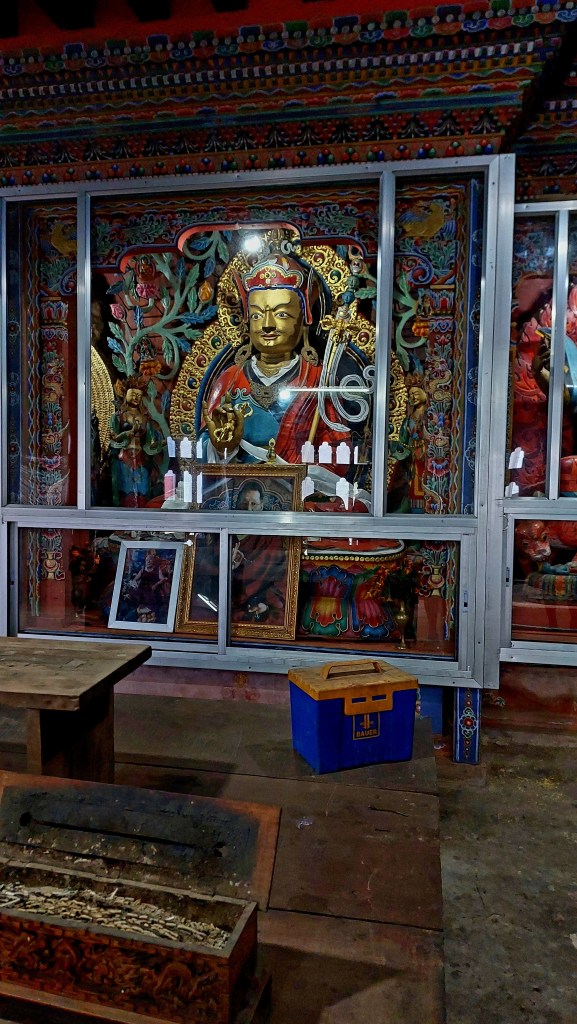
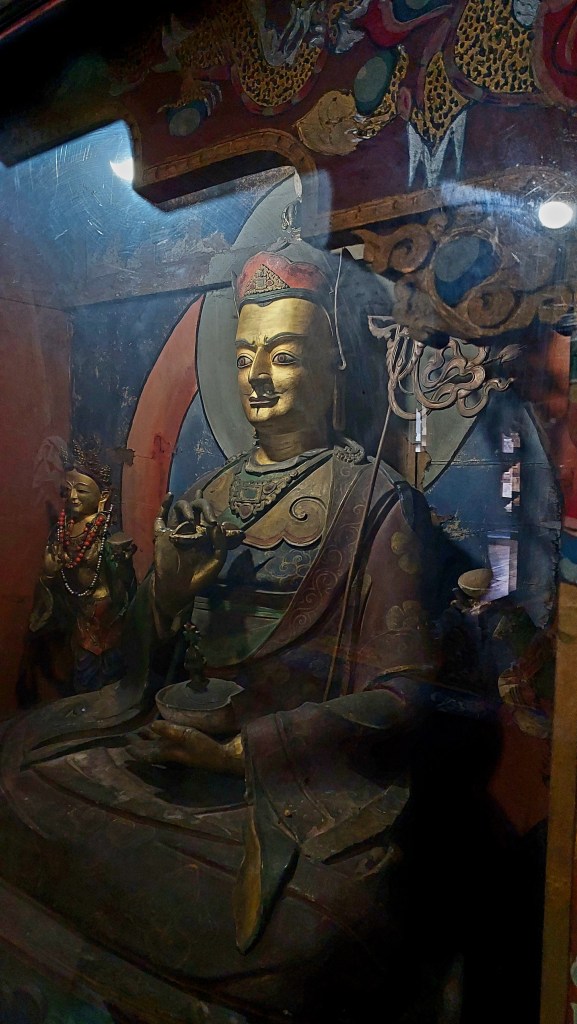
The centrepiece of the temple is Maitreya Buddha (the caretaker insisted it is Buddha Shakyamuni) and there is also a large image of Buddha Avalokitesvara. Smaller statues of Lam Ngawang Chogyel and Zhabdrung Ngawang Namgyel can also be seen on the altar.
On the right of the main altar is a smaller corner dedicated to dharma protector Aap Gennyen Jakpa Melen. He is believed to have appeared in human form, at times, and served Zhabdrung Ngawang Namgyel. His main abode is in Dechenphu in Thimphu. As Zhabdrung had just arrived in Bhutan it is possible that he followed him to Paro on the maiden visit.
Druk Choeding also plays a significant role in Bhutan’s history as the site of the first Tibetan invasion. In fact the Tibetan ruler Tsang Desi, who was responsible for Zhabdrung’s exit from there, sent an army to capture Zhabdrung. This temple was sieged but the local followers of Zhabdrung whisked him out to Drela Dzong before the Tibetans attacked.
The locals led by Zarchen Choejey and Hungrel Drung (the descendants are still alive today) raised a militia and managed to drive out the invading forces.
Today the place sits there, alone but intact. Right outside the gate people are scrambling for a parking slot, but everyone is heading towards the vegetable market.
The National Memorial Chorten is one of the most popular landmarks in Thimphu, where thousands of people visit every day. More visit during religious events presided by important lamas and rimpoches.
Many residents in Thimphu make it an evening routine to circumbulate it, an act which is believed to be a skillful means of practicing the Buddha Dharma without reading the scriptures. You just walk around it in clockwise direction. Interestingly, not many people have visited it inside, and very few people actually know or appreciate the full significance of this monument.
What it represents
The Memorial Chorten is the most sacred monument, built by the holiest of men of our time, patronised by a Queen Mother, and built in the memory of a dharma King.
Unlike other stupas, this one has temples built on all the three floors. The first floor is dedicated to powerful deity Dorje Phurpa (རྡོ་རྗེ་ཕུར་པ་, Vajrakilaya) and its retinue. The Vajrakilaya pratice is believed to embody the enlightened activities of all the Buddhas. The deity, Vajrakilaya, is considered as the wrathful form of Dorje Sempa (Vajrasattva) and is known for removing obstacles, and destroying the negative forces, obstructing the practice of compassion. Hence, one can make a wish here to clear one’s hurdles in life, as one embarks on the journey towards Bodhisattva, or one can seek to clear any obstacle standing in one’s way in a new venture.
This Vajrakilaya teaching was taught by Viyadhara Prabhahasti to Guru Padmasambhava, who practiced it in Yanglasho in Nepal, and concealed it thereafter. It was later revealed by Chogyur Lingpa (1829-1870).
The second floor has Ka-gye (Eight Great Sadhana Teachings), which was revealed by three tertons at different periods – Nyang Ral Nima Oser (1124-1192), Guru Chöwang (1212-1270), and Rigzin Godem (1337-1408).
The Kagye teaching is represented by the eight principal deities – Yamantaka (Dzongkha: Jampal Shinje), Hayagriva (Pema Sung), Vishudha (Yangdak Heruka), Mahottara (Chem Chok), Vajrakilaya (Dorje Phurba), Matarah (Mamo Botong), Lokestotrapuja-natha (Jigten Chotod) and Vajra Mantrabhiru (Mopa Dragnak). These eight deities represent the five wisdom deities of enlightened body (in Dzongkha, ku), speech (sung), mind (thuk), qualities (yönten) and activities (thrinley) of the Buddhas, plus the three worldly deities.
The third floor is dedicated to Lama Gongdu teachings, which literally translates as the Unified Intents of Gurus – a terma teaching revealed by Sangye Lingpa (1340-1396), and which is one of the most important texts in Dzogchen tradition.
All the above teachings, representations, symbolisms are from the esoteric termas that were believed to have been hidden by Guru Padmasambhava, and later revealed by tertons (treasure revealers) in the mediaeval and early twentieth century.
The construction
Aesthetically and architecturally it is the most perfect Jangchub Chorten (Stupa of Enlightenment) – one of the eight styles of stupa in Tibetan Buddhism.
The chorten was designed, and the construction supervised, by lama Dungse Thinley Norbu Rimpoche (1931-2011). The legendary yogi, lama Sonam Zangpo (1888-1982), is also believed to have been closely associated with the project.
The chorten was built under the royal patronage of the Second Queen of Bhutan, Ashi Phuntsho Choden (1911-2003), and was built in the memory of Third King Jigme Dorji Wangchuck (1928-1972) – hence the name National Memorial Chorten. It opened in June of 1974 – coinciding with the Coronation of the Fourth King.
The consecration ceremony was presided over by Dudjom Rimpoche, Jigdrel Yeshe Dorji (1904-1987), one of the greatest scholars of Vajrayana Buddhism of the twentieth century. He was also considered as a terton. Infact, his works form the basis of the Dudjom Ter-sar (New Terma of Dudjom) movement in Buddhism.
Despite not being ancient, it is still the most sacred stupa in Bhutan because of the powerful Vajrakilaya representations, and other powerful deities and teachings. Furthermore, according to different sources, many antiques and relics are buried in each floor as nangten. This makes it a wish-fulfilling and obstacle-clearing stupa to assist devotees with mundane issues.
Above all, the stupa receives thousands of prayers, and the presence of ordinary and extraordinary people, thereby accumulating millions of moelams of aspirations and blessings. Simply put, it is not just another monument.
It was a nice nostalgic evening sharing my journey into discovering and bringing the wellbeing curriculum to Bhutan.
The journey took me to Kanglung and to remote Silambi in Bhutan, and then to UC Berkeley and Yale in the US, and now we are now in Paro – in the valley where it all started in 2015. Our team has creeped into 40 schools and educators, who really believe in the future of education of the Bhutanese children.
Our country, and the world, are going through post-pandemic depression and economic recession. In Bhutan there are people leaving for foreign shores, a government that is caught off-guard, and a society that is not only condoning such a phenomenon but also encouraging it. All is not well, it seems.
Wellbeing initiative is a cure, I believe, albeit a slow one like every good thing in life.
I cannot save the country – or the world, but I am reminded of a Jewish saying, “He who saves a man, saves the mankind entire”. From the stories that were shared in the evening, there were two whose lives were altered for the better after learning of the wellbeing programme.
So, we keep going
(The last picture is the 2015 GNH Conference where the concept of GNH as contentment was proposed)
Tshog-kor (the full form is tshog kyi khorlo) is not a simple food offering but a profound and ritualised feast dedicated to a specific Vajrayana deity.
Thus Tshog Offering creates a sacred ritual space to practise higher tantras and, furthermore, the formation of a community and group practice. Literally Tshog-kor means “Offering in a Circle”.
The main goal of performing it is to gather and accumulate merits and wisdom and to maintain and restore the commitment to the Dharma. This is believed to help with better rebirth in a place of peace, prosperity and fortune.
In everyday parlance we say a person has accumulated merits (tsho-sa) to refer to a prosperous and fortunate person. We also wish someone generous to be reborn again as a tsho-sa person.
Lastly, there is saying, Lha-Dre-Mi-Sum choe lam chi, (The three beings – deities, demons and humans have the same behaviours) and hence in Vajrayana we often seek from the deities and the demons (this beings to stay away from us), we also need to reciprocate their favours by offering our gratitude.
Tshog-kor is just a gesture – a thought, in the simplest of explainations.
Therefore the most important aspect of Tshogkor is to make prayers of aspiration (moelam) and dedicate the merit for the benefit of all sentient beings.
“Waktsa rey, soenam rey”, my late mother used to say. It means every child brings a fortune to the house.
My mother practised what she preached. All my village cousins were raised and educated by my parents. Plus I have many adopted siblings from Yangtse, Pema Gatshel, Rangshikhar, Khaling, Radhi. They were children who were all raised by my parents.
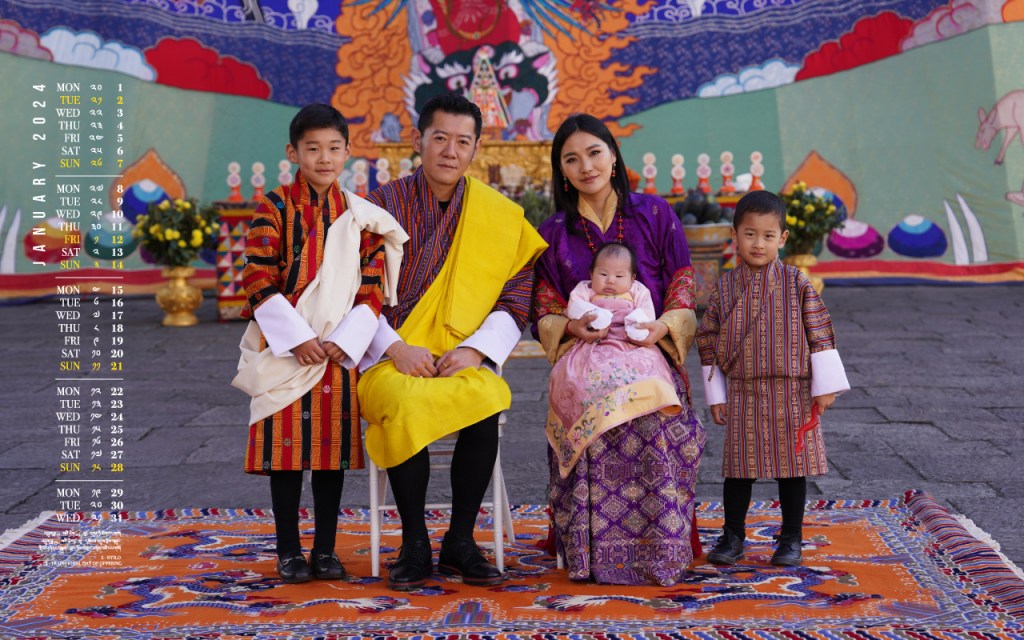
I have no doubt that the birth of the Royal Princess to our King and Queen will bring another fortune to the house (in this case the country).
So it is time to hope again, feel alive again, and live again. The pandemic years were frightening and stressful. The post-pandemic years have been depressing. Let’s all collectively say a prayer so that this Daughter of Ours restore the sense of purpose, community and country that seem to have diluted in recent times.
A collective moelam can move a nation on its right path.
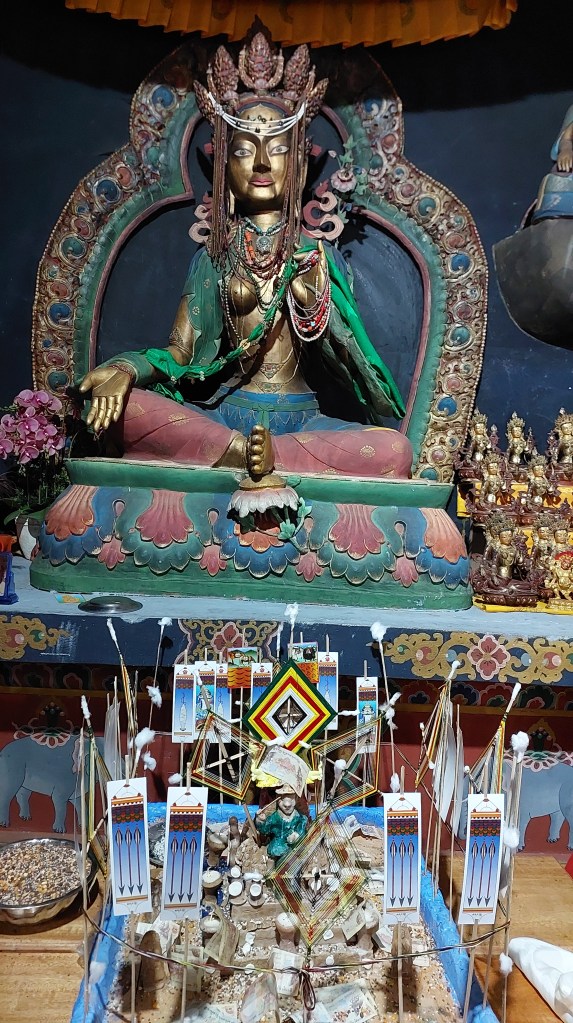
(Join in physically and virtually for the Green Tara Offering at Memorial Chorten from 23 to 26 September 2023)
The Death Railway (the official name is Thai-Burma Railway) is a historic 415 km train line between Ban Pong in Thailand and Thanbyuzayat in Myanmar. It was built during World War II in 18 months by the Japanese Imperial Army to supply troops and weapons at the Burmese front that was pushing towards South Asia.
The word, Death, was a nickname that came from the fact that over 110,000 people, between civilians and prisoners of war, died building this railroad – mostly because of maltreatment, malnutrition or malaria.
The story is immortalised in the Academy-winning film, Bridge Over River Kwai, 1957, directed by David Lean with Alec Guinness in the lead. The bridge in question is still in use and is located at Kanchanaburi – some 100km west of Bangkok.
The Death Railway was destroyed by Allied bombing towards the end of the War, and today a short section between Bangkok and Nam Tok still runs nevertheless. It attracts locals, and historians and tourists alike. For many visitors it is pilgrimage to the grim reminder of human history, of atrocity and tragedy and the futility of war to resolve human problems.
Of late, the Death Railway and Kanchanaburi have become the site of reconcilliation where the deads are remembered and the heroes celebrated. Former foes come together to own the past mistakes and learn to build a better future free of such human tragedies.
There are two trains that run daily. The train is still driven by the old locomotive system and the station that it kicks off from is the Thonburi station on the west banks of Chao Phraya river. The train stops more than it moves, and passes over the historic bridge over Kwai at Kanchanaburi. It then snakes along the tracks carved out of the hills towards Myanmar border.
The ride is free for Thai people, while foreign visitors pay a flat 100 Bahts irrespective of which station you get off, or get on. The fare-paying visitors can have a dedicated carriage with better seats.
The section between Kanchanaburi and Nam Tok is the most interesting part.
I am because we are – so an Ubuntu philosophy goes on the ontological question of who am I. This identification of one’s personhood with the society is closer to us, Asians, than the classical statement, “I think, therefore I am” as enunciated by Rene Descartes – the 17th-century French philosopher.
In Bhutan, we also have the moelam, which is a concept similar to karma but with a greater human agency to make things happen, instead of the simplistic good-begets-good, which at times is a bit fatalistic. In Bhutan, we say that we are, and everything is as it is, because of our moelam.
The beauty of moelam is that you have the power to change its course. In fact, moelam means “aspiration path”. You can aspire for anything – both good and bad. (Check my blog post on moelam)
We thrive as a community. We survived as a community. In the early prehistoric times, our ancestors fought off wild animals that were bigger, stronger, faster, and taller simply because we worked in groups.
Modern technologies, such as planes, trains, the Internet and smartphones, have shrunk the world. In the words of Tom Friedman, the world is flat. We have multiple ways to connect and to stay connected. Yet, people feel disconnected, lost ,and isolated. In many countries suicides are on the rise, and mental health has become a public health issue.
So, it is heartwarming, and feels hopeful, when over 70 strangers converge in the jungles of Bali and in less than a week feel an instant connection to each other. This is the fourth time I have been witnessing this. It is not a one-time wonder.
Maybe all is not lost. Maybe we can feel alive, safe, connected, and loved and we can exude our best without the fear of being judged or misunderstood when we are in the right community.
Do you have such a community? If not, I invite you to move out from the current herd and find a new one because there will always be a group that will welcome you, love you unconditionally and let you be who you are.
Being in the right community, the right organisation, or the right company is important for one growth and potential. Just as no flower or plant will grow well in a bad environment, every human needs, and deserves, the right one to flourish.
And of course, if you can’t find one you can also build one.
I am back to Bali for the fourth time. And a thought struck me, what attracts me to Bali? Spoiler alert: it is not the beautiful beaches.
Bali is world-famous for its stunning beauty with its lush rice terraces flanked by cone-shaped volcanoes, which all exude peace and tranquillity. The colourful festivals and daily ritual connect people to the divine and the supernatural like no other place on Earth. The big ocean waves make Bali the surfers paradise.
Nonetheless, what really attracts visitors back again is none of the above. It is the ordinary people that are the biggest magnetising force of Bali. With their genuine, warm and welcoming attitude to outsiders, every visitor finds himself or herself feeling like a local, or as adopted into the family. I have mine too in Danu and Ketut, who own and run the Danu Guest House in Ubud.
In Bhutan, we often talk about our unique culture and unspoilt nature as the selling points. Yes, we have some colourful traditions. So do other countries – and each culture is unique in its own way. We have high Himalayan mountains, for sure. However, the peaks in Nepal are taller, while many in Switzerland are even more gorgeous. As for the unspoilt nature, tropical rainforests in our own neighbourhood are bigger and as pristine.
Then, what will make travels to Bhutan really memorable will be the people – the guide, hotel staff, locals in the streets and in the farms. It will be the spontaneity of our ordinary folks – the human element – and our genuineness. As the tourism industry undergoes fundamental transformation I hope the project leaders are not only focussed on the tourism industry itself, but the larger socio-cultural changes and traditions and any effect or impact from other sections on them.To get to the point, we should be careful of the mindless rules, myopic legislations, and knee-jerk public policies that are often implemented with little or no regard for the socio-cultural nuances. Any policy or regulations have wider socio-cultural effects than just addressing the problem they are aimed at. Sometimes they have a corroding impact on the very fabric of our society. For instance, the recent rule forbidding borrowing money was strange. In a community where we share everything, where we are encouraged to be altruistic, suddenly the rule forbids us from lending money to someone. The other rule, which has been now suspended but not repealed, is about the ban on feeding stray dogs. This is cruel and un-Buddhist to say the least. When did we become so heartless?
It is these small straws that will ultimately break the camel’s back. It is these things that our authorities should be watchful for – instead of being enamoured or enraged by a social media influencer or a blogger who speaks the truth.
We must never forget what is our collective essence – the narrative that makes Bhutan. It is the people – the real gem, as our King often told us in the national day addresses.
And so is Bali. The people are the undisputed gem. Whenever I have firmed up my dates for the Bali trip, Danu and Ketut are some of the first people I contact because I feel not only welcomed there but also loved and cared for. And then there is Shiwa Rudraksha from where I buy all my gifts of corals. And Mrs. Preme who runs a warung (dhaba). Plus all my Bali-planted friends from other countries like Dan, Lisa, Kristina, Robin and Scott.
Referred to as Chenrizig in Bhutanese, and Avalokiteshvara in Sanskrit, this Thousand-Arms-Thousand-eyes-Eleven-Face deity is my favourite because of a very beautiful background story.
Eons back, a man vowed to end the sufferings of all beings in the universe. He asked the divinities to make his head explode in case he failed in his mission or if he gave up.
As months turned into years and years into decades, he saw more suffering. He persisted but more miseries appeared everywhere and they only multiplied. The world got worse instead of getting better.
Totally exasperated by the hopelessness of his mission, he gave up. Almost instantly his head exploded, as he had wished, and he died.
All along, however, Buddha Amitabha was watching him. When he saw the man dying he called a meeting of all the 33 divinities and told them that a person of such pure intention should not be let to die. He asked the divinities to donate their avaatar (head), and contribute their eyes and hands, and bring him back to life and make him continue his mission. Buddha Amitabha lent his head. Other ten deities followed. Words went around and demi-gods and even humans donated their hands and eyes.
As an ultimate reward for his purest intention he became enlightened, and was also admitted to the ranks of a divinity.
This is the story of Chenrizig Avalokiteshvara.
The wisdom. The message.
As we come into this world, some of us are endowed with many heads. For instance, the brilliant and brainy minds of this world. Some of us are multi-talented, like having many hands, or can out-work anyone (I used to be this out-working guy). Others have the means to recruit people and pay them to do their work (do we say extra hands?). Some of us are visionary as if we have more eyes than a pair. These are all gifts that we should not take for granted, or waste them. We must instead cherish them and celebrate because not everyone is fortunate to be endowed with extra eyes, arms or brains.
Conversely, it is also how you view yourself. If you really believe it, or if you practise gratitude, compassion, empathy, and mindfulness, you will realise you have those extra attributes. Some call this the abundance mindset.
To put it simply, you have more power and influence than you think you have. You have more hands than just two. You have more eyes than just a pair. Use them to help a fellow human – or a sentient being, so that the world is a better place.
And if you feel absolutely helpless, just like any average person with no extra faculty whatsoever, I am always motivated by, and reminded to get into the smallest acts of kindness, by one line from The Schindler’s List – a line from the Jewish tradition:
“He who saves one life, saves the world entire.”
Love, light and contentment to all. May you work to alleviate the suffering of a fellow human