New Year’s eve is when many of the promises, which won’t be kept anyway, are made. It is the time when resolutions are listed as we get tipsy and sing the old year goodbye.
Here is a better proposition.
How about that we take a moment to reflect, ponder and be grateful. We simply take too many things for granted – good health, good life and good people around you. And yet, we know that not everything is the same for everyone on the planet. We are the fortunate ones, actually.
Instead of saying, I want to be healthy, maybe you ARE healthy, instead of resolving to be better, maybe you ARE good enough. And if you are thinking of striving, you ARE already thriving.
When you believe you are enough you feel contented. You enjoy the inner peace. You refrain from desiring for more.
So, at least the New Year’s Day, take a time to be grateful. If you look around carefully you will find hundreds of things you can, or should, be grateful for.
If you find nothing, don’t forget that you are still alive. Not everyone made it through 2023.
(Take a moment to list down 10 things you are grateful for. Write them down on a piece of paper. Fold it and keep it in your purse. Later during the year, when you are down, go through the list. And smile 😊😊😊)
(Picture: On a boat off the coast of Bali, Indonesia. July 2023)
Big and bold ideas are often perceived differently by different people. We make sense of the world and events based on our belief systems, assumptions, worldviews, interests, and on circumstances we grew up with. So, let me share my understanding of this most ambitious and important project of this era – the Gelephu Mindfulness City – a concept like no other.
Let me start by clarifying, what it is not? The proposed Mindfulness City will not be a futuristic metropolis like Dubai or Singapore with megamalls and skyscrapers. The new “city” will be spread horizontally over a large area of 1,000 square kilometres. Farmland, heritage sites, biological corridors, and national parks will all be protected.
There also seems to be a major misconception among the Bhutanese that everything will be taken over and flattened to build this city. That does not seem to be the case either. Investors and institutions, both foreign and local, will be invited to submit their proposals to set up their branches and businesses here, and state land will be allocated according to the master plan. I believe that as much as possible, public infrastructure will be built on government land. If private land needs to be acquired, they will refer to industry best practices to ensure fair compensation.
What is it, and what does it mean for us?
Commitment of our King: The initiative is, first and foremost, a project envisioned by His Majesty the King with the people in mind – especially the youth. It is like an aspiration we have as parents for our children, so that they can live a happy and a fulfilling life. As someone who has taught in colleges and seen the raw talent of thousands of our youth, I have always felt that as a society and as a government, we have short-changed them by failing to create adequate opportunities. This bold initiative will address this shortcoming.
Coming of age: Bhutan has sacrificed a lot for the sake of the planet. In terms of ecological services, when monetised, Bhutan has been contributing something to the tune of US$ 15 billion (GDP is 3 billion). Maybe we leaned a little too much towards environmental conservation and deprived ourselves of the economic benefits and financial stability – something that became apparent during Covid-19. Of course, the new concept is not a U-turn from these conservation policies. It could be characterised as an attempt to find a balance between economic growth, environmental conservation, and cultural heritage.
Gelephu, thus, is a service to humanity that offers a new approach to being and living. It will be a peaceful space in the green Himalayan foothills, with clean water, food and crisp air, and where people meet their souls and add meaning to their lives. It will also be a place to pursue one’s passions, dreams, and career productively.
Common goal. Collective imagination: The Gelephu project has inspired a nation, sparked the collective imagination, and will give the Bhutanese a sense of shared purpose. As a social thinker, I have been lamenting the fact that as a country we have lacked a common goal since the advent of Parliamentary democracy in 2008. As elected governments come and go, we are pulled in different directions.
His Majesty’s royal address at the National Day was the most powerful since the Coronation Address. The scene of youth flashing the lights from their phones and singing a tribute to our King, who was standing in their midst during the National Day Concert is still fresh in our minds. I had the fortune of witnessing something similar again at the consecration of the Water Treatment Plant in Gelephu. This is symbolic of the entire nation that is rallying around our compassionate young King who has unveiled the most courageous leap forward to build a mindful nation based on the timeless values and principles of the Three Jewels.
It looks like the nation has woken up from a long slumber and walked straight into a beautiful dream. There is a lot of work to do. However, as His Majesty has said, “We should worry but we should not doubt” (our intentions or our capabilities).
So, what is our role?
Gelephu is firstly a Bhutanese vision. We need to rally everyone from every corner of the country to solidly stand behind it. People should feel a part of, have a stake in, and believe we will benefit from this endeavour. We need to instil confidence in our youth – the main beneficiary and the builders of this project. To do that, we just need to shower them with love and faith, just as loving parents would do to their children. It means to have their back if they need us, reassure them if they make honest mistakes, and show them that we really care. If we do that our youth will charge uphill for us.
The obvious question then is, do they deserve our love and faith? You bet they do. Let’s not forget their service to the nation during Covid-19. While leadership mattered, our Desuup volunteers patrolled the borders in the scorching Sun, distributed food and essentials to our doorsteps, and stepped up when the country needed them the most. What more do they have to prove?
Finally, we need to share our enthusiasm with the world and invite them in, provided they share the same beliefs.
Will they come though?
How do we attract investments and residents into this place? What is the pitch? How do we characterise this new “city”?
World over, especially after Covid, people feel the urge to slow down, even quit the rat race, return to nature, live a more meaningful life, or escape to a faraway place that welcomes them – even for a few days. Perhaps Gelephu can be such a place – a beautiful spot in the Himalayas framed by the living Edens of the Royal Manas National Park and Phibsoo Wildlife Sanctuary, that enables green, healthy and sustainable living, while building a firm, fulfilling a dream or operating a company out of it.
To add to that would be the traditional wisdom of life based on Buddhism – a 2500-year-plus timeless insight into one’s purpose and the meaning of life. The enduring wisdom of compassion and loving kindness offered from a place, where deer and elephants run in the wild, can be attractive to a world that is torn apart by war, hatred, greed, pollution, traffic, malls and materialism. This is something that only a few places on earth can offer.
Travelling with a group of lamas and Rimpoches for a few days in the vast plains of Gelephu visiting the proposed sites, I had to keep pinching myself to check if I was dreaming. A couple of times as I whizzed past the areca trees and paddy fields, I had a feeling of being in a parallel matrix. This is what attracts me to this project, and what will attract them. It has sparked something in me.
So, will they come? To paraphrase a line from one of my favourite films, Field of Dreams: If you build it, they will come. In this movie, the main character, a farmer facing foreclosure, instead imagines a baseball field in the middle of his cornfield where his idols, including his father, could come and play despite being long dead and gone. He suddenly hears a voice, “If you build it, he will come”. The farmer builds the baseball field and the ghosts of these players, including his father, do appear and play. The moral of the film is, if you believe in what you do, the impossible will happen.
In conclusion – the Golden Thread
The project is, however, more than just a fancy airport and mind-blowing infrastructure. To me, it is the idea and the intent behind it, which we need to ponder upon as a country. It is about thinking loud and doing things differently without the trappings of bureaucracy, petty-mindedness, “third-world” mentality or limiting ourselves of being a Landlocked country. It is about being brave and imagining big, but always with the greater good in mind – country and humanity. This is what a friend of mine views as the golden thread of this new vision.
In one of my essays I characterised Gelephu as a train station like the one in Sergio Leone’s film, Once Upon a Time in America, where no trains arrive.
Now the train is finally coming to Gelephu – both physically and metaphorically.
________________________________________________ Dorji Wangchuk (PhD), Professor, Writer, Researcher (Views expressed here are personal of the author)
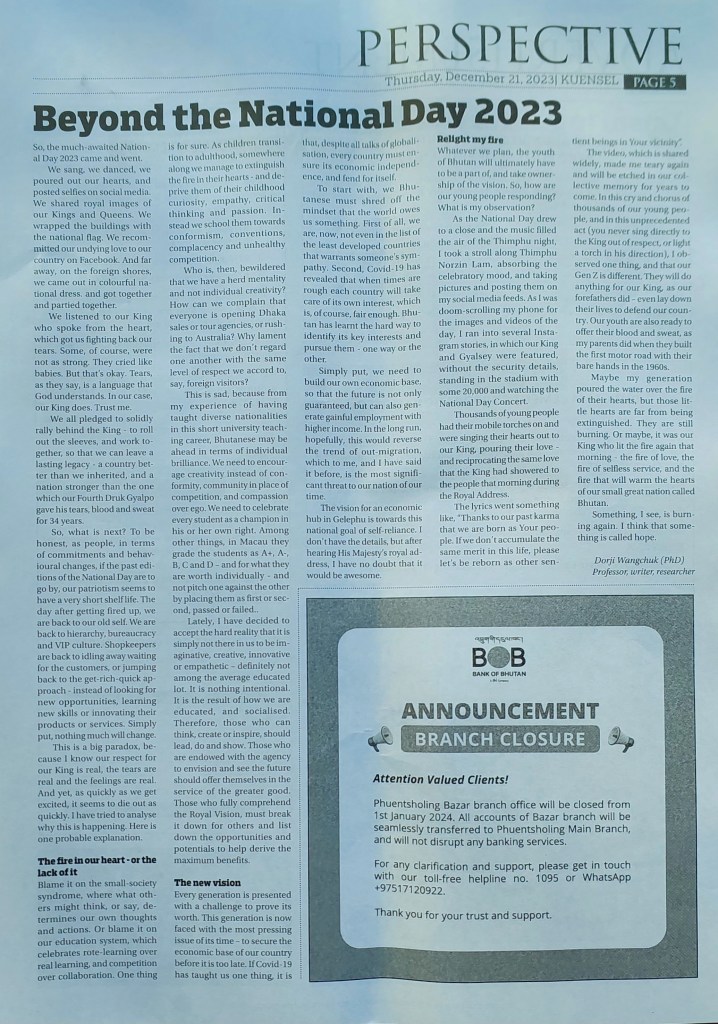
So, the much-awaited National Day 2023 came and went.
We sang, we danced, we poured out our hearts, and posted selfies on social media. We shared royal images of our Kings and Queens. We wrapped the buildings with the national flag. We recommitted our undying love to our country on Facebook. And far away, on the foreign shores, we came out in colourful national dress. and got together and partied together.
We listened to our King who spoke from the heart, which got us fighting back our tears. Some, of course, were not as strong. They cried like babies. But that’s okay. Tears, as they say, is a language that God understands. In our case, our King does. Trust me.
We all pledged to solidly rally behind the King – to roll out the sleeves, and work together, so that we can leave a lasting legacy – a country better than we inherited, and a nation stronger than the one which our Fourth Druk Gyalpo gave his tears, blood and sweat for 34 years.
So, what is next? To be honest, as people, in terms of commitments and behavioural changes, if the past editions of the National Day are to go by, our patriotism seems to have a very short shelf life. The day after getting fired up, we are back to our old self. We will be back to hierarchy, bureaucracy and VIP culture. Shopkeepers will be idling away waiting for the customers. People will be jumping back to the get-rich-quick approach – instead of looking for new opportunities, learning new skills or innovating their products or services. Simply put, nothing much will change.
This is a big paradox, because I know our respect for our King is real, the tears are real and the feelings are real. And yet, as quickly as we get excited, it seems to die out as quickly. I have tried to analyse why this is happening. Here is one probable explanation.
The fire in our heart – or the lack of it
Blame it on the small-society syndrome, where what others might think, or say, determines our own thoughts and actions. Or blame it on our education system, which celebrates rote-learning over real learning, and competition over collaboration. One thing is for sure. As children transition to adulthood, somewhere along we manage to extinguish the fire in their hearts – and deprive them of their childhood curiosity, empathy, critical thinking and passion. Instead we school them towards conformism, conventions, complacency and unhealthy competition.
Who is, then, bewildered that we have a herd mentality and not individual creativity? How can we complain that everyone is opening Dhaka sales or tour agencies, or rushing to Australia? Why lament the fact that we don’t regard one another with the same level of respect we accord to, say, foreign visitors?
This is sad, because from my experience of having taught diverse nationalities in this short university teaching career, Bhutanese may be ahead in terms of individual brilliance. We need to encourage creativity instead of conformity, community in place of competition, and compassion over ego. We need to celebrate every student as a champion in his or her own right. Among other things, in Macau they grade the students as A+, A-, B, C and D – and for what they are worth individually – and not pitch one against the other by placing them as first or second, passed or failed..
Since lately, I have decided to accept the hard reality that it is simply not there in us to be imaginative, creative, innovative or empathetic – definitely not among the average educated lot. It is nothing intentional. It is the result of how we are educated, and socialised. Therefore, those who can think, create or inspire, should lead, do and show. Those who are endowed with the agency to envision and see the future should offer themselves in the service of the greater good. Those who fully comprehend the Royal Vision, must break it down for others and list down the opportunities and potentials to help derive the maximum benefits.
The new vision
Every generation is presented with a challenge to prove its worth. This generation is now faced with the most pressing issue of its time – to secure the economic base of our country before it is too late. If Covid-19 has taught us one thing, it is that, despite all talks of globalisation, every country must ensure its economic independence, and fend for itself.
To start with, we Bhutanese must shred off the mindset that the world owes us something. First of all, we are, now, not even in the list of the least developed countries that warrants someone’s sympathy. Second, Covid-19 has revealed that when times are rough each country will take care of its own interest, which is, of course, fair enough. Bhutan has learnt the hard way to identify its key interests and pursue them – one way or the other.
Simply put, we need to build our own economic base, so that the future is not only guaranteed, but can also generate gainful employment with higher income. In the long run, hopefully, this would reverse the trend of out-migration, which to me, and I have said it before, is the most significant threat to our nation of our time.
The vision for an economic hub in Gelephu is towards this national goal of self-reliance. I don’t have the details, but after hearing His Majesty’s royal address, I have no doubt that it would be awesome.
Relight my fire
Whatever we plan, the youth of Bhutan will ultimately have to be a part of, and take ownership of the vision. So, how are our young people responding? What is my observation?
As the National Day drew to a close and the music filled the air of the Thimphu night, I took a stroll along Thimphu Norzin Lam, absorbing the celebratory mood, and taking pictures and posting them on my social media feeds. As I was doom-scrolling my phone for the images and videos of the day, I ran into several Instagram stories, in which our King and Gyalsey were featured, without the security details, standing in the stadium with some 20,000 and watching the National Day Concert.
Thousands of young people had their mobile torches on and were singing their hearts out to our King, pouring their love – and reciprocating the same love that the King had showered to the people that morning during the Royal Address.
The lyrics went something like, “Thanks to our past karma that we are born as Your people. If we don’t accumulate the same merit in this life, please let’s be reborn as other sentient beings in Your vicinity”.
The video, which is shared widely, made me teary again and will be etched in our collective memory for years to come. In this cry and chorus of thousands of our young people, and in this unprecedented act (you never sing directly to the King out of respect, or light a torch in his direction), I observed one thing, and that our Gen Z is different. They will do anything for our King, as our forefathers did – even lay down their lives to defend our country. Our youth are also ready to offer their blood and sweat, as my parents did when they built the first motor road with their bare hands in the 1960s.
Maybe my generation poured the water over the fire of their hearts, but those little hearts are far from being extinguished. They are still burning. Or maybe, it was our King who lit the fire again that morning – the fire of love, the fire of selfless service, and the fire that will warm the hearts of our small great nation called Bhutan.
Something, I see, is burning again. I think that something is called hope.
😎😎😎 OK. Jokes apart, this is big, and very prestigious in our world – the rarefied ivory towers of academia, where your whole research work done in your PhD years is recognised. It was conferred at the National Communication Association in Washington, DC – the world’s biggest association of academic peers in the communication and social science.
I am coming back to speak of it again for two reasons.
In recent days, seeing some of my good friends being recognised, some acquaintances on the victory pedestals, and some of my mentees going triumphant – all made me extremely proud as a Bhutanese. In spite of all our misplaced egos, we must remember that we are a nation of less than a million and to be doing well as a country, as a nation, and as individuals is something we need to take pride in. So, I thought this piece might also warm up many hearts on the even of the National Day.
Second, and more importantly, there are many young Bhutanese who are doing their postgraduate studies. Anything academic is stressful. We all know that. Postgraduate years are even more stressful, and frustrating and exasperating. PhD time is actually a very lonely journey. Very very lonely. And depressing at times. You wake up every morning and start rethinking your life’s choices. “Who forced me to do this?”, “I am dumping everything and going home. NOW!”, “Why is everyone’s research topic smarter than mine?” “Why does mine sound so dumb?”.
How many times have such deprecating thoughts crossed your mind?
With this post, I thought, maybe all those who are going through such dilemma and the pain of finishing the dissertation, and those who plan to pursue the highest that modern academia has to offer, will be encouraged to believe that this over-glorified thing called PhD is not only within their reach, but that they could also produce something that others in the field will recognise and acknowledge. It is within everyone reach.
I have taught three nationalities – in large cohorts, I mean. And let me say that Bhutanese are no less than anyone. In fact we are as smart or even smarter. Our problem is: we are bit laid back and one ugly thing is: we refuse to acknowledge each other.
So, to all of you, lonely people (read as PhD and maters candidates), out there, keep going!
You can’t imagine how many times I kicked myself. I even had to go back to the field, and write the main summary chapter, in the midst of pandemic, when I was also protecting my 30+ clan members from coronavirus.
And to all those who are not in this business of postgraduate studies, just tag your friends or family members doing masters or PhD, so that this simple message gets to them.
Happy National Day (On Dec 17th)
NB: Anyone who wants to read my super Dissertation, which actually no one will read😁😁😁, can drop me your email
(Sorry! No photo of mine with the award. I couldn’t travel to Washington DC to receive it because of prior work commitments. My guru and PhD supervisor, Prof Sandel, received it on my behalf on Nov 15 🤩🤩🤩)
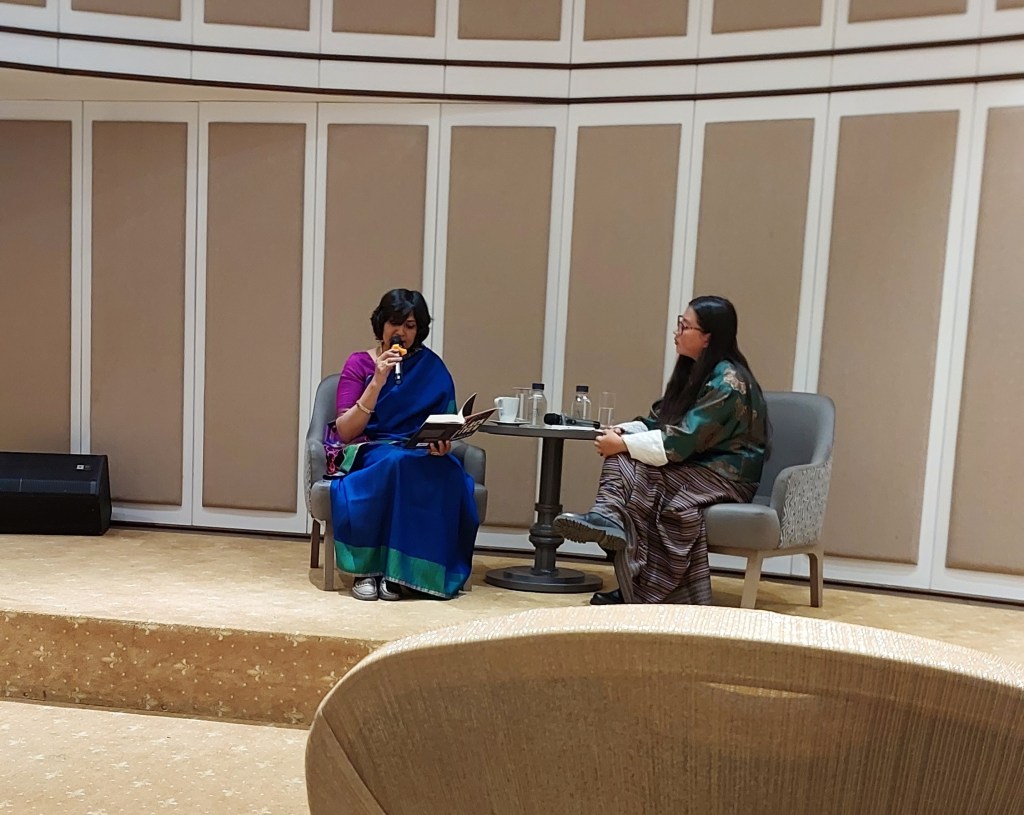
Got invited to the first Write Circle in Thimphu – an event for writers in conversation with other writers and readers – brought to town by Bhutan Echoes Festival Team.
It was a lovely evening. Such cultural events are something that I miss in Thimphu. Meaning the city has very little on permanent offer in terms of contemporary art and culture. For instance, there isn’t even a large public library where people can just hang out. Few book shops and an art gallery are all we have in the country.
Of course, those of us seeking such a place, or events, may be in the minority, but then a society could easily stagnate and regress when there is no investment in art, philosophy and culture. (And just to clarify, dzongs and temples are more of spiritual heritage sites in my definition. Culture is something more dynamic that responds to the changing circumstances around us – and which reflects mundane life and society).
So, amidst the overpowering election campaigns and gossips, and the nausea from AI-generated pictures flooding my social media feeds, it was a refreshing evening to listen to an author who sees beauty in the ordinary.
That’s what art and literature do. You see beauty in everything. Beauty in a tree, a river or in people. You heart opens. You see more. You live more.
Sometime back, someone asked my opinion on the changes in the course offerings of the Royal University of Bhutan – where apparently lots of arts and humanities courses were done away with – and replaced with digital technology programs.
My response was, “Science and technology, which have taken the first part of my life, make things comfortable for us. But art, philosophy and social science, which have given me a second inning to my career, make life itself worth living”.
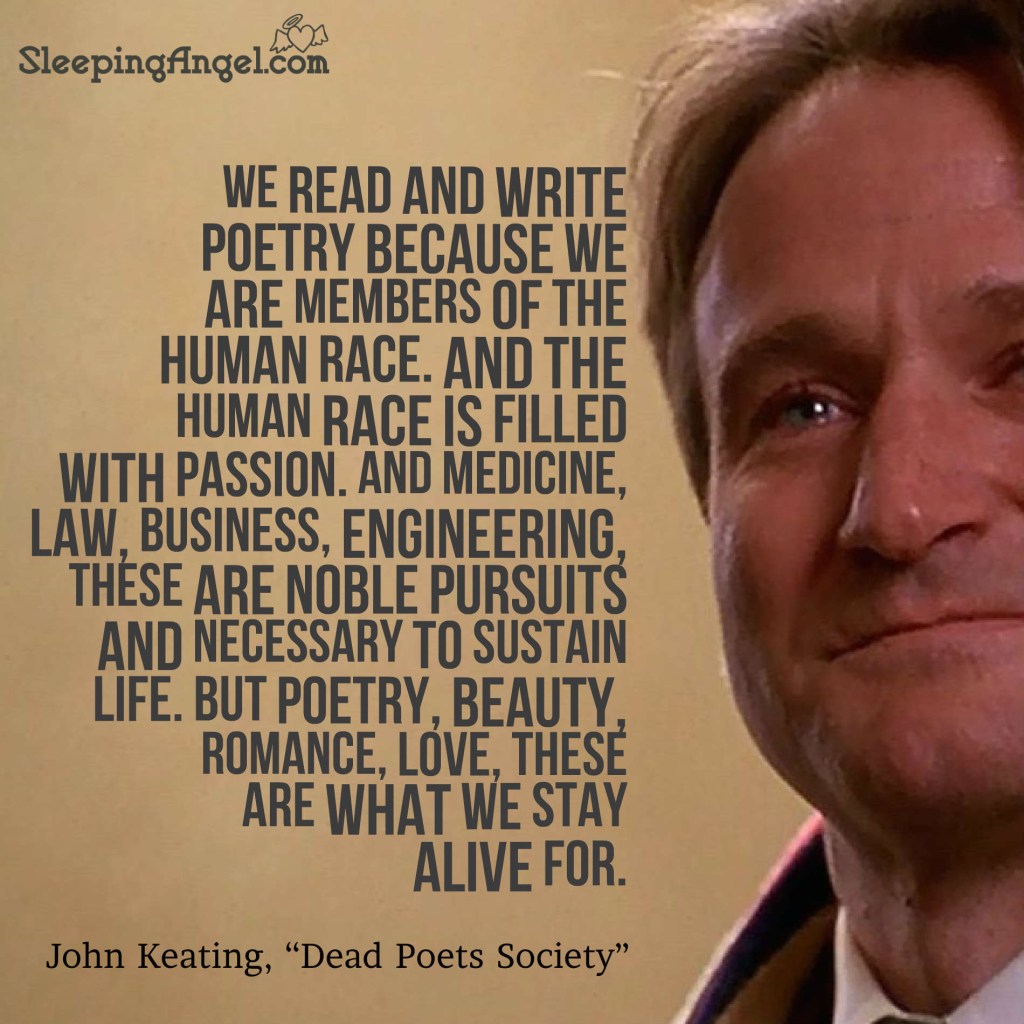
Yes, that’s paraphrasing a line from my favourite movie, Dead Poet Society:
“Medicine, business, law, engineering… these are noble pursuits and necessary to sustain life. But poetry, beauty, romance, love… these are what we stay alive for.”
This hidden sacred paradise is my favourite of all the sacred places in Bhutan – even more than the super famous Taktshang.
The temple was established by Sacha Rinchen (1710-1759) – the ninth Je Khenpo, and perhaps the greatest of them all.
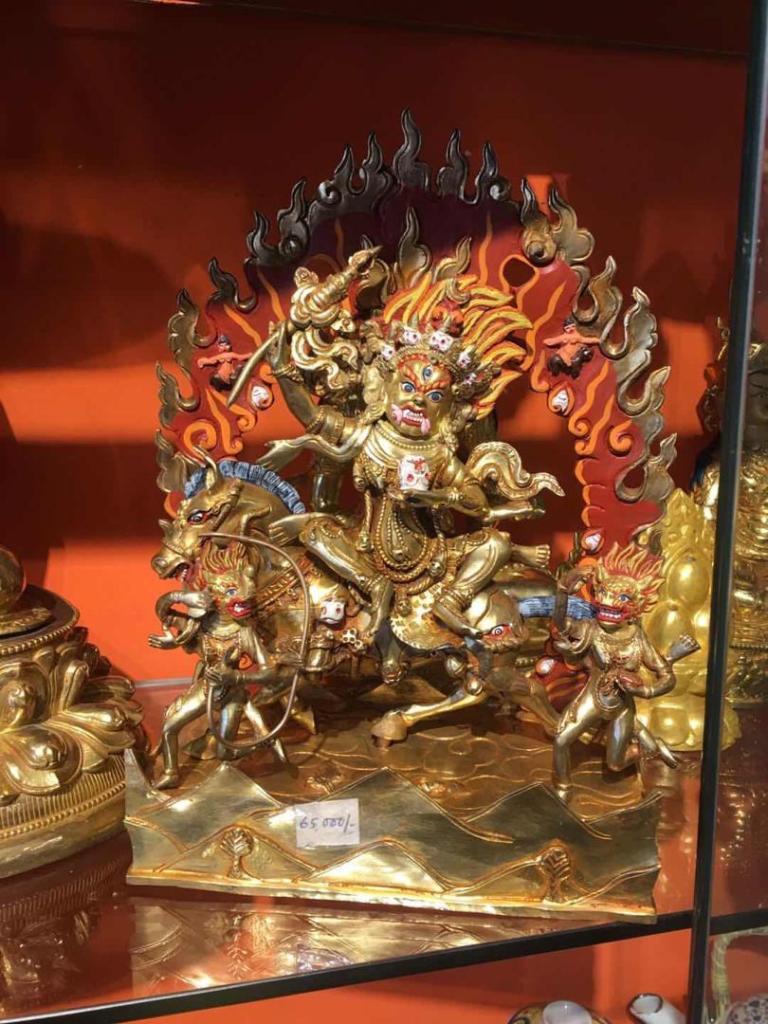
Chumphu was built as Tsari Nyipa (Second Tsari) – with reference to the famed Tsari (Crystal Mountains) in Tibet, which is believed to be the eternal abode of Dorje Phagmo. Story has it that Sacha Rinchen in his vision saw Dorje Phagmo telling him that in future the first Tsari would see a decline, and Chumphu Nye will be her main abode.
The main inner relic is a 5-feet tall statue of Dorje Phagmo (Vajravarahi), which according to one legend is rangjung (self-arisen) and not man-made. The other legend is that it was discovered in a lake – located some 30 minutes up the temple.
Whichever be the true story, the marvellous thing about this statue is that it is levitating – meaning it is floating.
I first visited this place in 2010 with a friend of mine called Sherub who grew up down in the valley. Sherub remembers playing with a bow string, by holding each end and making an arc, and throwing the string behind the statue, like a magician, and pulling both the ends from the gap below. This was done to prove that the statue was not anchored to the wall behind it.
Some 20 years back, a framed altar was built and the statue is sealed behind the glass, now, no one is allowed to do that. However, the levitating left foot can still be seen.
Chum(o)phu (meaning Female Water Mountain) can be reached from Paro Lhakhang Saarp after a gradual 4-hour climb and can be done as a pleasant day hike.
Dorje Phagmo (Skt: Vajravarahi; lit: Thunderbolt Sow) is the wrathful form of Vajrayogini, known as the foremost, supreme queen of all dakinis and a divine consort of Heruka Chakrasamvara (Khorlo Demchok). She is the Samantabhadri of wisdom, activities, and accomplishments, and therefore known throughout as the “Mother to all Buddhas”—the Ultimate Refuge for all deities, practitioners, and meditators of the Buddhadharma.
Story #1 – A young boy is in a long coma – somewhere in a hospital in New York. He was born with cerebral palsy. The doctors have given up hope and have asked the family to prepare for the worst – and to sign off to pull the plug. His sister, however, reached out to me through a common friend from the US with a “Heard you say they do miracles there in Bhutan. Can they do something for my brother?”.
My friend and I were trekking up to the Dodeydra Monastery in Bhutan, which was good timing – a good tendrel (auspicious coincidence), as we believe. When we get to the monastery the abbot compassionately listens to our request. He told me to instruct the family in America to gather around the boy at noon the next day, and face towards the east and pray, while he, the abbot, would launch blessings and prayers from Bhutan.
The next day, 15 minutes after the rituals were over, my friend’s phone rang again. There was screaming and sobbing on the other side. My friend thought the boy was gone. Nope. The boy woke up, and the family was crying out of joy. The doctor rushed in saw what was happening, and left the room in tears. “I have been doing this for 35 years. I don’t what you are doing but keep going,” he was quoted saying.
Story #2 – Recently, this same friend from the US told me that another friend of ours in LA was feeling low. His brother (a practising Zen Buddhist) has been diagnosed with stage 4 lung cancer and has been getting treated. He was going for the last radiation, followed by his review two weeks later. The doctors cautioned any optimism.
I invoked the blessings and conducted prayers for him in several places. My lama, Dorje Phagmo Rimpoche, after blessing him in absentia assured me that he would be alright.
Two weeks later I got a long text from my friend in LA. His brother’s lungs were clear and the doctors couldn’t believe their eyes when the CT scans came back.
I have more such stories from recent years. A newborn, who was breathing but not moving in a hospital in the US, and who moved her tiny finger after I invoked deity Palden Lhamo. Someone I know, again in the US, who felt fine receiving chemo after we commissioned the monks of Dodedra to chant Sangye Menlha (Medicine Buddha) mantra. He eventually recovered too.
Do these make sense?
I was born in a traditional Bhutanese family – of Buddhist dharma, rituals, prayers, and ceremonies. As a child, I used to accompany my grandfather, who was a lay lama, to conduct rituals for ordinary people in their homes in upper Tashigang in east Bhutan. For me these “things” are normal.
I was sent to a Catholic boarding school and later was sent off to Italy to major in microelectronics and engineering at the University of Bologna. Meaning, science and technology have been my better half, with spirituality and mysticism being the other side. Besides, I was exposed to other spiritual traditions – in that I lived among them.
In my third career in academia I have looked at the relationship between society and spirituality, and the role it plays in individuals. I still a have long way to go, but to answer the question, of whether rituals work, my reply is, it looks like it does. Of late, I have attended to around nine requests for spiritual help from outside the country. Only one did not make it through but the rest are doing fine.
To put it more aptly – medical science can take you very far these days, but it ends somewhere. There is a wall, and that’s where spirituality seems to take over. To put it simply, miracles appear where medicines end.
Of course, the two need not be linear. As my good friend, Nadya, says, the two can go alongside. Meaning while you get medical attention, you can also resort to religious ceremonies and shamanic rituals. After all, science has been with us for not more than 300 hundred years but the magic and miracles have been around for 5,000 – if not more.
As someone who has seen the power of the supernatural in many religious traditions, again, I am not advocating or promoting only the Buddhist rituals. Both Hinduism and Christianity have stories of miraculous power and recoveries. I myself recovered from a bad case of malaria when I was a child – after a mysterious Hindu priest appeared in front of our house in south Bhutan and tied a string around my arm. I started recovering moments later.
The point is science and technology have made us lose our innate power of healing, to start with, and have also made us skeptical of anything other than modern hospitals to attend to our health. The choice I believe is not to go simply for one or the other – but for both.
Science has made us lose our instincts, our sixth sense, and the power to feel the place and people – and by extension to absorb the energy of any kind, other than energy bars and synthetic painkillers. In short, we have become numb.
Of course rituals cannot cure all the cases but at least, the road of hope is longer than just relying on modern medicines.
And in that last stretch of hope one may find eventually the cure.
And not to forget
The traditional medicines (sowa rigpa) that is mainly based on medicinal herbs are, at times, a better choice than western allopathic medicines. Bhutan was known as Menjong (Land of Medicines) in ancient times – largely exporting rice and medicines to Tibet in exchange for salt, tea, and turquoise.
From my own experience, traditional medicines work better and have no side effects, for chronic ailments like gastritis, elevated bilirubin, bad cholesterol, and hypertension. Whenever I run some blood tests and these things show up, I drop by the Traditional Medicines Hospital in Thimphu to request some pills.
By reciting the Medicine Buddha it is believed that medicines one take increase in power of healing Palden Lhamo (an emanation of Mahakali) is believed to collect diseases in a black pouch and heal the world Tara Jigchoma is believed to help us recover from illnesses but also helps with our hypochondria (fear of falling sick)Masters like Dorje Phagmo confers kago on the sick to help them recover fully and quickly, or prevent people from falling ill.Neyphu Trulku Rimpoche is considered as an emanation of Medicine BuddhaMendrub Gonpa, Paro, as the name suggests, was the most famous seat for traditional medicines since the 16th century
“There are ferocious dogs guarding the place. So, I must call the Lama to tie them”, Wangchuk, a work colleague, told me when I shared with him that I was going to Tsetok Gonpa. Going up I did on the auspicious Tara Day, and Wangchuk not only had called the lama on my behalf, but he must have also spiced up my credentials. The lama welcomed me and provided me a guided tour with marvellous stories. I was also served tea and zaw (roasted rice) and offered lunch.
I started my visit by offering a butter lamp, and thanking the deities and divinities for everything in life.
Lodey Gyatsho – the founder
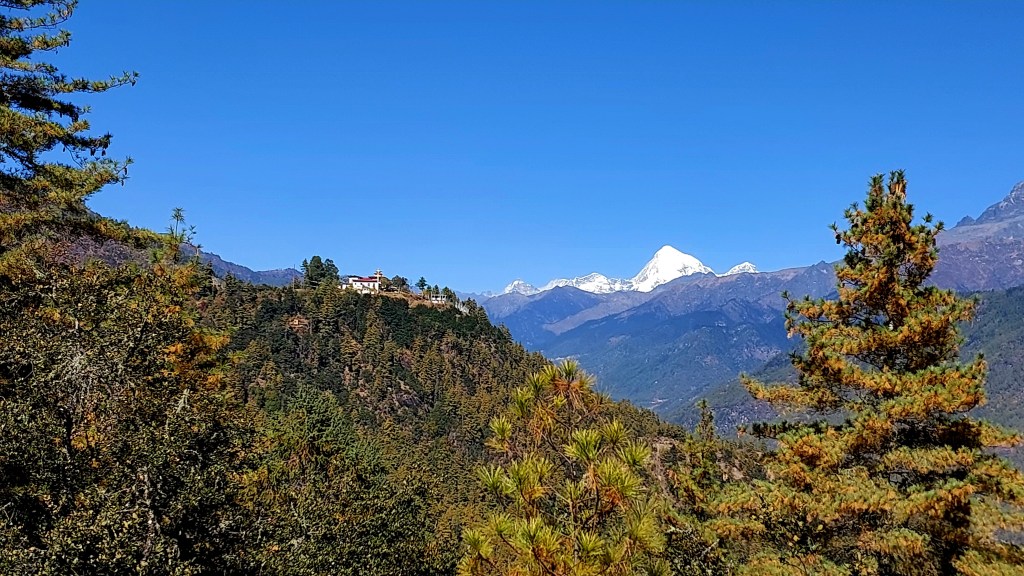
Tsetok gompa stands on the top of a mountain that is shaped like a vajra – an instrument used in Buddhist rituals. Tse means top in local languages, and hence Tsetok literally means “on top of the tse”. Gompa means “a meditation retreat hermitage”.
According to the resident Lama, Tashi Wangdi, Tsetok Gompa was established by lama Lodey Gyatsho – one of the six legendary students of Tshang Khenchen Pelden Gyatsho (1610-1684). All six are believed to have accomplished the highest level of tantric teachings. In fact, they were also referred to as drub-thob (The Accomplished One). Lodey Gyatsho was the youngest of the six Gyatshos. Many sources say they were all brothers.
Tshang Khenchen (literally meaning The Most Knowledgeable from Tshang) Pelden Gyatsho (1610 – 1684) was the biographer and a close friend of Zhabdrung Ngawang Namgyel (1594-1652).
Lam Tashi Wangdi adds that after their monastic education under Tshang Khenchen, the Gyatsho brothers were told to go out and fulfil their destiny of establishing seats of buddhist learning. Subsequently, Peljor Gyatsho established Geling Gonpa (which is now in Chukha Dzongkhag – opposite Chapcha), Sangnag Gyatsho established Thadra Gonpa in Thimphu – above Lungtenphu, Tsundru Gyatsho and Thinley Gyatsho built Tsundru Gompa and Phurdrub Gompa respectively – in Paro Dawakha, and Drakpa Gyatsho established the Jaba Jangchub Choling Gonpa in Jabana – also in Paro, on the way to Haa.
While the other Gyatshos immediately set off and fulfilled their destiny, Lodey Gyatsho, being the youngest, decided to take care of their ageing parents. However, as time went by he was increasingly drawn back to dharma and also felt repelled by the mundane farming life. He then returned to spiritual realm by entering into a serious retreat at Paro Taktshang Yoselgang and practiced the sacred Dorje Phurba (Vajrakilaya).
After twelve years of retreats and practices, Lodey Gyatsho saw in his vision the great Guru Padmasambhava who appeared to him and pointed to him the mountain facing Taktsang, and telling him that the Vajra-shaped mountain is the upper part of Thousand-spoked Wheel of Western Direction (nubcho khorlo tsib-tong) and that his destiny laid there.
Some mornings later, Lodey heard a loud knock on the door. This was strange because there were no temples and monasteries as we see them now. There were very few hermits and huts, and Yoselgang was the furthest spot of them all – and not even visited by birds or animals. When the lama opened the door he found a Vajrakilaya statue placed in front of his hermitage.
He took care of the statue, but one day he found that the statue went missing. Subsequently, he noticed a flickering light from the Vajra-shaped mountain, which he saw in his vision. After some days, he decided to hike to the mountain to see what that light was.
On reaching the peak of the mountain he found his Vajrakilaya statue on a flat stone in the middle of a small lake. He retrieved the statue and was planning to return to Taktsang Yoselgang when the local spirit, Genyen Bolap, approached him and asked him to stay there and build a temple – and that he would provide all the support.
Tsetok Gonpa was, thus, built.
The actual date of its establishment is lost in time. However, according to my calculation it must be around the mid of the 17th Century – just around the time when Zhabdrung Ngawang Namgyel had consolidated his place in Bhutan – because soon after Tshang Khenchen (The teacher of the six Gyatshos) was met with fierce opposition to his work in Tibet. Consequently, he was invited by Zhabdrung to move to Bhutan, which he did, and settled in, and built, the Menchuphu Gompa in Paro Shaba.
The sacred statues (ku-ten in Bhutanese)
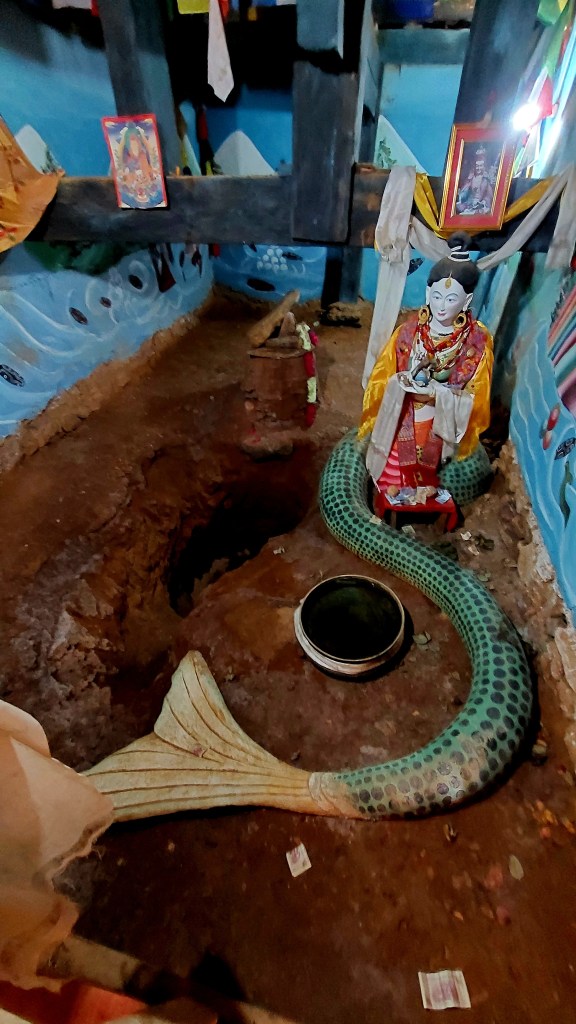
The temple has a statue of the Tshomen (mermaid) who was the guardian of the lake from where the Vajrakilaya statue was retrieved. The statue is on the ground floor and not for the faint-hearted since the Tshomen’s body looks like a giant snake. The lake is dried up because of the desecration works done by some delinquents.
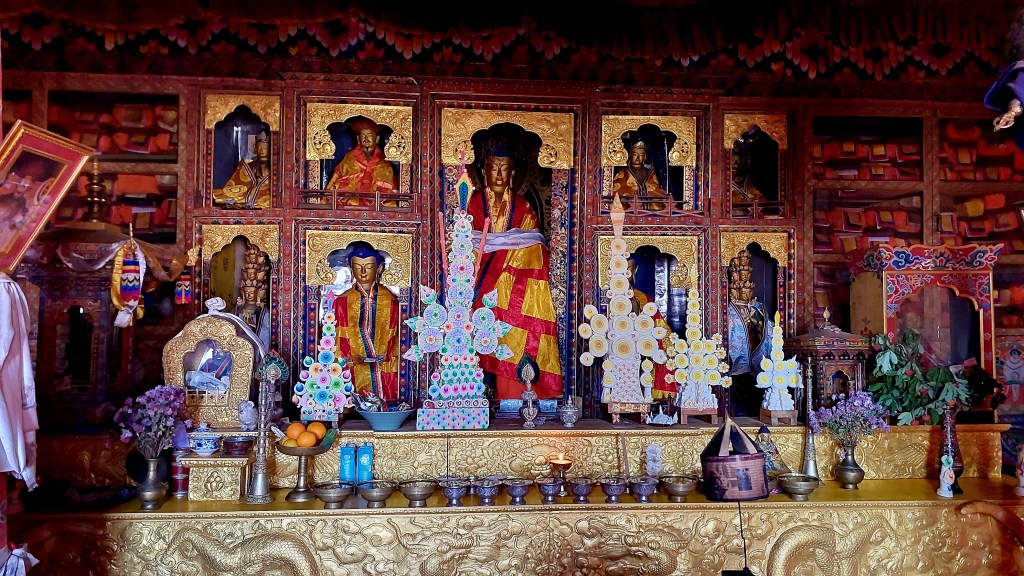
The main temple is on the first floor and depicts the Buddhas of Three Eons (Duesum Sangye) – Buddha Kashyapa (Sangye Yoesung), Buddha Shakyamuni (Sangye Sachathupa), and Buddha Maitreya (Gyalwa Jampa) – plus smaller statues of Guru Rimpoche, Zhabdrung Ngawang Namgyel and of the founder – Lodey Gyatsho.
The temple is adorned with medieaval swords and shields, and enquisite murals of pantheon of Vajrayana deities and divinities. The wooden flooring is over 200 years old and polished to perfection.
The sacred scriptures (sung-ten)
The temple has a rich collection of major scriptures and Buddhist canons such as Kanjur (words of Buddha) and Tenjur (commentaries), plus the sung-bum (speech teachings) of all the major masters of the past such as Tshang Khenchen, Zhabdrung Ngawang Namgyel, and others.
Lama Lodey Gyatsho was a renaissance man who not only perfected the Buddhist teachings and philosophy, he was also a master of all thirteen arts and crafts (zorigchusum) and also medicines (sowa rigpa) and astrology (tsi). In fact, the story goes that the blessed butter ointment (ngag-mar) made from his skull relic (kapala) is supposed to have cured a visiting tourist, who was suffering from an incurable chronic disease. This foreign visitor later donated a large sum of money and also rallied support to completely renovate the temple. His photo stands on the ritual stand (thri) of the caretaker-lama.
The sacred inner relics (nang-ten)
Set of Phurpa (ritual dagger). In the temple there is also a set of phurpas (ritual daggers) made out of wood, which used to be taken to the private houses during the rituals for the sick. Lodey Gyatsho meticolously carried out rituals and ceremonies for the seriously ill, and he made the phurpa set with the instruction that after his death, any lay monk can conduct the ritual with the phurpa set on the altar – and that the curative power and blessings would be the same as his. The phurpa set can be seen on the offering altar (sen-thri) of the main temple.
Vajrakilaya statue. The Vajrakilaya (Dorje Phurba in Bhutanese) statue is by far the most precious nang-ten of Tsetok Gonpa. The small statue – of five or six inches in height, is housed in a large amulet.
The Vajrakilaya practice represents the enlightened activities of all the Buddhas, and thus is powerful in removing obstacles in one’s journey towards realisation, destroying forces hostile to compassion, and purifying the spiritual pollution that is prevalent in these degenerative times.
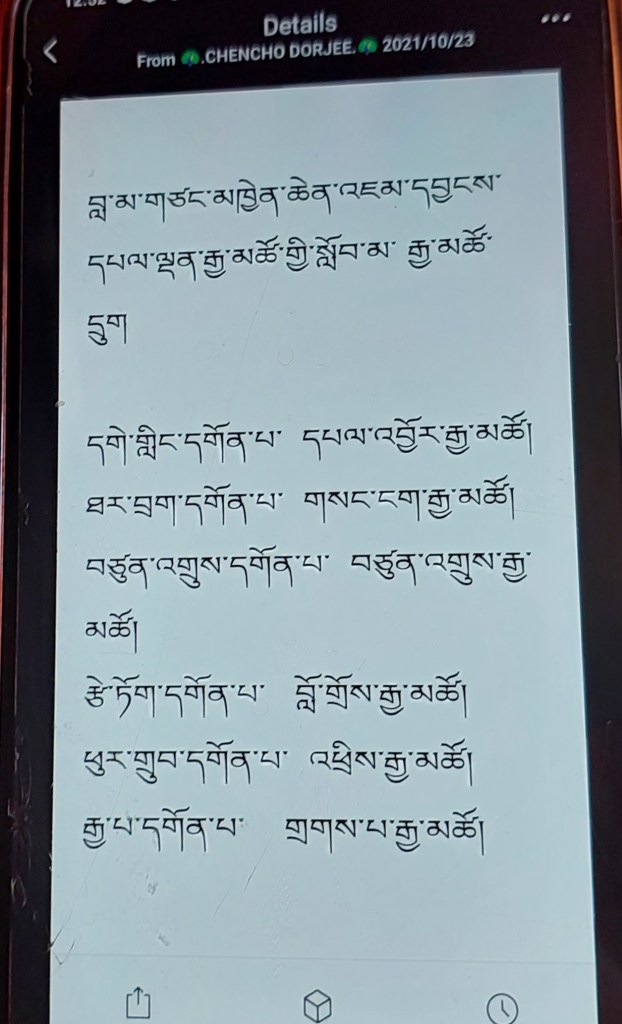
As the lama blessed me, I recited my favourite mantra, which was the first prayer that my grandfather taught me.
སངས་རྒྱས་ཆོས་དང་ཚོགས་ཀྱི་མཆོག་རྣམས་ལ། །
sangye chö dang tsok kyi chok nam la (In the Buddha, the Dharma and the Supreme Assembly)
བྱང་ཆུབ་བར་དུ་བདག་ནི་སྐྱབས་སུ་མཆི། །
changchub bardu dak ni kyab su chi (I take refuge until I attain enlightenment)
བདག་གིས་སྦྱིན་སོགས་བགྱིས་པའི་བསོད་ནམས་ཀྱིས། །
dak gi jinsok gyipé sönam kyi (Through the merit of practising generosity and so on)
འགྲོ་ལ་ཕན་ཕྱིར་སངས་རྒྱས་འགྲུབ་པར་ཤོག །
dro la pen chir sangye drubpar shok (May I attain buddhahood for the benefit of beings)
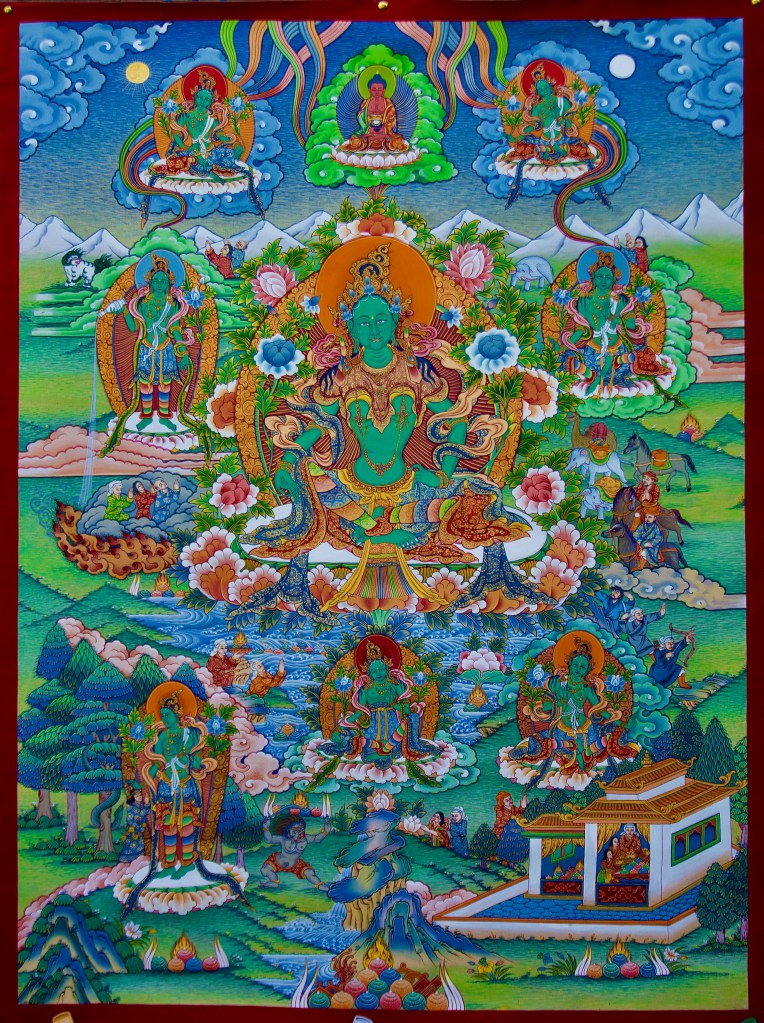
Tara and Manjushri Ter statues. There are also two beautiful ter statues of Tara (Jetsun Drolma) and Manjushri (Jetsun Jamyang). Ter statues are believed to be either antiques pieces, or of divine origins. Some are believed to have self-arisen and not made by humans. The Manjushri statue does not have the flaming sword, which I proposed to make one from a Sakya craftsman I know in Nepal, and offer it to the temple. The lama was very pleased with my offer.
The Wooden Mould. The temple also has a beautiful wooden mould to make miniature statues of animals and local deities. Legend has it that the mould contains all the animals living in the six realms. On close observation, some of the animals and figures looked like extraterrestrial beings – as depicted in Hollywood sci-fi movies.
The Kapala. An important and priced relic is the kapala (Sanskrit for skull) of Lodey Gyatsho that has been turned into a ritual cup – as customary in Tibetan Buddhism. The skull has self-arisen images of the Sun, Moon, and the Pleiades (Karma Mindruk), which appeared miraculously.
The skull is believed to have miraculous properties. For example, butter rubbed inside can be later used as ointment for any skin, muscle, or bone ailments. The water poured in and blessed is then distributed to devotees, which is believed to spare one from rebirth in the Lower Realms. It also claims to cure internal diseases with the digestive system, urinary tracks, lungs and heart.
The bell and vajra of the lama. The temple also has several personal effects of Lodey Gyatsho, chiefly his bell (drib) and the vajra (dorje). The bell is supposed to produce a sound, which when heard will release you from the rebirths in all lower realms.
The Annual Blessing and Bumday
Coinciding with the death anniversary of Lama Lodey Gyatsho on the Fifteenth Day of the Ninth Month of the lunar calendar, a week long rituals and ceremonies are conducted, during which it is advisable to visit this gompa to get access to all the relics to pray, and also make sponsorships and offerings.
Getting there
From Lango town, drive towards Tenzinling Tent City, and keep right at every major junction till you reach Dungse Thinley Norbu Kudrung Chorten.
The access road to Tsetok Gompa is marked here, but during monsoon the road is either bad or damaged. It takes 1.5 – 2 hours till the temple from here. 30 minutes if the access road is through.
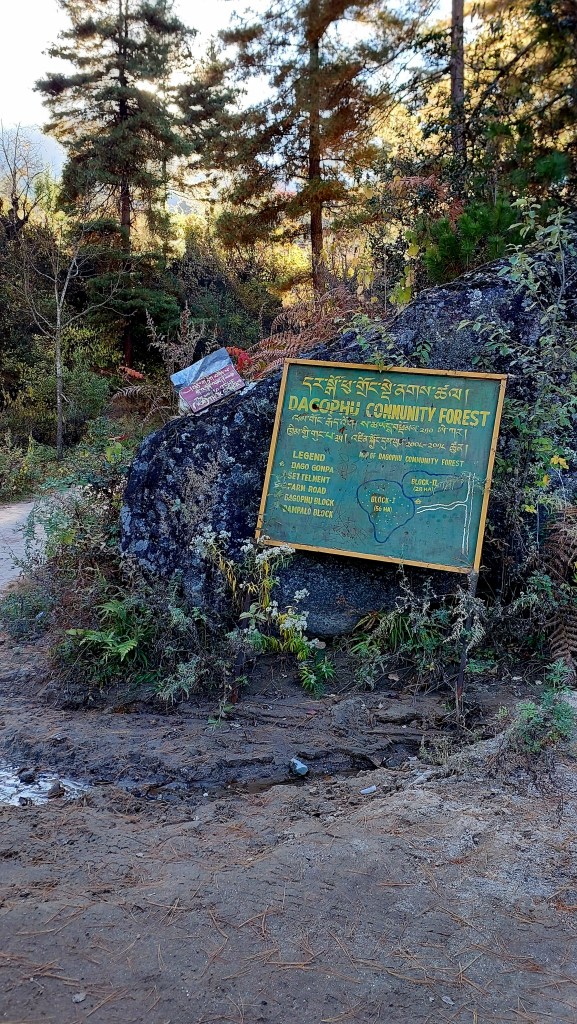
Look for this signboard at the gate of Dungse Thinley Norbu Kudrung ChortenThe temple from Jagathang villageThe karcha (sacred history) of the temple
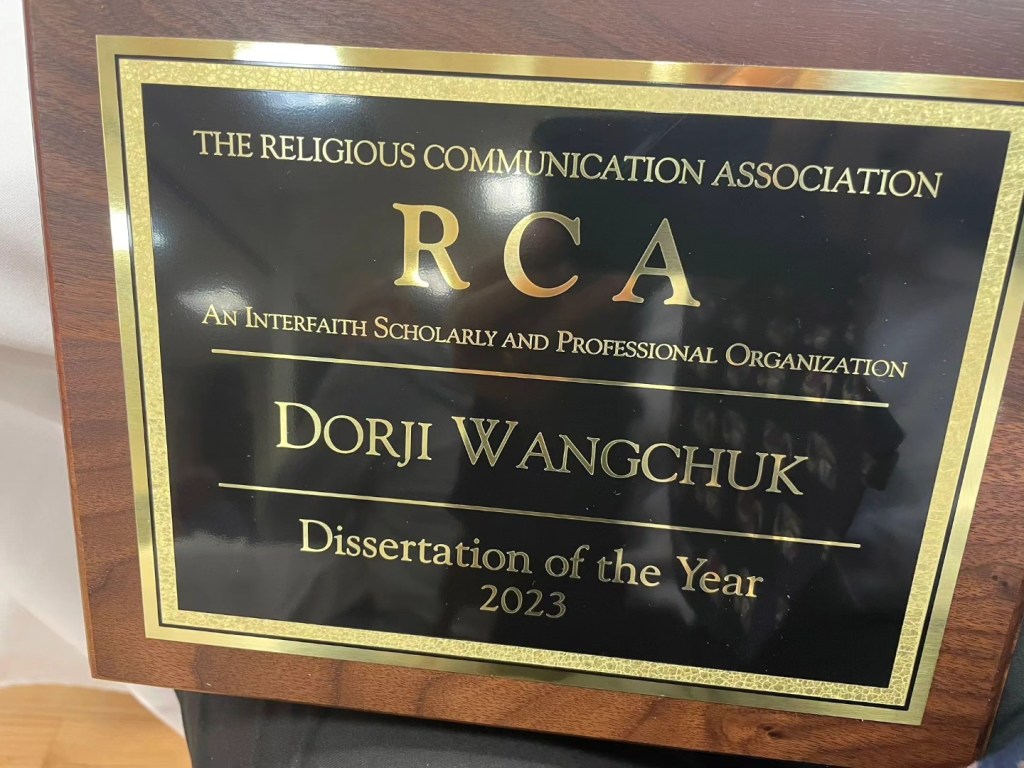
Happy to share the news that my PhD dissertation (aka research thesis) has been judged as the Dissertation of Year at the National Communication Association conference in Washington, DC, on November 15, 2023.
I was informed of it last October and was invited to attend the Award Ceremony in the US. However, because of some prior work commitments, I had to request my PhD supervisor, Prof. Todd Sandel, to receive the award on my behalf. In a way, he is the most appropriate to share the recognition.
Thanking everyone, who journeyed with me, on this joyful moment. As I have acknowledged therein, there is no such thing as a self-made man. Every help, big or small, or even the tiniest compliment or a word of encouragement, goes on to add up for the greatest of achievements.
After I woke up to the pictures of the Award on my WhatsApp (I was at Dodeydra monastery, which is good tendrel), I took a moment to pray to Manjushri, the deity of knowledge and wisdom, and wished that this humble work of mine inspire younger generation of Bhutanese to go more into seeking knowledge, do path-breaking research works and build a better world for all.
I took this video on my recent flight on Bhutan Airlines. In it you see a young air stewardess on Bhutan Airlines calming a terrified passenger (baby), who was screaming out of pain.
Probably his ear drum was hurting as the plane descended to Kolkatta. Minutes later he stopped crying and she handed him back to his mother.
As someone who has travelled with two young children in the past, and was frowned upon, and even shouted at, on international airlines, it really warmed my heart to witness this on our very own Bhutanese airlines.
Travelling itself is a stress. Travelling with toddlers, even more. You have to worry they may fall sick, run into something, or they may bring down the place itself.
But nothing is worse than adults being annoyed and upset about children being children.
World over, especially in the so-called advanced societies, adults often forget that they were infants once and may have inconvenienced others. Infants can only cry. They can’t speak or reason out. It is natural. Why is it so hard?
The world would be a better place with some compassion and empathy.
I am glad to see our young Bhutanese youth exhibiting these values in the degenerative times.

















 Dorji Wangchuk