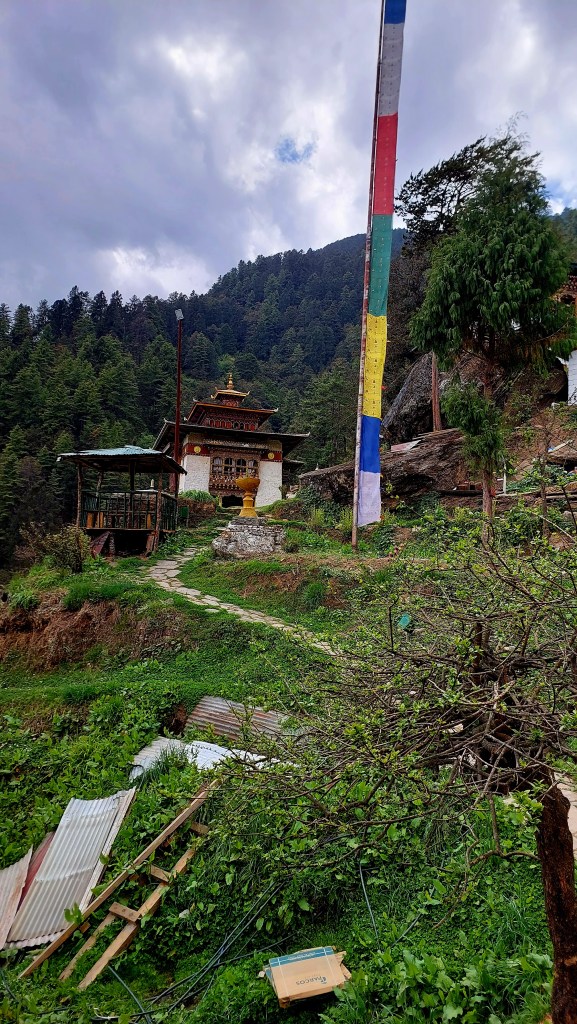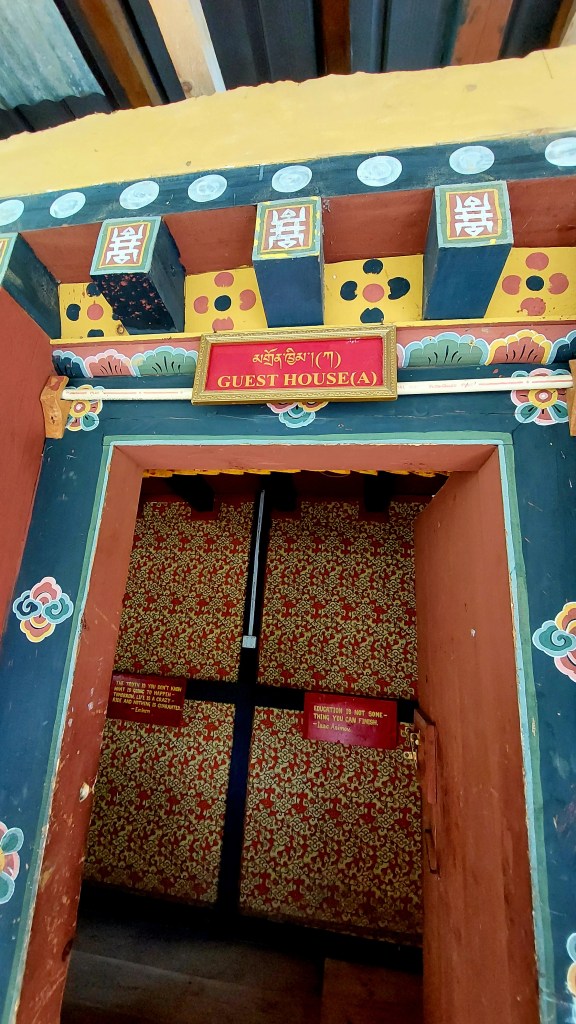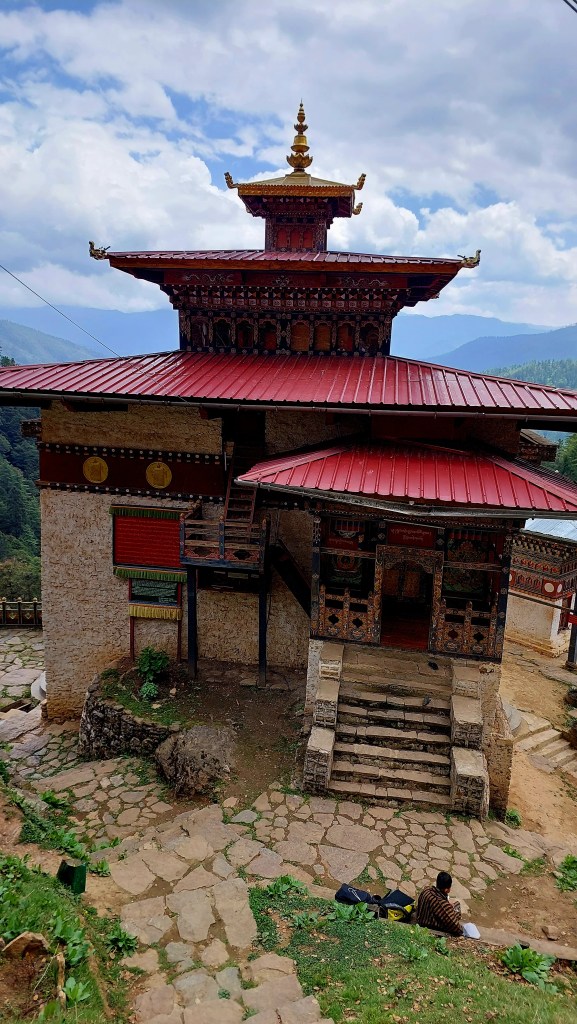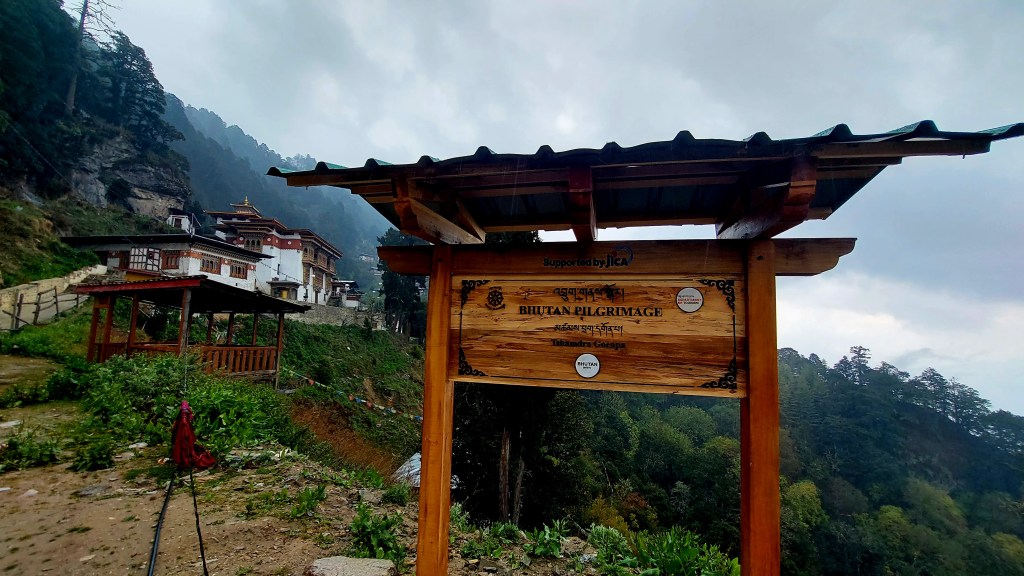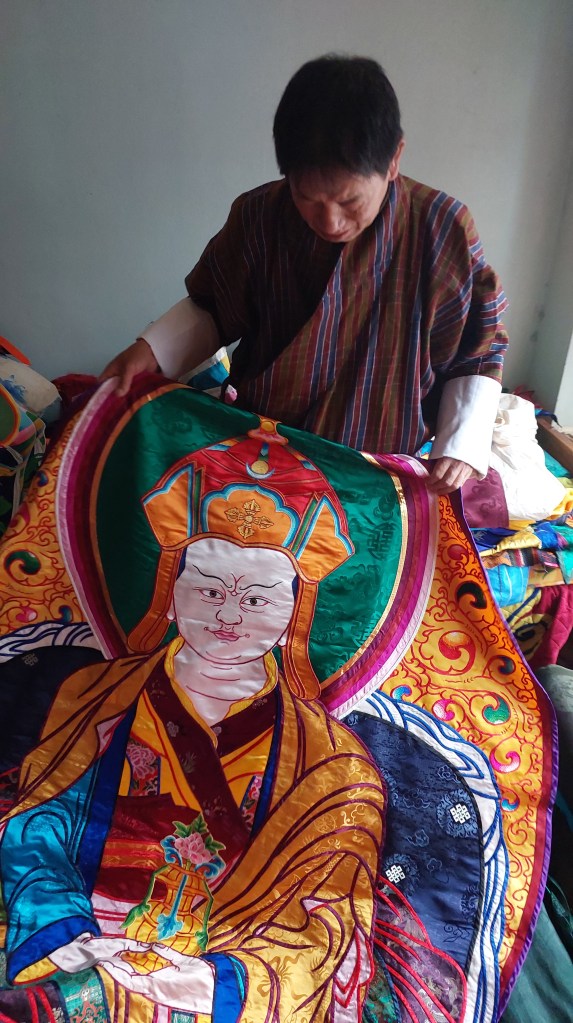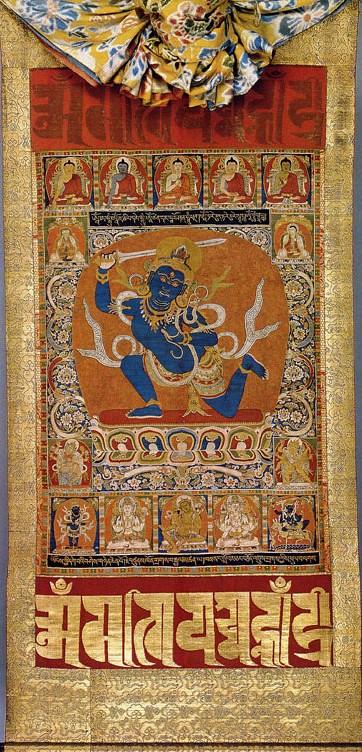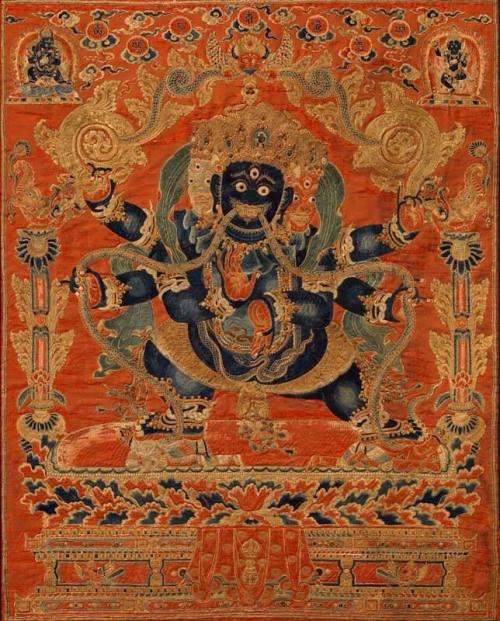
I have finally made it to Yanglesho after a good 20 years since I first heard about it. In these 20 years, of course, my spirituality has matured too, for me to fully appreciate the significance of this place. So, let me share here, for the benefit of all sentient beings. As they say, I think my Moelam (destiny) has matured to be here, at this time. 🙂 🙂 🙂
As an adherent of #Vajrayana Buddhism, nothing compares to a pilgrimage to the Asura caves at Yanglesho, where Guru #Padmasambhava attained, to put it simplistically, enlightenment. To be more precise, it was here that he achieved Yangdak (ཡང་དག་), corresponding to the Enlightened Mind, after practicing the Yangdak Heruka (ཡང་དག་ཧེ་རུ་ཀ་). Yangdak Heruka is a wrathful manifestation of #Vajrasattva (Dorji Sempa) and is similar to the deity Chakrasamvara (Demchok).
Several past and contemporary masters, chief among them the Late Jadrel Rimpoche and Chokyi Nima Rimpoche, consider Yanglasho as important as Bodh Gaya for practitioners of Tibetan Buddhism, especially the #Nyingma school.
Yanglasho, also appears in the history of #Bhutan as the place where the envoys of King Sindhu Raja of #Bumthang found him when they came looking for him. (In fact I first heard about Yanglasho when I did a documentary, In the Footsteps of Guru, for BBS in the 2004)
After he was exiled from his kingdom, he lived as a wandering yogi, visiting mainly the charnel grounds. When he visited the Parushakavana charnel ground, he came across the wrathful Vajravarahi (Dorje Phagmo), who agreed to initiate him, and help him attain the Knowledge-Holder of Spiritual Maturity. In Pema Kathang, Guru says Dorje Phagmo is his (adopted) mother. Guru, then, moved to Maratika Caves in eastern Nepal where he attained the Knowledge-Holder of Immorality – gaining victory over the Lord of Death. In Bodhgaya (Dorje-Dhen in Dzongkha), he achieved the Knowledge-Holder of Spontaneity. And finally in Yanglasho, he became the Knowledge-Holder of #Mahamudra.
Of these four knowledge-holder attainments, the Knowledge-Holder of Mahamudra is supreme.
The temple complex of Itum Bahal in Kathmandu hosts one of the most sacred Tara statues in the world. The Mahashanta Shweta Tara is a large bronze statue of White Tara. It is more sacred than the rest because it is believed to have given teachings. In fact is also known as “The Great White Tara Who Turned the Wheel of Dharma”.
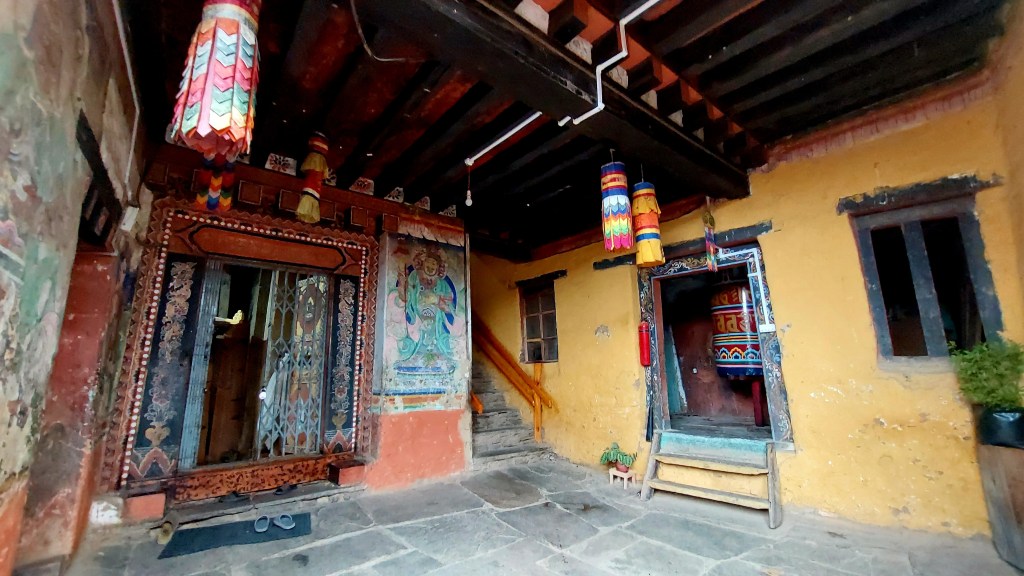
“According to what my father and my grandfather told me, it is believed that she flew to Kathmandu from Potala in Tibet,” says Bupendra Bahadur Sakya, the 8th generation caretaker of the temple. “Many masters and meditators even today have shared powerful experiences after praying and meditating here,” he adds. The statue is said to have to have flown to other parts of Nepal to be of benefit to other sentient beings.
I prostrated three times and made an offering of Rs. 1,000. “It feels very peaceful and powerful at the same time,” I tell him.
Bupendra was very pleased to hear that, and also to know that I am a Bhutanese. He shared that during the long Pandemic shutdown he really missed Bhutanese pilgrims. “You guys show great respect to Tara that my community finds very inspiring”.
Still, while Tara may not be the most favourite deity of the Newari Buddhists, this Tara is highly revered and there are special rituals observed by the Newari community.
The White Tara is in the middle. To her right is Prajnaparamita Tara (Yum Chenmo in Tibetan) in yellow color, and on its left is Green Tara (Dron Jang).
The small caged temple is in the courtyard to the north of Itumbahal.
The sacred texts known as Satasahasrika Prajñaparamita, which is translated as Perfection of Wisdom Sutra in One Hundred Thousand Lines (Skt. Śata-sāhasrikā Prajñāpāramitā; Tib. ཤེས་རབ་ཀྱི་ཕ་རོལ་ཏུ་ཕྱིན་པ་སྟོང་ཕྲག་བརྒྱ་པ།) is one of the principal texts in Buddhism. In Dzongkha it is simply referred to bum (འབུམ་,) – meaning ‘The Hundred Thousand’ – referring to the 100,000 lines of the scripture.
Story has it that it is based on the teachings of Buddha that was delivered at the Vulture Park in Rajgir (India). Manjushri is supposed of have attended the Teaching and dictated it to his disciple, who wrote them down. The sacred manuscript is attributed to Jinashri Jnana, a disciple of Manjushri, with Manjushri himself, the legend goes, writing the first three pages with his own index finger, and dictating the rest.
The complete set of 12 volumes texts were believed to have been delivered for safekeeping with the Nagas by Manjushri with an instruction that a man would come in distant future to retrieve them. That man would happen to be Nagarjuna – a brilliant second century scholar from South India.
The Temple and the Ser Bum:
I had heard that the manuscripts were in a family temple in Kathmandu and that it was possible to see them. Or at least that was what my Nepali friends told me. Having written the essence of the Prajanaparamita in my PhD dissertation, I was fascinated by the prospects of even getting a glimpse of the Original copy.
So, I decided to make a trip to Nepal.
After asking around, and based on a book by Keith Dowman, I traced the family temple to Vikramshila Mahavihar (aka Bhagwan Bahal or Tham Bahil) in Thamel. The local Newari people refer to the volumes as Ser Bum, while the proper Sanskrit name is Śata-sāhasrikā Prajñāpāramitā.
Getting to see it:
The Volume is taken out only on certain days – as deemed auspicious by the Newari calendar. There are no fixed days.
As instructed by another informant, I went to the office to introduce myself and make a request. Having a local reference helps but in my case, I was able to convince them that I was a serious scholar (maybe I looked very trustworthy) and, most importantly, I had to convince them that I was a devout Buddhist – and not part of any sinister groups. You have to make the appointment at least a day in advance for them to probably do some background-checks on us.
The Scriptures Appear:
I got back to Tham Bahil on the day of the appointment and was led to a closed room, where I joined some 20 Ladakhi monks, lamas and pilgrims, who had probably made the same request. After some 30 minutes of waiting, the four volumes of the scriptures were brought in, and then solemnly opened by the Chief Custodian from behind a glass wall. He spoke and explained everything in Hindi since he assumed that we were all from Ladakh. He showed the first three pages, written by Manjushri with his own finger, and the rest of the pages written by his disciple, Jinashri Jnana. The noise from the Courtyard outside was muffling his voice, and I felt sorry for the Ladakhis since they were mostly illiterate pilgrims, and probably don’t know much of the legend that was shared.
Tracing the Entrance to the Subterranean World:
According to another legend, Kathmandu was a huge lake surrounded by mountains. Eons before Shakyamuni Buddha, the Bodhisattva Kanakmuni is believed to have thrown a lotus seed in the lake. A big lotus with a thousand leaves and flowers blossomed out of that seed. On one of the flowers, a self-arising butter lamp burned miraculously.
Manjushri is believed to have visited the place, and after meditating on Phulchoki mountain, he struck one end of the valley with his divine sword and drained the water from the lake. And as for that Eternal Butter Lamp, a hill rose on which now stands Soyambhunath (Phagpa Shingkun) Chorten. Just below the summit of Soyambhunath, I was told by the Chief Custodian of Tham Bahil that there is a place called Shantipur, where Nagarjuna is supposed to have entered and returned from the Subterranean world of the Nagas with the scriptures.
I thanked him for this piece of information, got out of the temple and to the street where I stopped a taxi. “Monkey temple, my friend,” I told the driver in Nepali. We dribbled through the traffic of Kathmandu and got to Soyambhu in 15 minutes.
After a tough climb up the long stairs to Soyambhu Chroten, I asked around and found the place called Shantipur. Here Nagarjuna (in the Second Century) is supposed to have entered the Subterranean World on the invitation of the Naga King to come a teach the nagas the Buddha Dharma. And to reciprocate for the precious teaching, the Naga King offered the four volumes containing the Satasahasrika Prajnaparamita (the Ser Poti) to Nagarjuna.
What stands there today is one storied building with a large dark ornamented door. That door is supposed to lead to another golden door, one priest told me, and to another door, with a total of Five Golden Doors. That is the entrance to the World of the Nagas.
According to the same legend, the Naga King is still holding on to one more Volume and waiting for Nagarjuna to come and give more teachings, and offer him that last volume.
Leaving Soyambhu with a prayer:
I made a small offering through the door, rang the bell thrice as per the tradition and made a silent prayer and a Moelam: That this story and the legend, whether true or not, never dies and instead inspires thousands more like me, seeking both the knowledge and enlightenment – and that everyone who seeks them work towards the goodness of humanity and for the benefit of all sentient beings.
I climbed back to the Chorten and made 13 rounds of the Phagpa Shingkun (Soyambhu) and thanked the divinities, especially Manjushri, for this beautiful journey that I have undertaken – and requested him that I never get to my destination – and that may there be more of this wonderful mission.
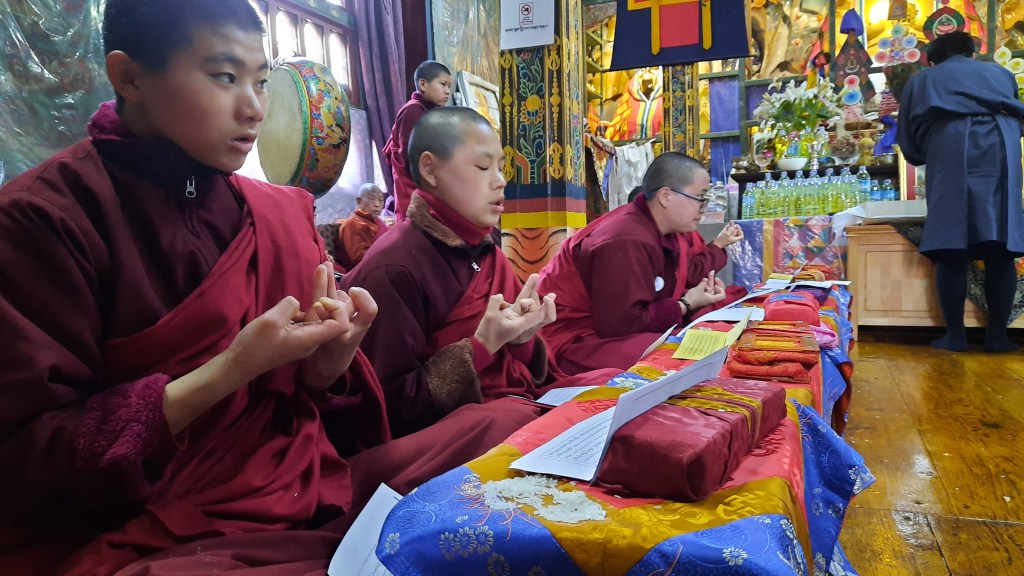
Nangkor, Zhemgang, 30 January 2023 – Phurpa Drubchen, literally meaning “Vast Accomplishment of Vajrakilaya”, is traditionally practiced as a purification ritual, and conducted as the Lunar year ends. The ritual has power to cleanse all accumulated negativities and defilements, while also clearing obstacles such as ignorance, envy and jealousy, and tragedies in the coming year.
The Vajrakilaya ritual was also the ritual that was conducted by Guru Padmasambhava before he could accomplish his enlightenment at Yanglasho in Nepal. Therefore, it is a very special ceremony for Vajrayana Buddhists.
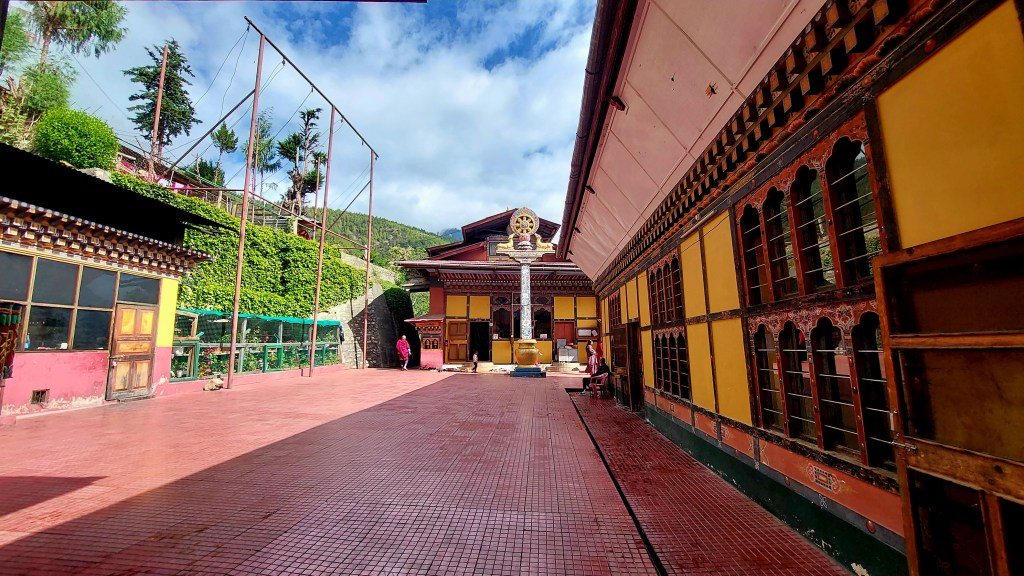
This year the first Phurpa Drubchen in Ngajur Pemachophelling was held from January 27 to 30, 2023. It was organised for the benefit of all sentient beings. Ngajur Pemachophelling Dharma Centre is located in Kikhar in Nangkor Gewog in Zhemgang.
I felt very fortunate to be a part of the Great Ritual (seen nothing like this before) with our lama, Dorje Phagmo Rimpoche (the highest female reincarnate lama in Tibetan Buddhism), personally doing the concluding religious dance and the ceremony to burn and bury the three poisons – ignorance, envy, jealousy, which stands in our way towards realisation. While I have been to Phurpa Drubchen before in other places, this was different at all levels. Most importantly, I felt one has to have trillions of moelam to witness a living Vajrayogini conduct a Vajrakilaya. This felt a different blessing and feeling, I must say.
It is believed that there are no bigger ceremonies in Vajrayana Buddhism than this and that any wishes made will be fulfilled. I have wished that the blessings of the Phurpa Lhatshok (Vajrakilaya deities) restore the peace and prosperity in our communities and our country, and in the world, that have all been battered by the pandemic. And that we all find our way to our hearts.
All in all, this was another great memory for me to add in the eventful year of the Tiger.
Onward with confidence to the New Year of Rabbit 🚶🚶♀️🚶♂️
I love this drive – except the Ossey stretch. It is so green and pristine, and the views are very scenic, especially the one overlooking Jigmecholing (aka Surrey), which is sooooo beautiful.
A must-do, if you haven’t.
Of course, a trip to Gelephu is incomplete without a visit to my kurmas in Dadgari Haat, where the noise, dust, and the commotion just brought back fond memories of the 1980s, when I used to accompany my father, a truck driver, to these places.
I feel at home here. The people still feels friendly. Of course, we, people on either side of the border, have a long history of being hosts and guests in the cross-border relations known as Shazi-Kurma. My family’s kurma was in Darranga and Kumarikata, being from Tashigang. It is similar to nyeps in Tibet who hosted the Bhutanese traders.
My first visit to India since 2020 BC (before Corona), lasted three hours. Both our Police and their SSB soldiers – the border guards on each side, were very polite. It was a smooth sail, like in those good old days. 😘😘😘
I bought a 3-kilo boulder of pink salt, and ate some bujia and turned back.
Phurpa Drubchen, meaning Vajrakilaya Purifiucation Ritual, is a very powerful purification ritual, which is traditionally conducted as the Lunar year ends. The ritual has power to cleanse all accumulated negativities and defilements, while also clearing obstacles, tragedies in the coming year. This powerful practice is, most importantly, believed to clear the path towards enlightenment, which is the ultimate goal in Buddhism.
Even Guru Padmasambhava is supposed to have performed the Vajrakilaya rituals before he attained an enlightened mind through the practice of Yangdag Heruka (ཡང་དག་ཧེ་རུ་ཀ་) at Yanglashoe in Nepal.
Phurpa Drubchen 2023
This year the grand finale of the Phurpa Drubchen will be held from January 27 to 29, 2023.
We are very fortunate, and glad to announce, that Her Eminence Dorje Phagmo Rimpoche personally recited the Phurba Nyenpa (non-stop recitation of Vajrakilaya mantra). She will also preside over the final rituals and ceremonies.
The three-event consists of Tordo on 27th Jan where the wrathful torma will be cast away to pave way for the New Year to be filled with positive merits and circumstances, while increasing the longevity, victory, happiness and harmony in the family, community and country.
The next day will be dedicated to the Dharma Protectors (Choesung Soelkha), where we will pay respects and gratitude (Tang-Rak), for the Year gone by and for the New Year.
The Tshogkor will be third and final day, 29th Jan. 2022 and will be dedicated to pay gratitude to the divinities such as Guru Padmasambhava and Tara for the gift of life, peace and prosperity. It is believed that they will visit us during the ceremony.
Who should attend:
While everyone is invited and encouraged to attend this powerful ceremony and the celebrations, these rituals are particularly recommended for those who are facing logka, duenzur, dursa, or thinsum (check with your astrologer), and women born in the Dragon year and men born in the year of Tiger. And those who are venturing into new projects (school, college, long journeys, career or profession change) or simply the spiritual pursuit, which is the ultimate goal of all sentient beings.
What can you offer:
Vajrakilaya and Protector deities rituals require many tormas. Besides, on all the three days there will be continuous smoke and butter offering as well as raising Prayer Flags. Furthermore, there will be offering of Tsok consisting of biscuits, fruits, and food.
You are welcome to offer or sponsor one of the above in full such as full sponsor of torma (already secured), or full sponsor of tshog, butter, prayer flags, or incense. Given that there might be duplications, and if you can place the trust on the dratshang, monetary contribution is best – and convenient.
For monetary offering, you can deposit directly into: Bank of Bhutan account 202081833 (Ngajur Pemachophelling)
For more information you can contact: Lopen Umze Anim Nyima Drolma. Tel – 17388847
For accomodation at the Centre: Mr. Thinley Penjor. Tel – 77434142
For donations contact: Mr. Chokzang. Tel – 1775 9200
Dates, Venue and direction:
Dates: 27-29 Jan 2023
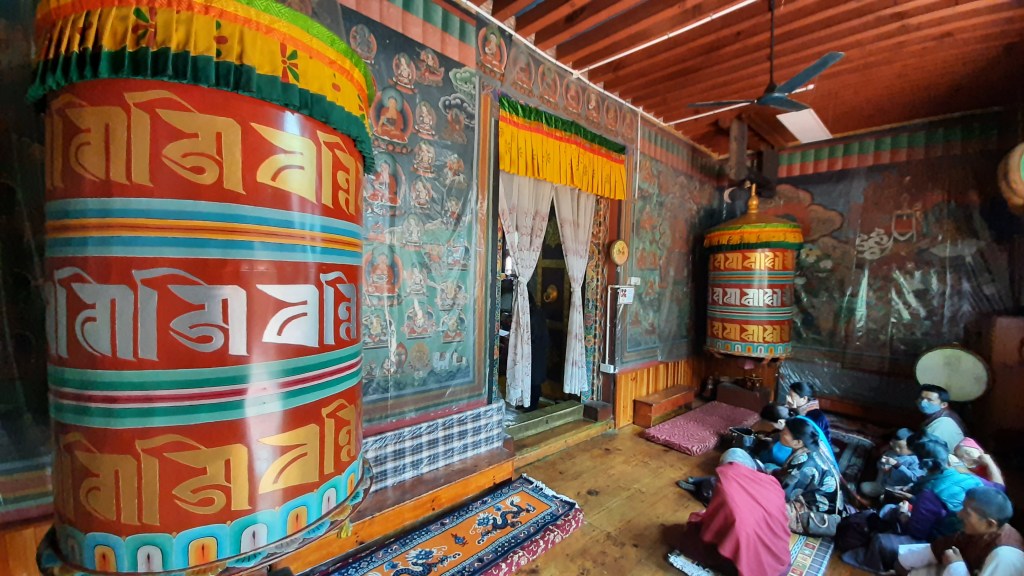
The venue of this event in the most-sacred Mebar Tokchoe temple (aka Ngajur Pemachophelling Dharma Centre) in Nangkor Gewog in Zhemgang.
The venue is 20 kilometers from Zhemgang town, 17 kilometers from Tingtibi and 4 kilometers from Dakphel towards Buli. It is under Kikhar chiwog.
It is easily accessible from Gelephu (107 km), or Trongsa (100km), and even Thimphu (300 km). All roads are blacktopped till the venue.
Place to stay and food: The Centre has seven rooms that can accomodate around 32 guests. Plus a camp site that can take up 15-20 tents. Food and water and food will be served by the Centre.
There are hotels in Zhemgang and Tingtibi too.
Other nearby pilgrimage sites: The famed Buli Tsho is a 45-minutes drive from the Centre. Zhemgang town is 30-40 minutes and is the site of Zhemgang Dzong, Lhamo Remati temple and Mani Dunjur built by late Jadrel Rimpoche.
On the importance of Drubchen:
“If there’s any drupchen happening, one must try to participate. Just as we should participate in tsok offerings again and again, it is really good to participate in a drupchen as a Vajrayana practitioner again and again. It is believed that just going to one drupchen will take care of all samaya breakages instantly. Where there is no drupchen, one should try to organize one. “…………………………..
I refrain from going to social events in Thimphu because it is a highly sophisticated city. People now greet you with a question, “Busy?” instead of kuzuzangpo. I am never busy. And, I guess, no one is in Bhutan except for the bees.**
More importantly, I avoid going around because of a very uncomfortable question I face: “Where do you work?”, which means what are you? First, I do many things to point out just one work. Second, in a city that is dominated by power and privileges, this question also implies that if you are not in the government service, you are of less value, or you are not serving your country – or a combination of both. As a matter of fact, many non-civil servant youth will even respond, “I am not working,” if they are not in the government.
While you can shrug off the topic as nonsensical, it actually gaslights you into believing that you aren’t doing much with life. In fact, ever since I left the government service I have often asked that existential question, and even pondered deeply if I was really playing the rolling stone that gathers no moss by moving too much.
I was in an eternal dilemma.
My moment of enlightentment, however, came through in 2019 while attending a wellbeing retreat in Bali in Indonesia. There, my good friend, Ron Elison (PhD), a professor-psychiatrist from University of California at Berkeley, was speaking on the topic of discovering one’s true self.
“Be a verb, and not a noun”, he said, somewhere in his hour-long talk. And went on to explain the difference.
I was like, “Wow! That’s me. I am a verb.”
Life is about doing. Not about being.
A verb describes an action, or an experience, such as “feel”, “run”, or “do”, while a noun only refers to a thing like a table, cat, or chair.
While saying, “I am a teacher” or “I teach” may sound similar, there is a difference. Being a verb is to be dynamic and action-oriented, while nouns are static and role-focussed.
For example, when you say, “I am the CEO,” your focus is yourself. But when you say, “I lead a company”, or better still, “I provide leadership to my team”, you are action-driven. Your focus is your people. Furthermore, a verb gets you into doing mode. If you think that your role is to lead or provide leadership, you will be motivated to do it.
As you verb your life along, you will soon discover that there is simply a greater joy in “doing” than in “being”. Although I resigned being an engineer in 2002, I still like building stuff. In fact not a day goes by that I don’t look for one of my tools. I love storytelling and taking pictures. I publish some on my blog or on my social media handles, but I don’t claim to be a writer. I like to learn new things and I went back to school at 49 and earned my second advanced degree, and now I teach another field: communication, social science and traditional wisdoms.
I am not a public servant but I serve rural communities by being there for them when they need. I helped build three temples as a social space in two far-flung villages of Rukha and Lamga – both in Wangdue Dzongkhag ( I am from Trashigang). I don’t say that I am a Buddhist. I just practise loving kindness and compassion (core Mahayana teachings) everytime an opportunity arises. These days I am helping organise Phurpa Drubchen (Vajrakilaya rituals) in Zhemgang to see off the Year of the Tiger and welcome the Year of the Rabbit. Hard-core Vajrayana practioner? Na! I am just verb-ing away my life.
There is science behind
There is something called linguistic determinism – a sociological perspective that stipulates that the vocabularies you use determine who you are or what you become. A Stanford professor suggests that people who use more “but” when talking were less successful in life because they get less things done. E.g. I want to do this, but…. I want to help you, but…
In our case, the way you self-identify yourself as just “being” or “doing” will also define whether or not your life will be a fulfilling one.
Of course, labelling others, and ourselves, makes our brain feel safe. Or so some psychologists would say. It has its positive sides too. For instance, if you are walking in a jungle at night and see a dark figure, you will panic. But if your friend tells you that is a bush, you feel reassured. It is nature’s way to keep us calm.
Nonetheless, using nouns is not how one should identify oneself. Labelling is self-defeating, as writer Austin Kleon notes:
Lots of people want to be the noun without doing the verb. They want the job title without the work.
Let go of the thing that you’re trying to be (the noun), and focus on the actual work you need to be doing (the verb).
Therefore, don’t be just a teacher, but teach and inspire your pupils. Do try to be a writer. Just write! Don’t say you are a civil servant. Serve the public. Make a difference in someone’s life. And, don’t look for a job. Look to work.
Being a verb will surely take you far and to more interesting places than just being a noun, because, a rolling stone gathers more moss.
~~~~~~~~~~~~~~~~~~~~~~~~~~
NB:
* In western cultures (Australia included), you have more chance to land a job, or a scholarship, if you use verbs when you describe your resume’. E.g. instead of saying, “I was the media director”, you say, “I led the strategic communication team for this or that event”. Always action words to describe yourself and your achievements. Another example: I never say, “I was the chief engineer of BBS”, but I say, “I brought TV into Bhutan in 1999”. And people go, “Wow!”
** When my friends, who are heading government departments, and corporations, say they are busy, I tell them, “You are not busy. You are stupid.”
I spent much of my youth learning science and technology. Now I am learning about our culture, traditions and spiritualityWe are the self-appointed wisdom keepers of the world – from 4 different cultures living in 5 different countries
My friend, Rajesh, has a problem. He doesn’t know how to introduce me when we meet new people.
I studied engineering in college, and worked as the chief engineer in Bhutan Broadcasting Service before I made a complete career-shift and went to make documentaries and host TV shows (Q&A with Dorji Wangchuk between 2003 and 2005). I also led the BBS as the GM of administration and HR, as the No. 2 at BBS. I eventually resigned from there to go into freelance filmmaking and newspaper column writing for two years before I was inducted as the Director of the Royal Office of Media in 2009 to head the media relations and public affairs for the highest office of the land. I served there for four and half years. I am now into my third career as an academic and educator – again in another field altogether- communication and social science. I teach media, communication and wellbeing leadership.
So who, or what am I? An engineer, TV anchor, media exec, filmmaker, writer, PR guy, or a professor?
Well, I am all of these – and none of these. In the sense I never liked to be stuck with titles and designations – and in short to be labelled, which in Bhutanese popular culture, you are often remembered by those titles instead of the given name.
First of all, when you take the label too seriously (many do) you entrap yourself with a list of do’s and don’ts, between what is proper and what is not, and within the boundaries set by the society. For example, if you are a TV star, you are not supposed to be underdressed. Or if you are a professor you cannot go dancing.
Second, when you are stuck with a title or designation, slowly and unconsciously you build a false identity of yourself around that label, such as “Now I am a director. I need to stop hanging around with my drunkard friend in a pub”. You get deeper and deeper into that “identity” that after a while it feels scary to leave, to change, or to move on, or move out of it. In general, this is what I see happening with many people with power. You take root. You build yourself a comfort zone. You don’t want to step down, or step aside. Eventually, you will undo your own legacy.
Lastly, isn’t life too short to be limited to doing just one thing?
The world is a beautifully crafted and diverse place where, besides the different cultures and traditions of different countries, there are microcosms of subcultures in every profession with their own charm and rich experiences. For instance, the microcosm of engineers is totally different as compared to, let’s say, that of the doctors, or taxi drivers. The life of a filmmaker is a world apart from that of a bureaucrat, or of a minister.
I call each of these lives another mode of existence. Nothing more. Nothing less. Each has it own share of fun and fares – and of struggles and skeletons. To live a life in full is to experience as many of these different worlds.
Although we inhabit the same country, or the same city, at the same time, the world we see and experience depends on what we perceive of ourselves. That’s why the identity you build for yourself is important. That’s why not being stuck with something – a job or a profession, enables you to immerse into varied experiences and microcosms of the different worlds that the universe offers.
Someone said, “Keep moving – unless you are a tree”.
It was January 2020. My bags were packed, ticket booked and hotels too. I was planning to fly back to Macau after the New Year break in Bhutan when I received an “urgent email”. I was asked not to re-enter the university campus and was told to wait for further instructions. A public health warning was issued.
What happened next is anyone’s guess.
Disruptions on a global scale where dreams and destinations had to be put on hold, and projects and prospects had to be dumped altogether. To put it a la John Lennon, life happened when I was busy making other plans.
Fast forward to three years, and we are in 2023. And things have become even more uncertain. Maybe the looming threat of another Covid pandemic is real. Maybe it is the lasting damage brought about by it. Whatever. We live in a critical time and must now accept that uncertainty will be a norm hereafter.
I had written about how we as a nation must respond to the post-Covid era. (See ”Thoughts and dreams on the eve of the National Day”, December 18th, 2021, Kuensel).
In this article let me share a few things that I learnt as Covid caged us indoors – fearful and pondering, but left me a better me – and also as a fatter me.
1. Just do it! Nothing is permanent.
If I have to meet a friend, or a relative, I just call right away. If I want to go for a pilgrimage, I set off immediately. If I need to do a gyelwa (accumulation of merit), I just do it. I don’t put it off for some other time because that day may never come. And if another pandemic strikes us, that day will never come.
Bhutanese are master procrastinators. We live, and act and do things, as if we are immortals. We must remember an old Bhutanese adage: “one day we will fall sick, we will feel the pain, and we will die eventually”. Covid has delivered the greatest teachings of impermanence.
If it is something positive, just do it! Do not procrastinate. And if you cannot be nice, do not be mean (my late mom’s golden rule). Remember, nothing lasts.
2. My way – and the highway
A little surprising fact about me. I get easily disappointed when things don’t go my way. I used to be, “My way or the highway.” Now I am “My way and the highway”. Covid has taught me that the world does not dance to my tunes only. There are many things that I can do nothing about. And there is no use of worrying about them.
Now, whatever is within my reach, I do my best. Whatever is beyond me, I let it be.
At times, though, I slip into my old self – and my heart sinks seeing some things unfold in front of me – only to immediately tell myself, “Nope! You shouldn’t be bothered with something that you have no control of.”
I let life move on and I follow it with humility, gratitude and acceptance.
3. I am enough. I have enough
In August 2013, after a long career in the government, I packed my small car and set off for my hometown – Tashigang, where I was assigned to replace a runaway American professor, and teach a class of media students at Sherubtse College.
That short stint left an indelible mark in my lifestyle. I realised you don’t need much to live or survive. I experimented living on 10 pieces of clothing. I succeeded.
It is in our nature to keep wanting for more. Now I think twice, or thrice, before I make any purchases – especially clothes.
No brands or bigger cars can make up for what you are not. Instead, if you just keep repeating to yourself, “I have enough. I am enough”, you will feel complete and content.
4. Smile! You are alive
In case you are not up to speed with the latest stats, Covid-19 has killed seven million people around the world. That is ten times the population of Bhutan. Plus over half a billion have been infected.
And yet when I look around I see we are all alive but back to grumbling en masse. It is appalling to observe how easily we forget the good things that happened to us, and around us, or were bestowed on us. The fact that we are still alive, in the first place, is in itself a great achievement. Not everyone has been as lucky. So, smile!
Don’t take anything for granted – your life, your job, and your relationships – the people under your care, or those around you.
Do everything that excites you. There is another popular Bhutanese saying – we don’t take anything when you die. Of course, you do. Your karma will follow you. The gyelwa you do will accompany you. Your legacy will be immortalised after you.
We lost 2020 and 2021, for sure, and also 2022 for many of us. We have gone through so much. But 2023 is here. Embrace it with a new you, and not as your old self.
Nyilo literally means the day when “the Sun returns”. It is believed to be the shortest day of the year.
One folk belief of Nyilo – the winter solstice, is that the Sun returns from the South after paying respect to Shinje (Sanskrit: Yamaraj). Shinje is one of the Deities of Ten Directions (ཕྱོགས་སྐྱོང་བཅུ་, chokkyong chu).
Since Shinje is also the Lord of Judgement of Death, there are believed to be many dead souls waiting for the final verdict. Some of them escape with the Sun, or they tag along. These dead souls called Shinpo are believed to bring harm, deaths and diseases to the human world.
What this entails is that the days following the Nyilo should, therefore, be dedicated to doing rituals to push them away. This maybe the reason why annual kurims for health of the house or of the clan, or even village, are conducted in the winter months.
The general norm for performing annual preventive or propitiating rituals is as follows: life threats averting rituals to be conducted in Winter months, and prosperity-seeking rituals around the Summer solstice. The latter is when the Sun returns from the North, which is ruled by Kubera – the wealth deity.
What may be suggested is that in Summer, for example, one can conduct Drolma Yuldog, or Namgyel Tongtshog, while in Winter you can do Jabzhi, Mikha Kharam, or even Tordog.