This study examines the phenomenon of social drinking in the small and remote community of Lamga in Athang gewog in Bhutan and it is studied through the lens of communication scholarship. The key research objective of this study is to describe the symbolic sequence of the toasting and drinking ritual and interpret the cultural meanings that ultimately help identify the sacred object of the communication ritual.
Drawing from the cultural view of communication and using the cultural discourse analysis as the methodological framework, social drinking in Bhutan can be understood as a structured sequence of symbolic acts – in which, firstly, there is the acknowledgment of non-human denizens such as wandering spirits, local deities and hungry ghosts that are believed to co-habit the same space as humans. Second, participation and performance in social drinking is a reaffirmation of the sense of community, social order and of interdependence of the various phenomena that come together at a specific place and time.
Third, it reveals the possibility of sacred time, where ordinary people’s lives are dictated by the spiritual rigour and not the clock, event or nature as expoused in the Geography of Time.
The significance of this study is that it looks at the social phenomenon from the lens of a communication scholarship. It, thus, fills a gap in, and contributes to, the sociological studies in and on Bhutan
The death of a student in India and the fatal bus accident that killed seven and injured dozens may be relatively small compared to bigger tragedies happening around the world. It maybe just one girl or one bus, but it is simply one too many for a small country like ours. However, as much as they are painful and they tear your hearts apart, the bitter truth is – they will keep happening more and more. Wider roads, faster vehicles and poor monitoring plus increased distractions from 3G/4G and smartphones.
They will also keep happening because we don’t learn from them. We just shrug them off with simplistic conclusions and we don’t do enough reflections and investigations on them. I am not saying that they will stop happening if we do. But I can bet there will be less of such incidents if we are bit more careful. For, investigations are not just to find who is at fault – or to start a blame game. They also provide useful recommendations as to what we can do in future to minimise such tragedies. They make us learn from our mistakes. And mistakes we would have made because nothing happens out of nothing.
Otherwise, what have we learnt from all the suicides so far? Nothing. What have we learnt from all the bus accidents so far? Nothing. What have we learnt from Wangdue Dzong fire? Nothing. This is because we close the cases too soon. We just want to bury our heads in the sand. I have no idea why we do that all the time.
It might sound like I am nagging over a spilt milk – but I hope from now on we can go beyond the prayers and butter lamps, or Facebook condolences. If we really want to honour those who are gone for no reason, we should not let their deaths be in vain – at least. There should be thorough investigations. And findings should be kept as state secrets but released through the media – so that we are informed and people become wiser. I would assume that not all the fires are from short-circuits or from butter lamps; not all bus accidents are from mechanical failures or drunk driving and not all suicides are committed by the mentally ill.
Even after the initial shocks are over and tears have dried down, and a slice of our heart is gone forever with the embers of the cremation, a question will linger in our minds: Why did that happen? Was it a suicide? Was it the boulder that pushed the bus off-road? I hope we start getting some answers.
Otherwise to quote a cliche, history will repeat to those who don’t learn from it. My apologies if I am sounding bit heartless or ominous.
😵😵😵
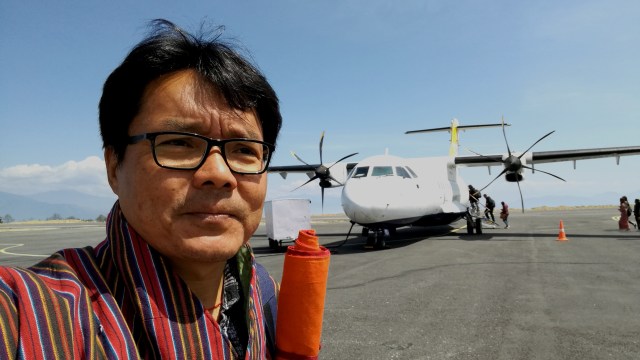
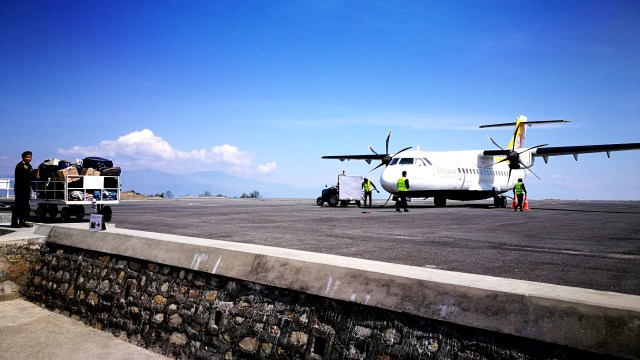
Did my first domestic flight. It was Sunday and so even memay Dangling must have been sleeping. He didn’t throw clouds around, or mists or wind, which are typical of Yonphula.
In keeping with the local tradition, I put on my only non-gray and new gho to ensure a good tendray (auspiciousness). This is Sharchopa culture
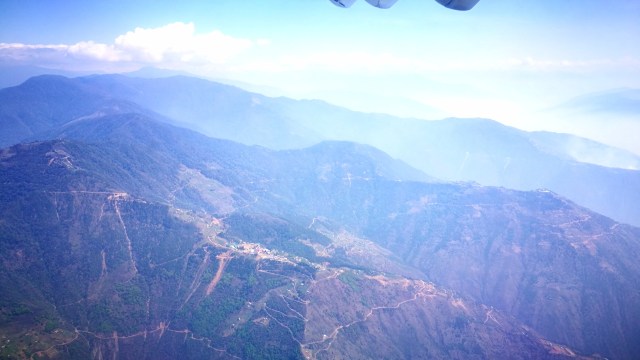
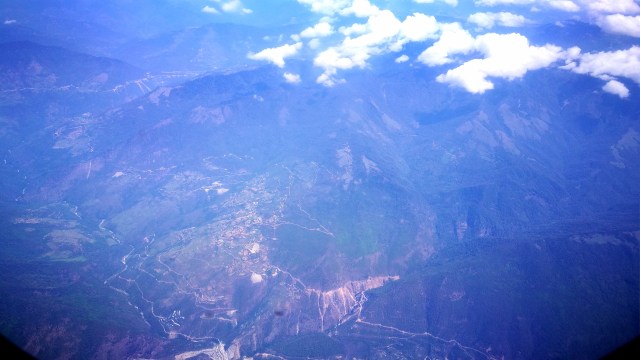
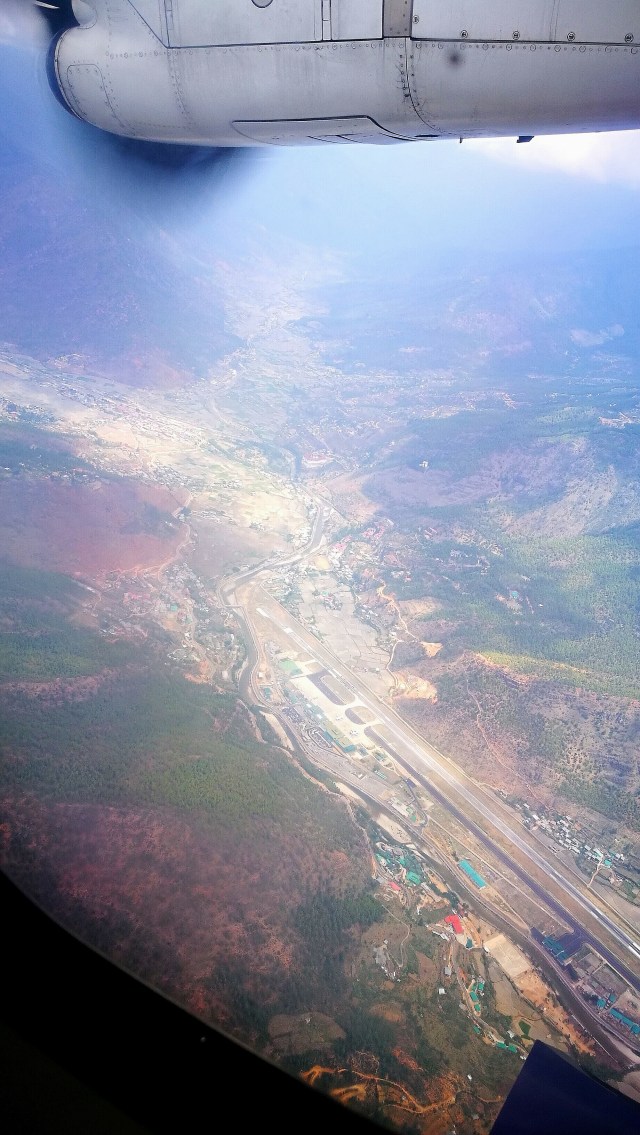
From high above I realized two things. First, how small our country is. From high above, you can see both ends of the country from one window. And second, we still have lots of forests and unexplored land.
Flight review
Ticket cost Nu. 4,800 one way. Cheaper than taking the car and doing a 2-day and 540km of roller-coaster ride. Good ground and onboard service. For someone who once took 13 days to get from Tashigang to Phuntsholing, it is rather surreal to make it to Thimphu in 30 minutes.
Suggestion to Druk Air
Have local pilots or air hostesses who can explain the places we are flying above. I could identity all the places but not many Bhutanese are familiar with our own country. On that route you can see famous places such as Dremetse, and all places along Kurichu valley, Chamkharchu valley, and Mangdechu valley, plus Phobjikha, Khotokha, Punatshangchu valley, Thimphu and all the mountains from Gangkhar Puensum till Kanchenjunga.
I did a guest lecture for final year media students at Sherubtse College. I introduced to them one of my pioneering work in academia – the middle path journalism – a theoretical framework for the Bhutanese media. The book chapter by the same title is already used in some foreign universities as a required reading. I am glad it will also be included here from next semester.
Besides the academics, the students asked me for some advices as they complete their college life in two months time. Here is what I shared with them.
1. Learn to communicate.
As a media student you will be expected to communicate well. If you don’t, you will be doubly handicapped – as a graduate and as a media graduate. Even otherwise, in any career or in life communicating well is a prerequisite to a successful life, career and relationships. Not communicating and not knowing are the same. Make sure you are able communicate so that you can share your knowledge and take our country and humanity forward.
2. Prepare from now.
Make the most of your time left out here to start preparing for whatever you will be pursuing as a career. If you heading for the civil service, revise your maths skills because that’s where media students suffer in the BCSE test. In other sections of the exam, you should be okay. If you are going for career in media, start collecting your portfolios of photograph you took, video you made and articles you have written. This will come handy when you apply for jobs. Be ahead of your competitors in life. Don’t lazy around.
3. Take life as it comes.
Most importantly, as you move into the next phase of your life, always remember that many good thing will happen – but so will bad things. The key thing to remind yourself is not to be too sensitive or be to reactive to either and to let go both eventually. Don’t take life too seriously. Enjoy your life, have fun, cherish each moment and people you meet and above all, be open-minded on everything. Do not discriminate between jobs, or people or experiences. Take everything with an open mind. People say that things happen, and people come in your life, for a reason. I would say you find reasons and make the best of everything.
Have a long-term vision, but do what is immediately placed in front of you. Grab anything that comes your way, do as many things as possible, go see places, meet as many people.
Lastly, whatever happens, especially if you are going through hell, keep going.
I grew up looking after cows. The job entailed herding the cattle into the jungles and leaving them there to graze – while I dipped my head in books or catch crabs in the stream. As the day passed and the Sun dropped towards the horizon, it was time to regroup the cattle and head them back home. Some cows, however, would have strayed off the herd and my job was to find them in the thick forest, where quite often I would lose my way.
“If you are lost, you should go back and find your footprints,” my grandfather would advise me. I followed him and never got lost – even once. “And that goes for your life too. Some day you will understand”.
For over 40 years, I followed the same advice when it came to my life too. Quite often I got lost in the medley of wrong choices and decisions – and found myself in the thickets of confusion and lack of confidence to move on. So, I often turned back and found my footprints – from the place and the path I followed.
In 2013, I was at a crossroads and I remembered his advice. So, I traveled back to where I was born and where my life started. This is the spot, where 51 years ago, among these splendid mountains of memay Ralang, Tshong Tshongma and Serkemla, with the Vajra Dakinis (Dorji Khandum) presenting at my birth, I saw the light of the world. The auspicious nativity was however countered with the sad economic conditions at home. My family was poor and had nothing. We lived in a one-room hut that had to be repaired with each passing storm. For much of my childhood, the piece of cloth I wore was the only one I had. I had no slippers or shoes. We scrambled for food and there was not much to be found. So, my sisters and I would wait for our grandfather, who was a lay lama and was served with some meat and rice for conducting rituals and religious ceremonies in the nearby villages of Radhi and Chaling. He rarely ate his lunch and instead packed them for us at home. All along my father was away, drafted into the army, following the brief war between our neighboring countries in 1962.
Nonetheless, the extreme poverty didn’t deter us from being happy. My mother had an endless supply of jokes, songs and stories. Some, she made them up. She was extremely talented. She taught us never to blame our misfortune on someone and instead smile against any adversity – and never to lose our sense of humor. My grandfather assured us that everything was temporary and that we would one day be back to our former glory. He used to tell me how our great grandfather used to launch long pilgrimage expeditions to Tsari Rongkor in Tibet – with 30-40 horses and several servants and porters. My mother and my grandfather also kept reminding us that we are descendants of “givers from the top and not receivers of alms from the bottom” (a Bhutanese aphorism to mean noble families who are not only wealthy but generous too) – and never to forget this fact even later in life. I was also told that one of our ancestors came from Aja and was a great yogi while our great-grandma who was still alive and living with us was an ashi from Tawang.
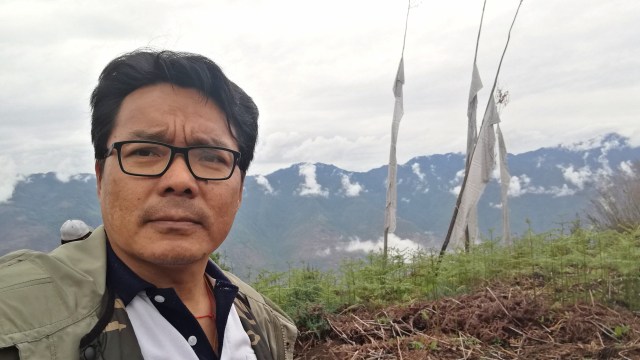
Today I stood here in silence for a few minutes and paid tribute to my two greatest persons whose lives, characters, and optimism shaped me and my life – and the lives and the characters of all my siblings. From this ground, where three prayer flags stand today, like the wind, I fluttered away – launching my expeditions into my dreams and journeys. As years rolled by, I rose to positions of power and prominence. I did things that I wanted to do and achieved what I wanted to achieve. I travelled the world – and continue to do so. I have not only managed to come out of those miserable conditions but have personally helped hundreds of families to do so in distant places like Athang gewog. And of course I have tasted glory and fortune too. Yes, I have come very far. My grandpa was right. The condition we were in when we lived here was temporary.
So, in life, if you are doing well, push harder. But if you are getting nowhere, just turn around. Retrace your footprints. Trace your roots. And launch yourself again. You will appreciate where, and how far, you have come; what kind of hurdles you have crossed, and how many things you have achieved in your journey called life. It will give you the confidence to move on.
For, you and only you can find your path and walk your dreams.
Where the three flagpoles stand, stood our hut I was born. A chorten in the memory of my late mother and grandfather would be just as befittingThe view to the north – memay Ralang (that looks like a back of an ox) and behind it, in the distance is the Tshong Tshong Ma peaksYul Pemachen, the legendary kingdom from the Khandro Drowa Zangmo tale, is on the hill to the left of the picture – with cluster of pine trees. It is a 30-minute walk from where I was born. This village is flanked by Bartsham, Gongthung, Dremetse and KorilaDrung Gonpa (from the word, Drungpa) is now the official name of my native village. It was established by my great-grandfatherHere in Tongling Pam once stood the manor of my great grandfather, who was the Lord of the regionOne of my 21 cousins receiving me in his house in Tongling PamThey give me everything they have. Truly an humbling experienceMore cousins and nephews paying visits with loads of gifts
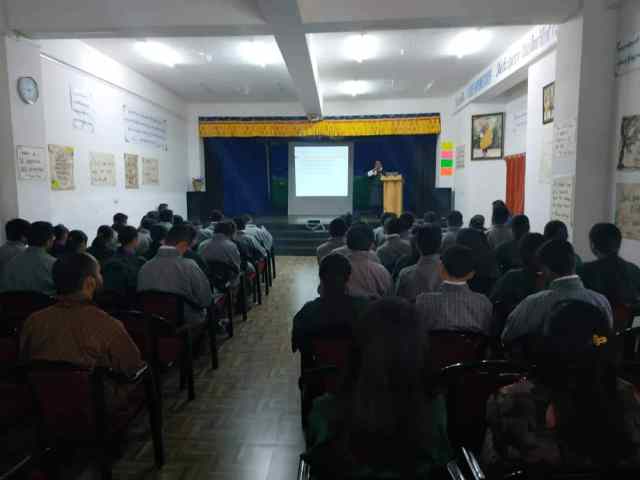
I spent a wonderful morning in Jakar High School today, where I was invited to give a talk to the students and teachers there.
In little over 45 minutes I was given to speak to 600+ audience, I shared my own story of how early on in my life I found my purpose (to be of service to others) and passion (media and movies) – and how everyone should find one’s life purpose to give a meaning to one’s life.
Purpose sets our direction; passion drives us
Purpose gives us a sense of direction, our principle and an ideology. Passion drives us, motivates us and gets us out of our bed. Without the two you will be wandering aimlessly. Without a greater purpose, we end up seeking happiness in the external and the material – and wait for salary raise with every new government – or get devastated, or fearful, by few audit memos.
Live in the present
One should be fully in the present moment to savour what life has to offer. That’s called mindfulness. And avoid the typical Bhutanese style of delayed enlightenment (where you enjoy moments retrospectively) or of hedonism (as if there is no tomorrow) or of nihilism (where you feel you are no one). As milay Rimpoche, we all have a purpose – otherwise Good must be stupid to throw us on Earth without one. Find your purpose and live your life meaningfully – and in the service to others – your family, friends, community and King.
The present generation, if I may characterize, seems less resilient when actually it has to be stronger than the previous generation. This is not good. If there are two things that one needs to cultivate to develop internal strength, they are empathy and attitude.
Empathy and perspective
Empathy is the ability for one to share and understand the feelings of others. This, unfortunately, seems to be lacking nowadays – especially among our public servants. Who has not walked or travelled for days to get some public service, only to be turned away at the counter by an unempathetic official.
Perspective, on the other hand, determines our relations with the social world. It guides you to make sense of whatever happens to you as you dwell in this samsara. Perspective is the space between what fate offers and how you react. As the great German psychologist, Victor Frankl, said, “between a stimulus and a response, there is a space. In that space we have the power to choose.” Unless you cultivate the right perspectives you will always make wrong choices.
So, what do you choose to be.
Life goes on
I ended my talk with my favorite line: in pursuing your passion and dreams, you will garner success. Don’t be overwhelmed by it. You will also face lots of disappointments. Fear not; for, disappointments will reveal who your true friends and family are. Cry if you must, but collect the broken pieces, smile, and learn to move on.
And whether you taste success or failures just say to yourself – life goes on. And life will most probably smile back at you.
Last week I visited the Norbuling Rigter College in Paro – accompanying a group of American businessmen who were touring Bhutan as a part of the Abroad Inc – a US-based executive education company.
While they interacted with the students, I also shared few observations plaguing our business sector. Here is an excerpt from the interactions.
1. Reinvent the Wheel – Many people ask me to suggest new business ideas while others seek my opinions on theirs. My take on this is that there is no need to absolutely invent a new product or service. In fact it is not even a good idea to start something new in Bhutan. We are not a nation of early adopters. So you can pick an old one and work on it and make it better. That’s called innovation. You can reinvent the wheel. For example, how can you improve the taxi service in Bhutan? Can you take over the water supply system in Thimphu from City Corporation? Can you do better ezays and pizzas? And so on and so forth. Look at existing businesses and see if you can do better. Actually you can, because currently our services and business outlets are really bad. Momo has not evolved since 1970s. You, as younger mind and better educated, can do better.
2. Commitment – I do lots of carpentry as hobby and for the last twenty years I have been visiting saw mills to buy sawn timbers. They would tell me to return after few hours. I drop the list of my requirements but I have no memory of any saw mill delivering anything on time. Likewise, recently it took me five reminder visits to a tailor to get two ghos stiched. Be it in the government offices or a business house, keeping commitment is a major difficulty in Bhutan. Can you keep your commitments? Can you be trusted? Can you keep your words? Can you deliver on your promises at all cost or whatever happens? If you can’t commit, nothing will work for you in your life – lesser still in business.
3. Value-added services. One dream of every Bhutanese is to earn without working. So being a middleman, receiving commissions or fronting businesses without lifting a finger are very popular. The other month I was driving up from Gedu and I came across many trucks with semi-finished wood products or potatoes going to India. I know there across the border, they work on the value-adding the products and sell them back to us at triple the price. We idiotically buy our own products that we could have done ourselves in the first place. Can you be less lazy and do the value addition here? Can you create jobs?
Having great idea is not enough but you should honour your commitments, innovate continously and stay ahead in your game. Then may be you can achieve some success in your businesses.
(Part of my talk at ELC High School where I shared about social media literacy)
“Finally let me get to something that I want to share from the core of my heart – while speaking my mind as usual.
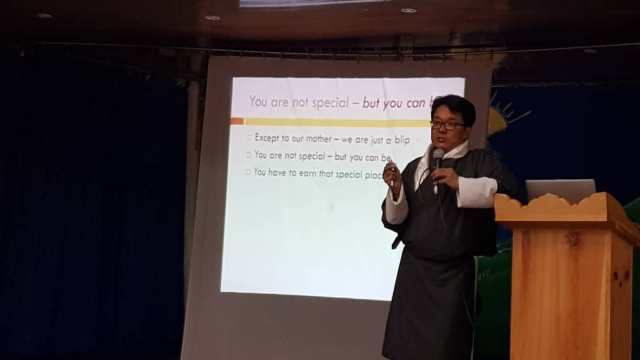
I am sure your parents, your teachers and the speakers before me must have told you that you are special. So, let me be the black sheep, and tell you some hard stuff. Maybe for your mother, you are special. To the rest of the world, you are not. The world doesn’t give a damn of your existence. You are just one of the 7 billion creatures on earth – called humans. When you leave this school, no college is going to roll out a red carpet for you. For those heading for the job market, the reception will even be worse.
When I was in school, I was told that I was special. Every VIP told us that we were special. But after I graduated from there, I felt like a stray dog. I spent one full week wandering around in Thimphu – in a deep winter, to get a slot for further studies. The same chief guest who told that we were special didn’t want to even see me.
You are not special. But….. You. Can. Be. One.
You are not special. But….. You. Can. Be. One. You can be special. However, you must earn that special place. You can only be – by doing something good to others – and by being in service of the community, King and country. Doing good should be a habit. It is like respect. You must earn it. You must work hard. You must practice. You must start from today. Right now. Sorry, not right now. Right now, please listen to my speech.
You can start by being a special person to your classmate, to your roommate. You can be a special person to this school. Then when you grow up, you will be special person to your community and the humanity – at large. Remember, the world doesn’t owe anything to you or me. We owe it to the world.
This country doesn’t owe anything to you or me. We owe it to this country.
For me, every moment of my day or my life, I try to be of service to others. It has now become my second nature. I try to be nice – even nice to total strangers.
Last week, I was hiking up to Taktsang. When I reached the waterfall below Khandro Yeshey Tshogyel’s caves, I overtook an old and fat Indian lady. I am saying “old and fat”, not to demean her but to make a point that she was unable to proceed any further – because of her weight and age. She was breathless. Taktshang stands at over 10,000 feet and one can suffer altitude sickness – especially among people coming from lower altitude. I thought she was sick so I ran some medical questions with her. “Are you OK? Are your feeling nausea?” “Headache?” “Do you have stomach cramp?” These are the symptoms of altitude sickness.
She had none. So, I joked to her that “you Indians, you eat too much rasmalai.” She smiled. I continued in perfect Hindi, “Actually, I like rasmalai and I am sure I eat more than you” She smiled again. “Come on, you have walked up till here and you are giving up?” “We will do it together. Hold my stick. I will pull you up like a gaur”. I let her hold one end of my walking stick and I started pulling her uphill. She was heavy. There are at least 200 steps to get to the top. A near vertical climb. We made a few steps each time and stopped to catch our breath. I taught her breathing exercise. I encouraged her. I raised her spirit by telling her that if she wanted, I can also call a flying tiger. I told her that I had Guru’s number.
After a vigorous 30 minutes (usually I take less than 10) we made it to the top. When we finally did the last step, there was a loud cheer from other tourists and visitors who were watching the whole drama. She looked at me and said, “Thank you. Thank you. You are my God today”. I felt nice. I felt special. I even thought that if had become a God, I should try flying off from Taktshang. I changed my mind and decided walking was still better for now.
To end my speech, as I said, to your mother, you are special. Furthermore, I must add two more persons for whom you are special. First, is your Principal here – madam Deki – an extraordinary educationist – a good human being. To her each one of you are special. She feels for you like a mother. And then as Bhutanese, each one of us, we are special in the eyes of our King. You can trust me on this.
Since the people for whom you are special are so rare, then what I want you to do is that as you grow up, I want you to never fail them – EVER! I want you to make them proud. Because to them, no matter what, you will always be special. For the rest of the humanity, you will have to earn your rights. Remember your parents don’t owe anything to you. Our King doesn’t owe anything to us. Your principal doesn’t owe anything to you.
I see many of my friends on the social media sharing newsfeeds from questionable sources on benefits of this or that plant, miracle foods, health supplements, weight-reducing stuff, fat-burning creams, etc. I would them to be very careful with these things. Some may be genuine but most are either fake or commercial stunts.
Every human body is different
One basic thing to remember when it comes to healthy living is that our human body is extremely complex and what worked in some countries or people, may or may not work in your body. In some case, it could be dangerous too. For example, quinoa gave me diarrhea when I once ate it. I guess my body didn’t recognize this magic food. Or I suppose, I don’t have the enzymes to break the quinoa into energy. Then there are scientific claims that they have been experimented on rats or guinea pigs. We are neither rats nor guinea pigs.
My simple approach to food is, whatever we (me and my ancestors) ate in the last 5,000 years is good. Something from a distant land could be tricky.
The detox myth
Human body is also very strong and resilient and can absorb quite a large dose of toxins, which we consume without knowing – like from pesticides, food colorant, packaging, etc. So, go slow on all these ads and websites about detox-week, detox foods, etc. I am not a medical doctor but I suppose that if there are toxins in your bloodstream, you die. If there isn’t, there is no such thing as detox either – unless of course you are a drug addict or an alcoholic. There is a nice article in the Guardian on this.
Like wise there is no such thing as lose weight. You burn fats and that has been achieved in our country through active lifestyles in the farms and not by drinking a magic portion. Now with urbanisation only way is to leave your car and walk up the mountain every morning and eat healthy.
Get professional advices
By the way, for those living in Thimphu and the major towns, you can visit the nutrition specialists for advice. You need not be ill to go there. Get professionals to suggest what is good and what is bad. Not the Google and not the TV. Make use of our free medical services. The nutritionist will get your medical history, check your BMI, and prescribe you what is good and what is not good for you. I did that few years back.
And don’t forget, we also have the Traditional Medicines in our free public health system. Visit them if you really want to know which plant to eat to lower your blood pressure, or to keep your diabetes and heart diseases on check.
Above all, have more confidence in your own body. It is gift.
(Transcript of my talk in Zhemgang Central School)
Well, let me start by saying how humbled I am to be asked to speak to you. I am neither a VIP nor a celebrity and so I must apologize to you for ruining your Sunday. I suppose, now, I must also do some justice after getting this honour.
I had a topic in mind, which I always share with school students wherever I go. It is about finding your passion and purpose in life. But after getting here and looking around, I see myself in you – a poverty-stricken boy that I was – of some 30-40 years ago. So, let me share my own childhood story that somewhat resonates with yours. Hopefully, it will inspire you to make a better world for yourself and for those around you.
Unlike what I am today, I grew up in a very poor family. We lived in a hut and our only priced property was a goat. As a child, I remember complaining about being hungry all the time. And so, when I turned 7, I was packed off to a boarding school in Phuntsholing Kharbandi, where the government provided everything from food to clothing to basic needs. There our life was hard. We slept on bug-ridden beds and ate worm-infested food. We woke up at 5 in the morning to study, pray, clean our campus, have breakfast and go to class. The academic part ended by mid-day and after lunch, we had to go to our respective workshops where we learnt tailoring, carpentry, sheet metalling, welding and so on.
For much of my school life, I also went barefoot – with Bata slippers at the most – or a pair of converse shoes that the school provided, which lasted for few months. We were all poor and so we didn’t mind being that way. Now, when I look back I cherish growing up poor. I thank my parents for the poverty. It hardened me like a steel. It taught me valuable life-lessons – to be empathetic and to identify with the down-trodden. It taught me to be a good human being.
I completed my school in 1982 and I was sent to work in a factory in Gedu. Two or three months into my first job, I realised that, although I was paid well, it was not what I wanted to do for the rest of my life and so I ran away to Thimphu to try for further studies. After waiting patiently at the door of the Department of Manpower (which had just been renamed as RCSC), for a week in freezing winter, I got admission to Dewathang Polytechnic to study electrical engineering. From there I went on to do advanced studies in electronics engineering in Italy in 1988. The generous scholarship to Italy also improved my economic situation. I could not only take care of myself but I also helped my parents bring up my two other siblings and three younger cousins – and build a house in Thimphu.
I returned from Italy in 1995 and I had a comfortable job as an engineer in BBS. For many a government job is the dream and destination. For me it was a platform to do more – do new things – to leave a legacy. I proposed introducing FM radio – which has better signal quality. You guys are too young to remember how badly BBS Radio sounded in those days. But FM was a hard sell because some foreign consultants had concluded that FM radio was unsuitable for Bhutan. I knew that it was not true and I challenged that finding. After successfully testing the FM technology, we introduced in the whole country starting from 1998. After FM, came the TV project, which faced another big challenge, as His Majesty the Fourth King had earlier shown some reservations on introducing television in the country. We all know that the King’s words are sacred, but I always believed that circumstances change and the prevailing context was that we required to bring in TV and Internet, which we ultimately did in 1999. In those years, I worked 16-18 hours a day on average. I worked with the laborers at site. I led the technicians to do installations on high towers. I pitched tents and lived at the construction sites.
I resigned from the government in 2006 after my career hit a wall. Just two weeks after I won a big international award for one of my documentaries, I was barred from making them. Instead of sinking into despair and lament, or fight a losing battle, I decided it was time to move on – and away. So, I pursued an independent life of filmmaking and journalism. However, in 2009 I was called back into the government again, in the service of His Majesty the King. I was there for four years – until 2013. That was the zenith of my career – an honour and a dream of every Bhutanese. My whole family, friends and I are still very proud that I have been through that.
After I was relieved from the palace, I offered myself to teach in Sherubtse College as a temporary teacher – gloriously known as adjunct professor in university parlance. There I discovered yet another world, in teaching and research.
I know you all dream of being successful in your life. If you define success in terms of being able to do things that you want and thrive too, then I must say I had a successful life. Today as I reflect on my life, there are three things I can draw from there – which I define as my style and approach. For, success and happiness start with one’s approach and attitude. People talk about nepotism and corruption. I had neither a powerful uncle nor did I indulge in corruptive practices. If I have been successful regardless, so can you.
Here are few things that may come handy.
First, learn the fundamentals.
In my career I have recruited, groomed, mentored and taught hundreds of Bhutanese. One shortcoming that we all seem to have, irrespective of our profession, is that we don’t learn the fundamentals – the basics. We let shortcuts and ego take over our learning. When I watch BBS today, I find that some shots are not even framed well. If you look into our private sector, we see lots of businesses failing because owners can’t keep proper accounts or read balance sheets – and salespersons lack basic courtesies. Whether you are, or you want to be, an engineer, a teacher, an architect, a footballer or a medical doctor, you must learn and master the fundamentals. If you don’t, you will find no success or meaning in any profession you choose.
I have done many things in life. I was trained to be an engineer all my life. But when I moved to documentary filmmaking I picked up the fundamentals of camera works, scripting, editing and directing. Since I am now in teaching and research, I decided to go back to classroom to learn the basics of research and methodologies. In all the things I did, I can say that I have achieved some level of “success” – whatever this word means.
As for you, at this stage, if you want to be an engineer in future, you need to be good in maths and physics. If you want to be a doctor or a vet, you need good foundations in biology. If you want to be a writer, you must perfect Dzongkha or English. In short, learning the fundamentals means learning the basics. If you don’t get your basics right, you will be an average – or below average.
Don’t be an average… This is the second thing I want to talk to you today. If you look around and observe what most people do, they do what is just expected of them. Many people don’t even do that. They are below the average. You are more than 300 here today and if your Principal has to pick some of you for some rewards, he wouldn’t know whom to choose. But let’s say, among you there are students, who do a little more. These students will be noticed. As life gets more competitive, you need to be noticed from a sea of average candidates. The same advice goes to teachers who have joined us here today.
If you choose to be an average, if you don’t do anything more, if you don’t take initiatives, if you are just conforming to the norms and conventions, if you don’t take some risks, you won’t get very far. You will have to struggle for a job, for a promotion, for a scholarship or for recognitions. You need to stick your neck out. Now this also comes at a cost. Our society demands conformity and does not tolerate initiatives or criticisms. So, the choice is yours. As for me, I have chosen, and choose, to stick out. I know everything wasn’t always easy or rosy for me. The ride has been bumpy at times, to put it mildly. But if I could rewind my life, there is nothing I would do differently.
Yes, always do a little more. Plant a tree, clean a classroom, water the garden, pick up a garbage without your teachers asking you. Form this habit at your age.
Last, is about moving forward…
I am sure many people must have showered you with all the promises of paradise. As a country, yes, there is no reason to be pessimistic. We live in a blessed land. However, as you live your life individually – like as you grow older, get a job, start a family and move forward in your profession, you will be faced with challenges and obstacles. Since your teachers and your elders have taught you how to succeed, let me tell you how to navigate your way out of disappointments, envies and enemies that will come your way – together with achievements, accolades and guardian angels. What I want you to always remember is to look forward and say to yourself, “OK! What next? Where next?”.
We, Bhutanese, have the habit of nagging on something that has gone wrong. Move on!
You know, in my life I have made mistakes too – a lots of mistakes – some were very big. But they only served to remind me that I am a human after all. The most important thing is to learn from them, never to make the same mistake twice and to move on. So do not kill yourself, if you fail in something.
On the other hand, do not celebrate too much or put on added arrogance if success comes your way. Do not behave like you descended from heaven – like some of my own friends do. You will actually learn that success and achievements are not necessarily good. They attract envies and jealousies. You must also know that despairs and disappointments are not necessarily bad either. They reveal who your true friends are.
Therefore, whatever happens in your life, promise me one thing – that you will always move on.
Let me conclude by also reminding you not to forget to have fun. This is a golden age. As you study and prepare for your life, have as much fun, make memories and as many friends as possible. After this, you will have to get down to how best to serve our King and Country.
Much of what I remember when I was your age was that I used to be my Principal’s worst nightmare because I was mischievous and fun-loving – always up to something. But unlike some youth of today, we never touched drugs or alcohol or attempted suicides. Please stay away from these things. You can have fun without indulging in drugs or drinks. They don’t bring any lasting joy. But they put an end to your parent’s happiness.
So, to wrap up, again, three things – learn your fundamentals, stop being an average and whatever happens with your life, just keep going forward.
I wish you all the best that our country, your life and the world, have to offer.
~~~~~~~
On the hot seat. It is always challenging to inspire others.With the principal and teachers of Zhengang Central SchoolSome teachers came to receive me at Wangdigang with tea, momos and biscuits. Thank you again. That was so sweet of you all.










 Dorji Wangchuk