My thoughts during Gyalsay’s birthday

Royal birthdays should be celebrated as a day of togetherness and as a reiteration of one’s commitment towards one’s country. The irreversible journey that we have undertaken in democracy will keep us divided more and more. It is only in the institution of monarchy that we will be united towards a common dream, goal and aspiration.

My father was one of Bhutan’s first drivers. In fact he had the License No. 4. He was a royal chauffeur for few years before he was sent to the newly established Bhutan Government Transport Service (BGTS) in 1966. In the seventies I spent my childhood school holidays taking free rides with him.

autowp-ru_mercedesbenz_lkw_l3500_1-1

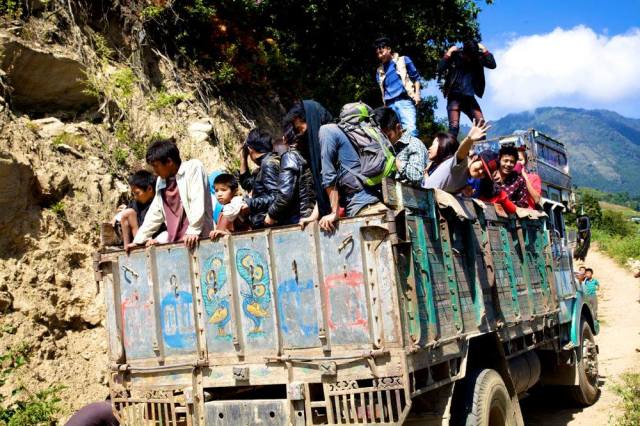
Since his black-coloured BGTS truck was one of the very few vehicles plying on the “highway” (sometimes the only vehicle on the road that day), my father would stop for everyone seeking a ride. After a while the truck would be brimming beyond its capacity that some passengers would protest, “There is no space, driver sahib. Don’t stop!” My father would pull his head out of the driver’s cabin and shout back, “Let them on board, as we move ahead you will all fit in.”

No one dare challenge him. BGTS drivers were very powerful guys those days. As the new entrants climbed on board and before they could settle in properly my father would mischievously zoom off. People would tumble on each other. There would be laughter. There would be laments. There were screams. Someone has his legs trapped while another has lost his slippers. There would also be some discussions over some extra spaces someone is occupying. Everyone would cooperate and slowly things would settle down. The journey would continue.

The rides were long and hazardous. The roads were narrow and slippery. Sometimes landslides and boulders would have blocked the way. Men would jump out and start clearing them with bare hands. While they worked, women would pull out the lunch packs and ara and zow. An ad hoc picnic would be spread on the road itself. Everyone shared or would be invited to eat and drink. The journey would resume. The progress was always slow. Night fell midway into the journey. It was scary. My father would be more focused. To his aid, someone would start chanting a prayer. Everyone would join in. We always got to the end of the journey. Safe and sound, as a cliché goes.

chukkha
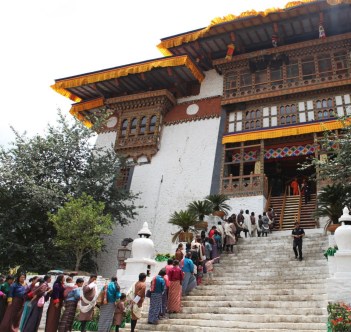
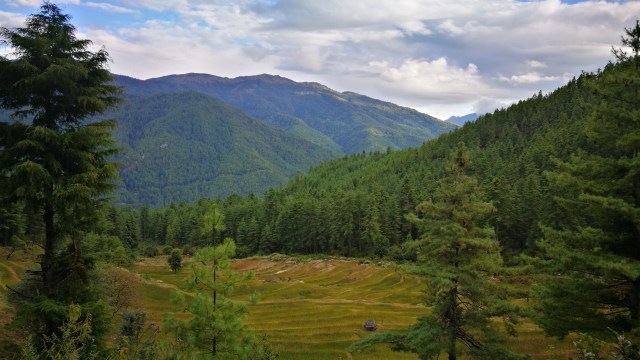
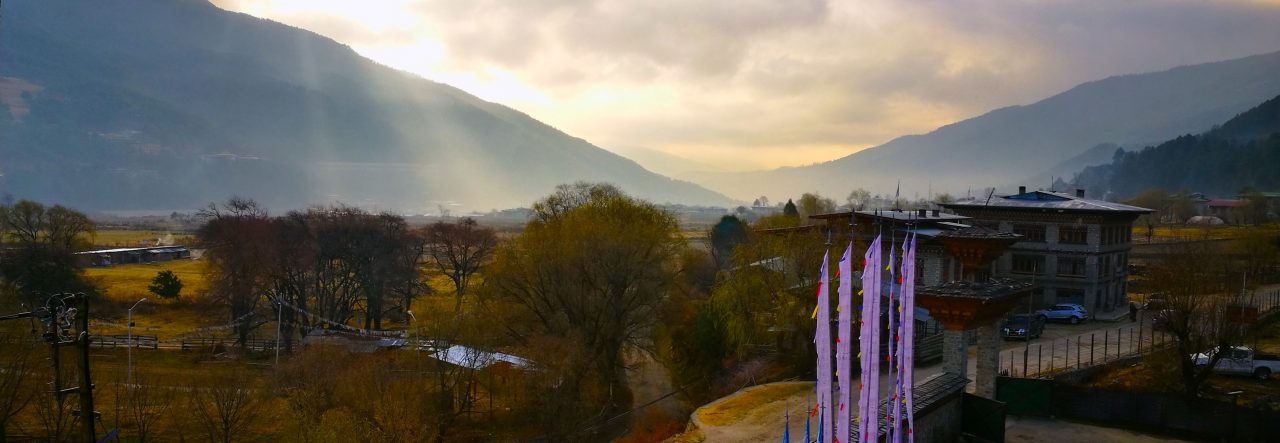
Chukha valley. The view from the air gave me a nostalgic memory of the countless free rides with my father

On 5th February we celebrated the first anniversary of the birth of HRH Gyalsay. I did onboard Bhutan Airlines bound for Bangkok. There was the inflight announcement wishing him “Happy Birthday”. Cakes were served. But for me such days, and birthdays in general, are also a time for serious reflection.

Our country has embarked on a journey – the journey of democracy. Notwithstanding the challenges, the ride has been relatively smooth so far. Other countries have gone through much rougher times.

Still, living abroad these days (I am doing my doctoral studies in Macau), I do catch up with my friends when I am back to Thimphu. Between some bar talks here and some whispers there, I am often confronted with laments and lauds, hopes and fear, screams and applauses.

The first defamation suit against a journalist has been withdrawn. A puzzling sigh of relief can be felt in the industry. Its impact will be there for long – or forever. A feature film has been denied certification. Those affected are screaming against invasion into their creativity and against curtailment to the freedom of expression. Some people claim that their feet have been stamped while others feel that their legs are trapped. Reactions are, far too often, knee-jerk.

For me, we are all going through a process – and a steep learning curve. As the truck of our democracy safely negotiate the muddy bends and shake a bit, everyone will ultimately find a space. However, we should never stop dreaming or working towards a better future or system – or prevent or scorn at someone who is doing that. No system is perfect and no laws are cast on stones. We should accept that they are created by imperfect human beings. There will always be room for improvement.

The mass is getting more vocal. New technological platforms are providing unlimited access to information and news to everyone. The so-called digital divide is now a passé. Even my illiterate sister is heavily on WeChat. Information is not a monopoly of the few. New political parties are in the offing. The overall progress is slow – but we are progressing nevertheless. The old power centres, such as the bureaucracy, are figuring out where they stand in the new era. Others who are too old to climb on to the truck will be left behind.

Where we really need to stop is to claim that the grass is green only on the other side. We can take inspirations and best practices from others. I don’t argue with that. But scrolling through facebook pictures of our compatriots standing in front of high-rise buildings and exotic shopping malls in foreign lands, many of us seem to fantasize that everything is messy in Bhutan while it is perfect ‘out there’. We give up too easily. Or we resign to any issue with a popular phrase, pha lay pha (meaning ‘out there in a foreign land’). We say (and some even claim without having been anywhere) that pha lay pha ghi people are better and brighter; and that, out there, the system is just and perfect and that societies are fair and equal. Maybe, in terms of public infrastructure, things are more convenient in some developed countries. But as a saying goes, the world is a just place and life is not fair anywhere. Out there, there are more countries with bad services and systems than there are with good ones. There are challenges everywhere. But, most importantly, in terms of people and sense of humanity, I feel, it is still a blessing to be a Bhutanese. I say, “still”, because we are also changing.

bhutan-airlines-2
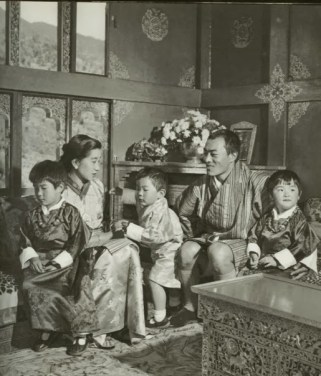
Thanks to HRH Gyalsay’s birthday we are served with cakes onboard. A day when Bhutanese people come together

Democracy comes with more freedom and choices but also with more challenges and responsibilities. It is slippery, at times. In the confusions and confrontations brought about by the changing times, what we, as Bhutanese from all walks of life, must always remember is that We. Are. In. This. Together.

We are in the same truck – part of the same process. There is no ‘us’ or ‘they’. And no one should feel indispensable, indestructible or immortal. Personal interests or egos should not override our sacred duties or official positions.

If there are boulders blocking our system, we remove them. If there are disagreements we discuss and solve them. If we have extra resources we share. If there are criticisms we accept. If people are screaming we listen. We should never forget that on either side of the so-called rules, policies, systems and fancy designations, we have real human beings with faces and families. That’s why GNH is a human-centric development and governance approach.

150715_10154859839915153_8139859142476203115_n

And whatever happens, remember we have the good fortune of our Golden Throne that has steered us safely along the bumpy and winding road from the not-so-easy historical past. It is an institution that continues to work selflessly for the people. Where in the world do people have such luxury?

Therefore, as we come together to celebrate the first birth anniversary of our Gyalsay, who is a manifestation of our collective moelam, we can make the occasion more meaningful by inner introspection rather than outer displays of posters and advertisements. We can remind ourselves of who we are as people, reflect on how we are doing as a nation and work together towards our common destination as a country. This way our Gyalsay, and our children, will inherit a stronger Bhutan.

This is more than a celebration. It is our sacred duty as citizens.

~~~

bhutan-baby
My belief in collective moelam grew after the birth of our Gyalsay
gyalsay2
Our Future.

~~~~~

(I have written an article, titled ‘2008 and Beyond’ in Bhutan Times in 2007, using the same metaphor)

Hema Hema – a Bhutanese Narrative

Using an unconventional method of storytelling Dzongsar Khyentse created hauntingly beautiful film where there is no hero or a villain; where the journey is undertaken from, and into, within. With heart screeching lines and poignant background score, you don’t watch Hema Hema, you become part of it.

I am glad that Hema Hema – the latest film by Dzongsar Khyentse, is not banned or barred, as it was reported in the social media but that the film is under review. Having watched it several times, I would like to share my analysis of the film here. I may add that I am not associated with the production of the film in any way. My sole intent is to offer a deeper reading into the film as a communication scholar while also providing a holistic view of the key messages.

Hema Hema is a film that deals with our mundane struggle with something called identity. While identity is socially constructed and determines one’s place in a society, it is also because of that same identity that one feels constricted in life. The film, thus, is an antithesis: how about a two-week getaway where your identity is concealed and where you could exult in the freedom of being unknown.

hemahemasingmeasongwhileiwait_01

A man known as ‘Expressionless’ (Tshering Dorji) makes it to such an event – convened once every 12 years by a god-like patriarch called Agay (Thinley Dorji). Expressionless is last to arrive at the secret venue where he joins few hundreds of other participants. Except for Agay, everyone wears a mask to hide his or her identity. They are also strictly prohibited from revealing themselves or trying to find out the identity of others. Punishments are severe and even inhuman.

As the festival rolls on, primal instincts and desires take over. Expressionless falls for ‘Red Wrathful’ (Sadon Lhamo) and thereafter things get out of control. He is thrown back into the worst of human confusions: fear, which leads him to commit a murder.

Hema Hema offers complex and coded meanings and messages that it is hard to decipher them all. Nonetheless, one key message is the rendering of bardo – a state where one is completely stripped of any identity. If having an identity is suffocating, losing it, or not having one, could be scary.

The film is also loaded with metaphors – and follows the dictum: show but don’t tell. Technological invasions into our lives and degradation of traditions are subtly portrayed. The film, however, does not take the high moral ground. Rather there is a silent scream of questions. As Expressionless goes back to the festival for the second time – twenty-four years later, he is betrayed by his cellphone. At the festival the mild and meditative sound is replaced with pungent techno music. The boedra dances have made way for hip-hop moves. The convener of the festival is a young and anonymous leader who speaks from behind a red curtain. Agay is old and frail. These are strong metaphors for what is going on around us these days.

The film, as Dzongsar Khyentse told in an interview, was inspired by our behaviors in the social media where we get a false sense of anonymity – and freedom. However, one can never be free from one’s conscience, which is the Ultimate Jury. In the final moments, Expressionless removes his masks and explodes in remorse for the crime he had committed and the deep regrets that he has been living with ever since. The resolution is simply beautiful: one has the choice to hide behind a mask, provided by the online world or by the real life, but one cannot hide anything from one’s conscience. It will always follow you and bug you.

In terms of production, Hema Hema is a celebration of Bhutanese ingenuity. While the writer-director had prior experience, all other key personnel were Bhutanese youth who have not been part of major projects before. And yet, Jigme Tenzing’s cinematography is mind blowing. Having sat as jury in international film festivals I can say that it is world-class. The performances by the lead actors, Tshering Dorji and Sadon Lhamo, are as good as they can get. One can feel the emotions, fear, desire, lust and even sadness. This was not an easy task with their real faces wrapped behind passive masks.

Everything in Hema Hema – the festival, dances and rituals, is fictional. Hence, to bring the audience to the present-day reality, the film starts and ends in a nightclub in Thimphu where a cocktail waitress (played by Zhao Xun) contemplates on her life. Symbols and semiotics are maximized. Every object, character, costume, music or landscape is masterfully chosen to blend with the overall message.

khyentse

Hema Hema is by far the best from Khyentse Norbu’s repertoire. It is a courageous film. Critics have often cited The Cup as the best. I would disagree. The Cup was, no doubt, an honest piece but it was more a film and less an art. It had a straightforward storyline and a number of obvious subplots. Hema Hema, on the other hand, is more an art and less a film – in that different viewers can deduce different meanings, as they uncover layers upon layers that are intricately woven like eastern Bhutanese textile.

My own experience of reading the film (I have watched it over ten times, as I am writing an academic paper) is that Hema Hema almost hypnotizes you. It is hauntingly beautiful. There is no hero or villain. The journey is undertaken from, and into, within – and for and against oneself. It grabs your soul and shakes it – with heart screeching lines and poignant background score. You don’t watch Hema Hema, you become part of it. This is what distinguishes this film.

This work, therefore, is a major breakthrough in, what I would term as, Bhutanese Narrative, which could be Bhutan’s contribution to the world cinema. Western and Euro-centric storytelling based on Hero’s Journey has long dominated the cine screen that any new or original style has been seen as a welcome respite – even in Hollywood. This happened with the New Iranian Cinema and later with the likes of Wang Kar Wai and Zhang Yimou. With adequate support and more engagements with film scholars and with other Bhutanese filmmakers emerging and perfecting the new narrative style there is an opportunity for Bhutan to spearhead another cinematic revolution that the world is eagerly yearning for.

This blog entry is the same version that was published in Kuensel, December 31, 2016


UPDATE. January 15, 2017

BICMA denied the certification of the film based on “inappropriate” use of the religious mask. The full report on Kuensel.

Teaching history. Talking history

There has been a great deal of discussion in Bhutan lately on changing the way we teach history in school – including a recommendation to resume teaching it in the national language, Dzongkha. The role of teaching history is not to improve the national language but to instil national pride and identity.

First of all, any debate is better than no debates at all. Although public discussions do not tantamount to much these days, for the sake of my own satisfaction and my duty as a citizen, let me share my views on this very important topic.

drugyel-dzong

For me, the essence of history goes beyond improving the national language or becoming a global citizen. Studying history should instil a sense of national pride and understanding of who we are as people and where we came from as a nation. Then as we read the world history we come together as humanity in mutual solidarity and learning from each other.

And hence, it doesn’t really matter whether it is taught in English or in Dzongkha. It should be taught in a language that best reaches the hearts and minds of the audience. More importantly, it should be taught by people who are passionate about history. There is no doubt that teaching in Dzongkha could provide a rich languaculture experience. But where is the capacity – let alone the passion or the motivation.

In any case, to be frank, the way it is done now, it is serving at nothing. And the fallout could be a declining sense of national pride and loss of the collective identity. Every man will start fending for himself.

I love history. When I was in Sherubtse I used to often sit in history class, which was taught by a superb Indian lecturer by the name of Somaranjan (whom they lost, by the way). I also conducted couple of guest lectures on the European Renaissance and the Advent of Modern Mass Media in Bhutan. I used to also spends long evenings talking with another history lecturer, and my good friend, Sumjay Tshering.

However, I am yet to meet one student who is passionate about the subject. That’s because learning history is reduced to memorising dates, names and places. As Einstein once said, what is the use of remembering something that you can find written somewhere? If I may requalify Mr. Einstein, in this day and age of Lord Google and Prophet Wikipedia, facts and figures are only important to us to the extent that we know where to look for them. Of greater importance should be to understand the question why than the question what.

The way history is taught is fundamentally wrong. The topic is treated as linear and isolated occurrences of events. Worse still, every event is viewed with a telescopic lens focusing on the specific event only. And hence, students of history can provide names of people and places and dates – in a chronological order – more or less.

But history is not linear. It is lateral. It is contextual. It doesn’t take place in isolation. Hence, when we teach or talk history we need to give the broader contexts.

Take for example the Treaty of Punakha 1912. If we look at the Treaty with a lens pointed at that event only, we might feel that we actually got a bad deal. How did we bind ourselves to the British – to advise us on foreign relations?

Now, broaden the horizon of that era. Look at what was happening around Bhutan. The British had been ruling India for over 200 years. They had colonized half of the Earth’s landmass. They had crushed without mercy every attempt of the Indian independence movement. Now shift your eyes towards the north. Again, there, the British had gunned down over 700 Tibetan ‘soldiers’ forcing their way to Lhasa. The Qing Emperor had issued new threats by claiming sovereignty over Nepal and Bhutan. They sent armies to Tibet to crush rebellions. The Great Game was still on. There was every chance that we could have been wiped out. And mind you, history has seen empires and kingdoms far greater than us vanish at the hands of colonial powers.

8x12-ancient-white-woman-with-white-husband-with-lots-of-bhutanese
While Bhutan enjoyed peace during the reign of King Jigme Wangchuck (1926-52), countries around were in turmoil. The World War II had reached the doorstep (Burma), and Britain was getting chased out of India. HMK2 must have been really stressed out, which could have affected his health.

If we give bigger geopolitical contexts to the Treaty, we then not only understand the event better, we also begin to appreciate our leaders more – in particular the masterstroke of Gongsar Ugyen Wangchuck. His foresight, statesmanship and wisdom have kept us safe and independent when all other more prosperous nations from that era  disappeared. We feel proud as Bhutanese. We feel grateful. The fact that we even managed to extract a treaty out of the British was an achievement in itself.

Take another example – and another dimension. The founder of Drukyul, Zhabdrung Ngawang Namgyel, promulgated the Chayig Chenmo (the Great Code of Law) in 1637. However, the year is just a ‘number’ unless we can bring some interesting context to it. What if we said that Chayig Chhenmo was ahead of the much-celebrated American Constitution by a good 150 years? To point out that we were ahead of the Americans? Now isn’t that a factually interesting comparison that would catch the ears of a listener? Wouldn’t our students, and people in general, take more interests in history?

One more example. Everyone knows that Tibet invaded Bhutan in 1644. The Bhutanese repealed them and as a mark of victory Drukgyel Dzong was built. That’s it. However, the 1644 and 1648 military invasions were not as simple as that. They were meticulously planned, armed and launched by the Mongol warlord, Gushri Khan, who was a descendent of Genghis Khan. It was a formidable army of combined Tibetan-Mongol forces. And by the way, the Mongols, since the time of Genghis, had not lost a war and their empire once stretched from the Sea of Japan to western Europe. The 1648 mission was not just to capture Zhabdrung or to retrieve Ranjung Kharsapani but to occupy Bhutan – once and for all. In fact they entered in three different places – Paro, Punakha and Bumthang.

To cut the long story short, the Bhutanese forces led by Tenzin Drukdra launched a surprise attack in Paro, one night, and completely eliminated the invaders and captured their generals. The 1648 loss was perhaps one of the very few battles that the great Mongols ever lost in history. Tibet was also enjoying a period comparable to the times of the Yarlung dynasty.

But somehow we prevailed. Isn’t that music to our ears? Doesn’t this mean anything to you as Bhutanese? Wouldn’t you now look at Drugyel Dzong with a bigger pride?

By the way, the Treaty of Punakha was signed in 1910 and not in 1912. But I am sure you were really absorbed by the narratives here that you didn’t bother about that minute detail, right? That is the essence of learning history. The bigger picture is more important. I am not saying that you learn the facts wrong. What I mean is that one should internalise the meanings instead of memorising the numbers.

Our country’s prime resource is our people – to paraphrase His Majesty the King. What we learn, believe, have faith in or take pride for, will ultimately determine whether our country will reach for greater heights. And if the national pride is today missing or lacking, I would put the blame squarely on our inability to appreciate history. By “we” I include the society in general – and not just history teachers or curriculum designers.

As a result of history being taught badly no one takes interest in this subject these days. This is evident from the fact that it is never a part of our daily conversation or of any social gathering. There has not been one major conference or workshop on history as far as I can remember. We don’t even have a history Society that would serve as the authority on the subject.

As is life, so is a nation. It is only through knowing your past that you can cherish the present and move confidently into the future.

My prayers as we close the 109th National Day celebration is that we could resolve to take greater interest in our own history.

~~~~~~~~

elections-in-bhutan_1-530x261
We made history. We make history. We are living history

Sharchop ngew culture

In January of 2015, I took my family for a road trip across Bhutan – from Thimphu in the West to my native Tashigang in the East. The journey was “historic” for my two daughters, who were 17 and 12. They had never been to that region before. As we crossed the midpoint – the town of Bumthang in Central Bhutan, and entered into the eastern half of the country, I stopped the car frequently to greet my relatives.

10498211_10155100168265153_7961344896157624270_o
My maternal relatives are the simplest and the most genuine people on Earth. Truly humbling to be with them.

My cousins, nieces, nephews and even distant uncles and aunts presented themselves in droves – and invited us to their houses. “I am your cousin,” a distant niece told my daughters. “Your father and my mother are khotkin-mathang (cross cousins)”. My daughters were amused. My wife just smiled. She has been through that before – during our first visit in 1992.

“Your father and I are like siblings because we are aata and uusa (parallel cousins),” said another. Then one of my aunts went, “You look so much like your abee (grandmother),” she told my younger daughter and gave a big bear hug as tears rolled down her cheek. “You should have known your grandmother. We are cousins but more like sisters. I really miss her. I think you are her reincarnation,” she added. “Promise me that you will come to meet your abee (grand aunt) again.”

Wherever we went we were greeted with genuine excitements and hospitality. In Tongling it was as if 3 days were declared as holiday. No one went to work. They all came to see us – bearing simple and honest gifts of eggs, maize, ara, tengma, butter tea, etc. There was so much laughter, tears of joy, memories of my late mother and that of grandfather whom they said I personified in every respect. We sang, danced, ate, drank and cherished the moments that were so beautiful that no amount of money can even dream of buying.

10926194_10155094012025153_6382988427768066495_n
My daughters with ajang Kinga, who is my father’s father’s sister’s son. He hosted us in Tashigang

Perhaps more than any of Bhutan’s nineteen ethnic groups, the Tshanglas (also known as Sharchop in Dzongkha, the national language) of Eastern Bhutan celebrate large family networks. In fact there is a popular saying that “there is no end to how many ngew (relatives) a Sharchop will have.” That’s because relatives are acquired not only through bloodline but also through marriages of family members. For example, the village of my younger brother’s wife considers me as one of them. “You should have informed us earlier, we are sognu thur (one family),” said one villager in Kheni in Tashi Yangtse. I was visiting that area with my students when I was teaching in Sherubtse College. I was rather embarrassed that I forgot the norm.

10922761_10155100168815153_5911111378655654707_o
Tashi Lebay – A dance that wishes for another such day. Hope it really brings some more of such times

The ngew culture also demands that ‘family’ relations be maintained till the 7th degree although now the norm is till the 4th degree. One of my cousins once counted how big we were based on the 7th degree rule. He came up with a figure for me: 2,400 relatives from 10 ethnic groups in 20 districts and extending beyond the borders to 5 countries of the globe. Hilarious? Not at all. I instead find it extremely wonderful. After all, what is life or happiness if it is not about a shared life, community or togetherness. When I was teaching in Kanglung I used to visit one relative every weekend and share meals, get to know the younger members that I had never met before and return to campus filled with enough food supply for the coming week. Those were some of the sweetest moments of my life. To walk into a village and discover that everyone was related to me in one way or another, what can you ask for more from life?

At the core of this extraordinary ngew culture is the kinship address system. Tshangla-lo has over 30 terms to address your kith and kin. (See the kinship map below). That is almost double as compared to other languages or dialects. The rich vocabulary is indicative of the strong bonding culture.

Using a kinship term does not just serve a mere referential purpose. My research shows that in calling someone ajang or khotkin or kota, a deeper inter-personal relationship is established, an identity is created and a social cohesion is set into motion.

Conversely, one could also assume (and I still have to verified this) that the lack of its usage would drift families and communities apart. That is already happening as people migrate to urban areas, as family income rises and there is less inter-dependence, and, of course, as imported terms such as “uncle”, “aunty” and “Sir” are used more and more.

After a couple of days in my two villages of Pam and in Tongling, my daughters had lost the count of how many cousins they had. “I think we have more than 100,” said one of them. But they were both certainly moved by the whole experience – especially the words of from my maternal uncle, Lepo, 82, who told them, “You may be ashamed of our living conditions. But this is where your father belong to. Come back again and if I am still alive, I will tell you where we come from. Your ancestry. You will be really proud to know that.”

The whole experience left an indelible mark on my daughters because on their Japanese side there is huge vacuum. They don’t know even one single maternal cousin. Japan has almost completely lost that ngew culture.

Hopefully, Bhutan never will.

~~~~~~~~~~~

NB – This article has been adapted from a course assignment piece. Anyone interested in the ‘academic’ version may drop into the mail box in the CONTACT page.

10926443_10155087510265153_6292576818284517769_n
Eastern Bhutan is untouched by modernisation. People have still retained their innocence.

slide1

img_3259
My great-grandfather was once unjustly outlawed by the local governor and driven out of our ancestral home. These people in Merak protected and sheltered my family for a decade. They consider me as their sognu (clan)


10930783_10155100168090153_4156574099836277517_o
Inducting them into Bhutanese rural life which is a universe apart from Japan


10887271_10155100171085153_4910576048502249877_o
The million dollar view from my land. You can see Bidung, Radhi, Bartsam and Yangyer and as far as Thrumshingla. I agreed to losing an acre for the farm road to pass through to get to the village.


10410162_10155103954260153_521418374468348662_n
In front of our ancestral home in Pam – The Tsorgon Phai 

Trust our own doctors

Earlier this year I had a mild discomfort in my upper abdomen that radiated to my back. I went to see Dr. Sonam Dukpa (at Menjong Diagnostic in Thimphu). He ran an ultrasound on me and found that I had a mild inflammation of my gallbladder. He packed me off with, “It happens. Nothing serious. No chilli or fats, lots of water and exercise. Come back only if you have fever. Not prescribing you anything.” Dr. Sonam often talks in phrases. I have known him for years. I went away little perplexed though. But I followed his advice. Drank lots of water (I still do), avoided chilli (I don’t eat meat) and, of course, walked for three full days – trekking to Athang Rukha.

A week later I happened to be in Bumthang where I took the opportunity to meet my family lama, Rangshikhar Rimpoche. In between talking about my siblings about who is where and how they were doing, I sought his advice; some divination to check if my life energy was running low. After going through several scriptures and his prayer beads he pronounced, “There is nothing bad happening to you. You will be alright from the 29th day of this month. Last year was astrologically a bad year for you. So, some residuals extending to few months this year,” he reassured me. He was as humourous as alwaus but he continued, “I think it is good that you fall sick sometimes because when you are healthy you forget your Lama, your family, your friends and, above all, to pray.” I burst out laughing. “Yes, Lama, you are absolutely right,” I replied, accepting it for it was true. I am bit careless.

Then a month later, transiting through Bangkok, I decided to see a doctor there. So I went to a hospital. I thought I might as well get a second opinion. The doctor there run the ultrasound and the blood test again. And found that my gallbladder was OK. Dr. Sonam Dukpa was right and so was my lama. The blood report, however, showed a slightly elevated bilirubin – indicating some problem with liver but not that high. Instead, he prescribed me some tablets to reduce my back pain – to be taken for 7 days.

60f7b546db2fb5deafb121636185f218

Few days later in Chiang Mai, over a breakfast, I was chatting with a German filmmaker and a friend of mine, on what we were working on – in terms of films and documentaries. He told me that he was doing something on the failure of allopathy. He went, “I don’t mean that western medicine is flawed but pharmaceutical companies are driven by profit thereby making people dependent on drugs they produce. They even have doctors, on their payroll, all over the world, prescribing medicines that we actually don’t need. We are getting poisoned legally. The world is sicker than ever. Did you ever ask why?”

“Wait!” I thought, “I have just been prescribed with some tablets in Bangkok.” While he was still going on with all the global pharmaceutical scams I ran a search engine on the medicine I had started taking. And Lord Google gave a shocking verdict. “Not approved for USA and Canada as extended use can cause cardiac arrest, heart disease and lever failure.” “What?” I thought, “The doctor who diagnosed that I had high bilirubin prescribed me that?” Bad news: I had already taken one pill. Good news: I had not taken the other 6. I dumped the $50 worth of medicines, the $150 in consultation fees into the garbage. I also realised that a strip of antibiotics that costs Nu. 40 in Bhutan costs around Nu. 400 in Thailand.

Having found my mini ‘enlightenment’ I started to be more regular with my 4 km daily jogging routine. The pain began to subside. As for my elevated bilirubin I emailed the medical report to Dr. Tshewang Dolkar (a traditional medicine practitioner based in New Delhi) who sent me some herbal medicines. I am alright now.

dococ
Role model – His Majesty with the medical team that assisted during the delivery of Gyalsay. While it is fashionable to fly to Bangkok, our prince was born on the Bhutanese soil

I am sharing this story because I know many people rush to Bangkok or Delhi on a slightest medical issue. Many pregnant women fly just to deliver babies. Well, just be careful. There is an industry out there. I don’t mean to generalise. In fact we had an excellent Thai doctor who attended to my wife when she had that head injury some years back.

You can avail of great diagnostic services that they offer. I still do my annual health check-up in Delhi or in Bangkok. What I am saying is to be careful with excessive, or unnecessary, use of pharmaceutical products – especially antibiotics and vitamins. Ask what you have been prescribed. Cross check with Dr. Google. Can you type? Of course, you can, right? Do it!

And trust our own doctors in Bhutan who are not profit driven. They might ignore you, frown at you or scold you. Just close your ears but take their good advices. I am also happy that the Health Ministry has cautioned doctors to be less generous with prescriptions. For certain ailments you can also try the traditional medicines hospital in every district. Get the best of both worlds – western and Bhutanese.

And finally, do not forget to say your little prayer every day – and move.

~~~~~~

doctors
The Life Guards – His Majesty, Her Majesty and the new-born Crown Prince with the medical practitioners of Thimphu.

Letter from Japan

A simple gesture can move a nation.

On a bleak, chillingly cold and wet February day of 1989, in Tokyo, the Fourth King of Bhutan, His Majesty Jigme Singye Wangchuck, made a ‘small’ gesture at the State Funeral of the Showa Emperor of Japan. That one simple act of humility would define the relations between the two monarchies forever.

Almost without exception, on that day, the people of Japan were in mourning. At Shinjuku Gyoen, in an open pavilion, the heads of state, from superpowers to kings from small monarchies such as Bhutan, had gathered from around the globe for the State Funeral for Emperor Hirohito.

hqdefault

The regal State Funeral was held on a cold February day at the end of winter in Japan. Usually along the Pacific coast it is dry and sunny as spring replaced winter. But not that day. There was a misty, freezing and cold rain. It almost seemed as if the heavens were reflecting the grief of the Japanese people.

World leaders from 163 nations, some former foes of Japan from World War II, were officially and formally present or represented for the State Funeral of a political monarch of a geopolitical partner, the nation of Japan. US President George H Bush, French President Mitterrand, King Juan Carlos of Spain and others were there too – dressed in appropriate (for them) Eurocentric mourning black, and not the Japanese culturally correct mourning white or national garb traditional for mourning. They were also warmly insulated from the near freezing temperature in the two white tents.

His Majesty King Jigme Singye Wangchuck was there too, but in his traditional Bhutanese attire – the humble knee-length gho. He wore no gloves, no hat, no coat, no muffler or anything but a simple, honest mathra gho to survive the 3-hour ceremony.

3a0cc66500000578-0-image-a-1_1478288899934
Crown Prince Naruhito has high regard for HM. In 2003 I had a short audience with him and the first question he asked was, “How is HM?” (It was just before 2003 military operations)

As the ceremony progressed officials and leaders were called upon, one by one, to pay their respects towards the Showa Emperor’s casket. The VIPs got up, walked towards the imperial coffin, bowed to it – reluctantly in some cases – turned and bowed to acknowledge the new Emperor, Akihito. Then, their official duty done, most left in their limos.

His Majesty King Jigme Singye Wangchuck, the King of Bhutan, when his name was called, stood up, walked solemnly towards the imperial casket, stopped and bowed deeply and longer – showing his deep compassion for the man who had been the Emperor. He then turned and bowed respectfully to the heir to the Chrysanthemum Throne, the new Emperor Akihito.

Then instead of leaving, like many others, he returned to his seat on the icy stand. As other leaders paraded, bowed twice and departed, His Majesty sat there alone, and endured the biting cold, in dignified mourning – for hours until the ceremony ended.

bhutan-king
HM with Emperor Akihito

NHK TV, Japan’s national broadcaster televised the entire State Funeral live and telecast it globally. One of the NHK cameras, on several occasions, went back to the lone figure of His Majesty in the VIP seating. The announcers and the audience began asking, kare wa darey deska? (Who is he?) Soon they found out, and was introduced as the young King of Bhutan. His Majesty was just 34.
The TV commentator also added that the Bhutan King genuinely shared the grief of all Japanese people and is staying until the end of the ceremony. This simple genuine gesture raised the mood of a grief stricken nation and teary smiles. His Majesty became very popular, which in turn led to Japanese people knowing about Bhutan. He received wide press coverage. A newspaper almost covered a whole page with his portrait.

Almost three decades later, the Japanese people still talk with awe and fondness about that simple and genuine action of His Majesty the King. It generated immense goodwill, which continues to strengthen the bonds between the Japanese and Bhutanese people even today.

In 2006, His Majesty has gone on to make another ‘simple’ and yet profound gesture. He abdicated the Golden Throne of Bhutan in favour of His Majesty Jigme Khesar and also established democracy. Perhaps in the simple life that he now leads (he is seen cycling regularly, mingles with ordinary citizens and hitches rides on taxis) one can find an exemplary role model in the greatest monarch of our times. Truly the King of Simplicity – a real Pelden Drukpa.

And as His Majesty turned 60, an important age by Buddhist belief, one can only be proud of having been his subject and pray that the universe shower him with good health so that he continues to inspire, and cycle, and touch more lives and hearts – not just in Bhutan but in the whole world.

(A longer version of this article is published in Bodhisattva King – a book edited by Thierry Matthou and Tshering Tashi for the Sixtieth Birth Anniversary)

(In 1989 I was a student in Italy from where I watched the telecast ‘live’ – with my wife translating the running commentaries. In 2003 when I visited NHK I met one of the production directors of that historic telecast who shared the story to me)

~~~~~~~~~~~~~~~~~~~~~~~~~

hm-khasadrapchu
The early 2000s- In Khasadrapchu School, during a mid-term plan review visit, HM sat down on the dusty football field to have a conversation with the children. After the chat was over, HM asked a child to hold his hand and “help” him get up. The scene was so cute, with the kid struggling to pull HM up. (Notice that HM is drinking out of a plastic cup the same tea is also served to the kids)

Education? Know thy needs well

Three things worth considering in education.

In light of the current discussion (or re-discussion) on education – or reforms, curriculum overhauls, needs assessments, blueprints, master plans, parliamentary reviews – or whatever you may call it, here are my thoughts on the topic – having been deep in this field for a couple of years now.

  1. Know thy needs well – Do we really know what we need? Or at least what we want? One of the experiences from my travels is that when I don’t know what I need, I tend to over pack. It happened many times. You don’t know what you need. So fear overtakes you. Instead, when I came to Macau, although I was coming for an extended stay, I just had one medium-size
    20160921_121029
    “What is education?” asks Prof. Ni of City University of Hong Kong. They don’t seem to know and they keep looking for it. Hong Kong has world’s best. But in Bhutan everyone claims to have the “answer”. That maybe the tragedy.

    suitcase with a 20-piece clothing. It is because I have been here before and I knew what I needed. My serious doubt with our education system is that we really don’t know what we want – let alone know what we need. So we are over packing our curriculum with things that we may never use or with things that someone told us were necessary. It is better to teach less, and teach well, than to pump in contents and concepts that students will never grasp (which is actually the case) or would ever use. One visiting British maths teacher once told me, after going through our Class 9 text books, that she taught those stuff in Class XI in UK. Are we trying to beat the British?

    We saw NAPE being discarded, Shakespeare being thrown out – and then reinstated, REC being pushed around, CAPSS being transferred, relocated and renamed – and all the while trying to figure out if multi-grade classrooms were good or bad.

  2. Motivating the teachers – Many talks and discussions on education end up, as a cliché goes, as old wine in new bottle. Over the years we have seen master

    12715310_1075658979151087_1337287899695439967_n
    Teachers in remote schools live in houses such as these. Not very inviting to be a teacher.

    plans being developed, policies being framed and reframed, curriculum overhauls being done, studies being conducted, surveys being carried out, blue prints being initiated. So much so that now there are no terminologies left to title any new initiatives or documents. However, all along we have also refused to take the bull by the horn – teachers’ motivation and quality. As long as teachers are treated at par with 9-to-5 civil servants, everyone will opt for the 9-to-5 life. And the longer we stay in that state of denial, the longer the top performers will continue to shy away from the noble profession – and nothing much will improve in our education system. We might get some temporary sparks but not long term solutions because whatever visions we have, plans we pursue or dreams we would like to achieve, ultimately it is the teachers who have to deliver the knowledge to students. A simple logic says good curriculum taught by bad or demotivated teachers will result in bad students. But a bad curriculum if given to a good teacher might produced good students. Ideally we should have an equation of good curriculum and good teachers.

    How to motivate the teachers? We could we start by building teachers’ quarters and by providing higher financial incentives – instead of erecting ceremonial gates and walls. His Majesty the Fourth King, whom we all boast as role model but only a few emulate, used to provide technical allowance to engineers (I was one) and one grade higher in civil service to doctors to entice Bhutanese students to take up these challenging professions. So all the toppers of my generation opted for medicines or engineering. Why is it so difficult to copy-paste that policy on the teaching profession, if getting good teachers is a challenge?

  3. Nothing wrong with our students – We, Bhutanese (my generation especially), think very low of our young people. We either underestimate them or suppress them – or both. We making sweeping statements like, ‘our children are spoilt’, ‘boys are criminals’, ‘girls are irresponsible’ and above all, students are dumb. They don’t know anything. Well, having moved from Sherubtse to Royal Thimphu College to University of Macau (that has top students from mainland China and many international students), I must proudly say that

    10648689_10154735566565153_2885719272636468032_o
    A radio documentary by two of my students in Sherubtse picked up an international award in China in 2014. But it went unnoticed (photo – with the organisers). One of the students couldn’t even get a job in Bhutan.

    Bhutanese students are, by any measure, no less. I have read, assessed and graded test papers and assignments here and back home. I feel proud of what I actually used to read – especially in Sherubtse. An expatriate colleague who now works in the American University in UAE confirms this too. Given the right conditions our students can perform at par with anyone – and will make our country proud and a better place. In fact, one Australian diplomat once told me (and this was also echoed by a Dutch professor) that they were very happy with Bhutanese whom they considered as top performers, hardworking, rarely creating problems and heading home when they are done with their studies.

    ~~~~~~~~

    I have also written on the same issue many years back. On my previous blog. http://dorjiwangchuk.blogspot.com/search?q=education

Learning By Heart

phil_joy-of-learningLifelong learning requires one to develop the joy of learning itself. I am trying to think of how I cultivated it. Was I immersed in books as a child? No. I was in a vocational school run by Catholics priests of the Selesian order of Don Bosco. And during the long summer holidays I had to look after cows, chase monkeys and fetch water. Did those priests have a spell on me? No. I was a little devil who was fond of Clint Eastwood, Dharmendra and Bruce Lee. Meaning I often bunked classes and sneaked in and out of the boarding school to visit Norgay cinema. Do I have my parent’s influence? No. Both of them were illiterate. So then how?

I think there are two explanations – My student life in Italy and Learning by Heart.

Italian education – I got my first degree in Italy (Bologna). I did engineering – majoring in microelectronics. In Italy, there is no such thing as rote learning. Meaning you don’t have to reproduce ad verbatim what you have been taught. The exam system is lot tougher. It is based on the open-book concept. So everything has to be understood well because you are tested for full comprehension and application of the subject or the topic. You have to go beyond the lecture notes and text books. You have to consult tons and ton of other materials. Library was my “favourite” place. When you do that you are inevitably exposed to many things and you develop the habit of knowledge acquisition and a taste for it.  Grazie, Italia!

Learning by Heart – Everyone is familiar with this term by heart, which actually means memorising. Memorising requires an organ called brain and not the other organ – heart. So then why do we say “by heart” when it should be “by brain”. Then, how did this phrase come about? Well here is what I have found out and the connection to my own anecdotal evidence.

Memorising requires you to remember things. The latin word for remember is recor, which is made up of two words: re – recollect, and cor – heart; recollect from the heart. Recollect from the heart? Yes. The genesis of this word takes us to the Romans and Greeks who thought that the heart was the seat of intelligence and memory, as well as emotion. And hence the phrase – learn “by heart”. Now one may asks, “were they wrong?” They can’t be. Let me attempt to break it down for you.

To have a heart means you have emotions, empathy, passion etc. I am not saying that if you have them you are a great learner. Just as we can’t say that every person with a big lung can win the Olympic marathon. But you need a big lung to be a long-distance runner. So a good heart is a great starting point because, as I was saying, it makes you empathetic and passionate by nature. In being so, you develop another subliminal quality – open-mindedness, simply because you have an open heart. A cruel person is often very narrow-minded, right? As an open-minded (read as open-hearted) person you do not discriminate people but you will instead  embrace all of them. You will not be biased or prejudiced in your thinking. You will find a value in every person that you meet. You learn from everything, every time and just just everybody. You soon develop the so-called joy of learning.

einsteinAt Yale University in the US, which I have had the fortune of visiting thanks to two good friends who work there, they have developed what they call emotional intelligence. Scientists there have found out that if you learn using your heart you learn more and your rate of success is better. Learning by heart, thus, has not been wrong all along. Except that it was WE who didn’t get it right. Just “memorising” per se has no use as Einstein once famously said, “I don’t remember things that I can find elsewhere”. He was derided by a student for not remembering the speed of sound.

To conclude, I think I developed the joy of learning by learning “by heart”. By developing my passion, being passionate and practicing empathy. Lifelong learning has procured me vast amount of knowledge, exposure, friendships, goodwill and opportunities. It has become a way of life. The open-mindedness in me has allowed me to seamlessly move from microelectronics to media to moviemaking to mass communication studies.

~~~

cool-cartoon-3936485

China: So Far So Near

20160929_203435
Chinese “shakam ezay” packet

It is the Academic Writing class and we are going through a journal article by an American woman who taught English in Shanxi province in the 80s. “The provincial capital is Xian, right? Which was also the capital of a medieval Chinese empire,” I offer my comment to the class. My knowledge of China is quite limited and also superficial. “Not that Shanxi. Another one,” my professor replies. “Oh! There are two Shanxis in China?” The class (just three of us) laughs at my latest realisation. Jay offers to explain the difference between the two Shanxis. “This is Shanxi, pronounced as Shaan Xi, meaning “Land west of Shan mountain”,” Jay writes in Chinese characters and also the romanised version. “Then why couldn’t we call “East” of Shan Mountain the other Shanxi?” I propose with the inquisitiveness of a child and refusing to admit defeat. “Oh, east of Shan is Shan Dong, another province, Dong means East. This is where Jojo comes from,” Jay continues. I burst out laughing again. Amused by own stupidity.

Ok. To summarise: there are two provinces with same name (but romanised as Shanxi (west of Mountains) and Shaanxi with double a, which means Land west of Shan for the benefit of sentient beings like me who cannot read Chinese). There is slight variation in how they are pronounced but to an untrained ear they are both identical. Obviously, they are totally different when written in Chinese characters. The writing system is not alphabet-based (meaning phonetic) but pictorial and ideographic representations.

The class continues. The topic for today is contrastive rhetoric – the difference between Anglophone and Chinese academic writing styles. A paragraph, in particular, from the journal article catches my eyes:

All Chinese know the standard procedures of Chinese courtesy: 
"This food is not very good, we are not good cooks, you must eat 
more." "This is Chinese candy, Chinese candy is terrible, this 
is especially terrible Chinese candy, you must have some." 
Certainly, all language-users rely upon idioms, clichés, and 
set phrases, but the Chinese seem always to rely upon them...

My face brightened as I noted the astonishing similarity to my own culture. If I just execute the “Find” and “Replace” function on my Word document of just one pronoun, it will be a valid description of popular courtesies we followed back home. I just translated them in my head in my native language and they fitted word by word. I smiled even more.

This is what I like about learning. A discovery such as this. First of all, in a place that is so far that I didn’t even know the existence of two similarly named provinces and yet to find out a similar tradition of basic social norms as mine.

It just reinforced my confidence in my own culture.

NB – “This food is not very good, we are not good cooks, you must eat more” are widely said in Dzongkha as Zhego tshuebchi ga nay ya bay matshub. Zhay may la and in Sharchopkha as Toh tshutpa thur hangraang drangmay may la. Zhey na la.  


~~~

20160930_150931
Jay explaining the difference between the two Shanxis


Leaving your comfort zone

14463036_185958378508199_8294682208825321234_nJourneys take you out of your comfort zone. You land up in strange places where you feel you have nothing. And where all your egos, fame, preconceived notions, assumptions and accomplishments vanish albiet temporarily. You feel vulnerable. You feel naked. You don’t know how to behave; you even don’t know what to eat (I am a veg) or even how to eat (the sequence or combinations). What to talk about? In the sense what is permissible and what are the social, political or religious taboos out there? How do you dress yourself appropriately? All in all, you are thrown into a whole new world, new culture and new social reality.

Once you tide over these initial apprehensions and challenges, you start connecting to the new world around you. You start assimilating, adjusting, making new friends, creating acquaintances, learning the social norms, etc. The result: you come out a stronger person – confident, proud, knowledgeable and with more wisdom. You have accumulated more over your previous achievements. You have new notions and loads and loads of fresh experiences. And, of courses, a bigger network of friends. You rediscover yourself – a new self. It could happen whether you land in Los Angeles or Lunana. But the further you stray from your comfort zone, greater is the feeling of vulnerability and bigger will be the sense of satisfaction.

So you want to travel to distant lands, to a distant culture in future? Yes?

img_8344
This is my favourite picture from all my travels. This is in Kheng Silambi (lower Monggar)

Then start now. Today.  Move out of your comfort zone. Train yourself in your own surrounding first. Visit places you haven’t been and meet people you didn’t know. Like, take a weekend trip to Nub Tshona Patra – on your own. Or to a nearby place if you are not living in Thimphu or Paro or Haa. Try get yourself to spend a night in a temple, or in a hut or in a simple monk quarter. Negotiate. Interact.

That’s what I did. I traveled to every part of Bhutan in my life. I was fortunate that I also had jobs that allowed that. But, again, I chose the job. I slept in a cowshed in Dagana, ate with locals everywhere, begged for food on our way from Singye Dzong (our ration ran out), nearly died at Gangla Karchu between Laya and Lunana, risked getting buried inside Tala tunnels, nearly got gored by a yak at Pelela, suffered a food poisoning in Kengkhar.

Then slowly you can venture further. Become bolder! Get yourself transferred to a remote school, BHU, Extension Office or a Range assuming that you are either a teacher, health worker, agriculturist or a forester.

Face the hardship. Cherish it. Take pictures. Keep a journal. This is important because when you write them down, they magically turn into beautiful memories immediately. Try.

Those who are already there (remote places), start looking around with a different lens from today. Objectively. Without prejudice. Can you see this as an “opportunity”? As a training ground for yourself for a greater role in your life? You should, if you just open your eyes – if you reflect on or see the beauty around you. But if you think that you are getting punished or that Thimphu is a better place, then you are in misery.

img_8670
In 2013 after I was relieved from the Palace, I packed everything I needed in a car and took off to Kanglung. Taught there for a year and half.

When I left Italy in 1995, where I could have easily landed a job (some of my Bhutanese colleagues did stay back), my Italian friends thought I had gone crazy. Now 20 years and loads of experiences later, they think little better of me. Bhutan is to Italy, what Lower Kheng is to Thimphu. Same analogy.

But don’t think of jumping straight to China when you are homing in towards 50. It won’t be just hard. It will kill you.

~~~~~~~~~~~~~~~~~

my-group
Two of a Kind -My group from the masters course. They are all from Hunan province and found out that they also grow chillis like we do in Bhutan. Two of China’s 34 provinces where chilli is a vegetable. Their favourite snacks – shakam ezay


img_20160921_210159
Where “East” meets “West” – What a joy to be here and rubbing shoulders with the best minds from the two “worlds”.  Can’t ask more from life.  I already feel wise.


20160913_175543
Special student – Thanks to my age and some experience, I am considered a special student here. I study, deliver lectures sometimes, assess students’ assignments, I get a office. What else?


classmates
The department of communications took in only 3 students this year – me, Jay and Jojo. So our class is more a “meeting” with superb professors like Mary Roberts from New Zealand