Chortens (Dzo. མཆོད་རྟེན་; literally meaning “Support to The Teaching”) come in all shapes and sizes. Contrary to popular belief, there are more than three architectural types of chorten.
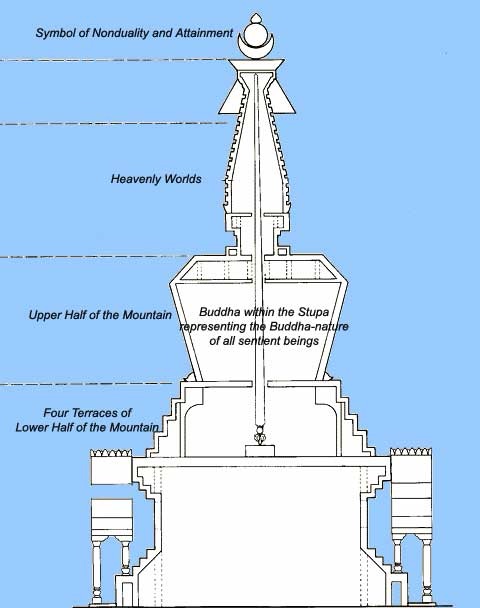
Stupas were adapted in the Buddhist world from earlier traditions as monuments for simply safekeeping the mortal remains of Buddha. Over time they evolved both in terms of physical aspects as well as the content. What is common to all types of chorten in the Buddhist world is that there are five physical structures to represent the five natural elements of earth, water, fire, wind, and space. Chortens in Buddhism are built as representation of the Buddha as seated in a lotus position.
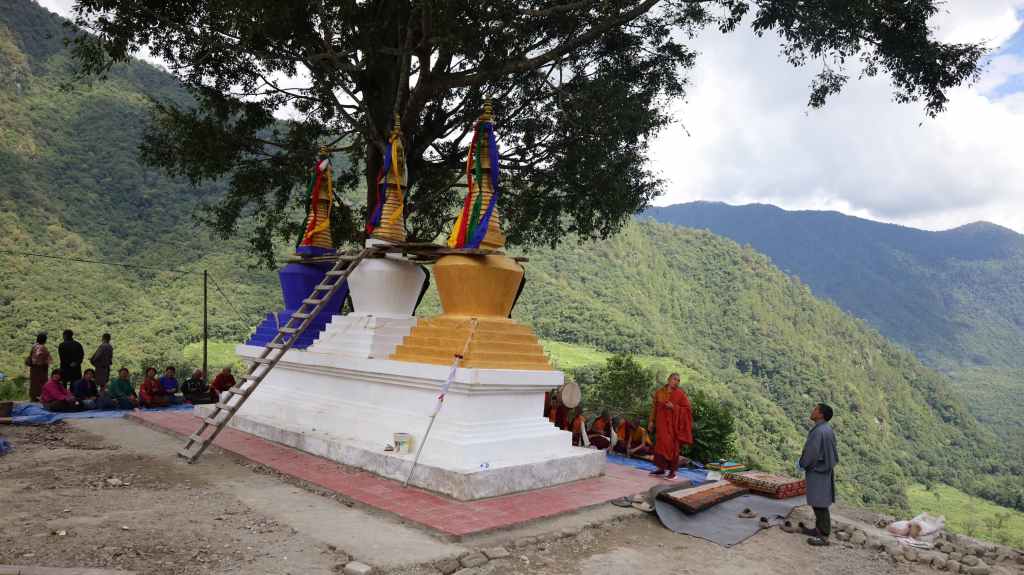
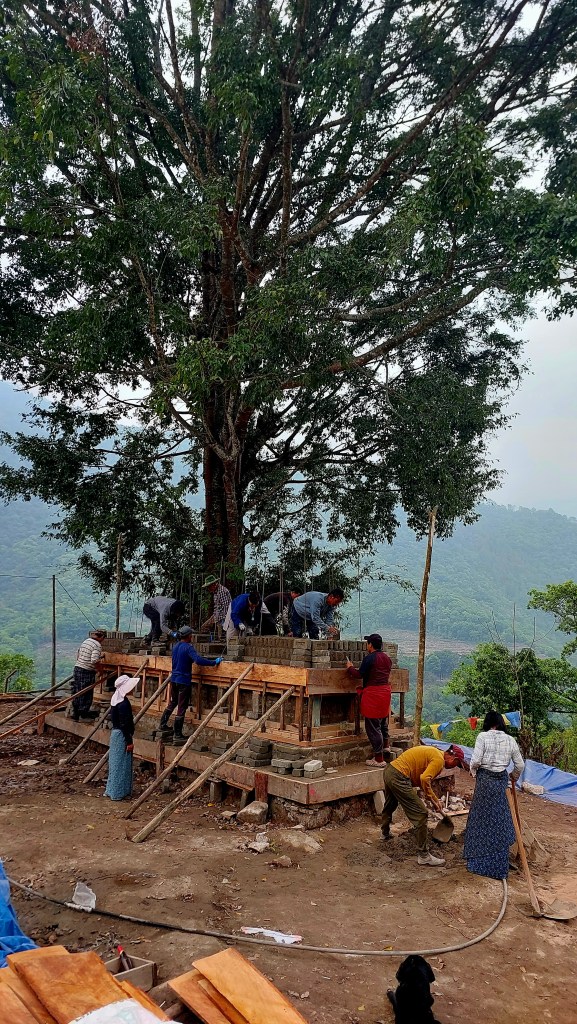
In this post let me share what goes inside a Bhutanese stupa, so that one day you can also build one. These pictures are from the Rigsum Gonpo stupa that my siblings and I sponsored to rebuild in Athang Morakha in Wangdue, as per the advice of my lama, Khandro Dorje Phagmo Rimpoche.
I dedicated the holy Saga Dawa month (the fourth month in the Bhutanese calendar) rebuilding a Rigsum Gonpo stupa in Morakha village in Athang Gewog. The place is associated with two very important figures in Vajrayana Buddhism. First, it is believed to be the abode of Vajrapani (Chana Dorje), which is referred to as Changlochen. Second, it is associated with Mendharawa – one of the principal consorts of Guru Padmasambhava.
Rigsum Gonpo (Dzo. རིགས་གསུམ་མགོན་པོ) means Lords Protectors of Three Families (or Realms) and refers to Chana Dorje (Vajrapani), Chenrizig (Avalokiteshvara) and Jamyang (Manjushri). The three stupas are the representations of these three important deities in Vajrayana Buddhism.
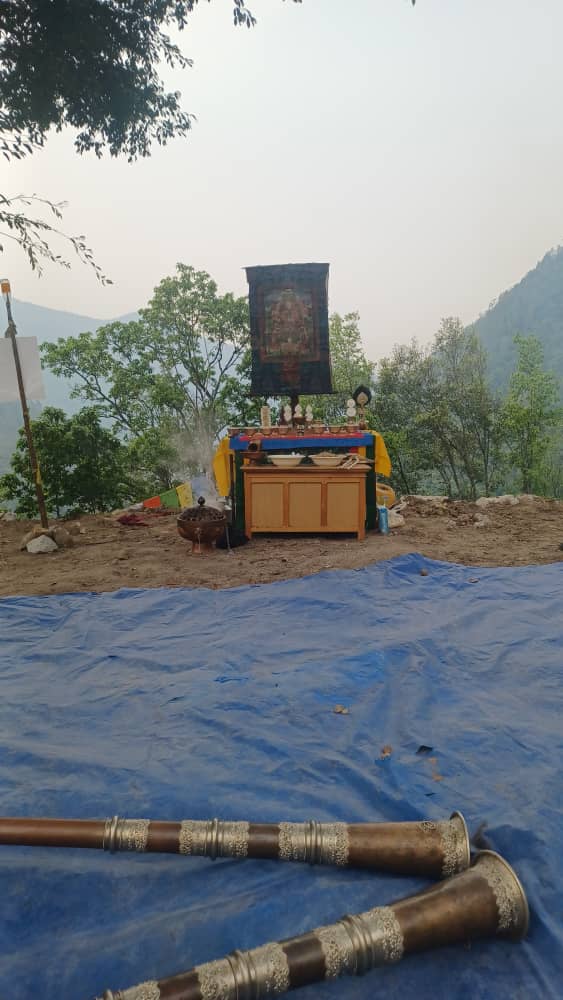
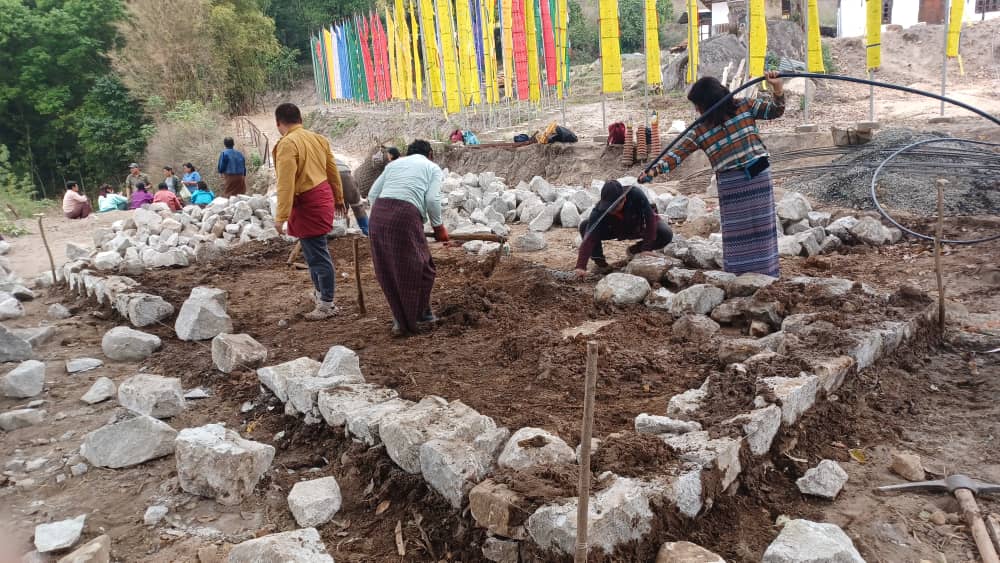
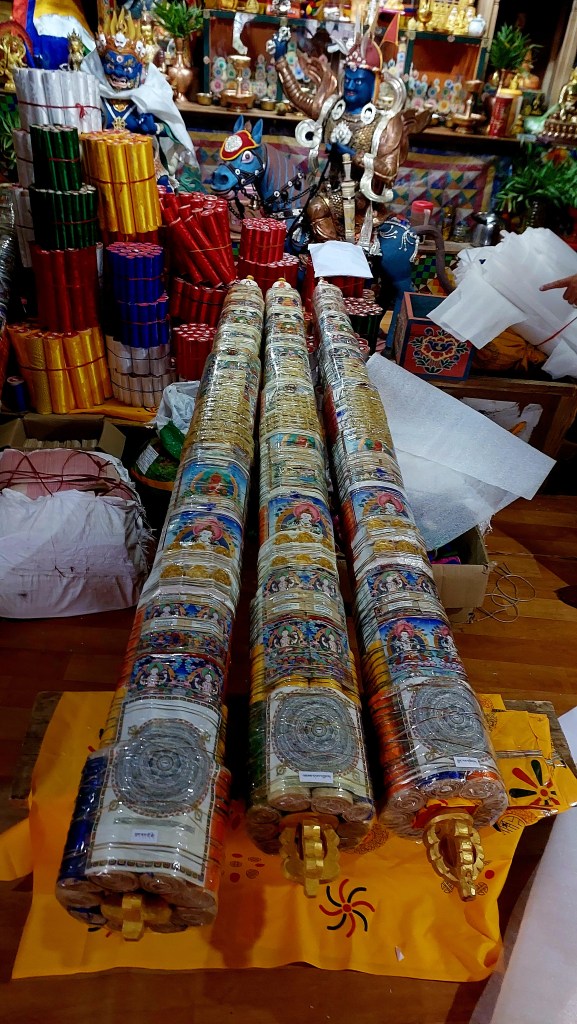
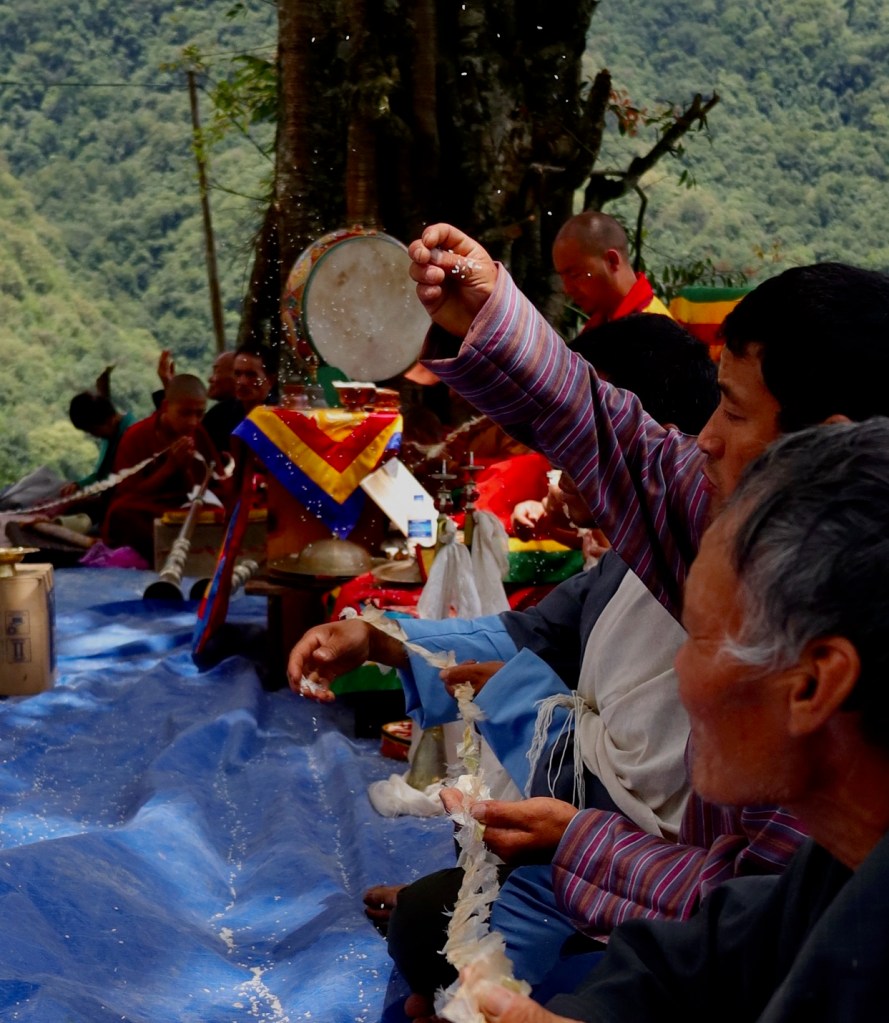
Picture 1 – Every major construction starts with a salang tendrel (Permission Seeking Ceremony) where we ask the consent of the earth deity to build the stupa. We offer 12 sacho bumter (vase of treasure) – four each for the three chortens. This offering is considered as a gift to the earth deity for allowing us to occupy the ground.Picture 2 – The first structure over the ground is the Sa-zin (foundation). This stage is important to provide the correct direction of the stupa (called Chho in Dzongkha). It should not face any direction randomly – especially its shadow should fall in the direction of any private homes. A master astrologer or a realised lama should do this to ensure that it benefits all sentient beings and hurts no one. Picture 3 – The next is to build three stairs called them-kha. Here inside the walls we have the first set of zung (relics) going in – consisting of farming implements and an old urn at the bottom layer. After covering this layer with juniper leaves the men and women garment and jewelries are spread – including arms and ammunition.Picture 4 – Then comes the Thri (throne) where the second set of Zung is buried. Here, inside of it, we offer a full set of religious musical instruments, and as many yangbum (vase of prosperity).Picture 5 – Every inch of the hollow space is filled with tsatsa (mini stupas) and dried juniper leaves. If juniper leaves are not available dry sand is fine too. The thing to remember is not to leave any space.
Picture 6 – The Thri is sealed and this marks the completion of the first stage of the constriction.
Picture 7 – Over the Thri, we build what we call the Tshemed-Zhi (The Four Immeasurable). It is four-step pyramid and in it we plant the sokshing – the soul of the stupaPicture 8 – Sokshing means “tree of life” and it is what makes the stupa come to life and bestow the power. It is a wooden pole sliced out of a young juniper tree, around which hundreds of scrolls of mantras, clay statues and precious objects are bound. This is best done by a master artisans, although it may be cheaper to do on your own. I prefer to get it from one master I know. Picture 9 – Planting the sokshing is one of the three most sacred stages of the construction of the stupa and hence, a realised lama should preside over this. It is believed the act of “planting” causes disturbances in the Lower Realm, and even the Lord of Death, Yama, can get upset. On the other hand, the upper tip is believed to send power of prayers and mantras, like a radio antenna, to the Higher Realms and the divinities would take a break to witness this sacred moment. Picture 10 – At the base of the sokshing we offer Kaypi-Mar (eternal butter) in a copper urn, and four sets of choeb-ting (water offering cups) filled with gemstones and precious metals. You fill the remaining empty spaces with sacred scriptures like Kanjur (Words of Buddha) or Bum Poti (Perfection in 100,000 lines).Picture 11 – The Bumpa (vase) – the conical shape structure is filled with statues of the deities and divinities.Picture 12-13 – Above the bumpa is the chug-sum khrolo (Thirteen Discs of Enlightenment) which envelopes the upper part of the sokshing. The completed chug-sum khorlo is in the picture below.Picture 14 – The golden parasol which covers the Chug-sum Khorlo is placed on top and both are given a golden color. The three stupas of Rigsum Gonpo are also given their respective colors: yellow for Manjushri, white for Avalokiteshvara, and dark blue for Vajrapani.Picture 15 – Finally, the top-most structure is the golden pinnacle. Usually the Sun, Moon and the Star representing the space are carved and placed there, but increasingly people offer golden pinnacle, which is costlier and believed to accumulate more merits.Picture 17 – The main sponsor of the construction is honoured with gifts of rice, textile and a white khadar.May this sacred stupa bless all sentient beings and bring peace and prosperity to this community and country.
Twenty five years ago yesterday (June 2), TV finally came to Bhutan. It was launched as one of the Silver Jubilee celebrations of His Majesty the Fourth Druk Gyalpo. While there were many great things done as a part of the celebration, including the introduction of the Internet on June 1, the arrival of television to Bhutan was the much-awaited moment for just everyone in the country for various reasons. Someday, if I feel, I will detail them out.
As many would know, I led that historic project, which I am still immensely grateful for the opportunity of a lifetime – something that I am still proud of and will remember it forever. I recall one morning in January of 1999 when the late Lyonpo Ugyen Tshering, who was then the Cabinet Secretary, called me and another colleague of mine, also Ugyen Tshering (who later became a parliamentarian) and conveyed to us the Royal Assent. In his simple misdemeanour he told us, “Even if you have to take the Druk Air aircraft to get it done, do it! Now it is a royal command.”
Running up to June 2, 1999, there are a few cute little details, and a secret, that I want to share here today. More in future.
The TV project, while it was proposed for months preceding to 1999, was given the final green light only 4 months before the actual launch date. So, it felt quite impossible to build a brand new TV channel in four months. When I started enquiring with the companies around the world for the essential equipment everyone just declined. One even told me that I was crazy. I was, actually. However, a French company agreed and I flew over to Paris to check the company. The deal was done.
In telecommunication engineering we also have something called redundancy – meaning we cannot depend on one set of equipment, since we are dealing with the public service. We need a back-up. And so, since it was impossible to get a second transmitter within that time period I stopped over in New Delhi and I requested my good friend, RK Gupta, who was then the Chief Engineer of Doordarshan to lend me a used transmitter. RK Gupta (he used to refer to me as “my Son”) sent a full set of equipment – all packed in three jumbo trucks from his branch office in Lucknow. Fortunately, I later realised that I had made this personal request, because the main transmitter from Paris came only on May 30th evening with only 60 hours to go on-air. We were literally counting hours and minutes, sleeping in tents at Sangaygang to get the job done and going home only for quick showers.
While my team was unpacking the main transmitter I immediately assembled the back-up station sent by Doordrshan and then got it working. This took away a lot of pressure from me. It was also because I was the only TV engineer back then. My team had not even seen what the TV test signal looked like before that. So I felt the whole national TV project on my shoulder.
June 2 came and the celebration kicked off in Changlingmithang and, at Sangaygang, which overlooked the whole Thimphu city, we briefly stopped to listen to the Royal Address. When HM made a mention of the introduction of TV, I was super proud, but deep inside I was still grappling with the fact that we had still not fully tested the equipment. We were making the last few connections to put the full power from the main transmitter through the antenna. I kept that a secret, because if people knew we were not fully ready, it would have panicked everyone. In a crisis you just keep your cool. We achieved the full power without burning any equipment just two hours before the actual launch at 4pm.
People will remember that the first historic transmission came 20 minutes late, but that was due to another last moment issue we had – and it was not from the technical side, although it is normal to hear the announcers say it is.
All in all, 25 years later here we are. Was it good, or bad for the country that we brought the TV? All I can say is, it was inevitable. In the years and months running up to 1999, I faced the Planning Commission and the powerful Cabinet (ministers were like gods those days) and I remember sternly repeating this same message.
1999 and beyond
BBS TV was not just about BBS. I can proudly say that the BBS TV, thanks to a technology called the DVCAM that we chose from several others, later gave birth to what we now have as the Bhutanese film industry. Norling and Tashi Nyencha were the first to jump in. DVCAM was a digital technology that made equipment affordable to small markets with shoe-string budgets. I designed a whole eco-system based on DVCAM, which was later adopted in many small Asian and African countries, for which I was conferred the Asia-Pacific Engineering Award in 2000 in Manila.
More than the award, these days I feel a deep sense of satisfaction seeing young artists and actors and our filmmakers – and thousands of jobs created by that single decision I made back then.
On the broader side, I would like to believe that BBS TV played a huge role, and continues to do, in our collective journey as a nation towards democracy and public discourse – and everything that came out of it. Both BBS and our Film Industry played a vital role in Dzongkha promotion and pop culture, which are strongly elements of national sovereignty. We reduced our dependence on foreign culture and entertainment.
Other than that, as I said, I only feel gratitude for the opportunity bestowed on me from the high above – for the trust and confidence in a 30-year old man – who was almost a one-man army. I felt, and I still feel that I owe it to my country (and not the other way around) for feeding me, clothing me and sending me for higher studies – and making me who I am today. My parents on their own, would never have afforded anything close if I was left to them.
Yesterday as I drove to Jaigaon and back my memories took me to all the mountains and peaks on Dagala, Takti, Ganglakha, Saureni and the southern foothills – among leeches and mosquitoes and occasional snows, to search for the perfect spot to place a TV & radio relay stations to serve our people better.
Wishing everyone a nice week of contemplation as we head for the last few days of the holy month. 🙏🙏🙏
Picture: The Guardian (newspaper), UK
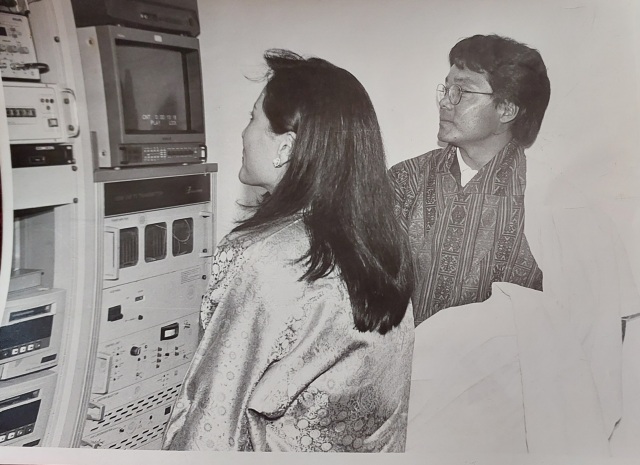
Her Majesty Ashi Tshering Pem Wangchuck inaugurated Bhutan TV at 4pm on June 1999Her Majesty Ashi Tshering Pem Wangchuck, Princess Chimi Yangzom Wangchuck and Ashi Sonam Choden visiting two days before the inauguration
Several people asked me as to what kind of businesses they can do in Gelephu – as the mindfulness city project kicks off.
Well, I am not the official representative on this, but for the benefit of the sentient beings who may require ideas from others, here are a few very obvious ones that come to my mind, from the various foreign travels I did in my life. Some of these businesses are already there, but more and better services will be required as projects, businesses and people settle in. I invite young Desuups who have been skilled to give an extra thought.
First, three golden rules to succeed:
1. Ditch the get-rich-quick syndrome: When you start a business, first aim to make a living and not make profits. If you secure the basic income to survive, it is a good start. Then as you become popular and you capture the market, you can think of profit. Work on a very low margin. As we say in Bhutanese, “don’t kill the red cow”. Start small. Minimum investment. Outwork your competitors.
2. Advertise your service: Market your products. Don’t wait for customers. These days with Facebook and other social media platforms it is easy. Stop wasting time making tiktok videos and doom-scrolling. Use social media with a purpose. Build a website. This gives you credibility.
3. Consistency, commitment & honesty: Be consistent. Don’t start and then wane. This is a classic case of any Bhutanese business. Keep your commitment. If you say 3pm, make it at 3pm! Who has not been to a place where they tell you to come back at a certain hour and when you go they have not even started the work. With Bhutanese it might work but not with others. And be honest and trustworthy. If you lose someone’s trust, you lose everything and you lose it forever. If people trust you, that is your biggest asset.
Don’t compete with anyone. Compete with yourself.
Now, here are some ideas – assuming that Gelephu will be an area with free movements of people, and with a real ease of doing business, which are all the hallmark of a special economic zone.
1. Shuttles, luggage, logistics and shipping services:
People arriving in Gelephu – whether it is for short visits or for longer stays will need to move around. If you have a car, you can provide the shuttle service. You can form a group, and offer a wider variety of vehicles. There will also be goods – like personal luggages to be delivered, and merchandise to be moved around too. Whatever be the case, shuttle service is a big business in any economically vibrant city. Packing, forwarding, shipping, air cargo, etc. will only increase as we move forward.
There will also be people moving in or having shipping containers and goods they have ordered from somewhere to be cleared from Kolkata and forwarded to Gelephu. In the initial period these clearing jobs will be a nightmare and they are best left to experienced hands. If you have some experience, put them to some use.
2. Visas, stay permits, translation and administrative services:
Any foreigner needs some paperwork to be done to enter or arrive in the city, start a business, apply for stay-permits, extend their stays, get a SIM card, Wifi services, etc. A small office with a photocopier, scanner, printer, camera and a make-shift studio are all you need to give a go. Alongside you could offer translation and translator services. People who come to Gelephu would most likely use agents in the beginning to do the running around.
3. Rentals, real estate & retirement homes:
As people move in, they will need a place to stay. Consider starting a property rental service and help people find a place. You can charge a fee for your service. This business is quite easy, and not so demanding that you can work from your own home. All you need is a good laptop and a website.
Short term lease or seasonal rentals in Gelephu may also become a trend for Bhutanese from the colder regions of Bhutan – Thimphu, Paro, Bumthang and Haa, to escape the winters. This is something I would consider – live in Gelephu from November to March.
4. Photography, video, writing and printing services:
As businesses explore the area of Gelephu to build their factories or homes, or whatever, they will look for professionals to take pictures and videos. Later to write reports, design company websites, design brochures for their business – or advertising and running their social media pages – and do their backend work. This is not bad if you like art, designs and creativity. And again something you can freelance out of your car.
5. Steam, sauna, medicinal baths and fitness centre:
One other business that will do well is a bathing centre. Better if you can access the hotsprings of Gelephu. Having regular steam and sauna baths provide a variety of health and beauty benefits, especially in south Bhutan where bugs and insect bites are common. The traditional hot stone or herbal baths can be a good tourist attraction, because of Bhutan being a land of medicinal herbs.
If you are a certified fitness trainer it is time to move to Gelephu and open a gym there for both visitors and locals who are very conscious of their health.
6. Laundry shops, and dry cleaning services:
Laundry and domestic help will really be in demand as people move to Gelephu. You may think people can use a washing machine, but having to iron the clothes takes time and people don’t have the time or patience for these things. When I do long-stays in Bangkok or Bali I always use the laundry service where they charge by kilos. A heavy duty dryer machine is a must in Monsoon in Gelephu when the humidity does not allow your clothes to dry.
Laundry service will also be required by hotels and guesthouses, who will happily outsource the washing of bedsheets and pillowcases on a daily basis. If you do it well, it is great business.
7. Gardening, domestic helps and security services:
Grass and weeds grow faster than you can think in south Bhutan because of the warm weather and torrential rain. Plus they don’t dry up in winter. Every house and every villa will require gardening service. Gardening does not mean only plucking the weeds. You must also offer design and construction service with ready-made plants and flowers transported from the nursery and transplanted. You can offer to maintain it for an annual or monthly fee.
There will be a floating population who will be in and out of their homes in Gelephu. So besides gardening, there will be the need for domestic helpers and to security guards while they are away.
8. Travels & tours:
Gelephu will become the entry point for travellers who may want to proceed to Manas or Phibsoo (within the GeSAR) or beyond to Zhemgang, Trongsa and Bumthang. Visitors may also want to explore and experience village life.
However, this will be the most competitive field and so you need to prepare for this the most by: Visiting all places of interest, studying the area, documenting and remembering the stories, myths and legends; Locating the best food and drinks that are not good but also hygienic and clean; Blogging, writing and advertising extensively; Learning how to make good videos, and put them on YouTube; Taking good pictures and making information brochures; and by being very resourceful
9. Rooms (Bed & Breakfast):
People need somewhere to sleep, and often the big hotel chains are expensive and soulless. Meanwhile, a quiet rural home with some history, a private hut with a shower, a proper breakfast and the proprietor who can share the local history, culture, traditions and knows the place and people there, could be a far more enticing place for a casual visitor. People will not come to Bhutan to look for luxury beaches or entertainment but for some authentic connection to nature and people and for some quiet introspection.
This could be a great retirement plan for many civil servants who are well travelled and knowledgeable, and who own land in Gelephu-Sarpang. Besides, south Bhutan has a much milder climate for the old ageing bones and muscles.
10. Food & beverages:
Coffee shops are my favourite places. I may not visit a local museum or a famous tourist spot but I always enter every coffee shop in town when I travel. I am addicted to coffee and besides that it is a nice place to make new friends and have a conversation. That’s the reason there are coffee shops everywhere in Europe and in southeast Asia. Better if the place has homemade pastries, bread, bun and cakes. Go for this! There are more people like me than you think – even among the Bhutanese.
I won’t mention restaurants. This is obvious. But one business that will do well is catering, but with a difference. You must cater the food to places with a view – in the wilderness, near the river, in the jungle. You can cater weddings, birthdays, official and unofficial events. Many professionals who will be move to Gelephu will be single or young couples who cannot cook.
Honorary Mention: Be a “Jack of all trades”.
There won’t be a huge mass of people rushing to Gelephu right away. It is more likely that there will be a good number of early adopters who will inspire more to move in. So instead of focussing on one trade, have as many in the beginning – and then focus on one. You can combine several businesses, like travel, shuttle service, and visa clearing, while your wife offers laundry service or leads a catering team.
(More business ideas in the legal, public relations, wellness, etc. later as I get a better grasp of what are coming there)
Identity has been mankind’s longest search. The question of “who am I?” has intrigued thinkers from Plato to Prince Siddhartha to Descartes. For us in Bhutan, this question has become even more relevant, as the country faces the onslaught of technology and outmigration, and the dilemma and divisions brought about by changing politics and policies. Simply put, what does it mean to be Bhutanese? This lack of common understanding, I believe, forms the core of our challenges – whether it is at an individual level or as a nation. Drawing from my PhD dissertation, I will attempt to give a definition to this slippery topic.
Identity has several definitions and concepts. Depending on the discipline, there are racial identity, gender identity, religious identity, cultural identity, political identity and so on. Here, by identity I am looking at the one coming from psychology – as in the personal identity, which describes one’s distinctive attributes that make a person unique. And more so, to the sociological definition, which refers to qualities, beliefs, and traits that characterise a person or a group. Scholars argue that it is the social circumstances in which people have been raised that determine the ways in which they identify themselves. Identity is, thus, believed to be produced through social interactions and experiences.
The traditional, virtual, and hybrid communities
A traditional community is where everything is shared – life, work, happiness, or sorrows. When you build your house, the whole village comes together without expecting a payment. Wherever celebrations and ceremonies are taking place, everyone is invited by default.
Nature and spiritualism occupy the centre stage in this community. It is not humans, but nature, which dictates everything including the pace and rhythm of life. Places are not just physical spots. They are sources of stories and spirituality, and of inspirations and wisdoms. Thus, kinship and family ties are extended not only to humans, but also to nature and to nonhuman forces and spirits. For instance, tigers are referred to as azha tah (maternal uncle Tiger), bears as aku Dhom (paternal uncle Bear), and elephants as memay Sangye (Grandpa Buddha). Certain deities and mountains are also embraced like a family. Examples of case in point are ama Jomo (mother Jomo), memay Chador (grandpa Vajrapani), or as memay Ralang – a mountain in Trashigang. Kinship terms do not only serve a referential purpose. They build and sustain emotional connections too. This may be the reason why Bhutanese are close to nature and mountains.
Time, in a traditional Bhutanese community, is conceived as cyclical and not as linear. For instance, older people do not remember their age. They will remember their Buddhist zodiac signs, which is a cycle of twelve years known as lo-kor. The correct question to ask is, “How many cycles have you done?” instead of, “How old are you?”. Nature also defines the flow of time. To lift from American sociologist Robert Levine, traditional Bhutanese prefer event time, and not clock-time. In rural Bhutan, you don’t say, “I will see you at 9.30”. Rather it would be something like, “Let’s meet before the Sun sets, and after we collect our cows from the jungle”. This may explain why Bhutanese are rarely on time.
At the other extreme of a traditional society is the virtual community where humans, instead of nature, are at the centre of the universe. Here everything must be rational, logical, scientific, and black and white. It is also where time is linear. The resulting characteristics are: more individualism, expressiveness, innovation and celebration of anonymity. Money and materialism are means to enhance one’s self-worth or belonging.
Striding between tradition and technology, between collectivism and individualism, and between money and meaning, is the hybrid community. Time starts to become linear here, and the cyclical concept is still accepted. Nature has its place, and so does rational science. There is more “we” and less “me” in this group, and wealth is to enable one’s pursuit of the greater good.
Therefore, the traditional Bhutanese identity is an interdependent self, which consists of a personal self, social self and a spiritual self. The social self is derived from one’s social identity as a parent, and from the vocation one practises. The spiritual self is the recognition and internalisation of the external nonhuman energies and spirits.
The chronotopic Bhutanese identity
While one may observe these identities manifesting in different generations or communities, an interesting finding is that you can also notice these multiple identities in individuals, as one lives through the changing circumstances and contexts in life. The ingredients of the interdependent self – the personal, social and the spiritual selves, are all there in each one of us – in different dosages and degrees. I call this the chronotropic Bhutanese identity. Chronotope comes from Greek and it means time-space (chronos means time, and topos – place). The term was coined by a twentieth century Russian philosopher Mikhail Bakhtin as a literary tool to posit the idea that time and place are inseparable in art. Chronotropic identity basically argues that a change in timespace configurations triggers a seamless shift in roles, behaviours, discourses, modes of conduct, mindsets, and cultural practices.
Take for example, the people of my generation – the predominantly hybrid group that grew up in a traditional setting, and got introduced to science and technology. We start the day by reciting a few lines of prayers. We then get up, wash and offer water and incense to the altar, have breakfast and open a laptop at work. The virtual community, on the other hand, may be on the technology from the moment they wake up till they retire to bed. They would attend spiritual calls on special religious occasions, or visit a temple like Dechenphu if they need something. Conversely, the traditional people access the technology too but not as a default mode. It sees materiality both in technology and spirituality, though.
The key to a harmonious Bhutan, then, is not only to recognise these parallel matrices, but, to paraphrase another philosopher, Jean Gebser, to embrace an integral consciousness that would involve a more holistic understanding of the reality, which includes both the rational thoughts and the intuitive sense of interconnectedness and spirituality. The Generation Z (or Gen Z – referring to people born roughly after 1999) must not refute the traditional as archaic and outdated. On the other hand, the hybrids should not discard the Gen Zs as not adhering to established norms. There is space for everyone.
What’s going on in Bhutan, instead
From a sociological perspective I feel that there is a loss of innocence among traditional Bhutan, which was accelerated by political changes.
By ‘innocence’, I mean where people are honest, spontaneous, sincere, always helpful, and trusting of others, and have a strong moral compass. In general, people who haven’t been corrupted by the evils of modern society. You can find some in rural Bhutan.
The loss of innocence has led us to empathy deficit among the hybrids – because of newfound power, ego and fear. And then, among the younger generation, a decline in the sense of belonging from being not understood. Unless we address these, people will go off on tangents in search of meanings to life, instead of drawing satisfaction and purpose from the service to the collective.
My greater concern, however, is for the next generation. For better or for worse, from an interdependent-self that we should be, Gen Zs are growing up as more expressive, questioning and independent selves. Instead of love and guidance by the collectivist society, it is viewed as a social divergence. Our youth, then, feel misunderstood, and even rejected. Research shows that when they are isolated from their physical communities, they will either go away, shut off completely, or hide behind computer screens and smartphones and try connecting with the online world. One issue with living on social media is the abundance of information and knowledge there – both good and bad. Information is not knowledge, and knowledge is not wisdom. In life you need wisdom. You develop wisdom only when you engage with the physical world, where you roll out your sleeves and get your hands dirty. This may explain the success of the Desuung program. It gives that opportunity – to go hands-on and feel a sense of belonging to a meaningful community.
Fortunately, some compassion is still around in Bhutan, which is evidenced by frequent and successful fundraisers on social media, like for someone in Australia who needs a surgery, or for a fellow Bhutanese who has to go for a transplant in India – or to simply save some yaks – or build a stupa.
So, what does it mean to be Bhutanese?
To be Bhutanese means to be compassionate, altruistic and spiritual; and be aware of one’s place in a family, community and country; and share this temporary space with other beings – that are both seen and unseen. If Bhutanese, young and old, could embrace this more, instead of over stressing on cultural paraphernalia or purely pursuing economic dreams or power, a brighter and a fulfilling future – as individuals and as a nation, will be more than guaranteed.
Korphu takes its name from a two-feet flat and oval boulder under which the great treasure revealer (terton in Dzongkha), Pema Lingpa (1450–1521) is believed to have taken shelter – after turning himself into a bee. “Gor means “stone” and phug means “cave”, and it became a cave for the Terton”, says former gup (headman) Zeko – an elderly gentleman whom I randomly met in Gelephu a month back and invited me to his village.
I had visited Nabji-Korphu before – in 2004, as a part of a UN team to open an eco-trail that the community had built with UN-GEF funding. It was a week-long trek from Langthil to Nimshong through some of the most dramatic trails – especially crossing the famed and scary Ugyen Drak. Needless to say, my team and I thoroughly enjoyed that trip and had only fond memories of me going broke midway into the trip – and scamming a colleague to be the chief guest and tip the villagers.
And now here I am back. It is 2024. How time flies!
“You can drive your car all the way to our doorstep, la” Zeko assured me when I met him in Gelephu. In fact that’s what we did.
The Lhundup Chodarling Temple:
The village of Korphu revolves around this temple – the history of which starts with the arrival of lama Chogden Gonpo (1497–1543) in Nabji. He was considered as the reincarnation of the treasure discoverer Dorji Lingpa (1346–1405), and was also a disciple of Pema Lingpa (1450–1521). He came there to disseminate the teachings of Dorling Tradition and offered statues of Guru Rinpoche and Dorji Lingpa – both of which can be seen there even today.
Few years after his arrival, an epidemic of smallpox spread in the valley and took many lives. Chogden Gonpo requested his guru, Pema Lingpa to come to Nabji to help cure the disease. Pema Lingpa obliged and came and conducted several rituals and prayers and cured the valley of the disease.
Pema Lingpa then built a two-storied retreat center following which many disciples joined him and build small huts and houses around his centre. Korphu, therefore, is one of the few cluster villages in Bhutan with houses attached to one another unlike the typical farmhouses in Bhutan that are independent and spread.
Korphu is on the hill overlooking the beautiful paddy fields and the village of Nabji. In fact, many people in other parts of Bhutan refer to this twin village as Nabji Korphu. From Nabji if you walk it is a two-hour uphill climb.
The origin of Gorphu:
When Pema Lingpa was looking for a place to establish his retreat centre, he wanted a good source of water. After befriending a local hunter called Pema Dorji, he was shown a water spring at a place known as a Umchu Gang.
One day Pema Lingpa found animal traps around Umchu Gang and he immediately removed them so that no animal was hurt. When Pema Dorji found out, he charged Pema Lingpa for doing that. Finding him really furious and relentless in his attacks, Pema Lingpa magically brought down wind and hailstorm over the place, while he himself turned into a bee and took shelter under a flat boulder.
Pema Dorji saw that he was dealing with no ordinary man, and apologised. He also gave up his hunting business and became a gomchen – lay monk under Pema Lingpa. He named the place after the boulder – as Gor-phug, and over time it was mispronounced as was popularised as Korphu.
The relics of the temple:
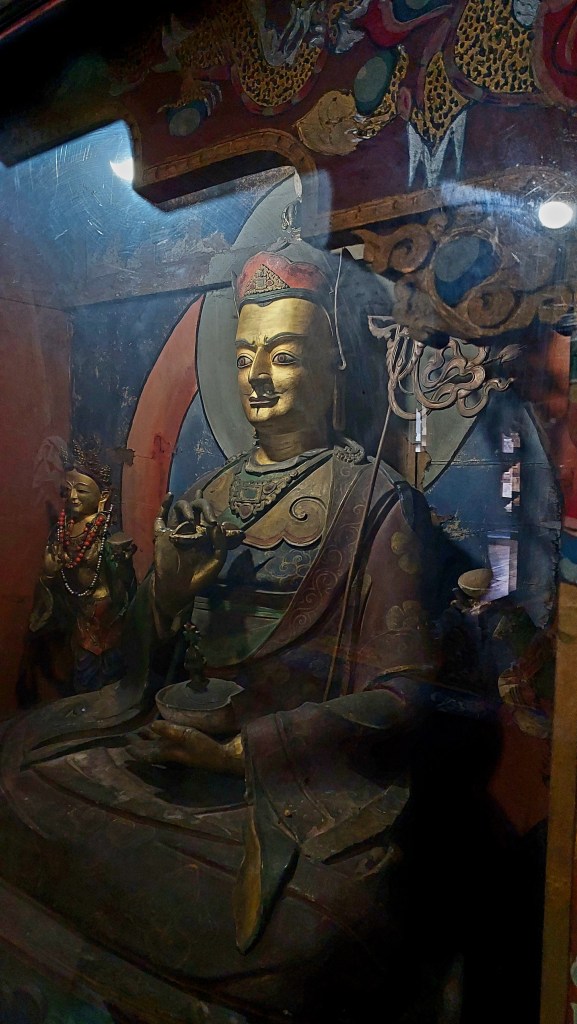
While Nabji is associated with Guru Padmasambhava, Korphu is a seat of Pema Lingpa. The outer structure of the temple has been renovated but the inside still is old and feels very sacred. There are the statues of Guru Padmasambhava and Avaklokiteshvara that are believed to be the handworks of Chogden Gonpo. Both the statues have the powers to grant any wish one makes, the caretaker told me.
The inner relics (nangten) are: a volume of Transcendental Wisdom in 8,000 stanzas which are referred to as Gyatongpa, which is believed to have been written in golden ink by Pema Lingpa; the ceremonial hat of Ani Choeten Zangmo, the grand-daughter of Pema Lingpa, and who is widely known for establishing a Peling seat in Dremetse in Mongar; the dress worn by Pema Lingpa, which he wore when he dove into Mebar Tsho in Bumthang; and two bells crafted by Pema Lingpa.
The sacred chamber of the Guardian Deity (Goenkang) is dedicated to Gonpo Maning Nagpo – flanked by the two local mountain deities Ap Jowo Durshing and Ap Muktsen.
Visiting Korphu:
Visiting Korphu brought me immense joy and smiles from funny memories from the earlier trip. The people of Korphu are some of the nicest folks I came across and every guest is treated like a VIP. They take pleasure in serenading you and singing you off as as you leave their magical village.
Truly it is a place I recommend before modernity or some other things erase this genuine Bhutanese hospitality. This time I also got to get blessings from each and every nangten they hold in the sacred village temple. As a descendent of Peling lineage, it was an emotional experience to see so many personal effect of this greatest of masters.
And this time, as Ap Zeko promised, it was a cool drive from Wangdigang in Zhemgang for an hour along the narrow black-topped road till the doorsteps of both Nabji and Korphu temples.
It is a place I will return again to listen to more stories, songs and soak in their warm hospitality.
I closed my week-long New Year Pilgrimage with a visit to Athang Rukha – my adopted village for 18 years now. The village of Rukha is one of the few sacred abodes of Palden Lhamo – one of the three supreme protectors of Bhutan.
My association with Rukha.
For those of you who have not been following my work, I have been associated with that valley since 2007 when I went there for the very first time on a documentary mission. The remoteness of that place (it was two days of walking through the leech infested jungles) and the misery I came across shook me to the core that I decided then and there that whatever remained of my life would be dedicated to doing something for that village. The valley is now known for the Oleps – the last hunter-gatherers of Bhutan.
I subsequently volunteered for a foundation that went on to lift them out of abject poverty to a dignified life. When the project ended, the villagers and I had bonded so much that they wouldn’t let me leave. So, I stayed on and we built some temples together in a valley that didn’t even have a prayer flag when I first got there (they practised shamanism and nature-worship). I provided the funds using my own money (which ran out every now and then and the work stopped) and the people there did the hard work – extracting the timber, carrying the boulder, ramming the mud, etc.
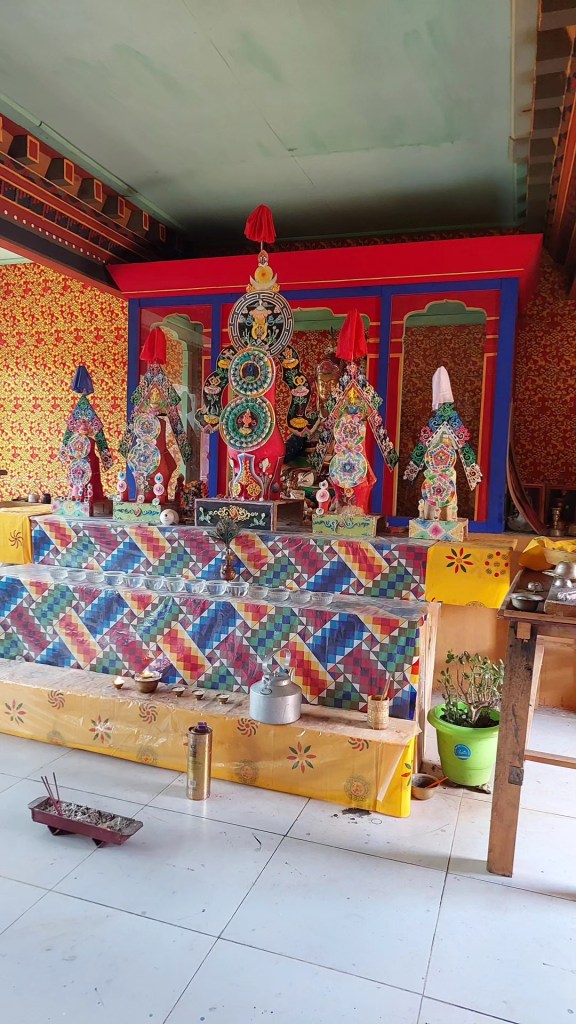
Fast forward to 2024, the third temple – a tshokhang (community hall) dedicated to Guru Padmasambhava – my birth deity, is getting the finishing touches of religious art on the ceiling – three mandalas of Tshela Namsum (Buddha Amitayus, Unisha Vijjaya and Tara). These mandalas when completed would throw down more blessings when anyone does ceremonies to Sangye Tshepamay, Namgyelma or Jetsun Drolma.
Abode of Palden Lhamo.
The place is believed to be the abode of Palden Lhamo and visited by both Guru Padmasambhava – on his way to Bumthang in the Eighth Century, and by Terton Pemalingpa in the Sixteenth Century on his way from Bumthang looking for a place that would eventually become Gangtey Gonpa.
A temple built in the mediaeval era stood there until it was completely destroyed in the early 1930s after the original inhabitants abandoned the valley because of the smallpox epidemic. Between 2009 and 2014, the Oleps, the new settlers of Rukha and I built the temple over the mud ruins of the original temple. Left untouched, the ruins can be seen on the ground floor. The carpenter, Chorten Tshering, was told in his dream by a girl not to destroy the mud ruins.
In 2014 when the former Tsugla lopen Samten Dorji consecrated the first temple, many old people from the valley heard the sounds of the religious instruments for the first time in their life. Furthermore, many young people, and every elder member, took the oath from Tsugla Lopen to refrain from hunting and killing wild animals – a skill and way of life they inherited from their forefathers. Now, a twice-monthly Lhamo Tsho-ja is conducted with households taking turns.
Traditionally the Oleps practiced shamanism and animism, and this continues in some forms till this day. And here, I have been very respectful not to force anyone into one or the other spiritual practices. As Buddha said, I can only show the way.
In 2020, when the pandemic hit and we were all stuck, the Rukha Lama, Ugyen Tshering, and I initiated another temple to be used as Tshokhang, so as to turn the first temple into a Neykhang (place for protector deities) and dedicate it solely to Palden Lhamo. I also built an altar with 21 Taras for my daughter and grandson whose birth deity is Tara. In 2022, the tshokhang was consecrated by Gangtey Rimpoche, who also presided over a three-day Tshechu with mask dances – the first one to be instituted in lower Sha region.
The blessings of Palden Lhamo and Tara are evident. Rukha has been receiving bountiful harvest, in general, and the families who were solidly behind the temple project are having a fulfilling time with their children doing well with their life.
And the story continues..
From going hungry to building a better life for themselves and their children, to temples and hosting the first Tshechu in the region, the Oleps have come a long way in less than two decades. It has been close to an economic and social miracle – a case study in development management. The credit fully goes to the people who believed in themselves and were ready to work hard.
Along the way the State also provided the valley with a power-tiller road (2011) upgraded to a farm road (2018), electricity (2019), and mobile phone network (2023). From a two-day treacherous hike the road to Rukha has been reduced to an hour-long pleasant drive from the Wangdue – Tsirang highway.
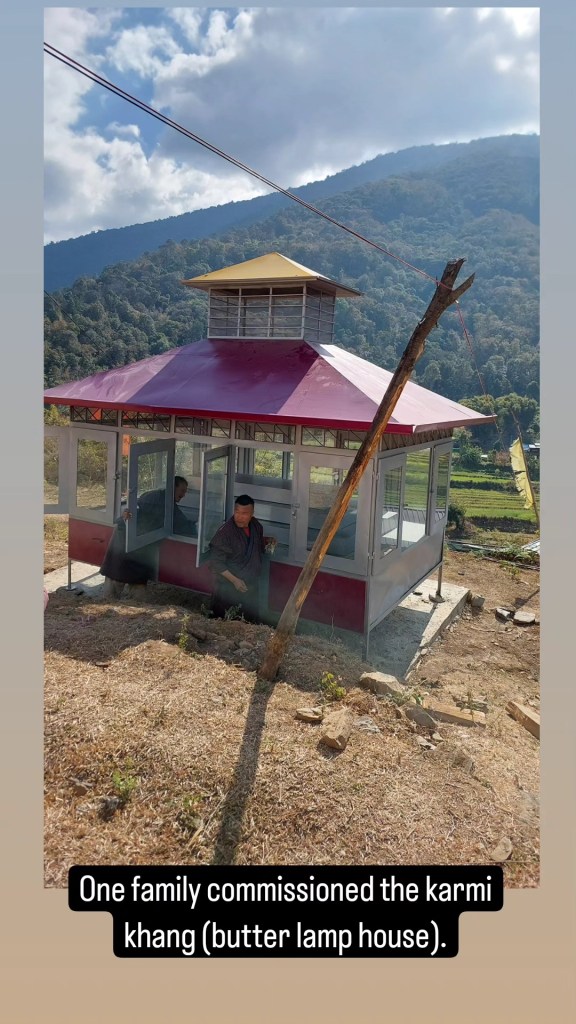
I offered three butter lamps in a new large Karmi Khang that a family from Rukha had bought in the memory of their father, who passed away a few months back. It arrived on the same day I landed there. I prayed that the people of Rukha continue on their path and be a part of this small great nation, as it moves confidently into the future.
They say you cannot take anything with you when you die. This is not true. You will carry with you the good and bad karma and the merits and retributions you accumulated. And more importantly, you will also leave behind the memories of you in people whose lives you made some difference.
So, as you breathe in the Dragon Year 2024, I invite you all to take a moment to reflect on a few questions. How many thoughts and prayers (moelam zangpo in Bhutanese) have you sent to others? How many smiles have you brought in someone else? How many lives have you touched through your small or big works?
As a Mahayana Buddhist, these should be the questions of your life – and the greater meaning of a pilgrimage.
(Itinerary of my pilgrimage – Semtokha Dzong (Thimphu), Dobji Dzong (Paro), Lhakhang Karpo (Haa), Punakha Dzong (Punakha), Mebar Tokchoe (Zhemgang), Lamga and Rukha (Wangdue)
This year, 12th January will be celebrated as Sharchop Losar or Chunyipa Losar. However, it appears that this is not just the new year’s day for central and eastern Bhutan, but for Bhutan as a whole.
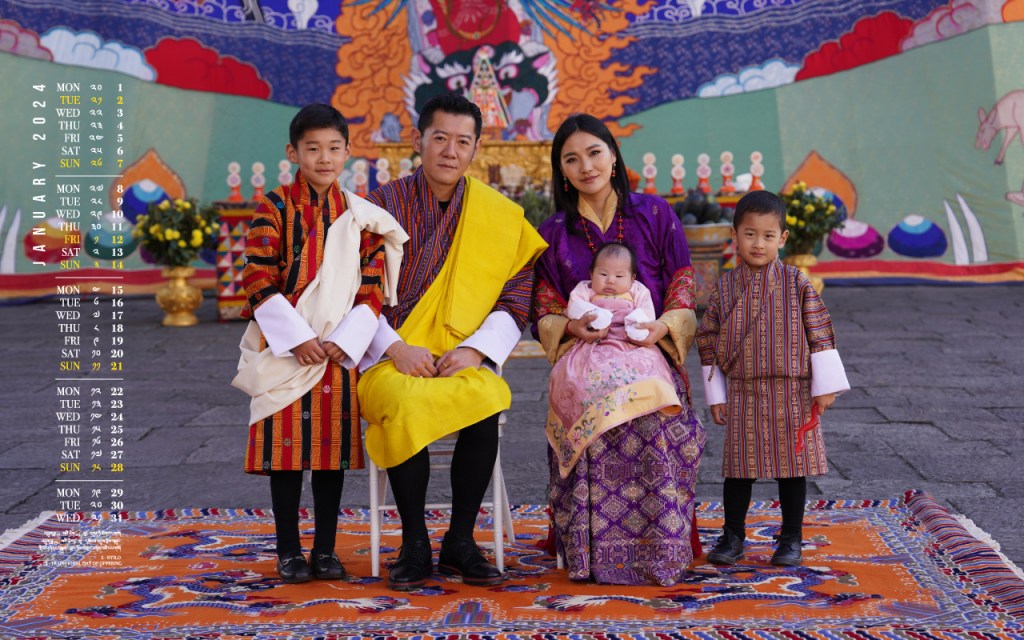
Historical records show that the Founder of Bhutan, Zhabdrung Namgyel observed this day by returning to Punakha (he was more a travelling ruler) and having his subjects visit him and pay homage and tributes. It is said that the three-way staircase of the main entrance to Punakha Dzong was built to welcome the three regional governors called the penlops on that day. Zhabdrung also made all state appointments while also greeting other lesser regional leaders and their retinues as they paid tribute to him. Thus, the day was referred to as buelwa phuewi nyim, which is poorly translated as traditional day of offering.
Astrological significance
This day falls on the first New Moon after Nyilo – a traditional Bhutanese holiday, and in the month when the Moon meets with the Cancri constellation. In the older Lama Gongdue (བླ་མ་དགོངས་འདུས་) – a terma teaching revealed by Sangye Lingpa (1340-1396), the month is considered as the first month of its calendar year. This was probably the calendar prior to the adoption of the official Buddhist calendar followed in Bhutan. The celebration of New Year on this day in central and eastern Bhutan is thus more local, and more traditional Bhutanese.
According to Bhutanese scholar, Karma Phuntsho (PhD), Zhabdrung Ngawang Namgyal was a serious follower of Terton Sangay Lingpa’s teachings and incorporated rituals such as the Lama Gongdue into the ritual curriculum of the Central Monastic Body. And this may also be the reason why he marked the day as the day of accepting tributes and a day of celebration with his people.
Why do Tibetans celebrate the New Year a month later?
The Tibetan New Year’s day, which comes a month after, coincides with the Mongolian New Year known as Horda (ཧོར་ཟླ་), which the latter instituted as their calendar – to mark the day of victory over the Tangut Kingdom by the first emperor, Genghis Khan.
After Gushri Khan (1582-1655) invaded Tibet in 1641, the Horda became the Tibetan calendar and thus the Mongolian New Year day was celebrated as the Tibetan New Year. Furthermore, Gushri Khan was referred to as Chogyal (Dharma King). And thus this Losar (New Year) was also referred to as Gyalpoi Losar (རྒྱལ་པོའི་ལོ་གསར་) – King’s New Year. Older folks in Bhutan would be familiar with this term
In essence, the Dawa Dangpi Losar has neither any auspicious significance to Bhutan, nor any important astral reasons. As Dr. Karma Phuntsho adds, it is even odd that we celebrate it as the main Losar, which is a legacy of Mongol rule over Tibet.
Let’s celebrate Chunipa Losar as our New Year
In sociological studies we say that repeated behaviour becomes a habit. A habit embraced by a mass becomes a culture. A culture repeated periodically becomes a tradition. So, we can institute some new traditions, and retrieve some older ones, around this Day, so that over time it consolidates as the Bhutanese New Year.
First of all, call it Bhutanese New Year! As someone trained in sociolinguistics, trust me, vocabulary matters. To continue with the misnomer Sharchokpa Losar would do no good.
Second, making appointments, promotions and pay raises: Following Zhabdrung’s tradition, new and important appointments could be made on this day. Promotions and bonuses can be declared on this day.
I am not limiting this invitation to the government only. That would take time. I would rather invite our private sector, and companies to do that. Pay the bonuses and give a salary raise on this day. Why not? As I said, if we all do this every year it would become a tradition. Employees all over Bhutan would be eagerly waiting for this day – and a whole new industry can come up on this just like the red envelope tradition in East and Southeast Asia.
Third, PIT Day. No one likes taxes but as a cliche goes, it is the only sure thing in life besides death. So, why not do it on the eve of this day? Why not celebrate it? Why not file your personal income tax with a prayer that your few ngultrums take this country an inch forward and benefit as many sentient beings? Make it a happy moment to pay your taxes. It is all in the mind.
Fourth – make it a Day of Offering: Most importantly, as Buddhists, it can be the day of offering to your root-lama and to the gompas you visit, astrologers you consult and places you revere. Just as our forefather did to Zhabdrung, we can do it to the lamas of our time. As we believe in Bhutan, such offerings will “clear your obstacles for this life, and help you accumulate positive merits in your next”. And so, why not start the year with a bang.
Above all, make it a tradition in your own family to meet – and, again, to paraphrase a local saying, “meet and eat one meal together”. If not, WeChat is there.














 Dorji Wangchuk