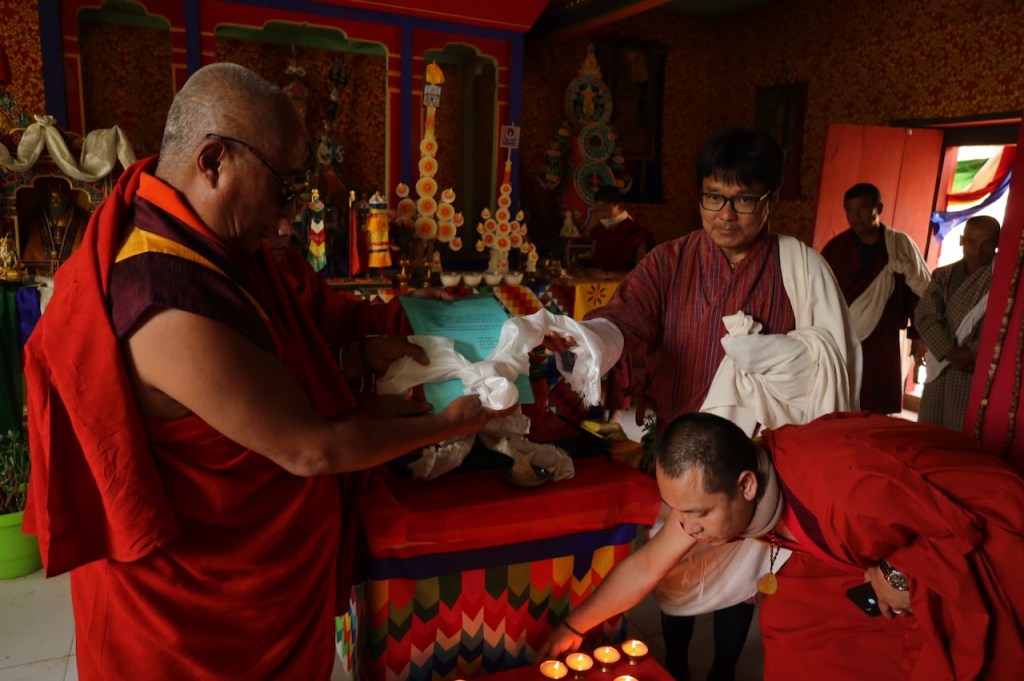
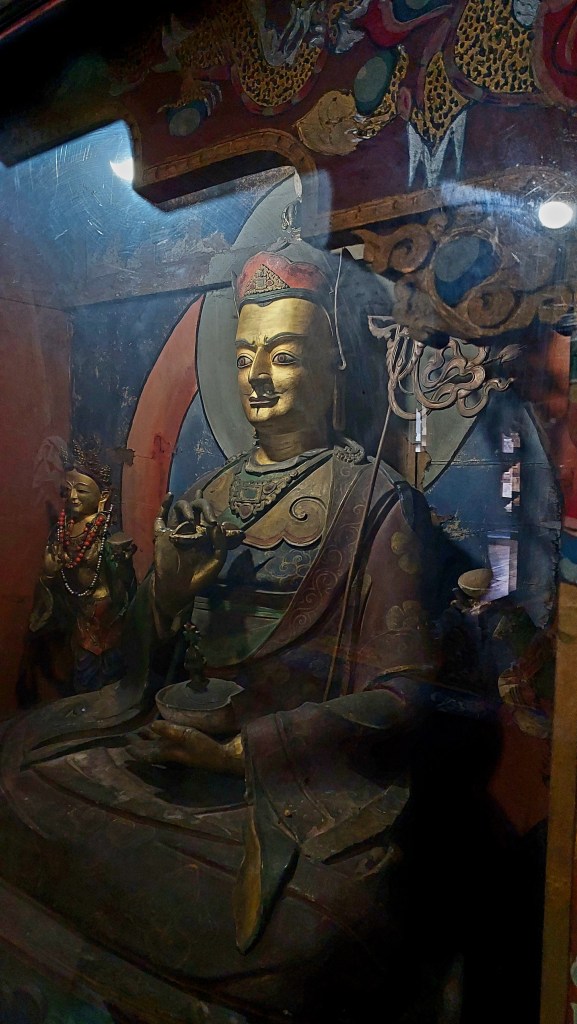
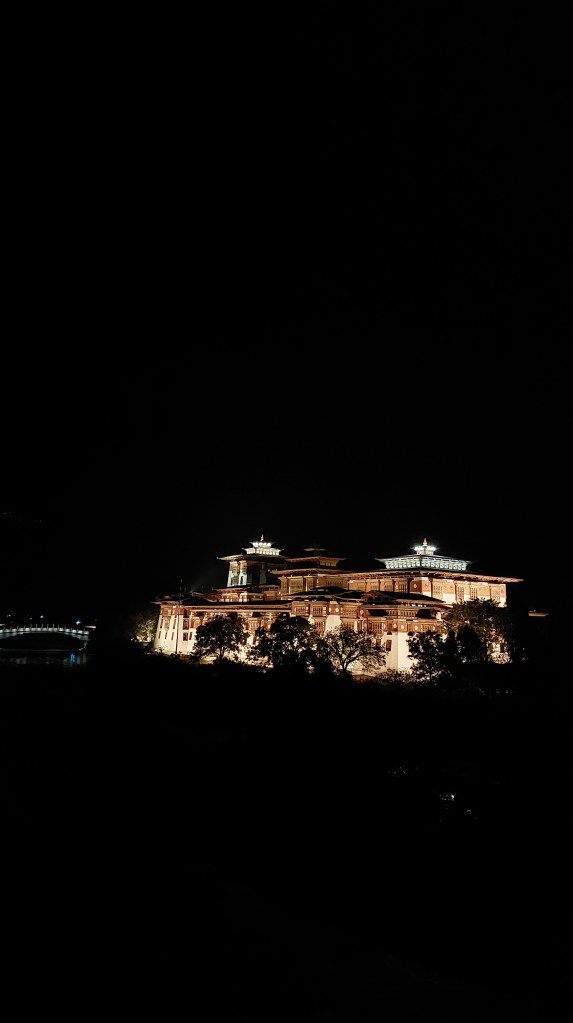
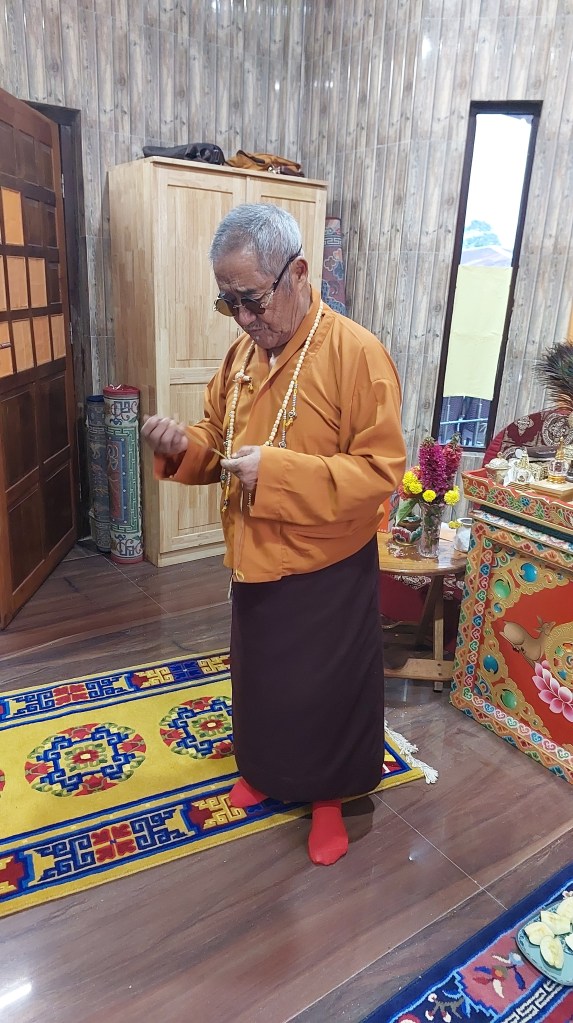
Paid my homage on the Nyilo Day to our founding father, Zhabdrung Ngawang Namgyel, at the sacred Machen Lhakhang in Punakha Dzong. Sought his blessings for the new year and what he thought of me coming out of my semi-retirement. He responded with a perfect dice number which means, Awesome! (this is according to the caretaker-monk).
Waking the Talk.
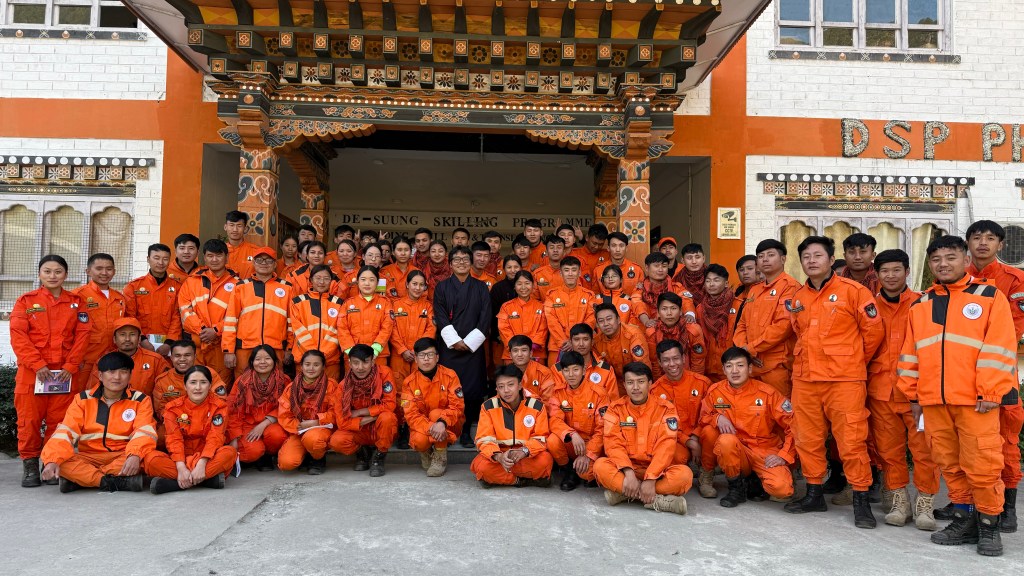
On this day I completed revising the Buddhist iconography, and Foundation of Buddhism, which were two courses I taught this group of 200+ young Bhutanese – in September and October. (To all the Tour agencies maliks, please know that I trained these guys. So take them with blind faith).
I also gave the guys some peptalk where I told them not to only find faults in the stars, the society or the state but to look at themselves in the mirror and challenge themselves first.
I said, “We always think it is someone’s fault when life does not go our way. You know, for me I am my biggest biggest obstacle. For instance, these days I feel too lazy to go for morning walks. I keep rejecting all job offers because I don’t want to work full-time. I struggle to eat healthy, or work as hard as I used to. At your age I used to work 18 hours a day. Can you do that? Can you wake up at 5 in the morning, work like crazy, and go to bed at midnight for 5 years every day?”
I told them to just go out, explore and grab every opportunity, take what comes their way, and they will eventually find their place and purpose in the world. At the very least, they could carry some boulders at GMC. The world may be unfair but you can’t change it if you only look for excuses.
Aum Om’s Homestay
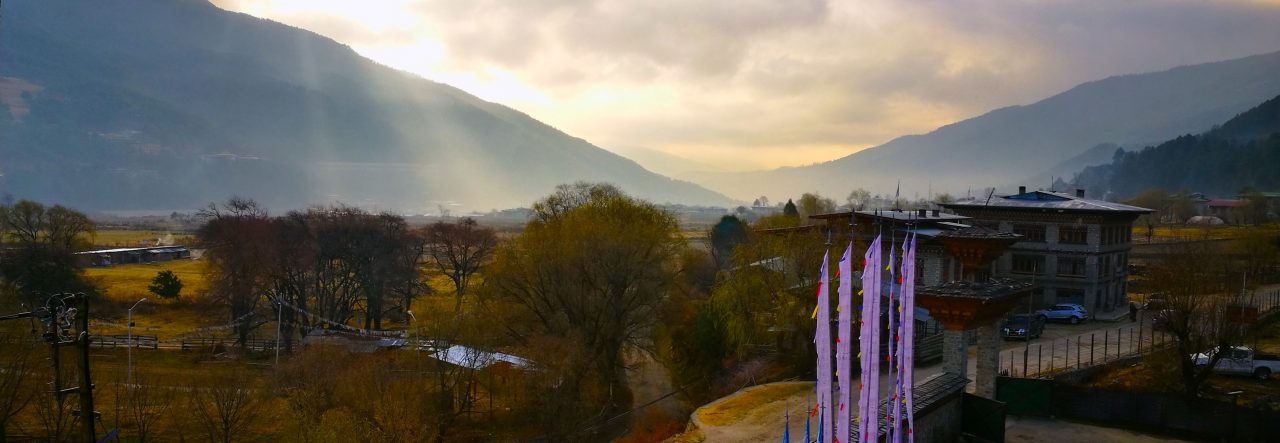
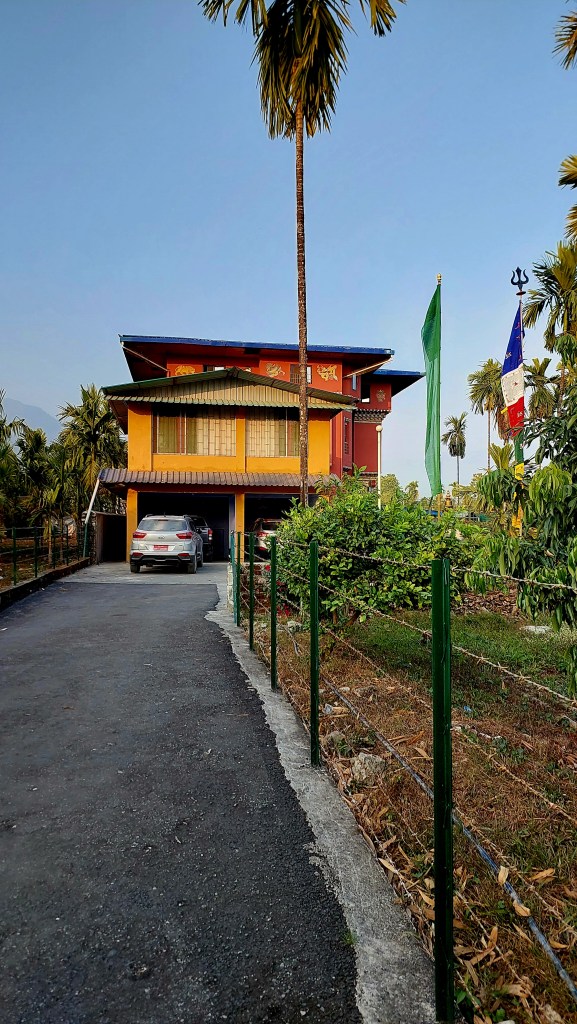
On the eve of the Nyilo I had a free meal (she refused to take the payment) at Aum Om’s Homestay. After running around in foreign land for months I wanted to eat something authentic Bhutanese, and I called her up. Aum Om is the sister of the legendary artist Asha Karma of VAST. The homestay, certified for tourists, is tucked away in the quiet corner overlooking the Punakha valley.
Aum Om is a quintessential Bhutanese lady – super warm, generous, strong, dignified, and a great homemaker. Her place is an oasis of peace and perfection. (If you want to go there, and you must, you can find her place on Google Map too)
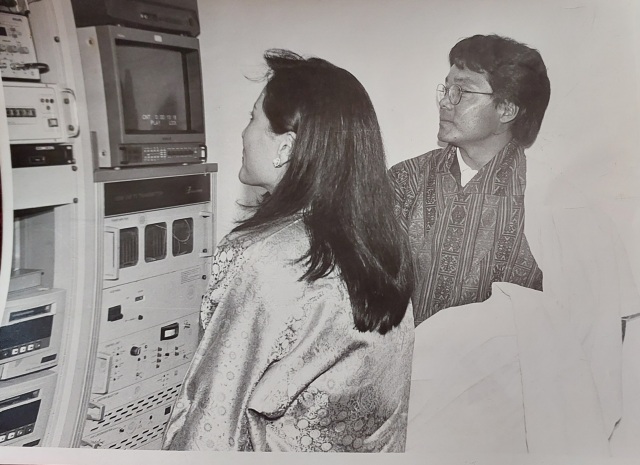
Twenty five years ago yesterday (June 2), TV finally came to Bhutan. It was launched as one of the Silver Jubilee celebrations of His Majesty the Fourth Druk Gyalpo. While there were many great things done as a part of the celebration, including the introduction of the Internet on June 1, the arrival of television to Bhutan was the much-awaited moment for just everyone in the country for various reasons. Someday, if I feel, I will detail them out.
As many would know, I led that historic project, which I am still immensely grateful for the opportunity of a lifetime – something that I am still proud of and will remember it forever. I recall one morning in January of 1999 when the late Lyonpo Ugyen Tshering, who was then the Cabinet Secretary, called me and another colleague of mine, also Ugyen Tshering (who later became a parliamentarian) and conveyed to us the Royal Assent. In his simple misdemeanour he told us, “Even if you have to take the Druk Air aircraft to get it done, do it! Now it is a royal command.”
Running up to June 2, 1999, there are a few cute little details, and a secret, that I want to share here today. More in future.
The TV project, while it was proposed for months preceding to 1999, was given the final green light only 4 months before the actual launch date. So, it felt quite impossible to build a brand new TV channel in four months. When I started enquiring with the companies around the world for the essential equipment everyone just declined. One even told me that I was crazy. I was, actually. However, a French company agreed and I flew over to Paris to check the company. The deal was done.
In telecommunication engineering we also have something called redundancy – meaning we cannot depend on one set of equipment, since we are dealing with the public service. We need a back-up. And so, since it was impossible to get a second transmitter within that time period I stopped over in New Delhi and I requested my good friend, RK Gupta, who was then the Chief Engineer of Doordarshan to lend me a used transmitter. RK Gupta (he used to refer to me as “my Son”) sent a full set of equipment – all packed in three jumbo trucks from his branch office in Lucknow. Fortunately, I later realised that I had made this personal request, because the main transmitter from Paris came only on May 30th evening with only 60 hours to go on-air. We were literally counting hours and minutes, sleeping in tents at Sangaygang to get the job done and going home only for quick showers.
While my team was unpacking the main transmitter I immediately assembled the back-up station sent by Doordrshan and then got it working. This took away a lot of pressure from me. It was also because I was the only TV engineer back then. My team had not even seen what the TV test signal looked like before that. So I felt the whole national TV project on my shoulder.
June 2 came and the celebration kicked off in Changlingmithang and, at Sangaygang, which overlooked the whole Thimphu city, we briefly stopped to listen to the Royal Address. When HM made a mention of the introduction of TV, I was super proud, but deep inside I was still grappling with the fact that we had still not fully tested the equipment. We were making the last few connections to put the full power from the main transmitter through the antenna. I kept that a secret, because if people knew we were not fully ready, it would have panicked everyone. In a crisis you just keep your cool. We achieved the full power without burning any equipment just two hours before the actual launch at 4pm.
People will remember that the first historic transmission came 20 minutes late, but that was due to another last moment issue we had – and it was not from the technical side, although it is normal to hear the announcers say it is.
All in all, 25 years later here we are. Was it good, or bad for the country that we brought the TV? All I can say is, it was inevitable. In the years and months running up to 1999, I faced the Planning Commission and the powerful Cabinet (ministers were like gods those days) and I remember sternly repeating this same message.
1999 and beyond
BBS TV was not just about BBS. I can proudly say that the BBS TV, thanks to a technology called the DVCAM that we chose from several others, later gave birth to what we now have as the Bhutanese film industry. Norling and Tashi Nyencha were the first to jump in. DVCAM was a digital technology that made equipment affordable to small markets with shoe-string budgets. I designed a whole eco-system based on DVCAM, which was later adopted in many small Asian and African countries, for which I was conferred the Asia-Pacific Engineering Award in 2000 in Manila.
More than the award, these days I feel a deep sense of satisfaction seeing young artists and actors and our filmmakers – and thousands of jobs created by that single decision I made back then.
On the broader side, I would like to believe that BBS TV played a huge role, and continues to do, in our collective journey as a nation towards democracy and public discourse – and everything that came out of it. Both BBS and our Film Industry played a vital role in Dzongkha promotion and pop culture, which are strongly elements of national sovereignty. We reduced our dependence on foreign culture and entertainment.
Other than that, as I said, I only feel gratitude for the opportunity bestowed on me from the high above – for the trust and confidence in a 30-year old man – who was almost a one-man army. I felt, and I still feel that I owe it to my country (and not the other way around) for feeding me, clothing me and sending me for higher studies – and making me who I am today. My parents on their own, would never have afforded anything close if I was left to them.
Yesterday as I drove to Jaigaon and back my memories took me to all the mountains and peaks on Dagala, Takti, Ganglakha, Saureni and the southern foothills – among leeches and mosquitoes and occasional snows, to search for the perfect spot to place a TV & radio relay stations to serve our people better.
Wishing everyone a nice week of contemplation as we head for the last few days of the holy month. 🙏🙏🙏
Picture: The Guardian (newspaper), UK
Her Majesty Ashi Tshering Pem Wangchuck inaugurated Bhutan TV at 4pm on June 1999Her Majesty Ashi Tshering Pem Wangchuck, Princess Chimi Yangzom Wangchuck and Ashi Sonam Choden visiting two days before the inauguration
May 2, 2024 – I drove to Athang Rukha to attend the last day of the Mani Dungdrup – organized by a certain Lama Wangdi from Punakha.
I had mainly pushed myself there, despite my heavy schedule, for one reason – the Rukha Lama Ugyen Tshering and seven men and women came and worked tirelessly in the heat of Gelephu to organise the Sacho Bumter for Dorje Phagmo Center the week earlier. I intended to reciprocate their favour, quickly pay respects to Palden Lhamo and Avalokiteshvara and turn back. So, it was just another trip for me. I have been doing this for 18 years now.
The Arrival
However, this time the Rukha Lama had other plans. The villagers were told to receive me with full honors of a VIP-Lama or whatever. So, to my great embarrassment I was received with the blaring sounds of dung-jaling (Tibetan religious horns and trumpets) and ladies singing as they led me in procession to the temple.
At the venue, the jing-ser ritual was going on and the Presiding Lama, Venerable Wangdi – the former Lam Neten of Tsirang, signaled me to my seat.
When the ceremony was over he explained the significance of the Jing-Ser ceremony to the people, and also acknowledged my arrival.
“We have not met before. So I am honored to meet you in person. The locals here speak very highly of you,” Lam Wangdi told me as he turned to me.
He continued, “Almost nine years back I accidentally discovered this sacred abode of Palden Lhamo, but with no religious events whatsoever. So, I initiated and we did four editions of Mani Dungdrub from 2016 to 2019. I was told you were living abroad then. Then, Covid struck and this is the first one since normal life resumed”.
In 2015, Lam Wangdi, who was then the Lam Neten (District Abbot) of Tsirang Dratshang, was invited to preside over a death ritual in the first village of the valley. While there, he was told that a Palden Lhamo temple was newly built further up in the valley. He felt pulled by some mysterious forces and one day, accompanied by his two attendants, he trekked up to Rukha. He was so mesmerized by the place that he vowed to initiate a Mani Dundrub (Million recitation of Avalokiteshvara mantra) for three years.
He turned to me again, “These people even didn’t know what Mani Dungdrub was, forget about having the religious items to conduct one. I had to carry everything on my back,” he told me. “Now, to see all these temples that you have built, the sacred statues you have put, and a resident lama posted here, it all makes me very emotional. So, I told people before you arrived, “Take good care of this man. Follow whatever he says. Do not let him ever leave this valley. He is a very special person.”. I hope you will continue to support this valley. If you need me, I will come and join you till my last breath”.
I was humbled by his offer. And I felt that he too was drawn here like me by some distant karma from our past lives. He is from Punakha and I am from Trashigang.
The Celebration:
The day continued with celebrating the Birth Anniversary of the Third King of Bhutan, a solemn tribute. This was followed by lunch.
In the afternoon before the Chenrizig Ku-Sung-Thug Wang, which required rest of the day, the Support Committee for Rukha Temple was launched with me as the unanimously-elected Chairman and 45 founding members. Blessing the initiative, Lama Wangdi remarked again to say how proud he was to see the youth of Rukha taking charge of the future of Palden Lhamo Temple.
“Many years back when I first landed here I made a little wish – that the Buddha Dharma flourish from this abode of Palden Lhamo. With the compassionate work of our khenpo (Dr. in Dzongkha) Dorji Wangchuk, and your own good fortune and hard work, I have been telling myself that the wish of this old useless man has been granted. Furthermore, today when you – the young people, informed me that you were launching this Committee to continue the works of khenpo and mine, I told myself that I can die as a happy man because you embody the wishes of our King and of His Holiness Je Khenpo”.
He continued, “Before I came, I was telling myself that this would be my last time because I am not young anymore. I am 72. But now, I have decided to make another wish and that is – before I die I will offer a Rigsum Gonpo (Chenrizig-Jamyang-Chana Dorje) Thongdrel to this sacred place”.
The day ended and dinner was served. I decided to take leave of my new-found friend and before I left, I asked him,
“Lama, did you say that you will initiate the Thongdrel for this temple here?”.
“Yes,” he replied.
“Well, then, I would like to commit Nu. 100,000 from my side for the thongdrel. Let me know when you need the money.”
He was very pleased. “That makes my work easy. I will match your offer with 100,000, and find the rest,” he replied. “So, I was right. You are really something. I don’t know what”.
We both laughed. And wished each other goodbye with a vow that we would continue to work for the valley and for Buddha Dharma.
Leaving Rukha:
As I drove back, alone, along the narrow dirt road towards Wangdue-Tsirang highway my mind always takes me to different moments in the 17 years I have frequented this valley – some sweet, some scary and many of friendship, laughter and selflessness. Like the lama, I too made a prayer when I first landed here in 2007:
“And that whatever was left of my life would be dedicated to uplift this godforsaken community to show them the path to a better future.”
I am glad that 17 years later we are way ahead of that simple moelam.
Some backgrounders
– Rukha is one of the few abodes of Palden Lhamo in the country. While there are sacred chambers dedicated to her, there are only few places in Bhutan that can claim as her abode. Rukha is one of them. The site was blessed by Guru Rimpoche and Pema Lingpa (on his way from Bumthang looking for the site that would later become Gangtey Gonpa)
– Lam Wangdi currently serves as resident lama of Dho-Jagar Lam temple in Punakha. When he comes to Rukha for mani dungdrub he brings everything that is needed for the event – butter lamps, prayer flags, khadar, chadri items, incense sticks, flour to make ritual cakes, etc. The local contribute what they produce – rice, and some butter
Several people asked me as to what kind of businesses they can do in Gelephu – as the mindfulness city project kicks off.
Well, I am not the official representative on this, but for the benefit of the sentient beings who may require ideas from others, here are a few very obvious ones that come to my mind, from the various foreign travels I did in my life. Some of these businesses are already there, but more and better services will be required as projects, businesses and people settle in. I invite young Desuups who have been skilled to give an extra thought.
First, three golden rules to succeed:
1. Ditch the get-rich-quick syndrome: When you start a business, first aim to make a living and not make profits. If you secure the basic income to survive, it is a good start. Then as you become popular and you capture the market, you can think of profit. Work on a very low margin. As we say in Bhutanese, “don’t kill the red cow”. Start small. Minimum investment. Outwork your competitors.
2. Advertise your service: Market your products. Don’t wait for customers. These days with Facebook and other social media platforms it is easy. Stop wasting time making tiktok videos and doom-scrolling. Use social media with a purpose. Build a website. This gives you credibility.
3. Consistency, commitment & honesty: Be consistent. Don’t start and then wane. This is a classic case of any Bhutanese business. Keep your commitment. If you say 3pm, make it at 3pm! Who has not been to a place where they tell you to come back at a certain hour and when you go they have not even started the work. With Bhutanese it might work but not with others. And be honest and trustworthy. If you lose someone’s trust, you lose everything and you lose it forever. If people trust you, that is your biggest asset.
Don’t compete with anyone. Compete with yourself.
Now, here are some ideas – assuming that Gelephu will be an area with free movements of people, and with a real ease of doing business, which are all the hallmark of a special economic zone.
1. Shuttles, luggage, logistics and shipping services:
People arriving in Gelephu – whether it is for short visits or for longer stays will need to move around. If you have a car, you can provide the shuttle service. You can form a group, and offer a wider variety of vehicles. There will also be goods – like personal luggages to be delivered, and merchandise to be moved around too. Whatever be the case, shuttle service is a big business in any economically vibrant city. Packing, forwarding, shipping, air cargo, etc. will only increase as we move forward.
There will also be people moving in or having shipping containers and goods they have ordered from somewhere to be cleared from Kolkata and forwarded to Gelephu. In the initial period these clearing jobs will be a nightmare and they are best left to experienced hands. If you have some experience, put them to some use.
2. Visas, stay permits, translation and administrative services:
Any foreigner needs some paperwork to be done to enter or arrive in the city, start a business, apply for stay-permits, extend their stays, get a SIM card, Wifi services, etc. A small office with a photocopier, scanner, printer, camera and a make-shift studio are all you need to give a go. Alongside you could offer translation and translator services. People who come to Gelephu would most likely use agents in the beginning to do the running around.
3. Rentals, real estate & retirement homes:
As people move in, they will need a place to stay. Consider starting a property rental service and help people find a place. You can charge a fee for your service. This business is quite easy, and not so demanding that you can work from your own home. All you need is a good laptop and a website.
Short term lease or seasonal rentals in Gelephu may also become a trend for Bhutanese from the colder regions of Bhutan – Thimphu, Paro, Bumthang and Haa, to escape the winters. This is something I would consider – live in Gelephu from November to March.
4. Photography, video, writing and printing services:
As businesses explore the area of Gelephu to build their factories or homes, or whatever, they will look for professionals to take pictures and videos. Later to write reports, design company websites, design brochures for their business – or advertising and running their social media pages – and do their backend work. This is not bad if you like art, designs and creativity. And again something you can freelance out of your car.
5. Steam, sauna, medicinal baths and fitness centre:
One other business that will do well is a bathing centre. Better if you can access the hotsprings of Gelephu. Having regular steam and sauna baths provide a variety of health and beauty benefits, especially in south Bhutan where bugs and insect bites are common. The traditional hot stone or herbal baths can be a good tourist attraction, because of Bhutan being a land of medicinal herbs.
If you are a certified fitness trainer it is time to move to Gelephu and open a gym there for both visitors and locals who are very conscious of their health.
6. Laundry shops, and dry cleaning services:
Laundry and domestic help will really be in demand as people move to Gelephu. You may think people can use a washing machine, but having to iron the clothes takes time and people don’t have the time or patience for these things. When I do long-stays in Bangkok or Bali I always use the laundry service where they charge by kilos. A heavy duty dryer machine is a must in Monsoon in Gelephu when the humidity does not allow your clothes to dry.
Laundry service will also be required by hotels and guesthouses, who will happily outsource the washing of bedsheets and pillowcases on a daily basis. If you do it well, it is great business.
7. Gardening, domestic helps and security services:
Grass and weeds grow faster than you can think in south Bhutan because of the warm weather and torrential rain. Plus they don’t dry up in winter. Every house and every villa will require gardening service. Gardening does not mean only plucking the weeds. You must also offer design and construction service with ready-made plants and flowers transported from the nursery and transplanted. You can offer to maintain it for an annual or monthly fee.
There will be a floating population who will be in and out of their homes in Gelephu. So besides gardening, there will be the need for domestic helpers and to security guards while they are away.
8. Travels & tours:
Gelephu will become the entry point for travellers who may want to proceed to Manas or Phibsoo (within the GeSAR) or beyond to Zhemgang, Trongsa and Bumthang. Visitors may also want to explore and experience village life.
However, this will be the most competitive field and so you need to prepare for this the most by: Visiting all places of interest, studying the area, documenting and remembering the stories, myths and legends; Locating the best food and drinks that are not good but also hygienic and clean; Blogging, writing and advertising extensively; Learning how to make good videos, and put them on YouTube; Taking good pictures and making information brochures; and by being very resourceful
9. Rooms (Bed & Breakfast):
People need somewhere to sleep, and often the big hotel chains are expensive and soulless. Meanwhile, a quiet rural home with some history, a private hut with a shower, a proper breakfast and the proprietor who can share the local history, culture, traditions and knows the place and people there, could be a far more enticing place for a casual visitor. People will not come to Bhutan to look for luxury beaches or entertainment but for some authentic connection to nature and people and for some quiet introspection.
This could be a great retirement plan for many civil servants who are well travelled and knowledgeable, and who own land in Gelephu-Sarpang. Besides, south Bhutan has a much milder climate for the old ageing bones and muscles.
10. Food & beverages:
Coffee shops are my favourite places. I may not visit a local museum or a famous tourist spot but I always enter every coffee shop in town when I travel. I am addicted to coffee and besides that it is a nice place to make new friends and have a conversation. That’s the reason there are coffee shops everywhere in Europe and in southeast Asia. Better if the place has homemade pastries, bread, bun and cakes. Go for this! There are more people like me than you think – even among the Bhutanese.
I won’t mention restaurants. This is obvious. But one business that will do well is catering, but with a difference. You must cater the food to places with a view – in the wilderness, near the river, in the jungle. You can cater weddings, birthdays, official and unofficial events. Many professionals who will be move to Gelephu will be single or young couples who cannot cook.
Honorary Mention: Be a “Jack of all trades”.
There won’t be a huge mass of people rushing to Gelephu right away. It is more likely that there will be a good number of early adopters who will inspire more to move in. So instead of focussing on one trade, have as many in the beginning – and then focus on one. You can combine several businesses, like travel, shuttle service, and visa clearing, while your wife offers laundry service or leads a catering team.
(More business ideas in the legal, public relations, wellness, etc. later as I get a better grasp of what are coming there)
Landing in Bhutan’s only international airport, especially for those flying in for the first time, can be quite an experience with terrible air turbulences and sudden drops in altitude as we ram through the clouds towards Paro Valley. When you look out of the window, the wings are almost scrapping the trees and the roofs of the houses, or scratching the rock face of Dongkala or Dra Karp. But these are nothing compared to the 1990s rides with a maverick American pilot called George, who used to take us down on a nose dive and make us all pray or vomit – or both.
What is reassuring is the amazing safety record of Paro Airport. That’s because, besides the visual flight rules that the pilots have to abide by, here, the captain in command has to take full control of the landing – unlike other airports in the world where the co-pilots can also have the option to land the aircraft. Of late, pilots can also depend on better navigation support services such as GPS on the plane, and one more VOR station on the ground, to guide their way through the mist and the mountains. So, travellers who have been doing this route since the 1990s will also remember frequent flight cancellations, which are rare nowadays.
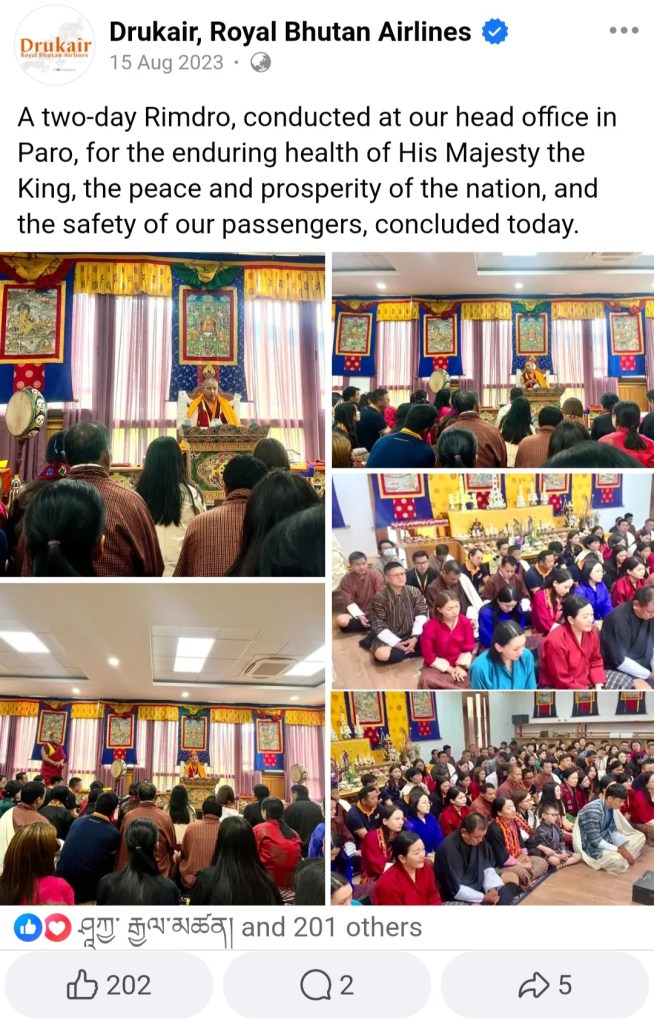
We Bhutanese, however, leave no stones unturned. Even the gods and the higher hands are invoked regularly for the smooth operations of these flights. (See Druk Air Facebook page)
The temples in the mountains often play host to appeasement rituals to local protector deities such as Dongko Tsen and Jowo Drakey of Paro, and Aap Chundu of Haa. Likewise, they invoke Tsi-Mar in Bumthang, and Aum Jomo and memay Dangling over Yonphula, Tashigang.
Being Bhutanese is about recognising that we are just part of the universe with the presence of different forces and nonhuman agencies – and not just with our human ingenuity or ego. Everything we do, is about harmony between humans, nature, and the supernatural – including flying the latest Airbus that science and technology have to offer.
Identity has been mankind’s longest search. The question of “who am I?” has intrigued thinkers from Plato to Prince Siddhartha to Descartes. For us in Bhutan, this question has become even more relevant, as the country faces the onslaught of technology and outmigration, and the dilemma and divisions brought about by changing politics and policies. Simply put, what does it mean to be Bhutanese? This lack of common understanding, I believe, forms the core of our challenges – whether it is at an individual level or as a nation. Drawing from my PhD dissertation, I will attempt to give a definition to this slippery topic.
Identity has several definitions and concepts. Depending on the discipline, there are racial identity, gender identity, religious identity, cultural identity, political identity and so on. Here, by identity I am looking at the one coming from psychology – as in the personal identity, which describes one’s distinctive attributes that make a person unique. And more so, to the sociological definition, which refers to qualities, beliefs, and traits that characterise a person or a group. Scholars argue that it is the social circumstances in which people have been raised that determine the ways in which they identify themselves. Identity is, thus, believed to be produced through social interactions and experiences.
The traditional, virtual, and hybrid communities
A traditional community is where everything is shared – life, work, happiness, or sorrows. When you build your house, the whole village comes together without expecting a payment. Wherever celebrations and ceremonies are taking place, everyone is invited by default.
Nature and spiritualism occupy the centre stage in this community. It is not humans, but nature, which dictates everything including the pace and rhythm of life. Places are not just physical spots. They are sources of stories and spirituality, and of inspirations and wisdoms. Thus, kinship and family ties are extended not only to humans, but also to nature and to nonhuman forces and spirits. For instance, tigers are referred to as azha tah (maternal uncle Tiger), bears as aku Dhom (paternal uncle Bear), and elephants as memay Sangye (Grandpa Buddha). Certain deities and mountains are also embraced like a family. Examples of case in point are ama Jomo (mother Jomo), memay Chador (grandpa Vajrapani), or as memay Ralang – a mountain in Trashigang. Kinship terms do not only serve a referential purpose. They build and sustain emotional connections too. This may be the reason why Bhutanese are close to nature and mountains.
Time, in a traditional Bhutanese community, is conceived as cyclical and not as linear. For instance, older people do not remember their age. They will remember their Buddhist zodiac signs, which is a cycle of twelve years known as lo-kor. The correct question to ask is, “How many cycles have you done?” instead of, “How old are you?”. Nature also defines the flow of time. To lift from American sociologist Robert Levine, traditional Bhutanese prefer event time, and not clock-time. In rural Bhutan, you don’t say, “I will see you at 9.30”. Rather it would be something like, “Let’s meet before the Sun sets, and after we collect our cows from the jungle”. This may explain why Bhutanese are rarely on time.
At the other extreme of a traditional society is the virtual community where humans, instead of nature, are at the centre of the universe. Here everything must be rational, logical, scientific, and black and white. It is also where time is linear. The resulting characteristics are: more individualism, expressiveness, innovation and celebration of anonymity. Money and materialism are means to enhance one’s self-worth or belonging.
Striding between tradition and technology, between collectivism and individualism, and between money and meaning, is the hybrid community. Time starts to become linear here, and the cyclical concept is still accepted. Nature has its place, and so does rational science. There is more “we” and less “me” in this group, and wealth is to enable one’s pursuit of the greater good.
Therefore, the traditional Bhutanese identity is an interdependent self, which consists of a personal self, social self and a spiritual self. The social self is derived from one’s social identity as a parent, and from the vocation one practises. The spiritual self is the recognition and internalisation of the external nonhuman energies and spirits.
The chronotopic Bhutanese identity
While one may observe these identities manifesting in different generations or communities, an interesting finding is that you can also notice these multiple identities in individuals, as one lives through the changing circumstances and contexts in life. The ingredients of the interdependent self – the personal, social and the spiritual selves, are all there in each one of us – in different dosages and degrees. I call this the chronotropic Bhutanese identity. Chronotope comes from Greek and it means time-space (chronos means time, and topos – place). The term was coined by a twentieth century Russian philosopher Mikhail Bakhtin as a literary tool to posit the idea that time and place are inseparable in art. Chronotropic identity basically argues that a change in timespace configurations triggers a seamless shift in roles, behaviours, discourses, modes of conduct, mindsets, and cultural practices.
Take for example, the people of my generation – the predominantly hybrid group that grew up in a traditional setting, and got introduced to science and technology. We start the day by reciting a few lines of prayers. We then get up, wash and offer water and incense to the altar, have breakfast and open a laptop at work. The virtual community, on the other hand, may be on the technology from the moment they wake up till they retire to bed. They would attend spiritual calls on special religious occasions, or visit a temple like Dechenphu if they need something. Conversely, the traditional people access the technology too but not as a default mode. It sees materiality both in technology and spirituality, though.
The key to a harmonious Bhutan, then, is not only to recognise these parallel matrices, but, to paraphrase another philosopher, Jean Gebser, to embrace an integral consciousness that would involve a more holistic understanding of the reality, which includes both the rational thoughts and the intuitive sense of interconnectedness and spirituality. The Generation Z (or Gen Z – referring to people born roughly after 1999) must not refute the traditional as archaic and outdated. On the other hand, the hybrids should not discard the Gen Zs as not adhering to established norms. There is space for everyone.
What’s going on in Bhutan, instead
From a sociological perspective I feel that there is a loss of innocence among traditional Bhutan, which was accelerated by political changes.
By ‘innocence’, I mean where people are honest, spontaneous, sincere, always helpful, and trusting of others, and have a strong moral compass. In general, people who haven’t been corrupted by the evils of modern society. You can find some in rural Bhutan.
The loss of innocence has led us to empathy deficit among the hybrids – because of newfound power, ego and fear. And then, among the younger generation, a decline in the sense of belonging from being not understood. Unless we address these, people will go off on tangents in search of meanings to life, instead of drawing satisfaction and purpose from the service to the collective.
My greater concern, however, is for the next generation. For better or for worse, from an interdependent-self that we should be, Gen Zs are growing up as more expressive, questioning and independent selves. Instead of love and guidance by the collectivist society, it is viewed as a social divergence. Our youth, then, feel misunderstood, and even rejected. Research shows that when they are isolated from their physical communities, they will either go away, shut off completely, or hide behind computer screens and smartphones and try connecting with the online world. One issue with living on social media is the abundance of information and knowledge there – both good and bad. Information is not knowledge, and knowledge is not wisdom. In life you need wisdom. You develop wisdom only when you engage with the physical world, where you roll out your sleeves and get your hands dirty. This may explain the success of the Desuung program. It gives that opportunity – to go hands-on and feel a sense of belonging to a meaningful community.
Fortunately, some compassion is still around in Bhutan, which is evidenced by frequent and successful fundraisers on social media, like for someone in Australia who needs a surgery, or for a fellow Bhutanese who has to go for a transplant in India – or to simply save some yaks – or build a stupa.
So, what does it mean to be Bhutanese?
To be Bhutanese means to be compassionate, altruistic and spiritual; and be aware of one’s place in a family, community and country; and share this temporary space with other beings – that are both seen and unseen. If Bhutanese, young and old, could embrace this more, instead of over stressing on cultural paraphernalia or purely pursuing economic dreams or power, a brighter and a fulfilling future – as individuals and as a nation, will be more than guaranteed.
Korphu takes its name from a two-feet flat and oval boulder under which the great treasure revealer (terton in Dzongkha), Pema Lingpa (1450–1521) is believed to have taken shelter – after turning himself into a bee. “Gor means “stone” and phug means “cave”, and it became a cave for the Terton”, says former gup (headman) Zeko – an elderly gentleman whom I randomly met in Gelephu a month back and invited me to his village.
I had visited Nabji-Korphu before – in 2004, as a part of a UN team to open an eco-trail that the community had built with UN-GEF funding. It was a week-long trek from Langthil to Nimshong through some of the most dramatic trails – especially crossing the famed and scary Ugyen Drak. Needless to say, my team and I thoroughly enjoyed that trip and had only fond memories of me going broke midway into the trip – and scamming a colleague to be the chief guest and tip the villagers.
And now here I am back. It is 2024. How time flies!
“You can drive your car all the way to our doorstep, la” Zeko assured me when I met him in Gelephu. In fact that’s what we did.
The Lhundup Chodarling Temple:
The village of Korphu revolves around this temple – the history of which starts with the arrival of lama Chogden Gonpo (1497–1543) in Nabji. He was considered as the reincarnation of the treasure discoverer Dorji Lingpa (1346–1405), and was also a disciple of Pema Lingpa (1450–1521). He came there to disseminate the teachings of Dorling Tradition and offered statues of Guru Rinpoche and Dorji Lingpa – both of which can be seen there even today.
Few years after his arrival, an epidemic of smallpox spread in the valley and took many lives. Chogden Gonpo requested his guru, Pema Lingpa to come to Nabji to help cure the disease. Pema Lingpa obliged and came and conducted several rituals and prayers and cured the valley of the disease.
Pema Lingpa then built a two-storied retreat center following which many disciples joined him and build small huts and houses around his centre. Korphu, therefore, is one of the few cluster villages in Bhutan with houses attached to one another unlike the typical farmhouses in Bhutan that are independent and spread.
Korphu is on the hill overlooking the beautiful paddy fields and the village of Nabji. In fact, many people in other parts of Bhutan refer to this twin village as Nabji Korphu. From Nabji if you walk it is a two-hour uphill climb.
The origin of Gorphu:
When Pema Lingpa was looking for a place to establish his retreat centre, he wanted a good source of water. After befriending a local hunter called Pema Dorji, he was shown a water spring at a place known as a Umchu Gang.
One day Pema Lingpa found animal traps around Umchu Gang and he immediately removed them so that no animal was hurt. When Pema Dorji found out, he charged Pema Lingpa for doing that. Finding him really furious and relentless in his attacks, Pema Lingpa magically brought down wind and hailstorm over the place, while he himself turned into a bee and took shelter under a flat boulder.
Pema Dorji saw that he was dealing with no ordinary man, and apologised. He also gave up his hunting business and became a gomchen – lay monk under Pema Lingpa. He named the place after the boulder – as Gor-phug, and over time it was mispronounced as was popularised as Korphu.
The relics of the temple:
While Nabji is associated with Guru Padmasambhava, Korphu is a seat of Pema Lingpa. The outer structure of the temple has been renovated but the inside still is old and feels very sacred. There are the statues of Guru Padmasambhava and Avaklokiteshvara that are believed to be the handworks of Chogden Gonpo. Both the statues have the powers to grant any wish one makes, the caretaker told me.
The inner relics (nangten) are: a volume of Transcendental Wisdom in 8,000 stanzas which are referred to as Gyatongpa, which is believed to have been written in golden ink by Pema Lingpa; the ceremonial hat of Ani Choeten Zangmo, the grand-daughter of Pema Lingpa, and who is widely known for establishing a Peling seat in Dremetse in Mongar; the dress worn by Pema Lingpa, which he wore when he dove into Mebar Tsho in Bumthang; and two bells crafted by Pema Lingpa.
The sacred chamber of the Guardian Deity (Goenkang) is dedicated to Gonpo Maning Nagpo – flanked by the two local mountain deities Ap Jowo Durshing and Ap Muktsen.
Visiting Korphu:
Visiting Korphu brought me immense joy and smiles from funny memories from the earlier trip. The people of Korphu are some of the nicest folks I came across and every guest is treated like a VIP. They take pleasure in serenading you and singing you off as as you leave their magical village.
Truly it is a place I recommend before modernity or some other things erase this genuine Bhutanese hospitality. This time I also got to get blessings from each and every nangten they hold in the sacred village temple. As a descendent of Peling lineage, it was an emotional experience to see so many personal effect of this greatest of masters.
And this time, as Ap Zeko promised, it was a cool drive from Wangdigang in Zhemgang for an hour along the narrow black-topped road till the doorsteps of both Nabji and Korphu temples.
It is a place I will return again to listen to more stories, songs and soak in their warm hospitality.
Seeking three divinities, three deities and my three teachers
We celebrate the New Year on the first day of the twelfth month – at least in the eastern half of Bhutan from where I come from that’s the case. So, the last few days of the eleventh month and the first week of the “new year” are spent on pilgrimage inside Bhutan – visiting temples, sacred places and getting blessings from my teachers and conducting rituals for the year. I do this to pay gratitude for the closing year, while propitiating the deities and divinities, and receiving the blessings for the new year.
On the first leg of my pilgrimage I covered Semtokha Dzong to pay my respects to the Supreme Guardian deity, Yeshe Gonpo (Mahakala in Sanskrit) where the resident caretaker lopen Wangchuk considers me his jindha (patron) and conducted a brief soelkha for me.
I continued the next day visiting Dobji Dzong (estd 1531) in Paro where there is an amazing statue of a smiling Milarepa, which is believed to have spoken in the past. The statue is said to have been gifted by the Tibetan patrons to lama Jetsun Ngawang Drukpa (1682-1748) – the founder of Tshamdrak Gonpa, during his last religious mission to Tibet. Milarepa, who is supposed to have become enlightened in one lifetime after committing some atrocious deeds, gives me hope that if one is committed, one can attain enlightenment in a go. That’s a dream, which increasingly looks like it will be a dream.
On the same day, I also visited Lhakhang Karpo in Haa – a sacred place, believed to have been built on the spot where a white dove released by King Songtsen Gempo (617-650) from Tibet landed. The place is believed to be the abode of powerful local guardian, Aap Chundu – a deity known for his physical strength, and also for being honest, dedicated and principled.
The second leg of my pilgrimage took me to Punakha – the former winter “capital” of Bhutan where the monastic body still travels to avoid the freezing cold of Thimphu. Punakha Dzong has the Machen Lhakhang, which contains the sacred remains of Zhabdrung Ngawang Namgyel in permanent retreat (thudam in Dzongkha). I make it to Punakha at least once a year to pay my respects and receive the blessings of the divine founder of Bhutan. Without Zhabdrung, there might not have been Bhutan.
In Punakha I also received kago from one of my teachers, Most Venerable Lopen Samten – the former Tsugla lopen. He is also my “Google Scholar” for anything related to Vajrayana Buddhism.
On the following day (today) I drove straight from Punakha to Gelephu, where my family lama, Rangshikhar Rimpoche, resides. He is another teacher I visit at the start of every year. There is nothing I can say that people don’t know about him. The oldest and the most humorous of my three teachers, it always feels blissful to be in his presence that I feel it is okay if I died the next day. I mean, that’s how powerful he is and how peaceful you feel that I always wondered that if God really existed it would look like and be like him.
“How is my year?” I asked him. I have been quizzing him like this for over 40 years. He is one of the few togdenpas I know and who is known for perfect divinations.
“Just be a little careful in this coming month till 27th day,” he warned me, “And remember to say your barchel lamsel prayers every morning and don’t be careless”.
With that assurance, and after updating who is where in my family, I took his leave, so as not to hog his time. There were two groups waiting after me.
(To be continued with a third leg of my pilgrimage – from Zhemgang, Bumthang, Wangdue and end in Paro. I will be breaking my pilgrimage for a few days here in Gelephu to work on another article on the mindfulness city project)
😇😇😇 Tentative itinerary
– Semtokha Dzong – The oldest dzong built by Zhabdrung Ngawang Namgyel. Grand altar to Yeshey Gonpo
– Dobji Dzong – Built by Lama Ngawang Chogyel in 1531. Talking statues of Milarepa and Guru Padmasambhava.
– Lhakhang Karpo – 7th Century. Medicine Buddha and an altar to Ap Chundu
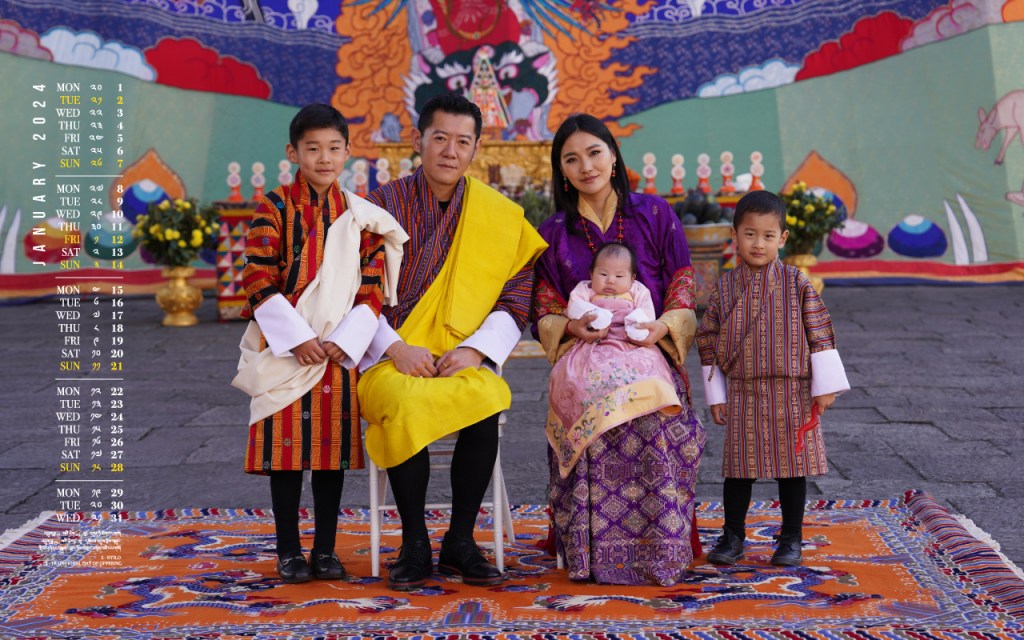
This year, 12th January will be celebrated as Sharchop Losar or Chunyipa Losar. However, it appears that this is not just the new year’s day for central and eastern Bhutan, but for Bhutan as a whole.
Historical records show that the Founder of Bhutan, Zhabdrung Namgyel observed this day by returning to Punakha (he was more a travelling ruler) and having his subjects visit him and pay homage and tributes. It is said that the three-way staircase of the main entrance to Punakha Dzong was built to welcome the three regional governors called the penlops on that day. Zhabdrung also made all state appointments while also greeting other lesser regional leaders and their retinues as they paid tribute to him. Thus, the day was referred to as buelwa phuewi nyim, which is poorly translated as traditional day of offering.
Astrological significance
This day falls on the first New Moon after Nyilo – a traditional Bhutanese holiday, and in the month when the Moon meets with the Cancri constellation. In the older Lama Gongdue (བླ་མ་དགོངས་འདུས་) – a terma teaching revealed by Sangye Lingpa (1340-1396), the month is considered as the first month of its calendar year. This was probably the calendar prior to the adoption of the official Buddhist calendar followed in Bhutan. The celebration of New Year on this day in central and eastern Bhutan is thus more local, and more traditional Bhutanese.
According to Bhutanese scholar, Karma Phuntsho (PhD), Zhabdrung Ngawang Namgyal was a serious follower of Terton Sangay Lingpa’s teachings and incorporated rituals such as the Lama Gongdue into the ritual curriculum of the Central Monastic Body. And this may also be the reason why he marked the day as the day of accepting tributes and a day of celebration with his people.
Why do Tibetans celebrate the New Year a month later?
The Tibetan New Year’s day, which comes a month after, coincides with the Mongolian New Year known as Horda (ཧོར་ཟླ་), which the latter instituted as their calendar – to mark the day of victory over the Tangut Kingdom by the first emperor, Genghis Khan.
After Gushri Khan (1582-1655) invaded Tibet in 1641, the Horda became the Tibetan calendar and thus the Mongolian New Year day was celebrated as the Tibetan New Year. Furthermore, Gushri Khan was referred to as Chogyal (Dharma King). And thus this Losar (New Year) was also referred to as Gyalpoi Losar (རྒྱལ་པོའི་ལོ་གསར་) – King’s New Year. Older folks in Bhutan would be familiar with this term
In essence, the Dawa Dangpi Losar has neither any auspicious significance to Bhutan, nor any important astral reasons. As Dr. Karma Phuntsho adds, it is even odd that we celebrate it as the main Losar, which is a legacy of Mongol rule over Tibet.
Let’s celebrate Chunipa Losar as our New Year
In sociological studies we say that repeated behaviour becomes a habit. A habit embraced by a mass becomes a culture. A culture repeated periodically becomes a tradition. So, we can institute some new traditions, and retrieve some older ones, around this Day, so that over time it consolidates as the Bhutanese New Year.
First of all, call it Bhutanese New Year! As someone trained in sociolinguistics, trust me, vocabulary matters. To continue with the misnomer Sharchokpa Losar would do no good.
Second, making appointments, promotions and pay raises: Following Zhabdrung’s tradition, new and important appointments could be made on this day. Promotions and bonuses can be declared on this day.
I am not limiting this invitation to the government only. That would take time. I would rather invite our private sector, and companies to do that. Pay the bonuses and give a salary raise on this day. Why not? As I said, if we all do this every year it would become a tradition. Employees all over Bhutan would be eagerly waiting for this day – and a whole new industry can come up on this just like the red envelope tradition in East and Southeast Asia.
Third, PIT Day. No one likes taxes but as a cliche goes, it is the only sure thing in life besides death. So, why not do it on the eve of this day? Why not celebrate it? Why not file your personal income tax with a prayer that your few ngultrums take this country an inch forward and benefit as many sentient beings? Make it a happy moment to pay your taxes. It is all in the mind.
Fourth – make it a Day of Offering: Most importantly, as Buddhists, it can be the day of offering to your root-lama and to the gompas you visit, astrologers you consult and places you revere. Just as our forefather did to Zhabdrung, we can do it to the lamas of our time. As we believe in Bhutan, such offerings will “clear your obstacles for this life, and help you accumulate positive merits in your next”. And so, why not start the year with a bang.
Above all, make it a tradition in your own family to meet – and, again, to paraphrase a local saying, “meet and eat one meal together”. If not, WeChat is there.
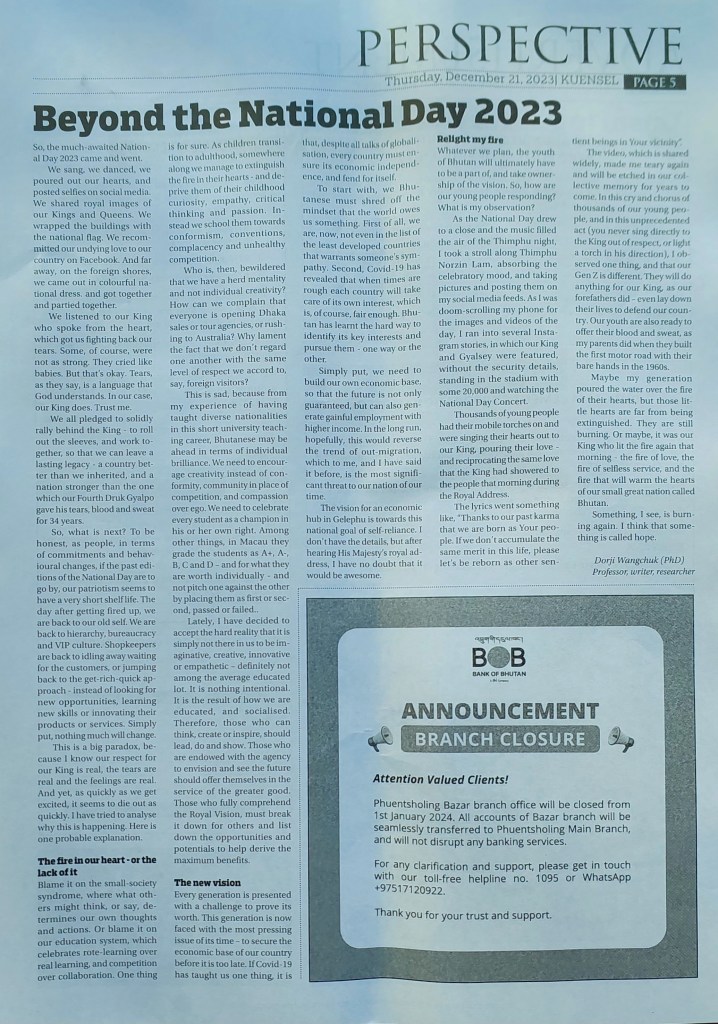
So, the much-awaited National Day 2023 came and went.
We sang, we danced, we poured out our hearts, and posted selfies on social media. We shared royal images of our Kings and Queens. We wrapped the buildings with the national flag. We recommitted our undying love to our country on Facebook. And far away, on the foreign shores, we came out in colourful national dress. and got together and partied together.
We listened to our King who spoke from the heart, which got us fighting back our tears. Some, of course, were not as strong. They cried like babies. But that’s okay. Tears, as they say, is a language that God understands. In our case, our King does. Trust me.
We all pledged to solidly rally behind the King – to roll out the sleeves, and work together, so that we can leave a lasting legacy – a country better than we inherited, and a nation stronger than the one which our Fourth Druk Gyalpo gave his tears, blood and sweat for 34 years.
So, what is next? To be honest, as people, in terms of commitments and behavioural changes, if the past editions of the National Day are to go by, our patriotism seems to have a very short shelf life. The day after getting fired up, we are back to our old self. We will be back to hierarchy, bureaucracy and VIP culture. Shopkeepers will be idling away waiting for the customers. People will be jumping back to the get-rich-quick approach – instead of looking for new opportunities, learning new skills or innovating their products or services. Simply put, nothing much will change.
This is a big paradox, because I know our respect for our King is real, the tears are real and the feelings are real. And yet, as quickly as we get excited, it seems to die out as quickly. I have tried to analyse why this is happening. Here is one probable explanation.
The fire in our heart – or the lack of it
Blame it on the small-society syndrome, where what others might think, or say, determines our own thoughts and actions. Or blame it on our education system, which celebrates rote-learning over real learning, and competition over collaboration. One thing is for sure. As children transition to adulthood, somewhere along we manage to extinguish the fire in their hearts – and deprive them of their childhood curiosity, empathy, critical thinking and passion. Instead we school them towards conformism, conventions, complacency and unhealthy competition.
Who is, then, bewildered that we have a herd mentality and not individual creativity? How can we complain that everyone is opening Dhaka sales or tour agencies, or rushing to Australia? Why lament the fact that we don’t regard one another with the same level of respect we accord to, say, foreign visitors?
This is sad, because from my experience of having taught diverse nationalities in this short university teaching career, Bhutanese may be ahead in terms of individual brilliance. We need to encourage creativity instead of conformity, community in place of competition, and compassion over ego. We need to celebrate every student as a champion in his or her own right. Among other things, in Macau they grade the students as A+, A-, B, C and D – and for what they are worth individually – and not pitch one against the other by placing them as first or second, passed or failed..
Since lately, I have decided to accept the hard reality that it is simply not there in us to be imaginative, creative, innovative or empathetic – definitely not among the average educated lot. It is nothing intentional. It is the result of how we are educated, and socialised. Therefore, those who can think, create or inspire, should lead, do and show. Those who are endowed with the agency to envision and see the future should offer themselves in the service of the greater good. Those who fully comprehend the Royal Vision, must break it down for others and list down the opportunities and potentials to help derive the maximum benefits.
The new vision
Every generation is presented with a challenge to prove its worth. This generation is now faced with the most pressing issue of its time – to secure the economic base of our country before it is too late. If Covid-19 has taught us one thing, it is that, despite all talks of globalisation, every country must ensure its economic independence, and fend for itself.
To start with, we Bhutanese must shred off the mindset that the world owes us something. First of all, we are, now, not even in the list of the least developed countries that warrants someone’s sympathy. Second, Covid-19 has revealed that when times are rough each country will take care of its own interest, which is, of course, fair enough. Bhutan has learnt the hard way to identify its key interests and pursue them – one way or the other.
Simply put, we need to build our own economic base, so that the future is not only guaranteed, but can also generate gainful employment with higher income. In the long run, hopefully, this would reverse the trend of out-migration, which to me, and I have said it before, is the most significant threat to our nation of our time.
The vision for an economic hub in Gelephu is towards this national goal of self-reliance. I don’t have the details, but after hearing His Majesty’s royal address, I have no doubt that it would be awesome.
Relight my fire
Whatever we plan, the youth of Bhutan will ultimately have to be a part of, and take ownership of the vision. So, how are our young people responding? What is my observation?
As the National Day drew to a close and the music filled the air of the Thimphu night, I took a stroll along Thimphu Norzin Lam, absorbing the celebratory mood, and taking pictures and posting them on my social media feeds. As I was doom-scrolling my phone for the images and videos of the day, I ran into several Instagram stories, in which our King and Gyalsey were featured, without the security details, standing in the stadium with some 20,000 and watching the National Day Concert.
Thousands of young people had their mobile torches on and were singing their hearts out to our King, pouring their love – and reciprocating the same love that the King had showered to the people that morning during the Royal Address.
The lyrics went something like, “Thanks to our past karma that we are born as Your people. If we don’t accumulate the same merit in this life, please let’s be reborn as other sentient beings in Your vicinity”.
The video, which is shared widely, made me teary again and will be etched in our collective memory for years to come. In this cry and chorus of thousands of our young people, and in this unprecedented act (you never sing directly to the King out of respect, or light a torch in his direction), I observed one thing, and that our Gen Z is different. They will do anything for our King, as our forefathers did – even lay down their lives to defend our country. Our youth are also ready to offer their blood and sweat, as my parents did when they built the first motor road with their bare hands in the 1960s.
Maybe my generation poured the water over the fire of their hearts, but those little hearts are far from being extinguished. They are still burning. Or maybe, it was our King who lit the fire again that morning – the fire of love, the fire of selfless service, and the fire that will warm the hearts of our small great nation called Bhutan.
Something, I see, is burning again. I think that something is called hope.














 Dorji Wangchuk