Chortens (Dzo. མཆོད་རྟེན་; literally meaning “Support to The Teaching”) come in all shapes and sizes. Contrary to popular belief, there are more than three architectural types of chorten.
Stupas were adapted in the Buddhist world from earlier traditions as monuments for simply safekeeping the mortal remains of Buddha. Over time they evolved both in terms of physical aspects as well as the content. What is common to all types of chorten in the Buddhist world is that there are five physical structures to represent the five natural elements of earth, water, fire, wind, and space. Chortens in Buddhism are built as representation of the Buddha as seated in a lotus position.
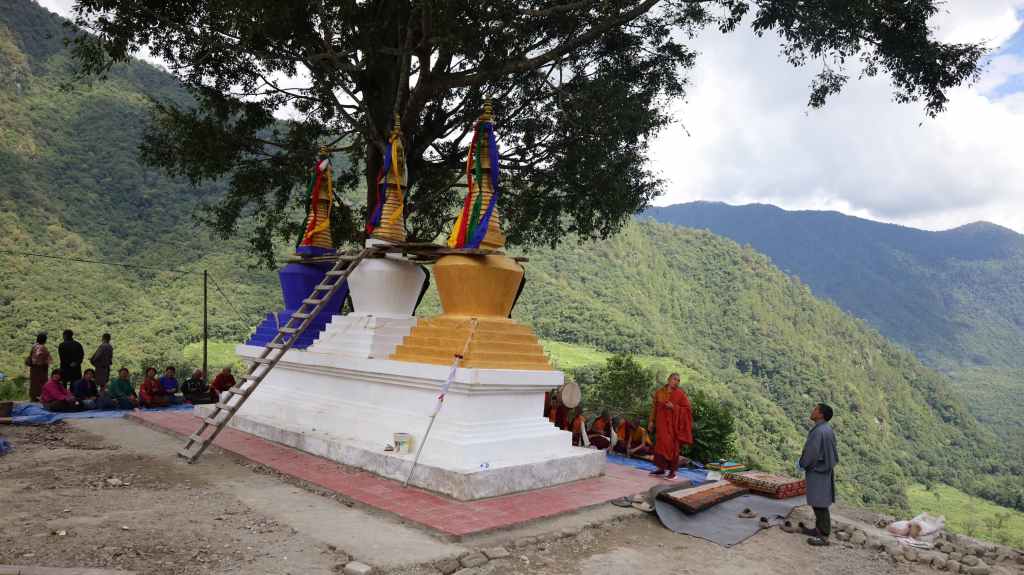
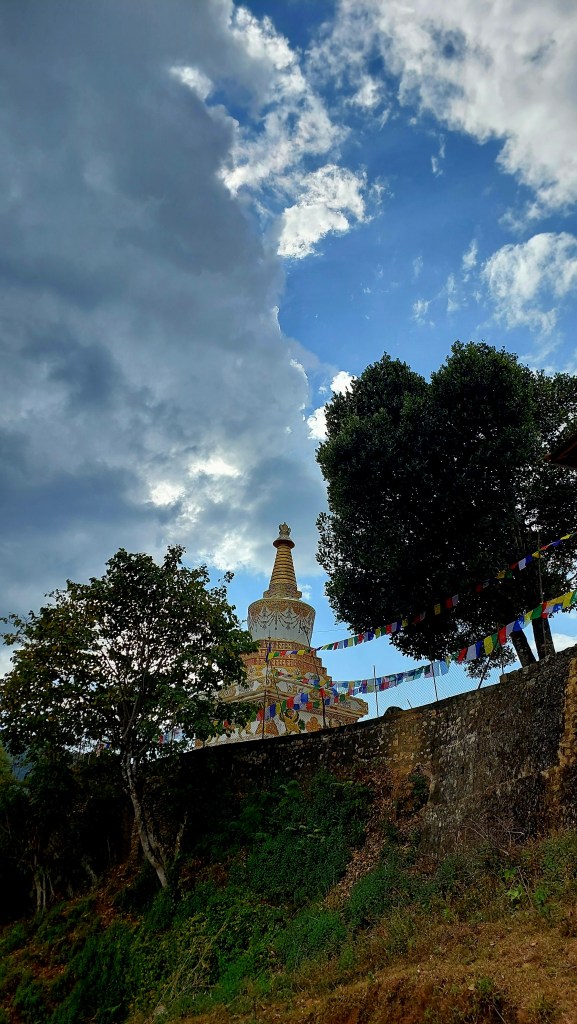
In this post let me share what goes inside a Bhutanese stupa, so that one day you can also build one. These pictures are from the Rigsum Gonpo stupa that my siblings and I sponsored to rebuild in Athang Morakha in Wangdue, as per the advice of my lama, Khandro Dorje Phagmo Rimpoche.
I dedicated the holy Saga Dawa month (the fourth month in the Bhutanese calendar) rebuilding a Rigsum Gonpo stupa in Morakha village in Athang Gewog. The place is associated with two very important figures in Vajrayana Buddhism. First, it is believed to be the abode of Vajrapani (Chana Dorje), which is referred to as Changlochen. Second, it is associated with Mendharawa – one of the principal consorts of Guru Padmasambhava.
Rigsum Gonpo (Dzo. རིགས་གསུམ་མགོན་པོ) means Lords Protectors of Three Families (or Realms) and refers to Chana Dorje (Vajrapani), Chenrizig (Avalokiteshvara) and Jamyang (Manjushri). The three stupas are the representations of these three important deities in Vajrayana Buddhism.
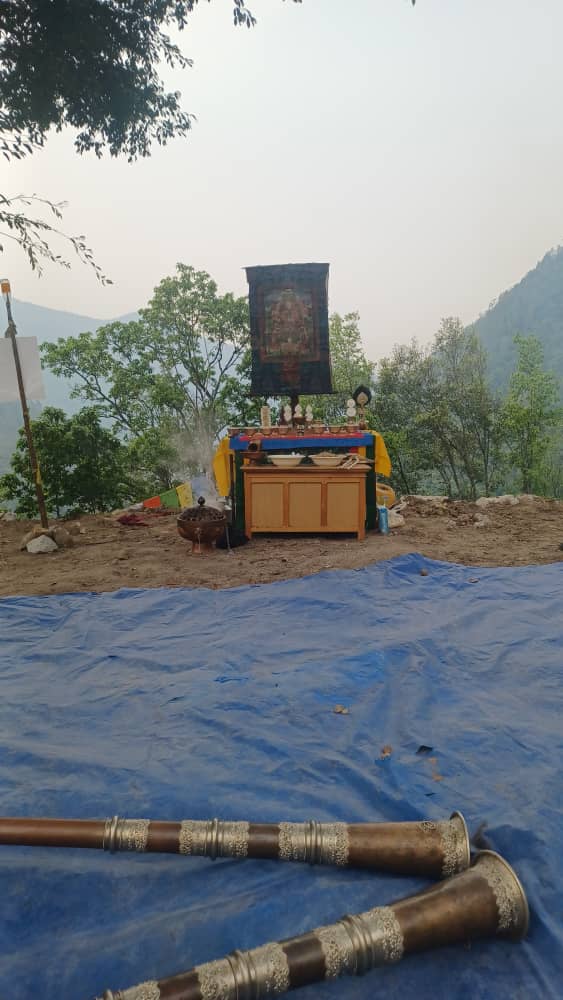
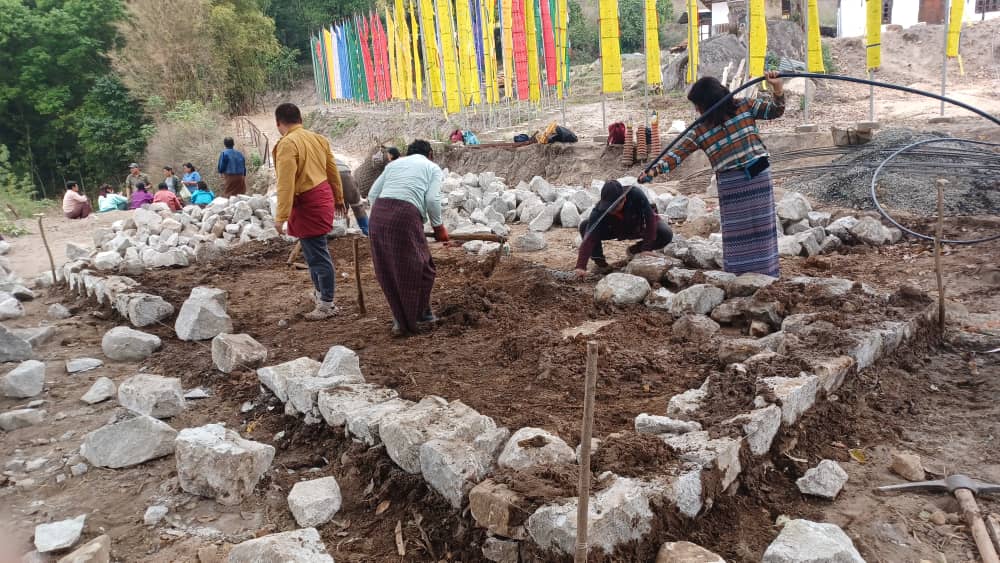
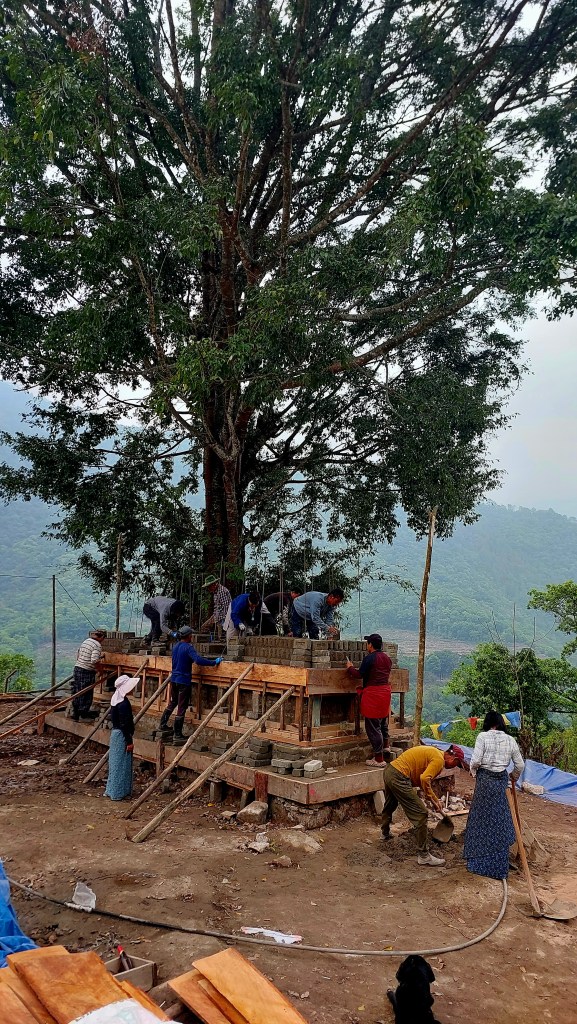
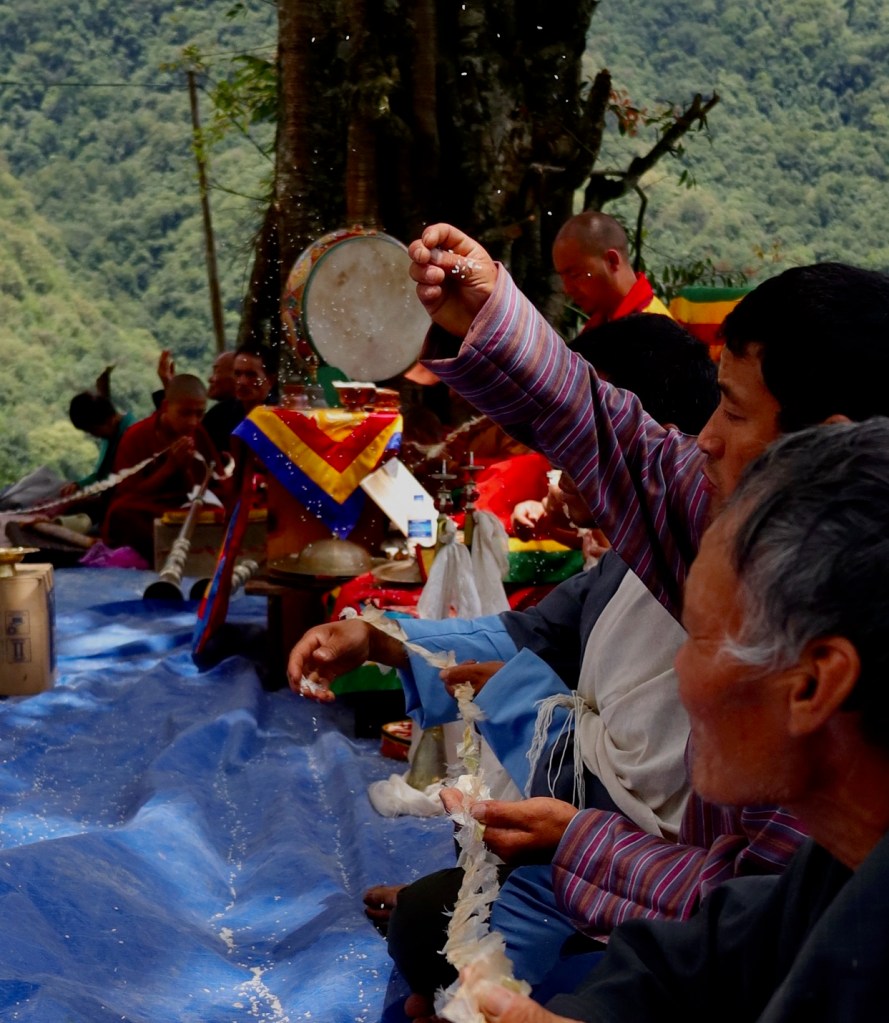
Picture 1 – Every major construction starts with a salang tendrel (Permission Seeking Ceremony) where we ask the consent of the earth deity to build the stupa. We offer 12 sacho bumter (vase of treasure) – four each for the three chortens. This offering is considered as a gift to the earth deity for allowing us to occupy the ground.Picture 2 – The first structure over the ground is the Sa-zin (foundation). This stage is important to provide the correct direction of the stupa (called Chho in Dzongkha). It should not face any direction randomly – especially its shadow should fall in the direction of any private homes. A master astrologer or a realised lama should do this to ensure that it benefits all sentient beings and hurts no one. Picture 3 – The next is to build three stairs called them-kha. Here inside the walls we have the first set of zung (relics) going in – consisting of farming implements and an old urn at the bottom layer. After covering this layer with juniper leaves the men and women garment and jewelries are spread – including arms and ammunition.Picture 4 – Then comes the Thri (throne) where the second set of Zung is buried. Here, inside of it, we offer a full set of religious musical instruments, and as many yangbum (vase of prosperity).Picture 5 – Every inch of the hollow space is filled with tsatsa (mini stupas) and dried juniper leaves. If juniper leaves are not available dry sand is fine too. The thing to remember is not to leave any space.
Picture 6 – The Thri is sealed and this marks the completion of the first stage of the constriction.
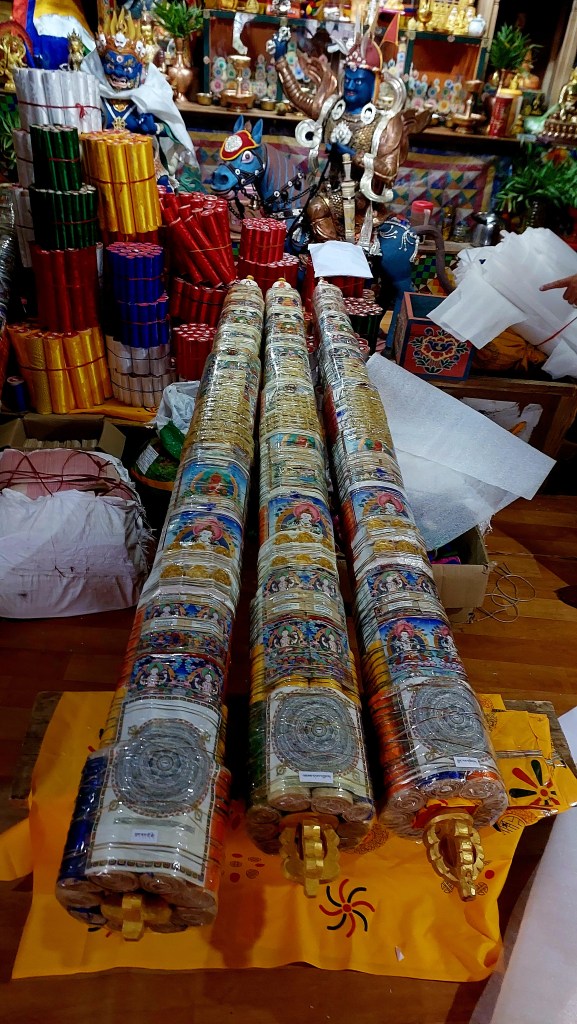
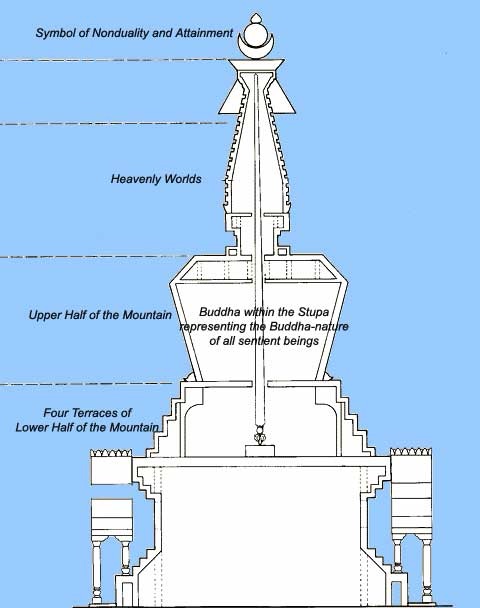
Picture 7 – Over the Thri, we build what we call the Tshemed-Zhi (The Four Immeasurable). It is four-step pyramid and in it we plant the sokshing – the soul of the stupaPicture 8 – Sokshing means “tree of life” and it is what makes the stupa come to life and bestow the power. It is a wooden pole sliced out of a young juniper tree, around which hundreds of scrolls of mantras, clay statues and precious objects are bound. This is best done by a master artisans, although it may be cheaper to do on your own. I prefer to get it from one master I know. Picture 9 – Planting the sokshing is one of the three most sacred stages of the construction of the stupa and hence, a realised lama should preside over this. It is believed the act of “planting” causes disturbances in the Lower Realm, and even the Lord of Death, Yama, can get upset. On the other hand, the upper tip is believed to send power of prayers and mantras, like a radio antenna, to the Higher Realms and the divinities would take a break to witness this sacred moment. Picture 10 – At the base of the sokshing we offer Kaypi-Mar (eternal butter) in a copper urn, and four sets of choeb-ting (water offering cups) filled with gemstones and precious metals. You fill the remaining empty spaces with sacred scriptures like Kanjur (Words of Buddha) or Bum Poti (Perfection in 100,000 lines).Picture 11 – The Bumpa (vase) – the conical shape structure is filled with statues of the deities and divinities.Picture 12-13 – Above the bumpa is the chug-sum khrolo (Thirteen Discs of Enlightenment) which envelopes the upper part of the sokshing. The completed chug-sum khorlo is in the picture below.Picture 14 – The golden parasol which covers the Chug-sum Khorlo is placed on top and both are given a golden color. The three stupas of Rigsum Gonpo are also given their respective colors: yellow for Manjushri, white for Avalokiteshvara, and dark blue for Vajrapani.Picture 15 – Finally, the top-most structure is the golden pinnacle. Usually the Sun, Moon and the Star representing the space are carved and placed there, but increasingly people offer golden pinnacle, which is costlier and believed to accumulate more merits.Picture 17 – The main sponsor of the construction is honoured with gifts of rice, textile and a white khadar.May this sacred stupa bless all sentient beings and bring peace and prosperity to this community and country.
May 2, 2024 – I drove to Athang Rukha to attend the last day of the Mani Dungdrup – organized by a certain Lama Wangdi from Punakha.
I had mainly pushed myself there, despite my heavy schedule, for one reason – the Rukha Lama Ugyen Tshering and seven men and women came and worked tirelessly in the heat of Gelephu to organise the Sacho Bumter for Dorje Phagmo Center the week earlier. I intended to reciprocate their favour, quickly pay respects to Palden Lhamo and Avalokiteshvara and turn back. So, it was just another trip for me. I have been doing this for 18 years now.
The Arrival
However, this time the Rukha Lama had other plans. The villagers were told to receive me with full honors of a VIP-Lama or whatever. So, to my great embarrassment I was received with the blaring sounds of dung-jaling (Tibetan religious horns and trumpets) and ladies singing as they led me in procession to the temple.
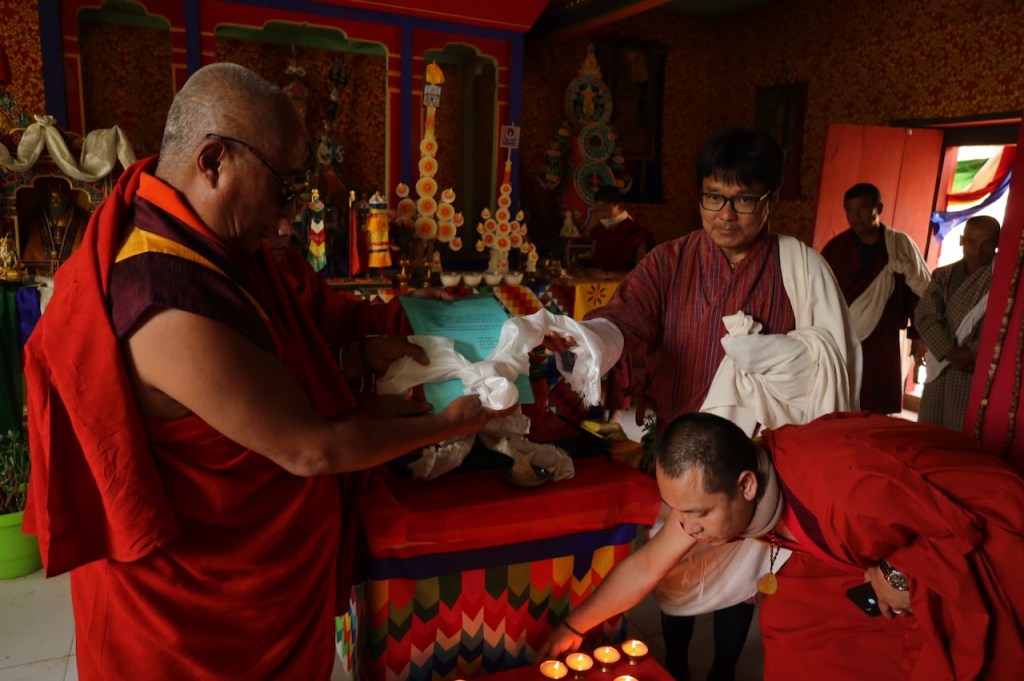
At the venue, the jing-ser ritual was going on and the Presiding Lama, Venerable Wangdi – the former Lam Neten of Tsirang, signaled me to my seat.
When the ceremony was over he explained the significance of the Jing-Ser ceremony to the people, and also acknowledged my arrival.
“We have not met before. So I am honored to meet you in person. The locals here speak very highly of you,” Lam Wangdi told me as he turned to me.
He continued, “Almost nine years back I accidentally discovered this sacred abode of Palden Lhamo, but with no religious events whatsoever. So, I initiated and we did four editions of Mani Dungdrub from 2016 to 2019. I was told you were living abroad then. Then, Covid struck and this is the first one since normal life resumed”.
In 2015, Lam Wangdi, who was then the Lam Neten (District Abbot) of Tsirang Dratshang, was invited to preside over a death ritual in the first village of the valley. While there, he was told that a Palden Lhamo temple was newly built further up in the valley. He felt pulled by some mysterious forces and one day, accompanied by his two attendants, he trekked up to Rukha. He was so mesmerized by the place that he vowed to initiate a Mani Dundrub (Million recitation of Avalokiteshvara mantra) for three years.
He turned to me again, “These people even didn’t know what Mani Dungdrub was, forget about having the religious items to conduct one. I had to carry everything on my back,” he told me. “Now, to see all these temples that you have built, the sacred statues you have put, and a resident lama posted here, it all makes me very emotional. So, I told people before you arrived, “Take good care of this man. Follow whatever he says. Do not let him ever leave this valley. He is a very special person.”. I hope you will continue to support this valley. If you need me, I will come and join you till my last breath”.
I was humbled by his offer. And I felt that he too was drawn here like me by some distant karma from our past lives. He is from Punakha and I am from Trashigang.
The Celebration:
The day continued with celebrating the Birth Anniversary of the Third King of Bhutan, a solemn tribute. This was followed by lunch.
In the afternoon before the Chenrizig Ku-Sung-Thug Wang, which required rest of the day, the Support Committee for Rukha Temple was launched with me as the unanimously-elected Chairman and 45 founding members. Blessing the initiative, Lama Wangdi remarked again to say how proud he was to see the youth of Rukha taking charge of the future of Palden Lhamo Temple.
“Many years back when I first landed here I made a little wish – that the Buddha Dharma flourish from this abode of Palden Lhamo. With the compassionate work of our khenpo (Dr. in Dzongkha) Dorji Wangchuk, and your own good fortune and hard work, I have been telling myself that the wish of this old useless man has been granted. Furthermore, today when you – the young people, informed me that you were launching this Committee to continue the works of khenpo and mine, I told myself that I can die as a happy man because you embody the wishes of our King and of His Holiness Je Khenpo”.
He continued, “Before I came, I was telling myself that this would be my last time because I am not young anymore. I am 72. But now, I have decided to make another wish and that is – before I die I will offer a Rigsum Gonpo (Chenrizig-Jamyang-Chana Dorje) Thongdrel to this sacred place”.
The day ended and dinner was served. I decided to take leave of my new-found friend and before I left, I asked him,
“Lama, did you say that you will initiate the Thongdrel for this temple here?”.
“Yes,” he replied.
“Well, then, I would like to commit Nu. 100,000 from my side for the thongdrel. Let me know when you need the money.”
He was very pleased. “That makes my work easy. I will match your offer with 100,000, and find the rest,” he replied. “So, I was right. You are really something. I don’t know what”.
We both laughed. And wished each other goodbye with a vow that we would continue to work for the valley and for Buddha Dharma.
Leaving Rukha:
As I drove back, alone, along the narrow dirt road towards Wangdue-Tsirang highway my mind always takes me to different moments in the 17 years I have frequented this valley – some sweet, some scary and many of friendship, laughter and selflessness. Like the lama, I too made a prayer when I first landed here in 2007:
“And that whatever was left of my life would be dedicated to uplift this godforsaken community to show them the path to a better future.”
I am glad that 17 years later we are way ahead of that simple moelam.
Some backgrounders
– Rukha is one of the few abodes of Palden Lhamo in the country. While there are sacred chambers dedicated to her, there are only few places in Bhutan that can claim as her abode. Rukha is one of them. The site was blessed by Guru Rimpoche and Pema Lingpa (on his way from Bumthang looking for the site that would later become Gangtey Gonpa)
– Lam Wangdi currently serves as resident lama of Dho-Jagar Lam temple in Punakha. When he comes to Rukha for mani dungdrub he brings everything that is needed for the event – butter lamps, prayer flags, khadar, chadri items, incense sticks, flour to make ritual cakes, etc. The local contribute what they produce – rice, and some butter
Morakha takes its name from a remark made by an attendant of Guru Padmasambhava. It was during the time when Guru Rimpoche and Mendarawa were in the area. Mendarawa was in the village, while Guru was meditating in the mountains between Phobjikha and Athang. When the Guru inquired about Mendarawa, the attendant is supposed to have replied, “She is (Mo-ra) in the village (Khar)”. Thereafter the place where Mendarawa dwelled was named Morakhar, and later simply Morakha.
Morakha Temple stands over the village of Lomsokha in the main Athang valley. The site is believed to be the spot where Mendarawa practised the Vajrapani saddhana – known as Chana Dorje drub in Bhutanese. A temple was later built on the spot by the followers of Mendarawa and Guru Rimpoche. The exact date is not known.
Coupled with the Athang Tsho (lake), which is at the other end of the valley, the region was a mandatory destination of all emanations of Terton Pema Lingpa, and the followers of the Peling tradition. The area, therefore, received hundreds of pilgrims each year – thus adding to the prominence and economy of Athang region since the mediaeval era. It was only in the post-modern era that the region saw the decline, as the natives were lured to the urban areas of Thimphu and Wangdue. During the same period, pilgrimages from Tibet stopped for reasons known to everyone.
Mendarawa, and Adha mathra and Adha Rachu:
In front of Morakha temple is the boulder that is believed to be the handloom of Khandro Mendarawa, the spiritual consort of Guru Padmasambhava. While the Guru spent his time in the mountains of Athang (also colloquially pronounced as Adha), Mendarawa spent her days practising the Vajrapani mantra, and by night weaving the traditional clothes. The stone relic can be seen even today. Some local sources claim that the origins of the popular Adha mathra and Adha rachu – a traditional handwoven textile and pattern have their origins here in the works of Khandro Mendarawa. And because of their association to Mendarawa, these patterns of traditional textiles have spiritual blessings and are auspicious for special occasions.
According to one source, Athang Morakha is only place visited by Mendarawa. All other important sites of Guru are associated to either Yeshey Tshogyel or Tashi Khyidron. This makes Athang a very special valley
Betel leaves:
Another very popular item associated with this place and to Mendarawa are the betel leaves, which are believed to have been planted by her. The only surviving plant, which is standing in front of the temple, is jealousy guarded, as many attempts to graft and reproduce have been unsuccessful. The betel leaves from this plant are used for making mendrub (medicinal pills) or rilbu (blessed pills). Another local claims that the betel leaves available in the wild in the jungles of Athang gewog are equally blessed by Mendarawa – and they are used for Zhugdrey ceremony in Gangtey Monastery during the annual Gangtey Tshechu and Drubchen.
Chana Dorje relic (ter) statue:
The most prized possession of Morakha Lhakhang is a finger-sized relic statue of Vajrapani (similar to the one in Bartsham temple in Trashigang). It is tucked away in a secured safe and can be seen only on special occasions.
Vajrapani is referred to, in abbreviated form, as Chador in Bhutanese, and every newborn that receives his or her name from this temple is called Chador. So, every other person in this gewog is called Chador, and almost every Chador you meet may be from Athang gewog.
According to the caretaker monk, the sacred Chador statue is believed to have been retrieved by Terton Pema Lingpa from Mebar Tsho (lake) in Bumthang. “One statue flew to Tsakaling in Mongar, another to Paro Dongkala, and the last one came to Morakha,” he adds.
When the original Morakha temple was destroyed by fire this relic statue is believed to have flown away and stayed safe on a nearby tree. It was later discovered by the resident monks and brought back to the temple.
Vajrapani is also a popular deity, who is revered as a part of the supreme Trinity of Protector Deities called the Rigsum Gonpo (རིགས་གསུམ་མགོན་པོ་) – literally translated as “Lords of Three Families” with the three families being Avalokiteshvara, Manjushri and Vajrapani.
The affiliation to Gangtey Gonpa:
The association of Morakha Lhakhang to Gangtey Gonpa started with the life and works of the Second Gangtey Trulku, Tenzin Lekpai Dondrub (1645-1727), who is considered as the most prolific of all the previous Gangtey Trulkus, and who operated mainly in this region. Although a realised being, he lived a simple life of an itinerant monk – who are locally referred to as gomchens.
His works and the patronage he received from the Athang area became the inspiration for the popular adage, “Lama Ganteyb. Jindha Adhap” (Lama from Gantey, patrons from Athang). Today the monastic center is affiliated to Gangtey Gonpa, and the current Gangtey Trulku Rimpoche initiated the reconstruction and the expansion of the temple into a proper monastic institute.
Who must visit?
While Chana Dorje practice is recommended for everyone to pave the path towards ultimate enlightenment, the blessing is a must for those born with birth-mewa 2 and 4. It is strongly recommended that people born with these mewas make a pilgrimage to this sacred place and/or to Bartsham Chador Lhakhang in Trashigang. This is because Chana Dorje is the deity of those born with birth mewa 2 and 4. Birth mewa 2 are those born in the 1944, 1953, 1962, 1971, 1980, 1989, 1998, 2007, and 2016. Birth mewa 4 are those born in 1942, 1951, 1960, 1969, 1978, 1987, 1996, 2005, 2014, 2023
Getting there:
The total drive time from Thimphu is just 3-4 hours making it a nice day trip. There is a farm road that takes off from Kamichu on Wangdue-Tsirang highway. It is pliable with small cars (maybe not during the wet season).
When you get down to the valley floor from the Lapsaka Pass, look for a signboard. Take the road to the left marked as Athang Morakha Changlochen Chador Lhakhang.
What to take:
Take rice, flours, lentils, cooking oil and food supplies for the monks there. There is a community of monks headed by the abbot – with no subsidy from the state.
Where to stay: There are decent guest rooms at Morakha Lhakhang in case people want to stay overnight, which I highly reccomend. Contact person: Lopen Sonam Drugyel 17480524.
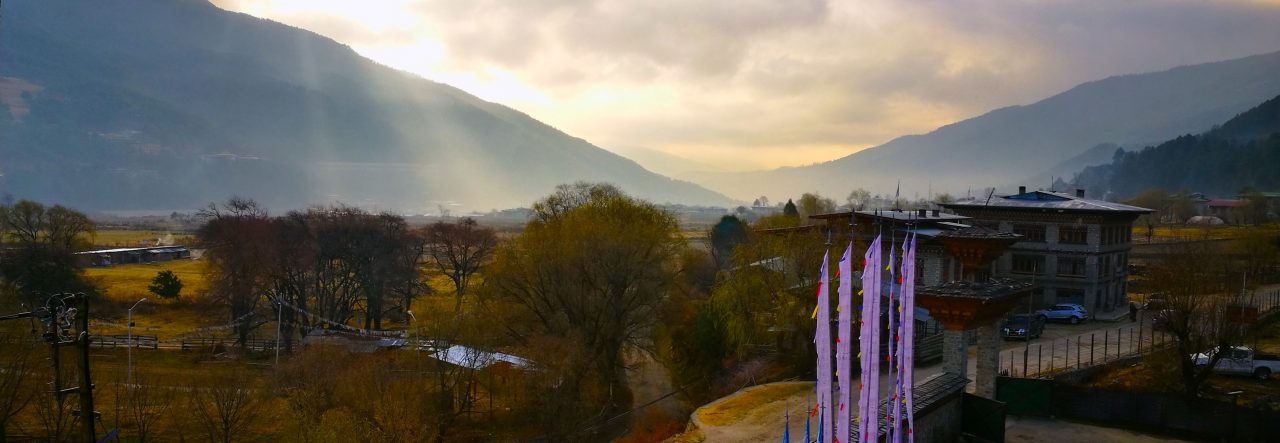
The bridge to cross towards Athang from Wangdue – Tsirang highwayAfter dropping down to Athang valley floor, you will get to this cross road.
Korphu takes its name from a two-feet flat and oval boulder under which the great treasure revealer (terton in Dzongkha), Pema Lingpa (1450–1521) is believed to have taken shelter – after turning himself into a bee. “Gor means “stone” and phug means “cave”, and it became a cave for the Terton”, says former gup (headman) Zeko – an elderly gentleman whom I randomly met in Gelephu a month back and invited me to his village.
I had visited Nabji-Korphu before – in 2004, as a part of a UN team to open an eco-trail that the community had built with UN-GEF funding. It was a week-long trek from Langthil to Nimshong through some of the most dramatic trails – especially crossing the famed and scary Ugyen Drak. Needless to say, my team and I thoroughly enjoyed that trip and had only fond memories of me going broke midway into the trip – and scamming a colleague to be the chief guest and tip the villagers.
And now here I am back. It is 2024. How time flies!
“You can drive your car all the way to our doorstep, la” Zeko assured me when I met him in Gelephu. In fact that’s what we did.
The Lhundup Chodarling Temple:
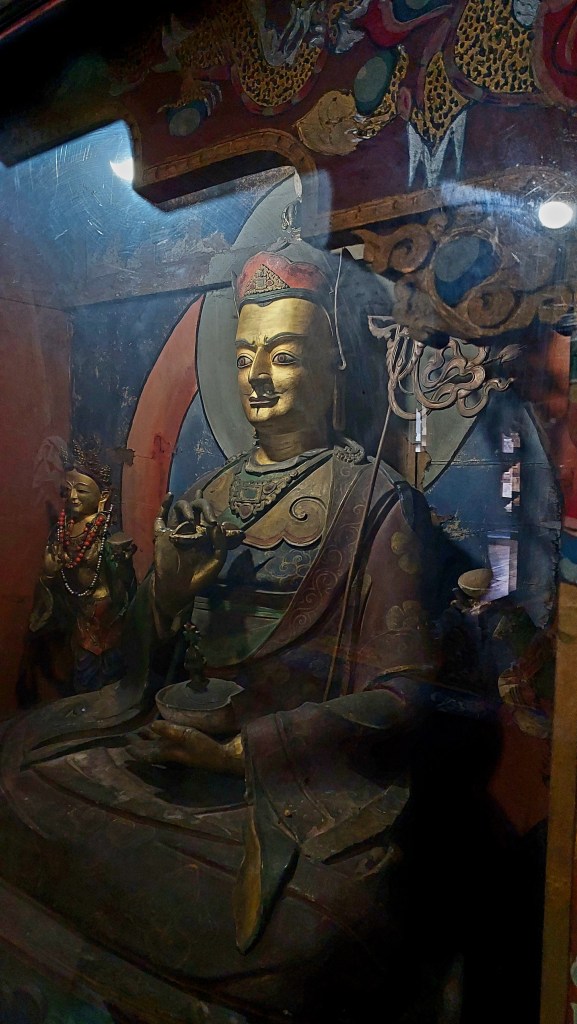
The village of Korphu revolves around this temple – the history of which starts with the arrival of lama Chogden Gonpo (1497–1543) in Nabji. He was considered as the reincarnation of the treasure discoverer Dorji Lingpa (1346–1405), and was also a disciple of Pema Lingpa (1450–1521). He came there to disseminate the teachings of Dorling Tradition and offered statues of Guru Rinpoche and Dorji Lingpa – both of which can be seen there even today.
Few years after his arrival, an epidemic of smallpox spread in the valley and took many lives. Chogden Gonpo requested his guru, Pema Lingpa to come to Nabji to help cure the disease. Pema Lingpa obliged and came and conducted several rituals and prayers and cured the valley of the disease.
Pema Lingpa then built a two-storied retreat center following which many disciples joined him and build small huts and houses around his centre. Korphu, therefore, is one of the few cluster villages in Bhutan with houses attached to one another unlike the typical farmhouses in Bhutan that are independent and spread.
Korphu is on the hill overlooking the beautiful paddy fields and the village of Nabji. In fact, many people in other parts of Bhutan refer to this twin village as Nabji Korphu. From Nabji if you walk it is a two-hour uphill climb.
The origin of Gorphu:
When Pema Lingpa was looking for a place to establish his retreat centre, he wanted a good source of water. After befriending a local hunter called Pema Dorji, he was shown a water spring at a place known as a Umchu Gang.
One day Pema Lingpa found animal traps around Umchu Gang and he immediately removed them so that no animal was hurt. When Pema Dorji found out, he charged Pema Lingpa for doing that. Finding him really furious and relentless in his attacks, Pema Lingpa magically brought down wind and hailstorm over the place, while he himself turned into a bee and took shelter under a flat boulder.
Pema Dorji saw that he was dealing with no ordinary man, and apologised. He also gave up his hunting business and became a gomchen – lay monk under Pema Lingpa. He named the place after the boulder – as Gor-phug, and over time it was mispronounced as was popularised as Korphu.
The relics of the temple:
While Nabji is associated with Guru Padmasambhava, Korphu is a seat of Pema Lingpa. The outer structure of the temple has been renovated but the inside still is old and feels very sacred. There are the statues of Guru Padmasambhava and Avaklokiteshvara that are believed to be the handworks of Chogden Gonpo. Both the statues have the powers to grant any wish one makes, the caretaker told me.
The inner relics (nangten) are: a volume of Transcendental Wisdom in 8,000 stanzas which are referred to as Gyatongpa, which is believed to have been written in golden ink by Pema Lingpa; the ceremonial hat of Ani Choeten Zangmo, the grand-daughter of Pema Lingpa, and who is widely known for establishing a Peling seat in Dremetse in Mongar; the dress worn by Pema Lingpa, which he wore when he dove into Mebar Tsho in Bumthang; and two bells crafted by Pema Lingpa.
The sacred chamber of the Guardian Deity (Goenkang) is dedicated to Gonpo Maning Nagpo – flanked by the two local mountain deities Ap Jowo Durshing and Ap Muktsen.
Visiting Korphu:
Visiting Korphu brought me immense joy and smiles from funny memories from the earlier trip. The people of Korphu are some of the nicest folks I came across and every guest is treated like a VIP. They take pleasure in serenading you and singing you off as as you leave their magical village.
Truly it is a place I recommend before modernity or some other things erase this genuine Bhutanese hospitality. This time I also got to get blessings from each and every nangten they hold in the sacred village temple. As a descendent of Peling lineage, it was an emotional experience to see so many personal effect of this greatest of masters.
And this time, as Ap Zeko promised, it was a cool drive from Wangdigang in Zhemgang for an hour along the narrow black-topped road till the doorsteps of both Nabji and Korphu temples.
It is a place I will return again to listen to more stories, songs and soak in their warm hospitality.
The third leg of my New Year Pilgrimage 2024 took me to Mebar Tokchoe temple in Kheng Kikhar in Zhemgang where my teacher #3, Dorje Phagmo Rimpoche (popularly known as Khandro Dorje Phagmo) has established a nunnery called Ngajur Pemachophelling.
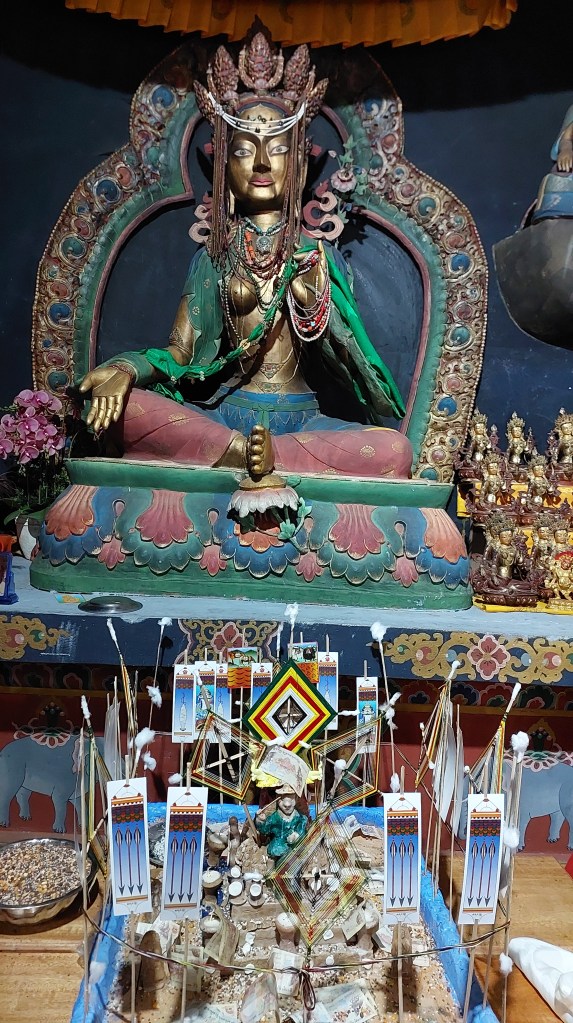
I conducted a Drolma Yuldhog, which literally means “Obstacles removing Tara ritual”, which is considered as the king of all rituals. While one could conduct the Drolma Yuldhog at one’s home or at other sacred places, for me there is no better place than here.
First, Khandro Dorje Phagmo is considered as the emanation of Jetsun Drolma (Tara). Second, Mebar Tokchoe temple is believed to have been established by Monmo Tashi Khyidron on the advice of Guru Padmasambhava to pave the way for the success of Samye monastery construction in Tibet. During the same endeavour, Guru is believed to have advised King Thrisong Detsen to conduct Drolma Yuldhog to clear the obstacles standing in the way in the establishment of Samye monastery. And third, the invocation of the blessings of Tara done by nuns is believed to yield better merits.
So, there are lots of reasons – both religious and historical – that make this place special for a Drolma Yuldhog. I commission this ritual twice a year – once after the winter solstice and one after the summer.
It is always a sublime and blissful moment to be here. To paraphrase the some lines from the rituals:
“May you be free from the Seven Internal and Six External Sources of diseases. May you be protected from all negative energy. May you all be firmly on the Path to Enlightenment”
Seeking three divinities, three deities and my three teachers
We celebrate the New Year on the first day of the twelfth month – at least in the eastern half of Bhutan from where I come from that’s the case. So, the last few days of the eleventh month and the first week of the “new year” are spent on pilgrimage inside Bhutan – visiting temples, sacred places and getting blessings from my teachers and conducting rituals for the year. I do this to pay gratitude for the closing year, while propitiating the deities and divinities, and receiving the blessings for the new year.
On the first leg of my pilgrimage I covered Semtokha Dzong to pay my respects to the Supreme Guardian deity, Yeshe Gonpo (Mahakala in Sanskrit) where the resident caretaker lopen Wangchuk considers me his jindha (patron) and conducted a brief soelkha for me.
I continued the next day visiting Dobji Dzong (estd 1531) in Paro where there is an amazing statue of a smiling Milarepa, which is believed to have spoken in the past. The statue is said to have been gifted by the Tibetan patrons to lama Jetsun Ngawang Drukpa (1682-1748) – the founder of Tshamdrak Gonpa, during his last religious mission to Tibet. Milarepa, who is supposed to have become enlightened in one lifetime after committing some atrocious deeds, gives me hope that if one is committed, one can attain enlightenment in a go. That’s a dream, which increasingly looks like it will be a dream.
On the same day, I also visited Lhakhang Karpo in Haa – a sacred place, believed to have been built on the spot where a white dove released by King Songtsen Gempo (617-650) from Tibet landed. The place is believed to be the abode of powerful local guardian, Aap Chundu – a deity known for his physical strength, and also for being honest, dedicated and principled.
The second leg of my pilgrimage took me to Punakha – the former winter “capital” of Bhutan where the monastic body still travels to avoid the freezing cold of Thimphu. Punakha Dzong has the Machen Lhakhang, which contains the sacred remains of Zhabdrung Ngawang Namgyel in permanent retreat (thudam in Dzongkha). I make it to Punakha at least once a year to pay my respects and receive the blessings of the divine founder of Bhutan. Without Zhabdrung, there might not have been Bhutan.
In Punakha I also received kago from one of my teachers, Most Venerable Lopen Samten – the former Tsugla lopen. He is also my “Google Scholar” for anything related to Vajrayana Buddhism.
On the following day (today) I drove straight from Punakha to Gelephu, where my family lama, Rangshikhar Rimpoche, resides. He is another teacher I visit at the start of every year. There is nothing I can say that people don’t know about him. The oldest and the most humorous of my three teachers, it always feels blissful to be in his presence that I feel it is okay if I died the next day. I mean, that’s how powerful he is and how peaceful you feel that I always wondered that if God really existed it would look like and be like him.
“How is my year?” I asked him. I have been quizzing him like this for over 40 years. He is one of the few togdenpas I know and who is known for perfect divinations.
“Just be a little careful in this coming month till 27th day,” he warned me, “And remember to say your barchel lamsel prayers every morning and don’t be careless”.
With that assurance, and after updating who is where in my family, I took his leave, so as not to hog his time. There were two groups waiting after me.
(To be continued with a third leg of my pilgrimage – from Zhemgang, Bumthang, Wangdue and end in Paro. I will be breaking my pilgrimage for a few days here in Gelephu to work on another article on the mindfulness city project)
😇😇😇 Tentative itinerary
– Semtokha Dzong – The oldest dzong built by Zhabdrung Ngawang Namgyel. Grand altar to Yeshey Gonpo
– Dobji Dzong – Built by Lama Ngawang Chogyel in 1531. Talking statues of Milarepa and Guru Padmasambhava.
– Lhakhang Karpo – 7th Century. Medicine Buddha and an altar to Ap Chundu















 Dorji Wangchuk