Chortens (Dzo. མཆོད་རྟེན་; literally meaning “Support to The Teaching”) come in all shapes and sizes. Contrary to popular belief, there are more than three architectural types of chorten.
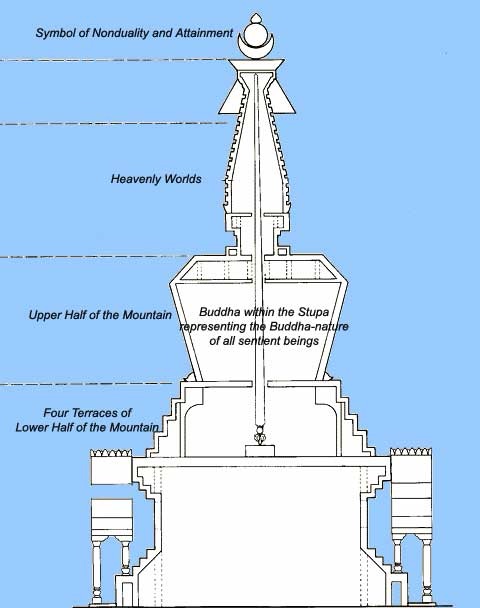
Stupas were adapted in the Buddhist world from earlier traditions as monuments for simply safekeeping the mortal remains of Buddha. Over time they evolved both in terms of physical aspects as well as the content. What is common to all types of chorten in the Buddhist world is that there are five physical structures to represent the five natural elements of earth, water, fire, wind, and space. Chortens in Buddhism are built as representation of the Buddha as seated in a lotus position.
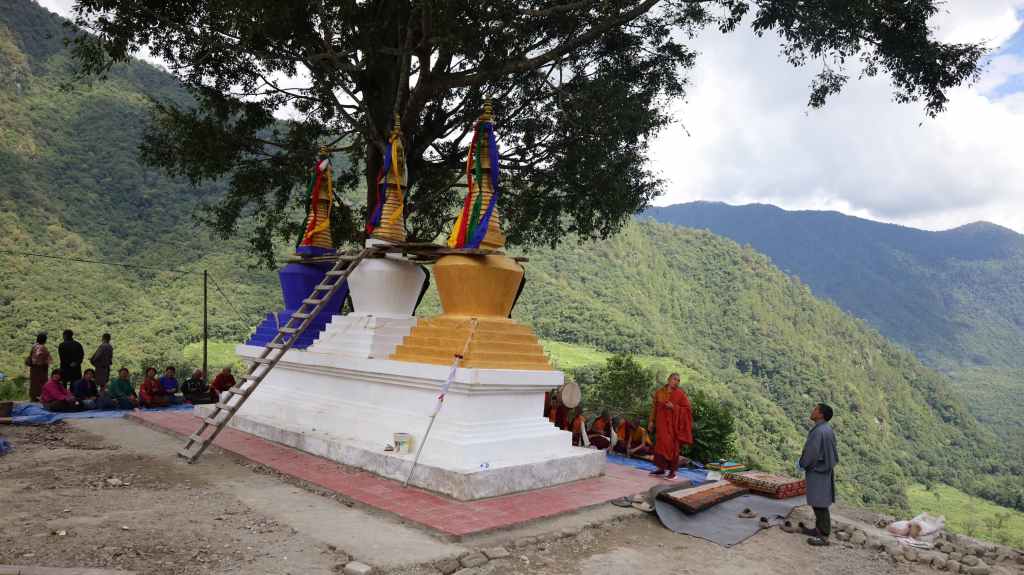
In this post let me share what goes inside a Bhutanese stupa, so that one day you can also build one. These pictures are from the Rigsum Gonpo stupa that my siblings and I sponsored to rebuild in Athang Morakha in Wangdue, as per the advice of my lama, Khandro Dorje Phagmo Rimpoche.
I dedicated the holy Saga Dawa month (the fourth month in the Bhutanese calendar) rebuilding a Rigsum Gonpo stupa in Morakha village in Athang Gewog. The place is associated with two very important figures in Vajrayana Buddhism. First, it is believed to be the abode of Vajrapani (Chana Dorje), which is referred to as Changlochen. Second, it is associated with Mendharawa – one of the principal consorts of Guru Padmasambhava.
Rigsum Gonpo (Dzo. རིགས་གསུམ་མགོན་པོ) means Lords Protectors of Three Families (or Realms) and refers to Chana Dorje (Vajrapani), Chenrizig (Avalokiteshvara) and Jamyang (Manjushri). The three stupas are the representations of these three important deities in Vajrayana Buddhism.
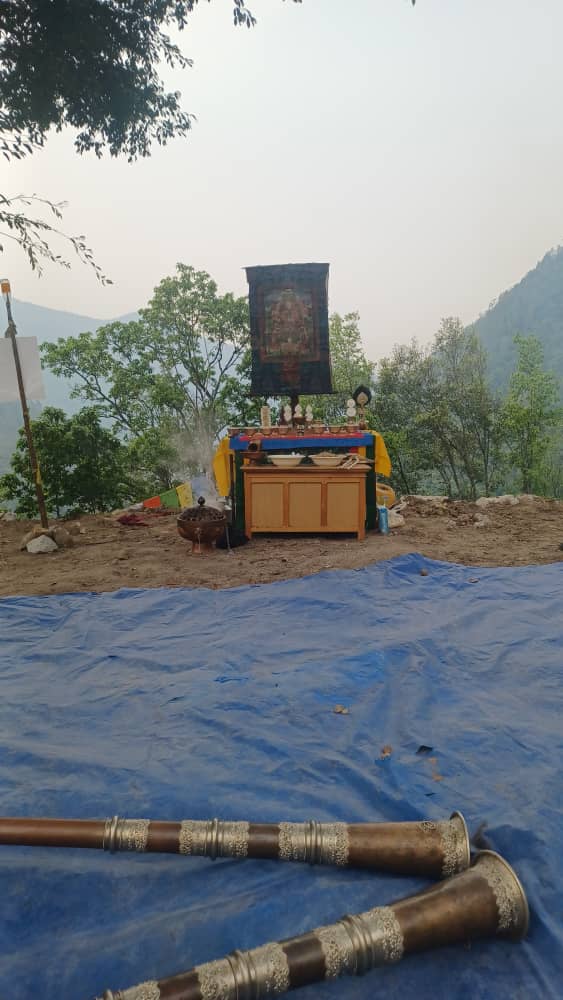
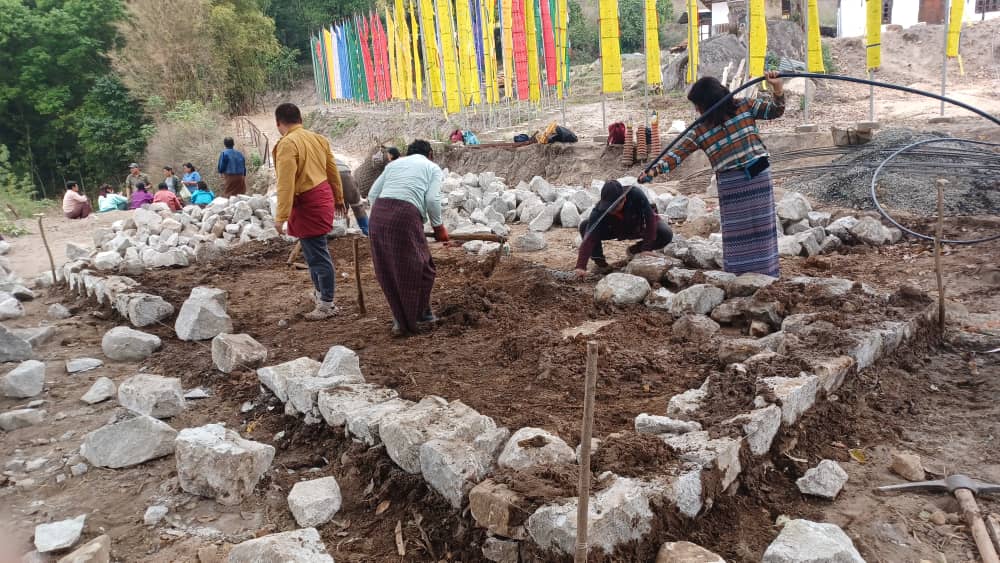
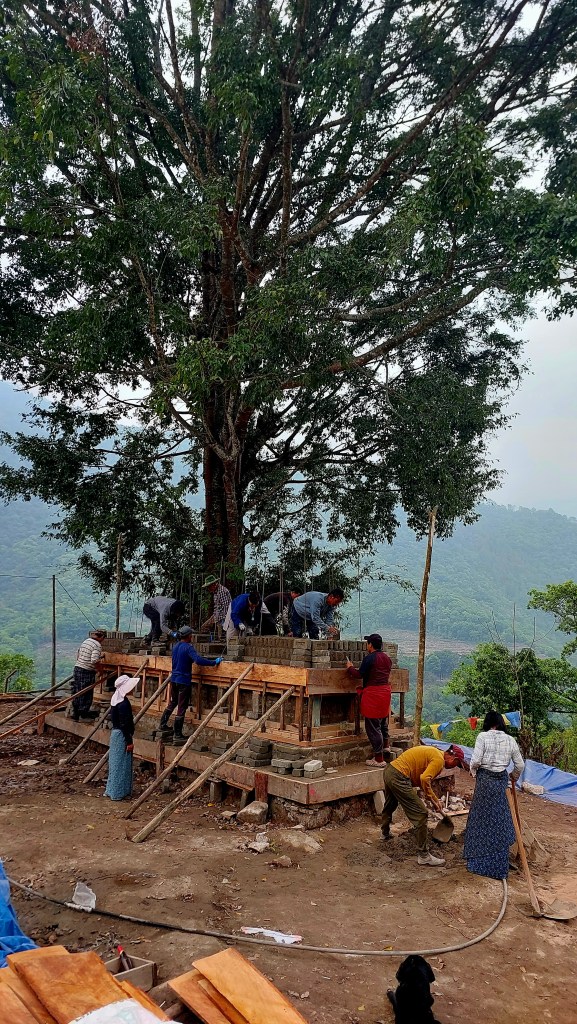
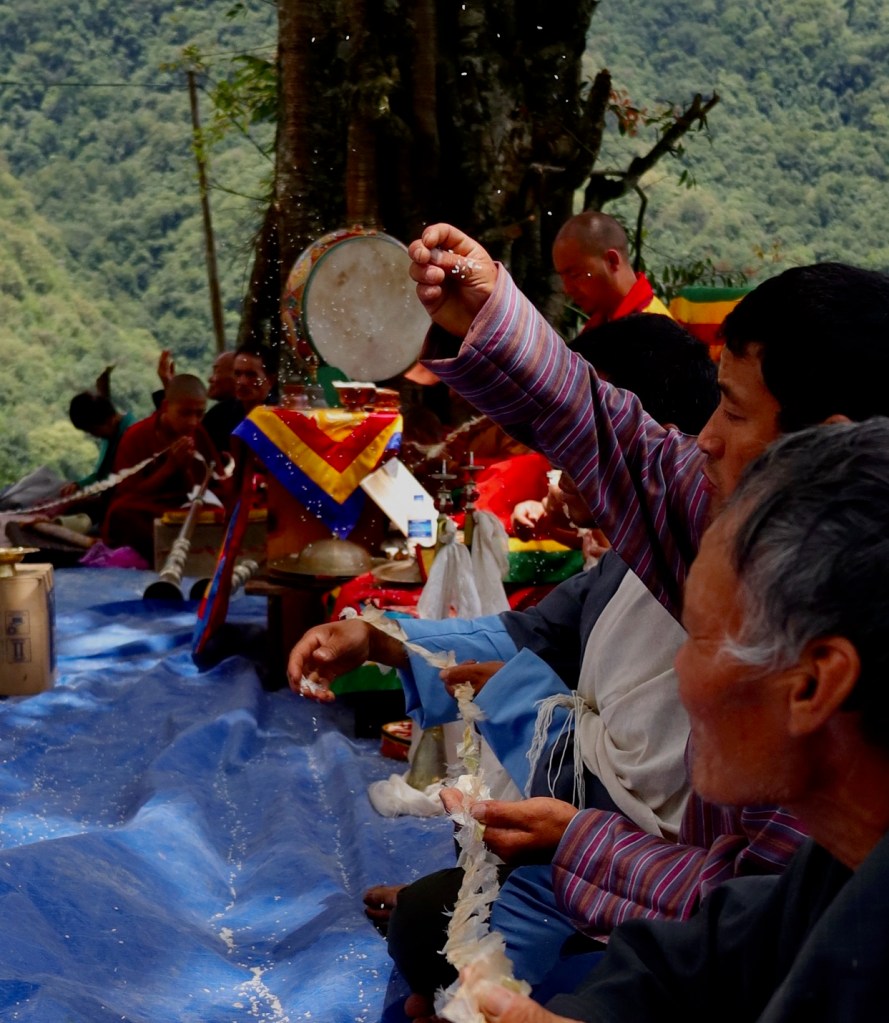
Picture 1 – Every major construction starts with a salang tendrel (Permission Seeking Ceremony) where we ask the consent of the earth deity to build the stupa. We offer 12 sacho bumter (vase of treasure) – four each for the three chortens. This offering is considered as a gift to the earth deity for allowing us to occupy the ground.Picture 2 – The first structure over the ground is the Sa-zin (foundation). This stage is important to provide the correct direction of the stupa (called Chho in Dzongkha). It should not face any direction randomly – especially its shadow should fall in the direction of any private homes. A master astrologer or a realised lama should do this to ensure that it benefits all sentient beings and hurts no one. Picture 3 – The next is to build three stairs called them-kha. Here inside the walls we have the first set of zung (relics) going in – consisting of farming implements and an old urn at the bottom layer. After covering this layer with juniper leaves the men and women garment and jewelries are spread – including arms and ammunition.Picture 4 – Then comes the Thri (throne) where the second set of Zung is buried. Here, inside of it, we offer a full set of religious musical instruments, and as many yangbum (vase of prosperity).Picture 5 – Every inch of the hollow space is filled with tsatsa (mini stupas) and dried juniper leaves. If juniper leaves are not available dry sand is fine too. The thing to remember is not to leave any space.
Picture 6 – The Thri is sealed and this marks the completion of the first stage of the constriction.
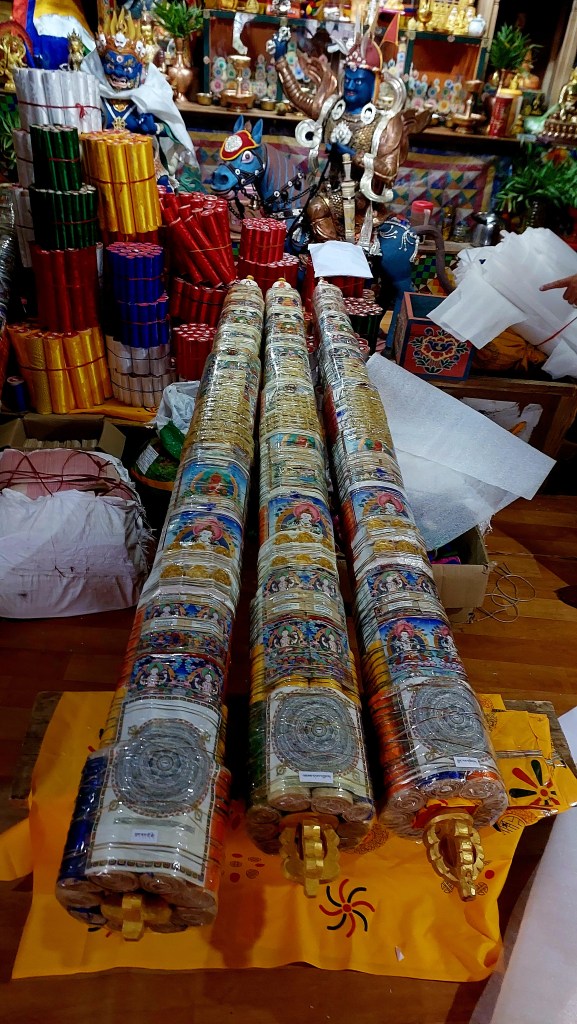
Picture 7 – Over the Thri, we build what we call the Tshemed-Zhi (The Four Immeasurable). It is four-step pyramid and in it we plant the sokshing – the soul of the stupaPicture 8 – Sokshing means “tree of life” and it is what makes the stupa come to life and bestow the power. It is a wooden pole sliced out of a young juniper tree, around which hundreds of scrolls of mantras, clay statues and precious objects are bound. This is best done by a master artisans, although it may be cheaper to do on your own. I prefer to get it from one master I know. Picture 9 – Planting the sokshing is one of the three most sacred stages of the construction of the stupa and hence, a realised lama should preside over this. It is believed the act of “planting” causes disturbances in the Lower Realm, and even the Lord of Death, Yama, can get upset. On the other hand, the upper tip is believed to send power of prayers and mantras, like a radio antenna, to the Higher Realms and the divinities would take a break to witness this sacred moment. Picture 10 – At the base of the sokshing we offer Kaypi-Mar (eternal butter) in a copper urn, and four sets of choeb-ting (water offering cups) filled with gemstones and precious metals. You fill the remaining empty spaces with sacred scriptures like Kanjur (Words of Buddha) or Bum Poti (Perfection in 100,000 lines).Picture 11 – The Bumpa (vase) – the conical shape structure is filled with statues of the deities and divinities.Picture 12-13 – Above the bumpa is the chug-sum khrolo (Thirteen Discs of Enlightenment) which envelopes the upper part of the sokshing. The completed chug-sum khorlo is in the picture below.Picture 14 – The golden parasol which covers the Chug-sum Khorlo is placed on top and both are given a golden color. The three stupas of Rigsum Gonpo are also given their respective colors: yellow for Manjushri, white for Avalokiteshvara, and dark blue for Vajrapani.Picture 15 – Finally, the top-most structure is the golden pinnacle. Usually the Sun, Moon and the Star representing the space are carved and placed there, but increasingly people offer golden pinnacle, which is costlier and believed to accumulate more merits.Picture 17 – The main sponsor of the construction is honoured with gifts of rice, textile and a white khadar.May this sacred stupa bless all sentient beings and bring peace and prosperity to this community and country.
Twenty five years ago yesterday (June 2), TV finally came to Bhutan. It was launched as one of the Silver Jubilee celebrations of His Majesty the Fourth Druk Gyalpo. While there were many great things done as a part of the celebration, including the introduction of the Internet on June 1, the arrival of television to Bhutan was the much-awaited moment for just everyone in the country for various reasons. Someday, if I feel, I will detail them out.
As many would know, I led that historic project, which I am still immensely grateful for the opportunity of a lifetime – something that I am still proud of and will remember it forever. I recall one morning in January of 1999 when the late Lyonpo Ugyen Tshering, who was then the Cabinet Secretary, called me and another colleague of mine, also Ugyen Tshering (who later became a parliamentarian) and conveyed to us the Royal Assent. In his simple misdemeanour he told us, “Even if you have to take the Druk Air aircraft to get it done, do it! Now it is a royal command.”
Running up to June 2, 1999, there are a few cute little details, and a secret, that I want to share here today. More in future.
The TV project, while it was proposed for months preceding to 1999, was given the final green light only 4 months before the actual launch date. So, it felt quite impossible to build a brand new TV channel in four months. When I started enquiring with the companies around the world for the essential equipment everyone just declined. One even told me that I was crazy. I was, actually. However, a French company agreed and I flew over to Paris to check the company. The deal was done.
In telecommunication engineering we also have something called redundancy – meaning we cannot depend on one set of equipment, since we are dealing with the public service. We need a back-up. And so, since it was impossible to get a second transmitter within that time period I stopped over in New Delhi and I requested my good friend, RK Gupta, who was then the Chief Engineer of Doordarshan to lend me a used transmitter. RK Gupta (he used to refer to me as “my Son”) sent a full set of equipment – all packed in three jumbo trucks from his branch office in Lucknow. Fortunately, I later realised that I had made this personal request, because the main transmitter from Paris came only on May 30th evening with only 60 hours to go on-air. We were literally counting hours and minutes, sleeping in tents at Sangaygang to get the job done and going home only for quick showers.
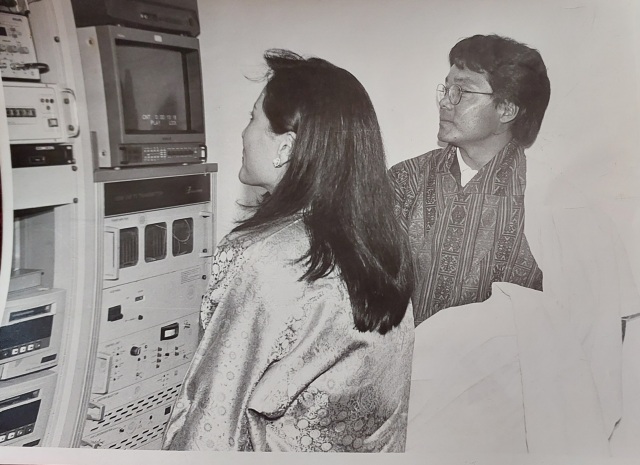
While my team was unpacking the main transmitter I immediately assembled the back-up station sent by Doordrshan and then got it working. This took away a lot of pressure from me. It was also because I was the only TV engineer back then. My team had not even seen what the TV test signal looked like before that. So I felt the whole national TV project on my shoulder.
June 2 came and the celebration kicked off in Changlingmithang and, at Sangaygang, which overlooked the whole Thimphu city, we briefly stopped to listen to the Royal Address. When HM made a mention of the introduction of TV, I was super proud, but deep inside I was still grappling with the fact that we had still not fully tested the equipment. We were making the last few connections to put the full power from the main transmitter through the antenna. I kept that a secret, because if people knew we were not fully ready, it would have panicked everyone. In a crisis you just keep your cool. We achieved the full power without burning any equipment just two hours before the actual launch at 4pm.
People will remember that the first historic transmission came 20 minutes late, but that was due to another last moment issue we had – and it was not from the technical side, although it is normal to hear the announcers say it is.
All in all, 25 years later here we are. Was it good, or bad for the country that we brought the TV? All I can say is, it was inevitable. In the years and months running up to 1999, I faced the Planning Commission and the powerful Cabinet (ministers were like gods those days) and I remember sternly repeating this same message.
1999 and beyond
BBS TV was not just about BBS. I can proudly say that the BBS TV, thanks to a technology called the DVCAM that we chose from several others, later gave birth to what we now have as the Bhutanese film industry. Norling and Tashi Nyencha were the first to jump in. DVCAM was a digital technology that made equipment affordable to small markets with shoe-string budgets. I designed a whole eco-system based on DVCAM, which was later adopted in many small Asian and African countries, for which I was conferred the Asia-Pacific Engineering Award in 2000 in Manila.
More than the award, these days I feel a deep sense of satisfaction seeing young artists and actors and our filmmakers – and thousands of jobs created by that single decision I made back then.
On the broader side, I would like to believe that BBS TV played a huge role, and continues to do, in our collective journey as a nation towards democracy and public discourse – and everything that came out of it. Both BBS and our Film Industry played a vital role in Dzongkha promotion and pop culture, which are strongly elements of national sovereignty. We reduced our dependence on foreign culture and entertainment.
Other than that, as I said, I only feel gratitude for the opportunity bestowed on me from the high above – for the trust and confidence in a 30-year old man – who was almost a one-man army. I felt, and I still feel that I owe it to my country (and not the other way around) for feeding me, clothing me and sending me for higher studies – and making me who I am today. My parents on their own, would never have afforded anything close if I was left to them.
Yesterday as I drove to Jaigaon and back my memories took me to all the mountains and peaks on Dagala, Takti, Ganglakha, Saureni and the southern foothills – among leeches and mosquitoes and occasional snows, to search for the perfect spot to place a TV & radio relay stations to serve our people better.
Wishing everyone a nice week of contemplation as we head for the last few days of the holy month. 🙏🙏🙏
Picture: The Guardian (newspaper), UK
Her Majesty Ashi Tshering Pem Wangchuck inaugurated Bhutan TV at 4pm on June 1999Her Majesty Ashi Tshering Pem Wangchuck, Princess Chimi Yangzom Wangchuck and Ashi Sonam Choden visiting two days before the inauguration
May 2, 2024 – I drove to Athang Rukha to attend the last day of the Mani Dungdrup – organized by a certain Lama Wangdi from Punakha.
I had mainly pushed myself there, despite my heavy schedule, for one reason – the Rukha Lama Ugyen Tshering and seven men and women came and worked tirelessly in the heat of Gelephu to organise the Sacho Bumter for Dorje Phagmo Center the week earlier. I intended to reciprocate their favour, quickly pay respects to Palden Lhamo and Avalokiteshvara and turn back. So, it was just another trip for me. I have been doing this for 18 years now.
The Arrival
However, this time the Rukha Lama had other plans. The villagers were told to receive me with full honors of a VIP-Lama or whatever. So, to my great embarrassment I was received with the blaring sounds of dung-jaling (Tibetan religious horns and trumpets) and ladies singing as they led me in procession to the temple.
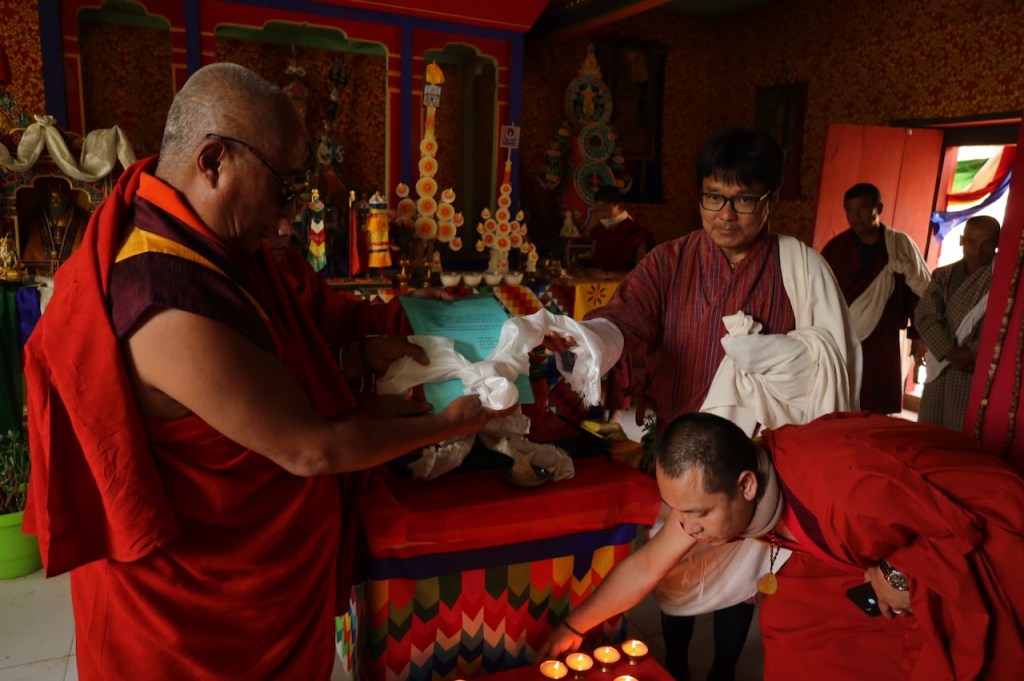
At the venue, the jing-ser ritual was going on and the Presiding Lama, Venerable Wangdi – the former Lam Neten of Tsirang, signaled me to my seat.
When the ceremony was over he explained the significance of the Jing-Ser ceremony to the people, and also acknowledged my arrival.
“We have not met before. So I am honored to meet you in person. The locals here speak very highly of you,” Lam Wangdi told me as he turned to me.
He continued, “Almost nine years back I accidentally discovered this sacred abode of Palden Lhamo, but with no religious events whatsoever. So, I initiated and we did four editions of Mani Dungdrub from 2016 to 2019. I was told you were living abroad then. Then, Covid struck and this is the first one since normal life resumed”.
In 2015, Lam Wangdi, who was then the Lam Neten (District Abbot) of Tsirang Dratshang, was invited to preside over a death ritual in the first village of the valley. While there, he was told that a Palden Lhamo temple was newly built further up in the valley. He felt pulled by some mysterious forces and one day, accompanied by his two attendants, he trekked up to Rukha. He was so mesmerized by the place that he vowed to initiate a Mani Dundrub (Million recitation of Avalokiteshvara mantra) for three years.
He turned to me again, “These people even didn’t know what Mani Dungdrub was, forget about having the religious items to conduct one. I had to carry everything on my back,” he told me. “Now, to see all these temples that you have built, the sacred statues you have put, and a resident lama posted here, it all makes me very emotional. So, I told people before you arrived, “Take good care of this man. Follow whatever he says. Do not let him ever leave this valley. He is a very special person.”. I hope you will continue to support this valley. If you need me, I will come and join you till my last breath”.
I was humbled by his offer. And I felt that he too was drawn here like me by some distant karma from our past lives. He is from Punakha and I am from Trashigang.
The Celebration:
The day continued with celebrating the Birth Anniversary of the Third King of Bhutan, a solemn tribute. This was followed by lunch.
In the afternoon before the Chenrizig Ku-Sung-Thug Wang, which required rest of the day, the Support Committee for Rukha Temple was launched with me as the unanimously-elected Chairman and 45 founding members. Blessing the initiative, Lama Wangdi remarked again to say how proud he was to see the youth of Rukha taking charge of the future of Palden Lhamo Temple.
“Many years back when I first landed here I made a little wish – that the Buddha Dharma flourish from this abode of Palden Lhamo. With the compassionate work of our khenpo (Dr. in Dzongkha) Dorji Wangchuk, and your own good fortune and hard work, I have been telling myself that the wish of this old useless man has been granted. Furthermore, today when you – the young people, informed me that you were launching this Committee to continue the works of khenpo and mine, I told myself that I can die as a happy man because you embody the wishes of our King and of His Holiness Je Khenpo”.
He continued, “Before I came, I was telling myself that this would be my last time because I am not young anymore. I am 72. But now, I have decided to make another wish and that is – before I die I will offer a Rigsum Gonpo (Chenrizig-Jamyang-Chana Dorje) Thongdrel to this sacred place”.
The day ended and dinner was served. I decided to take leave of my new-found friend and before I left, I asked him,
“Lama, did you say that you will initiate the Thongdrel for this temple here?”.
“Yes,” he replied.
“Well, then, I would like to commit Nu. 100,000 from my side for the thongdrel. Let me know when you need the money.”
He was very pleased. “That makes my work easy. I will match your offer with 100,000, and find the rest,” he replied. “So, I was right. You are really something. I don’t know what”.
We both laughed. And wished each other goodbye with a vow that we would continue to work for the valley and for Buddha Dharma.
Leaving Rukha:
As I drove back, alone, along the narrow dirt road towards Wangdue-Tsirang highway my mind always takes me to different moments in the 17 years I have frequented this valley – some sweet, some scary and many of friendship, laughter and selflessness. Like the lama, I too made a prayer when I first landed here in 2007:
“And that whatever was left of my life would be dedicated to uplift this godforsaken community to show them the path to a better future.”
I am glad that 17 years later we are way ahead of that simple moelam.
Some backgrounders
– Rukha is one of the few abodes of Palden Lhamo in the country. While there are sacred chambers dedicated to her, there are only few places in Bhutan that can claim as her abode. Rukha is one of them. The site was blessed by Guru Rimpoche and Pema Lingpa (on his way from Bumthang looking for the site that would later become Gangtey Gonpa)
– Lam Wangdi currently serves as resident lama of Dho-Jagar Lam temple in Punakha. When he comes to Rukha for mani dungdrub he brings everything that is needed for the event – butter lamps, prayer flags, khadar, chadri items, incense sticks, flour to make ritual cakes, etc. The local contribute what they produce – rice, and some butter
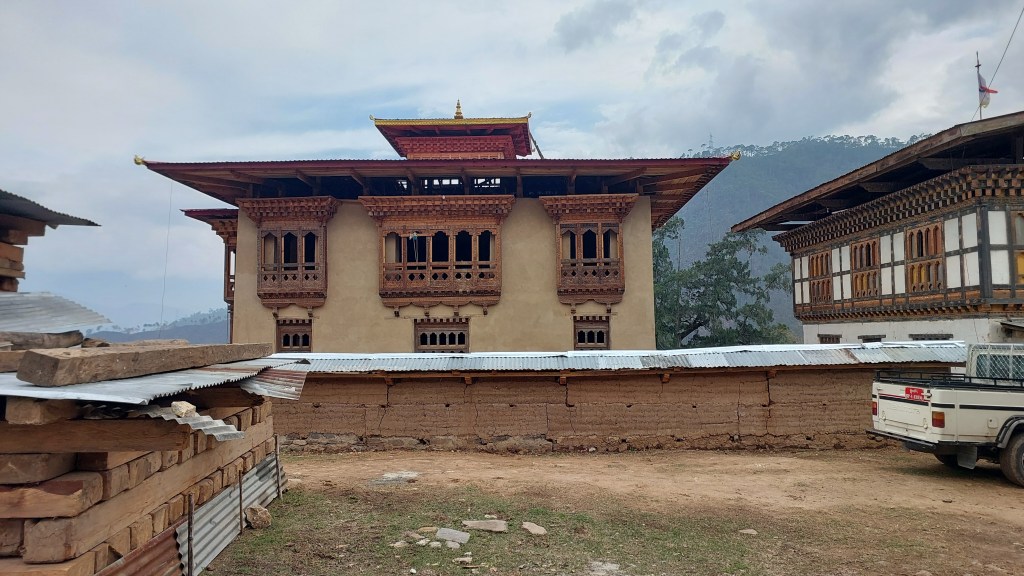
Jarogang Temple is located in the village by the same name. It is in Athang gewog – and one can see it perched on the hill across the river, when driving along Wangdue-Tsirang highway and when you reach around Kamichu.
Jarogang takes its name from Legon Jarog Dongchen – one of the three supreme protectors of Bhutan. This deity together with Yeshey Gonpo (Mahakala) and Palden Lhamo (Sridevi) make up the trinity of protector deities for Bhutan as established by Zhabdrung Ngawang Namgyel (1594-1651).
During the Second Tibetan invasion in 1934, Semtokha Dzong was captured and occupied. Zhabdrung Ngawang Namgyel felt that his presence in the country was causing too many troubles for his hosts and may lead to more deaths in his name. So he decided to leave for India – enroute to Ladakh where the King there, Senge Namgyel, had invited him. Like many of his predecessors Zhabdrung Ngawang Namgyel intended to go on a lifelong retreat to Mt. Kailash, which was then part of the Ladakhi Kingdom.
However, when he reached a stream after descending from Jarogang village, the deity Jarog Dongchen appeared to him and requested him to stay. The deity assured him that he would take care of the invaders. Zhabdrung, then, is believed to have returned to Jarogang and stayed in the house of Zomlha Chugmo (literally meaning Wealthy Lady of Zomlha). Few days later Zhabdrung again felt he was not only freeloading on the local people but also causing too much burden. He again set off only to be met with the deity at the same spot, who then informed the Zhabdrung that Semtokha Dzong has been razed down by a fire and all invaders have been killed. Zhabdrung named the small stream where he heard the news as Deychu – to indicate the stream where he received the good news. Zhabdrung returned to Jarogang and informed his hostess that he had decided to return to Chari.
The “kutsab” and the sacred relics of Zhabdrung
On the day of his departure, the hostess begged him to stay there and offered him the large house from where Zhabdrung could base his dharma activities. It is believed that Zhabdrung made two statues which resembled himself out of the rice dough and presented them to the hostess as his kutshab (representative). The statue, he promised, would carry the same sacredness of blessing as receiving it in person from him.
While one of the statues is still there today, the other is believed to have flown away and landed somewhere in Tsirang. No one knows about it. However, the people of lower Wangdue and Tsirangtoe believe that the area would have good harvest and all nine grains because somewhere there is this second statue “stuck on a tree”, according to the legend.
The other amazing relic (for me) is his phurpa (ritual dagger), which seems to be very powerful. There is also a conch, a bell and a cymbal, which were all gifted to the Zomlha Chugmo. There is also a small metal statue called kharsapani, which is also believed to be self-arisen (rangjung). Some sources say that there were more relics and belongings of Zhabdrung but were apparently taken to Lama Lhakhang in Wangdue Phodrang Dzong – and brought here when the new dzong was built to be used as nangten. Nevertheless, in my view, Jarogang Lhakhang still has the biggest collection of relics associated with Zhabdrung – making it a recommended pilgrimage destination for every Bhutanese – irrespective of the faith, sect, or religious affiliations. In fact Zhabdrung was the founding Father of Bhutan – besides being the emanation of Avalokiteshvara and Guru Rimpoche.
The trees of Jarogang
The visit to Jarogang is incomplete without visiting the jackfruit tree, which is believed to have grown out o a seed planted by Zhabdrung Ngawang Namgyel. Even today the lama and the monks of Jarogang make the offering of the first harvest to the Machen Lhakhang – where the mummified remains of Zhabdrung is preserved today (he was never cremated). This tradition has been continuing for over three hundred years now.
There is also a tall cypress tree below the temple, which is believed to have grown out of the Zhabdrung’s walking stick. Legend has it that with numerous wars and invasions, he doubted if his mission to establish a Drukpa state would be successful. Thus, he planted the walking stick and is supposed to have made a moelam (aspirational prayer) that if he were to succeed a tree would grow out of the stick.
(Triviality: The exteriors of Jarogang temple retains the mud color without getting the white lime wash. The folk theory is that the local deity of Uma demanded that Jarogang temple should not get a whitewash. In retaliation the deity of Jarogang demanded that Uma Gonpa won’t get a sertog (the rooftop pinnacle). So even today Jarogang temple is not whitewashed, and Uma Gonpa has no sertog)
Getting there
Along the Wangdue-Tsirang highway, before you reach Kamichu there is a cantilever bridge and on the other side of the bridge is marked as the headquarters of Jaypee construction company. Cross the bridge and drive for some two kilometers till you reach a diversion – marked with two signboards. To the left is to Jarogang, and to the right is Athang gewog office.
Morakha takes its name from a remark made by an attendant of Guru Padmasambhava. It was during the time when Guru Rimpoche and Mendarawa were in the area. Mendarawa was in the village, while Guru was meditating in the mountains between Phobjikha and Athang. When the Guru inquired about Mendarawa, the attendant is supposed to have replied, “She is (Mo-ra) in the village (Khar)”. Thereafter the place where Mendarawa dwelled was named Morakhar, and later simply Morakha.
Morakha Temple stands over the village of Lomsokha in the main Athang valley. The site is believed to be the spot where Mendarawa practised the Vajrapani saddhana – known as Chana Dorje drub in Bhutanese. A temple was later built on the spot by the followers of Mendarawa and Guru Rimpoche. The exact date is not known.
Coupled with the Athang Tsho (lake), which is at the other end of the valley, the region was a mandatory destination of all emanations of Terton Pema Lingpa, and the followers of the Peling tradition. The area, therefore, received hundreds of pilgrims each year – thus adding to the prominence and economy of Athang region since the mediaeval era. It was only in the post-modern era that the region saw the decline, as the natives were lured to the urban areas of Thimphu and Wangdue. During the same period, pilgrimages from Tibet stopped for reasons known to everyone.
Mendarawa, and Adha mathra and Adha Rachu:
In front of Morakha temple is the boulder that is believed to be the handloom of Khandro Mendarawa, the spiritual consort of Guru Padmasambhava. While the Guru spent his time in the mountains of Athang (also colloquially pronounced as Adha), Mendarawa spent her days practising the Vajrapani mantra, and by night weaving the traditional clothes. The stone relic can be seen even today. Some local sources claim that the origins of the popular Adha mathra and Adha rachu – a traditional handwoven textile and pattern have their origins here in the works of Khandro Mendarawa. And because of their association to Mendarawa, these patterns of traditional textiles have spiritual blessings and are auspicious for special occasions.
According to one source, Athang Morakha is only place visited by Mendarawa. All other important sites of Guru are associated to either Yeshey Tshogyel or Tashi Khyidron. This makes Athang a very special valley
Betel leaves:
Another very popular item associated with this place and to Mendarawa are the betel leaves, which are believed to have been planted by her. The only surviving plant, which is standing in front of the temple, is jealousy guarded, as many attempts to graft and reproduce have been unsuccessful. The betel leaves from this plant are used for making mendrub (medicinal pills) or rilbu (blessed pills). Another local claims that the betel leaves available in the wild in the jungles of Athang gewog are equally blessed by Mendarawa – and they are used for Zhugdrey ceremony in Gangtey Monastery during the annual Gangtey Tshechu and Drubchen.
Chana Dorje relic (ter) statue:
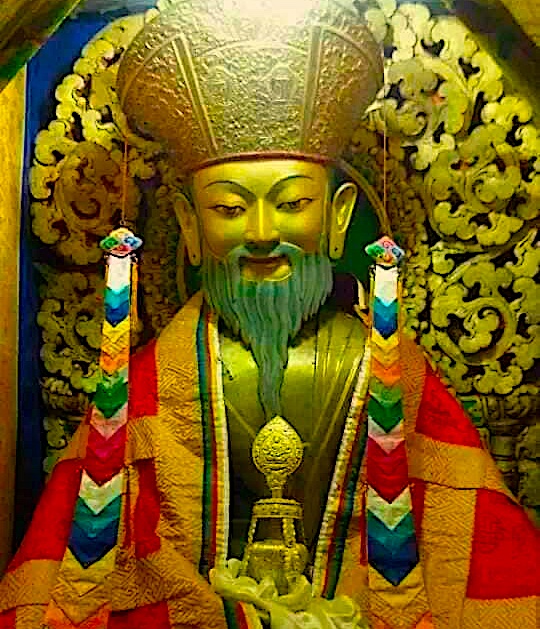
The most prized possession of Morakha Lhakhang is a finger-sized relic statue of Vajrapani (similar to the one in Bartsham temple in Trashigang). It is tucked away in a secured safe and can be seen only on special occasions.
Vajrapani is referred to, in abbreviated form, as Chador in Bhutanese, and every newborn that receives his or her name from this temple is called Chador. So, every other person in this gewog is called Chador, and almost every Chador you meet may be from Athang gewog.
According to the caretaker monk, the sacred Chador statue is believed to have been retrieved by Terton Pema Lingpa from Mebar Tsho (lake) in Bumthang. “One statue flew to Tsakaling in Mongar, another to Paro Dongkala, and the last one came to Morakha,” he adds.
When the original Morakha temple was destroyed by fire this relic statue is believed to have flown away and stayed safe on a nearby tree. It was later discovered by the resident monks and brought back to the temple.
Vajrapani is also a popular deity, who is revered as a part of the supreme Trinity of Protector Deities called the Rigsum Gonpo (རིགས་གསུམ་མགོན་པོ་) – literally translated as “Lords of Three Families” with the three families being Avalokiteshvara, Manjushri and Vajrapani.
The affiliation to Gangtey Gonpa:
The association of Morakha Lhakhang to Gangtey Gonpa started with the life and works of the Second Gangtey Trulku, Tenzin Lekpai Dondrub (1645-1727), who is considered as the most prolific of all the previous Gangtey Trulkus, and who operated mainly in this region. Although a realised being, he lived a simple life of an itinerant monk – who are locally referred to as gomchens.
His works and the patronage he received from the Athang area became the inspiration for the popular adage, “Lama Ganteyb. Jindha Adhap” (Lama from Gantey, patrons from Athang). Today the monastic center is affiliated to Gangtey Gonpa, and the current Gangtey Trulku Rimpoche initiated the reconstruction and the expansion of the temple into a proper monastic institute.
Who must visit?
While Chana Dorje practice is recommended for everyone to pave the path towards ultimate enlightenment, the blessing is a must for those born with birth-mewa 2 and 4. It is strongly recommended that people born with these mewas make a pilgrimage to this sacred place and/or to Bartsham Chador Lhakhang in Trashigang. This is because Chana Dorje is the deity of those born with birth mewa 2 and 4. Birth mewa 2 are those born in the 1944, 1953, 1962, 1971, 1980, 1989, 1998, 2007, and 2016. Birth mewa 4 are those born in 1942, 1951, 1960, 1969, 1978, 1987, 1996, 2005, 2014, 2023
Getting there:
The total drive time from Thimphu is just 3-4 hours making it a nice day trip. There is a farm road that takes off from Kamichu on Wangdue-Tsirang highway. It is pliable with small cars (maybe not during the wet season).
When you get down to the valley floor from the Lapsaka Pass, look for a signboard. Take the road to the left marked as Athang Morakha Changlochen Chador Lhakhang.
What to take:
Take rice, flours, lentils, cooking oil and food supplies for the monks there. There is a community of monks headed by the abbot – with no subsidy from the state.
Where to stay: There are decent guest rooms at Morakha Lhakhang in case people want to stay overnight, which I highly reccomend. Contact person: Lopen Sonam Drugyel 17480524.
The bridge to cross towards Athang from Wangdue – Tsirang highwayAfter dropping down to Athang valley floor, you will get to this cross road.
The famed Athang Tsho (lake) is a beautiful subtropical lake, and some 6 acres in size, in Athang Gewog in lower Wangdue. It is located above Lopoka village on a plateau at the edge of several paddy fields.
The legend:
Legend has it that the tshomen (literally meaning Lake Woman, but referring to the deity of the lake) moved here from a distant place where there was no peace or sanctity because of sacrilegious acts by the locals. Disguised as a young highland girl, with a herd of yaks, she arrived in Phaktakha village in Athang and sought shelter for the night in a house belonging to an old lady. The lady offered a room in the basement.
Next morning when the old lady went to check on the girl, the latter was nowhere to be seen and instead a small pool of water was in the basement. She then rushed out of the house and to her astonishment found her rice fields were covered with a huge lake. The yaks were there but not the girl. The old lady instantly knew she was dealing with a tshomen.
Angry and mad, she called out to the tshomen and told her to come out of the lake. The girl appeared and told the old lady that she found this place to be very pure and peaceful and begged her to let her stay. As a price for the land on which the lake was to be hosted, the girl offered a horse that laid a golden egg every month, plus the yaks. There was only one condition: the old lady must never reveal the horse to anyone and was to be kept hidden away in the basement. The old lady agreed and accepted the offer.
As months and years passed the old lady increasingly became wealthy and was the talk and suspicion of the village and then the valley. No one understood how, but in one village gathering the old lady accidentally revealed something that made everyone curious. When she was standing up to leave, she was asked why the hurry or the need to leave? She made a slip of tongue and told them that she needed to feed the horse. The villagers always knew that she never owned a horse and so, one of them decided to snoop in. He found that she in fact did own one in the basement and to his great surprise the horse also laid a golden egg.
As the horse left the house and the village, however, it refused to move and the men pushed and flogged the horse till the next mountain. At a point from where the lake can be last seen the horse is believed to have wept. On this spot a small lake was formed. The place is still visible today.
From here there are two versions of the story. One that says that the horse died of intense flogging and the other that claims that the horse was beheaded after it refused to move. Whichever is the correct one, there is a grassland with a peculiar grass that is reddish in colour. This is believed to be the blood stain of the horse after its hide was spread here to dry.
The saddle and the sling of the horse were believed to be in Wangdue Dzong. And the house, or the descendants, of the old lady are believed to be in Phaktakha, a village just above the lake.
Social and cultural significance:
The lake is believed to be the Lhatsho of Peling tradition of Vajrayana Buddhism and hence it is a very sacred lake. Until the late twentieth century it was a mandatory pilgrimage destination for the Lhalung Sungtruel line of lamas and the reincarnation of Thuksey Rimpoches. The valley received lots of pilgrims from Tibet and from other parts of Bhutan. This explains the prosperity of Athang region, which despite its remoteness had the fame of producing lots of Wangdue Dzongpons and noble families.
Locals consider the lake as the most important part of their village. They say that the Tshomen has made Athang gewog very prosperous since ancient time despite a very small population. Even today, The sacred lake is believed to bestow the devotees the blessings of wealth, beauty and loyalty. It is also very much part of the local mood too. When there is an impending death or a pandemic the lake has been seen to change its color to a dark hue.
There is a simple altar built at the lake for people to conduct simple rituals and ceremonies. I recommend the Riwo Sangchoe prayers that are believed to bless honour the nature around and the non-human forces and spirits.
Getting there:
The total drive time from Thimphu is just 4 hours making it a nice day trip. There is a farm road that takes off from Kamichu on Wangdue-Tsirang highway. It is pliable with small cars (maybe not during the wet season).
When you get down to the Athang valley floor, from the Laptsaka Pass, look for a signboard. The road to the left is to Lomtsokha where there is the Chana Dorje temple of Morokha. After that you will pass a bridge, and from there you will reach another junction. To go to the lake go right. There is a 5-minute walk from where the road ends.
This trip is highly recommended, as you can tie up with a visit to the sacred Morokha Temple in the same area, where there is the relic statue of Chana Dorje – believed to have flown there from Bumthang.
What to take:
Get plenty of plain cooked rice, plain crackers or sweet biscuits for the fish population in the lake. Make sure there is no salt on anything you feed.
And, of course, fresh cow milk for the Tshomen (Lake Woman), and incense sticks.
Several people asked me as to what kind of businesses they can do in Gelephu – as the mindfulness city project kicks off.
Well, I am not the official representative on this, but for the benefit of the sentient beings who may require ideas from others, here are a few very obvious ones that come to my mind, from the various foreign travels I did in my life. Some of these businesses are already there, but more and better services will be required as projects, businesses and people settle in. I invite young Desuups who have been skilled to give an extra thought.
First, three golden rules to succeed:
1. Ditch the get-rich-quick syndrome: When you start a business, first aim to make a living and not make profits. If you secure the basic income to survive, it is a good start. Then as you become popular and you capture the market, you can think of profit. Work on a very low margin. As we say in Bhutanese, “don’t kill the red cow”. Start small. Minimum investment. Outwork your competitors.
2. Advertise your service: Market your products. Don’t wait for customers. These days with Facebook and other social media platforms it is easy. Stop wasting time making tiktok videos and doom-scrolling. Use social media with a purpose. Build a website. This gives you credibility.
3. Consistency, commitment & honesty: Be consistent. Don’t start and then wane. This is a classic case of any Bhutanese business. Keep your commitment. If you say 3pm, make it at 3pm! Who has not been to a place where they tell you to come back at a certain hour and when you go they have not even started the work. With Bhutanese it might work but not with others. And be honest and trustworthy. If you lose someone’s trust, you lose everything and you lose it forever. If people trust you, that is your biggest asset.
Don’t compete with anyone. Compete with yourself.
Now, here are some ideas – assuming that Gelephu will be an area with free movements of people, and with a real ease of doing business, which are all the hallmark of a special economic zone.
1. Shuttles, luggage, logistics and shipping services:
People arriving in Gelephu – whether it is for short visits or for longer stays will need to move around. If you have a car, you can provide the shuttle service. You can form a group, and offer a wider variety of vehicles. There will also be goods – like personal luggages to be delivered, and merchandise to be moved around too. Whatever be the case, shuttle service is a big business in any economically vibrant city. Packing, forwarding, shipping, air cargo, etc. will only increase as we move forward.
There will also be people moving in or having shipping containers and goods they have ordered from somewhere to be cleared from Kolkata and forwarded to Gelephu. In the initial period these clearing jobs will be a nightmare and they are best left to experienced hands. If you have some experience, put them to some use.
2. Visas, stay permits, translation and administrative services:
Any foreigner needs some paperwork to be done to enter or arrive in the city, start a business, apply for stay-permits, extend their stays, get a SIM card, Wifi services, etc. A small office with a photocopier, scanner, printer, camera and a make-shift studio are all you need to give a go. Alongside you could offer translation and translator services. People who come to Gelephu would most likely use agents in the beginning to do the running around.
3. Rentals, real estate & retirement homes:
As people move in, they will need a place to stay. Consider starting a property rental service and help people find a place. You can charge a fee for your service. This business is quite easy, and not so demanding that you can work from your own home. All you need is a good laptop and a website.
Short term lease or seasonal rentals in Gelephu may also become a trend for Bhutanese from the colder regions of Bhutan – Thimphu, Paro, Bumthang and Haa, to escape the winters. This is something I would consider – live in Gelephu from November to March.
4. Photography, video, writing and printing services:
As businesses explore the area of Gelephu to build their factories or homes, or whatever, they will look for professionals to take pictures and videos. Later to write reports, design company websites, design brochures for their business – or advertising and running their social media pages – and do their backend work. This is not bad if you like art, designs and creativity. And again something you can freelance out of your car.
5. Steam, sauna, medicinal baths and fitness centre:
One other business that will do well is a bathing centre. Better if you can access the hotsprings of Gelephu. Having regular steam and sauna baths provide a variety of health and beauty benefits, especially in south Bhutan where bugs and insect bites are common. The traditional hot stone or herbal baths can be a good tourist attraction, because of Bhutan being a land of medicinal herbs.
If you are a certified fitness trainer it is time to move to Gelephu and open a gym there for both visitors and locals who are very conscious of their health.
6. Laundry shops, and dry cleaning services:
Laundry and domestic help will really be in demand as people move to Gelephu. You may think people can use a washing machine, but having to iron the clothes takes time and people don’t have the time or patience for these things. When I do long-stays in Bangkok or Bali I always use the laundry service where they charge by kilos. A heavy duty dryer machine is a must in Monsoon in Gelephu when the humidity does not allow your clothes to dry.
Laundry service will also be required by hotels and guesthouses, who will happily outsource the washing of bedsheets and pillowcases on a daily basis. If you do it well, it is great business.
7. Gardening, domestic helps and security services:
Grass and weeds grow faster than you can think in south Bhutan because of the warm weather and torrential rain. Plus they don’t dry up in winter. Every house and every villa will require gardening service. Gardening does not mean only plucking the weeds. You must also offer design and construction service with ready-made plants and flowers transported from the nursery and transplanted. You can offer to maintain it for an annual or monthly fee.
There will be a floating population who will be in and out of their homes in Gelephu. So besides gardening, there will be the need for domestic helpers and to security guards while they are away.
8. Travels & tours:
Gelephu will become the entry point for travellers who may want to proceed to Manas or Phibsoo (within the GeSAR) or beyond to Zhemgang, Trongsa and Bumthang. Visitors may also want to explore and experience village life.
However, this will be the most competitive field and so you need to prepare for this the most by: Visiting all places of interest, studying the area, documenting and remembering the stories, myths and legends; Locating the best food and drinks that are not good but also hygienic and clean; Blogging, writing and advertising extensively; Learning how to make good videos, and put them on YouTube; Taking good pictures and making information brochures; and by being very resourceful
9. Rooms (Bed & Breakfast):
People need somewhere to sleep, and often the big hotel chains are expensive and soulless. Meanwhile, a quiet rural home with some history, a private hut with a shower, a proper breakfast and the proprietor who can share the local history, culture, traditions and knows the place and people there, could be a far more enticing place for a casual visitor. People will not come to Bhutan to look for luxury beaches or entertainment but for some authentic connection to nature and people and for some quiet introspection.
This could be a great retirement plan for many civil servants who are well travelled and knowledgeable, and who own land in Gelephu-Sarpang. Besides, south Bhutan has a much milder climate for the old ageing bones and muscles.
10. Food & beverages:
Coffee shops are my favourite places. I may not visit a local museum or a famous tourist spot but I always enter every coffee shop in town when I travel. I am addicted to coffee and besides that it is a nice place to make new friends and have a conversation. That’s the reason there are coffee shops everywhere in Europe and in southeast Asia. Better if the place has homemade pastries, bread, bun and cakes. Go for this! There are more people like me than you think – even among the Bhutanese.
I won’t mention restaurants. This is obvious. But one business that will do well is catering, but with a difference. You must cater the food to places with a view – in the wilderness, near the river, in the jungle. You can cater weddings, birthdays, official and unofficial events. Many professionals who will be move to Gelephu will be single or young couples who cannot cook.
Honorary Mention: Be a “Jack of all trades”.
There won’t be a huge mass of people rushing to Gelephu right away. It is more likely that there will be a good number of early adopters who will inspire more to move in. So instead of focussing on one trade, have as many in the beginning – and then focus on one. You can combine several businesses, like travel, shuttle service, and visa clearing, while your wife offers laundry service or leads a catering team.
(More business ideas in the legal, public relations, wellness, etc. later as I get a better grasp of what are coming there)
The new longer runway for the Gelephu Airport will run parallel to the existing one and will extend towards Sarpang (and not towards Mao Khola). The runway will pass over Paitha Khola river and Aiepoli river. Land needed for this has been acquired and finalised, as per the reports.
The 3,000 metres runway and the new Terminal Building and associated infrastructure are estimated to cost around Nu. 20 billion – and will be able to accommodate the Airbus a320 family and Airbus a350.
The existing airport with its small terminal building and the 1500m runway, while serving the domestic flights, will also cater to regional flights such as to Kolkata, Guwahati and Bagdogra. The Department of Air Transport has officially renamed the airport as Gelephu International Airport and received the international certification from the ICAO (UN agency that looks after aviation). International flights to the above destinations will start soon using the existing Druk Air ATR-42. Some clearances for the air route from the respective governments are awaited. (Source: The Bhutanese and Department of Air Transport, Paro International Airport)
What does this mean for GMC?
In my view, potential investors can fly in directly from India, Nepal and Bangladesh in the immediate future. Bhutanese people living in Gelephu and in the nearly Dzongkhags can fly out without having to drive to Paro to catch the flight. Indians living in nearby Assamese districts can use it too. Connectivity is the key to any economic growth and nothing is faster, safer and reliable than air connections. And since the airport has been certified, private business jets can also fly there, which will facilitate the travels of large international investors.
In 2 years time, hopefully we should have the new airport up and running. My dream is to see our own airlines acquire an Airbus a321 and fly direct to Australia, Dubai and Kuwait. Establishing such physical connections may perhaps reverse the migration, or at least create a circular one with investments and movements and keep the emotional connection with the country.
Druk Air that flies on Fridays and Sundays is reportedly seeing an average of 20 passengers on every flight (the plane capacity is 30). As I mentioned in my earlier post, if we make service available, people will find ways to use it.
Technically, it is also possible to land the Airbus a320 types of aircrafts on this 1500m runway but may require special certification of pilots to do that since it is stretching a bit. However, this would link Gelephu immediately to Delhi, Bangkok and Singapore. There are few international airports around the world (Santos Dumont Airport – Rio de Janeiro – Brazil) that have shorter runways than Gelephu and where Airbus 320 and Boeing 737 operate.
Another key infrastructure is the railway link, which will facilitate export of boulders and agriculture products while bringing down the prices of imported goods. The railway connection is also really important because a project as massive as an entire new city cannot be done by depending on the trucks and taxis only. Heard the Northeast Frontier Railway are working on that. Hope the imminent visit of the Indian PM will give a new impetus.
Dreaming on? Sure, for, there is no cost to dreaming. It actually feels nice. Better than engulfing yourself with negativity and pessimism.
Landing in Bhutan’s only international airport, especially for those flying in for the first time, can be quite an experience with terrible air turbulences and sudden drops in altitude as we ram through the clouds towards Paro Valley. When you look out of the window, the wings are almost scrapping the trees and the roofs of the houses, or scratching the rock face of Dongkala or Dra Karp. But these are nothing compared to the 1990s rides with a maverick American pilot called George, who used to take us down on a nose dive and make us all pray or vomit – or both.
What is reassuring is the amazing safety record of Paro Airport. That’s because, besides the visual flight rules that the pilots have to abide by, here, the captain in command has to take full control of the landing – unlike other airports in the world where the co-pilots can also have the option to land the aircraft. Of late, pilots can also depend on better navigation support services such as GPS on the plane, and one more VOR station on the ground, to guide their way through the mist and the mountains. So, travellers who have been doing this route since the 1990s will also remember frequent flight cancellations, which are rare nowadays.
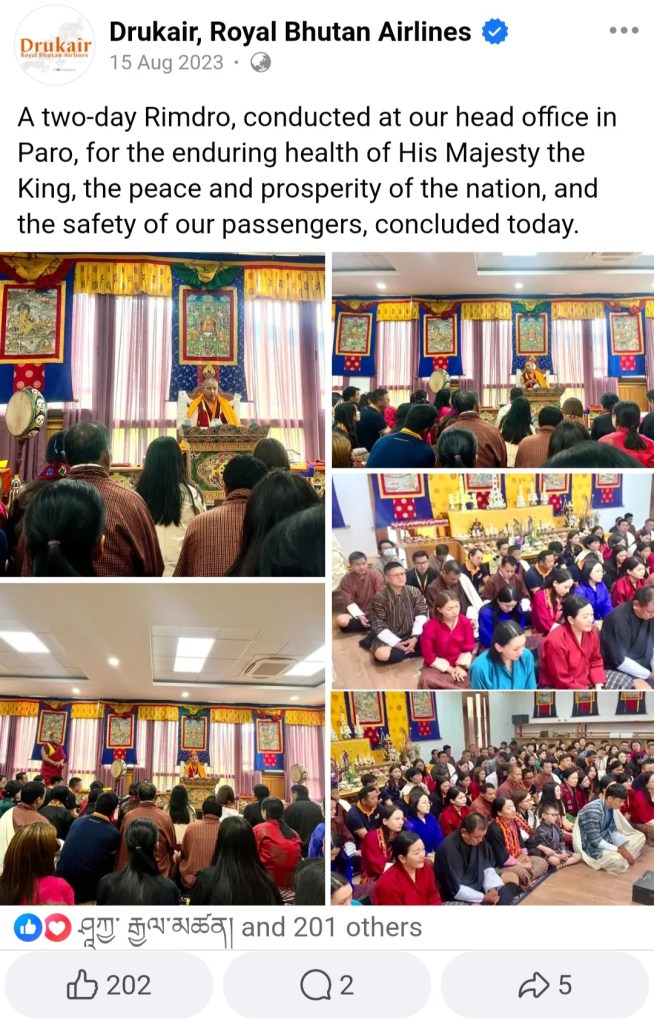
We Bhutanese, however, leave no stones unturned. Even the gods and the higher hands are invoked regularly for the smooth operations of these flights. (See Druk Air Facebook page)
The temples in the mountains often play host to appeasement rituals to local protector deities such as Dongko Tsen and Jowo Drakey of Paro, and Aap Chundu of Haa. Likewise, they invoke Tsi-Mar in Bumthang, and Aum Jomo and memay Dangling over Yonphula, Tashigang.
Being Bhutanese is about recognising that we are just part of the universe with the presence of different forces and nonhuman agencies – and not just with our human ingenuity or ego. Everything we do, is about harmony between humans, nature, and the supernatural – including flying the latest Airbus that science and technology have to offer.
Identity has been mankind’s longest search. The question of “who am I?” has intrigued thinkers from Plato to Prince Siddhartha to Descartes. For us in Bhutan, this question has become even more relevant, as the country faces the onslaught of technology and outmigration, and the dilemma and divisions brought about by changing politics and policies. Simply put, what does it mean to be Bhutanese? This lack of common understanding, I believe, forms the core of our challenges – whether it is at an individual level or as a nation. Drawing from my PhD dissertation, I will attempt to give a definition to this slippery topic.
Identity has several definitions and concepts. Depending on the discipline, there are racial identity, gender identity, religious identity, cultural identity, political identity and so on. Here, by identity I am looking at the one coming from psychology – as in the personal identity, which describes one’s distinctive attributes that make a person unique. And more so, to the sociological definition, which refers to qualities, beliefs, and traits that characterise a person or a group. Scholars argue that it is the social circumstances in which people have been raised that determine the ways in which they identify themselves. Identity is, thus, believed to be produced through social interactions and experiences.
The traditional, virtual, and hybrid communities
A traditional community is where everything is shared – life, work, happiness, or sorrows. When you build your house, the whole village comes together without expecting a payment. Wherever celebrations and ceremonies are taking place, everyone is invited by default.
Nature and spiritualism occupy the centre stage in this community. It is not humans, but nature, which dictates everything including the pace and rhythm of life. Places are not just physical spots. They are sources of stories and spirituality, and of inspirations and wisdoms. Thus, kinship and family ties are extended not only to humans, but also to nature and to nonhuman forces and spirits. For instance, tigers are referred to as azha tah (maternal uncle Tiger), bears as aku Dhom (paternal uncle Bear), and elephants as memay Sangye (Grandpa Buddha). Certain deities and mountains are also embraced like a family. Examples of case in point are ama Jomo (mother Jomo), memay Chador (grandpa Vajrapani), or as memay Ralang – a mountain in Trashigang. Kinship terms do not only serve a referential purpose. They build and sustain emotional connections too. This may be the reason why Bhutanese are close to nature and mountains.
Time, in a traditional Bhutanese community, is conceived as cyclical and not as linear. For instance, older people do not remember their age. They will remember their Buddhist zodiac signs, which is a cycle of twelve years known as lo-kor. The correct question to ask is, “How many cycles have you done?” instead of, “How old are you?”. Nature also defines the flow of time. To lift from American sociologist Robert Levine, traditional Bhutanese prefer event time, and not clock-time. In rural Bhutan, you don’t say, “I will see you at 9.30”. Rather it would be something like, “Let’s meet before the Sun sets, and after we collect our cows from the jungle”. This may explain why Bhutanese are rarely on time.
At the other extreme of a traditional society is the virtual community where humans, instead of nature, are at the centre of the universe. Here everything must be rational, logical, scientific, and black and white. It is also where time is linear. The resulting characteristics are: more individualism, expressiveness, innovation and celebration of anonymity. Money and materialism are means to enhance one’s self-worth or belonging.
Striding between tradition and technology, between collectivism and individualism, and between money and meaning, is the hybrid community. Time starts to become linear here, and the cyclical concept is still accepted. Nature has its place, and so does rational science. There is more “we” and less “me” in this group, and wealth is to enable one’s pursuit of the greater good.
Therefore, the traditional Bhutanese identity is an interdependent self, which consists of a personal self, social self and a spiritual self. The social self is derived from one’s social identity as a parent, and from the vocation one practises. The spiritual self is the recognition and internalisation of the external nonhuman energies and spirits.
The chronotopic Bhutanese identity
While one may observe these identities manifesting in different generations or communities, an interesting finding is that you can also notice these multiple identities in individuals, as one lives through the changing circumstances and contexts in life. The ingredients of the interdependent self – the personal, social and the spiritual selves, are all there in each one of us – in different dosages and degrees. I call this the chronotropic Bhutanese identity. Chronotope comes from Greek and it means time-space (chronos means time, and topos – place). The term was coined by a twentieth century Russian philosopher Mikhail Bakhtin as a literary tool to posit the idea that time and place are inseparable in art. Chronotropic identity basically argues that a change in timespace configurations triggers a seamless shift in roles, behaviours, discourses, modes of conduct, mindsets, and cultural practices.
Take for example, the people of my generation – the predominantly hybrid group that grew up in a traditional setting, and got introduced to science and technology. We start the day by reciting a few lines of prayers. We then get up, wash and offer water and incense to the altar, have breakfast and open a laptop at work. The virtual community, on the other hand, may be on the technology from the moment they wake up till they retire to bed. They would attend spiritual calls on special religious occasions, or visit a temple like Dechenphu if they need something. Conversely, the traditional people access the technology too but not as a default mode. It sees materiality both in technology and spirituality, though.
The key to a harmonious Bhutan, then, is not only to recognise these parallel matrices, but, to paraphrase another philosopher, Jean Gebser, to embrace an integral consciousness that would involve a more holistic understanding of the reality, which includes both the rational thoughts and the intuitive sense of interconnectedness and spirituality. The Generation Z (or Gen Z – referring to people born roughly after 1999) must not refute the traditional as archaic and outdated. On the other hand, the hybrids should not discard the Gen Zs as not adhering to established norms. There is space for everyone.
What’s going on in Bhutan, instead
From a sociological perspective I feel that there is a loss of innocence among traditional Bhutan, which was accelerated by political changes.
By ‘innocence’, I mean where people are honest, spontaneous, sincere, always helpful, and trusting of others, and have a strong moral compass. In general, people who haven’t been corrupted by the evils of modern society. You can find some in rural Bhutan.
The loss of innocence has led us to empathy deficit among the hybrids – because of newfound power, ego and fear. And then, among the younger generation, a decline in the sense of belonging from being not understood. Unless we address these, people will go off on tangents in search of meanings to life, instead of drawing satisfaction and purpose from the service to the collective.
My greater concern, however, is for the next generation. For better or for worse, from an interdependent-self that we should be, Gen Zs are growing up as more expressive, questioning and independent selves. Instead of love and guidance by the collectivist society, it is viewed as a social divergence. Our youth, then, feel misunderstood, and even rejected. Research shows that when they are isolated from their physical communities, they will either go away, shut off completely, or hide behind computer screens and smartphones and try connecting with the online world. One issue with living on social media is the abundance of information and knowledge there – both good and bad. Information is not knowledge, and knowledge is not wisdom. In life you need wisdom. You develop wisdom only when you engage with the physical world, where you roll out your sleeves and get your hands dirty. This may explain the success of the Desuung program. It gives that opportunity – to go hands-on and feel a sense of belonging to a meaningful community.
Fortunately, some compassion is still around in Bhutan, which is evidenced by frequent and successful fundraisers on social media, like for someone in Australia who needs a surgery, or for a fellow Bhutanese who has to go for a transplant in India – or to simply save some yaks – or build a stupa.
So, what does it mean to be Bhutanese?
To be Bhutanese means to be compassionate, altruistic and spiritual; and be aware of one’s place in a family, community and country; and share this temporary space with other beings – that are both seen and unseen. If Bhutanese, young and old, could embrace this more, instead of over stressing on cultural paraphernalia or purely pursuing economic dreams or power, a brighter and a fulfilling future – as individuals and as a nation, will be more than guaranteed.











 Dorji Wangchuk