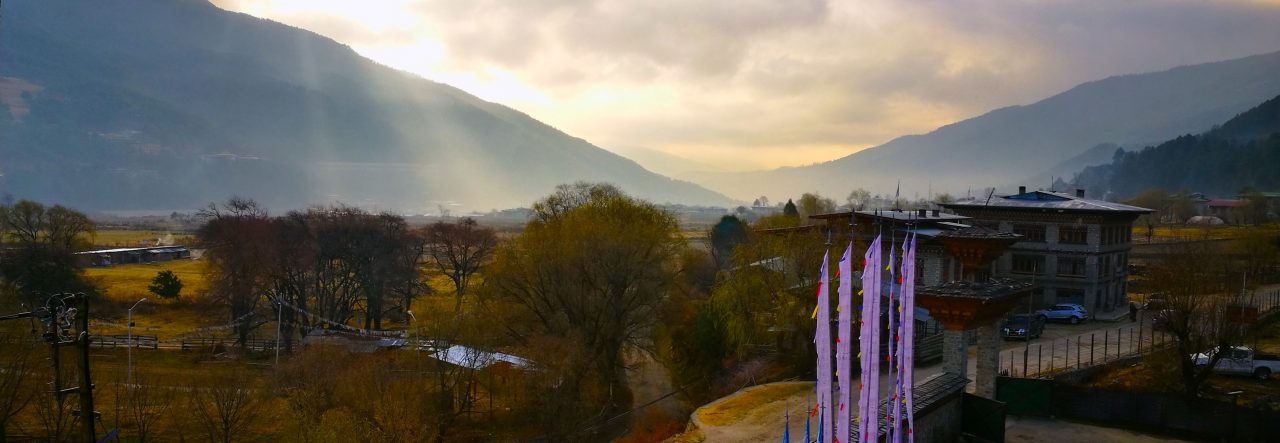
Starting off on the New Moon of the holy Saka Dawa month and ending it on the Birthday of Guru Rimpoche, I have completed my first experience with the popular 10-day Vipassana meditation programme.
Attending a Vipassana course has been seven years (three covid-years included) in the making. I registered for it several times, got my place confirmed, but everytime I chickened out at the last moment. To be honest, I couldn’t imagine waking up every day at 4 am (I am a night owl). Or sit still for 13 hours daily, because I have recurrent back pain. I also have another condition – a mild form of Restless Leg Syndrome (RLS), which urges me to move my leg or sitting positions every few minutes. I am also claustrophobic and to have my eyes shut and be alert for a long time is out of the question. So, Vipassana increasingly became a dream. For the same above reasons, I also stayed away from sitting through religious sermons that go on for days or months.
However, covid matured me into the fact that life was indeed uncertain (I was supposed to complete my PhD in 2020. I did it only in 2022) and so, one should never put away things for some other time. Besides, I was getting neither younger nor stronger and if I really wanted to do it, I had to go for it. And this time it was it.
My Vipassana experience
Sikkim welcomed me with an incessant monsoon rain. As I made my way up the banks of the huge Teesta in a small taxi, the swollen and muddy river gushed downstream with large trunks of trees and tin roofs.
“I don’t come here in this season, but Covid made me never to skip every opportunity to earn,” says Dawa Sherpa, the taxi driver. “Plus carrying Bhutanese going on pilgrimage always makes me feel blessed too”.
I checked into the Dharma Sineru in central Sikkim with mild diarrhoea and nausea. Perhaps I picked some germs in a roadside dhaba I ate in Odlabari. I thought I would be ok the next day as we started the course, which was not to be.
There were 56 of us – 26 male and 26 females. Few dropped out by the third day. It is common for people to do that. The course is not a walk in the park.
The first day of the course was terrible. My stomach condition had worsened, plus it was bloating too – making it uncomfortable to sit. To make matters worse my tension headache struck again. Happens, and this time it lingered on. I felt miserable.
The next day my headache had subsided but my stomach was still not settling down. I persisted. Despite these health challenges I increased sittings with lotus position from two to five to ten minutes.
The Day 3 looked hopeful. My stomach had quietened. I started catching up with the group. We had to observe our breath entering our two nostrils. This was my first training in the art of meditation. I have no other experience at all. I was beginning to enjoy it when another tragedy loomed.
I started feeling a sharp pain in my left lower back. I was like, “OMG! My back is giving up”. It happens from time to time thanks to an injury from a bicycle fall in college. I silently invoked my protector deities to help me pull through.
Day 4 was, however, no better. The pain had worsened. At every break I rushed to the room, stretched and did some exercise my physiotherapist had taught me, applied a coat of Tiger Balm, and rushed to the Hall.
But during one of the breaks, one of the assistants, didn’t see me come out of my room and came in checking. I was just finishing applying the Tiger Balm. Our eyes crossed.
“My back is giving up on me,” I told him as I started finishing the routine.
”Oh! If you want I can ask the Teacher to give you some rest,” he kindly offered.
“No! No! I don’t want to miss even one session.” I replied. I will persist.
And persisting I did but barely made it to the end of the day, which concludes with a Q&A with the Teacher – Norbu Bhutia, a kind-hearted and committed Sikkimese gentleman. I approached him and told him I had a request to make. I explained to him that I needed a seat with a backrest because my back was giving up on me – thanks to a past injury.
“Oh!” he replied.
I assumed that he was wondering why I had not declared my condition in the registration form, or during registration, which would have actually led them to not qualify me for the course. Vipassana courses are done as per the Theravada Buddhist tradition, which emphasises on strict rules and code of conduct called Pancha-Sila. Not be honest about your physical condition can be construed as lying, which is one of the Pancha-Sila.
“It happened 25 years ago and it never was a big problem for me and I am leading a normal life. But this time it is snapping,” I added.
“OK,” he said, “We will arrange a seat with a backrest for you”.
Moving to top gear
From Day 5, I shifted to top gear. I slowly sat still for 15 minutes straight without moving a finger, stretching my leg or opening my eyes. I was pleased with my progress. From the earlier day we had moved from Anapanna meditation, which is observing the normal respiration as it comes in and as it goes out, to Vipassana meditation that involves observing one’s physical sensations as they emerge, without judging or dwelling on them. This way you develop equanimity because, after all, all phenomena are impermanent. So why waste one’s precious time and life on them?
The Adittana Meditation
I was not done, as yet. There was one more goal to achieve even for a new student – a 60-minute sitting where you cannot open your eyes, hands or legs. It is called Adittana (strong determination) Meditation. I was mortified by the requirement and thought that was impossible for someone with RLS.
“Your mind is more powerful than your body,” said the teacher. “If you tame your mind, you can tame your physical body”.
For me it was always the other way around. I thought that I needed to tame my body to start taming my mind. But this golden advice from him was a breakthrough. I started visualising in my mind that it was possible. And I set out to achieve it on my last day. But, lo and behold, I scored my first 60-minute motionless sitting on Day 7. Of course, I had to, and I still have to, put in lots of effort. The thing is, one should do it effortlessly.
What next?
This is just the introduction to the technique and I don’t claim (no one can) to have mastered the art in just 10 days. It will take years to make a significant progress in this field. The founder of the Vipassana movement, Shri Goenka, himself trained under his Burmese teacher for 14 years in Burma before he felt he could teach others.
And yet, for me this was a great personal achievement – to know that I can wake up at 4 in the morning every day if I want to, and that neither RLS nor a chronic back issue should limit what you want to do in life. This opens up new opportunities for me such as venturing into more serious Vajrayana practices such as Dzogchen, or short solitary retreats. I am also confident to sit through long discourses and receive Thri-Lung-Wang, literally meaning ‘Initiation-Transmission-Empowerment’, which is very popular for lay practitioners in Bhutanese Buddhism, or sit though the sacred teachings on Prajanaparamita (Dz. ཤེར་ཕྱིན་, ཤེས་རབ་ཀྱི་ཕ་རོལ་ཏུ་ཕྱིན་པ་, Sher-chin, Eng: Perfection of Wisdom), or Rinchen Terzo (Dzo: རིན་ཆེན་གཏེར་མཛོད་, The Treasury of Precious Termas).
Vipassana was a great experience and I plan to do it once every year. If for nothing, it humbles me into being a monk, even if it is for a limited time.
Most importantly, I would like to integrate the essence, or the ultimate goal, of Vipassana, and Buddhism in general, which is to deepen the concepts of equanimity and impermanence. I will make every effort to make the most of every moment – but not to over-cherish the good times because they won’t last, and not to over-despair during bad times because they won’t last either.
And if either good times or bad ones overpower you, observe your breath as it comes in, and as it goes out.
BHAVATTE SABBE MANGALAM – May all beings be happy

Getting there
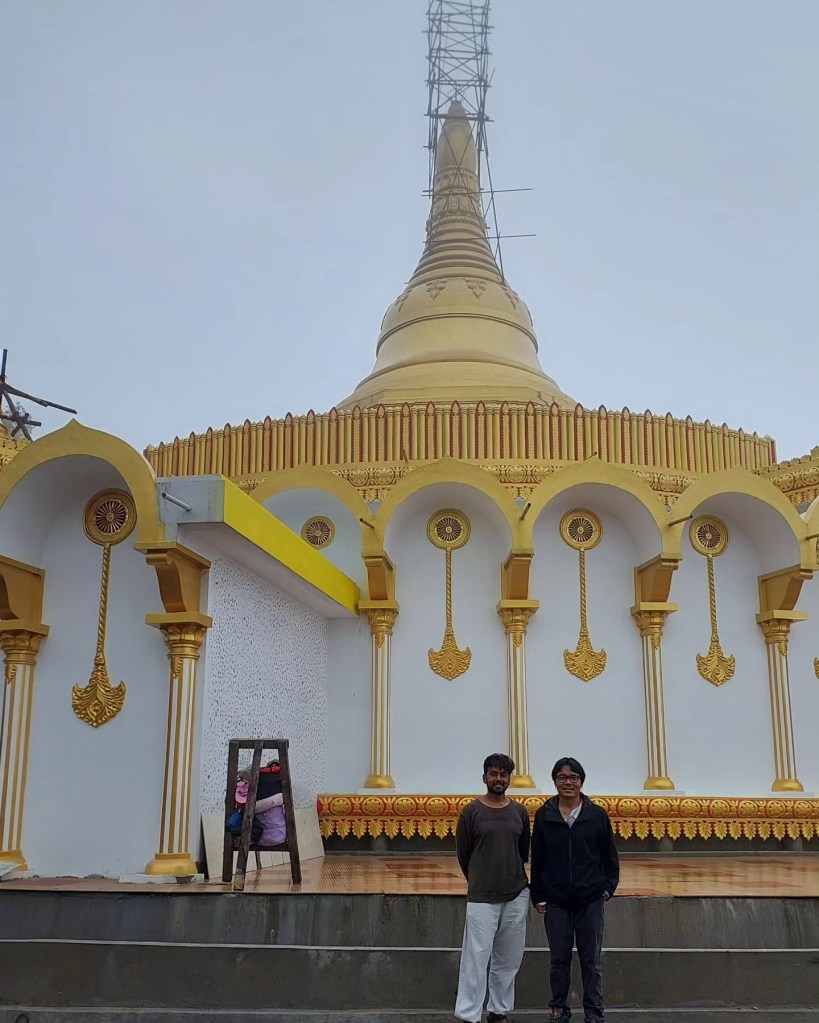
Dhamma Sineru is set in the rural mountains of central Sikkim with a view of the Himalayan peaks of Kanchenjunga, Lachen and Lhachung. It is around 7 hours drive from Bagdogra Airport, New Jalpaiguri Train Station, or from the borderingy city of Phuntsholing in Bhutan.
It takes about 30-60 minutes from Gangtok.
Who should attend it?
From what I gathered in this first 10-day course, Vipassana is ideal for any adult – and especially for those in. It humbles you into seeing the reality as it is. You realise that none of them will ultimately matter. For 10-days you live a life of austerity, discipline and anonymity that is free from ego, greed or jealousy – The Three Poisons that keep us in samsara.
Although Vipassana is not a therapy for any illness – mental or physical, it is very therapeutic for both body and mind. The body gets some rest from the excessive sugar, carbs, or processed food. Mentally it purifies your mind into clearer thinking.
It is highly recommended for mid-career professionals and people heading towards, or passing through, mid-life crisis. It gives you a great opportunity to take stock of your life, and strategise what remains of the years ahead.
What does it cost to attend one?
All Vipassana courses are delivered FREE of any mandatory fee to the participants. You may donate after the course if you feel you benefited or that someone can benefit with your donation. The only cost is getting to the venue.
From Bhutan it costs Nu. 8,000 and up (as of July 2023) to be dropped at the centre by a taxi from Jaigaon (India). You can ask the same taxi to pick you up if you don’t want to stay on for a few days exploring Gangtok or Tashiding after the course.


 Dorji Wangchuk
Loved reading it. Perfect for the social media generation.
LikeLike
Also for people going through mid-life crisis or in dilemma about career change
LikeLike
Thanks for sharing the pictures too. I see that they finished the Meditation Hall. In 2019 they were still building it. Do you know if a centre in Bhutan is being built?
LikeLike