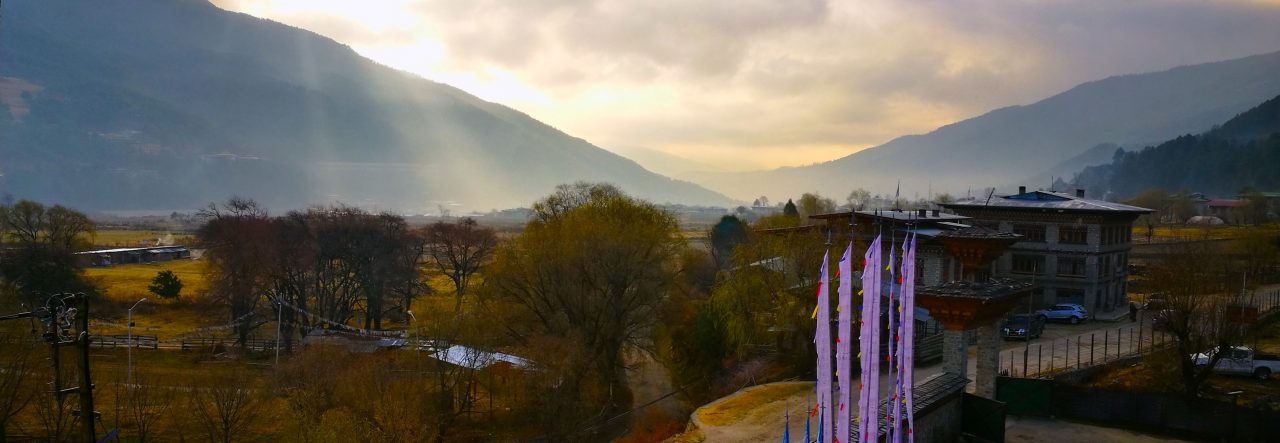
Machiphu, Taktshang, Paro
🙏🏻🙏🏻🙏🏻
One of the nine major caves that encompass the sacred mountains of Taktshang is called Machiphu. It is named after Tibet’s greatest yogini, Machig Labdron (1055-1154). And it is located above the more iconic Pelphu complex (popularly referred to as Paro Taktsang).
Machik Labdrön is believed to be a reincarnation of Yeshey Tshogyel, and together with her teacher, the Indian mahasiddha Pha Dampa Sangye, is considered as the founder of the Chod practice. She is both a dakini and a deity – believed to be an emanation of Prajnaparamita (Yum Chenmo in Bhutanese).
Historically, she was a contemporary of Milarepa. She was an adept and outstanding teacher, and a mother, who defied social norms that only men can practice higher tantra with the required seriousness, strength and vigour.
Machig’s life in brief
Machig Labdron was born in Labchi in southern Tibet into many auspicious signs, including a third-eye mark on her forehead.
She was a gifted child who could memorise and recite the Prajñāpāramitā Sūtra (Perfection of Wisdom) at a very young age, which made him famous in her area because every house would invite her to read the sutras every year.
After she lost her mother Machig turned 13, she dedicated herself entirely to studying Buddhist texts and sutras under many teachers
When she turned 23, she fell in love for an Indian yogi Topa Sangye with whom she bore several children. However, feeling called back by spirituality, she left her children in their father’s care and went to meditate in isolated places across more than 100 charnel grounds and desolate landscapes. She later returned to her children and guided them and they became her devoted disciples, who carried her legacy and practices.
The Machiphu Temple.
The ground floor takes us to a small doorway with a cave which fits just three people. Here Machig Labdron is supposed to have received the nectar of longevity from Buddha Amitayus. This is where you seek long life. Buddhists believe you can extend your life through seeking one.
On the upper follow there is a temple with the statue of Machig Labdron in the middle, Phadampa Sangye on her left, and Buddha Amitayus on her right.
The pilgrimage for childless couple.
Behind the temple there is a rock face with the footprints of Machig Labdron and Phadampa Sangye. Since time immemorial Machiphu and Machig Labdron are sought after by childless couples. If one seeks a son, one makes the wish to Phadampa Sangye. If one wants a girl, one makes the wishes to Machig Labdron. On the day of my visit, three women had come to seek the blessings.
What do I learn?
I didn’t seek another son or a daughter for myself but I made a moelam that my descendants flourish in numbers and in deeds – and take the Buddha Dharma further – just as my father did his tiny bit and I did a little more. We are after all the descendants of several masters of the past.
I don’t know much about the teachings of Machig Labdron, and I don’t practice the Chod either, but personally these famous five lines of hers, which I came across, were so liberating for me in the past.
Confess your hidden faults.
Approach what you find repulsive.
Help those you think you cannot help.
Anything you are attached to, give that.
Go to the places that scare you.
Of the five, the last one, ‘Go to the places that scare you’, speaks to me so deeply. This is because behind my calm demeanour I have always been a little devil – always daring to move beyond the norm, beyond what I am told is possible – or sometimes what is socially acceptable.
At the age of 8, I went to a Catholic boarding school. Not because of anything other than to stay away from going hungry at home. We were very poor.
Later when I turned 19, I left for Italy to study engineering at the University of Bologna. I didn’t speak the language nor have I stepped out of the country until then.
To give some context, it was during the time when Bhutan was completely isolated. There was no air link nor telephone. My parents only knew I had reached safely in Perugia, only after three months. That’s how long letters took to reach Bhutan.
In 2002, after successfully bringing radio and TV into Bhutan, I stepped down from a successful post of chief engineer to become a TV presenter/producer – which was bit crazy for someone who always struggled with communication. (I suffered from speech delay and probably ADHD and spoke full sentences only when I was four).
In 2013, after leaving my position as a senior palace official, I dared to become a simple teacher (gloriously termed as professor) in the remote Sherubtse College, where my office was a cold corner with a broken wooden desk, dingy toilets, and stained floors. I repaired my wooden chair too, and used my own equipment to teach media, journalism and documentary filmmaking.
My pilgrimage to Machiphu is to seek the blessings of the divine feminine to keep granting me the courage to go to such places. And by that I don’t mean physically scary places, but to keep going – to keep moving out of my comfort zone.
As we grow older sometimes we just feel like hanging our gloves and retreating to the comfort of our home and family – to say, I am done! However, if you look around there are things to do, places to go, people who need you, and some people who want you.
And there are also people who want you to disappear so that (they think) they can have a field day – in which case then you would be handing the victory to them. To them, I say,
“HELLLLLOOO! I am still here”
May the spirit of Machig Lhabdron guide you, help you with courage, to confront your inner demons, fight the outer monsters, and push you out of your comfort zone. To greater meaningful moments in your life. Or whatever remains of it.
🙏🏻🙏🏻🙏🏻
Core lessons from Machig Labdrön by Lama Tsulthrim Allione
- Embrace and offer: Instead of running from fear, pain, and desire, one should “cut through” them by offering them as food to the demons and deities. This practice intensifies experiences to reveal their empty nature and sever attachment to a solid self.
- Rest in your nature: Stop the relentless search for an end goal, because the mind is already empty and clear, like space. True peace comes from resting in this natural, unfabricated state, rather than chasing transient goals.
- Take responsibility: “Carry the load” of all phenomena. This means taking responsibility for your own life and experiences, and not avoiding what you might consider unpleasant or insignificant. It is an invocation to keep your heart and mind open.
- Challenge dualistic thinking: Recognize that the mind creates the labels of “good” (gods) and “bad” (demons) for phenomena. This dualism, called ladre, keeps us trapped in grasping and aversion. What you call a “demon” is simply an experience you are afraid of, and a “god” is an experience you desire; both can be used to cut through fixation.
- Fearlessness through wisdom: Through the practice of Chöd, you can achieve a fearlessness that transcends both hope and fear. By cutting through the illusion of a separate, solid self, you can achieve a state of boundless compassion and liberated wisdom.
Reaching there.
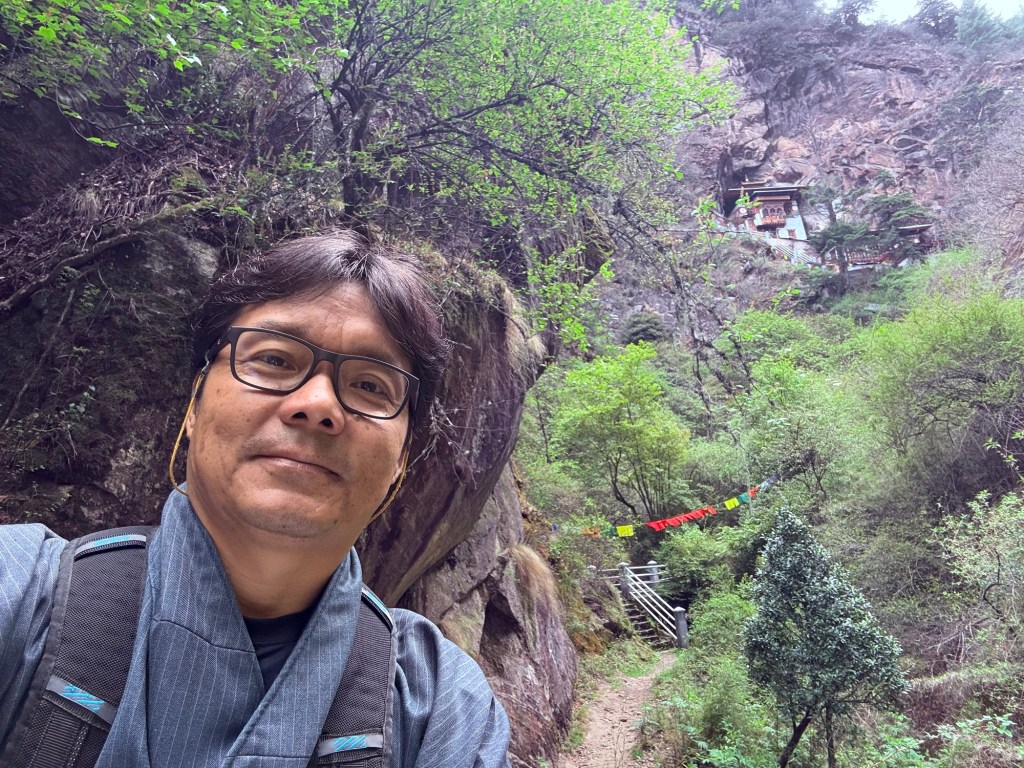
From the famous viewpoint at Taktshang, after a few stairs down, instead of going down towards Taktshang Pelphug, you take the trail to the left and climb and hike up for around 15-20 minutes. You get a beautiful top view of the iconic Taktshang. The temple of Machiphu can be seen as soon as you turn behind the bend.
👨🏻🦯➡️👨🏻🦯➡️👨🏻🦯➡️



Dr, did you visit Wangdi Nye in Paro Dawakha la? Its Guru Rinpoches nye.
LikeLike