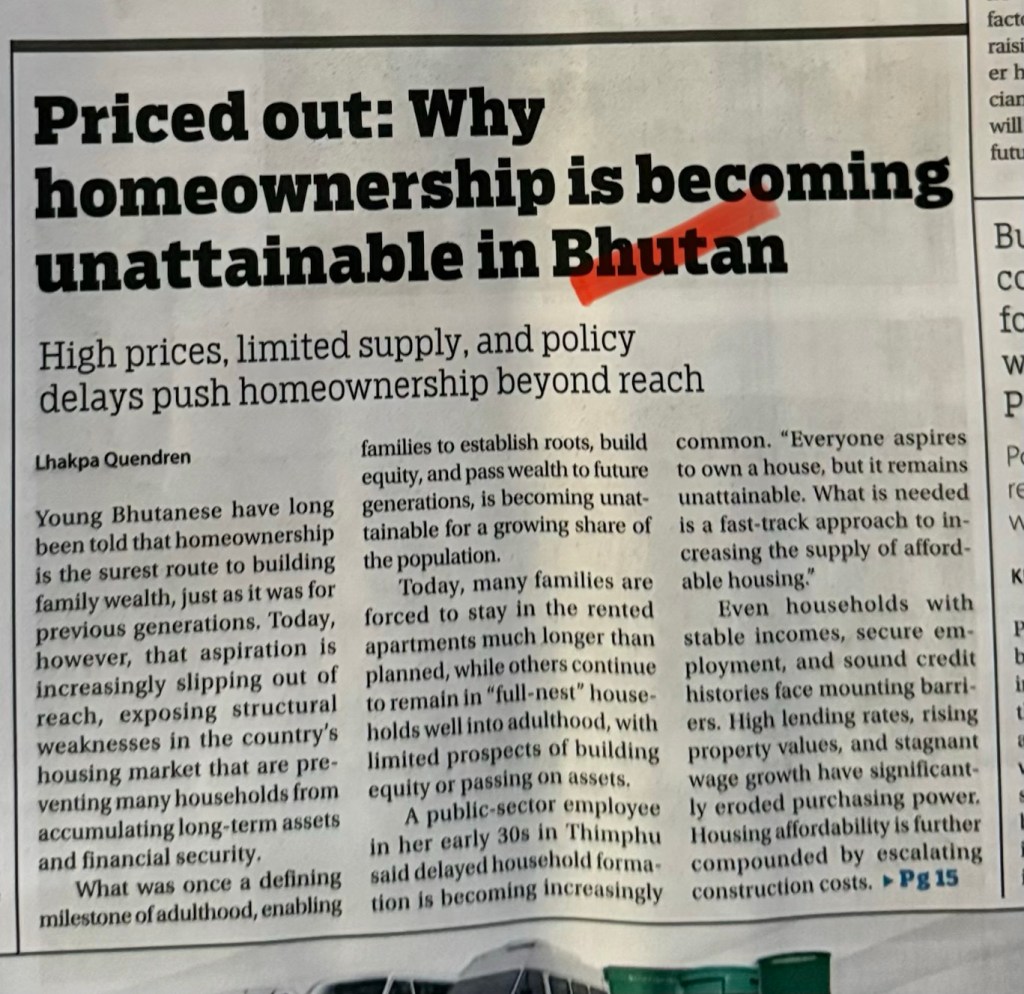
The headline equates Thimphu to Bhutan. It is quite misleading.
Yes, in the capital city the impossible housing market has priced out much of the Bhutanese population. That’s another issue all together.
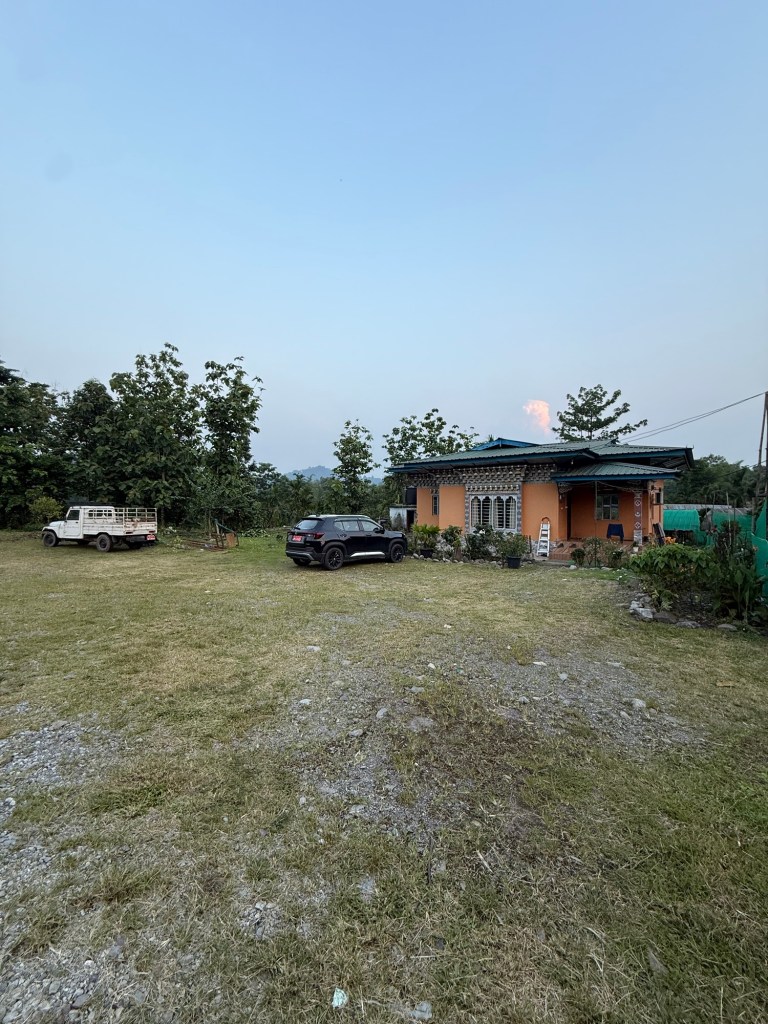
Here, I want to point out that Thimphu does not represent the whole of Bhutan in terms of character and the market. Elsewhere in the country, it is still possible to build and own a home, as long as you are not rushing to the urban towns or the priciest spots or being too choosy about what kind of houses you want. And as long as you follow my late mother’s advice: don’t try to match up with the rich and powerful. Find your own place, know where you stand, and you will find peace everywhere.
Simply put, it is not all gloom and doom in the rest of Bhutan—or in Bhutan, in general. Your life is not wasted because you don’t own a building in Thimphu. I don’t own any building with rental services, for that matter.
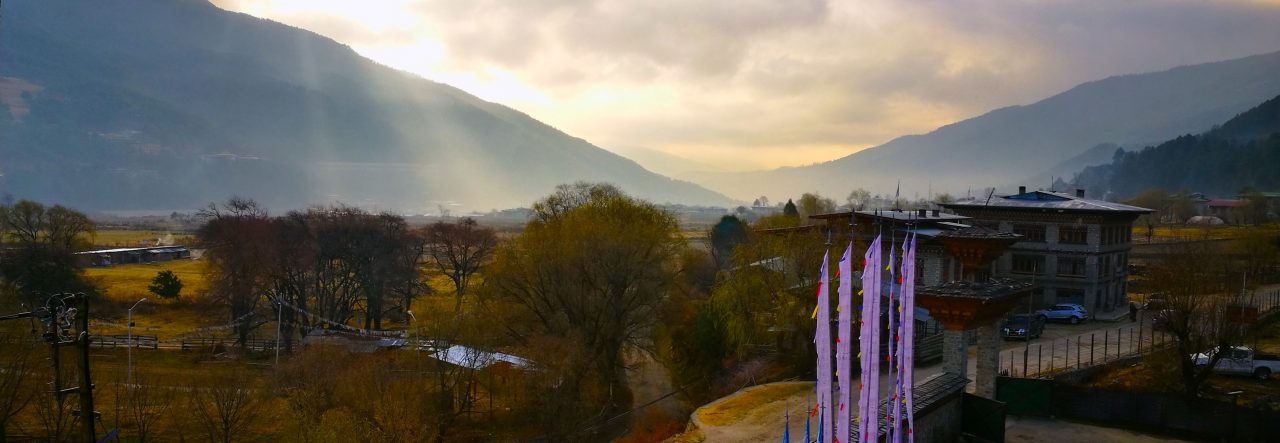
The improved connectivity in terms of roads and internet and car ownership has drastically improved in the last two decades so that you don’t have to own something in Norzin Lam (the priciest spot in the country). I know many who live in, or have built houses in Paro and commutes to Thimphu.
Look for solutions. Not problems.
I am in Gelephu these days, and I see many opportunities cropping up. I feel Phuntsholing will surely rebound. These places offer lower construction costs too. Prices for a plot can be between Nu. 500,000 and 1 million. With another million, but with a lot of hard work, you can build a decent 2-bedroom house. You need to move fast and detach yourself from the fixation of Thimphu. Ultimately, of course, you can aim to own something in the capital city, because of its higher returns.
For those who are retiring and those of us who come from faraway districts, but have lived and worked in the west, a modest traditional house in the outskirts of Paro, Phuntsholing, or Gelephu is still within the reach of a middle-income household. However, it requires some financing schemes from the bank, which for now don’t exist. The only solution is to sell our ancestral land and raise the fund, which of course is practical if you are not planning to make use it.
For those who are starting off their careers, consider moving to places that are growing like Gelephu, Samtse and Nganglam. Unless you have a birth lottery, Thimphu will keep you in perennial poverty. Instead, you can start from the peripheral districts where, after you establish your financial stability and security, you can move in to Thimphu and Paro to invest for your next generation.
These are some solutions, which worked for me, and maybe they will work for you too. (By the way, my first job was in Gedu – not Thimphu.)
🙋♂️🙋♂️🙋♂️