Bhutan Stroke Foundation in 2026

On the eve of the Sharchop Losar (New Year), I convened the first Board Meeting of the year for Bhutan Stroke Foundation where we welcomed the new Executive Director, Rinchen Khandu — who was formerly a teacher and university lecturer, and the Project Manager, Tandin Chogyel.

We also created a space in the foundation for the founder and former Executive Director, Dawa Tshering. He will continue as Advisor and Goodwill Ambassador on pro-bono. In the organizations I lead, I have begun to honour those who have come before us by assigning emeritus and advisory roles. And not to simply write them off. Besides, Dawa’s story is the story of the Foundation. After his wife got a stroke, he decided that no one should go through what he went through. Isn’t this inspiring?

What does the Foundation do?

The Bhutan Stroke Foundation fills the gap between the clinical services provided by the state and the time people make a full recovery. From the day they are declared out of danger till they are fully reintegrated to the society it takes between six months to two years.

For those in the higher socio-economic status, things are okay. They manage. But for economically distressed families and rural folks, having a stroke patient at home suddenly turns life into hell. Their livelihood is hampered, career is disrupted, and their full recovery is not guaranteed. Only those who face this know the gravity. The government cannot reach everywhere and to everyone. We must do our bit.

We pride ourselves as a Buddhist nation, and make happiness our brand. But Buddhism is not about seeking happiness. It is about removing or helping remove the causes of suffering. In the words of His Eminence Zuri Rinpoche, there is no greater Dharma than helping someone in distress and living a life of hell. As a pop song goes, heaven is a place on earth. So is hell. What the foundation is doing is putting Buddhism into practice.

For me, with two spiritual projects at GMC on my shoulders, I am hard-pressed for time and energy. But, thinking of all the suffering, I just decided that I need to find both and keep going with this.

In gratitude.

As we welcome the new year, we would like to thank Zuri Rinpoche for keeping us afloat by granting us the Endowment Fund of Nu. 4 million. We thank our two other spiritual patrons – His Highness and Eminence Kathok Situ Rimpoche of Kathok Yoesel Samtenling Monastery ཀཿཐོག་འོད་གསལ་བསམ་གཏན་གླིང་དགོན་སྡེ། and Her Eminence Dorje Phagmo Rimpoche, whose donations and blessings keep us all safe and strong.

We thank the Government of India for supporting projects for the CSOs, including the BSF, and all the individual donors and friends in Japan, Italy, Australia and in the US.

2025 has been a fairly successful year for BSF where we consolidated a small young foundation and made our presence by reaching out to 10,000 people in 13 Dzongkhags through advocacy programs. For the first time, the foundation didn’t close the year in red.

Looking ahead.

ADVOCACY. We will continue to create awareness about stroke and cardiac arrest, which is no longer a disease of the elderly. Incidences of stroke now affect people as young as 12. Cases have skyrocketed after Covid-19. Everyday there is one or more people admitted in Thimphu hospital from stroke. Noticing the signs and symptoms is crucial. Prevention is the key. Check the health advice in the footnotes.

POST-STROKE CARE. Our centre in Thimphu continues to host some 20–30 people who are recovering and slowly reintegrating back to the society. People from rural areas are often rushed to Thimphu in an ambulance in a medical emergency. And once they are declared out of danger, they are discharged and shown the Exit door. Many don’t know where to go. They don’t know where to stay to continue with physiotherapy sessions and treatment that can go on for months. Some don’t even have extra clothes or money. We try to help all the cases. To respect their privacy, we don’t splash them on Facebook. We don’t take selfies when we rescue patients from the hospital doors. We don’t show off feeding the sick.

NEW CENTRES. In the coming years, we look forward to creating three more such centres for post-stroke care and information — in Gelephu, Mongar and Trashigang. We are aware of many stroke patients in villages without proper care – lying in bed for years – some with bad bedsores. Hopefully we can reach out to them.

Furthermore, the need for such centres will only increase with one fifth of the population living overseas and ageing parents left on their own here.

Looking forward to all your goodwill and support.
Ending the Snake Year on a high.

I am ending the Year of the Snake on a high note. A few more temples and statues built here, a few more differences I could make in other people’s lives there, and a couple of big deals I could broker elsewhere (at pro bono, though).

One thing that I continue to do is not to differentiate between things, occasions, moments, experiences or people, and to embrace everything and cherish everything that comes my way. I have learnt that there is no absolute, although life as seen by us the mortals and the unenlightened is still relative, imperfect, and dualistic. However, we make every effort at every moment to see the impermanence, emptiness and perfection of nature that really is.

In a few days time, those of us who are from the East will welcome the New Year.

To all who have walked with me, thank you for the company. Let’s keep going.
To all who have supported me, thank you for fueling me up. Please keep it coming.
To all those who were unkind to me, I thank you too for, it made me more stubborn – more committed, while really my compassion.
To all those who sought my help and benefited in some ways, I thank you because you made me come alive. You made me feel that I mattered.

Wishing everyone a Happy and a Harmonious Year of the Horse.

Back to the Basics

Buddhism, whether we like it or not, whether we agree or not, has diverged quite a bit into various schools and sects – often characterised by dogmas and divisions, and us-versus-them attitudes.

While these variations are natural evolution (and by the way, Buddha never restricted anyone from moving away from one path), this development has nonetheless taken away believers and practitioners from the core fundamentals of concepts and conduct, and of mindfulness and wisdom, which are all emphasized in the early texts.

For instance, the two concepts of impermanence and emptiness are almost forgotten as people relentlessly seek power and wealth as if they are unchanging, solid and permanent.

In my own analysis of why the younger generation of Bhutanese feel alienated from the religious traditions points to situation of dichotomy between where they try to access Buddhism from, what they are faced with every day. In other words, the proliferation of technology has brought about the translated teachings of the sutras such as Heart Sutra and Diamond Sutra to the smartphones of the tech-savvy Bhutanese, who then see no connection between the basic philosophical tenets and the ritualistic traditions they are invited to. What is the relation between emptiness and disposing off the torma?

Furthermore, the GenX and the various Buddhist teachers and institutions of our time would do Dhama a favour if we all once went back to what Gatama Buddha taught, and then resume our spiritual journey. Meaning, we refresh our memories and mindset with some dose of impermanence and emptiness, rather than over glorify power, fame and fortune. This would make us a little more Buddhist, a little more humble, and a little more content. Otherwise, mindlessly conducting rituals and going about with all the mundane vices is confusing our younger generation.

Along this thought my sitting room will now have this large statue of Buddha Shakyamuni – and nothing else, to greet visitors coming to my humble place in GMC. At least, to all the chhilips who come there will be told to start their mindfulness residency by understanding the Four Noble Truths.

Of course, the statue is laden with all the precious zung and relics to honour our own Vajrayana tradition.

🙏🏻🙏🏻🙏🏻


Buddhism, whether we like it or not, whether we agree or not, has diverged quite a bit into various schools and sects – often characterised by dogmas and divisions, and us-versus-them attitudes.

While these variations are natural evolution (and by the way, Buddha never restricted anyone from moving away from one path), this development has nonetheless taken away believers and practitioners from the core fundamentals of concepts and conduct, and of mindfulness and wisdom, which are all emphasized in the early texts.

For instance, the two concepts of impermanence and emptiness are almost forgotten as people relentlessly seek power and wealth as if they are unchanging, solid and permanent.

In my own analysis of why the younger generation of Bhutanese feel alienated from the religious traditions points to situation of dichotomy between where they try to access Buddhism from, what they are faced with every day. In other words, the proliferation of technology has brought about the translated teachings of the sutras such as Heart Sutra and Diamond Sutra to the smartphones of the tech-savvy Bhutanese, who then see no connection between the basic philosophical tenets and the ritualistic traditions they are invited to. What is the relation between emptiness and disposing off the torma?

Furthermore, the GenX and the various Buddhist teachers and institutions of our time would do Dhama a favour if we all once went back to what Gatama Buddha taught, and then resume our spiritual journey. Meaning, we refresh our memories and mindset with some dose of impermanence and emptiness, rather than over glorify power, fame and fortune. This would make us a little more Buddhist, a little more humble, and a little more content. Otherwise, mindlessly conducting rituals and going about with all the mundane vices is confusing our younger generation.

Along this thought my sitting room will now have this large statue of Buddha Shakyamuni – and nothing else, to greet visitors coming to my humble place in GMC. At least, to all the chhilips who come there will be told to start their mindfulness residency by understanding the Four Noble Truths.

Of course, the statue is laden with all the precious zung and relics to honour our own Vajrayana tradition.

🙏🏻🙏🏻🙏🏻

Fare Thee Well, my Brother.

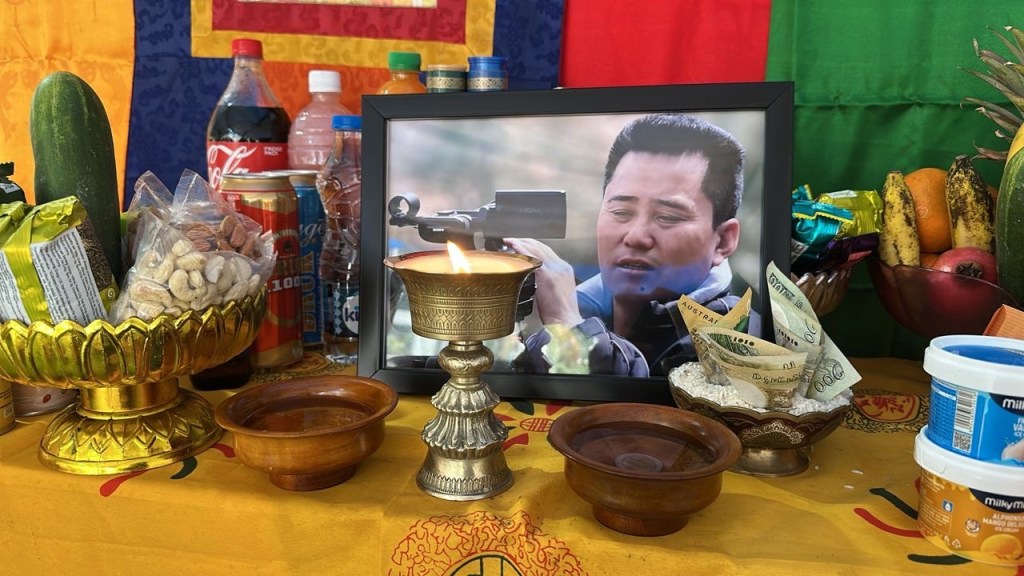
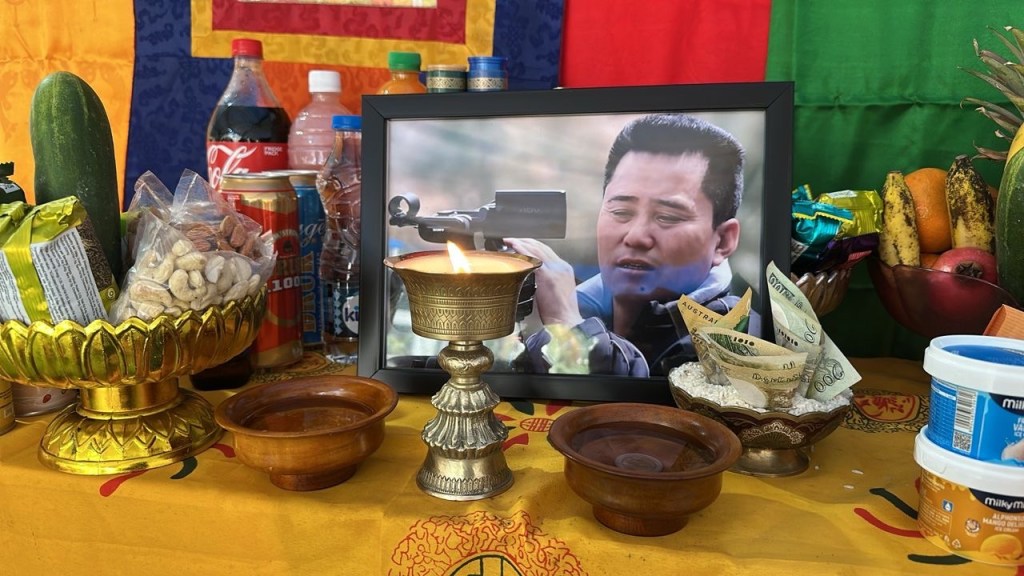
My cousin, childhood friend, schoolmate, business partner, and a family friend passed away after a long battle with a terminal illness. He was just 64. His demise leaves a hole in my heart that will never be filled. 

The loss will always be felt by his family and the film industry, for Pema was the liveliest person, the most loving father, and helpful to everyone in the film fraternity. He was self-taught and gave everything to the art, and to others. He kept nothing for himself.

When we were growing up, he took care of me like my elder brother. He used to defend me fiercely, taught me many things. All my siblings loved him as our elder brother. Our families were thick and close. My mom and his mom were cousins from the Shongphu Chukmo clan.

He was a brilliant student but dropped out of school because classrooms bored him. He lived his life on his own terms – carefree and joyful, till my father found him a wife and married him off one evening and told him to settle down. He did listen, and raised a large family of four children and many grandchildren. His children love him. His grandchildren adore him.

He was a trained agronomist, a carpenter and welder, and self-trained film director (Bhu Tashi), line producer (Chepai Bhu, Nazhoen Chharo, and others), singer (Tshomo Tshomo), film editor, graphic artist, musician (he played saxophone and keyboard), three times award winning sound designer and cameraman. And many more.

In our adult life he cheered me at every success I achieved. He was happier and prouder, and had greater confidence and belief than I had for myself. We ran a successful production studio and the radio for a couple of years, where he trusted me and my judgments, and my decisions with his life. Never once did he challenge me.

But there is one thing that the world can learn from Pema – optimism and strength in the face of adversity. And to never lose one’s sense of humor no matter how bad life goes. In 2018, when he was diagnosed with a terminal disease and the doctors gave him a few months, he told my daughter that he would beat the odds and live much longer. He did and went on to live almost eight years. 

When he was getting the chemo and was recovering in a hospital in India, he kept sending me dirty jokes every day. He said that I was more stressed than him because I was in the middle of completing my PhD. 

He showed immense courage and strength that I had never known before. Even the doctors were inspired. This is something that will stay with me, this is something he has taught me as his final lesson as I will miss his presence, our long conversations, and his encouragements from the stands.

Fare Thee Well, my brother. The earth beneath me already feels weak without you. Although we have been preparing for this day, it still took one full day for me to compose myself and gather strength for this short piece.

And to the world, we are poorer by one good selfless person.

Fare Thee Well, My Brother

My cousin, childhood friend, schoolmate, business partner, and biggest fan passed away after a long battle with a terminal illness. He was just 64. His demise leaves a hole in my heart that will never be filled. 

The loss will always be felt by his family and the film industry, for Pema was the liveliest person, the most loving father, and one of the most helpful persons that walked on this earth. He lived his life on his own terms. He gave everything and kept nothing for himself.

He took care of me like my elder brother in school, defended me fiercely, and cheered me at every success I achieved. He was happier for me than I was for myself and had greater confidence and belief in me than anyone in the world.

But there is one thing that the world can learn from Pema—optimism in the face of adversity and to never lose one’s sense of humor. In 2018, when he was diagnosed with a terminal disease and the doctors gave him a few months, he told my daughter that he would beat the disease and live much longer. He did and went on to live almost eight years. As he was about to get chemo and was recovering in a hospital in India, he kept sending me dirty jokes every day. 

He showed courage and strength that I had never known before. This is something that will stay with me, as I will miss his presence, our long conversations and ideas, and his encouragements.

Fare Thee Well, my brother. The earth beneath me already feels weak without you.