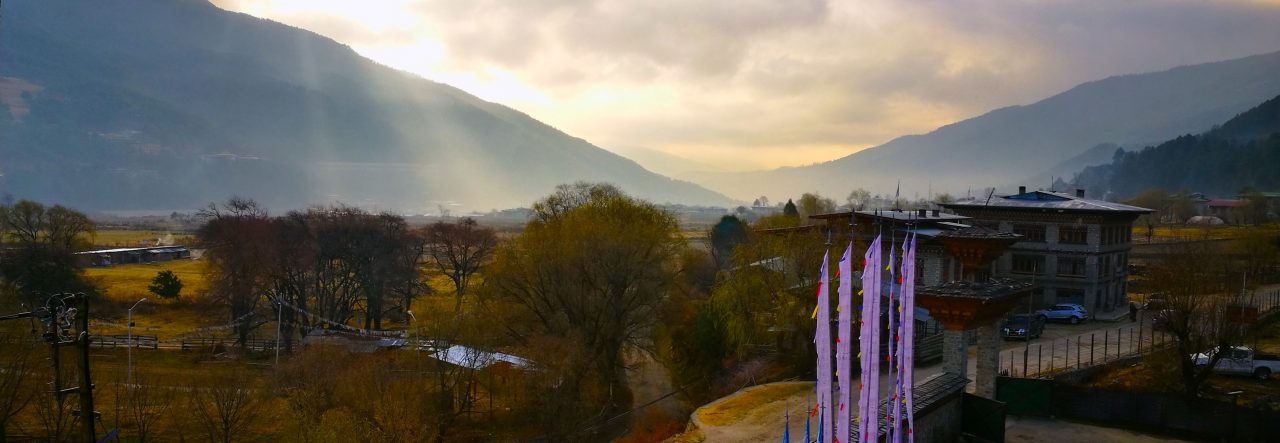
Today I made my long-awaited visit to the ancestral home in Bebena belonging to my former work colleague Phuntsho Dendup.
Phuntsho and I worked together in His Majesty’s Secretariat between 2009 and 2013. We share many stories and memories – especially of state visits to India and other countries.
Visiting his house is like walking into an architectural marvel and the modern history of Bhutan. The house is a little over 60 years old and was built by his father, Shaab Dophu, who served as palace attendant of the Third King before he was appointed as Haa Ramjam (sub-district officer) and then in Dungna and finally in Chapcha. He was the attendant who walked alongside the visiting Indira Gandhi during the historic visit of Indian PM Jawaharlal Nehru in 1958. (See photo)
What is striking about the house is the perfect proportion and the intricate details of every corner, both inside and outside the house. The interior mural paintings, the mud walls, the windows are all classy and tasteful. Phuntsho’s father must have been a perfectionist like him.
Phuntsho is the most organised person I have ever worked with. All the personal effects of his father, and all the items from his time with His Majesty are neatly displayed like in a museum. His proudest moment is witnessing the signing of the 2007 Treaty Signing between Bhutan and India in Delhi of which he carries an autographed memento from our King.
The ancestry. The past.
Phuntsho’s mother, Aum Pem, traces her ancestry to the legendary master craftsman Pinsa Dewa, who is credited with making bronze statues for Zhabdrung Ngawang Namgyel in the eighteenth century.
Her father, Lotey, served the First and Second Kings as a palace retainer. The Third King appointed him as the chief commissioner of a new royal initiative—the Institute of Zorig Chusum. He personally crafted the golden pinnacle of Tashichho Dzong and of Dodeydrak Temple.
The only statue-relic of Guru associated with Pinsa Dewa and held by the family was offered by Phuntsho’s parents to be the main inner relic of the large Buddha Shakyamuni statue in Tashichho Dzong when it was expanded in 1968.
Here and after.
Phuntsho retired from his last position as Acting Director in the Ministry of Information, in 2022 and now lives with his wife and dedicates his time to prayers and spiritual activities. He is proud to inherit the house and has no plans to tear it down despite the land being a prime real estate area of Thimphu.
However, he says,
“I don’t know what the future holds for this masterpiece. I have done my part by maintaining it. My children will do what is best for themselves.”
“If such houses are taxed like they do now, my children will be tempted to bring it down and build a more commercially viable five-storied building. I don’t know,” he adds.
My hopes and prayers are that this house and other traditional houses in Thimphu valley receive some sort of heritage status and subsidy from the state and are preserved for posterity. For these houses have a soul – a character that reflects our collective past, history, and culture. New concrete buildings are modern but without the warmth and class as these houses.
And above all, these houses tell our story. The story of an ordinary family associated with Pinsa Dewa, of a family offering their only treasure to the state, and of a palace retainer who walked the visiting foreign PM over the mountains of Bhutan. And of his son being the third generation to serve our monarch in a simple capacity.
With each house being replaced by a hollow building, a part of us is lost forever.

