Compassion Maketh Bhutanese

Compassion and selfless service are a trademark of every Bhutanese – and if we can maintain these qualities regardless of where you are, and if we can implant these values in our young ones, rest is just cultural paraphernalia and performances, which will evolve over time anyway. A compassionate heart is what we must develop as a foundation in our children, and is what we must practice as higher sentient beings.

I draw happiness from simple acts of selfless service – whether it is to make someone happy (loving kindness) or to help alleviate a suffering (compassion). And true selfless service starts when you stop asking, what is in it for me? For example, there is nothing for me – directly or indirectly – neither in trying to raise funds for a Bhutanese who is hospitalised in Perth, or to make Zhiwaling Heritage Hotel win an online award – and not even in trying to bring investors and investments into the Gelephu Mindfulness City.

There is also nothing for anyone who is responding to my requests. But, doing something together creates memories. Memories keep people together. It enhances solidarity. It makes relationships grow stronger. Ultimately, collective memories of all Bhutanese is what makes a Bhutanese nation – if Benedict Anderson’s assertions on imagined communities and nationalism are true.

Nonetheless, again, to say there is nothing in exchange for the selfless service we practice is also not totally true. I have been around for long enough to see and even experience that the universe always finds ways to pay you back – sometimes more than what you have given to others.

This belief comes from the Buddhist concept of the circle of karma. My favourite story on this goes something like: One Sharchokpa shopkeeper saw that his sales were never picking up while his neighbour’s shop was doing a roaring business. Someone suggested him to go see the Late, and the short-tempered, Holiness Jadrel Sangye Dorje Rimpoche (🙏).

“Do you give?” Rimpoche asked the man.

“No, la”, the man replied.

“How you expect to get, if you don’t give anything?” Rimpoche shouted back, and chased him away.

This phenomenon of getting-by-giving does not seem to exist only in the spiritual realm. There was also a scientific study being done in the US by a researcher on this topic of giving and getting. This research concluded that if you give $1 you ultimately get back, miraculously, $1.65. In other words, if you give away a million dollars, you get back 1.65 million some through some twists and turns. Companies that donate see their income go up by 1.65 times. People who give generously have seen their wealth grow instead of becoming poorer.

So, keep giving to keep living.

😈😈😈

(For those who are interested in becoming a giver and also “succeed” in life and business – if you don’t believe in spiritual masters or spiritual masters only, there is this book, Give and Take, by Adam Grant, which highlights lots of stories and studies.

  • Benedict Anderson, Imagined Communities (1992)

The Tiger’s Nest Again

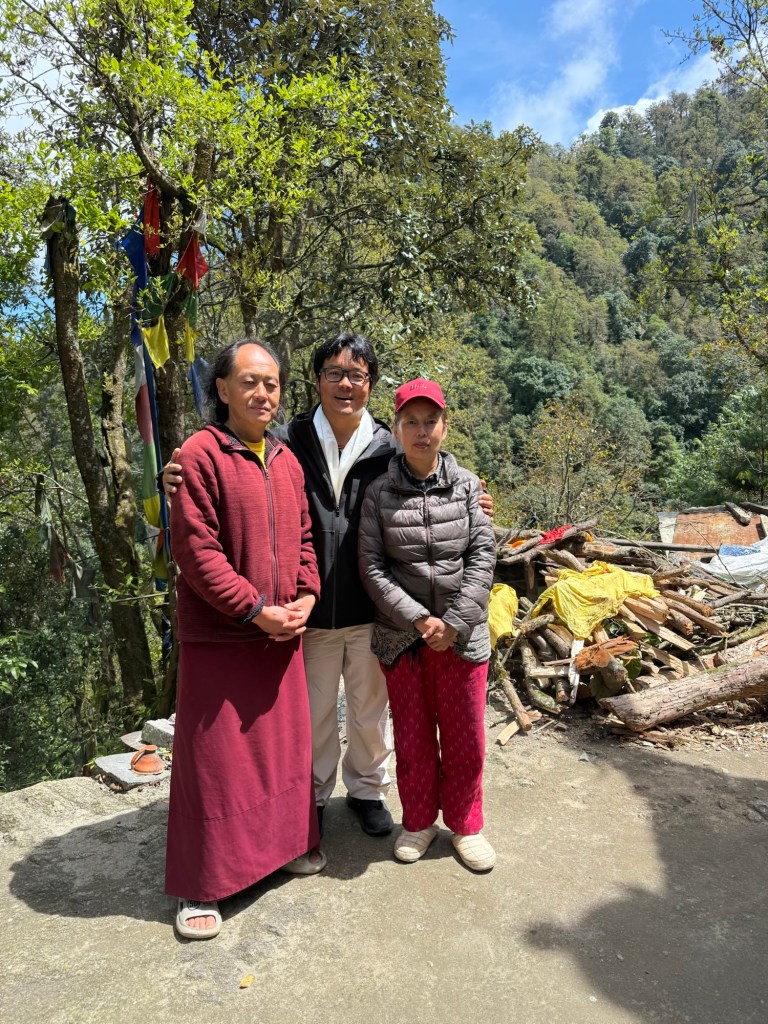
This sacred pilgrimage to Taktshang was enhanced by reconnecting to this little monk, whom my friends and I are trying to help with his physical challenges. He studies at Taktshang Zimchu Saap.

This time he introduced me another monk who also has the same health challenges. I happily agreed to help him too, as I silently repeated this line from one of the greatest Buddhist scholar:

For as long as space endures,
For as long as sentient beings exist,
Until then, may I, too abide,
To dispel the misery of the world.
(Shantideva in Bodhicaryāvatāra) 😻😻😻

Coming to the hike to legendary Taktshang, it is actually not easy. I know not everyone can make it up there but it is something we all take for granted. Many do not make it beyond the Cafeteria. Some don’t dare start at all from the base

Therefore, as long as you can – as long as your legs and lungs can carry you up, keep going. At some point in life you won’t be able to. This year I plan to do every second month.

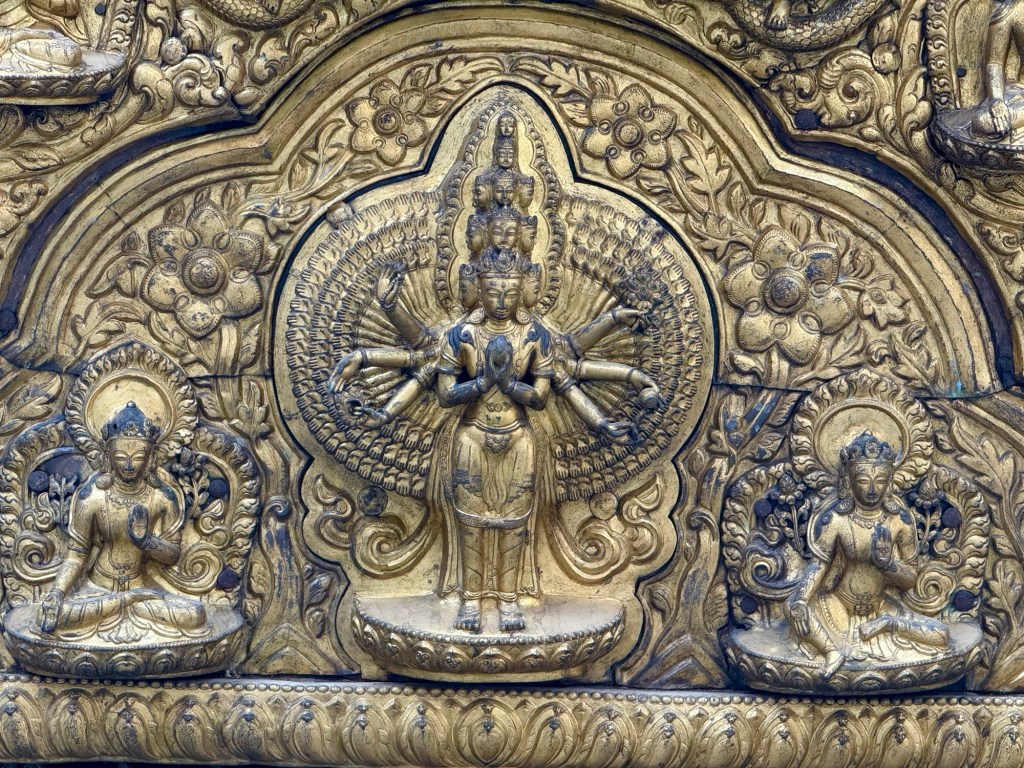
And for my favourite temple up there, it is the Tshela Namsum – the last one from the main entrance. There are Green Tara, Amitayus and Unisha Vijjaya to bless you with peace, longevity and prosperity respectively.

What else do you need?

The World to Bhutan, and from Bhutan to the World.

As a cliché goes, these days I am bringing the world to Bhutan, and Bhutan to the world. I am doing within my personal capacity, and drumming up among my network of friends and acquaintances that I have accumulated over the decades of my professional career.

It is not without challenges though. Systemic complexities and contradictions appear like before – to the point one is even gaslighted to rethink one’s motive. It is not as smooth as Instagram shows you. But then what is easy these days? As someone said, we have become champions in complicating even the simplest of things. And so, I guess I will keep going as long as I can.

Fact remains that as our country embarks on the most ambitious idea of the mindfulness city(which is ambitious even by global standards) and of high-income country and GNH 2.0 and so on, we do what we can within our means and with a sense of selfless service – for the greater vision to materialise and for the collective dream to be fulfilled.

It is not something that is achievable by one person or an organisation. I believe that the cumulative outcome of all our tiny individual efforts will make the difference between success and failure. And, by the way, in this Project, unless someone has some hidden tricks inside their large gho pocket, there is no room for failure – and no such thing as Plan B. We need to succeed as a nation. And it will be hard work and sacrifices for some time.

The 20,000 MW Dream.

Currently in the energy sector, our country faces a power deficit in winter months. This is a paradox because for years we have been told of a bright future. The deficit may even get worse because of the drying up of our rivers. From the month of October till the month of May, the water from our rivers that drive the turbines can barely push 25 percent of the installed capacity of our power plants. This amounts to around 400 megawatts (MW).

On the other hand, the demand for power peaks in winter to around 1000 MW, resulting in a shortfall of around 600MW. This deficit is covered through importing electricity from India during the winter month – and that too at a higher tariff from the Indian energy market.

To address this, from what I learnt, the government has opened the power sector to private investments from both local and international companies. It has set an ambitious target to harness 20,000 MW within 2040. A couple of large companies from India have signed MoU with the government, but it is still a long way from achieving the target. The push for energy is not just in hydropower but also in solar and wind technology. And for foreign investments in solar, there is the option of 100% equity ownership.

From End to Means.

Another shift from previous thinking on energy we produce is to see it as an enabler for other sectors, and not just as a cash cow. In other words, there is a push to use the excess power we produce to drive other sectors such as mining and manufacturing – instead of just exporting it for state revenue. In other words to see power as a ‘means’ and not just as an ‘end’. This is a much-needed policy shift, because the earlier model produced economic growth without generating employment.

As this perspective takes root, we may see more opportunities for power-incentive plants and products if this policy remains stable over a long-run.

Hopefully this time we will get it right and the Sun of Happiness will really shine on us 😻

The Last Losar

Kyichu, Paro

Kicking off the first day of the Lunar New Year – known as Dawa Dangpa, with a lhabsang of a rental in Paro that will serve as my office as well as guesthouse/residence for my local support team.

The “last” New Year.

Interestingly, for Sharchop traditionally this Losar is somewhat a “sad” moment because it is the last celebration before the tough farming season.

The Sharchop people of eastern Bhutan are a happy-go-lucky community that finds every excuse to have a good time.

Starting from the Blessed Rainy Day in September the people in eastern Bhutan engage is a series of celebrations, happy days lasting for six months, such as Ngenpa, Nyilo, Dawa Chunipa, and finally Dawa Dangpa. Coinciding with this celebration the people would go on an overdrive and do merrymaking for a mininum of 3 days.

Time and traditions have changed with urbanization.

👍👍👍

NB: I also visited Kyichu temple (my new neighbour in Paro) to offer gratitude and prayers to Jowo Shakyamuni and to my friend Za Rahula (asked him to take care of my stroke patients).

The Surrender

High society for a day
‘Surrender’ was the word that was popping on my head yesterday as I attended the annual polo match between Thailand and Malaysia. The trophy is known as the Queen’s Cup and all proceeds and donations go to a cancer initiative patronised by Her Majesty Queen Sirikit.

Anyway the point is, my new-found friends from Columbia University New York texted saying they were going for this. I had met them only a day earlier but I instantly connected with them after a brief convo that went like, “You are from Bhutan? My best friend is close to your King”, “I know him. I was chatting with him this morning”, ” Oh my God!”, “Let’s take selfie snd send it to him” and so on.

And so I went after another one encouraged me with, “Oh! You must come. They would love to see you there”. In fact the owners of the club, who were organizing this noble event, welcomed me like a VIP and even included me in their official photo of the award ceremony. What an honour!

Yes. The surrender.

Since Covid-19 killed all my plans for my third career in the academia as a tenured professor, I stopped planning my and I just let the universe take me – putting my faith in myself (to adapt to any new situation), in my Gyalwa-goms (whose blessings and generosity I can always count), and the protection of my lama and my dharmapala – to whom I continue to serve to further the Buddha Dharma.

They say everything happens for a reason. Well, I believe one must actually go beyond and uncover that reason and not just leave and resign with ‘there-must-be-a-reason’. You do it by being open, broad-minded and genuine. “What is the universe trying to tell me here?” One must ask. This way you discover the greater meaning of the reason of every encounter and every moment passing by you.

And yes! I found why I was pulled there. I have had a eureka moment there for my works in compassionate leadership research and education – a field that I am currently working in.

The thing about surrender (there is a book by Michael Singer on this) is you MUST show up authentically – with no ego, with no prejudice, without laziness (I drove over 200km yesterday), without being a miser or mean, and without expectations. And then let the things be revealed to you. Amazing things have happened after I adopted this philosophy of life.

I shared some photos to a couple of my friends and one guy texted, “Damn! From building stupas and making pilgrimages to polo clubs that’s a big jump. What a progress!”

Well, it is because I just surrendered.

😁😁😁

(NB – Gyalwa Gom is another local term to refer to enlightened monarchs and fore-bearers)

We run our own race – fight our own demons.

I read this post by His Eminence Namgay Dawa Rimpoche, one lama I have begun to respect.

I read it again, and again, and again. Thank you, Rimpoche, for sharing this and for the vulnerability. Learning about your health struggles was humbling, and made me grateful for my own health and life, which as you say some people take for granted.

“We all face our own battles, often silently. We don’t always show the world the pain we carry, the struggles we endure.”

This line hit me hard because it is so true. We are all fighting our own battles. And yes! I have been fighting mine too. And finally, I won after 12 years. (check my earlier posts)

Courage. Compassion. Fear.

In my current line of work, I have also dealt with celebrities and hundreds of net-worth individuals – some of whom were billionaires. I must say each one of them is fighting a battle of some sort. Everyone has a demon they are up against – some are unthinkable, some laughable – but suffering is subjective.

To anyone who may be going through, or have gone through, an ordeal of your own, I wish you courage. I wish you courage to come out of it unscathed.

To everyone else I also wish you courage too because fear, I have realised, is the opposite of compassion.

The opposite of compassion is not cruelty. It is fear. We fear being judged, we fear being seen as weak, we fear being labelled for sharing our story – and we fear when we think of practicing compassion on someone. Especially when we are in some position of power where we fear losing the privileges for breaking a rule to save someone.

May the divinities protect Rimpoche’s health, and bestow him the longest a human has ever survived, for the world needs more compassionate beings like him. His humour is a bonus to humanity. His honesty is a national treasure.

This thing called success.

And to the people who feel they are struggling with their career, or life in general, please remember that your “failure” (whatever this means) is not due to someone’s “success” (whatever this means too). Each one of us is running our own race.

You don’t judge them either because one never knows what the other person is going through, have been through, or how much people have endured to get where they got.

More importantly, there is no such thing as success or failure in life. There is just.. life. And you gotta enjoy it while you are alive. Cherish every moment. Laugh while you can, and don’t be mean to anyone- if you cannot do good (my illiterate mother’s advice).

You are already successful if you are alive. For instance, one high-school student whom I have been sponsoring the studies just got diagnosed with leukaemia (blood cancer).

Think how lucky you are that you just completed reading my post in good health. Think again, and then slowly read Rimpoche’s post. Read them three times, at least.

🙏🏻🙏🏻🙏🏻

To the Altar before Self

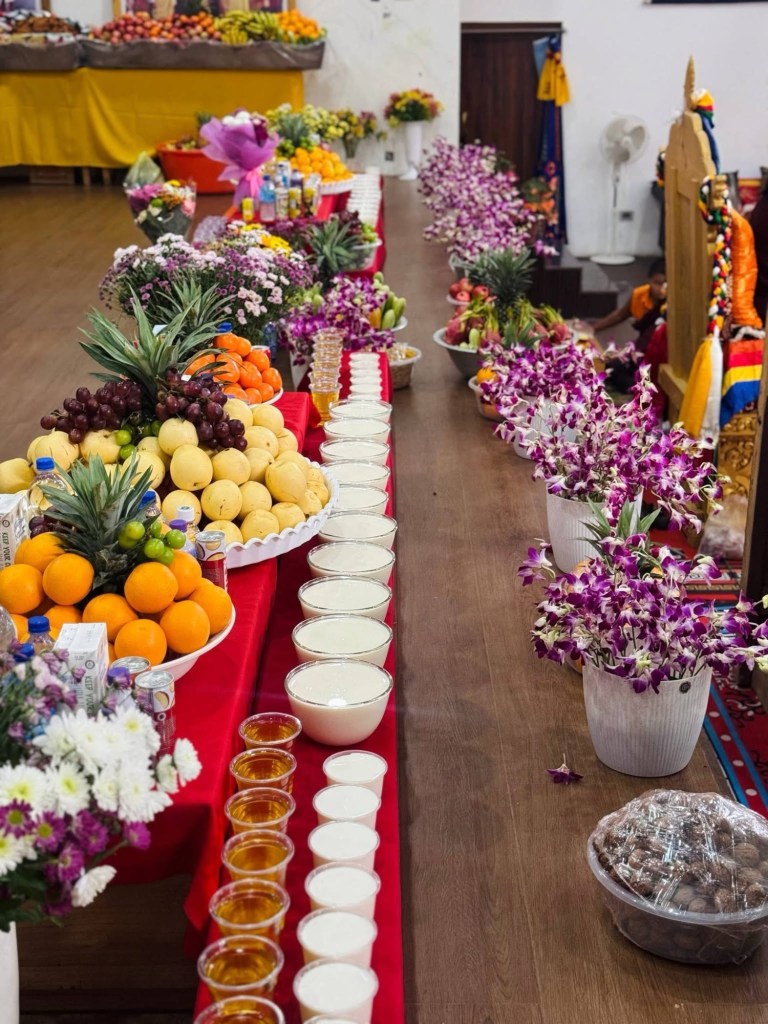
As a child growing up with a lama-grandfather, whenever we started off our meal, I was told to first offer it to Kencho Sum (Three Jewels; དཀོན་མཆོག་གསུམ; Skt. Triratna). So, every morning it is customary for us to offer food first to the altar before the family eats. And furthermore, before we take the first bite we place a few grains of food outside the plate for the unseen spirits like the hungry ghosts. Before we drink we pour out a drop and invite the unseen beings to join in. It is others before self. Always.
When I landed my first job, I was reminded incessantly by my father to offer my first salary in entirety to Kencho-sum – through our family lama, Rangshikhar Rimpoche. He believes that the divinities and the universe will root for my success and happiness if I did that. I think he was right. I did have a fair amount of success – whatever that means.

Later, or in the past decades, I changed a couple of jobs and every time I received my first salary, or the first contract money, I offered it to Kencho-sum without spending a ngultrum.

So, in line with this tradition I have offered my first paycheck this time too for a full-time gig that I have started last month. My modest salary was divided and offered to the temples of my birth place in Tashigang, and to my lamas, who represent the Three Jewels. Besides, I invoked the blessings of Semtokha Dzong in my current city of residence, and from my personal yidam, Palden Lhamo, in Rukha, plus from the deities and divinities of Nyechen Dongkala and Tashigang Dzong. I sent offering to all these places from my first salary.

I also shared with the little nuns of Dorje Phagmo dratshang in Zhemgang (No pictures to protect their privacy).

In the process, I have also received the annual blessings from my three Perfect Teachers, and so, I am all set for a successful year of travels and teaching life.

I have often been asked how to teach compassion to children. Honestly, I have not thought about it. However, compassion is about empathising with someone’s suffering and taking an action to alleviate it. Empathy starts with recognising the presence of others in our lives and in everything we do. It is about thinking of others all the time before self.

May all sentient beings find their way towards realisation with this small act of goodness I learnt from my father and my grandfather.

(Most photos are from my lightning trip to Zhemgang, where Dorje Phagmo is preparing for the annual Phurpa Tordok rituals for the wellbeing of the country. You may donate if you wish)

Traditional Day of Offering

In Bhutan a popular national holiday is the Traditional Day of Offering. Locally known as buelwa phuewi nyim (འབུལ་བ་ཕུལ་བའི་ཉིནམ།) it commemorates the day when, during the medieval era, the three regional governors of Bhutan paid their homage and tributes to the central theocratic government that was headed by Zhabdrung Ngawang Namgyel in Punakha Dzong.

With a day late (I am always late) I paid my homage and tribute to our founding-father in Machhen temple and invoked his blessings for a super successful year for our King, people, and country.

A few months back when I was teaching the courses on Buddhism and iconography to the Dessups who are training to be cultural guides, I urged them to visit the sacred Machen Lhakhang once a year – irrespective of their faith or religion – and simply by the virtue of being a Bhutanese. For, he is the founding father to whom we must express gratitude.

May we be blessed into usefulness for all sentient beings.
🙏🏻🙏🏻🙏🏻

Keep Giving. Keep living

My traditional New Year got off to a nice start with this post from somewhere – helping bring a little less suffering to someone I have never met from a place I have never been.

Actually, I had forgotten about this. It happened a month back. I was into something busy, when a social worker I know texted me to help acquire a wheelchair.

I could call up somebody in our health system and get one for free but that might deprive another person of the free service, and really how much does a wheel chair cost? Somewhere in the region of 10,000 I was told.

“I will send you a little more. Get the best one.” I told her. “And please keep doing what you are doing.”

These people inspire me. They do, because as much as my heart went out to this unknown person who needs a wheel chair (life must be hard), my rational mind told me I should keep supporting people like Goldy who are giving something we all have – time. For, generosity is not just about money. You can share your time, knowledge, skills, wisdom, and many more.

Thank you, Goldy Layo Rai and all the people out there who are giving away your time and energy to make the life of another sentient being better.

All our collective works and thoughts make our own lives worth living. It brings immense joy and fulfillment. In fact there is an old Bhutanese saying – You don’t only do good to others. You do it for yourself.

Losar Tashi Delek to all.

Keep giving! Keep living!

🙏🏻🙏🏻🙏🏻

Life in a fast lane

Back home for Bhutanese Losar (New Year) after dropping a VIP guest and after a couple of business meetings in Bangkok.

Came back home with a heater. It is so cold in Thimphu these days 🥶🥶🥶

Happy Losar to all – especially to the other half of Bhutan from Pele-la and beyond.

Life has moved in the fast lane again for me. Yup! After listening to the National Day address I decided to come out of my early retirement and self-imposed isolation, and do what I can and when I can.

Lots of travels, a couple of new countries, 3 conventions and two academic conferences in the calendar.

#lifeonthefastlane #bangkokthailand