Restoring the sense of belonging and purpose

Sense of belonging, as I have mentioned in a past article, What it means to be Bhutanese?- is our authentic connection to our common heritage, our collective present, and our shared future. Losing the sense of belonging means that people have lost this connection – as in not knowing where they come from, or where they belong, and see no future ahead of them. This is a terrible state to be in because one feels worthless, unrecognised, and increasingly pushed away. Humans are social animals and we always seek a place and a community where we feel accepted, valued, and validated.

I have also pointed out that the sense of belonging is an emotional question and not an economic one. A case in point is my generation and the one before who were happy with the little we were paid but worked happily and with pride because we felt a sense of belonging, and duty towards our country, and responsibility towards our community.

The problem of the decline of belongingness is not confined to Bhutan. It is a global issue. For instance, a study from Stanford University shows that one in five Americans do not feel a sense of belonging and suffer from chronic loneliness. Sense of belonging is defined by psychologists “as the experience of personal involvement in a system or environment so that persons feel themselves to be an integral part of that system or environment”.

How have we got here?

Major psycho-social shifts do not happen in a vacuum. They are caused by many factors – big and small. Here I will point out a few of them.

Social media and mobile phones: The mass proliferation of communication technology, such as smartphones and social media, has connected humanity more than at any point in history. However, the newer and faster connections have made the connection itself shallow – giving us less time to absorb and appreciate.

More significantly, social media amplifies the illusive greener pasture – making us always feel that there is something “out there” that is better than what we have in front of us – be it people or places. It promotes distant heroes and role models instead of nearer natives and achievers. It tends to devalue everything in front of you if you are not careful.

Power and money over meaning: The rapid urbanisation, the bureaucratization of society, and the monetization of every aspect of our lives are eating into our souls as a nation. Adding to that is the social hierarchy that seems to turn off the younger generation. I don’t make a judgement on whether that is right or wrong. Some degree of social structure is required to maintain the social order. Beyond that, it can be suffocating for everyone.

I don’t undervalue money either – or the need to pay for services. However, the anti-freebies section may not realise that in social democracies such as the Nordic countries, many things come free from the state as a part of ensuring some egalitarian ideals. I view money as a means and not as an end in itself – as in to pay my bills, support my family, help others, build religious structures, and not let it rule my mind or life. However, truth be told, we are putting greater emphasis on money and hierarchy over men and meaning.

Education that competes: Enough has been said about the modern education system. And so, let me just add that what we measure is what we will eventually get – with everything in life. Assessment is a key component in education and learning. Putting one student on the pedestal estranges the rest. Grading them like factory products will make them compete against each other. And if history as a subject is taught as numbers and names to be memorised, it will just be a number or a name, and not a feeling. All these have alienated our youth, and not helped them to learn to appreciate our heritage and traditions, build communities, or make them feel like an integral part of the greater whole.

All is, however, not lost and below I will reiterate the ongoing Desuung and the new Gyalsung program as solutions and initiatives to restore these feelings.

How do the Desuung and Gyalsung programs help?

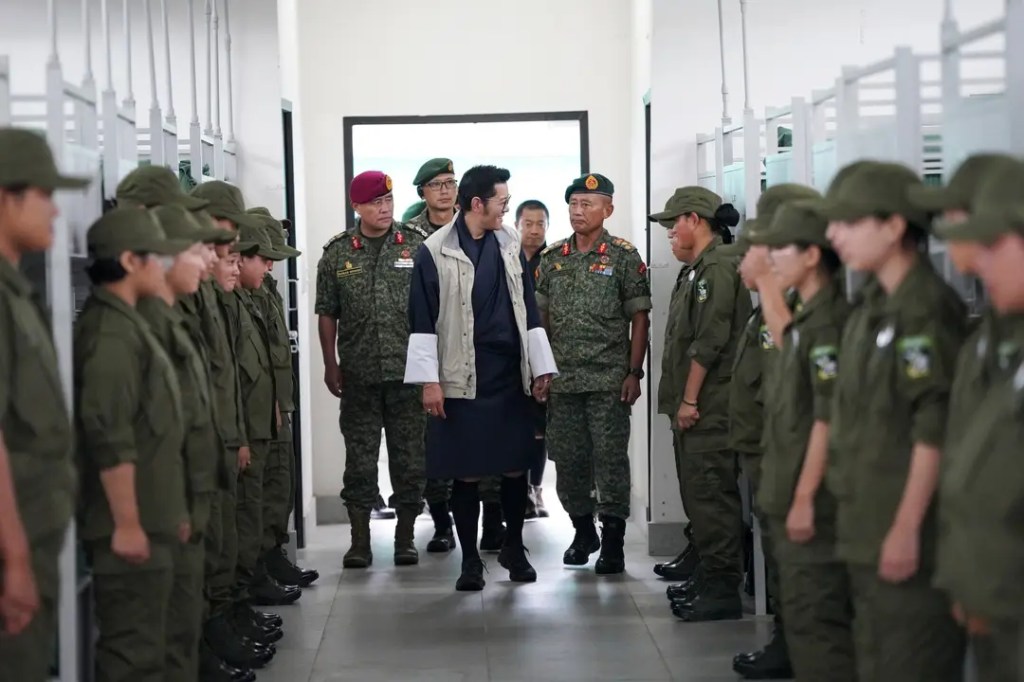
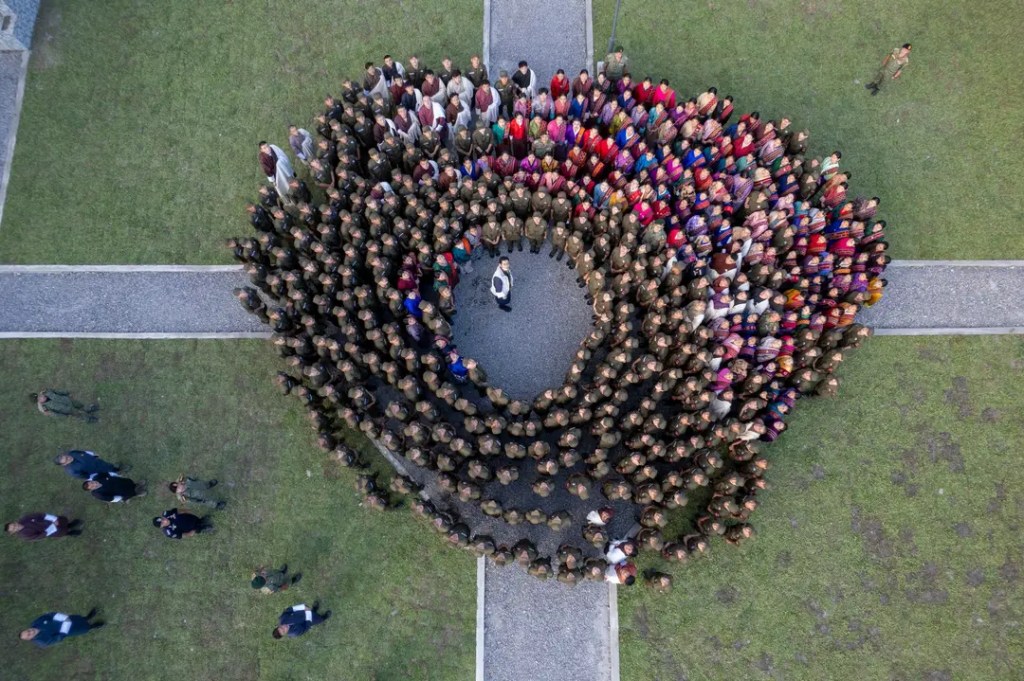
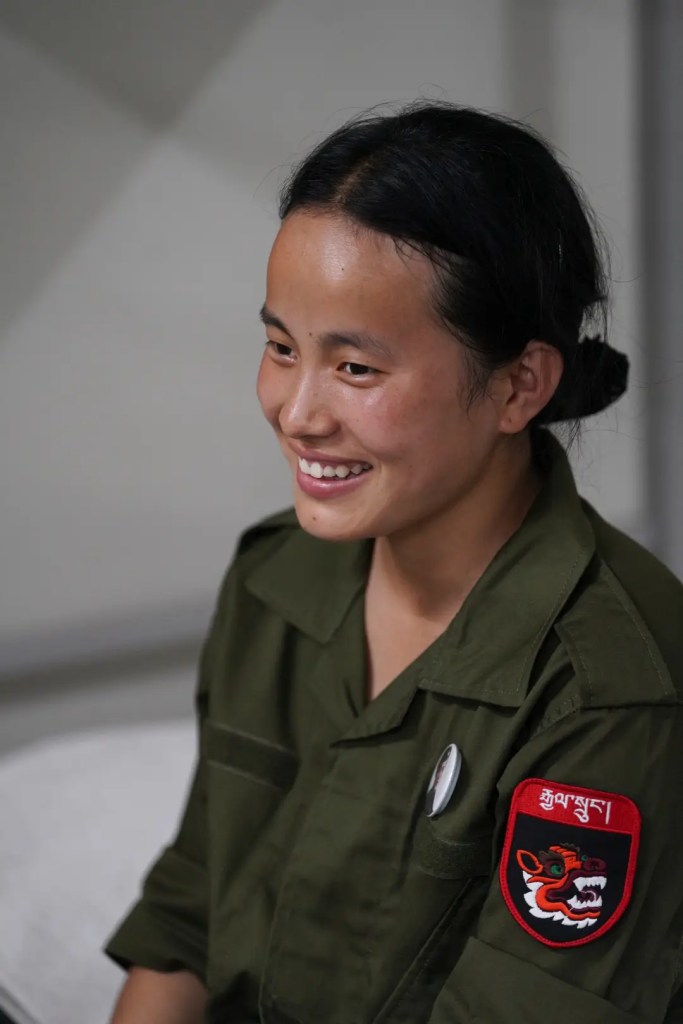
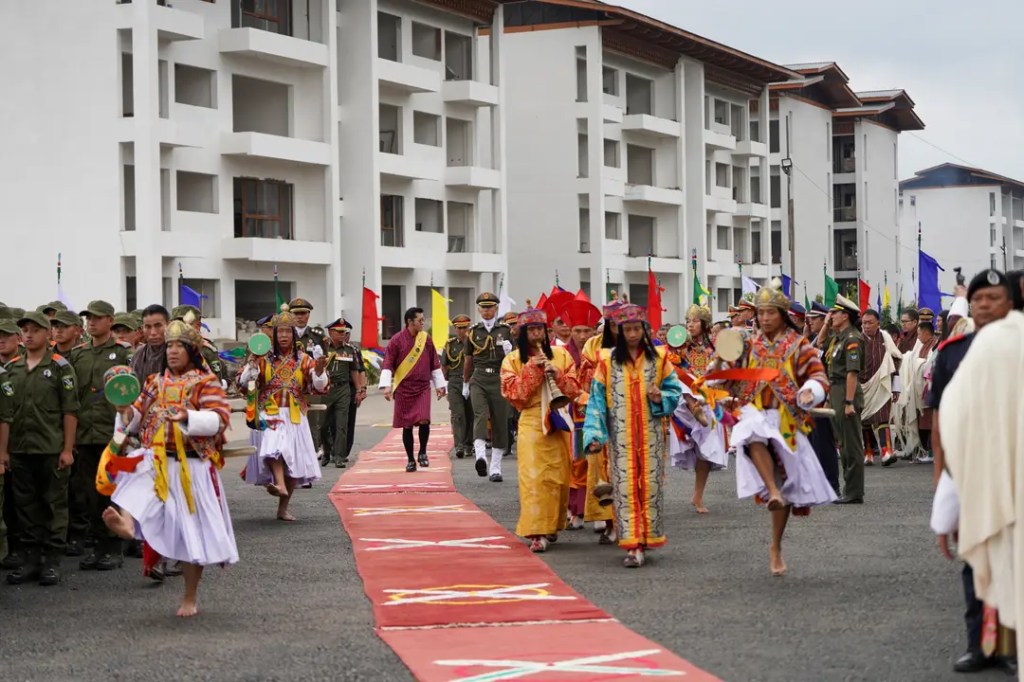
I have mentioned in another article that the success of the Desuung program can be attributed to making our youth feel proud and validated. They find a community that accepts them, and their works and efforts are recognized. They get an opportunity to serve the country – something that every Bhutanese look forward to. As I see pictures of the Gyalsung program kicking off, I feel the same sense of duty, diligence, discipline, and pride can be achieved for the younger Bhutanese who will undergo the Gyalsung program.

World over, national service has three recurrent themes – an enhanced feeling of shared purpose and patriotism, instilling loyalty and diligence, and giving a sense of belonging, resilience, and direction. I will elaborate on a few of these points.

Sense of shared purpose and resilience: As one begins to be a part of a bigger Bhutanese community, dreams and aspirations will be shared and will find acceptance. They will forge life-long and meaningful friendships and fraternity. They will learn to look out for each other and build trust and confidence – and not indulge in unnecessary competition and in self-destructive ego and confrontations that they have seen elsewhere.

As the program extends to a year, our youth will have time to go through a roller-coaster of emotions and self-discovery. Many will harden up and might find their meaning in life, which eluded them from being in their comfort zone. They will find a shared purpose, build a collective dream, and envision a future for themselves and for those around them.

Sense of belonging and patriotism: The over-emphasis we give to one small section of the society – the esteemed civil service, has us questioning our basic fundamental duty and rights to patriotism – as in if those who are outside of it should feel less Bhutanese and lack the love for the country. This has ramifications on the psyche of the young as they see their parents and relatives increasingly feel estranged – and not contributing meaningfully to the country.

With Gyalsung, young boys and girls will learn to love the country and be loved and find their way to feel belonged through service to the King and country – irrespective of profession, social standing, race, or wealth. They will learn that no one has a monopoly on patriotism and each one of them is entitled to feel for their country like any other. They will find a culture to be experienced, traditions to be learned, relationships to be nurtured, and an inner self to be discovered. They will learn that the country is big enough to fit every dream and find things to do, places to go, people to meet and communities to serve. They will discover that they have a place in the world. It will be a worthwhile journey, I am sure.

——————–
Of cars, bans, and the artificial demand


Following the lifting of the import ban on cars, there was a sudden uproar when consumers realised a huge increase in taxes for new cars. While the taxes may be a cause, another reason for the cost escalation, in my view, is the ban itself. Simply put, if you ban, or limit something, the price of the commodity increases. This phenomenon is called artificial demand, or artificial scarcity – in microeconomics.
The concept of artificial demand is based on psychological human behaviour, whereby we place higher value on anything that is in short supply. The more the value we put on something, the higher the price. The entertainment industry and high fashion goods manufacturers practise this by issuing limited editions and selling the exclusivity narrative. Advertisements and commercials are solely based on creating artificial demand to stimulate sales.

Some large multinationals and unscrupulous corporations also practise artificial demand by manipulating the supply of goods into the market. Such wilful market distortions are illegal in countries like the US and the EU. In our case here in Bhutan, however, the artificial demand and price escalations may be unwittingly created through blanket bans and moratoriums.

Banning the ban.

For quite some time now, I have been discouraging the practice of imposing blanket bans as a tool in governance. Bans, moratoriums, suspensions and changing policies have become a norm with democratically-elected governments after 2008. Blanket bans should be enforced only as the last resort and that too after thorough and independent research that factors in all short-term implications and long-term consequences, plus the collateral damages on other sectors. For instance, the “ban” on drones for private users has severely limited the filmmakers and the creative industry and its potential use in the delivery of goods to difficult locations and relief materials during disasters.

Bans may be effective as urgent short-term measures to stabilise a market or an emergency situation but are ineffective in the long run. Studies following the 2008 US financial crisis and the 2012 European debt crisis found that sporadic sales restrictions largely failed to support prices and reduced liquidity overall. Bans also skew long-term and larger opportunities for the overall economy and the employment market. Although it is hard to imagine something that has not happened before our eyes, researchers can mathematically model different options and possible outcomes, and do the cost-benefit analysis of any public policy. Bhutan aims to double its GDP by 2029 and become a high-income economy by 2034. If few things will thwart these achievable dreams, those will be unstable policies, unpredictable bans, subjective applications of “rules”, and the decline of the population.

Bans on car imports do not serve the desired purpose of limiting the numbers either. There have been several bans in the past 15 years. If you look at the data over the same period you can see that the upward trend has been the same. Instead, the bans have put our young people, who were working in the car dealerships, out of jobs.

Effects of bans and artificial demand.

Fear and FOMO. I am even inclined to think that bans drive up sales instead of reducing it. This is because unpredictability generates unfounded fears and suspense – plus market speculations. Fear emerges out of our reptilian brain, which produces the most primitive and illogical instincts in us. There is nothing worse than unpredictability to garner irrational behaviours. For instance, my Isuzu pick-up has almost hit 70,000 km. And at the rate I am using, it is safe to go on for two more years. However, what if there is another import ban and if this one becomes unreliable? With my wanderlust life, my skin and my work depend on it. It doesn’t matter that, as a teen, I survived on erstwhile BGTS trucks – some of which were falling apart when we were moving on the road. Like me, there might be many who will make premature purchases out of fear. One dealer told me they had several inquiries asking if there would be another ban because they wanted to wait for the current tax rates to be reduced.

Recovering lost sales. The management of STCB has clarified that it is also the manufacturers who have raised the prices. Of course, why wouldn’t they? The Bhutanese market may be small, but it still brings them an annual revenue of over Nu. 5 billion. They will try to make up for the zero sales in the last two years – and blame the price increase on technology, transport, steel prices, wages, crude oil and even their dogs and cats. I have also taken a “jab” at the dealers. They need to recover the overhead costs of the last two years. While the employees may have been laid off, they still had to pay the rent for the showroom, and utility bills such as electricity, water, and for the cleaners and watchmen. Ultimately, though, all these costs and expenditures will be passed down to the customers and it is the ordinary people who will bear the brunt of the ban eventually.

Revenge buying. We must also not be naive to think that foreign manufacturers and corporations are angels. They are aware of the artificial demand theory and they know they can cash in on it. They expect that our young salarymen, who have entered the job market in the last two years, will rush to buy no matter what. In sociology, this phenomenon is called revenge buying. The manufacturers also understand that unpredictable rules create unfounded fears in older people like me. Unlike us, their decisions are based on research and evidence.

The solutions.

The State has two powerful mechanisms to regulate public finance: monetary and fiscal tools. These can be used strategically and tactfully to steer the economy. For example, if there is heavy public investment in mass transport, people won’t be compelled to buy private vehicles. If the government refrains from buying Prados and Landcruisers as pools, and instead goes for vehicles that are made in India, a lot of hard currency will be saved. There are many ideas as long as one is not stuck with old habits. No new solutions can be found for any issue with the same beliefs and behaviours that created the problem in the first place.

As for the rising number of cars in the streets of Thimphu and Phuntsholing (these are the only two places in Bhutan facing congestion), the long-term solution is developing public transportation, where everyone benefits. I would even go further by making it free, or heavily subsidised, like in some EU countries. Thimphu has about 70,000 vehicles in a population of little over 140,000, which is perhaps the highest car-person ratio in the world. There have been talks about electric trams and pedestrian streets. We should fish back those bold ideas. If pollution is the issue, this government initiated the idea of electric cars in 2014. I feel this can be reinvigorated through not only giving tax breaks but by making all government pool vehicles electric. There will be less misuse too and less dependency on fossil fuel.

Most importantly, the car import ban should not be nationwide. Thimphu’s municipal problem does not necessarily apply to other 19 urban centres. Good connectivity and seamless movements of goods, people and services are essential for an economy to grow. Beyond Thimphu, other places do not even have a reliable taxi service.

The lifting of the counterproductive ban itself was necessary, and I disagree with the school of thought that argues that we should have extended the ban. On the surface, it may look logical, but national monetary and fiscal policies are not like personal saving accounts and spending habits. Every action, big and small, by the central bank and the government, has huge implications on the economy, and ramifications on hundreds of thousands of businesses and people – most of which will never come to light.

While this current government may not be responsible for the increased tax rates, it has the power to review them without necessarily bringing them down drastically. It can also introduce some new innovative schemes. However, it cannot wash its hands off, because like anywhere else, and more so in Bhutan, we look up to the government for relief, guidance and leadership.


Dorji Wangchuk (PhD)
Professor, Engineer, Communication Scholar

(The print version appeared in Kuensel, 31 Aug 2024)

Don’t swap self identity and cultural identity

Those who missed my talk at the last Bhutan Echoes 2024, I post the link to the full video here.

What does it mean to be Bhutanese? To be Bhutanese means to be compassionate, altruistic and spiritual. It emerges out of the sense of self that we construct for ourselves which I define as the interdependent self consisting of the personal self, social self and the spiritual self.

Not in this video, but there is one confusion that seems to be there (and I will elaborate it in my next article) – especially among our youth.

When we talk about identity in Bhutan it is often equated to cultural identity and overpowered by political identity (e.g. ID card, nationality, etc). Unlike self-identity, cultural identity is a collective sense of identity among a group coming from, or is part of, a same culture. For instance, forget about the nationality, even a region such as the Himalayas will have a common and generalisable cultural identity, but very different self-identity among its inhabitants.

The other confusion is with cultural identifiers as identity, such as wearing a gho, speaking the national language, religious festivals, temples, etc. These are known as identifiers in cultural studies and as symbols in everyday language.

Here by identity I refer to the definition from psychology which is the sense of self – the personhood – the self-identity as in those characteristics and attributes, both inherent and acquired, that make us unique. E.g. The way someone from Merak Sakten makes a sense of self will be very different from someone who is born and brought up in Phuntsholing.

Cultural identity will change with culture but self-identity should not. A compassionate person will be compassionate whether you are in Bhutan or in Manhattan. In Bhutan you wear a gho but in Manhattan you wear a suit.

Identity is personal and it provides the foundation of your being – and something that will give you the principle, integrity, resilience, etc. Isn’t this what we are lacking nowadays?

Enjoy the video and happy to keep this in the national conversation.

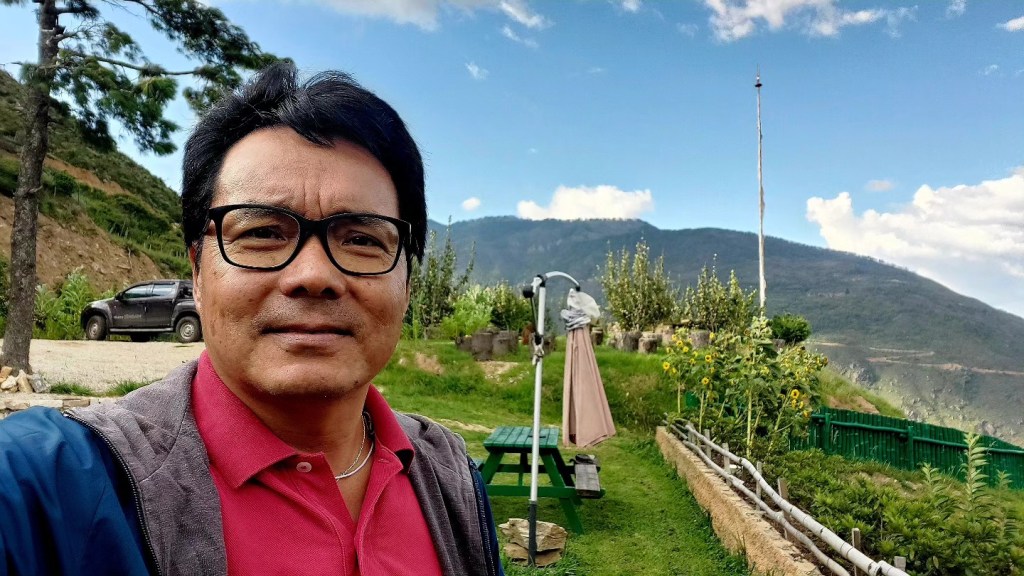
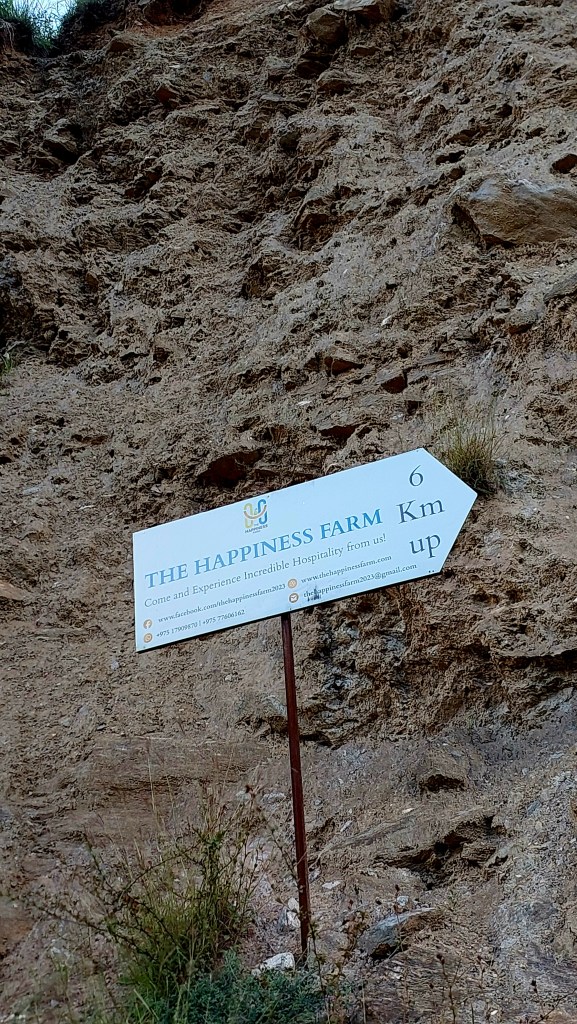
Happy weekend at The Happiness Farm


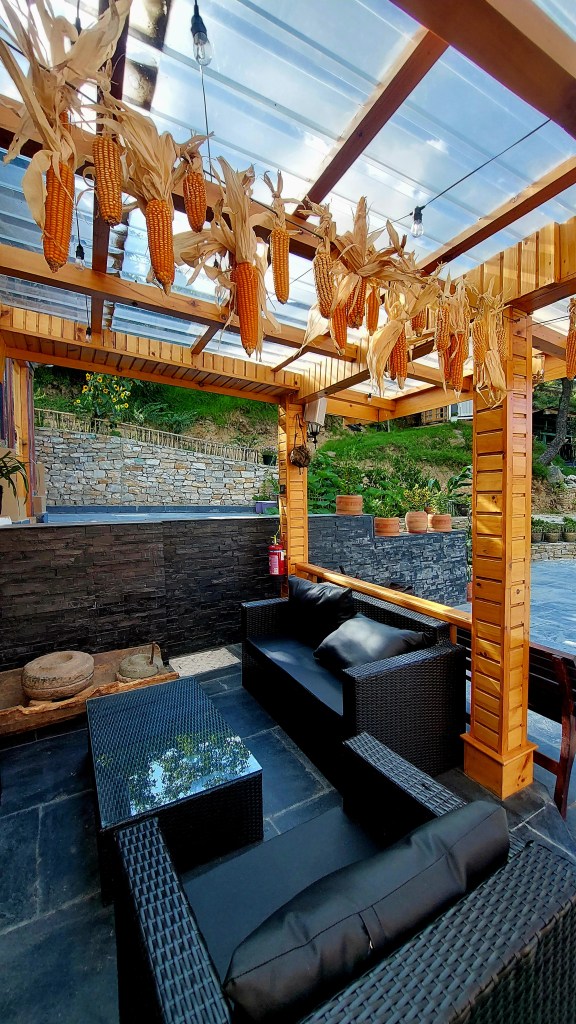
I made my first visit to The Happiness Farm belonging to my Gewog-mate, Dorji (we come from the same area but we’re not related). He resigned from a high-paying and jet-setting job to start this farm.

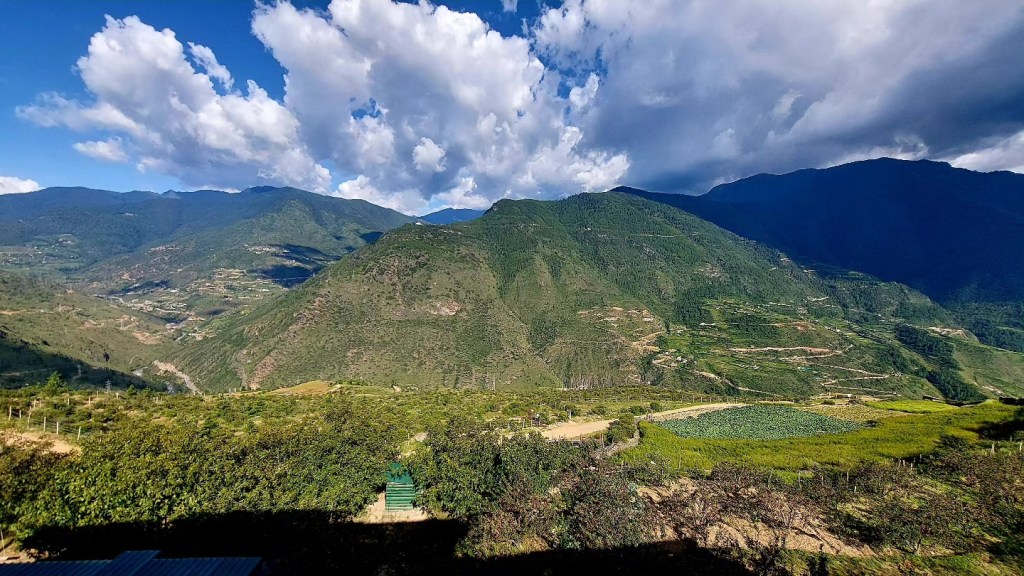
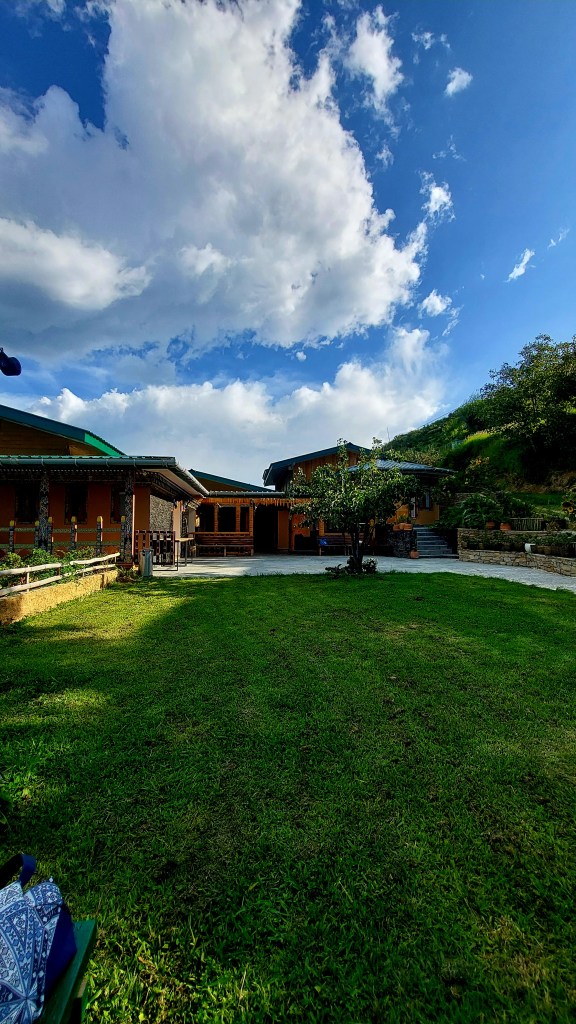
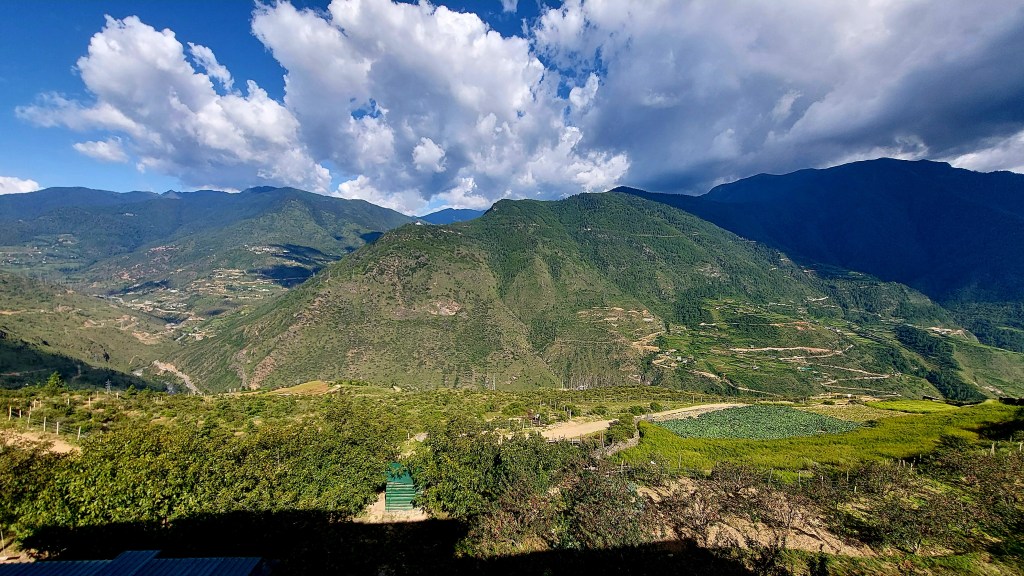
The place is conveniently located between Paro and Thimphu and above Chuzom in Issukha village. It offers certified 3-star accommodation with stunning views of Langka Gonpa and Dagala mountains, and the charm and idyllic setting of a Bhutanese farm with full modern amenities.

Above all, it offers organic food (pesticide-free and really organic) and fruits and vegetables, which are good to detox your kidney and liver for a few days – away from all the processed food. The nights are quieter and devoid of the city noise.

For those who are raising children among the malls and malices of Thimphu, the place offers a safe space for them to be reconnected to our roots – farm, chicken, nature, birds, silence, without losing the comfort of a nice bed and bathroom. We are spoilt after all. Let’s admit it.

The place is ideal for those who simply need to be away in solitude to think through a major project (met a guy who was doing that) or life’s transition. The setting will definitely make you have the much-needed breakthrough. If you are not working on any project deadlines, it is fine too. You can simply unwind and decompress from your tough schedules and often stressful time at the workplace. Modern life is convenient but tough on our body and mind.

For me, it is a great place to do my writing, work online (they have good wifi), and catch up with some walk and fresh air. Your lungs and your eyes are the happiest here.

Really inspiring of my village-mate who had the courage to leave a well-paid job to go back to our roots – farming.

At a time when the Bhutanese youth, and even older professionals, are leaving the country in plane-loads because of the perceived lack of opportunity, he is a reminder that if you work hard you can create opportunities you desire – and at home. He has university degrees from some of the world’s best universities. He could have left too.

Our government planners and donor friends might like to check people like him and their places and initiatives.

😍😍😍

(P.S. this is not a paid article but my own way of encouraging fellow Bhutanese who are serving the country and humanity in their own ways)

For bookings and informatiom call +97517909870

Location:
https://maps.app.goo.gl/Rvs2xBwS1mbTJctV6

Flying higher and further

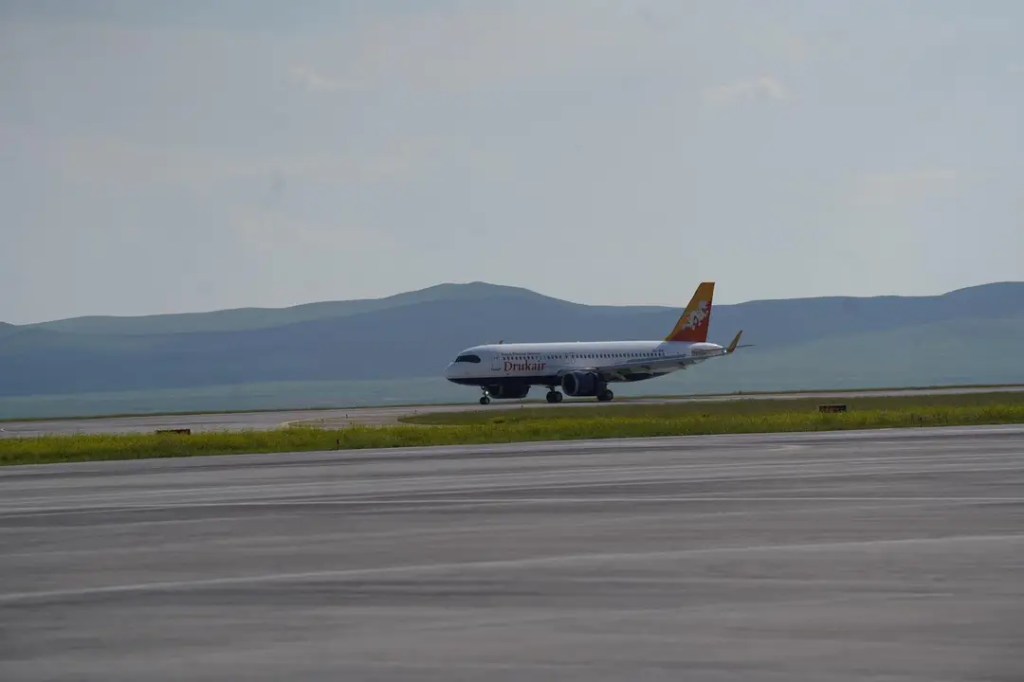
In one of the boldest moves by our national airline, Druk Air, a firm order has been placed for five new aircrafts – three Airbus A320neo and two Airbus A321XLR. Bold ambitions call for bold decisions, and I must commend our national carrier for this move. In my view, it is a huge step forward for the Gelephu Mindfulness City (GMC) project and also for Bhutan as a nation. The news, while it was covered by the mainstream media agencies, did not make much of a splash across social media, where greater dissemination and education on a topic happens these days. So, let me share my broader understanding on the larger benefits.

Destination Gelephu.

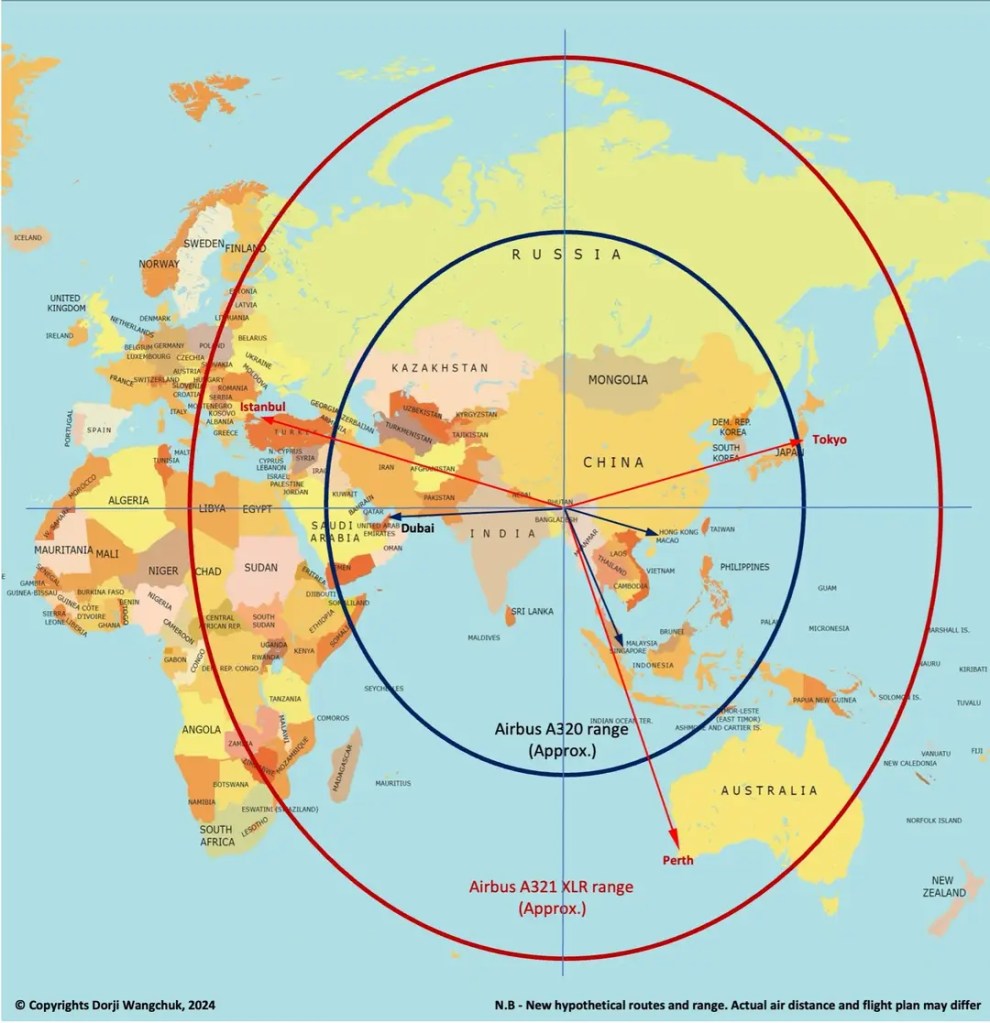
While the A320neo may be a replacement for the ageing A319 fleet, the two A321XLR are obviously for Gelephu. The Airbus A321XLR is the largest aircraft in the A320 family – and also a great choice given that the airline does not have to maintain a separate set of crews to fly them. The A321XLR can accommodate anywhere between 180 to 220 passengers depending on the cabin configuration. It is a single-aisle wide-body airliner with a maximum range of 8700 km (8,400 km, according to latest changes), which makes it possible for the airline to extend its wings for direct flights to distant destinations such as Tokyo, Perth, or Istanbul. XLR stands for “extra-long range”.

The Airbus A321XLR with a longer fuselage wouldn’t be able to operate out of Paro with the current runway length. Therefore, they could be solely destined for Gelephu, where the new international terminal and a longer runway will be built. Gelephu could become the operational base for these aircrafts. If this is so, it is significant because, firstly, in the airline business, a base airport means that the aircrafts will be stationed there permanently for both operations and maintenance. Consequently, a good number of employees such as pilots, maintenance engineers, ground staff, and even cabin crews will have to be based there, thus opening direct opportunities for local businesses in terms of housing, hospitality and other businesses. As the airport itself becomes fully operational, if well planned and strategized, it can then spur a chain of opportunities for other sectors, such as cargo, catering, transportation, tourism, trade, innovation and other sectors. The list is endless.

Second, the aircraft with its longer operational range (distance between two places) could be deployed for direct medium and long-haul flights to destinations such as Australia, Middle East, South East Asia and the Far East. This will be vital because if Gelephu is to attract foreign investments and investors, direct air connectivity to other economic hubs, and direct flights to global hub airports such as Hong Kong, Dubai, and Frankfurt will be the key. Business travellers, especially those higher up in the corporate ladder are super sensitive to travel time.

Third, here are some fun facts. By 2050, which is just 25 years to go, five of the ten biggest economies will be within the operational range of the Airbus A321XLR. Furthermore, by 2035, which is just ten years from now, seven of the ten biggest cities in the world by population will be within the operational range of Airbus A320neo. (See the map)

Paro – the gateway to Bhutan.

As the Gelephu Mindfulness City project gathers steam, one question that crops up in my circle of friends is – what would happen to Paro? In the sense that, would this place see a decline? To answer that simply, it will continue to retain its status, or even get vibrant thanks to the GMC Project. Paro will continue to be the international gateway to Bhutan – especially for leisure travels and cultural tours. In fact, with new routes to the Middle East being launched from October of 2024, it could spur more tourism arrivals. Dubai happens to be just a flight away from any major city on Earth. It will be especially convenient for passengers from Europe and the US. Of course, Bangkok and Delhi are well connected too, but Dubai has become the global hub for air travel.

One issue to be addressed, though, is that unlike business travellers, leisure travellers prefer cheaper fares over travel time. Bhutanese airlines have a long way to go in terms of a more dynamic pricing – preferring instead to maintain a high and flat rate, and fly with unsold seats. This has led to losing business to airlines operating in and out of Bagdogra. Likewise, the Bhutanese diaspora, who are dispersed in over 100 countries, will also factor in the airfare as the major determinant on how frequently they can travel home.

Looking beyond profits.

Over 70 countries would fall within the operational range of the Airbus A321XLR. In one of my earlier articles, I have mentioned the role of national flag carriers as furthering national identity through projecting the country internationally. Countries like Japan, Malaysia and a few middle eastern states have propelled their flag carriers to promote their national identity world-wide, which in many cases did not make business sense. To this end, popular bloggers like Yeshey Dorji have called for Druk Air to be delinked from the business-centric goals of Druk Holdings & Investments, and let it be subsidised to focus on nationhood and connectivity – or find a balance between profit-making and nation-building.

Furthermore, with the call for everyone to come together, work hard and co-create the royal vision for Gelephu, the strategic role that our airlines can play cannot be understated. I can only reiterate that efficient air transport will promote international trade and investments, and more importantly facilitate the movement of people and goods. Besides, as a small landlocked country, a reliable and convenient air connection to Gelephu is not only of key importance, it could also help physically promote the brand Bhutan to the world. This is what Singapore Airlines achieved for Singapore in the 1970s. Bhutanese people are generally hospitable, kind and fun. It won’t take long to build a global airline with the best onboard services and customer care.

And not the least of considerations, is the Bhutanese diaspora that is spread across the planet – especially in Australia, Japan and the Middle East. A direct air connection will make it possible for our people to conveniently travel home and more frequently. This might open up a circular migration and investments, and acquisitions of properties while at the same time allowing children to be kept connected to their roots. Of course, you can always hop on to a Thai Airways or an Air India flight, but there is nothing like getting on board an aircraft that carries your own national flag from end to end. You already feel safe, proud and at home as soon as you are on board, although the aircraft may be still attached to the airport terminal in a foreign land.

(This article appeared on Kuensel newspaper of 17 August 2024)

(Photo credit: Official page of HM the King, Airbus official website)

Drukair, Royal Bhutan Airlines #gelephumindfulnesscity #mindfulnesscity #mindfulness #airbus #airbus319 #airbus320neo #airbus321xlr #airbus #bhutan #perth #bhutaneseabroad #bhutanesediaspora

The Joy of Lifelong Learning

Following my post, and the talk at Bhutan Echoes, on What it means to be Bhutanese, I have received over 200 requests for the soft copy of my dissertation. I thank you all for reaching out to get my humble work – although it is still in the inhuman academic form. I promise to work on a book for mass distribution. 

Many also shared their secret dreams of pursuing their bachelors, masters and PhD. So this post is mainly for you people and for the lifelong learners, and readers. 

First of all, I would like you all to keep your dreams alive and stay focussed on that path. Someone once told me, you stop learning, you stop living. For our country too, on any day I would prefer to have a good educated population. Ignorance does not bode well for anything. Just look at what’s happening these days beyond our borders.

Second, to start yourself off, treat yourself like an academic. Take time to read academic stuff, and watch and listen to academics on YouTube. Give an academic bent to the place where you currently work by googling on how to innovate your job and your profession. Take the free courses on Coursera.org from some of the best universities to get you in the mood and to speak the right language. Nothing will go to waste even if you don’t go back to school.

Third, in terms of cultivating the right attitude, have a dual feeling – of respect for others’ ideas on one hand, while also motivating yourself into critically thinking and telling yourself that you can add to the idea itself. This will push yourself into really training and exercising your brain positively. But, do not, under any circumstances, underestimate yourself on one hand (this is very Bhutanese), while also shooting down other people’s ideas and works. Such an attitude will get you nowhere in life. This is a very common “third-world mentality”, which the colonial powers used to instil in the colonised people during that period. Sadly, we still see some remnants of such filthy behaviour even in our midst. 

You may probably achieve the goal you aim for:

Yes, setting your mind on a goal can often take you to the goal itself. You must have heard that from every motivational speaker. But here is my own story. 

Many years back when I had just moved into documentary filmmaking from engineering, I stumbled upon a leaflet of the prestigious Japan Prize for International Documentary Contest. I decided to win that prize, and as a reminder (I mentioned that I am absent-minded) I kept that leaflet in my bag and carried it with me everywhere I went. I won the Japan Prize a year later in 2003 – less than one and half year after I started making documentaries. All my life I have been a technician and an engineer but I learnt the art of documentary filmmaking almost instantly. Of course, you should work hard, work smart, and burn many midnight candles, and find a mentor.

Another story – when I was teaching in Sherubtse, and after rubbing shoulders with the academics, I was completely awed by people like Dr. Karma Phuntsho and Dr. Kuenga Wangmo with doctorate degrees – as in how they spoke, the depth of their talks, the humility, and how they carried themselves. So, I decided that I would also pursue doctoral studies, which I was told was necessary if I wanted to be taken seriously in academia. So, look for the right inspirations.

Enjoy the journey. Don’t mind the destination:

An interesting plot twist to my PhD goal occurred when I started off in Macau. Both my supervisor and another professor of sociology advised me to take the opportunity of being there to leave a legacy in the field – meaning to take on some difficult questions that would kickstart a national conversation, while adding to the discipline itself. They told me that I already had an illustrious career and so I should not rush with my course. I followed their advice. I don’t know if my work is of any substance or weight, but I think I have achieved the goal of starting a national conversation. The Bhutan Echoes 2024 gave me the ultimate stage to amplify the question: What does it mean to be Bhutanese? I am grateful to the Royal Patron and the organisers of Bhutan Echoes. I hope every educated Bhutanese everywhere will ask that question, “Who are we?”, “Does this represent us the Bhutanese?”, or “Are we not better than this?” on a continuous basis as we go on with our lives – anywhere on Earth, and as we make public policies, enact laws, and implement the rules and regulations.

Lastly, for those with hundreds of familial and social commitments, just be patient. Children will grow and fly away. As you grow older you can actually go back to school in peace. I started my PhD journey at 49, and had the time of my life.

I wish you all the same – a terrific journey, whenever that happens, of fun and of learning, and of sparking some national conversations, or even an international one. And not stressful years of yearning for that prestigious title.

Of course, as I was sharing with a colleague sometime back, there is no denying the fact that it is nicer to grow old with those flashy titles MPhil and DPhil. If for nothing, your validity period in the society will be extended by many years.

Sense of Belonging – Part II

In my earlier post on belonging I mentioned that sense of belonging is, firstly, the connection one makes with the past, the present or the future; second, that it is not a fixed state and that people continuously evaluate their belongingness to a place or a group; and third, that loss of sense of belonging is an emotional breakdown, and not an economic disruption (although one could also argue that the latter could trigger the former).

How does one reclaim one’s sense of belonging?

Between 2013 and 2014, when I taught in Sherubtse College I started every class with the existential quest, “Who am I?” Some found it funny, some loved it and many were very confused. When the students went on break they packed off with a mandatory homework: to retrace their ancestry by meeting and spending time with their grandparents..

Whether or not your life has come to a halt, or you are a young person finding a footing in this world, establishing connections with your family elders and ancestors is a good start. After all, blood is thicker than water. You will feel grounded, loved, or cared for. Just give it a try!

After that find your own community – a place that you are comfortable with, and values you and your beliefs. For instance, I found mine among the Oleps in Athang Rukha in western Bhutan – although I am from the extreme east. You could also create one (VAST Bhutan is a perfect example – created by Azha Karma). Quite often, in such a circle you will find your holy grail – the purpose and meaning to your life.

Let me share my own experience of getting lost, tracing my footsteps, and discovering myself again.

I grew up looking after cattle on school holidays in Trashigang Pam. And because I was absent-minded, or engrossed in reading comic books, by late afternoon I would have lost all the cows in the jungle. My paternal grandfather who would come to my rescue had only one technique: trace the footsteps.

That advice would become my life’s philosophy when I felt lost. Ten years back that’s what I did with my life. I traced my footsteps because I was going through the lowest point of my life.

I asked my father to take me to the exact spot where I was born. I always knew I was born somewhere in the jungles between Radhi and Merak in Trashigang. I had nothing on my mind. I just wanted to spend that downtime to look for that place before life takes over again.

However, standing on the spot where a hut once stood, I had my own unplanned Buddha-moment – a moment of Realisation. My whole life replayed in front of me like an old black-and- white movie.

Because of some power struggles and family feuds in the area, my great-grandparents had lost everything and so I grew up extremely poor. We often depended on food loans, and collecting leftover grains in someone’s field – a practice called kangsong.

Then, schooling came, followed by a prestigious scholarship to the world’s oldest university in Bologna (Italy) to study engineering and eventually returning home in 1995 and pursuing a rich and an extraordinary career of bringing TV to Bhutan and a couple of  international awards in documentary filmmaking. Many would give an arm to achieve what I achieved. From walking barefoot as a child to dining in the Imperial Palace of Japan, indeed I have come a long way. I thought if I had come this far, I could still go a little further.

I also reconnected with my folks and especially with my old illiterate uncle, Lepo, who lives there, and who reminded me of my place in the world.

“We are descendants of lamas and lords, and not of scammers and suckers. Other than that, what can I say,” he told me.

Other uncles, Dondrub and Sangay Wangdi, showed me the temples and retreat centres in the area that our ancestors built, and the place where our manor once stood. They introduced me to all my relatives and to the descendants of the people who once served my great grandparents. They shared stories of my late mother and grandfather and cried. I cried with them too. I had finally come home – both physically and metaphorically. It was a very healing moment. (In 2020, my siblings and I sponsored the whole village on pilgrimage to India and Nepal).

Tracing my footsteps gave me tremendous courage to reset my life and start a new career altogether at 46. And in doing so, I found new communities – the academics and the spiritual groups who welcomed me. I am always indebted to my media studies students and Sherubtse College. I also completed the first of the three temples I would eventually build in Athang Rukha.

I also went back to school and earned my PhD (in social science this time). Along the way, I was conferred four academic awards in the US – including the Dissertation of the Year Award 2022. I was looking forward to a tenured position in academia, but I withdrew my plans as something greater just kept me home, for now.

Covid also reminded us of the impermanence, and my lama was even more brutal. “What more do you want to achieve, and how long do you want to push on? Maybe, it is time for you to pave the way for your next life”.

That’s the magic of retracing your past. It puts you solidly on your true path, and to a future. Today my life intersects between community service and spiritualism, and research, teaching and collaboration with some of the finest minds humanity has to offer, and mentoring current and future global leaders to make the world better.

Leadership and belonging:

One big responsibility that leaders have is to instil a sense of belonging among those who are in his or her charge. And by leader, I mean anyone with a sphere of influence – including parents, teachers, media influencers and celebrities.

For leaders in the business and in the government I suggest a book by Owen Eastwood, Belonging. In it the author recommends that leaders must start by asking the question: What is the optimal environment for this group to perform to their best? And take a proactive and facilitative role to create one. You do that by valuing each and every employee for their strengths and skills. You value the time and life they have put to the organisation.

The book goes on to say that when we experience a sense of belonging our body produces feel good chemicals in the brain, which leads to healthy and a highly productive life (good for the organisation too). Whereas people underperform or leave when they don’t feel the sense of belonging. This, in my view, explains the high attrition rate in civil service.

In conclusion…

May you all find your place in the world – especially the young ones who are seeking it. Keep looking for it! Meet real people in the streets, farms and cafes. Stop wasting money following fake celebrities on TikTok or some billionaires whose lives and backgrounds we don’t identify with.

Be open and be broad-minded. Listen to ordinary folks. If you are humble and respectful, you’ll find wisdom everywhere and in everyone.

Above all, ask for help. There are more good people in the world than mean ones. And you are loved.

Sense of belonging

At the on-going Bhutan’s literature festival, Bhutan Echoes, where I was invited to share my doctoral dissertation, two concepts – loss of belongingness and loss of innocence, resonated with the young moderator. I guess, he also represents the feelings of our next generation.

I have argued that these two losses are the principal root cause for most of the issues we face with our youth today.

Let me define what sense of belonging is in this article.

Sense of belonging is, firstly, our authentic connection to our shared past, our shared present and our shared future. When people have no connection to their story of their past, when people feel that they have no stake or say in the present circumstances, or when people see no hope for the future, they lose the sense of belonging. They feel worthless, and unrecognised, and pushed away. One can only imagine where people will head for, or resort to because as social animals, we always seek a place and a community where they feel they are accepted, belonged and valued.

How do we come to such conclusions? As communication scholars, we are trained to observe, listen to and analyse social interactions such as verbal and non-verbal cues. This field of study is callled ethnography of communication. It posits the idea that what we communicate reveals a lot of our identity, beliefs systems and socio-cultural dispositions.

To put it simply, statements like “Nga yoena mena ei. Yoe ru toob, mi ru toob” (Whether I am there or not, it is fine) – a common statement these days can index to loss of self-worth and motivation. It is not a good sign for a country of less than quarter a million of productive citizens.

Second, a sense of belonging is not a fixed state. We constantly evaluate our surroundings and people around us – and ask: do I belong here? Am I wanted? Am I useful? Just because you have a job in the government, or you come from a good family, do not guarantee anything. If someone feels useless, they will either go haywire or in the best case scenario, which is especially true for Bhutanese, they will walk away – a phenomenon that has been coined in sociology as quiet-quitting. 

Third, a sense of belonging is not a rational thinking but an emotional feeling. This means from the perspective of neuroscience it emerges from an area in the brain called the limbic system. Humans have three areas of the brain: the frontal neocortex, which is broadly termed as the logical brain; the limbic area, which is the emotional brain; and the oldest layer called the reptilian brain, which mainly controls our survival instinct.

So, because it is an emotion, using facts, figures and logic will not reinstate a sense of belonging to any person. For instance, the government promising to double the per capita income by 2029 or 2034 will not change anyone’s mind from leaving if they have so decided. Loss of sense of belonging is an emotional breakdown, and not an economic disruption.

Fortunately, when it comes to a shared future, we have the ambitious Gelephu Mindfulness City project, which has given us a topic to talk about, and something to look forward to – or simply to gossip on.

As someone who has seen a lot in life, if there is something that we can achieve, it is always what we perceive as something impossible. In recent memory, the 2003 military operation comes to my mind. Earlier to that we have fended off the British – sometimes militarily, sometimes through diplomacy. History and our past achievements are with us, as we embark on the most important project of our generation and the next.

Another initiative that will help address the sense of belonging will be the Gyalsung program, which will connect our youth to the past, and firmly ground them into the present.

Hope is, as they say, on the horizon.

Building a stupa

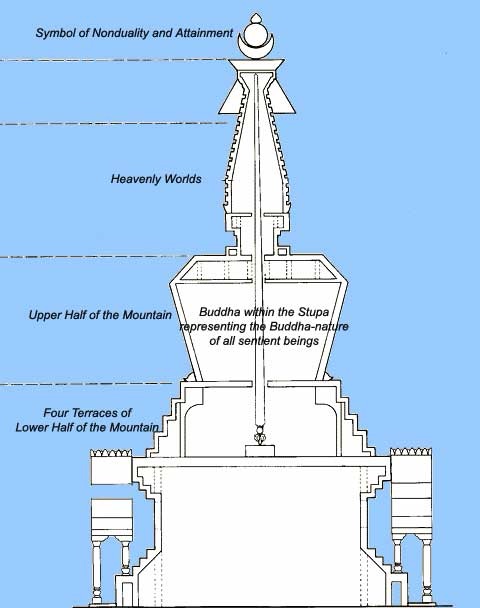
Chortens (Dzo. མཆོད་རྟེན་; literally meaning “Support to The Teaching”) come in all shapes and sizes. Contrary to popular belief, there are more than three architectural types of chorten.

Stupas were adapted in the Buddhist world from earlier traditions as monuments for simply safekeeping the mortal remains of Buddha. Over time they evolved both in terms of physical aspects as well as the content. What is common to all types of chorten in the Buddhist world is that there are five physical structures to represent the five natural elements of earth, water, fire, wind, and space. Chortens in Buddhism are built as representation of the Buddha as seated in a lotus position.

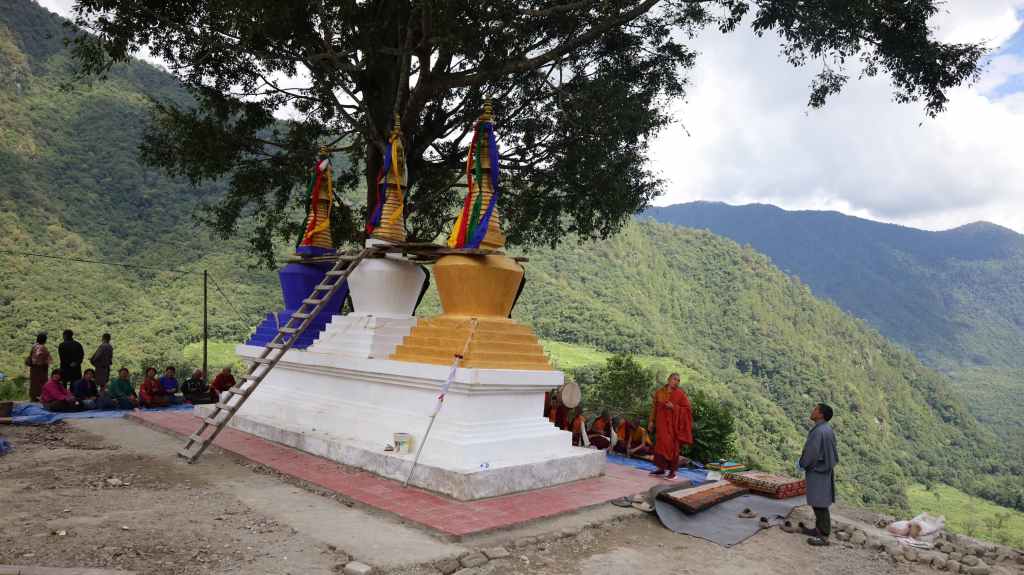
In this post let me share what goes inside a Bhutanese stupa, so that one day you can also build one. These pictures are from the Rigsum Gonpo stupa that my siblings and I sponsored to rebuild in Athang Morakha in Wangdue, as per the advice of my lama, Khandro Dorje Phagmo Rimpoche.

I dedicated the holy Saga Dawa month (the fourth month in the Bhutanese calendar) rebuilding a Rigsum Gonpo stupa in Morakha village in Athang Gewog. The place is associated with two very important figures in Vajrayana Buddhism. First, it is believed to be the abode of Vajrapani (Chana Dorje), which is referred to as Changlochen. Second, it is associated with Mendharawa – one of the principal consorts of Guru Padmasambhava. 

Rigsum Gonpo (Dzo. རིགས་གསུམ་མགོན་པོ) means Lords Protectors of Three Families (or Realms) and refers to Chana Dorje (Vajrapani), Chenrizig (Avalokiteshvara) and Jamyang (Manjushri). The three stupas are the representations of these three important deities in Vajrayana Buddhism.

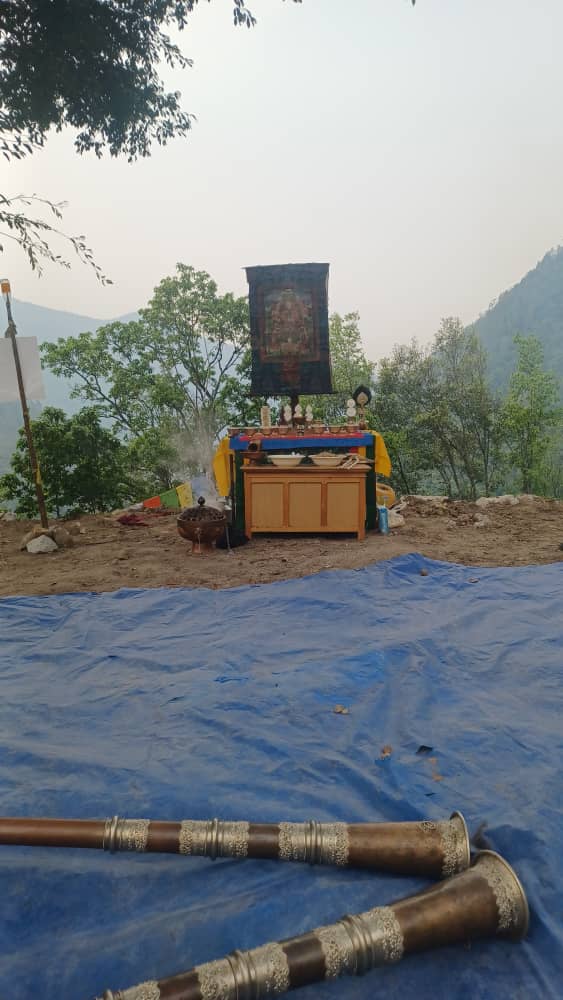
Picture 1 – Every major construction starts with a salang tendrel (Permission Seeking Ceremony) where we ask the consent of the earth deity to build the stupa. We offer 12 sacho bumter (vase of treasure) – four each for the three chortens. This offering is considered as a gift to the earth deity for allowing us to occupy the ground.

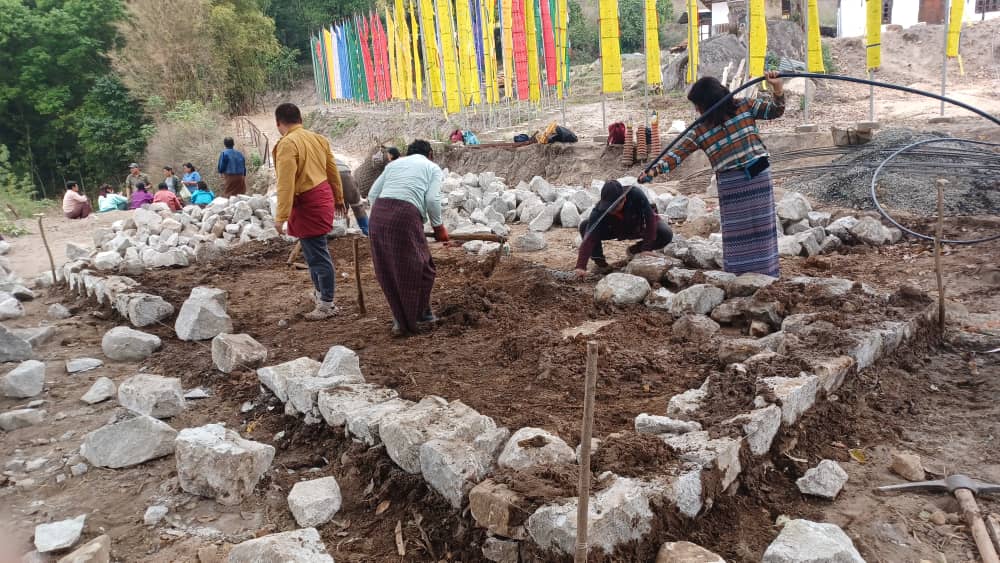
Picture 2 – The first structure over the ground is the Sa-zin (foundation). This stage is important to provide the correct direction of the stupa (called Chho in Dzongkha). It should not face any direction randomly – especially its shadow should fall in the direction of any private homes. A master astrologer or a realised lama should do this to ensure that it benefits all sentient beings and hurts no one. 

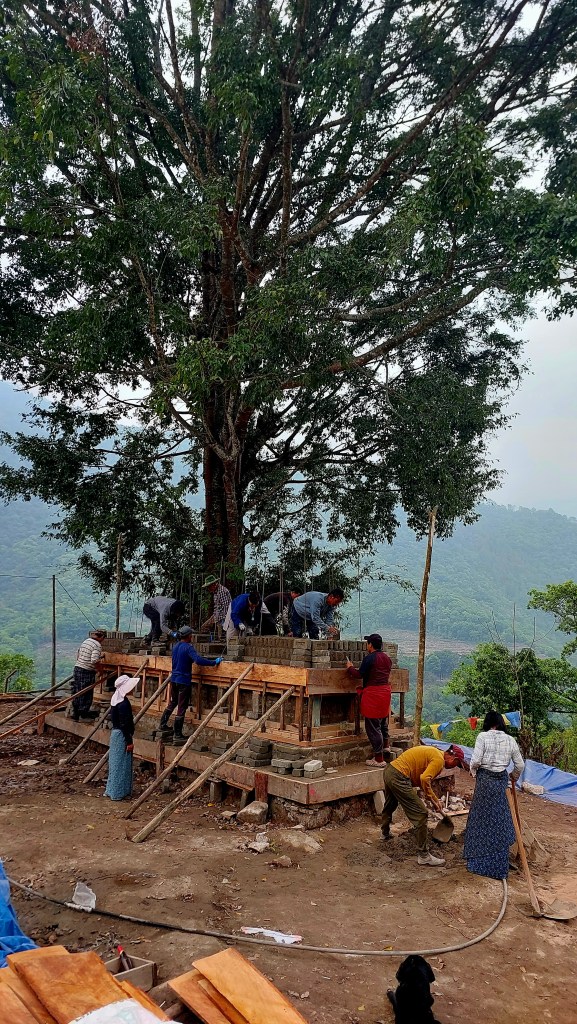
Picture 3 – The next is to build three stairs called them-kha. Here inside the walls we have the first set of zung (relics) going in – consisting of farming implements and an old urn at the bottom layer. After covering this layer with juniper leaves the men and women garment and jewelries are spread – including arms and ammunition.

Picture 4 – Then comes the Thri (throne) where the second set of Zung is buried. Here, inside of it, we offer a full set of religious musical instruments, and as many yangbum (vase of prosperity).

Picture 5 – Every inch of the hollow space is filled with tsatsa (mini stupas) and dried juniper leaves. If juniper leaves are not available dry sand is fine too. The thing to remember is not to leave any space.

Picture 6 – The Thri is sealed and this marks the completion of the first stage of the constriction.

Picture 7 – Over the Thri, we build what we call the Tshemed-Zhi (The Four Immeasurable). It is four-step pyramid and in it we plant the sokshing – the soul of the stupa

Picture 8 – Sokshing means “tree of life” and it is what makes the stupa come to life and bestow the power. It is a wooden pole sliced out of a young juniper tree, around which hundreds of scrolls of mantras, clay statues and precious objects are bound. This is best done by a master artisans, although it may be cheaper to do on your own. I prefer to get it from one master I know.  

Picture 9 – Planting the sokshing is one of the three most sacred stages of the construction of the stupa and hence, a realised lama should preside over this. It is believed the act of “planting” causes disturbances in the Lower Realm, and even the Lord of Death, Yama, can get upset. On the other hand, the upper tip is believed to send power of prayers and mantras, like a radio antenna, to the Higher Realms and the divinities would take a break to witness this sacred moment.  
Picture 10 – At the base of the sokshing we offer Kaypi-Mar (eternal butter) in a copper urn, and four sets of choeb-ting (water offering cups) filled with gemstones and precious metals. You fill the remaining empty spaces with sacred scriptures like Kanjur (Words of Buddha) or Bum Poti (Perfection in 100,000 lines).

Picture 11 – The Bumpa (vase) – the conical shape structure is filled with statues of the deities and divinities.

Picture 12-13 – Above the bumpa is the chug-sum khrolo (Thirteen Discs of Enlightenment) which envelopes the upper part of the sokshing. The completed chug-sum khorlo is in the picture below.

Picture 14 – The golden parasol which covers the Chug-sum Khorlo is placed on top and both are given a golden color. The three stupas of Rigsum Gonpo are also given their respective colors: yellow for Manjushri, white for Avalokiteshvara, and dark blue for Vajrapani.

Picture 15 – Finally, the top-most structure is the golden pinnacle. Usually the Sun, Moon and the Star representing the space are carved and placed there, but increasingly people offer golden pinnacle, which is costlier and believed to accumulate more merits.

Picture 17 – The main sponsor of the construction is honoured with gifts of rice, textile and a white khadar.

May this sacred stupa bless all sentient beings and bring peace and prosperity to this community and country.

Spreading kindness and compassion

For many years now I have been helping young people who are struggling to pay their tuition fees, get to school, travel to colleges outside Bhutan, go for rehab, etc. I accept 3-4 cases a year. I can’t afford more. Wish I could. In recent years I have been doing a little more.

Back then I used to come across them during my official tours (my former colleagues will remember some). In recent years they are mostly referred to me by my friends and former students, because people facing difficulties come from their age group. They come from all corners of Bhutan – Sharchop, Ngalop, Lhotshampa, Khengpas.

I also don’t meet most of the beneficiaries because there is no need to really meet, take selfies and blast on the social media. Some, of course, I do run into them casually. Few months back I met a pharmacist who told me that I paid his travel expenses to go to Chennai for his scholarship – back in 2007.

There is, of course, one commitment they have to make. They have to practise similar level of kindness to two or three random strangers in a distant future when things are settled in their life. It can be to a struggling student, or a family. By making them commit to something like this the beneficiary receives the help with dignity, and with a promise to pass the favour to someone else in future – and not to receive it with shame, victimism or self-pity.

They must also pass the message of spreading kindness to their beneficiaries in future. This way we multiply the act of loving kindness to as many people in the world. Basically, a pyramid-scheme to spread and multiply goodness and compassion.

Nothing is legally binding. It is just a word of honour that I tell them to remember to uphold. I assure them that problems in life are temporary. They will get themselves firmly on their feet and when they do, they must help others, just as they received help.

I haven’t kept the count but I started somewhere in 2004. So, 20 years multiplied by 3 means I helped around 60 people through this simple pyramid scheme. In turn, if they helped 2 each means there are at least 120 kind people, if not more, in Bhutan.

Yesterday, I helped the third word of honour candidate for the year, through a mentee. The beneficiary is a high-school student, who was otherwise getting dropped-out, because the only source of funding – her grandfather, is hospitalised for over two months now. And her parents cannot afford to let her continue in a private school.

I did not meet the candidate, but I fully trust my mentee/referee. The second candidate, whom I met last month, was for buying him an air ticket to New Zealand. He was going on the Earn&Learn program.

I am sharing this personal initiative, one among many similar things I do, encouraged by someone, to lift the mood in these depressing times.

Loving-kindness (Skt. maitrī; Dz. བྱམས་པ་, jampa) and compassion (Skt. Karuna. Dz. སྙིང་རྗེ་ nyingjey) are the core practices in Mahayana-Vajrayana Buddhism. As a country that is founded on these ideals and values, we must never forget to practise them. This is what makes our country (still) a good place to be. We cannot take them for granted, though. We must nurture these values by practising them.

I know it is not easy. Nonetheless, while we maybe limited by our means to help others, we can still cultivate some jampa and nyingjey in our thoughts and prayers.

After all, nyingjey literally means “Supreme Heart”.

🥰😍🥳