Congrats to our young army officer, Jigme Palden, for dragging himself to the peak of Mt. Everest. I say “dragging” because everyone who has been above 5,000 meters will know that it is no more a casual walk after that altitude.
I was joking that the highest point I have been to in my life was 5,300 and with an extra shot of whisky I felt I was on the top of the world. What a feeling it was!
Jokes aside, first, Jigme’s personal achievement is not just about him. His achievement is a reminder, and inspiration, to our youth that there are still places to go, things to do and peaks to summit. It need not necessarily be another mountain, or the Moon, but could be the peaks of science and technology, of business and innovations, or art and music, and films or farming, and many more.
In a country where strong socio-cultural norms and the perceived limited opportunities make you feel constricted, young Jigme (I think he was my daughter’s schoolmate) is a reminder of the immense possibilities and potentials that the world offers and that one should not be holed up in the excuses provided by the society around you and the authorities above you. It is an example of having a dream and pursuing with with determination.
It is about thinking beyond the normal, routine and the acceptable. Nothing great has been achieved by humanity without challenging all the above.
Second, and most importantly, it is about challenging yourself – to wake up early, train hard, work late, put your heads down and keep going.
“You don’t conquer the peak. You conquer yourself”, a seasoned mountaineer once told me long time back. It is not about reaching the summit. It is about knowing yourself, where you can get, what you can do, and who you are at the deepest level – because only when you push yourself to the extreme you know what you are. This is perhaps a person’s biggest achievement in life. Once you figure this out, the rest will follow.
I join the nation in celebrating this proud moment of his achievement and in wishing for a wonderful life ahead of him with more “peaks” to conquer.
May the spirits of your ancestors, and the dharma protectors of this small great nation be with you.
So, it is not just me who is nauseated by this committee thing for every decision to be made in this country – especially with the over-emphasis on it. (See my earlier post)
Well, to share my own experience I have always believed in the old Bhutanese adage – consult others but decide for yourself. In much of what I do at personal – and at professional level, this old wisdom has been my modus operandi.
Sure, it has got me into trouble. I was slapped with 141 audit memos when I led the Bhutan TV project in 1999 (my promotion was held for several years because of these). At work, my colleagues were often caught off-guard when they found themselves lagging behind me. This attracted, and attracts, a lot of envies and jealousies. But never mind. Nothing lasts anyway.
There is one thing one must remember, though: And that is, never to do anything with greed, hatred or self-interest. If you leave those out, the universe will ultimately find you honest and innocent – no matter what you do or how you do. And you will have no skeletrons to hide in your cupboard. You can age with a smile and with a pure heart – a clean chit, with tens of achievements on your cap.
And so is life..
Time does not wait for anyone. As my good friend, blogger Yeshey Dorji, says: the world does not wait for Bhutan.
In life, if you get entangled with what others might say or think, you will age regardless, and soon it will be time for you to pack your belongings and vacate place. No one owns the job one has. Don’t make it too personal. Rather, do what is best for the job – not for yourself.
For those in leadership positions or in a place of power or privileges, cherish it! You are the Chosen One. But don’t waste the opportunity by playing safe, or by playing dirty – or by the holding back the best of yourself. Because when you go – and you will go one day, you want to go with a style, not with regrets and remorse. You should the proudest of yourself when you eventually retire.
The choice, of course, is yours.
By the way, the iconic Taktshang was not built by a committee. 😁😁😁
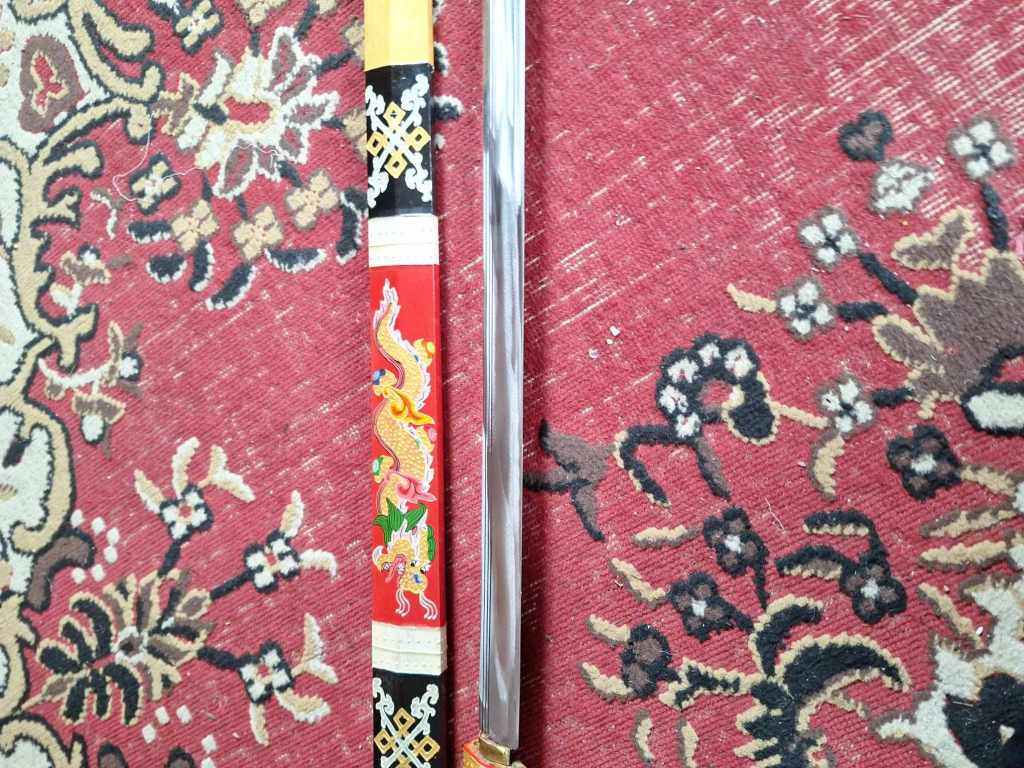
So I needed a few used patangs – ceremonial swords worn by decorated officials. I needed for my next project – another religious construction. After a few direct enquiries with people I knew, which bore no results, I posted my request on Facebook.
And to my surprise, a kind lady, who doesn’t want to be named, responded. Let’s call her Golden Heart. Golden Heart mentioned that she had in fact three patangs and a few karbas (Sharchop word for ladle). She said if they were fine for my project, I could have them. She called me immediately to get my home address.
“Do you want to know how I got those patangs?” she asked.
“I was walking along Thimphu street and I found an old woman in a scorching Sun selling them on the sidewalk,” she said. She decided then and there to buy all the goods although she had absolutely no use of them. She felt sorry that someone that old had to sit under the burning Sun to make ends meet.
“I felt so pity for her,” she added. “The old lady told me that her husband finds old patangs and restores them and sells them. And with the money they earn they survive.”
The karbas came from other rural salesman and were also bought out of sympathy.
What also struck me about Golden Heart is that she comes from the Lhotsham community, who are predominantly Hindu. Who would have thought? And how inspiring is it for me that my works get resonated beyond my own religious fraternity.
More than her religious faith, however, I learnt through our call that Golden Heart is driven by kindness and simplicity. Although she lives on a small pension and is currently broke, while undergoing a long medical treatment she refused any money from me.
To be honest, I am often discouraged by the bureaucratic roadblocks I have to encounter even when I am doing something good for some distant community, or for the nation. However, it is ordinary people like our Golden Heart, their support and simplicity and their words of encouragement that keep me going.
Thank you, Golden Heart. May you be blessed with speedy recovery and a long life. The world needs more of you.
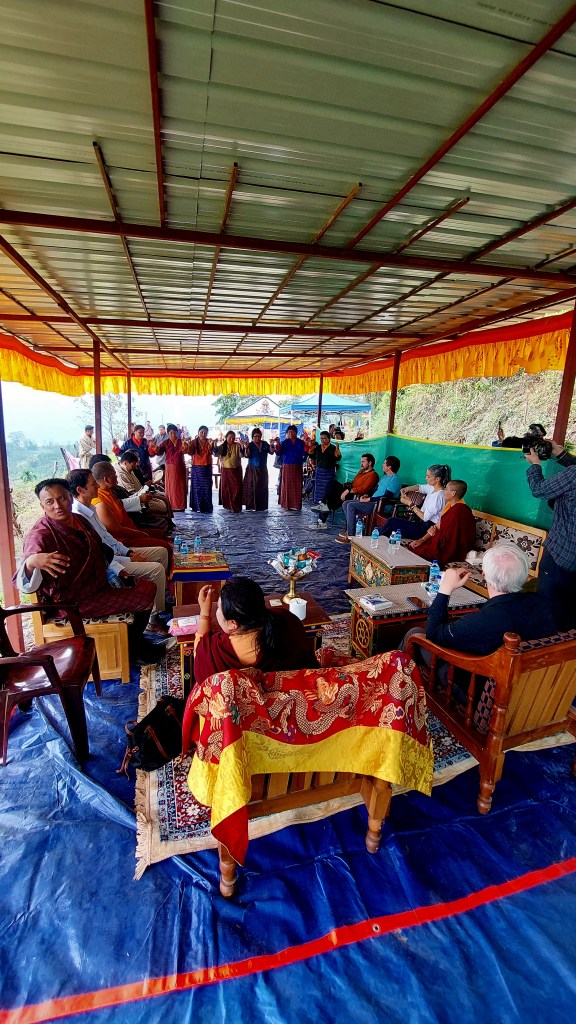
May 2, 2024 – I drove to Athang Rukha to attend the last day of the Mani Dungdrup – organized by a certain Lama Wangdi from Punakha.
I had mainly pushed myself there, despite my heavy schedule, for one reason – the Rukha Lama Ugyen Tshering and seven men and women came and worked tirelessly in the heat of Gelephu to organise the Sacho Bumter for Dorje Phagmo Center the week earlier. I intended to reciprocate their favour, quickly pay respects to Palden Lhamo and Avalokiteshvara and turn back. So, it was just another trip for me. I have been doing this for 18 years now.
The Arrival
However, this time the Rukha Lama had other plans. The villagers were told to receive me with full honors of a VIP-Lama or whatever. So, to my great embarrassment I was received with the blaring sounds of dung-jaling (Tibetan religious horns and trumpets) and ladies singing as they led me in procession to the temple.
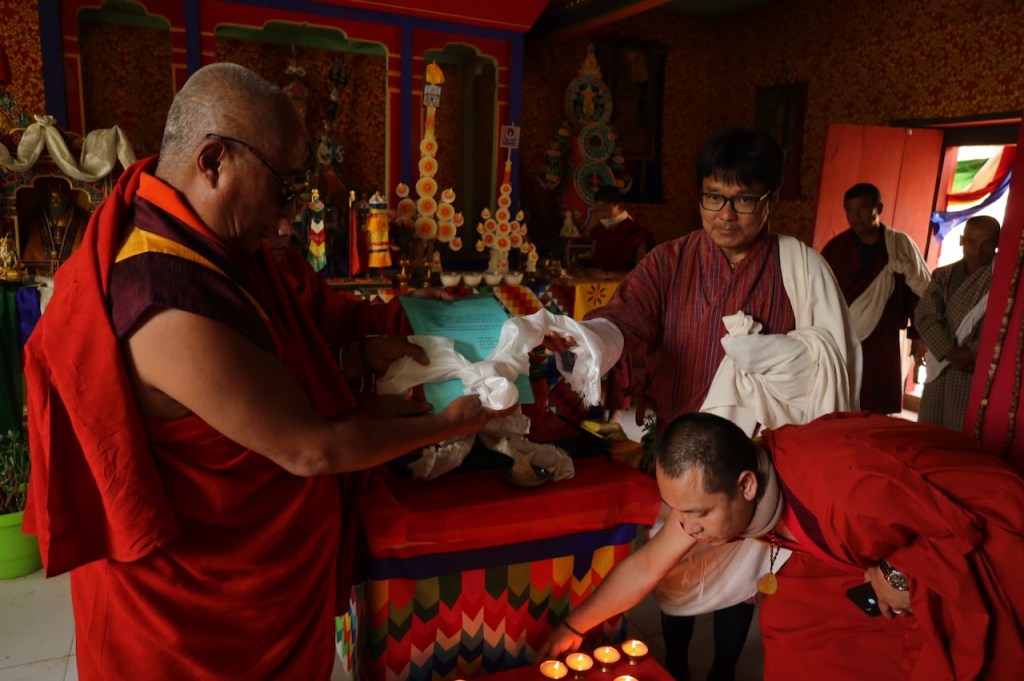
At the venue, the jing-ser ritual was going on and the Presiding Lama, Venerable Wangdi – the former Lam Neten of Tsirang, signaled me to my seat.
When the ceremony was over he explained the significance of the Jing-Ser ceremony to the people, and also acknowledged my arrival.
“We have not met before. So I am honored to meet you in person. The locals here speak very highly of you,” Lam Wangdi told me as he turned to me.
He continued, “Almost nine years back I accidentally discovered this sacred abode of Palden Lhamo, but with no religious events whatsoever. So, I initiated and we did four editions of Mani Dungdrub from 2016 to 2019. I was told you were living abroad then. Then, Covid struck and this is the first one since normal life resumed”.
In 2015, Lam Wangdi, who was then the Lam Neten (District Abbot) of Tsirang Dratshang, was invited to preside over a death ritual in the first village of the valley. While there, he was told that a Palden Lhamo temple was newly built further up in the valley. He felt pulled by some mysterious forces and one day, accompanied by his two attendants, he trekked up to Rukha. He was so mesmerized by the place that he vowed to initiate a Mani Dundrub (Million recitation of Avalokiteshvara mantra) for three years.
He turned to me again, “These people even didn’t know what Mani Dungdrub was, forget about having the religious items to conduct one. I had to carry everything on my back,” he told me. “Now, to see all these temples that you have built, the sacred statues you have put, and a resident lama posted here, it all makes me very emotional. So, I told people before you arrived, “Take good care of this man. Follow whatever he says. Do not let him ever leave this valley. He is a very special person.”. I hope you will continue to support this valley. If you need me, I will come and join you till my last breath”.
I was humbled by his offer. And I felt that he too was drawn here like me by some distant karma from our past lives. He is from Punakha and I am from Trashigang.
The Celebration:
The day continued with celebrating the Birth Anniversary of the Third King of Bhutan, a solemn tribute. This was followed by lunch.
In the afternoon before the Chenrizig Ku-Sung-Thug Wang, which required rest of the day, the Support Committee for Rukha Temple was launched with me as the unanimously-elected Chairman and 45 founding members. Blessing the initiative, Lama Wangdi remarked again to say how proud he was to see the youth of Rukha taking charge of the future of Palden Lhamo Temple.
“Many years back when I first landed here I made a little wish – that the Buddha Dharma flourish from this abode of Palden Lhamo. With the compassionate work of our khenpo (Dr. in Dzongkha) Dorji Wangchuk, and your own good fortune and hard work, I have been telling myself that the wish of this old useless man has been granted. Furthermore, today when you – the young people, informed me that you were launching this Committee to continue the works of khenpo and mine, I told myself that I can die as a happy man because you embody the wishes of our King and of His Holiness Je Khenpo”.
He continued, “Before I came, I was telling myself that this would be my last time because I am not young anymore. I am 72. But now, I have decided to make another wish and that is – before I die I will offer a Rigsum Gonpo (Chenrizig-Jamyang-Chana Dorje) Thongdrel to this sacred place”.
The day ended and dinner was served. I decided to take leave of my new-found friend and before I left, I asked him,
“Lama, did you say that you will initiate the Thongdrel for this temple here?”.
“Yes,” he replied.
“Well, then, I would like to commit Nu. 100,000 from my side for the thongdrel. Let me know when you need the money.”
He was very pleased. “That makes my work easy. I will match your offer with 100,000, and find the rest,” he replied. “So, I was right. You are really something. I don’t know what”.
We both laughed. And wished each other goodbye with a vow that we would continue to work for the valley and for Buddha Dharma.
Leaving Rukha:
As I drove back, alone, along the narrow dirt road towards Wangdue-Tsirang highway my mind always takes me to different moments in the 17 years I have frequented this valley – some sweet, some scary and many of friendship, laughter and selflessness. Like the lama, I too made a prayer when I first landed here in 2007:
“And that whatever was left of my life would be dedicated to uplift this godforsaken community to show them the path to a better future.”
I am glad that 17 years later we are way ahead of that simple moelam.
Some backgrounders
– Rukha is one of the few abodes of Palden Lhamo in the country. While there are sacred chambers dedicated to her, there are only few places in Bhutan that can claim as her abode. Rukha is one of them. The site was blessed by Guru Rimpoche and Pema Lingpa (on his way from Bumthang looking for the site that would later become Gangtey Gonpa)
– Lam Wangdi currently serves as resident lama of Dho-Jagar Lam temple in Punakha. When he comes to Rukha for mani dungdrub he brings everything that is needed for the event – butter lamps, prayer flags, khadar, chadri items, incense sticks, flour to make ritual cakes, etc. The local contribute what they produce – rice, and some butter
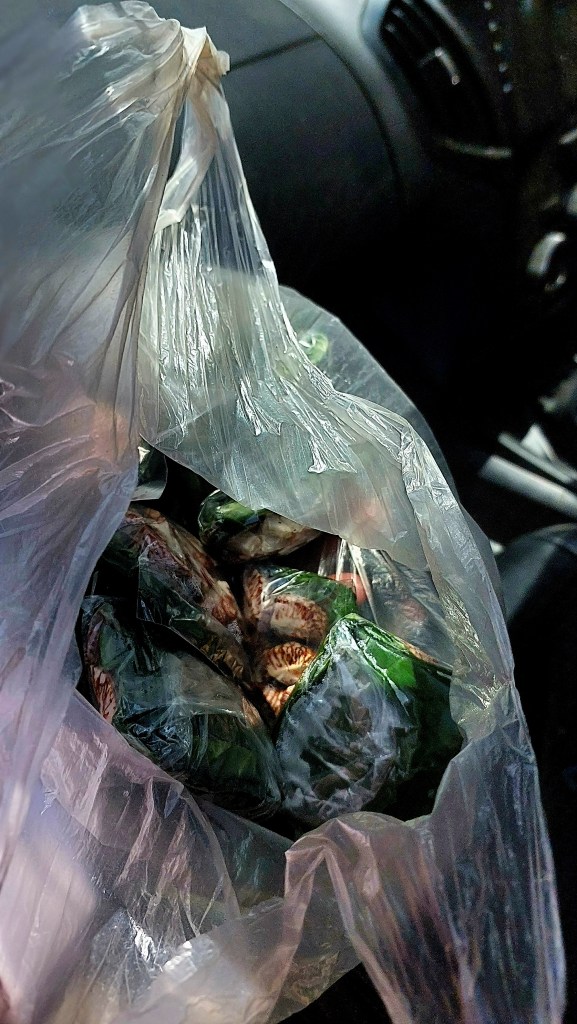
I don’t chew doma (betel nut) but in the freezing temperature of Thimphu dawn, I drove past an elderly woman who was selling it. She said she was feeding her family by doing this. I bought her whole stock.
So, what did I do with all the doma?
Many years back I called my lama, Dorje Phagmo, and asked her to protect me as I undertook one of my endless road trips across the country.
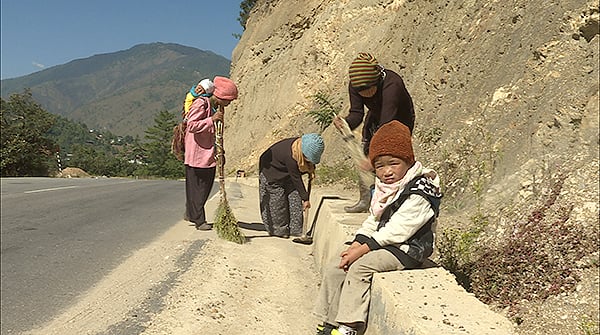
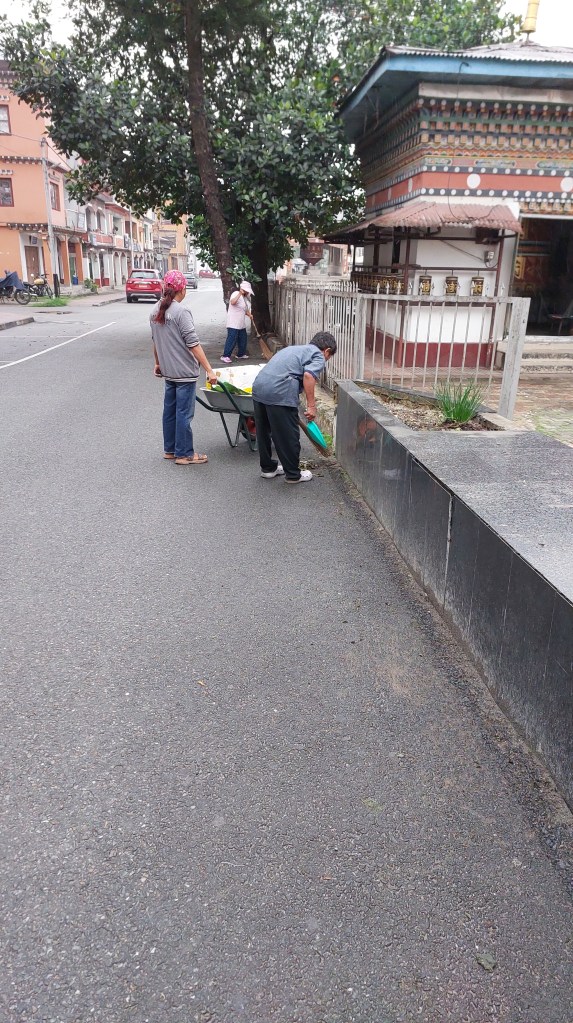
“Do you ever notice the road workers and their children along the highway?” She said. “Take some doma, and juice and biscuits for them. Their gratitude and happiness will be greater than my prayers. You will have a safe journey”.
Now, every time I hit the road, I buy a few cartoon of packaged juice, biscuits, candies and doma (betel nuts) and I stop and say hello to those people who are making my trips safe and successful.
This is where the whole stock of doma I bought yesterday from the elderly lady went – to the people working on the road.
You can’t hit two birds with one stone. You can hit many 🥰🥰🥰
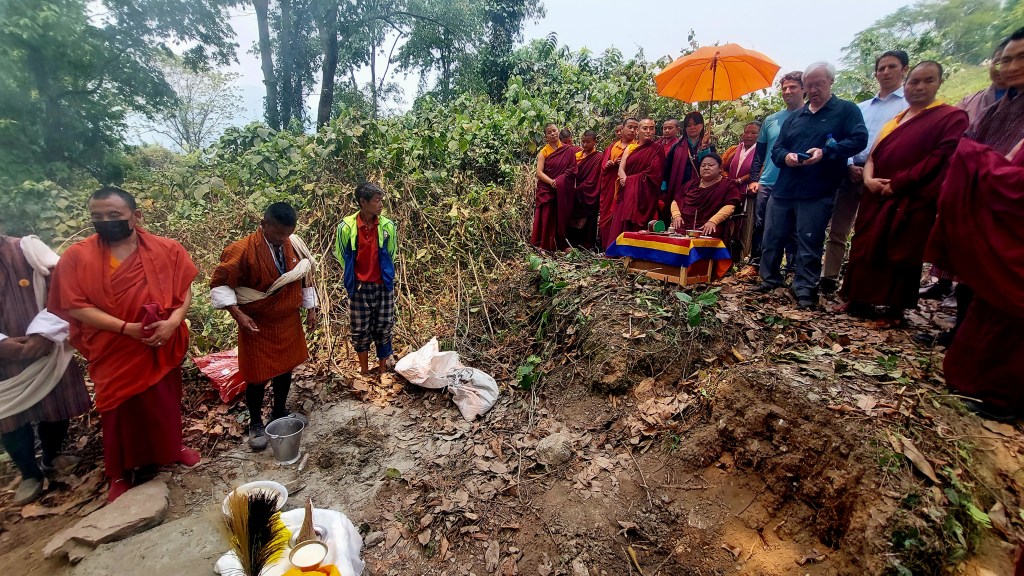
I returned from Gelephu after organising the Sacho Bumter ceremony for my lama, Khandro Dorje Phagmo, who is the highest female Rimpoche in Tibetan Buddhism. It was for the proposed site of the southern branch for Ngajur Pemachopheling Monastery – based in Zhemgang.
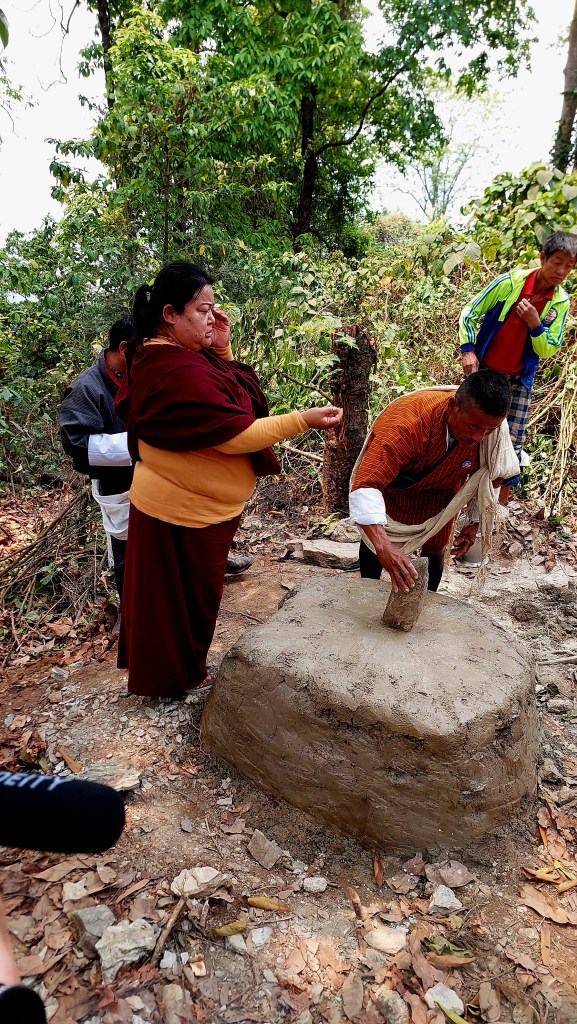
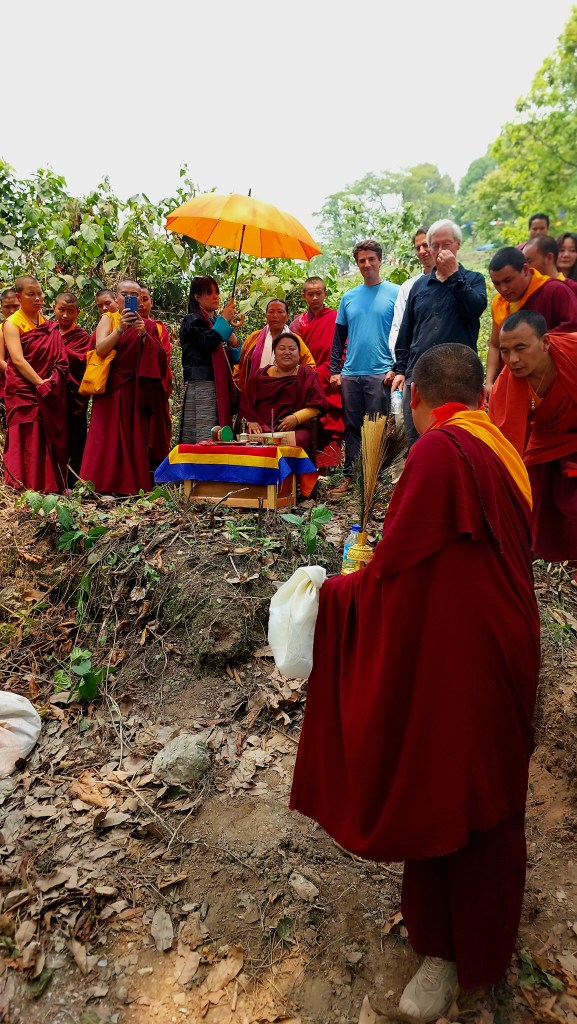
As a part of the ceremony, Riwo Sangchoe rituals and Tshogkor were also conducted to appease the local deities and offer gratitude to the divine – for the success of the project as well as for the Big Vision of our King.
On the request of the public of Serzhong a Thangtong Tshe-wang (long life blessing of Thangtong Gyalpo) was conferred to the people. This, by the way, made me extremely happy and emotional to see the authentic happiness of the simple folks – mainly people from my own ethnic group who were resettled in this area.
The idea to have a monastic centre there was conceived some years back by Khandrola to keep the old and sick nuns during winter. The idea gained traction after Gelephu was decreed as the mindfulness city based on Vajrayana ideals and philosophy. Hence, to align with the Royal Vision, the Dharma centre will not only be a nunnery, or a monastery, but more significantly, it will also accommodate a center for traditional wisdom and mindfulness, which I will be directing.
Much will, of course, now depend on the support and encouragement it receives from the Mindfulness City project and from the local communities, as this is not a commercial venture for personal benefits, but for the collective peace and prosperity of the country, and for the benefit for all sentient beings.
While this initiative overwhelms me, for now, I feel deeply deeply honoured and humbled to be a small part of both the visions.
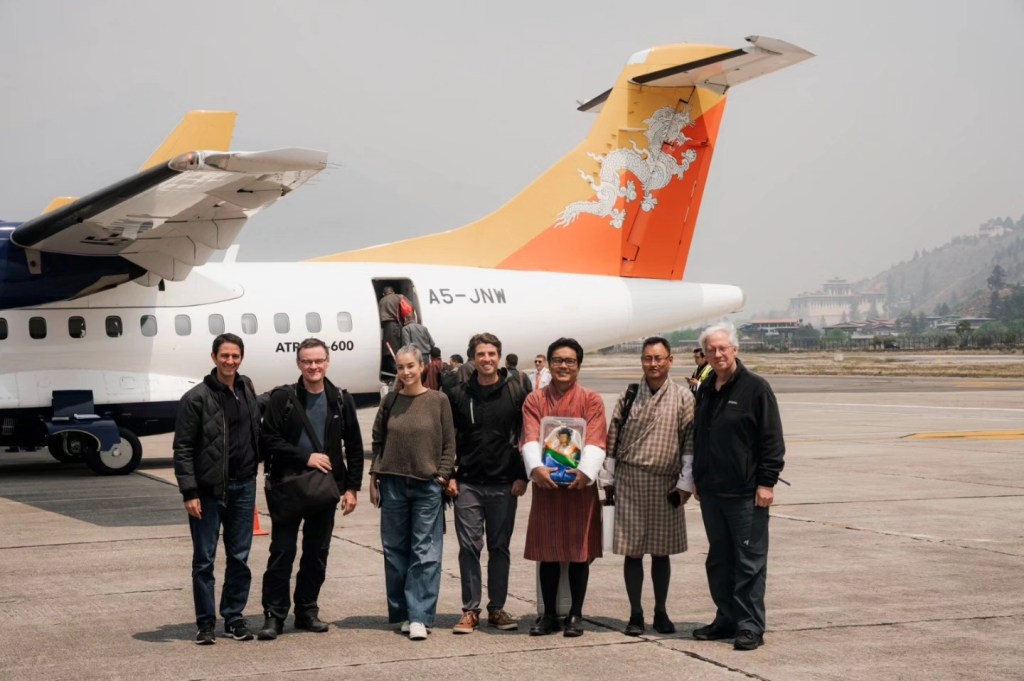
For the ceremony we were joined by my small group of friends from Abroad, who travelled from all over the world. I also received full support from my good friends from Athang Rukha, who came in droves to see that the ceremony in the jungles of Gelephu is pulled through. It was not easy for everyone with the heat and insects and with nothing available in the vicinity.
(I was also surprised to see many people from Lhotsham community coming to receive the blessing. They explained to me that Varahi is an important Hindu deity too. In Buddhism Dorje Phagmo is Vajra Varahi)
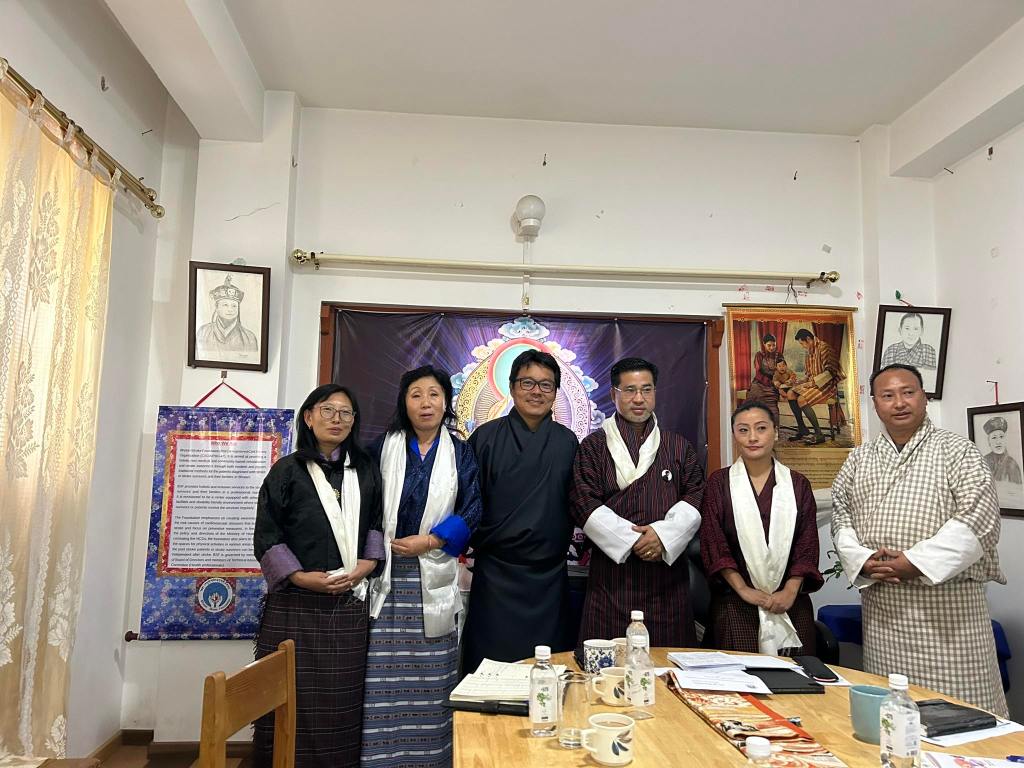
I spent my Saturday afternoon joined by four like-minded individuals (our goodwill ambassadors) to help the Bhutan Stroke Foundation achieve its goal of raising the Nu. 4 million Endowment Fund by October 2024. This is required by a recent government directive to all the CSOs in the country. If the goal is not achieved the foundation might have to close. But closing is absolutely not an option for now. On the other hand, I suggested to BSF to take this new requirement as an opportunity to work towards the sustainability of the foundation.
We must let this foundation continue their work. This is because everyday, there are several cases of our own people getting hit by brain stroke – of different magnitude – somewhere in the country. While stroke is terrible for just anybody, for the less affluent section of the population it is a huge burden on the family – financially as well as in terms of after-stroke care. One person who is recovering confided to me that seeing his wife struggle taking care of him, he wished many times that the stroke should have actually killed him instantly. How sad can one be to wish for one’s own death?
The Bhutan Stroke Foundation takes care of such people. True, we have a free medical service in the country but stroke leaves behind different types of devastation and aftermath, some of which are unthinkable, and for which the State and our medical system cannot attend to every such case. This is where NGOs and citizens can come together and help. Hence, I would like to invite all my friends to make your donations – no matter how humble, and indicate it to the secretariat that it is the Endowment Fund. I also have one additional request, and that is when you send your donation send it with a prayer that it helps as many sentient beings while also wishing that no one in your family or circle of friends get hit by such a malicious condition.
(By the way, I have made my donation to the Fund when I accepted to become a board member. My grandson’s birthday is coming up soon and I will be making another donation in his name (we always donate instead of celebrating birthdays), and for the good health and happiness of my family – and my large tribe – with a moelam that no human being go through such a terrible malice)
Jarogang Temple is located in the village by the same name. It is in Athang gewog – and one can see it perched on the hill across the river, when driving along Wangdue-Tsirang highway and when you reach around Kamichu.
Jarogang takes its name from Legon Jarog Dongchen – one of the three supreme protectors of Bhutan. This deity together with Yeshey Gonpo (Mahakala) and Palden Lhamo (Sridevi) make up the trinity of protector deities for Bhutan as established by Zhabdrung Ngawang Namgyel (1594-1651).
During the Second Tibetan invasion in 1934, Semtokha Dzong was captured and occupied. Zhabdrung Ngawang Namgyel felt that his presence in the country was causing too many troubles for his hosts and may lead to more deaths in his name. So he decided to leave for India – enroute to Ladakh where the King there, Senge Namgyel, had invited him. Like many of his predecessors Zhabdrung Ngawang Namgyel intended to go on a lifelong retreat to Mt. Kailash, which was then part of the Ladakhi Kingdom.
However, when he reached a stream after descending from Jarogang village, the deity Jarog Dongchen appeared to him and requested him to stay. The deity assured him that he would take care of the invaders. Zhabdrung, then, is believed to have returned to Jarogang and stayed in the house of Zomlha Chugmo (literally meaning Wealthy Lady of Zomlha). Few days later Zhabdrung again felt he was not only freeloading on the local people but also causing too much burden. He again set off only to be met with the deity at the same spot, who then informed the Zhabdrung that Semtokha Dzong has been razed down by a fire and all invaders have been killed. Zhabdrung named the small stream where he heard the news as Deychu – to indicate the stream where he received the good news. Zhabdrung returned to Jarogang and informed his hostess that he had decided to return to Chari.
The “kutsab” and the sacred relics of Zhabdrung
On the day of his departure, the hostess begged him to stay there and offered him the large house from where Zhabdrung could base his dharma activities. It is believed that Zhabdrung made two statues which resembled himself out of the rice dough and presented them to the hostess as his kutshab (representative). The statue, he promised, would carry the same sacredness of blessing as receiving it in person from him.
While one of the statues is still there today, the other is believed to have flown away and landed somewhere in Tsirang. No one knows about it. However, the people of lower Wangdue and Tsirangtoe believe that the area would have good harvest and all nine grains because somewhere there is this second statue “stuck on a tree”, according to the legend.
The other amazing relic (for me) is his phurpa (ritual dagger), which seems to be very powerful. There is also a conch, a bell and a cymbal, which were all gifted to the Zomlha Chugmo. There is also a small metal statue called kharsapani, which is also believed to be self-arisen (rangjung). Some sources say that there were more relics and belongings of Zhabdrung but were apparently taken to Lama Lhakhang in Wangdue Phodrang Dzong – and brought here when the new dzong was built to be used as nangten. Nevertheless, in my view, Jarogang Lhakhang still has the biggest collection of relics associated with Zhabdrung – making it a recommended pilgrimage destination for every Bhutanese – irrespective of the faith, sect, or religious affiliations. In fact Zhabdrung was the founding Father of Bhutan – besides being the emanation of Avalokiteshvara and Guru Rimpoche.
The trees of Jarogang
The visit to Jarogang is incomplete without visiting the jackfruit tree, which is believed to have grown out o a seed planted by Zhabdrung Ngawang Namgyel. Even today the lama and the monks of Jarogang make the offering of the first harvest to the Machen Lhakhang – where the mummified remains of Zhabdrung is preserved today (he was never cremated). This tradition has been continuing for over three hundred years now.
There is also a tall cypress tree below the temple, which is believed to have grown out of the Zhabdrung’s walking stick. Legend has it that with numerous wars and invasions, he doubted if his mission to establish a Drukpa state would be successful. Thus, he planted the walking stick and is supposed to have made a moelam (aspirational prayer) that if he were to succeed a tree would grow out of the stick.
(Triviality: The exteriors of Jarogang temple retains the mud color without getting the white lime wash. The folk theory is that the local deity of Uma demanded that Jarogang temple should not get a whitewash. In retaliation the deity of Jarogang demanded that Uma Gonpa won’t get a sertog (the rooftop pinnacle). So even today Jarogang temple is not whitewashed, and Uma Gonpa has no sertog)
Getting there
Along the Wangdue-Tsirang highway, before you reach Kamichu there is a cantilever bridge and on the other side of the bridge is marked as the headquarters of Jaypee construction company. Cross the bridge and drive for some two kilometers till you reach a diversion – marked with two signboards. To the left is to Jarogang, and to the right is Athang gewog office.
Morakha takes its name from a remark made by an attendant of Guru Padmasambhava. It was during the time when Guru Rimpoche and Mendarawa were in the area. Mendarawa was in the village, while Guru was meditating in the mountains between Phobjikha and Athang. When the Guru inquired about Mendarawa, the attendant is supposed to have replied, “She is (Mo-ra) in the village (Khar)”. Thereafter the place where Mendarawa dwelled was named Morakhar, and later simply Morakha.
Morakha Temple stands over the village of Lomsokha in the main Athang valley. The site is believed to be the spot where Mendarawa practised the Vajrapani saddhana – known as Chana Dorje drub in Bhutanese. A temple was later built on the spot by the followers of Mendarawa and Guru Rimpoche. The exact date is not known.
Coupled with the Athang Tsho (lake), which is at the other end of the valley, the region was a mandatory destination of all emanations of Terton Pema Lingpa, and the followers of the Peling tradition. The area, therefore, received hundreds of pilgrims each year – thus adding to the prominence and economy of Athang region since the mediaeval era. It was only in the post-modern era that the region saw the decline, as the natives were lured to the urban areas of Thimphu and Wangdue. During the same period, pilgrimages from Tibet stopped for reasons known to everyone.
Mendarawa, and Adha mathra and Adha Rachu:
In front of Morakha temple is the boulder that is believed to be the handloom of Khandro Mendarawa, the spiritual consort of Guru Padmasambhava. While the Guru spent his time in the mountains of Athang (also colloquially pronounced as Adha), Mendarawa spent her days practising the Vajrapani mantra, and by night weaving the traditional clothes. The stone relic can be seen even today. Some local sources claim that the origins of the popular Adha mathra and Adha rachu – a traditional handwoven textile and pattern have their origins here in the works of Khandro Mendarawa. And because of their association to Mendarawa, these patterns of traditional textiles have spiritual blessings and are auspicious for special occasions.
According to one source, Athang Morakha is only place visited by Mendarawa. All other important sites of Guru are associated to either Yeshey Tshogyel or Tashi Khyidron. This makes Athang a very special valley
Betel leaves:
Another very popular item associated with this place and to Mendarawa are the betel leaves, which are believed to have been planted by her. The only surviving plant, which is standing in front of the temple, is jealousy guarded, as many attempts to graft and reproduce have been unsuccessful. The betel leaves from this plant are used for making mendrub (medicinal pills) or rilbu (blessed pills). Another local claims that the betel leaves available in the wild in the jungles of Athang gewog are equally blessed by Mendarawa – and they are used for Zhugdrey ceremony in Gangtey Monastery during the annual Gangtey Tshechu and Drubchen.
Chana Dorje relic (ter) statue:
The most prized possession of Morakha Lhakhang is a finger-sized relic statue of Vajrapani (similar to the one in Bartsham temple in Trashigang). It is tucked away in a secured safe and can be seen only on special occasions.
Vajrapani is referred to, in abbreviated form, as Chador in Bhutanese, and every newborn that receives his or her name from this temple is called Chador. So, every other person in this gewog is called Chador, and almost every Chador you meet may be from Athang gewog.
According to the caretaker monk, the sacred Chador statue is believed to have been retrieved by Terton Pema Lingpa from Mebar Tsho (lake) in Bumthang. “One statue flew to Tsakaling in Mongar, another to Paro Dongkala, and the last one came to Morakha,” he adds.
When the original Morakha temple was destroyed by fire this relic statue is believed to have flown away and stayed safe on a nearby tree. It was later discovered by the resident monks and brought back to the temple.
Vajrapani is also a popular deity, who is revered as a part of the supreme Trinity of Protector Deities called the Rigsum Gonpo (རིགས་གསུམ་མགོན་པོ་) – literally translated as “Lords of Three Families” with the three families being Avalokiteshvara, Manjushri and Vajrapani.
The affiliation to Gangtey Gonpa:
The association of Morakha Lhakhang to Gangtey Gonpa started with the life and works of the Second Gangtey Trulku, Tenzin Lekpai Dondrub (1645-1727), who is considered as the most prolific of all the previous Gangtey Trulkus, and who operated mainly in this region. Although a realised being, he lived a simple life of an itinerant monk – who are locally referred to as gomchens.
His works and the patronage he received from the Athang area became the inspiration for the popular adage, “Lama Ganteyb. Jindha Adhap” (Lama from Gantey, patrons from Athang). Today the monastic center is affiliated to Gangtey Gonpa, and the current Gangtey Trulku Rimpoche initiated the reconstruction and the expansion of the temple into a proper monastic institute.
Who must visit?
While Chana Dorje practice is recommended for everyone to pave the path towards ultimate enlightenment, the blessing is a must for those born with birth-mewa 2 and 4. It is strongly recommended that people born with these mewas make a pilgrimage to this sacred place and/or to Bartsham Chador Lhakhang in Trashigang. This is because Chana Dorje is the deity of those born with birth mewa 2 and 4. Birth mewa 2 are those born in the 1944, 1953, 1962, 1971, 1980, 1989, 1998, 2007, and 2016. Birth mewa 4 are those born in 1942, 1951, 1960, 1969, 1978, 1987, 1996, 2005, 2014, 2023
Getting there:
The total drive time from Thimphu is just 3-4 hours making it a nice day trip. There is a farm road that takes off from Kamichu on Wangdue-Tsirang highway. It is pliable with small cars (maybe not during the wet season).
When you get down to the valley floor from the Lapsaka Pass, look for a signboard. Take the road to the left marked as Athang Morakha Changlochen Chador Lhakhang.
What to take:
Take rice, flours, lentils, cooking oil and food supplies for the monks there. There is a community of monks headed by the abbot – with no subsidy from the state.
Where to stay: There are decent guest rooms at Morakha Lhakhang in case people want to stay overnight, which I highly reccomend. Contact person: Lopen Sonam Drugyel 17480524.
The bridge to cross towards Athang from Wangdue – Tsirang highwayAfter dropping down to Athang valley floor, you will get to this cross road.
The famed Athang Tsho (lake) is a beautiful subtropical lake, and some 6 acres in size, in Athang Gewog in lower Wangdue. It is located above Lopoka village on a plateau at the edge of several paddy fields.
The legend:
Legend has it that the tshomen (literally meaning Lake Woman, but referring to the deity of the lake) moved here from a distant place where there was no peace or sanctity because of sacrilegious acts by the locals. Disguised as a young highland girl, with a herd of yaks, she arrived in Phaktakha village in Athang and sought shelter for the night in a house belonging to an old lady. The lady offered a room in the basement.
Next morning when the old lady went to check on the girl, the latter was nowhere to be seen and instead a small pool of water was in the basement. She then rushed out of the house and to her astonishment found her rice fields were covered with a huge lake. The yaks were there but not the girl. The old lady instantly knew she was dealing with a tshomen.
Angry and mad, she called out to the tshomen and told her to come out of the lake. The girl appeared and told the old lady that she found this place to be very pure and peaceful and begged her to let her stay. As a price for the land on which the lake was to be hosted, the girl offered a horse that laid a golden egg every month, plus the yaks. There was only one condition: the old lady must never reveal the horse to anyone and was to be kept hidden away in the basement. The old lady agreed and accepted the offer.
As months and years passed the old lady increasingly became wealthy and was the talk and suspicion of the village and then the valley. No one understood how, but in one village gathering the old lady accidentally revealed something that made everyone curious. When she was standing up to leave, she was asked why the hurry or the need to leave? She made a slip of tongue and told them that she needed to feed the horse. The villagers always knew that she never owned a horse and so, one of them decided to snoop in. He found that she in fact did own one in the basement and to his great surprise the horse also laid a golden egg.
As the horse left the house and the village, however, it refused to move and the men pushed and flogged the horse till the next mountain. At a point from where the lake can be last seen the horse is believed to have wept. On this spot a small lake was formed. The place is still visible today.
From here there are two versions of the story. One that says that the horse died of intense flogging and the other that claims that the horse was beheaded after it refused to move. Whichever is the correct one, there is a grassland with a peculiar grass that is reddish in colour. This is believed to be the blood stain of the horse after its hide was spread here to dry.
The saddle and the sling of the horse were believed to be in Wangdue Dzong. And the house, or the descendants, of the old lady are believed to be in Phaktakha, a village just above the lake.
Social and cultural significance:
The lake is believed to be the Lhatsho of Peling tradition of Vajrayana Buddhism and hence it is a very sacred lake. Until the late twentieth century it was a mandatory pilgrimage destination for the Lhalung Sungtruel line of lamas and the reincarnation of Thuksey Rimpoches. The valley received lots of pilgrims from Tibet and from other parts of Bhutan. This explains the prosperity of Athang region, which despite its remoteness had the fame of producing lots of Wangdue Dzongpons and noble families.
Locals consider the lake as the most important part of their village. They say that the Tshomen has made Athang gewog very prosperous since ancient time despite a very small population. Even today, The sacred lake is believed to bestow the devotees the blessings of wealth, beauty and loyalty. It is also very much part of the local mood too. When there is an impending death or a pandemic the lake has been seen to change its color to a dark hue.
There is a simple altar built at the lake for people to conduct simple rituals and ceremonies. I recommend the Riwo Sangchoe prayers that are believed to bless honour the nature around and the non-human forces and spirits.
Getting there:
The total drive time from Thimphu is just 4 hours making it a nice day trip. There is a farm road that takes off from Kamichu on Wangdue-Tsirang highway. It is pliable with small cars (maybe not during the wet season).
When you get down to the Athang valley floor, from the Laptsaka Pass, look for a signboard. The road to the left is to Lomtsokha where there is the Chana Dorje temple of Morokha. After that you will pass a bridge, and from there you will reach another junction. To go to the lake go right. There is a 5-minute walk from where the road ends.
This trip is highly recommended, as you can tie up with a visit to the sacred Morokha Temple in the same area, where there is the relic statue of Chana Dorje – believed to have flown there from Bumthang.
What to take:
Get plenty of plain cooked rice, plain crackers or sweet biscuits for the fish population in the lake. Make sure there is no salt on anything you feed.
And, of course, fresh cow milk for the Tshomen (Lake Woman), and incense sticks.