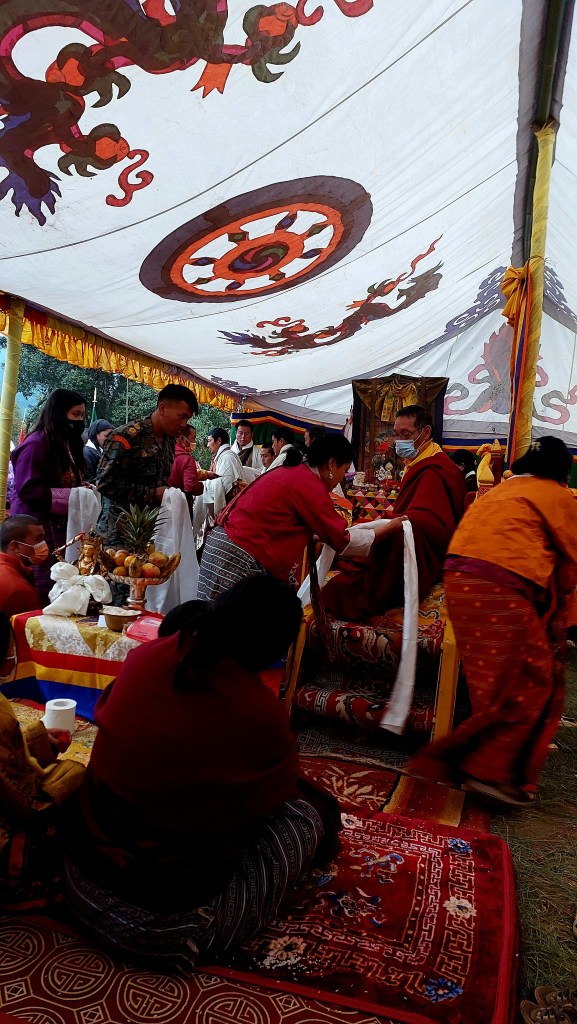
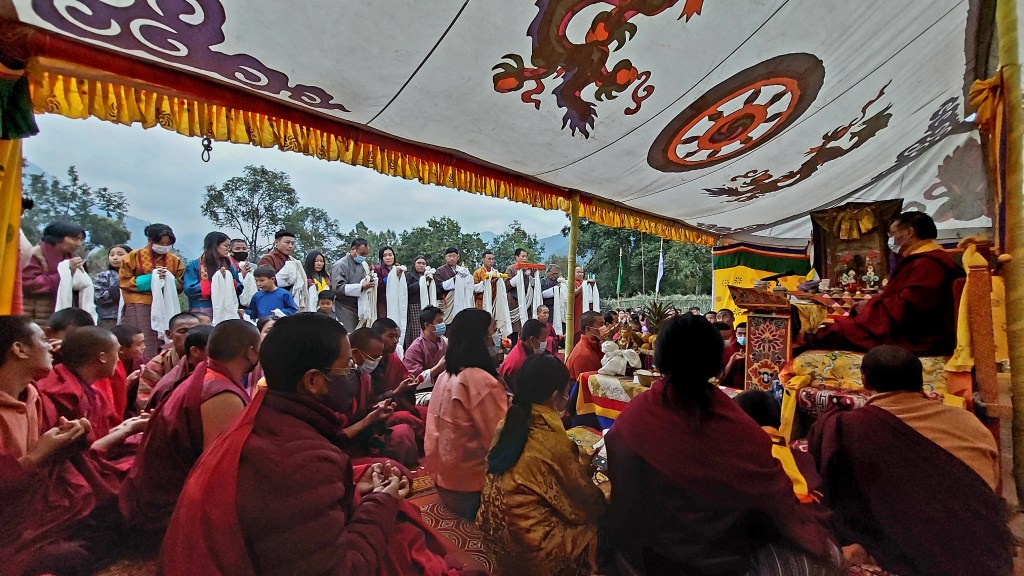
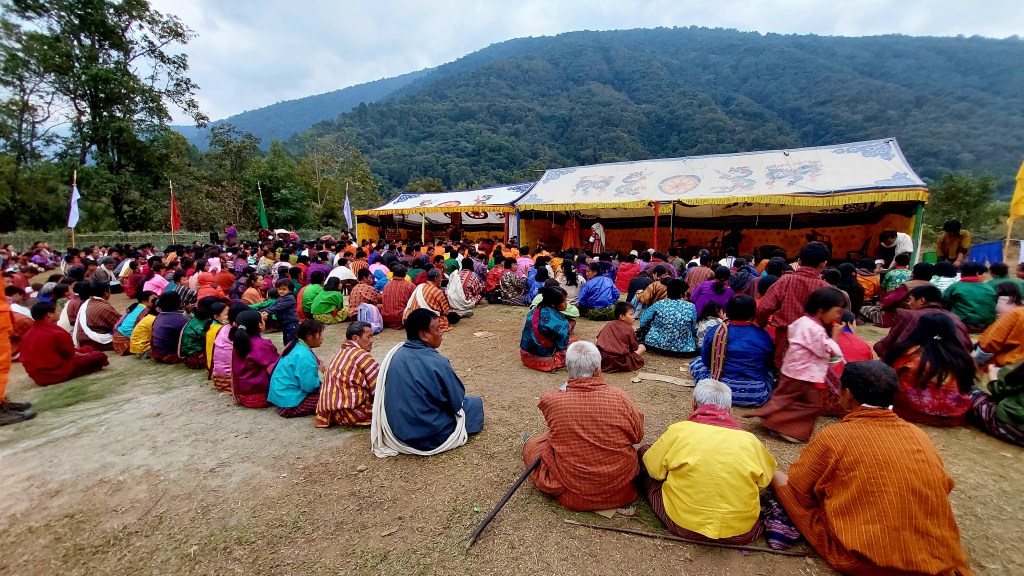
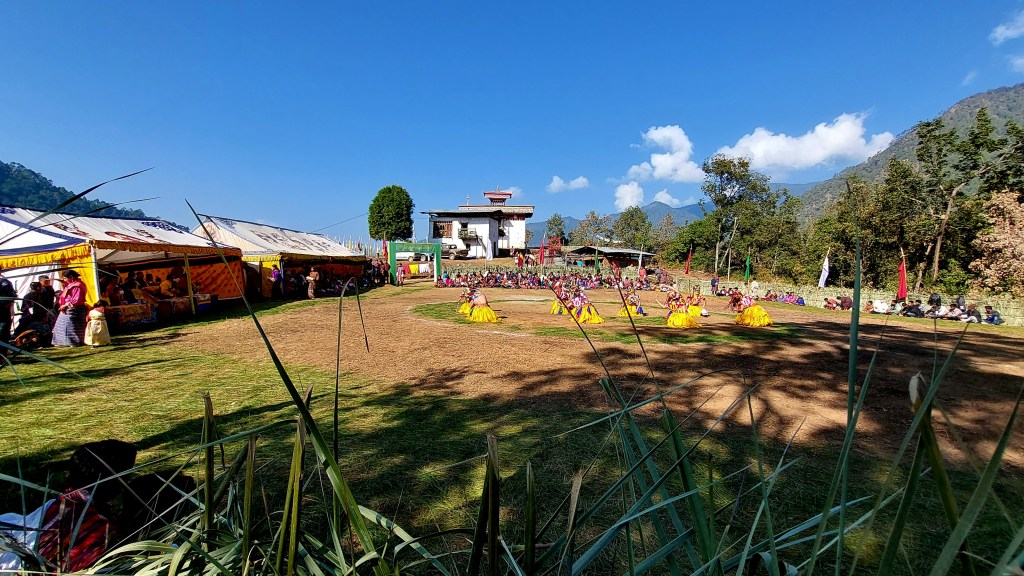
Athang Rukha, Wangdue, 23 December 2022. Tshe Wang is a Buddhist religious ceremony whereby a lama confers a life empowerment blessing to disciples and devotees. Literally translated as “life confidence”, Tshe Wang ensures the recipient to be healthy and confident to lead a life towards self realization and of service to all sentient beings.
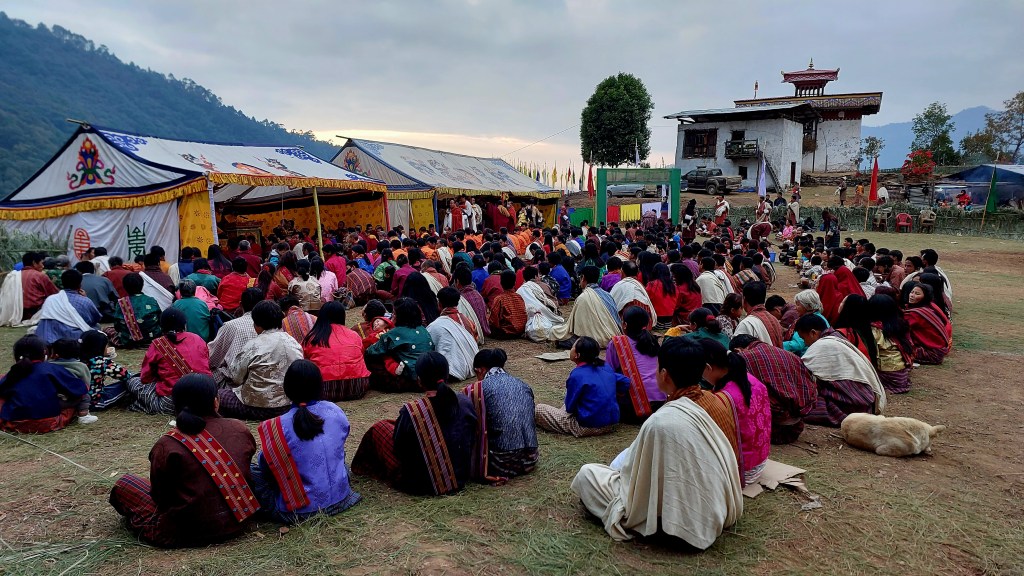
I had requested His Holiness Gangteng Trulku Rimpoche to confer a Tshe Wang to each and every person in the Rukha, on the last day, so that no one gets back to being what they were before I arrived in the valley in 2007. Meaning in abject poverty.
Rimpoche smiled, perhaps amused by another wierd request from me. 😂😂😂
Over the last few years I have also been reminding the people of Rukha that it is difficult to prosper but it is very easy perish, and destroy one’s hard work of many years and decades in an instant.
Furthermore, the village of Rukha has a history of vanishing. Between 1931 and 1933, a terrible epidemic wiped out the original inhabitants. The village remained desolated till all the land were granted to the Oleps by His Majesty the Fourth King in 1982. Until then the Oleps were forest dwellers practicing hunting and shifting cultivation – a practice that is locally known as tseri.
The presence and the blessings of a high lama is believed to deter any such terrible epidemic to occur again.
His Holiness not only agreed to bless them individually but even offered more. “Let me add Ta Cha Chung Sum Wang, since these people are farmers and have to disturb the earth and the environment,” Rimpoche said.
Ta Chha Chung Sum, which stand for Tandrin (Hayagriva in Sanskrit), Chhana Dorje (Vajrapani), and Jachung (Garuda). Their powers are believed to help the humans to ward off all negative forces from the nature and the supernatural. If this was the case then I thought the Ta Cha Chung Sum would also be useful to the Dessung boys and girls who have just started to work on a fishery project at the mouth of Harachu Valley. We invited them too for the blessing.
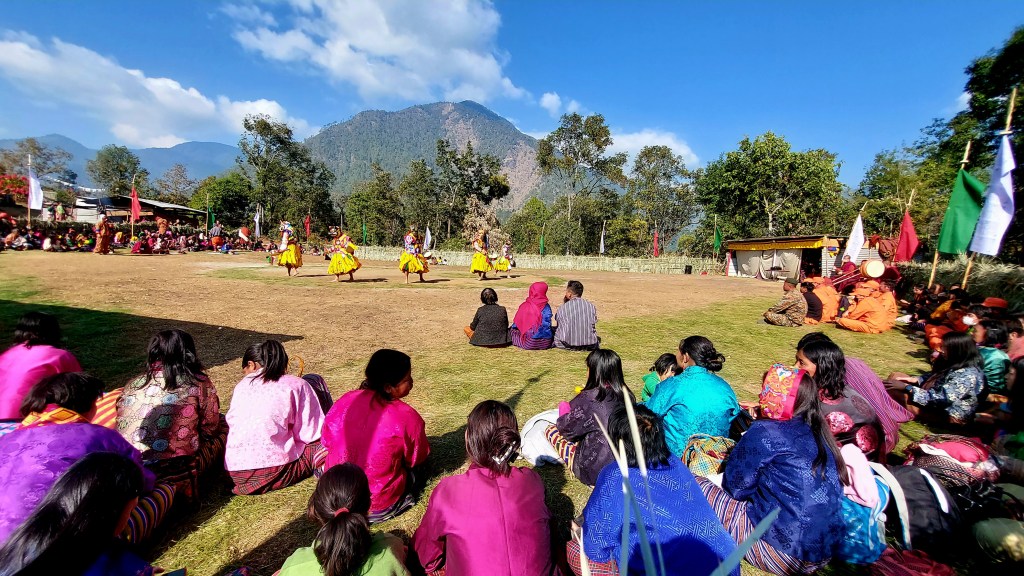
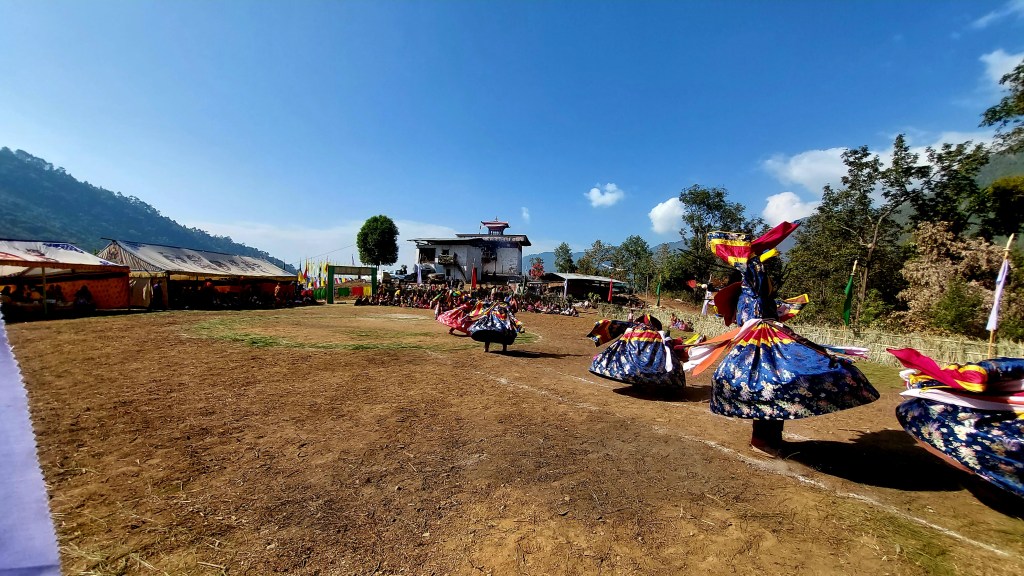
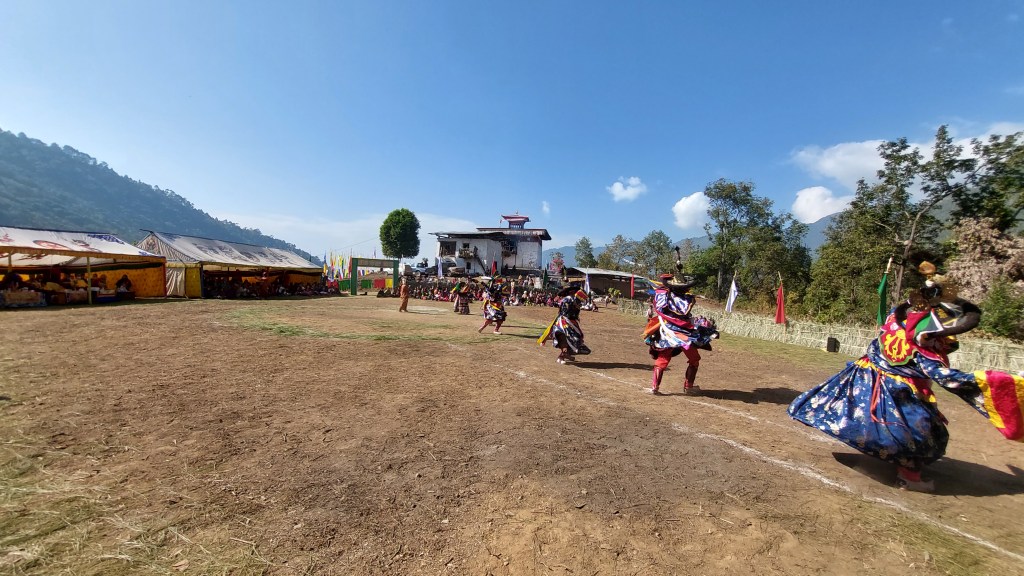
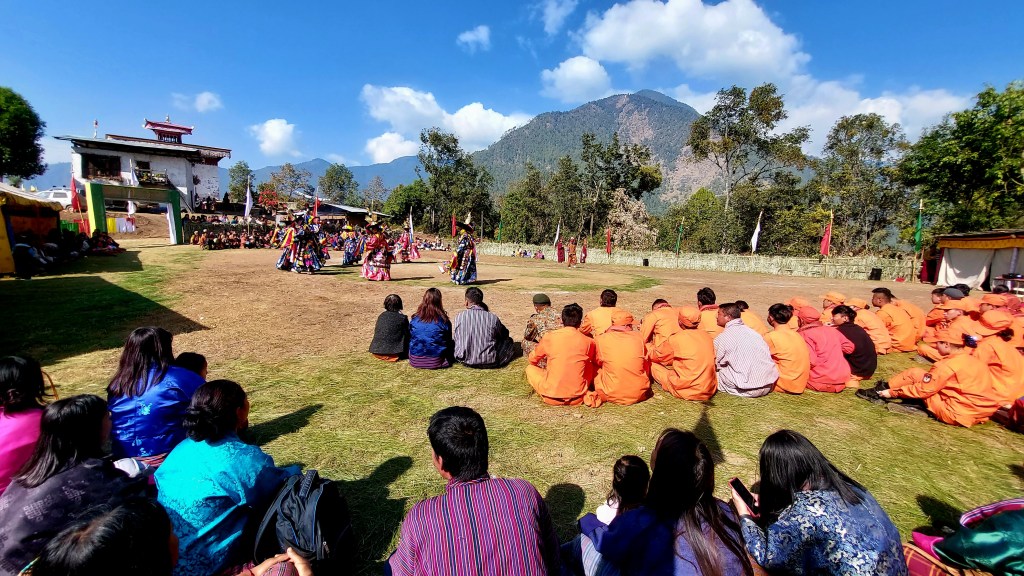
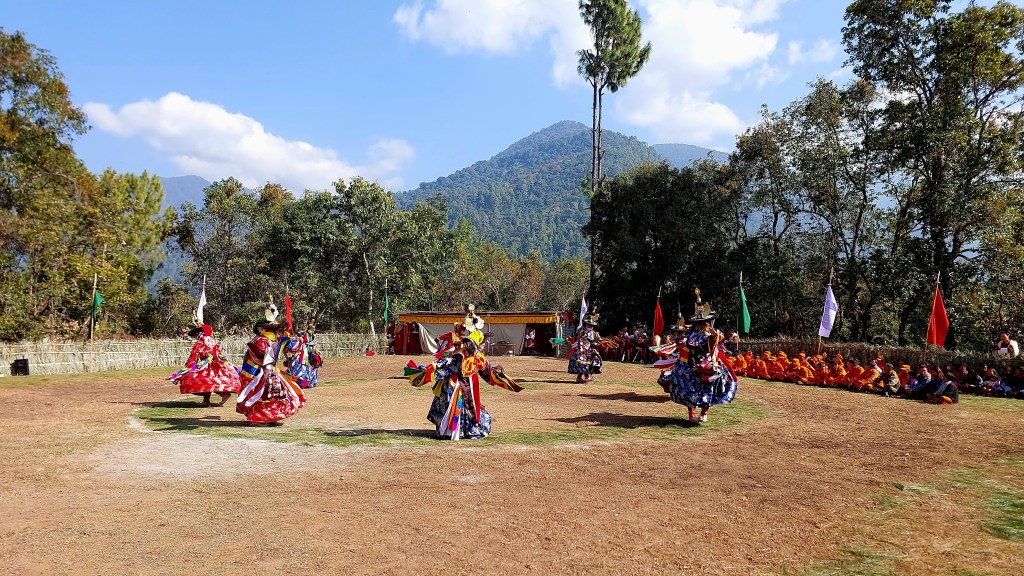
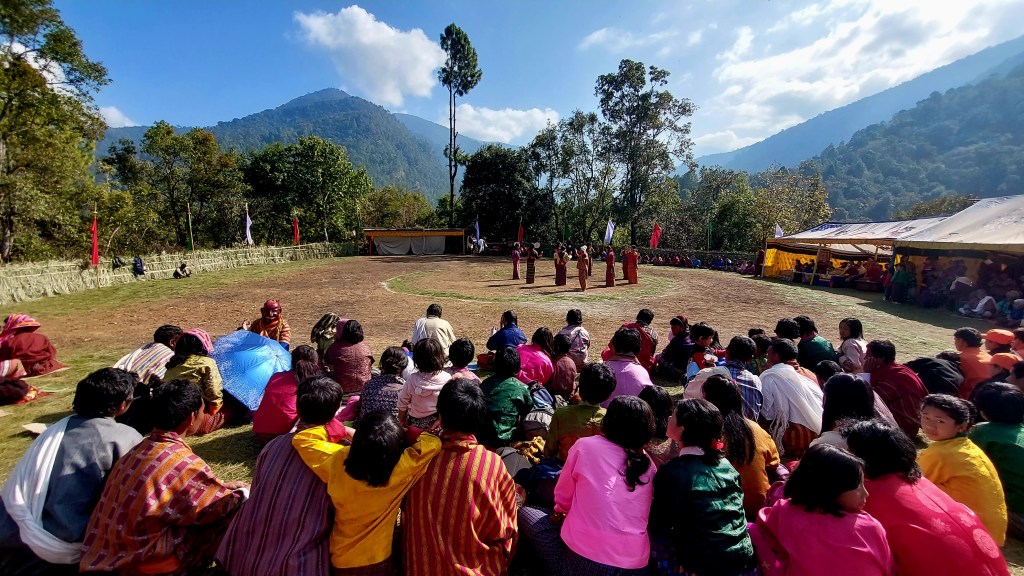
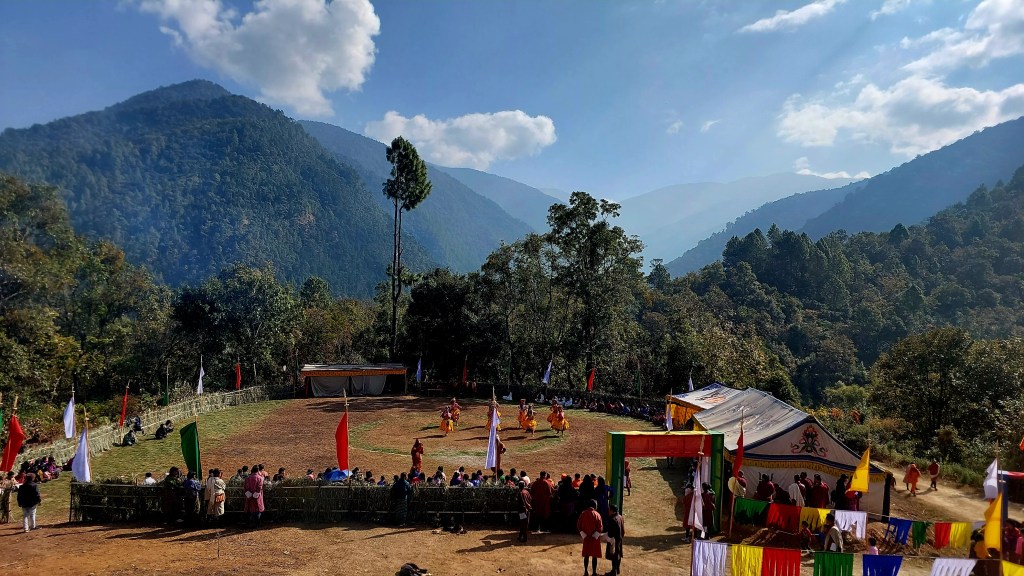
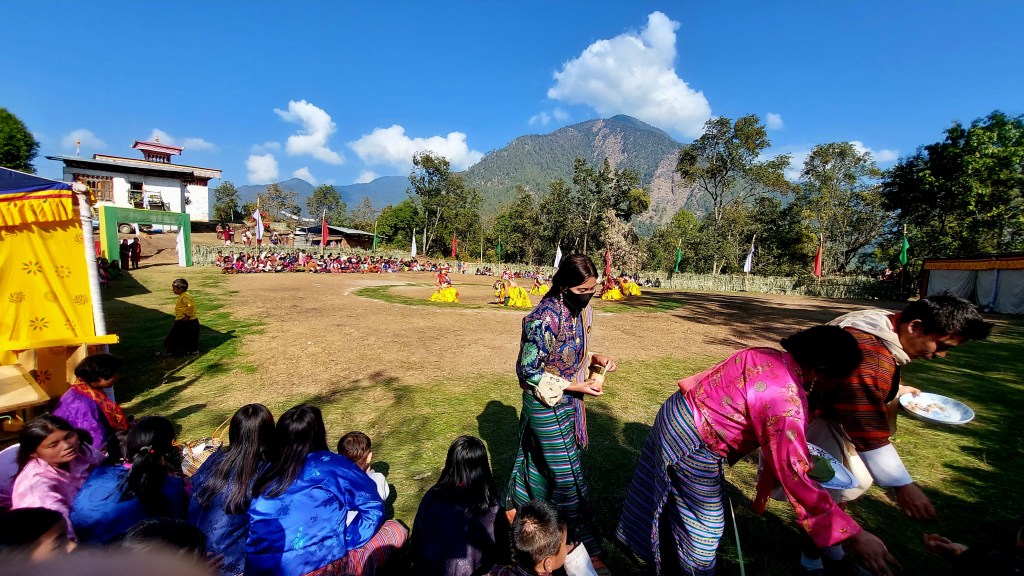
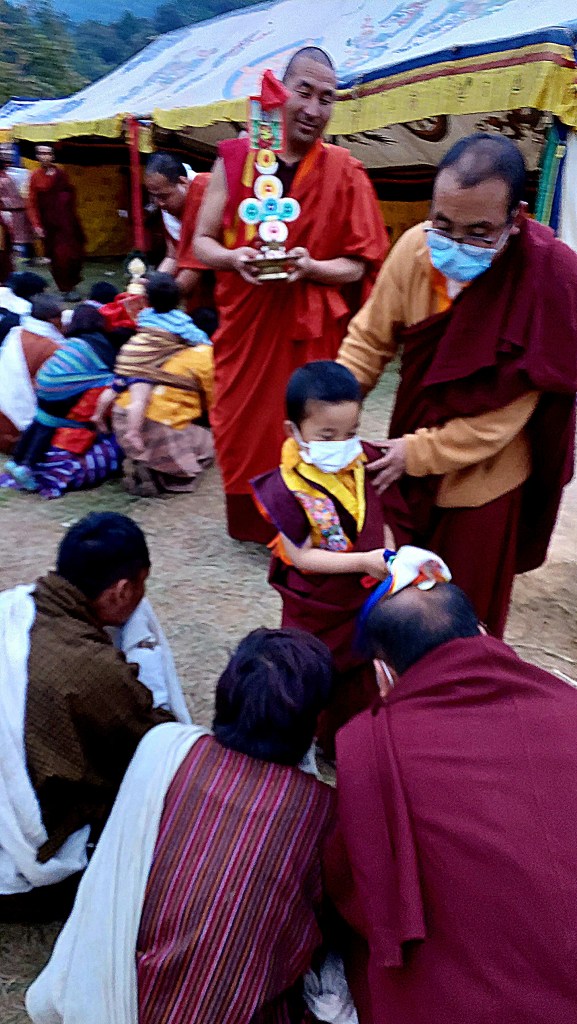
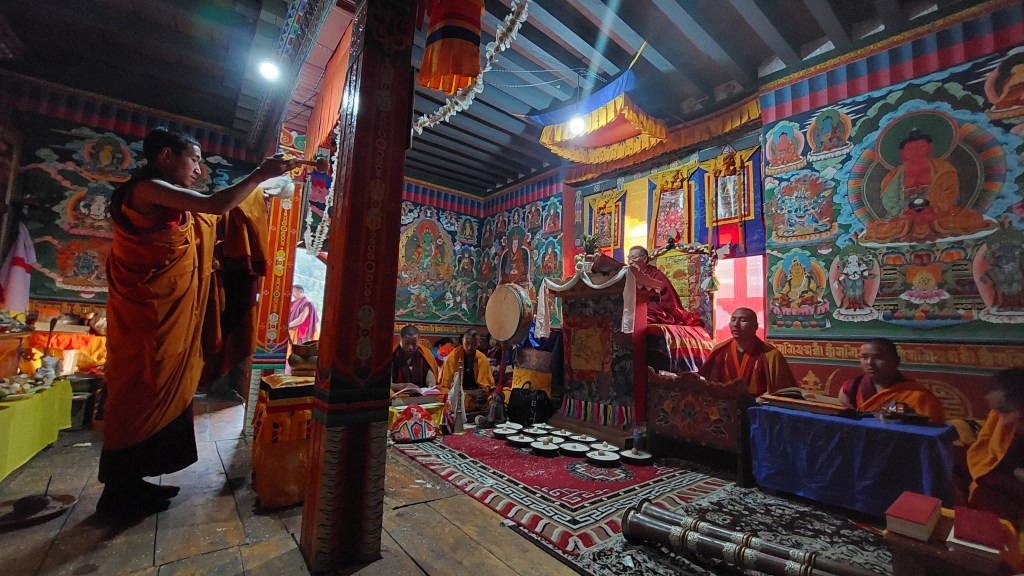
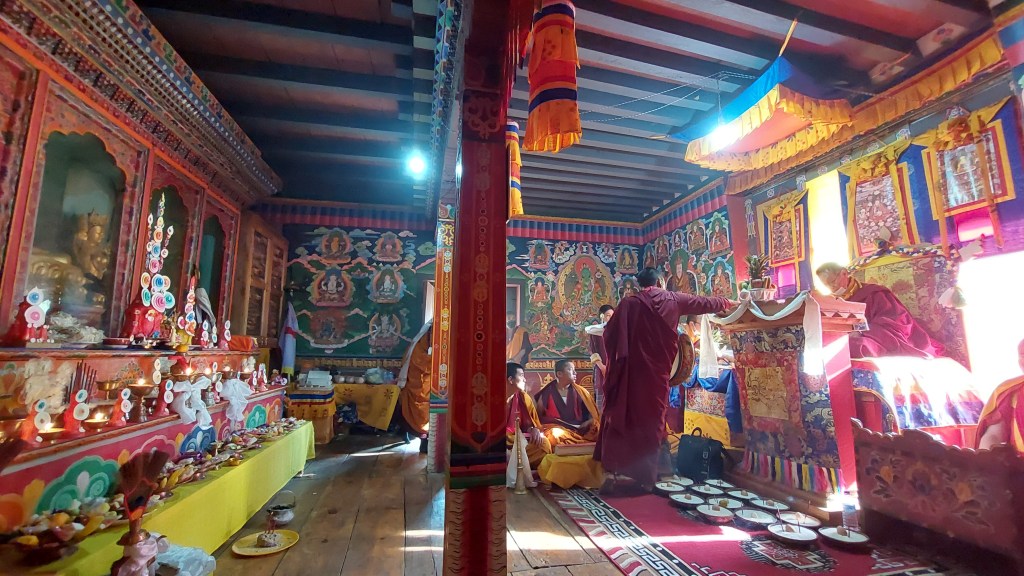
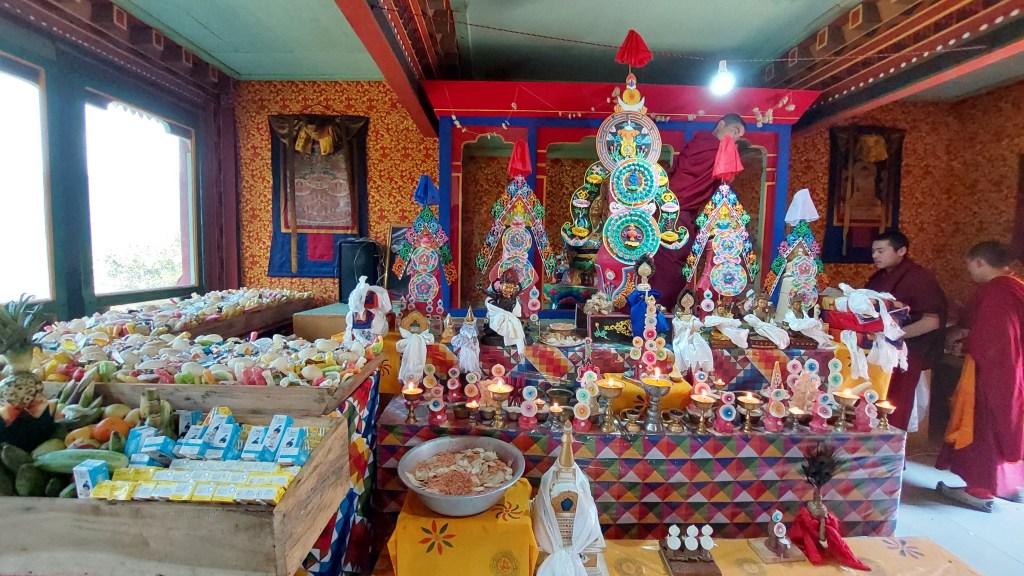
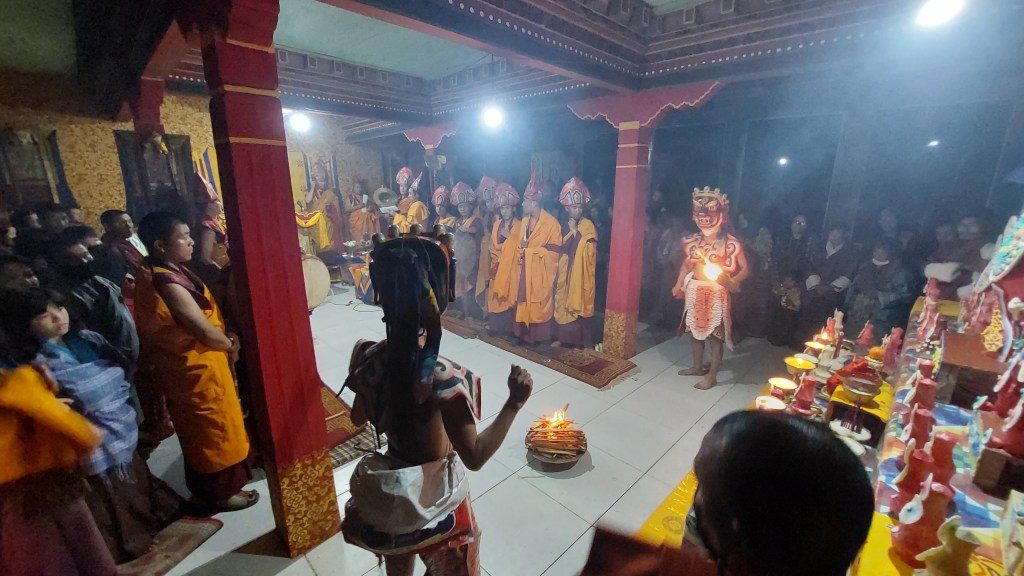
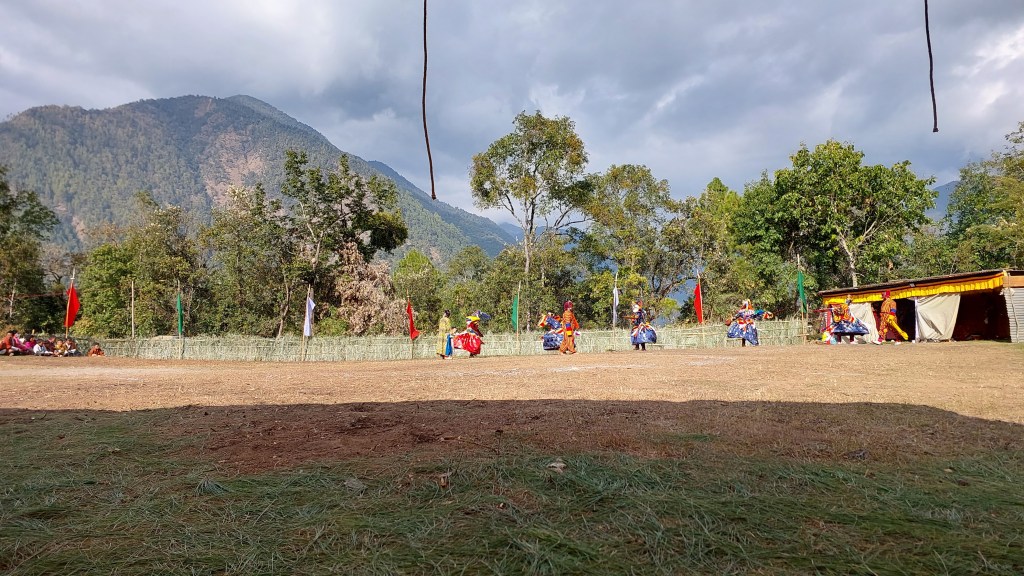
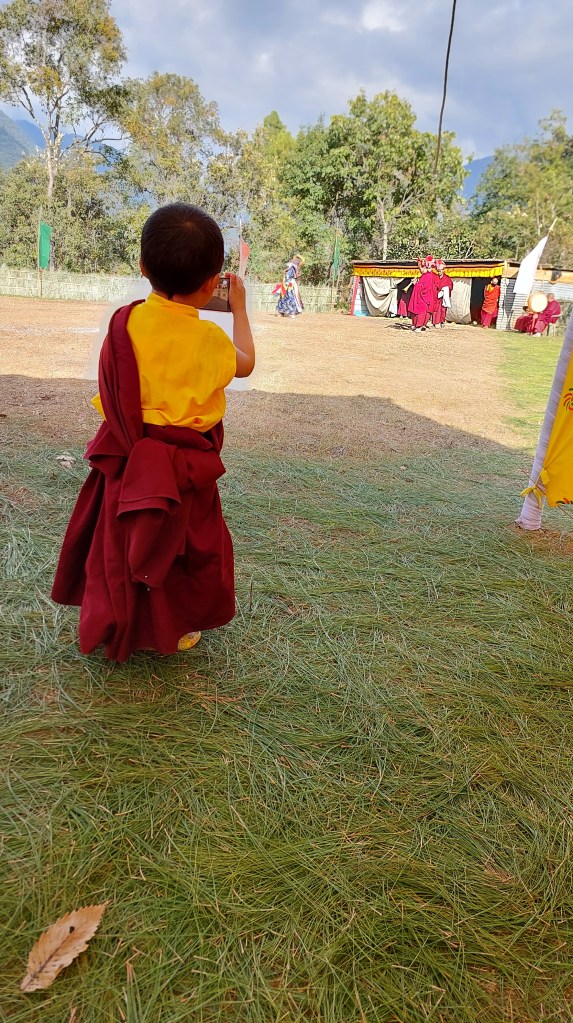
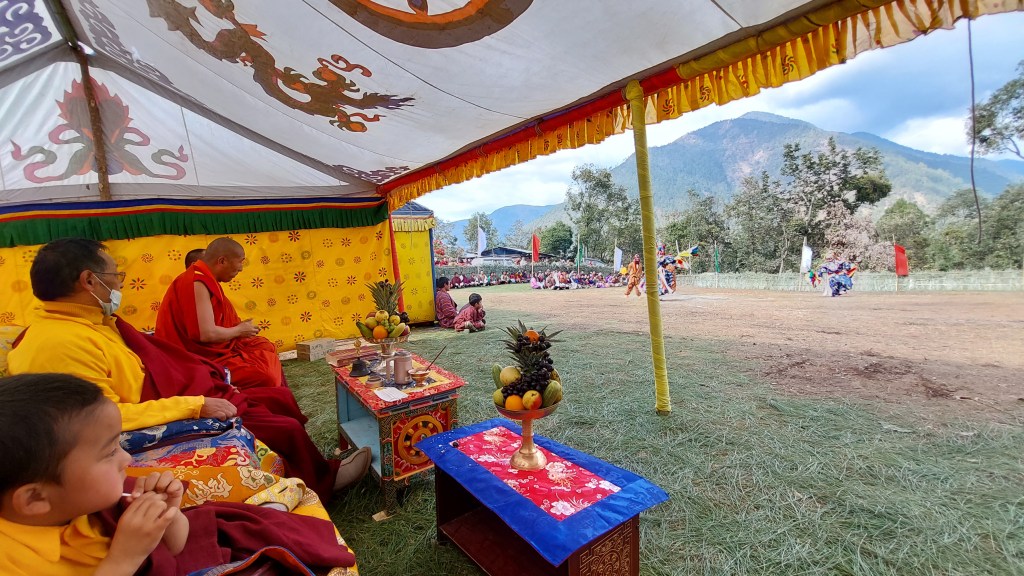
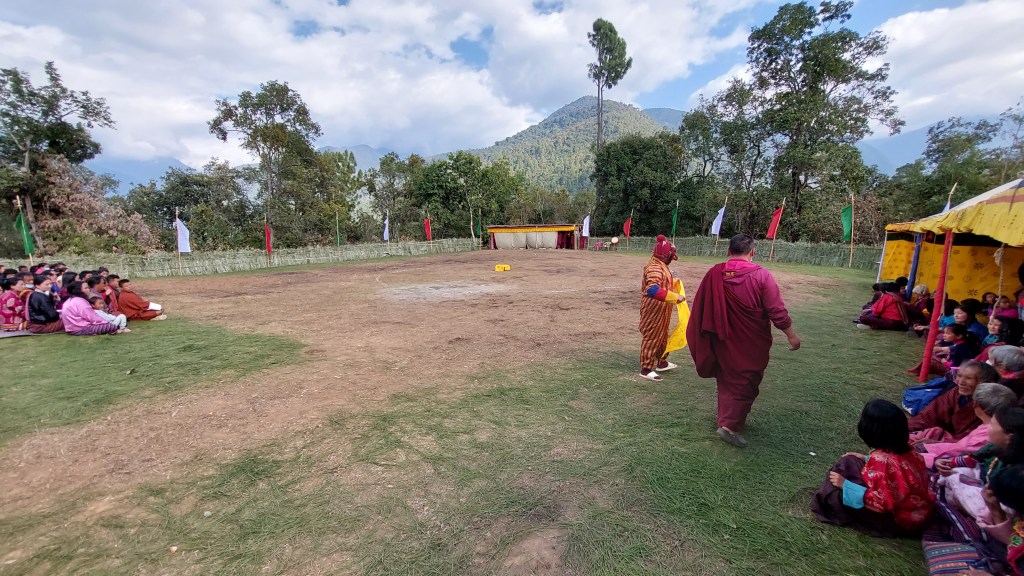
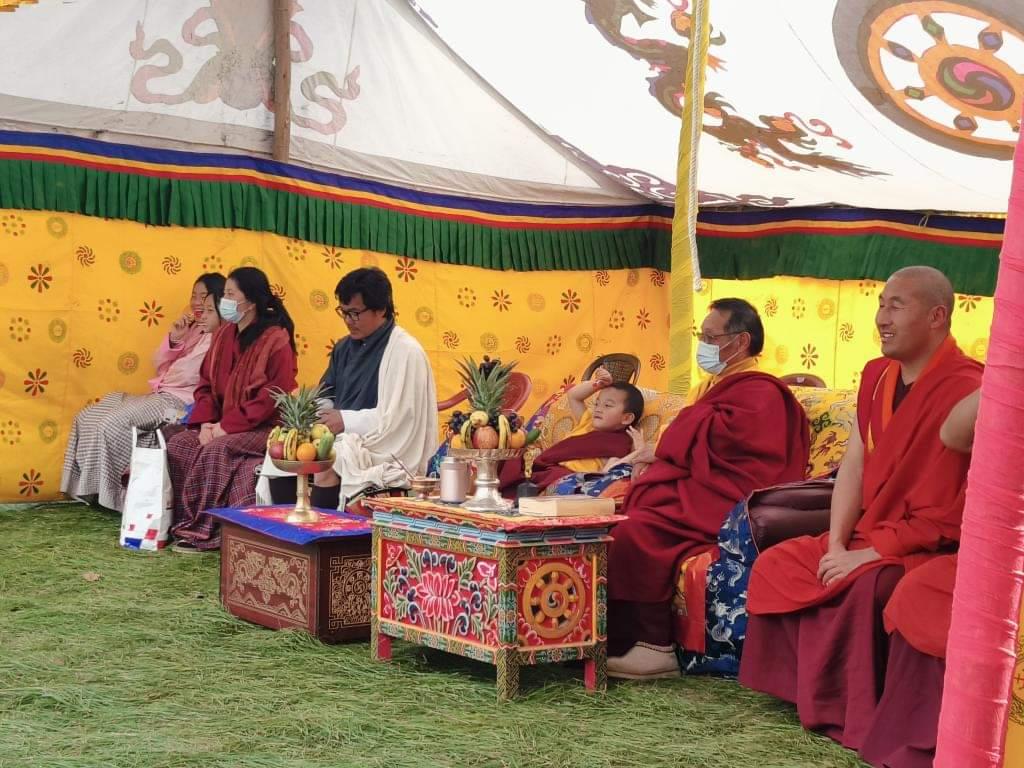
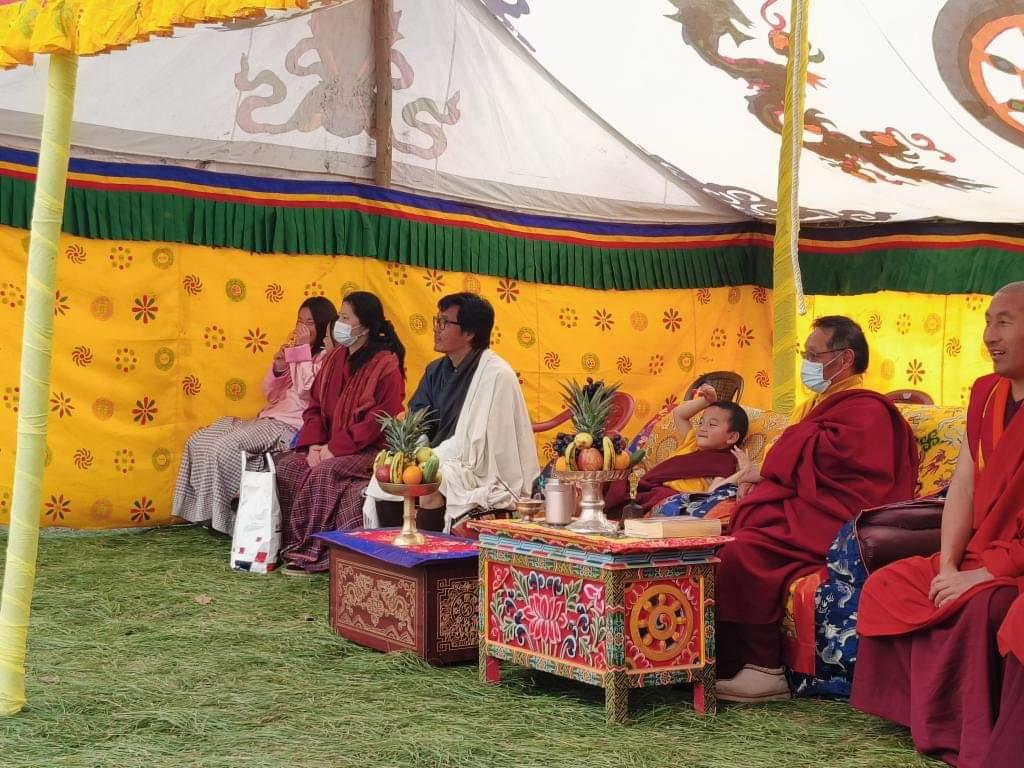
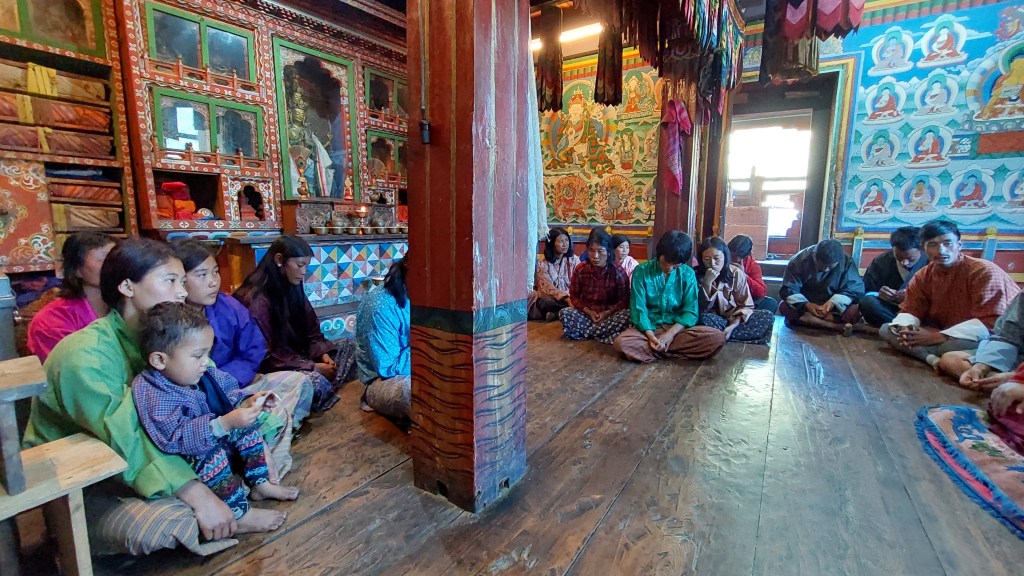
Having blessed the land with the sacred dances (chham) and having paid gratitide and 108,000 Offerings to the Divine (tshobum), the final day was a day of mass blessings by His Holiness Gangtey Rimpoche, and by the young Thuksey Yangsey – which is historic first in the valley, and which I am afraid may be difficult to make it happen again.
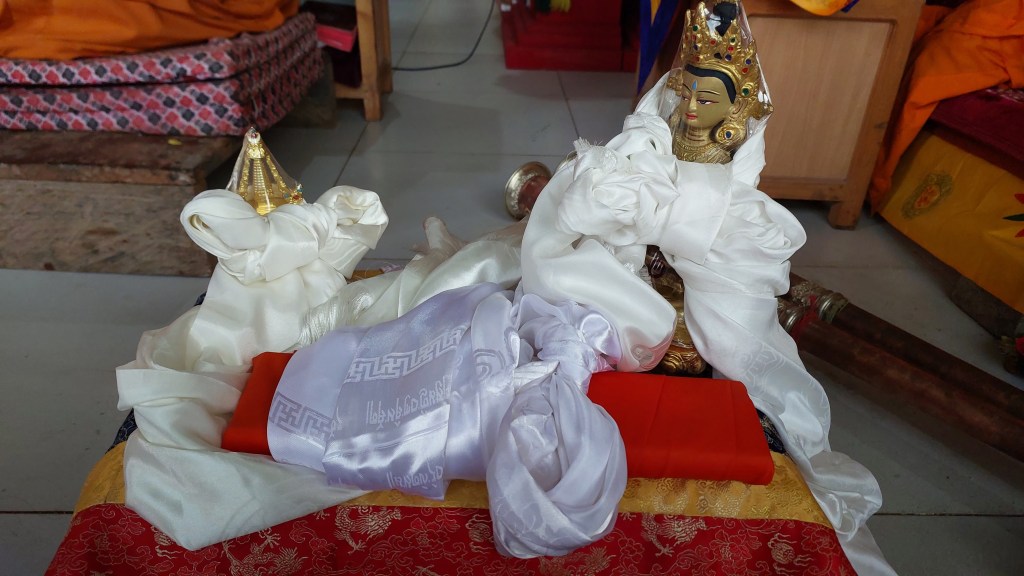
When I offered the Kusung Mendrel to thank the two Rimpoches for their blessings, His Holiness pulled out something from a bag and placed it on my head.
“This is most sacred phurba (ritual dagger) I have.” Rimpoche added.
As I received the blessing, I wished that the people of Rukha valley remain prosperous and never return to the state of poverty and destitutes, and that each and every person gathered here achieve realisation and work towards the benefits of all sentient beings.
And that our country remain the land of the peaceful dragon.
“This task falls on the jindha (religious patron),” His Holiness the Gangtey Rimpoche tells me with a smile. I nod obediently and take up my role for the occasion with honour, pride and reverence.
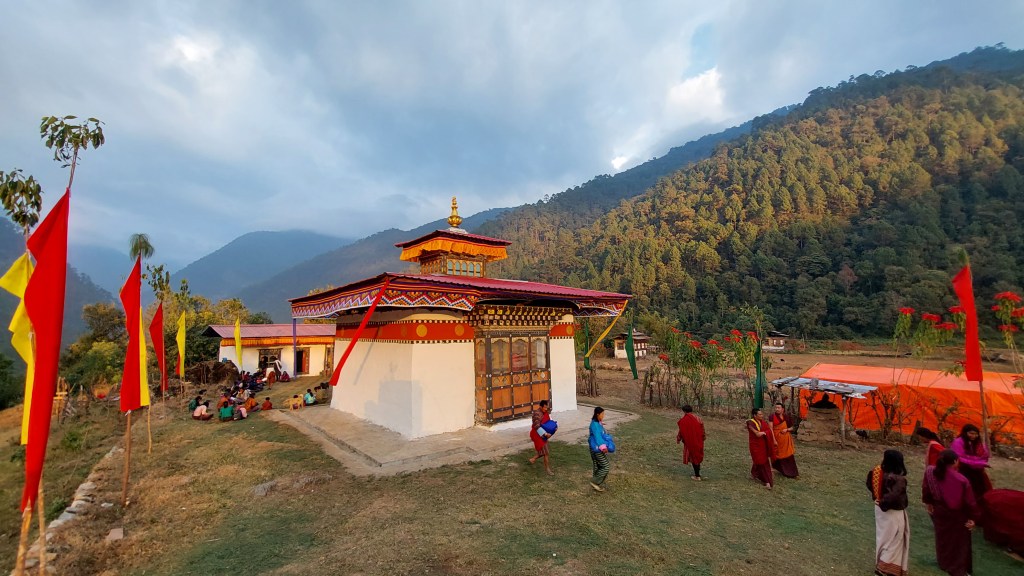
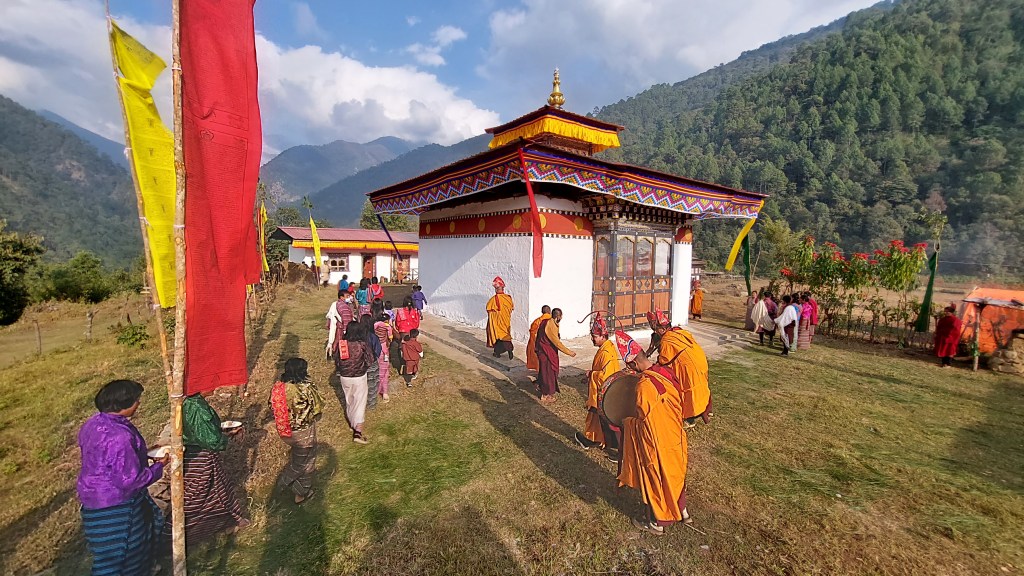
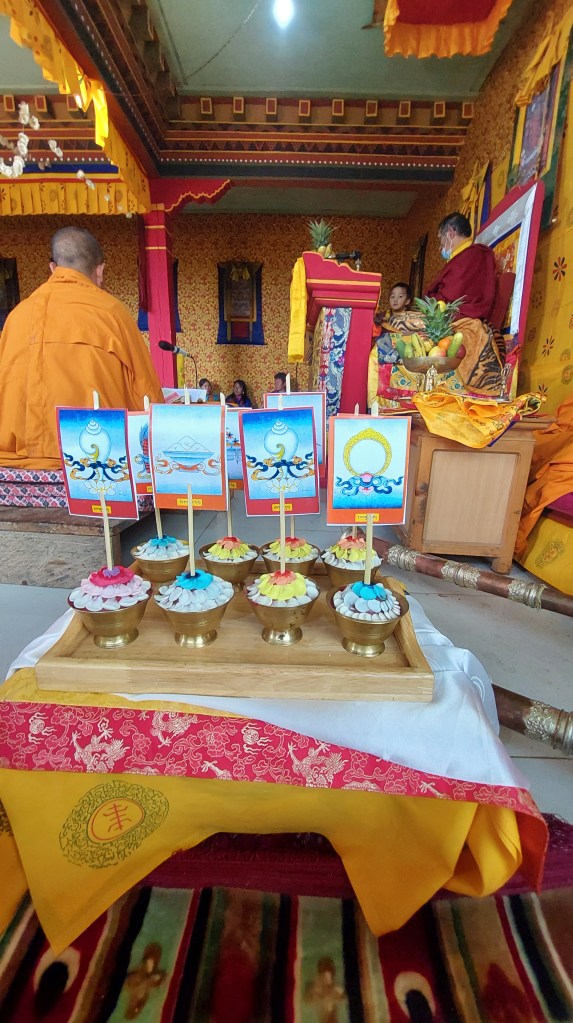
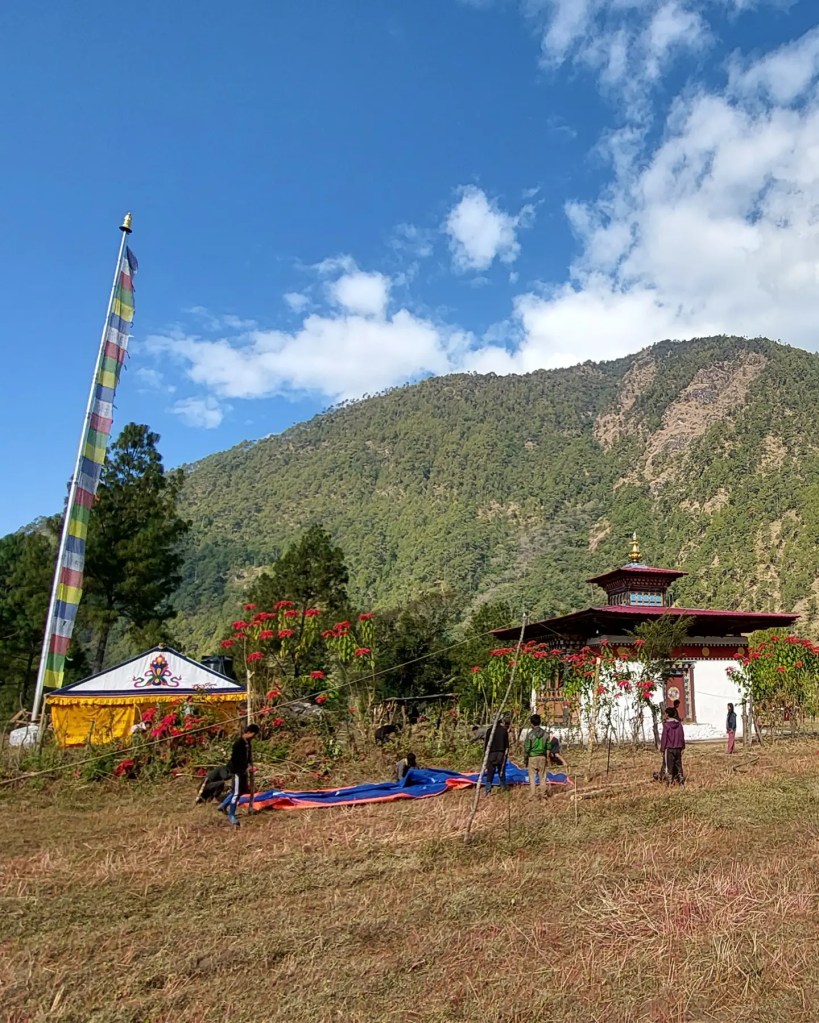
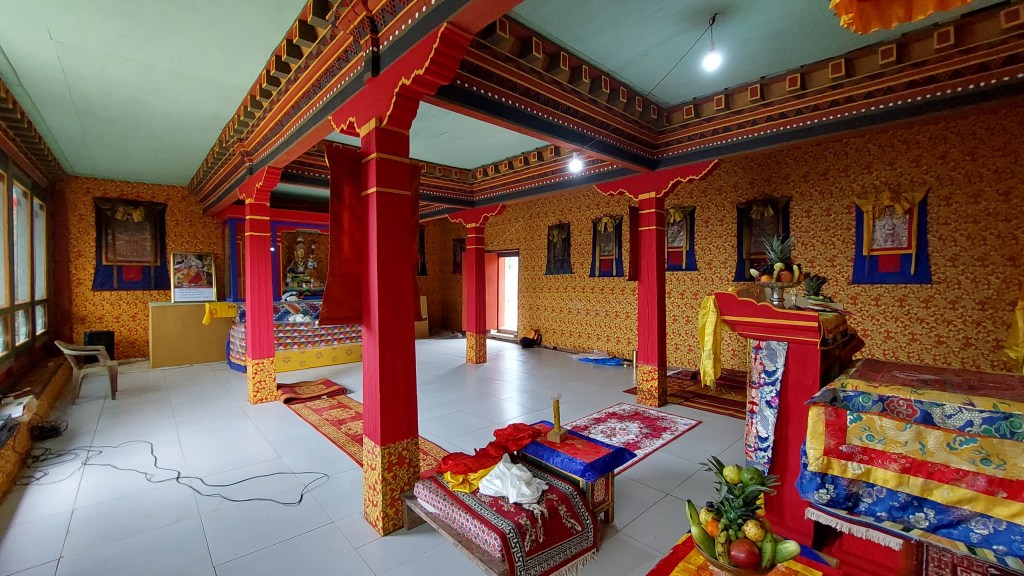
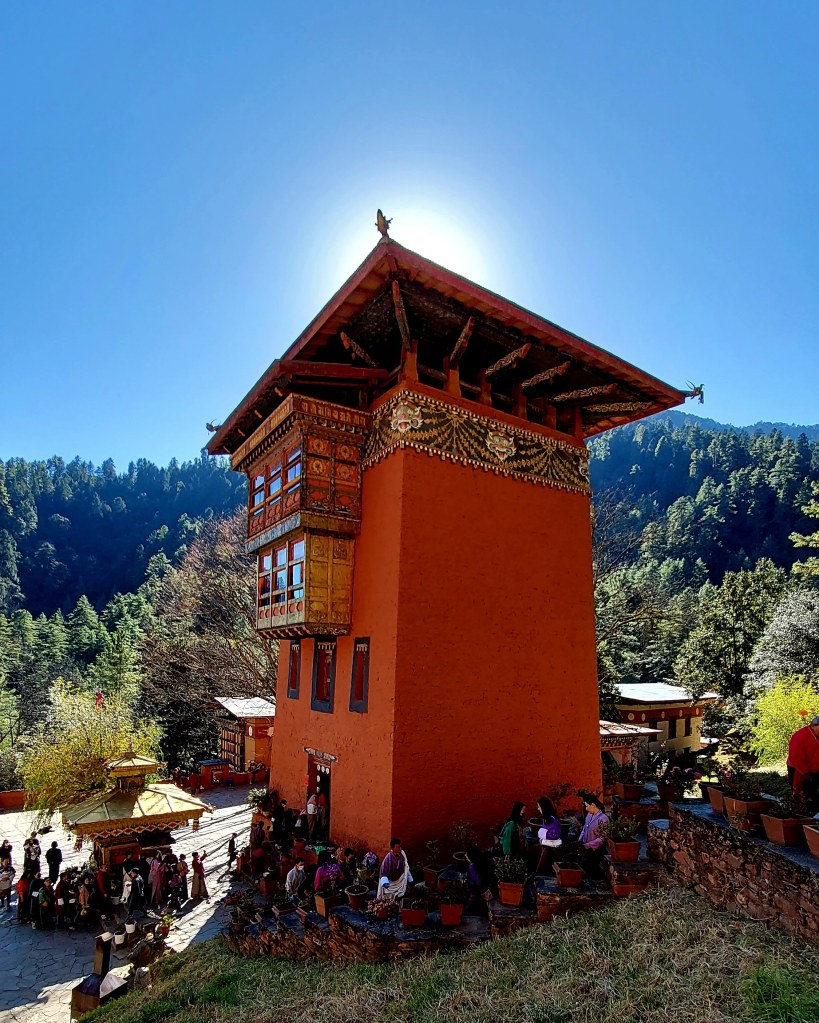
The task was to carry a large bowl of colored rice known as chhandru, which a lama would sprinkle around to mark the final act of consecration of a sacred place, monument or an object. This time the two new temples at Rukha and at Lamga are being consecrated.
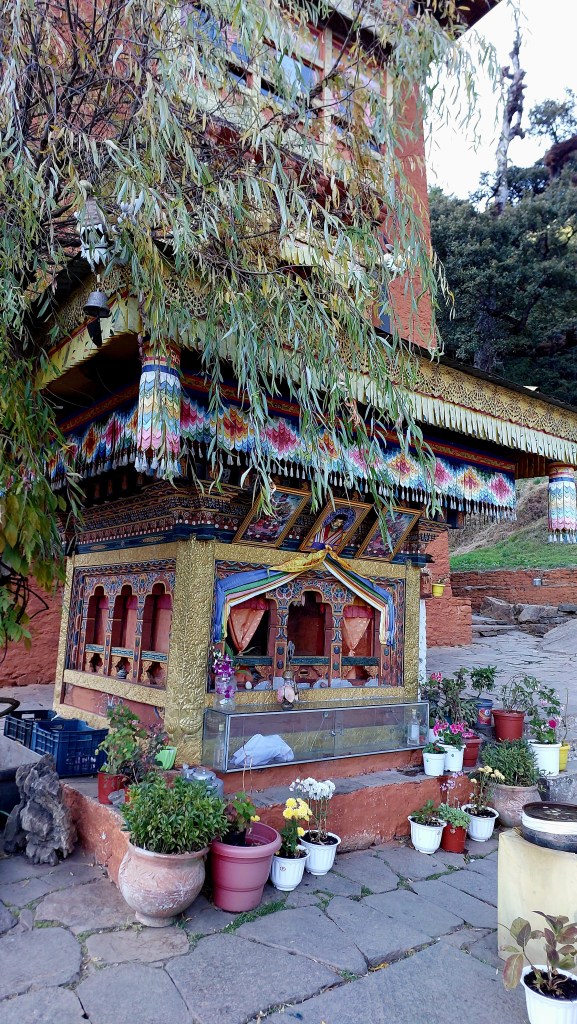
As I accompanied His Holiness Gangtey Trulku Rimpoche (one of the highest reincarnate lamas in the Nyingma tradition) in a procession of monks and lay officials carrying the eight sacred symbols, with sounds of horns and trumpets blaring in front of us, my mind travelled back to the nostalgic memories of my first trip to Rukha in 2007 when I found this village in total misery. Then to 2009 when all of them received their permanent houses in place of the bamboo shacks. And then to 2014 when we consecrated the first temple in Rukha – in honour, and at the site, of the dharma protector Palden Lhamo (Kaladevi, or Sri Devi).
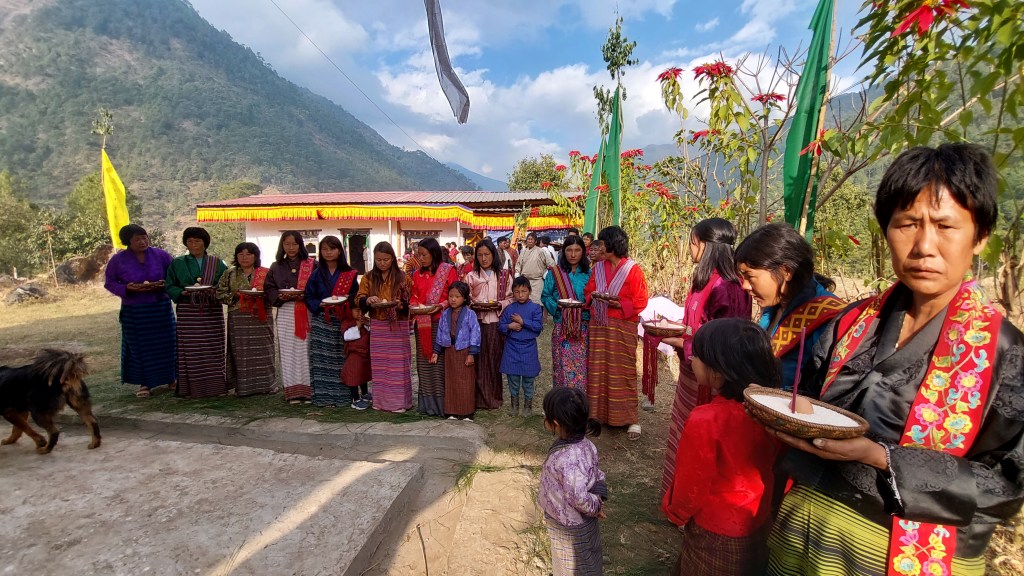
In Lamga, the sight of the thirteen women – lined up in a traditional reception style with a bangchung of rice, egg and josstick, took me back to 2015 when I visited them and they received me in a similar manner.
During that visit, I learnt that my friend, and their aging leader, Aap Mindru, had passed away and had left a death-bed wish to his family – to welcome me back to the village (this is accorded only to high lamas and officials) and to lead the village and help build a community temple in Lamga – among other things. He also left a piece of land if I wanted to build a house for myself (which I have refused until now). He was the only wise man of the village and I was both sad, and surprised by the wish and touched by the gift of a plot of land. Outside of my family there was only one person who left a death-bed wish left for me in my life.
I was financially unsound back then but I was determined to fulfill the wish of my Late friend – and become their leader. I promised to build a community temple together. We could start immediately but cautioned them that the progress would be slow, as I would have to depend on my salary only. My wife was more shocked by my promise because we had just struggled building the first one in Rukha, which was consecrated just a few months earlier by former Tsugla Lopen of Zhung Dratshang – in December 2014.
So, we worked when I had money, stopped when I became broke and resumed when I had saved enough to continue. Seven years later, ola! We did it!
His Majesty the King, at the recent National Day Address reminded that “there is nothing that the Bhutanese cannot do. It is just a matter of whether we want to do it or not”.
The Rukhaps – also known as Oleps, have done it. The Lamgaps, who are Phobjibs resettled here, did it. Just over a decade ago the Oleps were scrambling for food in the jungle or elsewhere – and living day by day – not knowing where their next meal would come from. And living in make-shift bamboo shacks. Yet in less than a decade, they were seeing a second temple being consecrated in their village. And now they are even joined by their urban members who drove into their village in their own cars. The villagers produced all the food and hosted some 50 monks needed for the three-day festival. The urban salary men and women pulled out one-third of the cash of 450,000 ngultrums required for the three-day festival. I covered the rest.
While there were outpouring of words of appreciation and gratitude to me for taking the lead, the Oleps and the Lamgaps have every reason to celebrate and take credit for the achievement.
There is an adage in Bhutanese: “Even if the privileged and the endowed give, but if those who receive cannot receive well, there won’t be any good outcomes.”
Therefore, the people of Rukha and Lamga are entitled to celebrate their extraordinary feat of doing all the hard manual labour – and above all, for believing in themselves and their dream, and come together and work towards it.
If only this is replicated among every Bhutanese across the whole country.
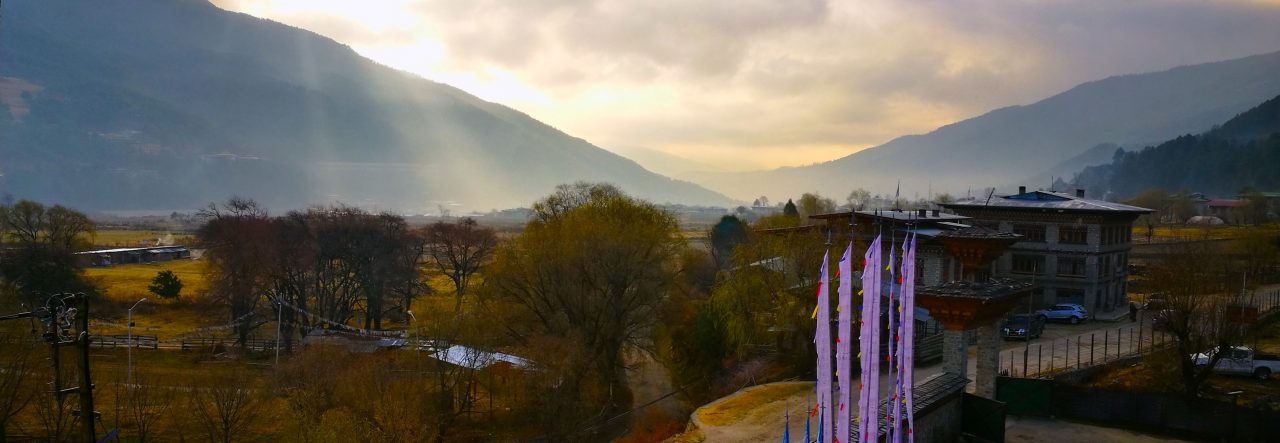
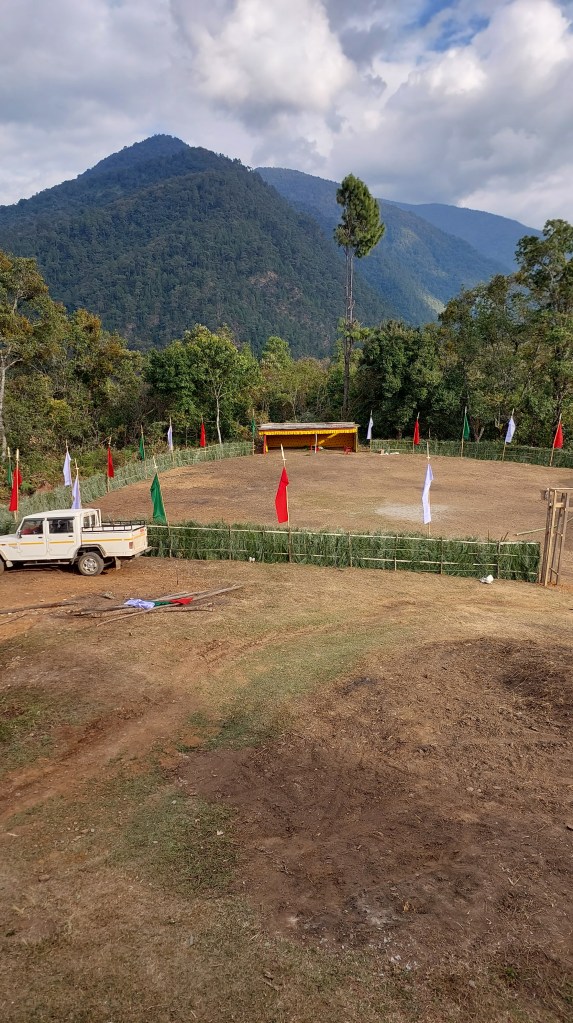
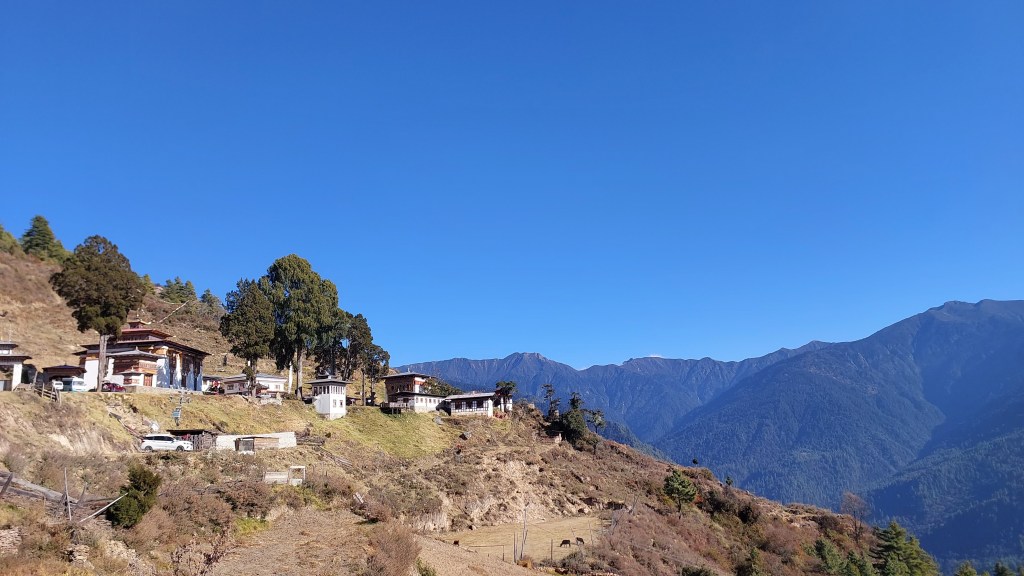
Athang Rukha – Wangdue. When the Rukhaps asked me to help them (re)build the temple at the site believed to be the abode of Palden Lhamo I had no choice but to accept. (As to why is another story for another time).
It was 2009, and when I looked around and toured the forested area, I thought, why not even a religious festival. Afterall, this regionel does not even seem to have received any form of Dharma (I later learnt that it did but because of remoteness, Shamanism prevailed again).
I had, of course, not the slightest of idea as to what really goes behind the religious dances. All I know is the sacred mask dances are sacred and they mimic the realm of Gods. And the masks are real deities bestowing the real blessings. And I wanted to cheery-top this region as a spiritual paradise, over its stunning natural beauty and a virgin territory. Many spiritual masters in the past conducted sacred mask dances as the final ceremony in the propagation of dharma – especially in Vajrayana Buddhism.
In 2020, I shared my vision with the newly-appointed resident Lama, Ugyen Tshering. He was bit shocked by my religious cluelessness but was kind to say it could be done. He knew the head dancer (chhampoen) of Gangtey Shedra.
Four months back when I approached His Holiness Gangtey Trulku Rimpoche with my wild request, which meant the monk-dancers had to be released from Gangtey Shedra, Rimpoche was bit surprised by my innocent request. I proposed that the sacred dances would be in conjuction with the consecration of the newly-built community tshokhang. He didn’t seem impressed and didn’t say a word on it.
I reached out to him again three months later during his short visit to Thimphu. His Holiness was still undecided but said he would look into it.
Again a week back I traced Rimpoche at his remote Winter residence in Sha Chitokha, in upper Wangdue.
“Oh! It is you again,” sighed His Holiness.
I gave a mischevious smile. 😁😁😁
“We can give a try. A few numbers this time,” Rimpoche told me. “Those that can be taken out,” He added.
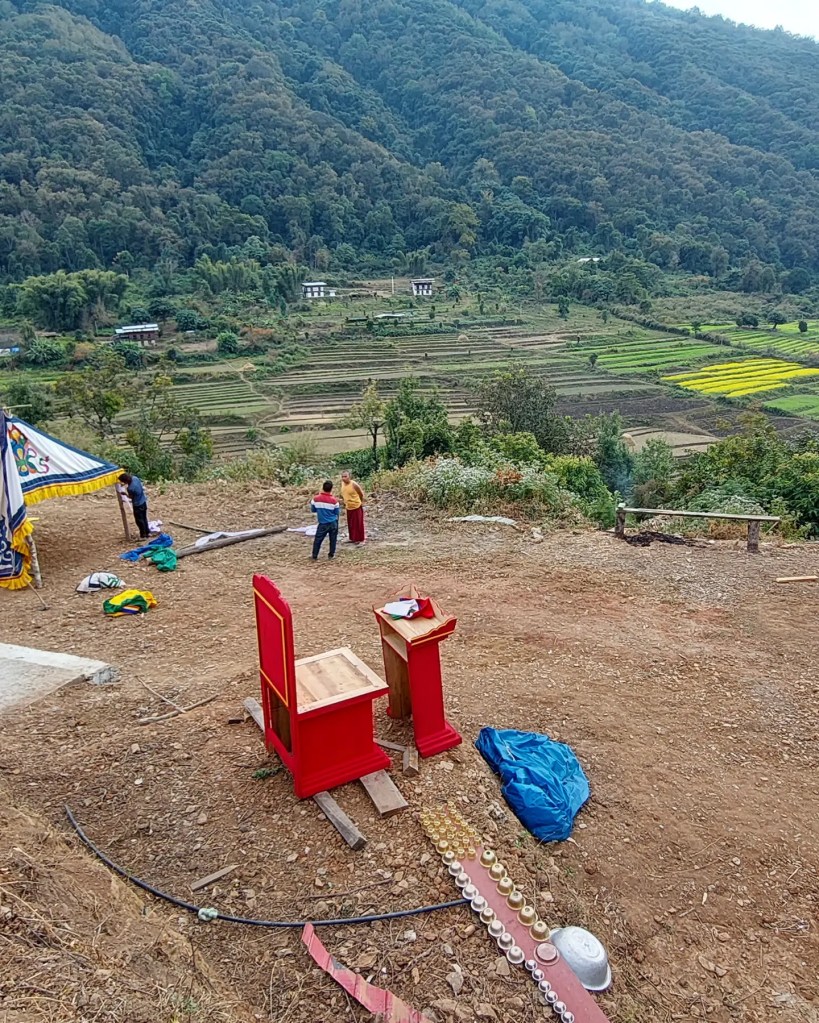
I was so elated that I could barely feel my feet on the ground. I felt as if I was flying from Chitokha to Wangdue to Rukha, where I have been posted for a month to personally oversee the preparation.
Moral of the story: sacred dances are very sacred and you just can’t take them anywhere, and do what you like.
Anyway, His Holiness and 49 monks led by three khenpos (and not one) of the highest order first conducted a long ritual in the temple, carried out the invocation of the protector deity Palden Lhamo, sanctified the ground, and did an elaborate ceremony just to prepare the ground.
Now I undertstand why everyone was less excited than me. My apologies.
Nonetheless, my eternal gratitude for helping me fulfil a dream goes to Gangtey Trulku. And then to Khandrola for consenting to let the young Thuksey Yangsey travel to such remote and inhospitable area. His presence made the occasion special and more sacred.
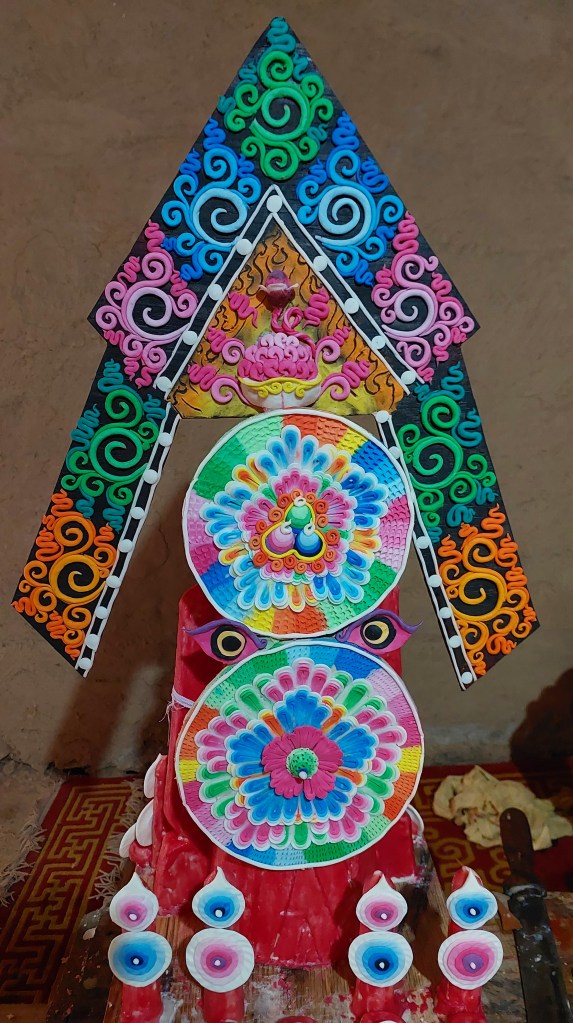
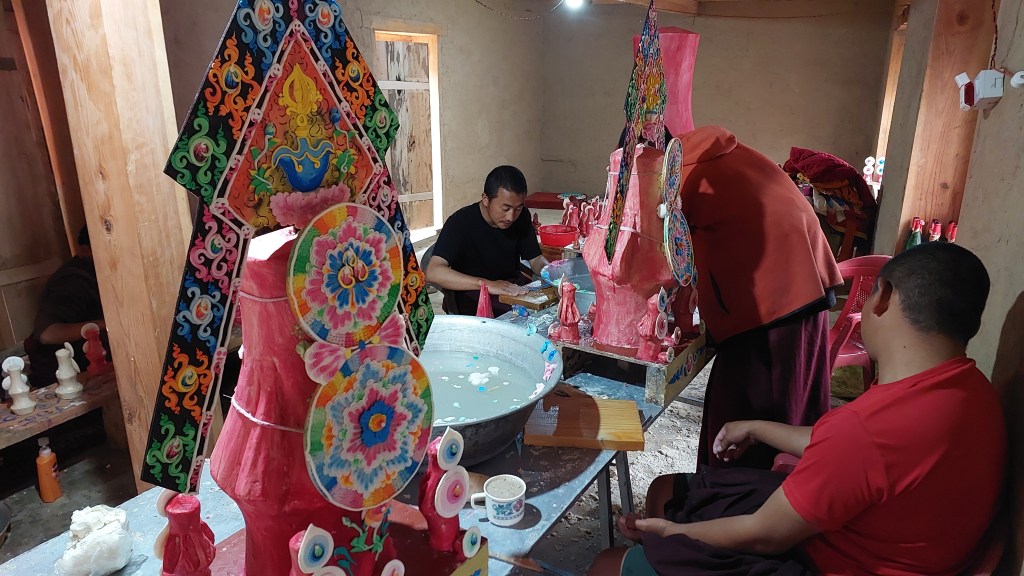
And finally to the khenpos and monks – for the hard work that goes behind unseen. They conducted the ceremonies and danced during the day, and at night prepare the ritual cakes, and rehearsed the dances.
May their deeds bring peace and prosperity in the region, and in the whole country.
What next? May be an annual festival would be difficult for this humble valley. Perhaps to make to every three years and then to commemorate this visit of the Gangtey Rimpoche and Thuksey Yangsey by organising a Baza Guru Dungdrub (billion chants of Baza Guru mantra) would be best as the way forward.
Aum Boko squints her eyes and checks the scale very carefully. The cheese weighs 100 grams less than the agreed amount.
“This one is rejected!” she shouts.
People around burst in laughter. The person who brought the cheese protests, but Boko is immovable. She has been tasked to collect the local contributions.
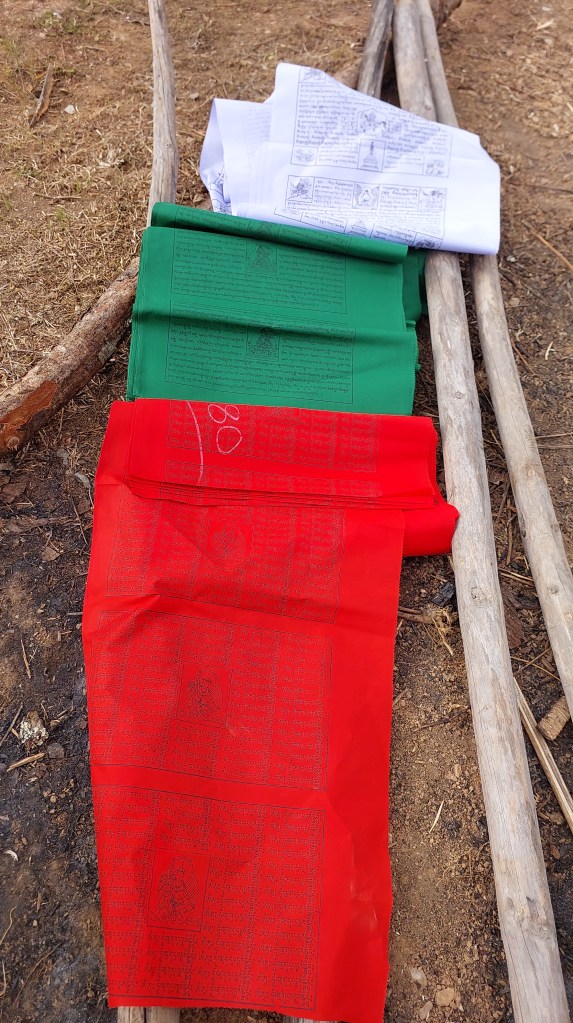
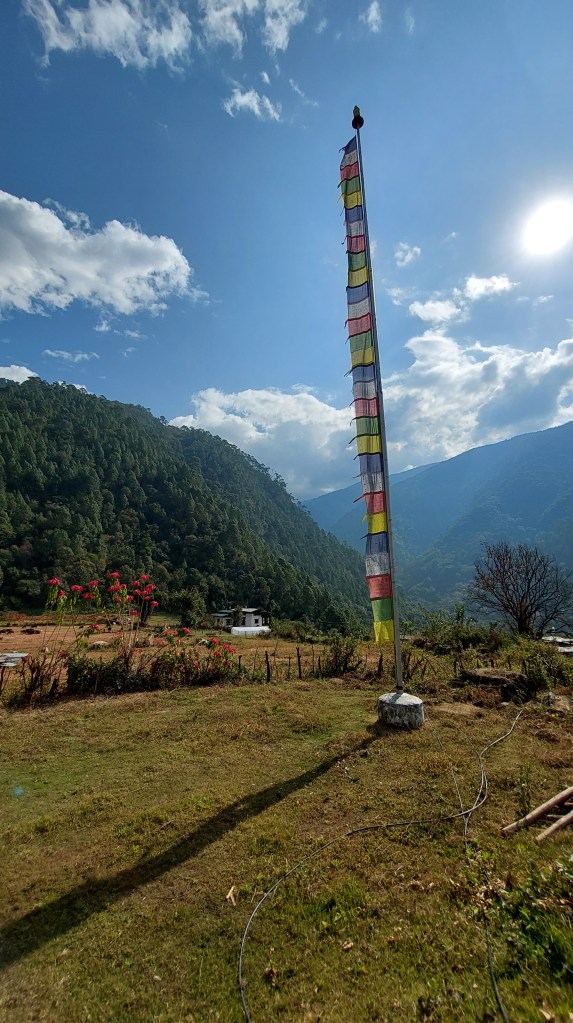
The two communities of Lamga and of Rukha are preparing for the consecration of the two temples in their respective villages. The traditional practice in rural communities is for every household to contribute an agreed amount of rice, butter, cheese, oil and vegetable – basically things they produce, while they look for a sponsor (jindha in local language) to cover the other major expenses, such as offering for monks, and pay for imported items such as flour, fats, salt, sugar, meat, and tea. A large amount also goes to purchasing decorative items such as prayer flags.
For this event, I am the jindha. For over 15 years I have been one in this valley.
I first worked as a volunteer for a foundation that did their housings and sent children to school. When that project closed, I stayed back and helped the community stay together and work on collective projects like building community halls, and village temples. We built three – two in Rukha, and one in Lamga.
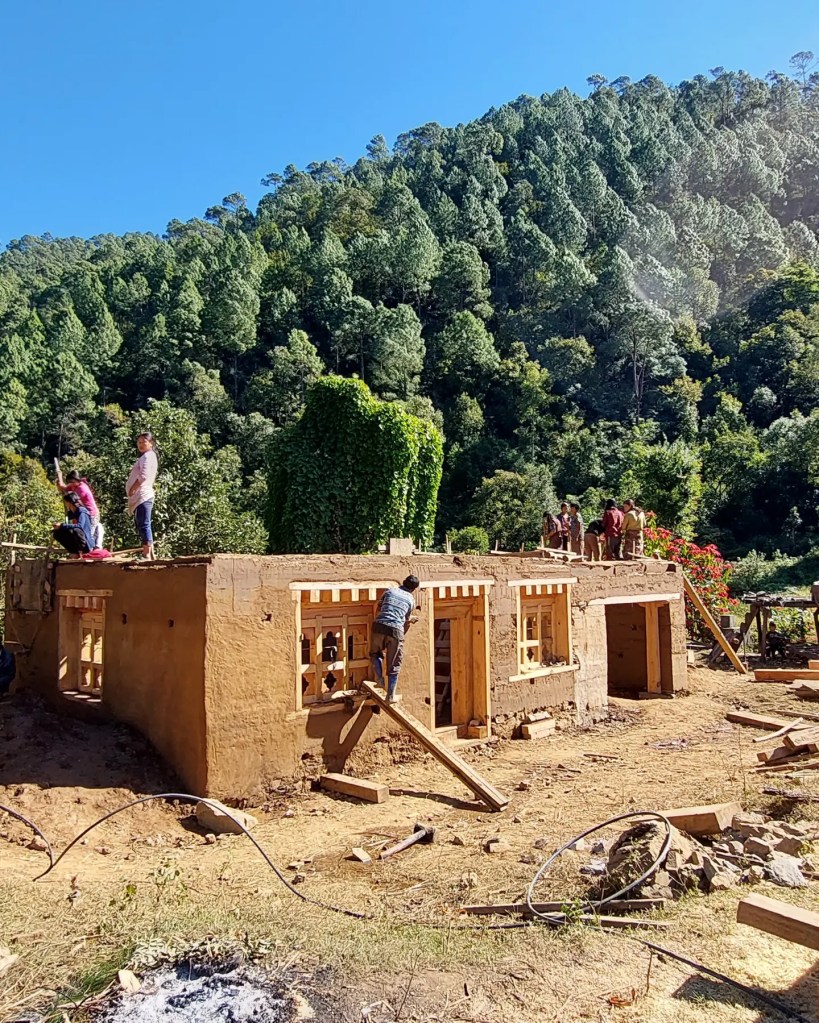
The deal has always been – I cover all the paid-out expenses, mainly buying the gilded statues and religious items, and roofing materials, cement, sand, stone aggregates, electrification and plumbing, while they did all the hard manual works.
It has been the greatest of collaborations.
So, a three-day grand celebration has been planned: one day of Tshobum – where we will honour our divinities, tutelary deities and our ancestors for their blessings and protection; one day of consecration (rabney) of the two temples at Rukha and at Lamga; and then close with a tshechu on the third day in honour of Guru Padmasambhava, and a tshe wang – a life empowerment blessing.
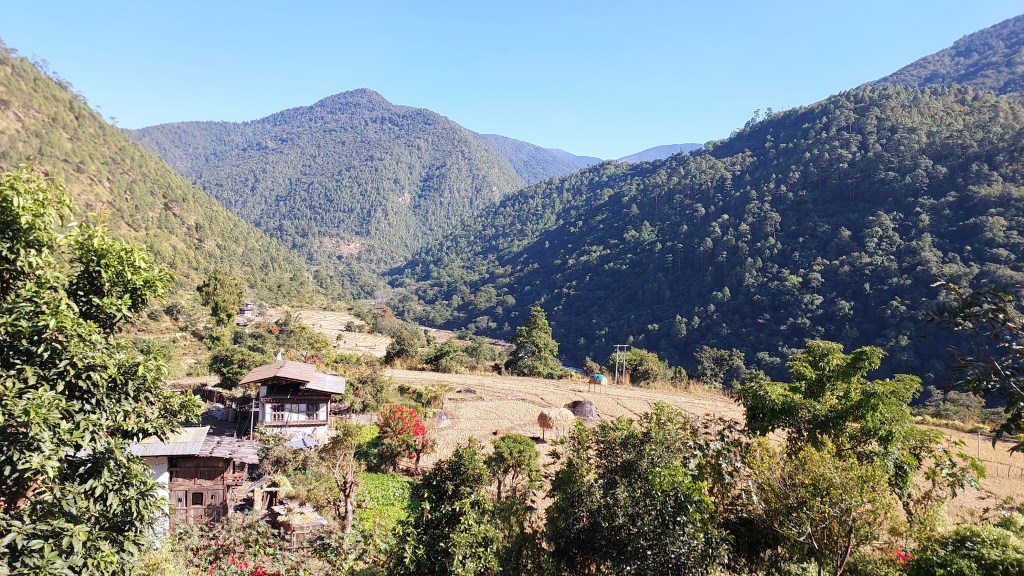
The covid-19 delayed both the construction as well as the consecration. It thus feels nice to be able to do this festival, as it will be giving a nice closing to my 15 years of service to the community. More importantly, we will celebrate their achievement of transforming from impoversished forest dwellers to successful farmers (Rukha is the only self-sufficient valley I know of in Bhutan).
As the day of the festival there is both the rush, and excitment. The valley will receive His Holiness Ganteng Trulku Rimpoche – the highest reincarnate Nyingma lama of Bhutan – whose lineage goes back to the 16th Century – to the great Terton (treasure revealer) Pema Lingpa. Sacred hagiography of Pema Lingpa relate his epic journey to look for the destined spot of Gangtey Gonpa.
This visit by the 9th Gangteng Rimpoche – the mind reincarnation of Pema Lingpa, will be a historic one. He follows the Second Gangtey Trulku, who visited the valley in the 17th century. We plan to commemorate this visit with annual Baza Guru Dungdrup – or even with a tshechu, from next year.
My smartphone alerts me with a new notification. Someone has added me to a WeChat group of natives from Tashi Yangtse. I am told that the group is planning a month-long recitation of the holy Kangyur canon, and that they are raising the funds to cover the initiative. I am not from Tashi Yangtse, but I have a connection there. It is happening in a temple that is dedicated to the choe-sung (dharmapala), which my family invokes regularly. I happily agree to contribute and make a transaction using a banking app.
Stories such as these have become a routine in the era of social media and mobile phones. In this article, based on a paper that I presented at the last International Vajrayana Conference, I share about how the tutelary deities and sacred places bring the Bhutanese people together. It was one of the findings from an ethnographic study that I conducted from 2018 to 2021 to look at the influences of technology on society – after being inspired by a provocative piece by Dzongsar Khyentse Rimpoche, What makes you not a Bhutanese?
Emergence of hybrid communities
Migration has depleted the rural communities. This in turn has led to the decline in farm productivity and land use, and additionally, as suggested by some scholars, to difficulties in sustaining the cultural and spiritual life. In the past decades, poor road connectivity and communication system meant that rural areas were abandoned for good by some, while others hardly ever returned there.
However, there are new promising trends and practices, which can be attributed to social media and digital networking platforms. Natives of the remote communities are connecting back to their families, relatives and to the protector deities. The reconstituted communities, however, adopt a hybrid mode, in that while some members meet in person, most engage with others online. The use of social media is, thus, contextualised to address time-space dilemmas, and integrated into local traditions to convey the vernacular languages, and the religious and ritualistic practices.
Repositioning of women
The era of the western education, which gained momentum in the 1970s, created some unsaid casualties – women and local languages. Their participation in the public discourse was limited as English language dominated the public forums such as the mass media. Even today women’s representation is poor when it comes to national leadership positions.
Social media and technology may change that scenario. The affordances of voice messaging apps such as WeChat has meant that anyone can express in their own language and post messages on the family or community WeChat groups. This has probably made WeChat the most popular social media in Bhutan. Almost all informal WeChat groups that I studied are either led by, or have active participation of, women, thus reclaiming the traditional role of women as the nang-ghi-aum (lady of the house).
Return of the vernacular
Contrary to the conventional wisdom, language is not just a means of communication. Wilhelm von Humboldt, the nineteenth century scholar, even went on to argue that our culture and our thought processes are influenced by the language we speak. Therefore, speaking a vernacular language sets the foundations for the appreciation and deeper understanding of one’s culture, timeless values, and the worldview.
Local languages are rich in moral values, belief systems and in collective imagination. Of particular interest is the finding from my study of the prevailing practices of anthropomorphism of the natural and the supernatural worlds, whereby we attribute human characteristics and behaviours to objects, gods, nature, or animals. It is perfectly normal to us to talk about Guru Sungjoen, dre-chhu, or tsho-korban. Whereas it does not sound well when we say them in English about speaking statues, demonic rivers, or runaway lakes.
Equally important is the practice of referring to deities and animals with kinship terms. In Tshangla, my native language, we call elephants – memay Sangye (Grandfather Buddha) and bears as ajang (uncle) omsha. We refer to the deity Jomo as ama (mother) Jomo, and in Bartsham, a village in eastern Bhutan, a tiny statue of Vajrapani in the community temple is fondly referred to as memay Chador.
Such rhetorical devices and sociolinguistic tools shape our identity as Bhutanese – of an interdependent self in harmony with not only the human world but also with the natural environment and the supernatural realm.
In the deities we unite
Instant personal communication devices extend religious practices and spirituality over space and time. Notwithstanding the technological determinism, though, tools are what they are: just a tool. Ultimately, it is the people and their sustained beliefs and values that will determine a societal relationship with technology. In the earlier International Vajrayana Conference, I had pointed out how, aided by the technological affordances of WeChat, users in Bhutan are practising and propagating Buddhist teachings such as compassion and loving kindness by saving yaks and pigs. What was inferred there was the inherent compassionate nature of the Bhutanese as the main catalysing agent.
In this paper, whether it is a community getting reconstituted, or an extended family coming together for the annual rituals, the binding force seems to be the tutelary deities and sacred places that provide a safe space and solace. For example, places like Dechenphu provide mental and spiritual support in a city that is increasingly perceived as unjust, greedy and stressful.
Why do all these matter?
The sociologist, Anthony B Smith, highlighted the importance of the “power of myths, symbols and memories to mobilise, define, and shape people and their destinies.” Along this school of thought, I also add the protector deities and sacred places as powerful centripetal forces to the existing symbols. This is vital for a small country like Bhutan where major discords and differences are not a luxury. In an era of divisive political era and discriminatory public policies, made worse by mindless and myopic bureaucratic rules that all seem to segregate rather than integrate, we must embrace and hold on to what unites us as people, as communities, and as a nation.
Nation building is a work in progress. And by nation-building I refer to the sense of nationhood, and that feeling of oneness as people. Nation-building is not the construction of hydropower dams or highways or hospitals. These are state-building. Furthermore, the existence of a country with simply a territory of human habitants does not guarantee a nation, as Massimo D’Azeglio, an Italian unification hero, famously pronounced, “We have Italy. Now let’s make the Italians”. Citizens must have a sentiment of unity, solidarity, and harmony, and work towards a common goal and a shared future.
Adding to the rural-urban migration impasse, there is now a growing concern of Bhutanese moving to foreign shores. Notwithstanding the gravity of the issue, in this day and age of instant communication technology, the world has not only flattened, to paraphrase Thomas Friedman, but has also shrunk considerably. Physical distance, thus, does not matter much as long as emotional distance is not created. Social media platforms such as Facebook and WeChat help maintain this vital emotional link to one’s place of birth, origin and people. However, stereotyping those who have left, or curtailing the opportunities of those who have stayed back will not be helpful in any manner. Instead, it might only exacerbate the problem.
In conclusion, on the eve of the National Day, each one of us must ponder on what unites us as Bhutanese and work on them. Given the role they play in national consciousness, sacred sites and deity citadels of national and local significance need to be protected by laws from the Parliament with some sort of a cultural heritage bill. I would go even further. Popular monuments like Paro Taktshang, which draws thousands of visitors every day, could be administered through its own Act, so that its power and influence can extend beyond the realm of spirituality.
Then, there is social media. Newer communication technology can create, what sociologist Benedict Anderson calls it, a “deep, horizontal comradeship” when he defined the nation as an imagined political community. It is essential, accordingly, that large state investments and initiatives be made to harness its immense power for public good – and for strategic national interests – such as bringing people together.
Dorji Wangchuk (PhD), Kawajangsa
(The original article appeared on Kuensel, the national newspaper, on 10th December 2022
Dechenphu Nyekhang (The abode of the deity) – by far the most visited temple in BhutanDokhachu Gonpa – the abode of deity Ekajati – another very popular temple in BhutanParo Taktshang – the most loved temple in BhutanVillagers come together when it is about religious events
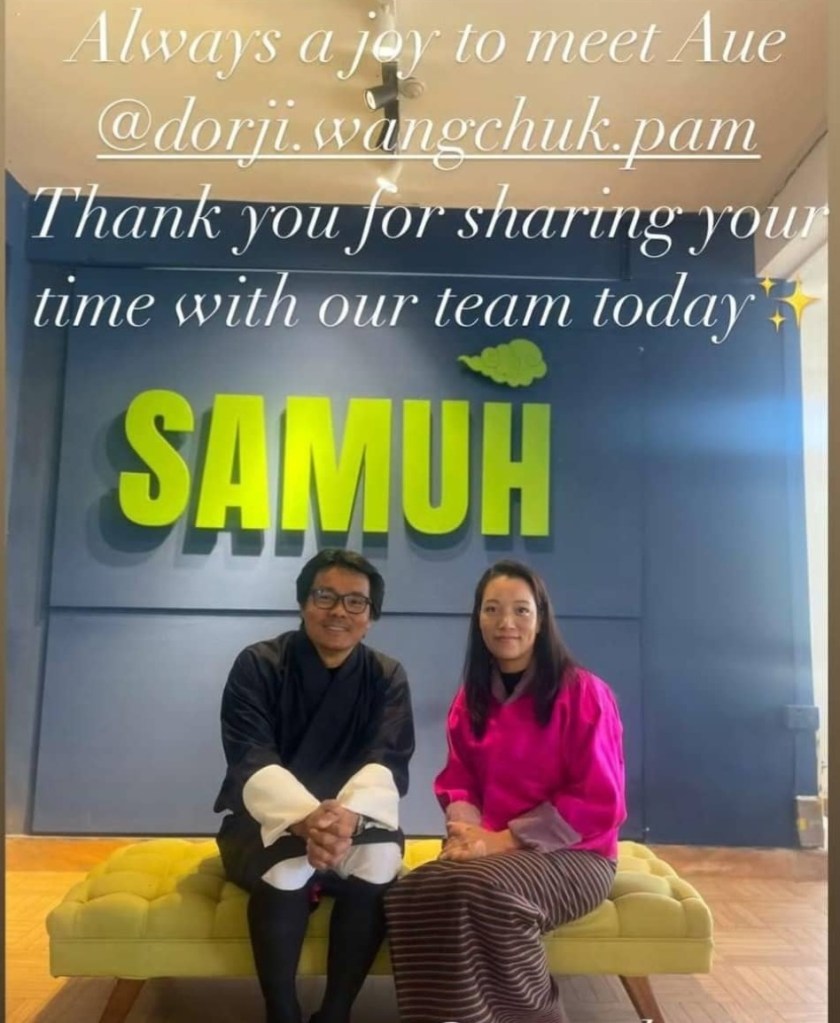
(Excerpt of my sharing session with Samuh OTT, Thimphu)
I have been asked to share my views on the future of media and technology, and what was in store for the OTT. As a veteran of the Bhutanese media and technology industry, I am often asked these questions
Well, here is my take.
Going back in time, I predicted the decline of the Bhutanese mass media way back in 2006 when everyone thought that with democracy it would be the otherwise. (Check my article in the launch issue of Bhutan Times).
The mass media (print and broadcast), of which I was one of the pioneers, will die – unfortunately – unless the State intervenes with some form of subsidy. While subsidy may be a bad word in a free market, the public service media is necessary to sustain the concept of a nation. Simply put, if we want to stay united as one nation, we better take care of BBS and Kuensel.
The universal mandate of media is to inform, educate and entertain the people. While earlier the role was taken up by the mass media, in the new era it will loosely be divided between the social media, online educational services, and the OTT. This is what they call fragmentation of the audience.
The next big things will be virtual reality (VR) and augmented reality (AR) – something that the OTTs may like to take note.
Interestingly there will be a return of the good old radio in the form of podcast – meaning people will just download and listen the audio files at leisure – as passive listening mode and as on-demand-services.
Nation-building does not only mean building hospitals, highways and hydropower. What is more important, according to social scientists, is the concept of nationhood. Radio and TV bring the nation together. In the same song we listen, in the same joke we all laugh, in the same news we celebrate or being concerned about, mass media can keep the minds united.
Now the role of nation building will be played by the OTT and the film industry.
Regulators and naysayers will continue to stand in their way but that’s not just in Bhutan, but everywhere. We faced higher brick walls during our time. But if you believe in what you are doing, if you believe that it is good of the people and country, you keep pushing. You keep changing the boundary. You redefine the borders.
You will face consequences. Be warned. I faced them too. And it was not fun. But past your 50s, your heart will smile at you. Trust me.
You will tell yourself, “You did what you had to do, and not what others wanted you to be.”
I gave a talk on how Bhutanese Buddhism ended up with thousands of deities, divinities, and holy ghosts, and the related ritualistic practices – a supposed departure from the time of Shakyamuni Buddha, whose teachings were only understood as philosophical. And whose works were considered as a major and silent social movement against the caste systems of his period.
In brief, Buddhism first saw a bifurcation in the Second Century to two schools – Theravada and Mahayana, the latter adopting the concept of a supreme god in Adi-Buddha (Dzongkha: དང་པོའི་སངས་རྒྱས།), which was believed to have existed and enlightened eons before the historical Buddha Shakyamuni.
The Theravada school continued to be nontheistic considering the Buddha dharma as a philosophy and moralistic code – based on the Vinaya scriptures that were written right after Gauthama Buddha.
The bifurcation to Theravada and Mahayana was followed by the emergence of Varayana in the Sixth Century, which spread to Bhutan and other Himalayan communities and cultures. Vajrayana embraced the existing pre-Buddhist deities and religious practices in these regions such as Bon and Shamanism. Many of their deities were inducted as dharmapalas (protector deities), or as an emanation of the Buddha.
As Vajrayana evolved from Mahayana it strengthened the concept of premordial Buddha – such as Samantabadra (ཀུན་ཏུ་བཟང་པོ་ Kuntu Zangpo), Vajradhara (རྡོ་རྗེ་འཆང Dorji Chang), and of Bodhisattvas (བྱང་ཆུབ་སེམས་དཔའ་ Jangchu Sempa) – such as Manjushri (འཇམ་དཔལ་དབྱངས་ Jampel Yang) and Tara (རྗེ་བརྩུན་སྒྲོལ་མ། Jetsun Drolma) , which further extended the list of “gods” and divinities.
On the other hand, strict Theravada adherents in countries such as Thailand, Burma, or Sri Lanka, recognise only Buddha Shakyamuni, and no other divinities.
The existence, or the recognition, of the hundreds of deities and divinities entails a long list of rituals – either as appeasements (soelkha-serkem) or as as celebration (tshogkor or tshechu). This is the reason for the countless, or endless, rituals being performed in the private homes, as well as in community temples and national monuments.
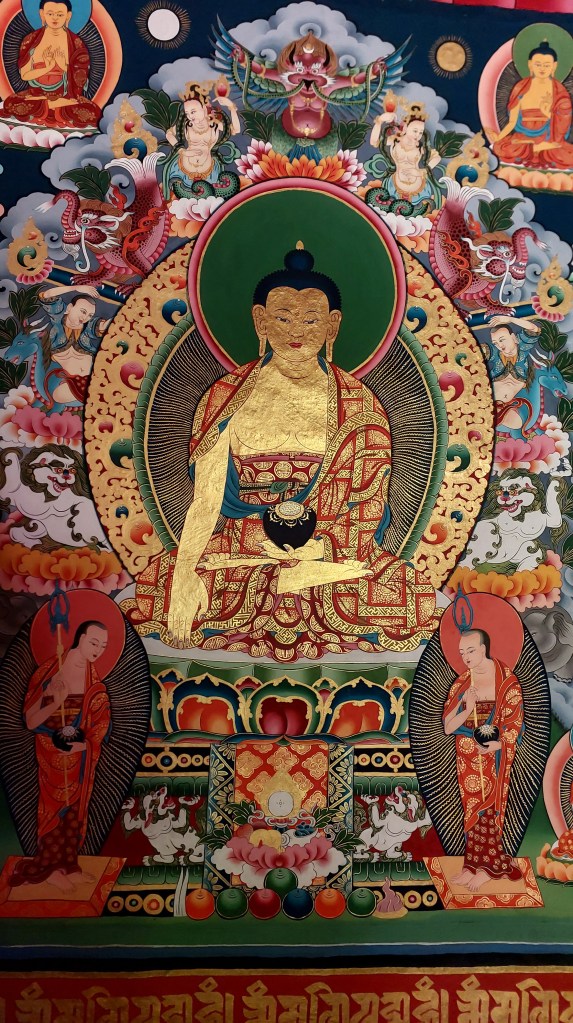
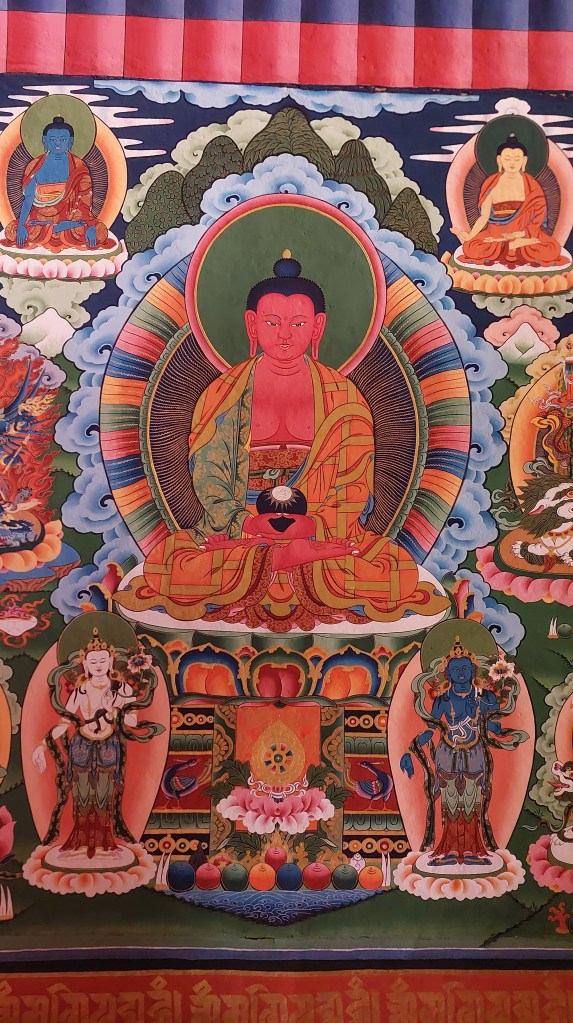
Shakyamuni BuddhaBuddha Amitabha – who preceded Buddha Shakyamuni, and who is revered by the Pure Land Buddhism (a Mahayana sect)
NB: The above statements may be bit over-semplified. In practice, there are few concepts that overlap the three schools of Buddhism.
Between school children who are seeking good scores in the forthcoming exams to youth vying for visa for foreign shores, there was a huge crowd at Dechenphu yesterday. Then there were those who were leaving for Australia. Talked to few of them.
Dechenphu is the most popular temple in Bhutan. It registers thousands of visitors every day and a couple of hundred thousands ngultrums in offering. The revenue, supposedly, helps support couple of nearby monasteries.
The deity, Genyen Jakpa Melen, is supposed to be very responsive to any help sought from him, be it to get good grades in school to winning an archery match. He is believed to protect you from obstacles when embarking on a journey.
When I visited this time, there was a long queue extending in the courtyard. Interestingly, not many bothered, or didn’t know, that the small shrine in the courtyard is actually where the deity Jakpa Melen resides, or where he is supposed to have immersed into after being subdued by a 14th century Drukpa lama, Jamyang Kunega Sengye – and is believed to emerge only when an enlightened being appears in the vicinity.
No one was paying respect there and instead everyone was squeezing into the tall temple that I gave up getting inside and instead paid my respect to the deity at this small shrine, and then visited the Guru Sungjoen in the temple above.
If you go to Dechenphu, do not forget to make your offerings at this shrine. Actually if you just do it there, it is as good as getting into the main temple.
The just-consecrated Wangdue Phodrang dzong shines ten years after it was destroyed by fire in 2012. All sacred relics were saved, fortunately.
In its resurrection I see new hopes, old glories and renewed confidence of what is possibile. And of course, a proud moment for the people of Shar Dargye.
Wangdue Phodrang (དབང་འདུས་ཕོ་བྲང་), which means “fortress of glorious unification”, was built when Zhabdrung Ngawang Namgyel set out to unify the collections of fiefdoms and valley kingdoms that made what is now Bhutan, and what used to be known as Lho Mon – the southern dark lands. Wangdue Dzong, therefore, is important for the unity of the country even now.
The dzong also is the repository of a sacred relic that is believed to be at par with the national treasure – Rangjung Kharsapani – the bone relic of Tsangpa Gyare Yeshe Dorji, which has a self-emanating Avalokiteshvara. Some scholars argue that Wangdue Dzong was not a strategic fort to fend off any invasions from the south, but rather the symbol of a unified Bhutan.
Other than the sanctity, Wangdue Dzong is a beauty – and a sight of relief to weary travellers coming from south and from the east as they head towards Thimphu and Punakha. It stands on a tri-junction of the important East-West and the North-South highways.
The villages of Lawa and Lamga in Athang gewog have an intetesting practice. The women are the boss. They decide on matters related to family and community. It is one of last matrilineal communities in Bhutan. At all public meetings, the households are represented by women. They come, they decide and things move.
In the years since I started working in this valley, I have noticed that this tradition has been maintained while it has waned in other nearby communities.
The eldest sister inherits the family house, known as the ma-khim. Literally meaning “mother-house”, the terminology itself indexes to the supremacy of the females. Other sisters, if any, are entitled for a house too and the father (if he wants to be respected as THE man) has to build them.
A man marries into the family as maap (son in-law) and traditionally does not get anything grom his ma-khim. And this practice of entering the home of the wife “empty-handed” also constributes to a less equal status to the wife.
Another interesting fact. There is no concept of pha-zhi (which means father’s farm) as practised in other parts of Bhutan because there was no land holding in the past. Much of the land was on a share-cropping basis.
























 Dorji Wangchuk