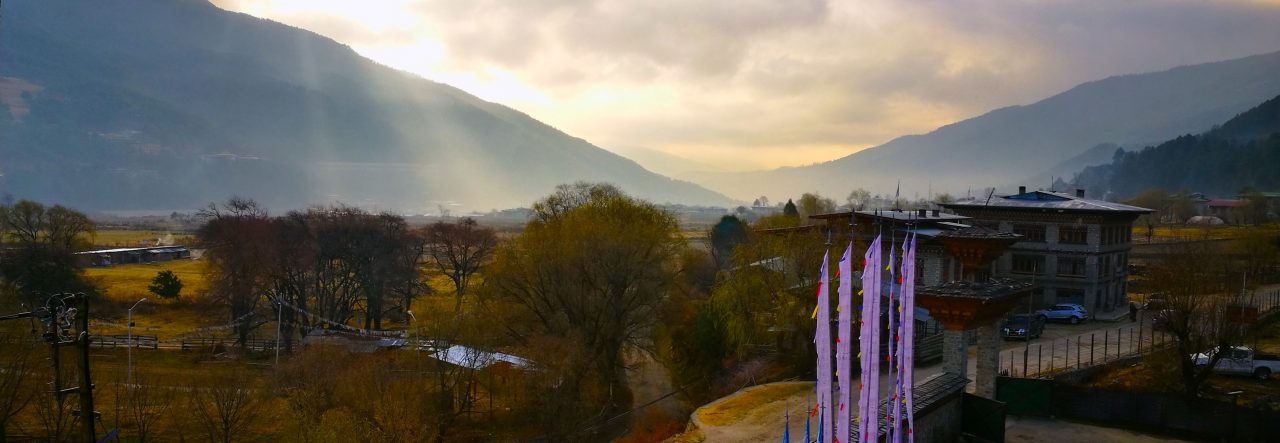
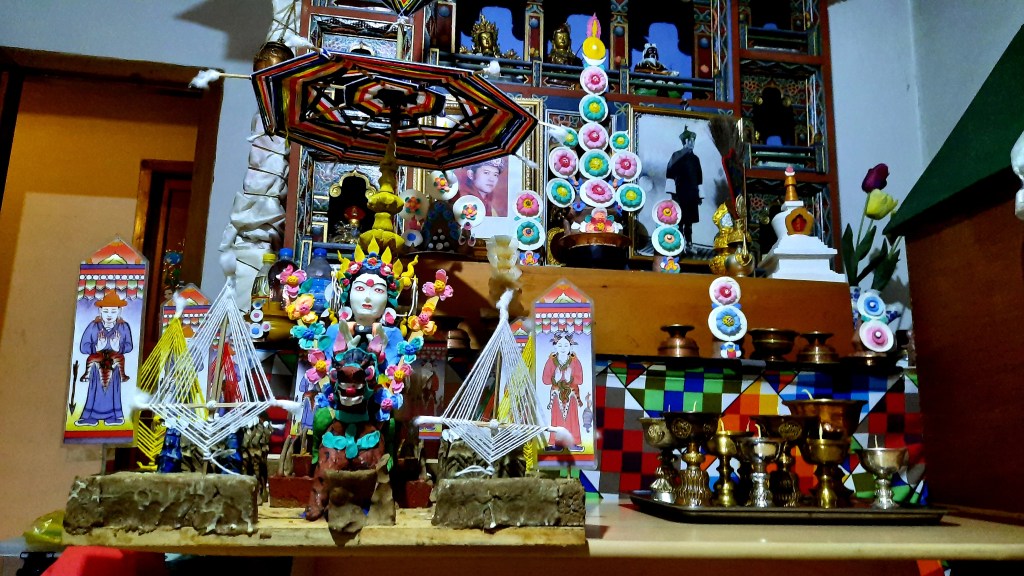
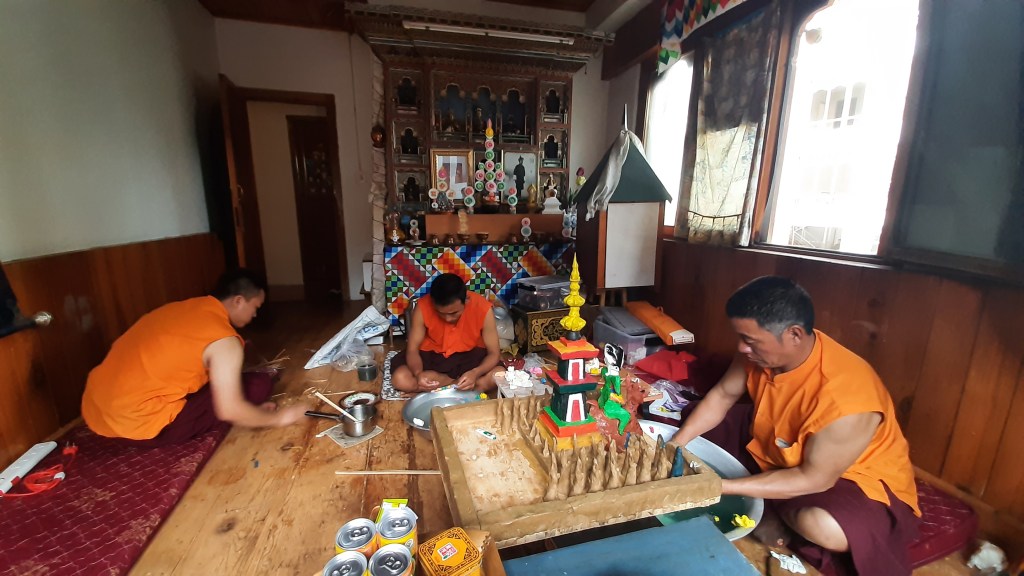
June 24, 2022 – The Summer Solstice has just passed by.
According to Buddhist legends, it is believed that the Sun returns from the North, and journeys to the South, after paying a visit to the Guardian King of the North, Namsey Zambala (Kubera) – the deity of wealth and prosperity in Buddhism.
The Summer Solstice is, therefore, a time for celebration and propitiation for wealth, good harvest, long life and prosperity. Usually a ritual to the wealth deity Zambala is conducted. The central monastic body still does these ceremonies. Devotees also recite Kuenzang Moelam (ཀུན་ཏུ་བཟང་པོའི་སྨོན་ལམ་ kuntuzangpö mönlam) for general wellbeing.
On the other hand, the Winter Solstice is a time when the Sun returns from the South, where the Guardian King is Shin-jey (Yama Raj), whose is also the Lord of Death. Around the Winter Solstice, Bhutanese perform “obstacles and death-preventing rituals” such as Jabzi and Mikha Kharam, and propitiating rituals to Tshepamay (Longeivity Buddha) and to Worldly deities such as Tsheringma. All included in what is term as Lho-choe or chhoga.
Supreme to all rituals is, however, Drolma Yuldog, which literally means “Obstacles removing Tara ritual”. Since Tara represents both a wealth-giving deity as well as obstacle-removing and enlightenment-granting divinity, there is nothing better than conducting Drolma Yuldog. Even Guru Padmasambhava is believed to have conducted Drolma Yuldog for King Thrisong Detsen, to pave way for the success of Samye monastery construction in Tibet.
The founder of Mahayana, Nagarjuna (Gyempo Ludrup in Bhutanese), is believed to have written the Drolma Yuldhog ceremony to help him win the Great Debate against the Theravada elders.
The Buddhist master, Atisha Dipankar, who revived Buddhism in Tibet in the 11th century, is supposed to have invoked Mother Tara when he found himself in a sea storm on his way to Indonesia.
Drolma Yuldog is basically the invocation of all 21 Taras, in which different Tara serve different roles and purpose. My favourite Taras are Tsugtor Namgyelma and Drolma Kurkulle. The ritual is parricularly recommended for people born with birth mewa 7 and for women.
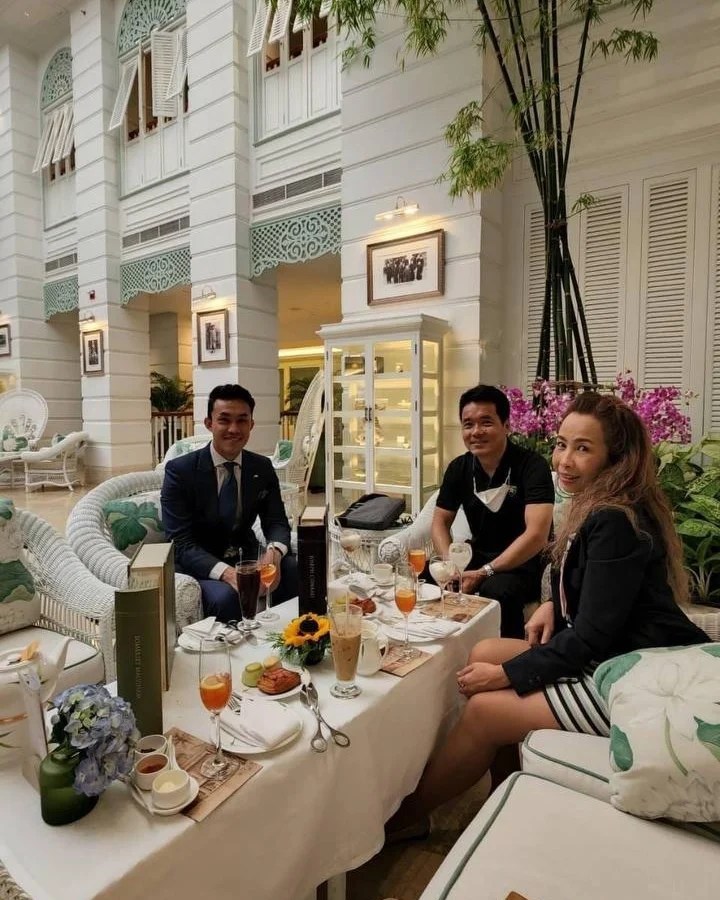
🏌♂️🏄♂️🏃♂️🏊♂️🧘🧘♂️ I took a break from the social media to get some few things done. I dropped my daughter to college, and while in Thailand I did a silent retreat, I caught up with some old friends, did some great writings (two books next year), had a health check-up (details below), and got my teeth fixed. To paraphrase my favorite uncle, late Ugyen Wangdi, I have reached an age where I have to look for spare parts 😂
OK. Back to health check-up. I knew that the series of lockdowns would have ruined my health in some way. After all, all I was doing was eat, sit, watch TV, work the laptops and sleep.
In fact my cholesterol, trygleceride, uric acid, and bilirubin had all crossed the upper limit. This is happening for the first time. I have also become overweight by 10 kilos. There were no symptoms whatsoever. It was just my gut-feeling that the lockdowns would have affected my health in some way.
So, to all my friends, get your blood CBC test and check your weight before they cause you further damages. This advice is especially for those who have entered the spare-parts age. 😁😁😁
And how is Bangkok? It was empty, devoid of tourists, and half the malls and shops, which I had been going for the past 25 years, have all disappeared. Unlike here, there is no kidu system. You are on your own. The shops I entered treated me like royal guest. And when I paid for things I bought, it was as if I was gifting them free money.
The Thai government has now relaxed all travel restrictions but arrival is only 7% as compared to the same period in 2019.
So, with all the talks of reopening to tourism here in Bhutan, I don`t think there would be a windfall. It would take at least another 2 to 3 years for the travel industry to become normal.
If the pandemic was bad looks like an impending global recession will be worse for the travel industry.
Two friends of mine sent me a few Facebook posts and asked me what I thought (because I am out of the social media). So let me share here, what I shared with them in case some readers find it useful.
Post 1 – A person was supposedly spreading Covid around. (I am not sure if he or she was doing this knowingly or unknowingly). What was definite was that this person was breaking the lockdown rules and was going around – and was allegedly evading calls from Health officials because his/her test returned positive.
Post 2 – FB users are arguing against the government decision to continue with the lockdown, and instead are proposing that Bhutan should start living with the virus.
Well, let me explain these two cases as an academic/researcher. What does social science say about this behaviour and feelings? I will refrain from making any legal or moral judgment. Other professionals may do that if they wish.
The common thread that binds the two case scenarios is called the perception of risk – as in how people respond when confronted with external threats and risks. While it may sound like a common-sense to think that this virus is dangerous and we need to stay away from it, one psycho-social theory on this topic has a different take. How each one of us, as individuals, perceive a risk varies from person to person. It is considered as a subjective feeling and not an objective and universal realisation. It is even different from nation to nation and from profession to profession. It is also different between men and women, or between a daily-wage worker and an industrialist, or between a teenager and an adult.
How individuals perceive a risk varies from person to person.
Strange, right? But it’s true. That’s why some people smoke although every research shows it will cause cancer. Then there are high-risks sports like rock climbing, bungee jumping, motor racing, skydiving where you are hundreds of times more likely to be killed than, say, if you play football. Same explanation goes for risky sexual behaviours and the increase in HIV/AIDS cases. We all perceive risks in different manners and indulge in risky behaviours because we are all different – psychologically and physiologically to start with – and followed by our socio-cultural circumstances and upbringing. One could also speculate something like: Even if Ebola hits us, there will be people, still, wandering around, or questioning the lockdowns and travel restrictions.
Psychologists have identified several factors that determine our perceptions of risk. I will explain a few here, and in brief:
Familiarity – When the first covid patient was announced, Thimphu became a ghost town. Now we have 100+ case load appearing every day and “Red buildings” everywhere, but we want the PM to call off the lockdown. It is because we feel “familiar” with this whole issue. Besides, the never-changing public health messaging of “wash your hand” and “wear mask” reinforces this familiarity bias.
Personal agency to control the situation – We are told that if we are vaccinated, and if we mask up, stay away from crowds, and wash your hands regularly, we are safe. When we have some level of confidence that we can control some things, some of us will jump. The public messaging has not moved beyond these 4 do’s – making some people more confident.
Physiological response – Two physiological responses are relevant here. First, our body’s production level of adrenaline and dopamine determines if we are natural-born risk takers. That’s why some people are sky jumpers and early adopters while others are no risk-takers at all. Second, fear activates the reptilian lobe of our brain. But this does not last long. Within minutes, actually, the neocortex and limbic areas begin to reactivate and people start reasoning and rationalising thereafter. And unless there is a new stimulus with new information and knowledge we will begin to form our own cognitive biases that best serve our personal interests.
Cost-benefits analysis – After the initial fears fade away, the rational brain starts to do the cost-benefit analysis. Am I forgoing too many opportunities by staying put? Won’t we all die one day anyway? What is real risk? Is it worth taking? This explains why tobacco smugglers got into action, because there was a huge mark-up.
Fair Vs unfair debate. It is a natural tendency for people to always compare – and play the victim card. “It is not fair because they have monthly salary deposited while there is nothing for me”. “It is not fair that bordering towns remain in lockdown more than Thimphu or Paro”. “Why are some shops open, and mine is told to be closed?” And worse (I have heard one man say this), “This is a rich man disease and we are all locked up to protect the elites. It is not fair. I have nothing to lose if I die.”
The fear factor– How much do we have to fear? And here again, people will seek information from sources that fit their preconceived notion. Such as, the fatality rate of Omicron is 0.0025%, or 1 in 40,000, which is lesser than that of the common flu – and lot less than other diseases that we have been living with. Or, I know someone who got it and without coughing even once he was declared recovered. Your frontal neocortex will also starts philosophising after being in a hard lockdown for months. What is the use of living like this? What is the meaning of life? Third year into the pandemic, fear is the last thing that one wants to hear – or think about. So save your resources instead of pouring into the fear tactics.
Life is precious but not everybody – Unfortunately different people value the preciousness of life differently. I am not talking about enlightened monks or my grandmother. In between the two lockdowns, and across the street I saw a worker cutting the tiles without mask. I told him that he might suffer from silicosis in the long run, besides catching covid. His reply was, “My life is worthless, la. I have nothing. I am not even married, Ha Ha Ha”.
So, to shout at someone, “Don’t you know that you will die?” or to remind that it is our collective gyenkhu (responsibility) or to say, “We have to protect the vulnerable” will have very little traction and buy-in, especially when the situation like this pandemic lingers on for so long. The collective becomes secondary when the bank balance is dropping like a rock – or when life itself begins to appear meaningless. Mind you, we are in the third year of the pandemic, and the end is nowhere in sight.
The physiological response to any threatening situation is termed as fight-or-flight mode, which is to either resist forcefully or to run for cover. From the Facebook posts that I have read, it appears that people have decided to resist it. Why and how we reached to this calls for another debate altogether. Again, these are purely brief academic assessments. It is for others to also chip in within their domains of expertise or responsibility, and ultimately for our leaders to make the tough call – based on everything that they can gather from everyone else.
However, understanding that each one of us perceive the risk in different manners – and that we are all different – psychologically and physiologically and not just socially or economically, is a good starting point to come up with better decisions, or to improve the public messaging through something called a strategic risk communication.
Who am I? I am the story I tell myself. We are the story we tell ourselves.
You want to know yourself; you want to discover who you are, or what constitutes your self-identity? Pay attention to what kind of stories you tell. If your stories are of bringing happiness to those around you, making a difference in someone’s life, helping fellow sentient beings you are a great person. That’s who you are. That’s your self-identity.
The stories you tell provides a window to your subconscious minds. When you reflect on these stories, you learn about yourself – your values, your intentions, and what are meaningful to you.
The British cultural studies scholar, Stuart Hall, defined national identity as “the story we tell ourselves”. As a nation, we are the stories we tell ourselves.
Who am I? I am the story I tell
Who do I want to be here on?You want to know how you will do in life, or what future has in store for you? Pay attention to what kind of stories you tell yourself – inside of yourself – that story that keeps replaying in your head. Quite often it is a story about blame games where everyone is wrong, where everything is unfair, and where everything is someone’s fault, your future will be like the present. You are stuck.
The beauty of telling stories is that you don’t have to keep playing the sad stories in your head. You can create a new one or change the story. Your past does not necessarily make you who you want to be. You can reset the story. When we change the story we tell, we change the way we see the world, and our place within it.
Back in the early 2000s, when I was continuously bullied in BBS, I kept telling myself: “It is not fair. I built this place. It was a small radio station when I came in. I changed it. I brought the technology. I brought in the foreign donors. I started the TV. I started the FM radio.” That story came rewinding in my brain
Then one fine day I told myself: “Wait! Is my destiny (lungten in Bhutanese) here coming to an end? Is the universe telling me something? Is my fate calling me somewhere?” Maybe. I thought.
I took a week leave, flew to Thailand to reflect in peace. Then after few days, instead deciding to come back, I mailed in my resignation. I felt a huge cloud cleared over me. I felt free. I called my friends in Europe. Someone sent me an air ticket, and gave me a place to stay. I wandered there around for a month. I had lived in Italy for 8 years as a student and knew that continent well and had enough friends who could feed me for months, if I wanted.
For years now, our normal ways of doing things have stretched us to the limit. Anything beyond, or besides, the norm was unthinkable – even intolerable. Making multiple visits for a simple service, whether it is from a government office or from a private sawmill, was normal – as it was normal to expect, and wait for, the state to provide everything. Conversely, new ideas, empathy, accountability, risk-taking, sense of duty, or thinking out-of-the-box became rare commodities. One dictionary definition of normal puts it as mediocre, average, and usual. With normality we have thus sunk into mediocrity – a dangerous disease that plagues our system and our society today. Power cuts, potholed highways, substandard public works, non-existent after-sales services, get-rich-quick mindsets, are norms rather than exceptions.
Then, Covid-19 happened. And disruptions and innovations became the norm.
Many public services went online. More utility bills were settled from a smartphone, and cooking gas and vegetables got delivered at our doorsteps. University graduates took up menial work. Zoom meetings replaced in-person travels and foreign trips. You don’t even have to get out of your car in the pouring rain to register at the checkpoints. Few days back I voted for my Gewog leaders in Tashigang by just walking over to a polling booth in Thimphu. Covid-19 has shown us that when we think beyond the norm, everything is possible.
The pandemic brought us together. For once since democracy dawned on us, we became one nation. We put our differences and designations on hold. We had parliamentarians and former ministers patrolling the streets in freezing cold and donning the simple and honest Desuung outfits. Soldiers, policemen, civil servants, and desuups walked in the blistering heat of the South. Our health workers worked past their breaking points. Farmers donated their precious produce. Businesses and private citizens wrote cheques to the Relief Fund. Students emptied their pocket money. Humanity took over hierarchy, commonality over compartmentalism, and abundance over scarcity.
Humanity took over hierarchy, commonality over compartmentalism, and abundance over scarcity.
Above all, led by our King, we brought the pandemic under control while achieving the fastest vaccination rate in the world. What else can we not do when we put our minds together? What is there that we cannot accomplish when we move beyond our comfort zones? The coronavirus has taught us that when a nation is united around a common cause extraordinary things ensue. When people agree on what is important, they reach for the unimaginable. This pandemic will subside one day. Do we then jump at the first opportunity to get back to our old self, to the comfort zone and to the old normal? Or do we maintain our new we?
Living within our means
In the post-covid19 era, we must aim to live with, and within, our own means and manpower. Self-reliance may be an ambitious dream, but it is not an impossible one. I have always believed that nothing is that difficult to be addressed or achieve. Things are difficult because we make it difficult. We let our ego precede our responsibilities and our abilities. We work in silos with us-versus-them mindsets. We also know what needs to be done. We have all the ideas and solutions. However, we don’t do what has to be done – because everything is about optics nowadays. Everyone wants to look good. Everybody wants to gain or retain favours. Meanwhile, our country gently weeps.
So, where do we start? We can start from the government. For, only when the system and people working in it facilitate growth and creativity, can the society generate more wealth and wellbeing. The Parliament has just endorsed the tax incentives for businesses in the Red Zone. Can we say that this is just a beginning? We should start small. We could aim for food self-sufficiency, for instance. Let’s be able to feed ourselves. Make that the short-term national goal. This virus will be tamed sooner or later, but another will appear, as humans push deeper into the wild such as the Amazon rainforest, or as mutations get easier because of global warming. We need to be more prepared. We can also cut wasteful expenditures like luxury cars, posh offices, ceremonial gates, tours and travels and ill-conceived and substandard public works. Fiscal policies should aim at increasing production and productivity of the citizens – and not pay for complacency and consumption. The word ‘growth’ must replace ‘development’ in the national planning mindset. As a sociolinguist and communication scholar, trust me, vocabulary matters.
The word ‘growth’ must replace ‘development’ in the national planning mindset.
The path to economic self-reliance does not end with the government. It is a massive undertaking – one that will require us to look way beyond the civil service. Any sociology student would have heard about systems theory, which postulates a ‘society as a complex arrangement of players, including individuals and their beliefs, as they relate to a whole’ such as a nation. Simply put, no major social issue, or a national cause, can be addressed by one section of the society, or for that matter by a single sector in the government. Do you ever wonder why none of our major problems gets solved? It will take the whole government, private sector, universities, schools, farmers – basically every citizen – to achieve the economic self-reliance. Like, we won’t get anywhere if citizens are lavish, spoiled or hedonistic.
Furthermore, it will also take several generations and many elected governments to get there. And this is where I am a bit sceptical – and not because of our quick-fix mentality but for the slash-and-burn approach that we are seeing more now. Some time back, I met a very senior retired government official on the Sangaygang road. Over a brief chat, one thing he told me was: once you are out of the circle your legacies are erased. My heart sank hearing that. Younger generations and newer political leadership should build on the shoulders of those who came before them. Otherwise, there is no way that we can go very far if we don’t learn from, or honour, the past legacies. Or if we keep engaging in cosmetic changes like renaming an organisation.
Building a society of trust
Last January, resourcing a Zoom session on education reform, attended by over 80 participants, I was asked to make just one recommendation to improve the education system. I had only one word: trust. Yes, trust and mutual respect are in short supply these days. Otherwise, there is no dearth of knowledgeable people and ideas, or even resources for that matter. But unless we trust our own people, and maximise our human resources, no major reforms will happen. No saviours will descend from a foreign land. We will have to build our own country. We will have to solve our own problems. To put it in a Bhutanese adage, we will have chew our own peebles.
Somewhere along we have coined our own version of the “Cancel Culture”. We reject our professionals as “so-called experts”. We brush-off our youth as spoiled brats. We treat our senior citizens as old timers. We scrap our entrepreneurs as profit hungry. Anyone outside the civil service is a lesser citizen. Even within the same ministry, or within the government, there are mutual misgivings. That’s why information sharing between state institutions has become a mirage.
Trust must start somewhere. Like we could look objectively at the excessive regulations, and the need for collaterals and committees and heaps of documents and signatures. Some checks-and-balances are necessary to protect the public interest. Anything excessive, or unpredictable, stifles the innovations and opportunities. Again, it is not that Bhutan has bad laws or regulations. Actually the opposite is true – as in it has some of the best policies and legislations in the world. Where things go horribly wrong is when you wake up one morning and find that your business became illegal overnight (unpredictability). It was banned. Or when you go to a government office and find that a certain regulation was changed six months before (inconsistency) and no public notification was issued. Or even worse still, when the rules are given multiple interpretations with every change in the dealing person (irregularity), or you get different answers from different people in the same office (contradictory).
One thing to also note is that the overpowering, inconsistent and blanket rules are not only putting a brake on people’s motivation and growth, they are also hampering the progress and opportunities for the government agencies themselves. To cite a simple example, the ban on drones is limiting its usage for aerial surveys (National Land Commission, Department of Forest), for patrolling (Royal Bhutan Army, Royal Bhutan Police), for rescue operations (Police, Desuung and the Department of Disaster Management), for medical deliveries (Ministry of Health), or for research, development, creativity (Royal University of Bhutan, and the film industry). Rules are not cheap either. They are expensive to administer. That’s why we have a bloated bureaucracy.
Trust entails a sense of ownership and belonging. Distrust breeds indifference and apathy, at best. Unless we correct all the above, Australia beckons and the brain-drain will gain further momentum.
We are a very small country that can purely operate from a space of trust
We are a very small country that can purely operate from a space of trust. Ideally provisional permits can be issued on the spot to enable the applicants to hit the ground running. The concerned public office can then check the credentials of the applicant with other state agencies and grant the final approval. It is possible. For example, when I enrolled for my PhD at the University of Macau in 2016, I couldn’t produce a few critical documents, like my original degree certificates from my previous universities, because I never made it to any of the convocations. The Admission Office let me in nevertheless, on a written assurance from me that I would produce the originals within three months, which I did. What is possible in Macau that is not possible in Bhutan? More trust and more penalties can be the way forward for public administration hereafter.
Common purpose. Shared future
Covid-19 has taken a huge toll on our economy, mental health, and governance. Our King continues to risk his own life. Huge state resources have been spent to keep us safe and fed. The treasury is most probably empty. And yet, the pandemic is far from over. We need to continue to show the same level of solidarity, sense of duty, innovations, flexibility and resilience that have brought us this far. And when this crisis ultimately recedes, we should also ask if we want to return to that old normal of rulebooks and routines, or whether we want to take into the future some of the best versions of ourselves that we manifested – and collectively regain the lost time and wealth. I believe this pandemic presents the biggest opportunity to relook at everything – from education to economy, from public service to the private sector, and from transportations to town planning.
We need to define a common purpose – a clear national vision.
As we embark on the path to recovery and resurgence, though, we need to define a common purpose – a clear national vision. Once upon a time, it was well-defined. We were on a mission to catch up with the world. My friends and I in the BBS (Bhutan Broadcasting Service) brought the television and FM Radio to the country in 1999 and 2000 respectively. We were part of the greater nation-building effort. We formulated the Vision 2020 document in 1996. And we came very very far. Now, I don’t know what we are doing – or where we are heading. Every five years there is a new direction, or a lack of it. Now the “nation” is nowhere. It is only “buildings” on everyone’s mind and everywhere.
Again, I have lived for extended periods in two countries in my life, besides my home country, and I have visited 40. I must say that the challenges we face in Bhutan face are universal. Meaning it is the same everywhere and so it does not make Bhutan any worse as compared to any other country I know well. Infact, in many ways it is still one of the best places to be in. But, given its size and the wise leadership in our monarchs, and the rich natural endowment and beauty, we Bhutanese can do better. Everyone can have a more meaningful and fulfilling life without the need to seek greener pastures – or without the need to chain ourselves.
Therefore, on the eve of this National Day, I have one dream for our tiny great nation. And that, coming out of this crisis, it will truly realise its greatness in smallness, and celebrate its resourcefulness over resources, and restore the traditional sense of dignity from dependency.
The choice is only ours to make. And the future will either stare at us with awe or with ire.
As cases of Covid-19 still rise in Thimphu and in Paro, a long lockdown awaits us, followed by the eventual reopening with strict health protocols aimed at preventing the resurgence. It is common knowledge now that wearing face masks, frequent hand-washing, and social distancing are the desired behavioural practices in people to stop the spread of the virus. Vaccines, although have been developed, are still a distant dream for us. It will be 2022 by the time an adequate percentage of the population is vaccinated to achieve the so-called herd immunity. For now, personal behaviours and responsibility seem to be the only way out.
One can observe that the use of face masks and the practice of hand-washing have picked up among the Bhutanese population. Any media and communication messages aimed at changing social behaviours take time. The successful adoption of hand-washing didn’t happen overnight. It can be attributed to consistent communications messages issued in the past by agencies like UNICEF and Health Ministry.
The third recommendation of social distancing has, however, completely caught us off guard. It is very new, and more interestingly, it is also against the accepted cultural norm of close social interactions that we maintain as people and as society – physically and emotionally. And thus, it has failed to catch on so far in Bhutan. This social phenomenon can be explained through the concepts of contact and noncontact cultures – proposed by anthropologist Edward T Hall in his seminal work, The Hidden Dimension.
According to Hall’s hypothesis, every society or culture practices an unwritten social rule called the personal space. An individual, when in public spaces such as markets or streets, subconsciously considers a small circular space around him or her as the personal space. If a stranger enters that space by being too close, one feels the personal space to be breached – unless, of course, the stranger enjoys an intimate relationship with the person. In other words, if I am standing in Norzin Lam and a stranger walks up and stands too close to me, I feel uneasy and my natural tendency would be to walk a few steps further and recreate that personal space again.
The average distance of the personal space depends on a culture and the society. As a general thumb rule, the physical distance in Asian and South American societies is less than a meter. In western cultures, it is more than 1.5 meters. Furthermore, in Bhutan, where we grow up in congested hostels rooms in boarding schools and queue up during school morning assemblies, where we almost squeeze against each other, the social distance or the personal space is close to zero. The long-term impact is then evident when we grow up and queue up to pay a bill at Bhutan Power or a bank and where the next person behind you is almost over you. In the US, if you do that, you could get arrested.
Everything about zero or close personal distance is not bad either. In fact it isn’t bad at all. It explains why our families and communities are emotionally close – and why we share everything from food to personal possessions to public spaces. There is a less possessive mindset of what is yours and what is mine. Even when we talk, we refer to our distant nieces and nephews or grandnephews as our children or our family. This impersonal attitude to private property also explains why Bhutanese have less hang-ups, or respect for intellectual property – another western invention. We tend to share everything – including songs, writings or an artistic piece. The close physical and emotional proximity is also the reason why Bhutanese feel closer to each other than say, nationalities of western countries. In Prem International School, an upscale boarding school in Thailand, Bhutanese students have been noticed to be closer to each other as compared to children from other nations. It also explain why we love games like archery – played in traditional style, while not securing anything in the Olympic Archery. And finally, why annual lochoes are still popular. To ask the people to socially-distance, then, is to imply that this is all wrong, which Bhutanese people will reject subconsciously.
Therefore, coming to the question: will the social distancing rule succeed in Bhutan? I think one can already deduce the answer based on what I have just elaborated. As a social science student I have some reservations on its imposition for short-term objectives, but if the government really wants to pursue this to curb the spread of the coronavirus, then it must do more than put out a lukewarm one-liner message to “practice social distancing”.
Sounds ridiculous? If you are not familiar with the context, yes. Because you are subjected to the direct translation, or transliteration, which always is very poor in Bhutan. So, let me try explain this using a mathematical language.

The zodiacal characteristics of the Year should be understood as the total sum of the characteristics of the Animal, Element and the Gender (actually it should be Energy here). So if C is the characteristics,

C(Year) = c(Animal) + c(Element) + c(Gender)

One of the characteristics of the Ox is hardworking, metal is determination and Female is feminine (soft). So, for example, children born this year will be softer in nature, whether boy of girl, but hardworking and determined. Tashi delek to new parents.

Coming to the translation, instead of "female", the better translation would be "feminine". But there is no need to spell out the two nouns, Iron and Female. It is enough to say Year of the Ox. That's what we do in real life. We don't all the three.

The other problem, which arises when you say all the three together, is that the nouns become adjectives and the overall meaning changes - and at times sounds ridiculous like the above.
The BKP, a registered political party, has issued a press release on what it feels are some shortcoming by the government. However, there was no debate on that – just some partisan reactions. Some agreeing with it totally. Others shooting it down completely. I thought there were some valid points in it, while I didn’t agree with everything, especially with some of the languages used.
This brings about a larger topic of why we, modern Bhutanese, are so bad in having a healthy debate? The answer lie in the language – on the vocabulary. It starts with the petty-mindedness that slams different views and as opposing views and opponents. The trouble, however, begins when these words are translated to local language, where it become བྱང་ཕྱད (enemy). E.g. During elections I have often heard the question: Who is his བྱང་ཕྱད? Meaning who is your enemy? Opponents are not enemies.
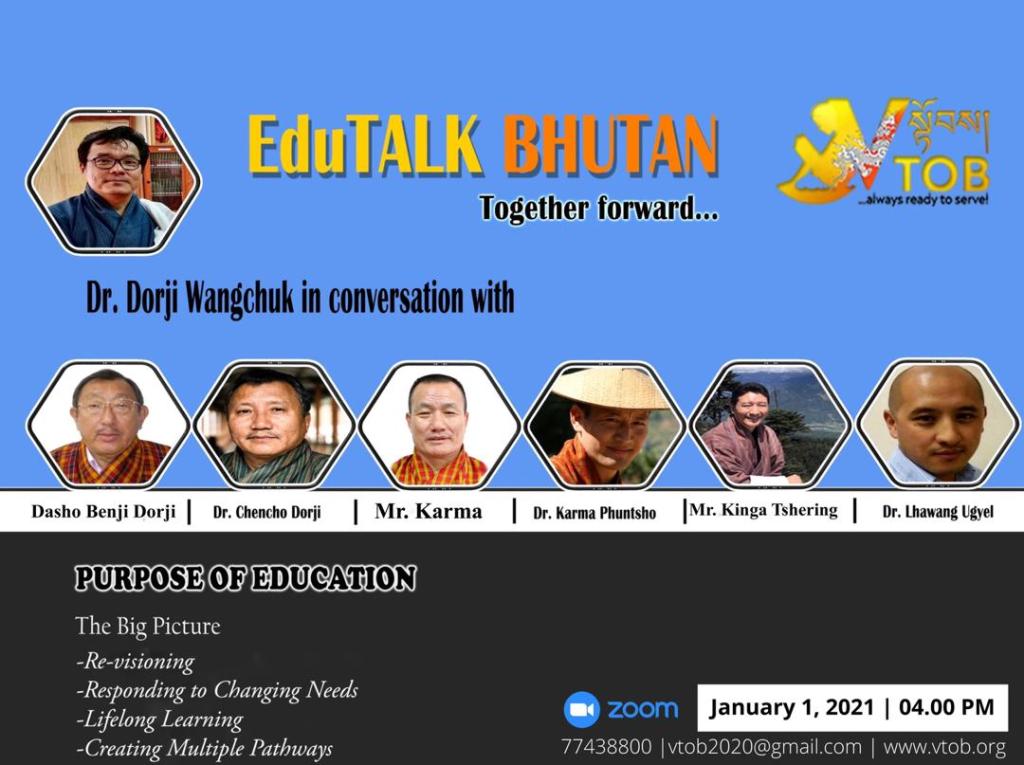
Next, do language and terminologies, matter? You bet! At an eduTALK on education that I was asked to moderate, I requested one panelist to switch from “vocational training” to “technical education” if we want more Bhutanese to acquire and practice technical skills. Any sociolinguist would tell you that language, vocabularies and terminologies are not inconsequential. Thankfully, the session was informed that Bhutan will hereafter avoid this word, vocational.
Coming to the question, if we need better debates, we need to coin less violent words.
(My opening statement as the moderator for the panel on curriculum at eduTALK 2021)
LET ME START by telling a story. As a former journalist and a filmmaker, storytelling is what I do best to illustrate an argument.
In 2016, when I left for Macau for my postgraduate studies I just had a small suitcase with maybe 20 pieces of clothes. Although I was going for 4 years, one small suitcase was enough because I had been to Macau before and I knew what I needed, or what I wanted there. I am sure everyone will agree that when you go on a trip and you don’t know what you need, you tend to overpack. Sometimes half of what you have packed is never used.
This brings me to the first point. When it comes to curriculum or what we want from the school education, do we really know what we need? Have we not over-packed our curriculum baggage with things that we may never use or are not relevant to that journey? Isn’t there a curriculum overload?When I was teaching in Sherubtse I used to joke that we have so much unnecessary stuff that our children have no time to learn the essentials – like reading or writing. I was not just kidding but I had to take weekends classes to teach grammar and writing. Ask any of my former students.
Second point, every time we talk about the quality of education all eyes are directed at curriculum only. We saw Shakespeare being thrown out – and then reinstated, REC being pushed around, CAPSS being transferred, relocated and renamed. I am sure anyone who follows the development in other countries would have heard that the best education system in the world, which is Finland, has done away with curriculum a long time back. I have been to Finland, not on a government-sponsored study tour, but at my own expense. In the several rounds of meetings at the University of Helsinki, what I discovered was that they invest everything in teachers education and training and then leave to individual schools and teachers to design what to teach. Have they messed up? Well, in 2016, the European Patent Office, which certifies and grants patents for inventions and innovations, has declared Finland the leading country in the world for the fourth consecutive year.
Third, these days it has become fashionable to put the “21st century” in every document we produce. Personally, I don’t believe there is such a thing as 21st century skills or knowledge but just to go along and follow the herd-mentality once in a while, what does a 21st century curriculum look like. A bit of Lord Google gives me words and concepts such as: not text-book driven or teacher-centred, but thematic, project-based and interdisciplinary. Skills and content not taught but self-learnt through research and application. Finally, knowledge is not memorisation of facts and figures but something constructed through addressing real-world problems.
On the first day, we heard several speakers making proposals to define the purpose of public education. One was to achieve economic excellence through harnessing the human potential; the other was to replicate the traditional monastic education model towards actualising the innate human potential. Two different choices both aimed at harnessing human power and not just hydropower. It need not be, however, a choice of either or – but rather an invitation to embrace both.
So the million dollar question: How does a 21st century curriculum look like, to deliver these ambitious goals and purposes of education.
RECENTLY, I was asked to moderate a session by a group of volunteer teachers on this topic. They were responding to the Royal Address at the National Day where education was called out for its failure to update to the needs of the new century and the changing times. The panelists were some of the best minds from the Bhutanese society.
I was curious by the question and so, as a researcher, I did a small survey where I randomly primed ten people from my contact list and asked them the question: According to you, what is the purpose of education.
I got seven different answers (see Annex).
Two things are certain when it comes to the purpose in education: first, there does not seem to be a clear understanding; and second, there is no consensus on the matter. How do we then judge, or how does the system implement, something the purpose of which we are not sure of, or agree to. This, perhaps, is the basis of why public education is in dilemma today all over the world and not just in Bhutan.
In the last two decades, though, as more people moved away from the traditional occupation of farming, the public discourse on the purpose of education in Bhutan has focussed on “preparing for the job market”. Thus, words such as “mismatch”, and phrases such as “21st century skills”, have been loosely tossed around.
But does getting a job, suffice as the purpose of education? If so, then we just need a few trade and technical schools where people can spend a maximum 2 years to learn something and then a job is secured. Some jobs can be learnt in less than a week – like sweeping or mopping the floor. Why do we need to invest in 16 years of education, taking some 20% of the State budget every year?
If you dig into a bit of history…
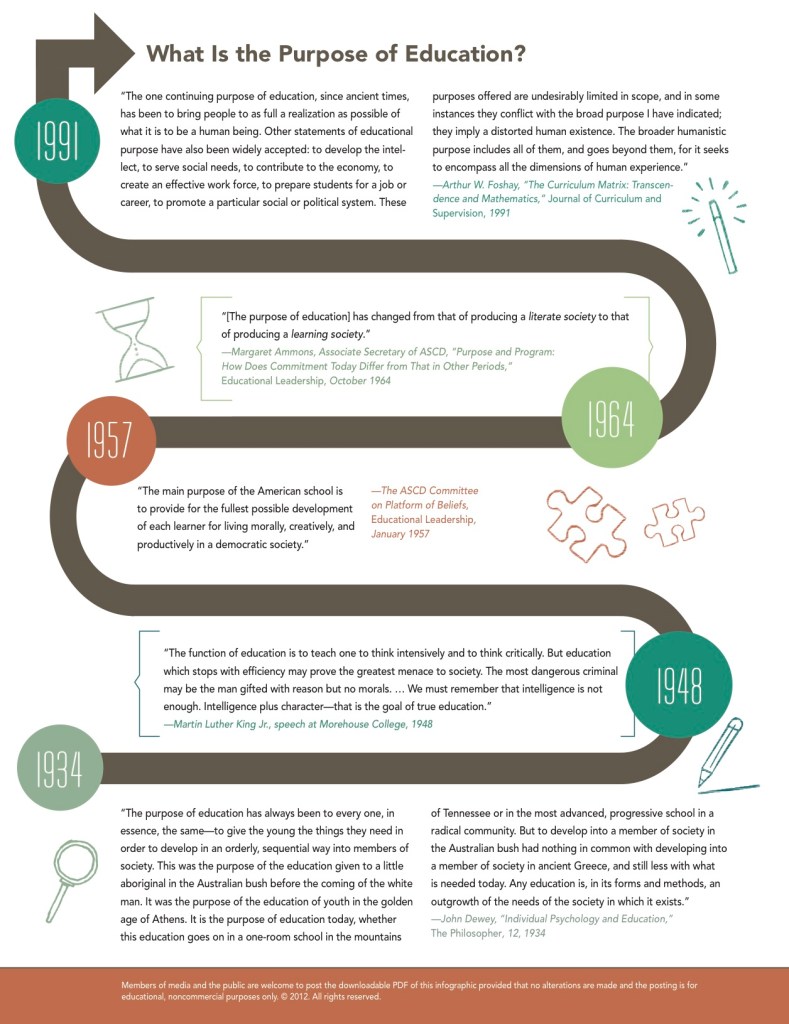
The oldest formalized learning model recorded in the western world comes from Ancient Greece, which focused on developing soldiers, public servants, statesmen and well-informed citizens. Students learned from a hired tutor in a master-student environment. It was an individualised curriculum. Socrates argued that education was about drawing out what was already within the student. The word education, in fact, comes from two Latin words, educere meaning “to lead out” and educare – which means to “to culture” or “to groom” a well-rounded person.
Few often cite that we have an education system, as old as the one from Ancient Greece, from some 2500 years ago: the monastic Sangha. Buddhism was actually an education system that aimed at seeking wisdom – and not just knowledge or information. The ultimate aim was to attain enlightenment. One of my favorite quotes, which I try to live by, is from Sakya Pandita, Kuenga Gyeltshen, who said: “Even if you are going to die tomorrow, it is still worth learning something new today”. Definitely getting a job was, then, not the purpose of education.
Diametrically opposite to the Buddhist perspective of education was the Pragmatist view enunciated by various scholars, such as the Late 19th Century American philosopher and linguist, Charles Sander Pierce. Education is to be pursued to only serve a practical purpose, like getting a job. This fitted well and further justified the Factory model of public education – the education system that became widely available following the Industrial Revolution. Hierarchy of disciplines came into existence, as science and mathematics took over art, music and philosophy.
The fourth, and the last perspective I will mention is, from John Dewey, another American philosopher-educationist from the early 20th Century, who believed that education served a greater purpose than just landing a job. He was convinced that education was an end in itself and a means – in that children became fully developed because of it. The economic goal, like landing a job, was just one of the by-products of being educated.
Which of these perspectives serve to re-define the purpose of our education system in Bhutan.
Unless this question is answered, I expect the discussion on the New Education Reform to become either a Dilli Haat where every person is shouting and trying to sell his or her wares, or we will have another Blue Print or Master Plan that lacks in basic coherence like a link between the vision and the strategy.
~~~~~~~~~~~~~~~~~~~~~~
Annex: Purpose of education : result of the small survey