Learning all over again

Going back to school is fun. You get to relive your life – the so-called “golden” student life all over again. However, it becomes more difficult as you age because you have to cope up (and sometimes put up) with other realities. In this article I will lay down some key issues and skills and chills of going back to college.

  1. Zeal For Learning

    20160915_201512
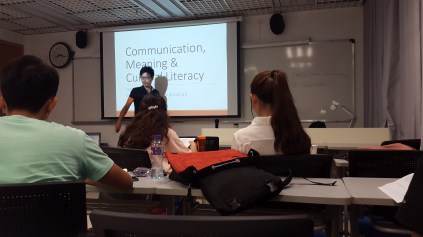
    I practiced media and communications for 20 years. Now finding out what I was doing. Better late than never. Terry, who is little more than half my age, taught us how to read an academic paper.

First and foremost, you got to have a genuine zeal for learning. You have to look at yourself and ask, “Do I really enjoy learning? Or was learning just a part of an ambition that I pursued?” You need to answer
these carefully because if you have made learning a MEANS and not an END in itself, you will suffer. Learning itself should be the end goal and not something that you do expecting a better job, career, money or fame.  I am not saying that this is wrong. But this is something you do when you are much younger – when you are, as the Italians say, in your primavera (spring season).

  1. READ? You. Can. Kill. Me. Instead

We (especially Bhutanese) don’t like to read. Not even something that we sign on. It is a national disease. We would rather be killed than be asked to read, for example, Bill Clinton’s 1008-page autobiography, My Life. I am not a voracious reader but I would easily pass the national average. Post grad studies requires you to read, read and read. In communications studies we are made to read even more – and on a variety of subjects – philosophy, anthropology, sociology, psychology, mass media, religion, history, politics, economy, current affairs, public relations and many more. If reading is your nightmare, don’t even attempt the post grad dream. But if you DO read, you are already a step closer.

  1. Shed off your ego

Ego is in our blood. I wish it showed up in our complete blood count (CBC) reports so that with another prick of a needle we can bring our ego level down just like we do with blood pressure. You should HAVE pride – but not ego. Pride gives us dignity. Ego destroys them. Now going back to school, can you rub shoulders with people half your age? Share a room in a dormitory? Get lectured by people younger than you? Seek help from anyone from a janitor to a gardener? Admit that you can’t even use your own mobile phone? Can you be, suddenly, nobody all over again in a strange place?

  1. Simple Living High Thinking

The increased income level in Bhutan in recent years has made us more materialistic than ever. I am amazed to see how much we pile up with stuff that we actually don’t need. In 2013 after I lived in a one-bedroom apartment in Sherubtse for a semester I decided to scale down my life. I realised I could live more with less. When I got back to Thimphu I started sieving through my wardrobe. And out came things that I never wore and didn’t even remember buying them. I returned to Kanglung for two more semesters – with 3 suitcases of cloths and 2 cartoons of old shoes that I gave away. I also gave away both my silk gho to my younger brother.
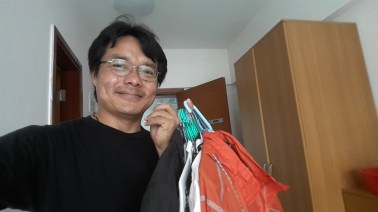
20160904_125034
Living on a 20-piece clothing. You live more with less

Going back to school means you have to detach yourself from that materialistic lifestyle. And adjust in a modest one-room flat after living in a house (in my case, in a villa). Can you do that? Do not romanticise these things? It is not fun after the second day. There is absolutely no private space. You have to line up for food instead of being served at the table. You have to do your laundry, clean your room, wash the toilet and scrub the basins. And if your roommate doesn’t care it is even worse. But living a simple life, you have more time for yourself, time to read, moments to reflect and time to pause – especially for someone like me who has been running since I graduated some 21 years back.

  1. New place Strange Place

Being in a new place is nice but NOT if you have decided that it will be your home for the next 3 years. You are not on a paid-holiday or a romantic honeymoon but for a more serious stuff in a strange land for an extended period. You have to make yourself at home – and quickly. Of course, there are services and supports centres. But unfamiliar surroundings can be dreadful. No friends to support you. No family members to rely on.
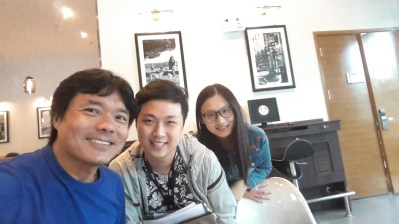
20160909_130515
My two ‘classmates’ whom I rarely meet

And in my case no compatriots to even seek help. I am the only Bhutanese in this mini-country (Macau is a SAR of China and administered independently like Hong Kong). What happens if you have a medical emergency? Or if your money runs out faster than you had planned? What if you lose your passport? Or if you cannot catch up with the rest of the class? And fall behind with assignments? And like in my case what if you have just two classmates whom you don’t even meet? Yes, you could be lonely. Being away from your family, friends, comfort zone could be terrible. The social, cultural, physical and mental challenges are big. If you are not up to it, you will collapse.

Now having given you all the “bad” news here, from my next blog entries, you will only have the best of being back to school, I promise. I will also share about how YOU can also do whatever you want to do when you grow older (which everybody will). A sneak preview to that: at the core of everything you do or you want to do in life is your health. Take a good care of it.

My friend, Ugyen Tshering (former Paro NC member), used to tell me, “Stay fit. Your chance of your lifetime may come when you hit sixty.” I followed his advice.

Eleven years to go for my chance at sixty.

~~~~~~~~~~~~~~~~~~~~

20160907_152336
Following Bhutan Standard Time with assignment submissions. 🙂
20160914_105615
No earthquakes like in Bhutan but a different type of natural disaster


mix method.jpg
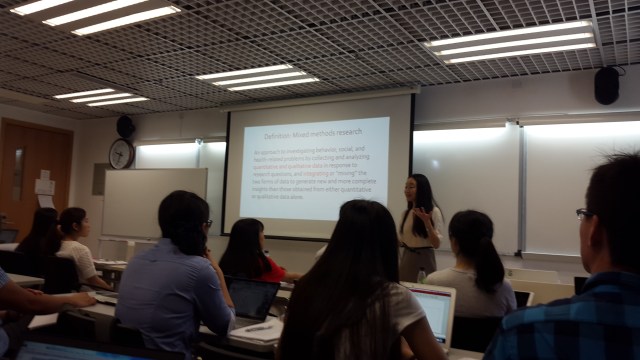
Visting professor Su Lee from John Hopkins speaking on mix method approach in research

Back to school

In this blog entry I try to explain why I decided to go back to school at this stage in life. From an off-the-cuff bucket list to a short stint as an adjunct professor with the Royal University of Bhutan to a research trip to Kheng Silambi with a team of social scientists from University of Berkeley, some things are simply meant to be in life.
20160830_161635
Going to school.  Books, water bottle and smiles

“Where is the original for this?” Jennifer, a very beautiful young lady, whose age was impossible for me to guess, asked me as she flipped through my academic transcripts. “Well, I graduated many years back, changed couple of jobs and so I really don’t know till which office the originals followed me,” I replied with a timid smile. “Yes, it’s been a long ago,” she added smiling back, “You have mentioned that you had asked your university to send a copy?” she went again. “Yes. But my university doesn’t open until the end of the month. They are on summer break,” I told her. She went back and forth her office desk and the counter for a couple of times and then closed my file with utmost care and handed it over to me with, “So you can enrol in your course while we wait for the certification from your university,” she went. And she gave all the things that I needed to start off.”

Unlike in Bhutan where we are told to come tomorrow if anything were missing, people here work based on trust. Nothing is denied or stopped as long as you speak the truth.  You keep going and you keep attending to the issues. Verbal commitments are honoured. People’s words are trusted.

I walked out of the building towards the library building, looked for an espresso coffee to wake myself up fully and got some lunch. My next appointment was the police department where twelve of us were shepherded in a university van to go over and renew our Stay Permit. After filling up two forms and after turning in our fingerprints I faced an official at her desk who went through my papers. “Oh. You made a mistake here,” she said. I got little worried. “Just overwrite it and put your initials,” she added.

20160830_133403
Mess food.  Cheap.  Good.  Healthy

Everyone here has been so helpful from the moment I landed in Macau. There is no doubt that things ARE as bureaucratic but here the civil servants believe, and take pride, in what they do – public service.

I could finally meet my professor towards the end of the day. He passed me a list of required courses that I had to take, an undergraduate course that I had to help teach and a course that I could apply for an exemption. I looked at the paper and my first class was just few hours away. On the very first and the same day! “Welcome to the student life,” I said to myself.

It was getting close to 7pm and I was having some trouble locating my classroom. After I gave up I sought the help of a janitor who was mopping the floor of the long corridor. “You go straight. Take the elevator to first floor,” he said with perfect Chinese-accented English that instantly reminded me of Russell Peters. I walked away forcing myself to keep a straight face.

20160830_212751
It is 9.30 PM and not AM.  Great for an owl like me.

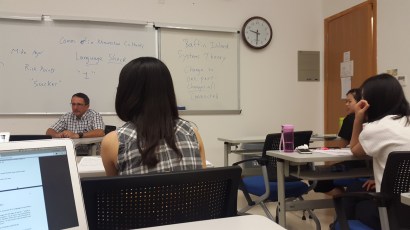
Finally I found my class. The professor was about to start the lesson. I bowed down to him in Bhutanese style and found an empty chair in the forth row. The class began. “Welcome to this course. I am professor Tony Schirato. You can call me Tony. And this is Terry, my teaching assistant.” Tony is Australian of Italian origin and is a full-professor and head of the communications studies. I met him on my previous visit and I was looking forward to his class. As he spoke I looked around to find myself with some twenty people. The oldest one was probably half my age. I started wondering if I was in a dream. I even poked my palm with my pen to check if I had died and gone to heaven. Pain. No. It was real. I was back to a classroom. After twenty-one years. Who would have imagined that?

As I was juggling between dream and reality the class ended. Fortunately it was called off “early”. It was still almost 9pm. We just had the course outline. I walked out with few new friends that I made for the group works and presentations – Charlotte, Ocean, Angel and Hala – all from Hunan in China.

The evening air was cool. There were still many students walking up and down the campus. I look around with my face beaming – partly because of the pride of having made it here (my first degree was in engineering and had nothing to do with communications studies) and partly giggling at myself for undertaking such a stunt at this age. “Why am I here?” I asked myself. Moment of reflection. “Because you made that a bucket list when you were 40,” I replied.

20160830_112645
The library.  Books for oldies like me.  Digital for others.

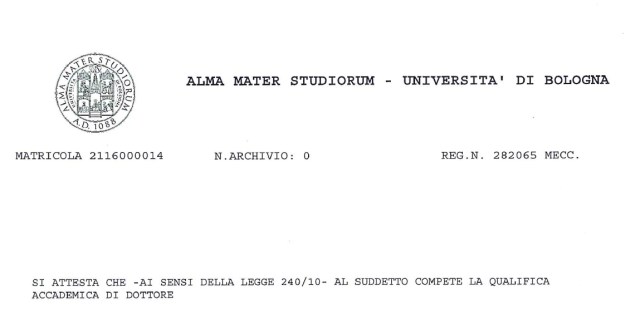
Yes. Some time back when I was homing in to 40, I was scared of entering into a mid-life crisis. I wrote a chapter, Life Begins at 40, for a book A Fly in a Forgotten Tea to cheer up. And to keep myself excited I also made a bucket list – of things that I wanted to achieve by the time I turned 50 (not very far away). First in the list was to meet Nelson Mandela; second – to fly a plane and third, to go back to a university for a PhD. It was not a well thought-out list but something that came out instinctively. Now I am here and as my Chinese friend asked, why do I need a PhD? Well, in the conventional sense of its usage such as furthering a career or making more money, I really don’t need one. I have already come long long way in my life and I am content with that. And I can still go further with my degree from Italy. Besides, I don’t need a PhD to add the fancy title of “Dr. “  in front of my name. I am already entitled to that having been conferred by my previous university and I never used it even once.

The idea of doing a PhD, however, gathered steam in recent years. First, my short stint in Sherubtse as an adjunct professor opened a new world to me. While inspiring our younger generation there I also discovered a fascinating life of research where I thought that it would be wonderful if I could bring together my life’s rich experiences into some scholarly works in the field of communications. I have seen, lived, built and experienced the development of modern mass media in Bhutan. From the first radio transmitter to setting up the Royal Office for Media, I have seen a lot. So, to put in purely academic format, I have all the anecdotal experiences, which many can just dream of. Therefore, I decided to pursue a third career in the academia. And if you intend to hang around in a place, you got to be the best. I have also understood something about our higher education system – and education in general – along the lines of where we are going wrong and what kind of catastrophe we are heading towards – as a society.

20160830_132937
Getting some food.  This is the general canteen.

Secondly, we really need to understand the media in Bhutan – the social media, in particular, and mass media in general. Mass media is now a reality especially that Bhutan is a democracy. Nothing will be more defining or damaging to our country than our failure to create a healthy relationship with the mass media. Ultimately we need to develop our own media model that is tailored to suit our history, culture, social circumstances and political evolution. I have called it the middle-path journalism.

The most important reason, of course, is what I always believed in, practiced and perfected over the years – the lifelong learning.

You don’t stop learning – because once you stop learning, you stop living – you stop growing.

One should learn new things, acquire new skills and absorb new knowledge every day. In a world that is changing so fast one could get stagnant or redundant very easily. When my generation finished our high school we (the so-called top students) were almost bullied by our government to go for engineering or medicines. Now I meet lots of engineers who cannot even get a decent job. My Chinese roommate says that in China no one studies after 30. I told him that in Bhutan people stop learning even much earlier.

So here I am. And coming back to my bucket list and the other two things, well, Nelson, sadly, passed away before I could meet him. I met his son through whom I sent my greetings. I was saddened but, at least, I feel, I can still fly a plane.

Life begins at 49? Possible.

~~~

doctor-certificate
The degree from my earlier university entitles me the use of Dr., which I never used.


20160830_120550
Back to tee shirts and blue jeans.  Bring it on!


20160825_122933
Will be getting an office soon.  Yaaaay!!!!


20160827_082220Macau University is inside Mainland China connected by an undersea tunnel. 
book1

Arrival in Macau

“Ladies and gentleman, as we will be landing shortly, please fasten your seat belts, stow your tray table and put your seat in upright position. The temperature in Hong Kong is…..”.HK1

The in-flight announcement wakes me up from my short nap. I am on Cathy Pacific flight from Bangkok en route to Macau in China. The flight was early and so I had dozed off after we took off from Suvarnabhumi Airport.

I open the window and look out. We are descending down the towering chunks of thick clouds over the South China Sea. Intermittently I get glimpses of some little spots down below that are actually large ships floating in the vast ocean. Few minutes later the aircraft descends below the cloud line and I get a better view. More ships in the sea and in the distance I see some coastline mountains that I presume is Mainland China.

The landing is smooth. The aircraft taxis to an apron. I buckle off and I go for my carry-on luggage and we slowly baby-step along the aisle. I am behind an Indian businessman who is already talking (read as shouting) on the phone. The air hostess at the exit door bids me goodbye in Japanese. I am always mistaken for my wife’s nationality.

HK14I hit the main terminal building. As I walk I look out. The Boeing 777 that I was on is now getting refuelled and checked while bags and suitcases file out from the bottom side door on to a conveyor belt. “Welcome to Hong Kong,” I say to myself, “and now get to the ferry terminal for Macau – as fast as you can.” Hong Kong Airport is the only airport that I have been to where one could get off from a plane and get on to a boat. There are regular services to Shenzhen, Zhuhai and Guangzhou on the Mainland and to Macau, which is a Special Administrative Region of China – under the Chinese government’s One-Country-Two-System arrangement.

Three hours and hot noodle lunch later I am on a large speedboat docking off and slowly heading for the open sea. Above us, an Airbus 380 bearing the Emirates logo is slowly approaching the runway with its landing gear down.HK15

Thankfully the sea is calm today and the much-dreaded motion sickness that I occasionally suffer from does not show up. And after undulating for an hour I see Macau’s iconic tower in the horizon and slowly the whole city comes into the view. Macau is a small island on the Pearl River delta bordering with Zhuhai city in Guangdong province. It was a Portuguese colony till 1999.

The Immigration officer takes my passport and asks me how long I was staying this time. Apparently he has records of my 3 previous visits. “Very long,” I tell him, “I am starting off my PhD at the University of Macau.” I reply as I wave at him the acceptance letter from the university. He gives a lukewarm endorsement but no further questions. My passport is stamped. I am admitted to stay for 60 days within which I have to renew my visa after the admission procedures at the university are completed. A 30-minute ride in a taxi passing by some of the world’s largest gambling hotels gets me to the new campus of the university. My professor had arranged another PhD student, Marilyn from China, to assist me with the check-in formalities at the Post Graduate Housing.HK17

But the reception has some problem getting me a roommate – probably because of my age and so Marilyn takes me out for dinner while they sort things out. When we are back to the office again, I am asked to follow a staff to my room on the 4th floor. I am introduced to my roommate – another PhD student from China, Mo Dazie – who is just 28.

As I check my room I find that my bed has a mattress but no pillow, blanket or bed sheet. “Where can I buy them?” I ask my new-found friend. “Come,” Mo says. We get along almost instantly. I follow him and we head out to a large store inside the campus. The campus is busy with students and professors moving in all directions. I look around, take a deep breath and smile, “So I am really back to college. I can’t believe it,” I tell myself.

“How old are you?” Mo breaks my thoughts. “49,” I reply. “49? Why you study?” Mo is rather dazzled. “I have been also asking myself. I don’t know,” I joke. We have a good laugh.

After getting my bed ready, I brush my teeth, wash my face and I crash. I don’t have the energy to even open my suitcase. It’s been a long day. As the world dims on me, I ask myself again, “What am I doing here? Why do I need to study?”

But I am too tired to ponder on these serious questions.

…………………………..

20160825_113524


King never sleeps

13698182_10154242382193260_689268589374906768_o

Bangkok – August 2016

In Thailand there is a beautiful tradition whereby a king is not supposed to sleep at night. He stays awake to protect his people who retire from a hard day’s work. The king, then, goes to bed at dawn. The tradition started from the kings of Ayutthaya who were at war with Burmese kingdoms. The people then could sleep peacefully because they knew that their King was awake and would protect them in case some enemies attacked in the middle of the night.

As the capital shifted from Ayutthaya to Thonburi to Krung Thep (aka Bangkok) this tradition, it seems, is still alive. King Bhumibol, it is being said, worked a lot at night going through reports, maps and charts. In fact some years back I was in a taxi to the airport when our traffic stopped at a crossing. It was 3 in the morning and the royal motorcade was passing by. I asked the taxi driver and in a rudimentary English he said, “King never sleeps”. “Why?” I asked him with child-like inquisitiveness. He couldn’t explain further because of his limited English.

A facebook picture of our own King looking towards a menacing river at night (which was taken from the recent flood disasters in the South) reminded me of this tradition. Thai people believe that our King embodies the spirit of a king who never sleeps. And who protects his people all the time.

However, we rarely attribute our good sleep to good governance – let alone be thankful about it. We have never thought that if we could go to sleep peacefully it is because we know we are safe; we know it is thanks to someone who is there for us. It is one of those things that we Bhutanese take for granted. Good kings, good leadership, clean air, clear water, what else do we not take for granted?

“You know what? We should be grateful that our King worries for us and that you guys don’t have to worry at all,” I used to tell my students in Sherubtse College at morning assemblies during my short stint there. “This is what we should really be grateful for”.

An Indian media tycoon, who own the NDTV group, once told me, “Now I know why you Bhutanese are happy. Because your King does all the work for you.” I was walking him to his car from an audience with His Majesty – at Taj Hotel in Delhi in 2011. I still think what the Thais tell me is the best. “You people should be lucky that you can sleep peacefully thanks to your King.”

Hopefully our people will say a little prayer before retiring to a peaceful sleep from now on.


From the set

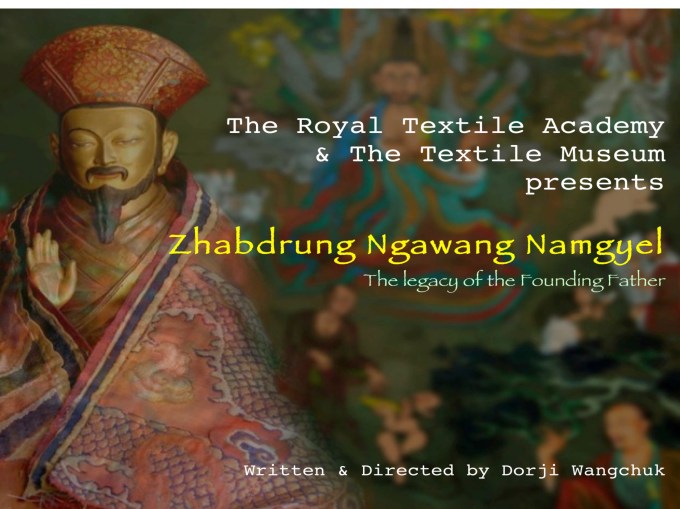
I just completed a large documentary titled, “Zhabdrung Ngawang Namgyel – the legacy of the founding father”.

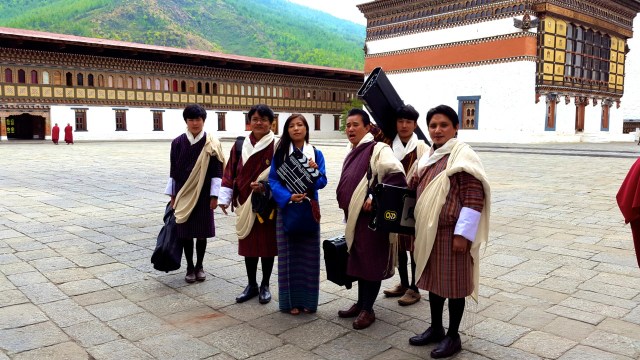
Here are some pictures from the set and from the places covered in the documentary

Slide1

Zhabdrung docu shoot
After the audience/interview with His Holiness the Je Khenpo (Chief Abbot of Bhutan)
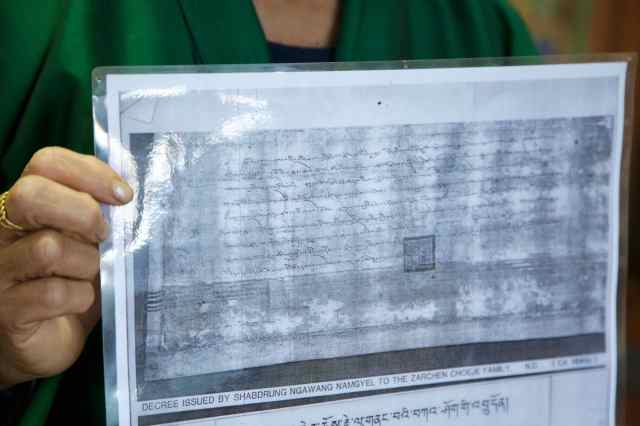
kasho
The decree granted by Zhabdrung to the Zarchen family of Paro
punakha
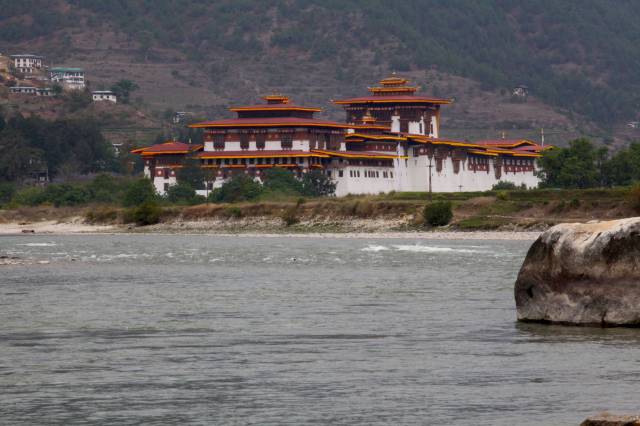
Punakha Dzong – the capital of the Druk Yul as established by Zhabdrung in 1637
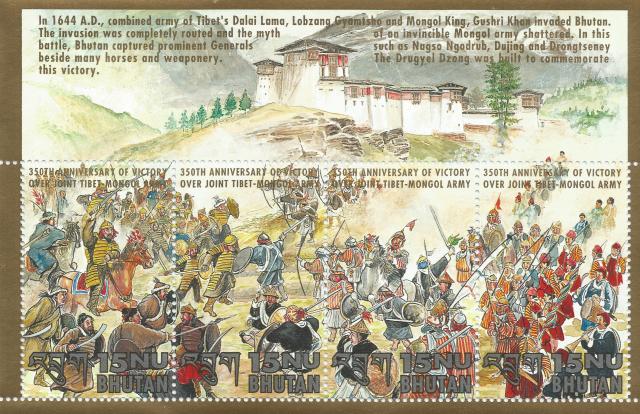
Stamp commemorative
A commemorative stamp tells the story of one of Bhutan’s biggest military victory


Best friends

….

Whether or not it is a “Friendship Week” this week, here is a video of the two greatest friends of Kanglung that I filmed in 2013. I think BBS did a piece after I alerted them. But anyway.

Every time I was driving back to my village, Pam, I noticed this bull and the pig were always together. So one morning I stopped by and flipped out my camera to film them. The bull wanted to go out grazing but the pig wanted to sleep. So the bull kept asking the pig to get up. I found that scene very moving and cute.

Other times I have seen the pig accompanying the bull on grazing spree. Most of the time, of course, the bull would be doing his round and the pig dozing off under a shed – but always together. Once, I saw the bull running around and crying out desperately for his friend. The pig was nowhere near. Days later I found them together again.

I have learnt that the owner wanted to slaughter the pig (this is customary). But Yonphola Rimpoche, Jigme Tenzin, told the owner not to do that because they were reincarnations of some special beings – and that the bull might die out of depression if his friend is gone.

So I was wondering what kind of moelam these two friends must have had from their past lives to be born as different species and yet could continue their friendship in this life.

Happy friendship to all.