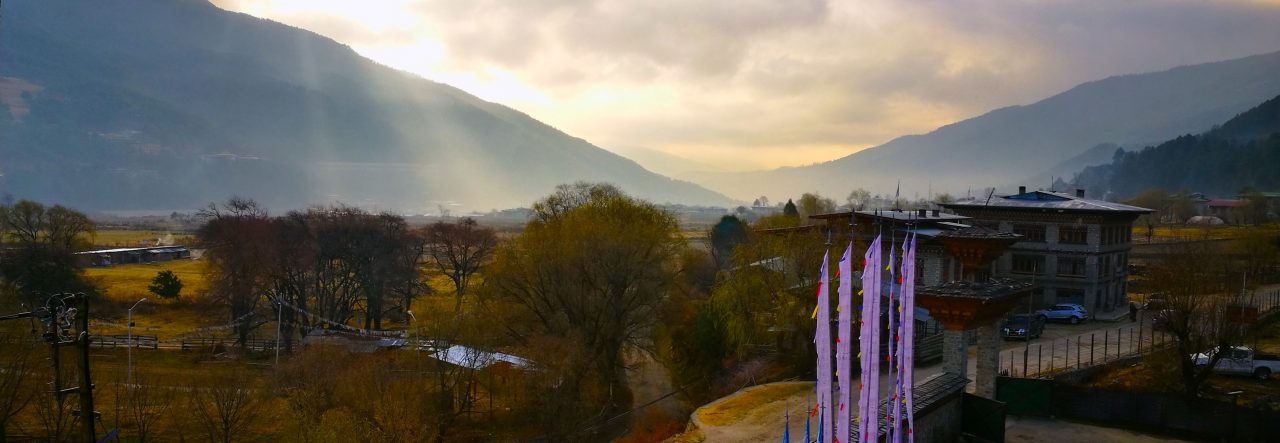
Obviously, my thoughts and prayers this past week were for the people of Nepal who faced the biggest Himalayan tsunami that caused immeasurable destruction along its path and an untold number of deaths.
Having been to Nepal many times on pilgrimages and conferences, this tragedy felt personal. I have reached out to a young monk I know in Nuwakot to see how I could help, although what they are facing is beyond anyone’s imagination or reach.
What is equally worrying is the fact that Bhutan too is prone to such a “tsunami” known as a glacial lake outburst flood (GLOF). I was expecting some reassurances and information on the state of our preparedness from our authorities, but I didn’t see much in the public domain. I am sure it was discussed.
So, here in this article I share what I know and have gathered from various scientific studies.
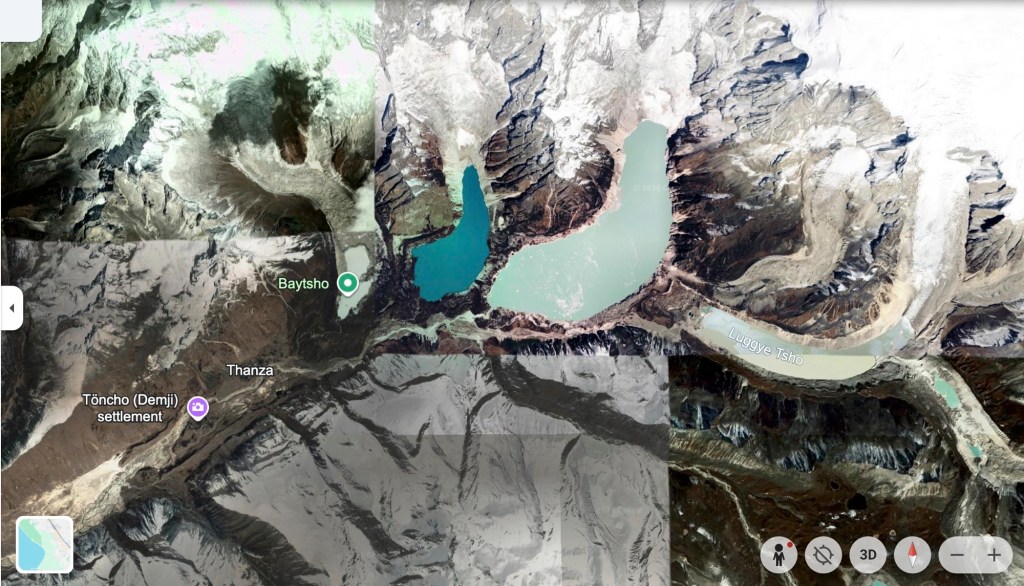
To share a bit of what I have seen, in 2004 I stayed in Lunana for four months doing the filming of my documentary School Among Glaciers. During our journey and the stay there, I trekked to several lakes and herders’ camps and saw the unmatched beauty as well as the dangers posed by the glacial lakes.
If you stand on the edge of any lake, such as the Rapstreng Tsho, in a distance you can see large chunks of snow and ice blocks—some as big as my house—fall into the lake every now and then. The impact on the water surface would create an explosion-like sound and a wave that would eventually hit the natural moraine dam I would be standing on.
If the ice or the avalanche is really big enough, the wave can even break the natural dam, draining out the whole lake and thereby causing the glacial lake outburst flood. This seems to be what happened in Nepal’s case.
What the research says.
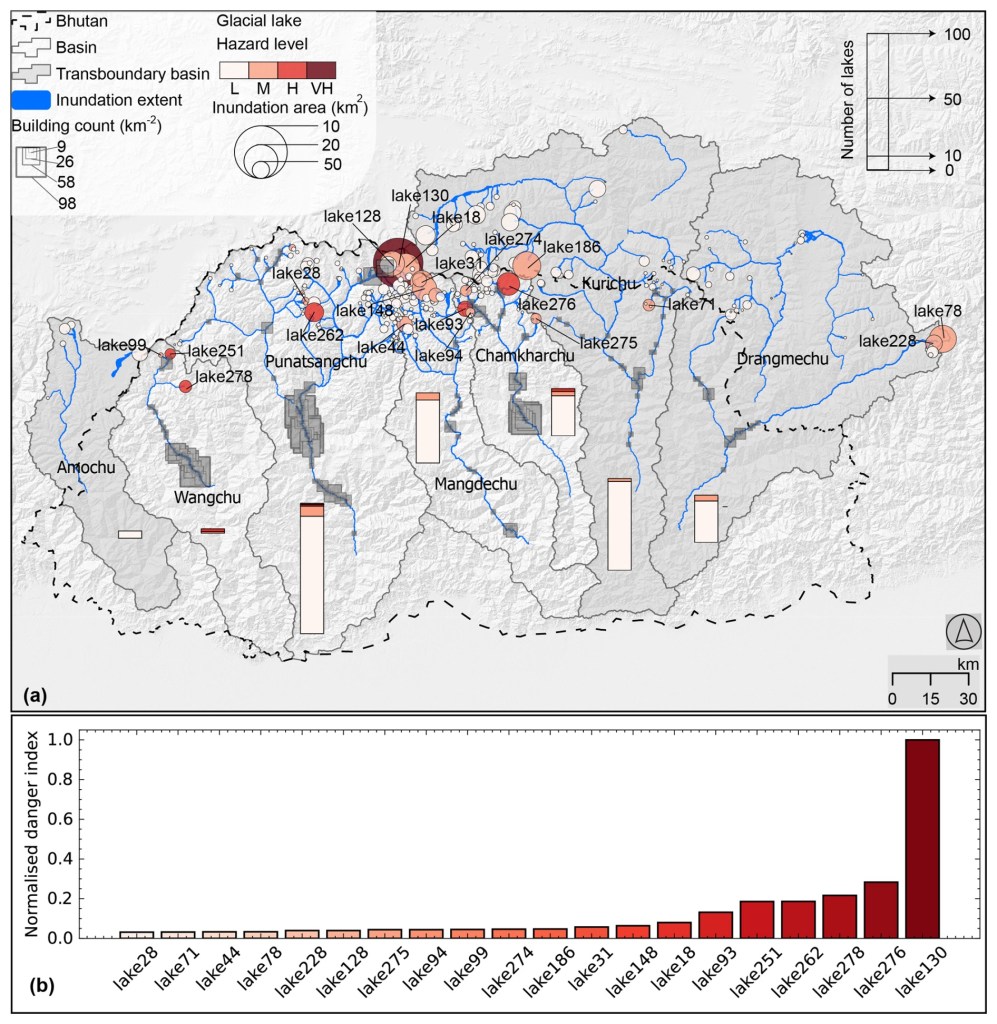
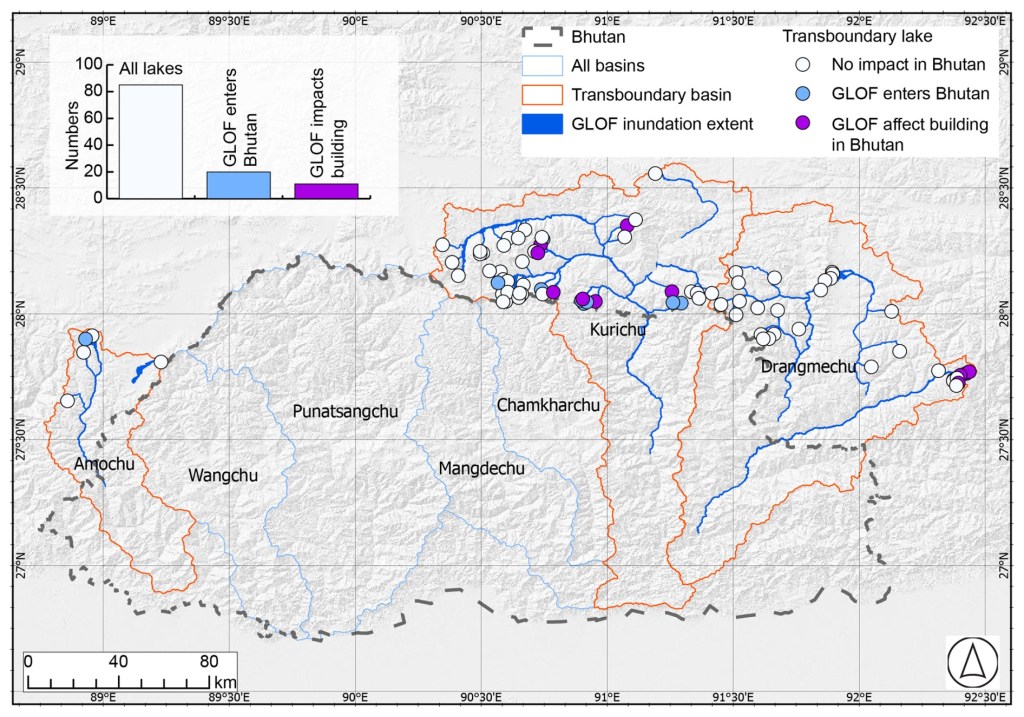
The Punatshangchu, Chamkhar Chu, and Pachu basins are at the highest risk, followed by settlements along Kurichu and Mangdechu. The last big GLOF occurred in Bhutan in 1994, hitting even the historical Punakha Dzong and damaging the Dzongchung.
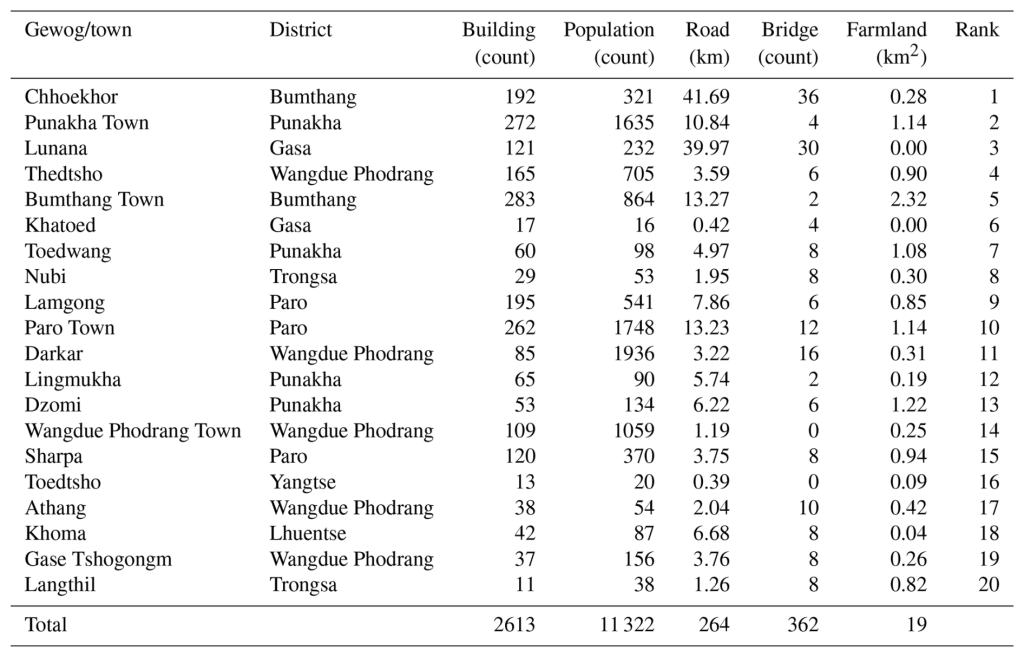
Bhutan has over 2,600 glacial lakes, out of which some recent studies have indicated that 28 could be hazardous. The study published in the European Geosciences Union journal finds that around 11,000 people, 2,600 houses and buildings, 250 km of road, 400 bridges, and 5,000 acres of land in Bhutan are at direct risk to potential GLOFs.
This may sound scary, but what is scarier is the possible outburst of the Thorthormi Lake, which lies behind Raptstreng Tsho in Lunana. It is a huge lake that is classified as “very high-hazard.” If it breaks, it would have a devastating effect on the settlements along the riverbanks in Lunana and more so in the Punakha-Wangdue valley and all the way past Lhamozingkha (Kalikhola). The lake holds some 50+ million cubic meters of water and can gush down a flood measuring 150 feet in height in some stretches. The one in Nepal reached 100 feet high.
Being positive.
However, to put forward some optimism and a suggestion, the lakes in Lunana are constantly monitored, and efforts are made every now and then to lower the level of the lake to lessen the pressure on the moraine dam. A team of glaciologists travels there frequently.
Early warning systems have been installed in places along Phochu, Mochu, Wangchu, Mangdechu, and Chamkharchu. And when these systems are activated, the affected population will have enough time to evacuate. For instance, depending on the volume of the water discharged, the flood from Thorthomi Lake in Lunana would take between two and four hours to reach the town of Punakha.
The suggestion now would be for these early warning systems to be regularly tested and some mock drills to be conducted. The population along the four river basins should be educated and prepared for, and infrastructure developments along these rivers should be well-thought out. Some cross-border coordination and information-sharing may also be initiated—if this is not already done – with India for Dragme Chu (Gongri), and with China for Amochu and Kurichu.
With climate change, winters are expected to be colder, summers will be hotter, rainfall harder, and winds stronger. Large ice blocks falling off and avalanches occurring are bound to happen. It is just a question of when, and not a matter of if.
We just need to be prepared.
🙏🏻🙏🏻🙏🏻


The sheer scale of that event suggests our current warning systems lack necessary predictive capability. A single lake breach could completely overwhelm local infrastructure.
LikeLike