We are poorer by a scholar

August 18, 2020

Drowned by the noise of the pandemic, impermanence has quietly taken away a gem of Bhutanese scholarship, Dasho Sangay Dorji, popularly known as Drungchen Sangay Dorji. 

While offering my condolence to his family, I take the honour to join many fellow scholars and students in paying a humble tribute to this humblest of men. I will spare all the accolades and his achievements. They are all in public domain. Let me just narrate my first of the few encounters, scholarly speaking, which I had with him.

I was researching on a particular aspect of Bhutanese culture and was hunting high and low for its roots in our spiritual traditions or religious texts. Being trained in western social science and engineering, these are not my playground. For weeks I was casting my net everywhere enquiring with just everyone I knew or was listed in in my phone contacts. And everyone told me, “May be you should approach Drungchen Sangay Dorji.” Finally, I managed to reach out to him and ask for help. 

As soon as I uttered my question, he instantly replied, ཀུན་བཟང་བླ་མའི་ཞལ་ལུང་, (Words of my Perfect Teacher by Patrul Rimpoche). He went on to tell me the page number where it appears and also gave me the full context and explanations. I was like, “Wow! No wonder many producers in BBS, where I previously worked, depended on him for any doubts or queries on Bhutanese history or religious studies.”

He was one scholar I truly admired. His book on Zhabdrung Ngawang Namgyel was my field manual when I made the documentary on the same subject, in 2016. And in the few subsequent interactions I had, he was always gentle, kind, humble and restrained – a sign of true greatness. Never did he show off or imply his multiple State decorations nor his immense repertoire of knowledge.

Our country is poorer by a scholar from today. I guess, the divinities wanted him too, and not just us.
😥😥

We are all front liners, now

August 17, 2020

Thought of keeping this low-key, but in view of the sad and worrying news coming out of Paro and Phuntsholing, I thought we needed a dose of optimism.

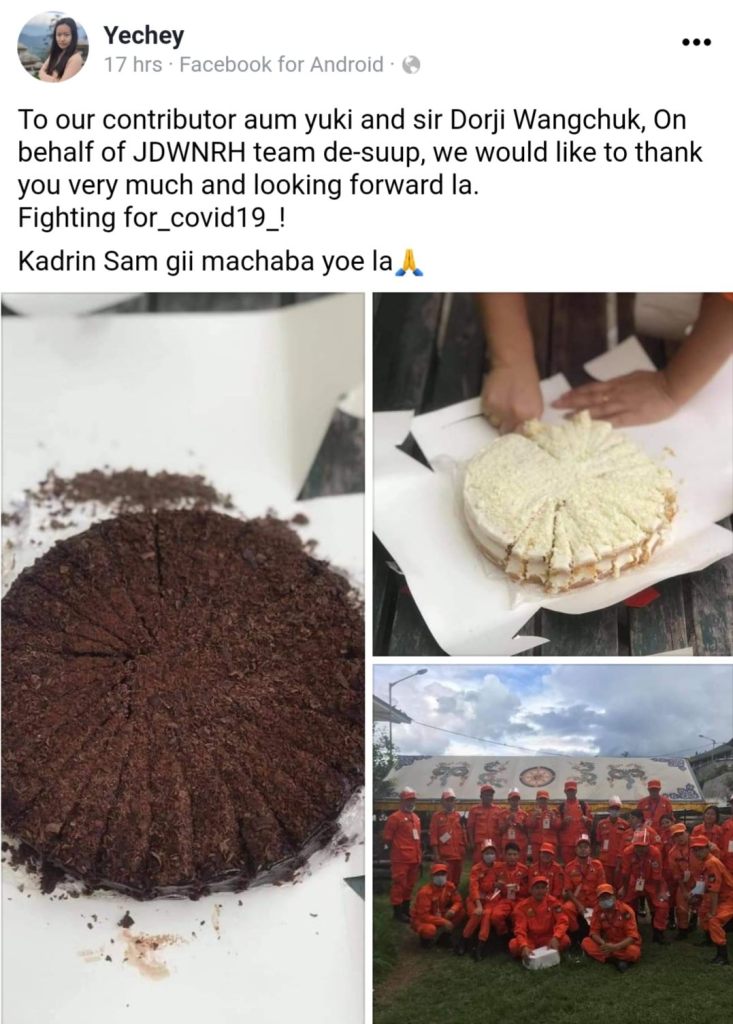
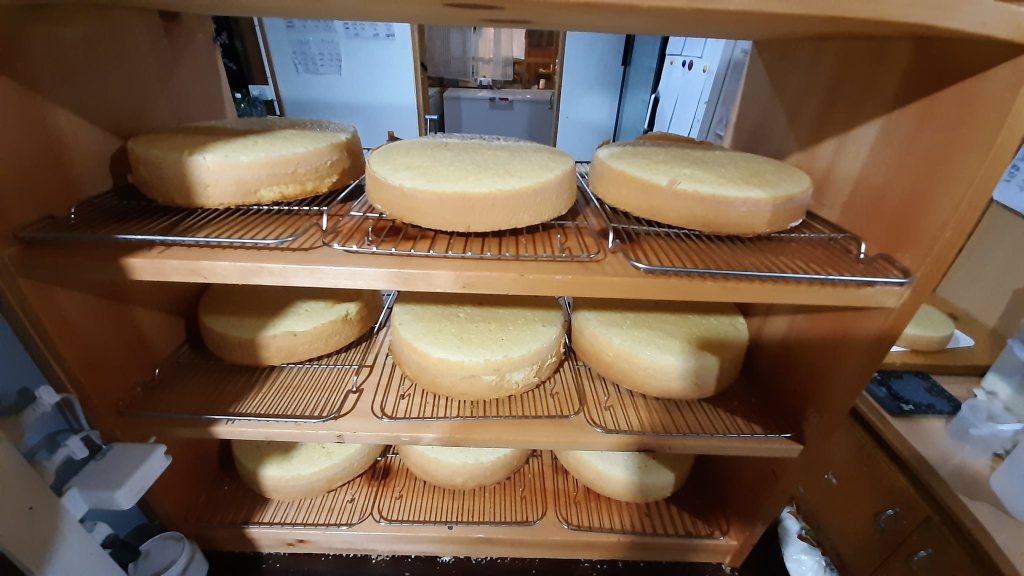
My wife, who runs Café Luna, has been baking free cakes and non-stop for the front-liners since the lockdown. Since our workers are not in, our two daughters are helping. We have reached out to our Desuungs posted in Taba-Dechencholing, Hospital, HMS, RIM, MyMart, FCB store and at the Memorial Chorten. We have also served the waste collectors of Greener Way, our Heath Ministry officials and doctors, our veterinary hospital staff, our two media houses – BBS and Kuensel, the Education Ministry officials and teachers, and, of course, our Prime Minister’s Office.

We did it as a small gesture of appreciation to the great service that they are rendering to our nation, and to say that we are all behind them – and together in this. We didn’t want to sit passively while our own fellows perspired, went hungry or risked their lives for us.

Besides the much-needed sugar boost, I hope all our front liners are fine and that their enthusiasm, strength and focus will outlast the pandemic.

As this situation prolongs, and gets more heated up now, our front liners may run out of steam and lose their morale or motivatation. They are humans like us, after all – and not robots. Therefore, those of us who are at home, forget about complaining, my hope is that you will do your bit to send your support and solidarity, to say the least – or help in whatever form you can.

With confirmed cases of local transmission for Covid19, the virus is at our doorstep, we are all front liners in this fight, now 🤺🤺

King for all sentient beings

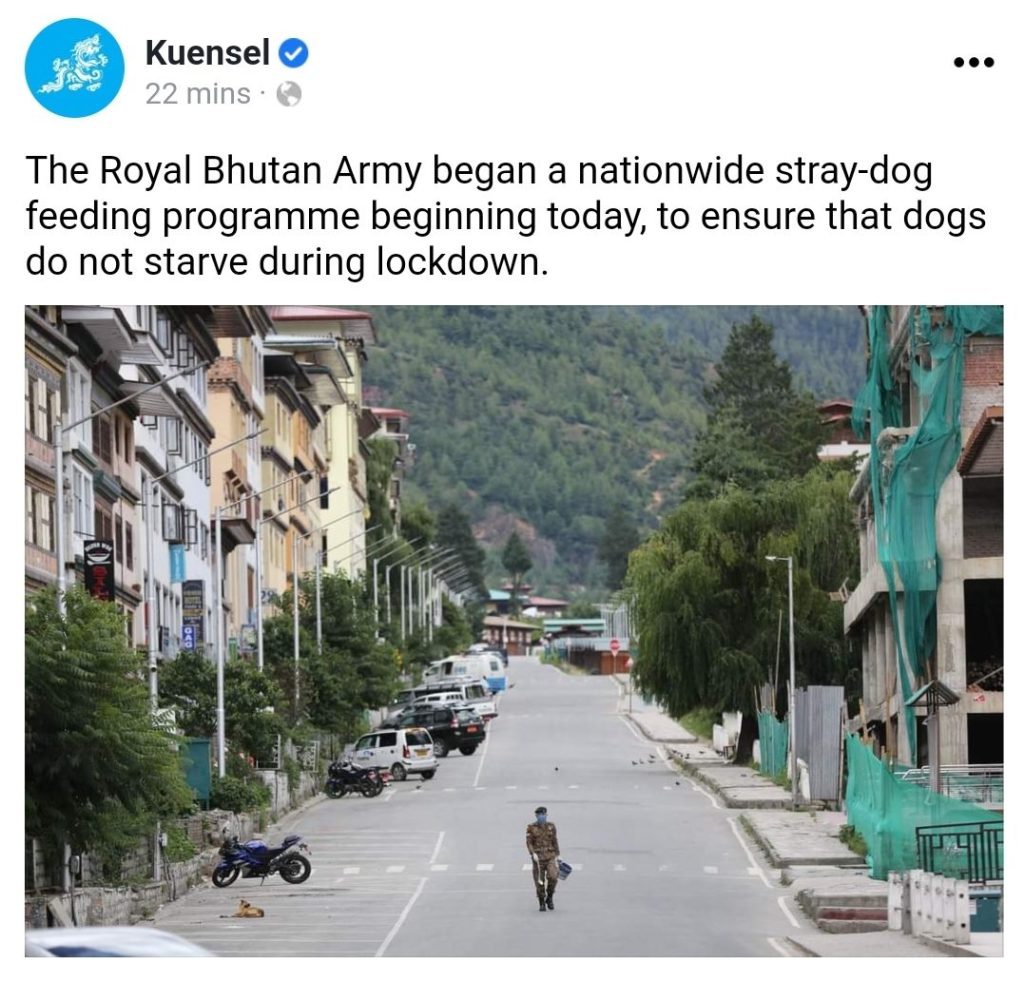
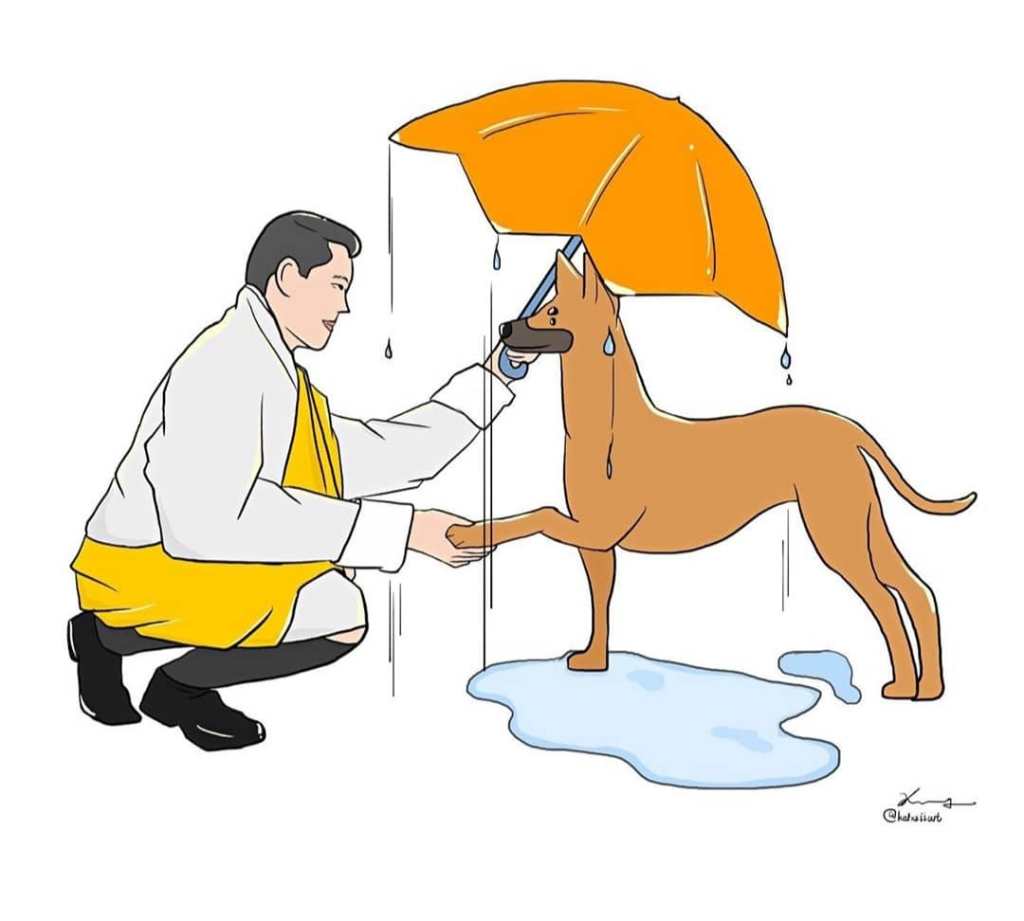
I teared up seeing these pictures – especially the first meme. Not only because I love animals but because I truly believe in a shared, compassionate and a humane world. 

As each one of us fear or fight for our own survival, we often forget that there are also other sentient beings – some less able than us – some who are very helpless. It took our King to notice that and to remind us. Following this, Bhutanese all over, individuals and institutions, have sprung into action to feed the estimated 45,000 stray dogs in the country. With the current lockdown, the strays could be going hungry. I even fed a stray cat. 😎😎😎

The RSPCA, the NGO working on animal welfare, has started receiving lots of support. Please keep them coming. I know them well – in person. The money will go where it should. The Royal Bhutan Army and the Police have been mobilised too. 

A society is only as good as how it treats its weakest members. As Bhutanese, now we can all be proud, happy and reassured. Now, we can all “feel held” and feel supported.

May these acts of compassion help us win our fight against the coronavirus 🙏🙏🙏
🐕
🦌
🐎
🐐

And the lockdown happened

August 11, 2020, Thimphu.

So the inevitable has happened. Nobody wished this but deep down we all knew it was inevitable. 

We are now in a complete lockdown – nationwide. 

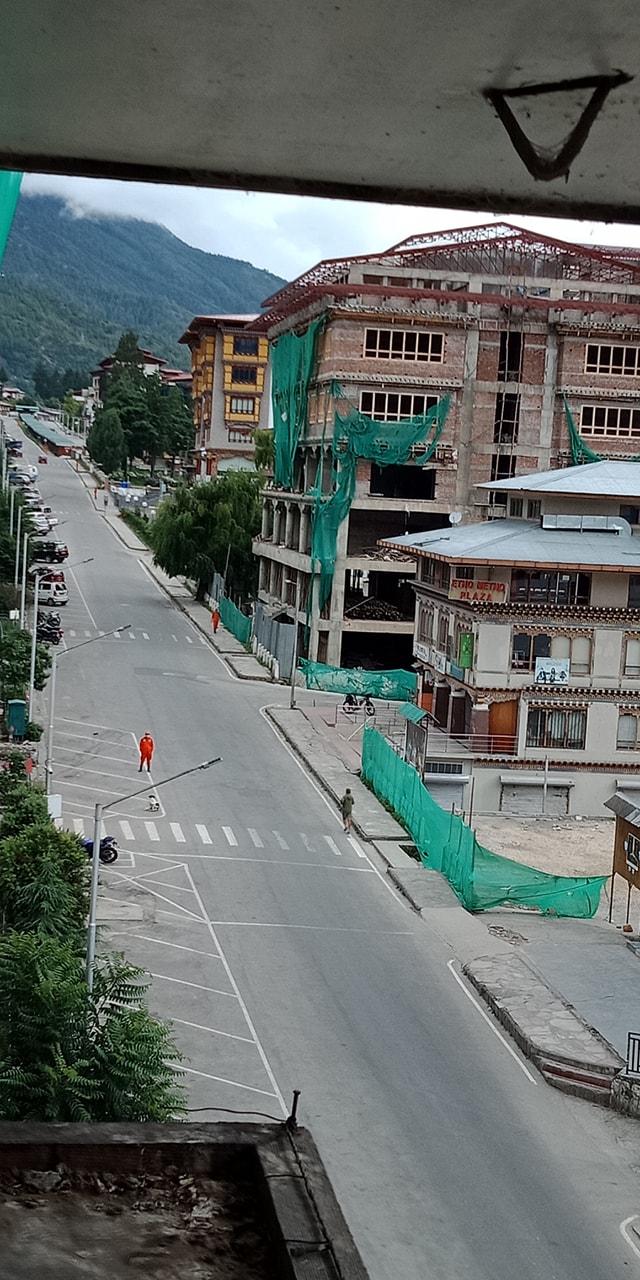
It is so quiet in Kawajangsa. Except for the laughter of my neighbor’s daughter, Thimphu is as silent as a cemetery. Even the wind has stopped blowing and the birds living on the trees of the Folk Heritage Museum have decided to quieten too. We are all holed up.

The million dollar question: What next?

The late American journalist-professor, Norman Cousins, once famously said, optimism doesn’t wait on facts. So while the government collects the facts, which will take some time, and since anxiety has gripped the nation, let me run through some optimism exercise. We start by asking a hard question: What was the worst case scenario? 

When the news of the lockdown appeared on my phone, my immediate thought was, “Hope it is not someone in Gelephu who contracted the virus from across the border and was wandering around unaware and has spread all over”. This would have been devastating. We would have what they call a Super-spreader. Instead what we have is a case of someone who was in quarantine and tested negative continuously, tested positive once and then tested negative and then released. And then tested positive again during a review check-up.

The next worst-case scenario is the possibility that she was reinfected – a pattern seen in many countries. Meaning she was infected outside the country, recovered on her own in Bhutan and reinfected after she left the quarantine. However, according to local medical practitioners I talked to, the reinfection theory can be ruled out too, if the studies from other countries are to go by. They pointed out that, awaiting test results of the contacts groups, this case could indicate towards dead viruses that are getting removed by the body, a process called virus-shedding, which sometimes shows up in subsequent tests.

Hence, it is not all gloom and doom. We could be potentially looking at case of dead viruses that showed up during the review test. In any case, we have someone whose medical records and whose travel history is known. I am not a health expert but I am optimistic that she (not she but the virus she was carrying) didn’t infect others. It is not case of a superspreader, for sure.

Coming to the woman, she has all my sympathy and compassion. It is not her fault. She didn’t jump the quarantine. And she visited the flu clinic as told. Maybe she could have been more serious with DrukTrace but this is another issue altogether. (Neither the developers of the DrukTrace nor the users have been serious about it.) Where we need to draw our attention to is not lose our sense of humanity – even when we are going through the a crisis.

Most importantly, as we wait for the health workers to do their job, let’s not lose our optimism. Let’s remind ourselves and feel (really feel) the hard works of our King and our leaders and the blessings of our divinities to keep us safe. Let’s not take these for granted. And whatever happens, we know we were in the safest of hands. 

Maybe I am wrong but it doesn’t help to panic or be pessimistic. Or maybe, on the flipside, we really needed this lockdown to get a valuable lesson – or to avoid something worse. We never know

Balancing the growth

I don’t know the context, or as they say the wisdom, on the decision by Bumthang Dzongkhag Yargye Tshogde to suspend the issue of permits to set up businesses in the district. But some wishful thinking occured on my mind as this news flashed on my timeline. 

A totally another idea.

Of late, I have been thinking why Dzongkhags and Gewogs in Bhutan do not do anything to attract good people and investments into their area so that wealth and jobs are created, more taxes raised and there is some form of balanced growth in the country. Instead, if we go by some recent posts from the districts, there seem to be additional walls built by dzongkhags, gewogs, and parks with the so-called ‘clearances’ for businesses in their areas. 

Elsewhere, even in India, states roll out red carpets to the likes of Tata, Gates or Bezos to build factories in their states. Indian PM Modi, when he was the chief minister of Gujarat, once received USD 200B of foreign direct investments.

Back home, we have often lamented that everything is happening in Thimphu. Everyone in investing in Thimphu. Or that most chhilip tourists visit only Paro and Thimphu. I am sure that if local governments roll up their sleeves in this direction, such capital-centric trends can be reversed. Maybe some could even lobby for tax and other in-kind incentives to attract investments.

Maybe the promotions or reelections of the local government leaders should be tied to taxes paid by their people within their territory.

Excuse this wishful thinking

Domestic tourism 😎😎😎

The Pandemic will spur a new trend in Bhutan – domestic tourism. And tourists will not be equated to dollar-paying visitors only. I welcome this development with an open arm. And with a big kiss.

Many middle class folks of Thimphu and Paro know every shopping mall in Bangkok but wouldn’t have stepped into Baeyul Langdra, which is around the corner. Forget about Omba Nye or Pemaling. And unless our people are on official tour (read as government paid-trip), no one actually travels to see our own land, to know our own people or customs better – or to purposely visit our own sacred sites. Most Bhutanese suffer from the Lhasa Ama Syndrome when it comes to local places.

Domestic tourism is more sustainable, leaves less social or cultural foot prints and prevents capital outflow. It also brings the people of the same country together in harmony and solidarity – and has many positive ramifications. 

Again, the choice is not an either-or but a case of the need for both – local and international visitors. So far the focus in terms of policy or marketing has been on international tourism. I am not challenging its benefits or validity. But like in every country, we can have both – local and international, and authorities, especially the Dzongkhag Administrations, can promote travels into their Dzongkhags. Gewog Administrations should play good hosts. If these things are in place, thanks mainly to the social media posts and selfies, international tourist flow into their areas will increase, with or without politicians making lofty promises or DYTs having to nag with elected governments. For example, I already have a solid enquiry for Athang Rukha through my posts.

Time to explore your own country better, people. 😁😁😁

Trekking to Salading La

Aap Phub Thinley and Aum Pechum are Norpen (head of cattlemen) for Gangtey Gonpa. They are from Lamga village in Athang gewog. Whenever I am in their village, they make a point to visit me. Sometimes they walk the whole day to reach Lamga. They live a semi-nomadic life with the herd, moving the camp once every one-two months between Rukha (peak Winter) and Salading (peak Summer). They have eight camps in total.

This time I reciprocated their visits, with me visiting them at Salading La, which stands between Phobjikha and Trongsa. I went with some gifts of tea leaves, rum, betel nuts and canned food for my old friends.

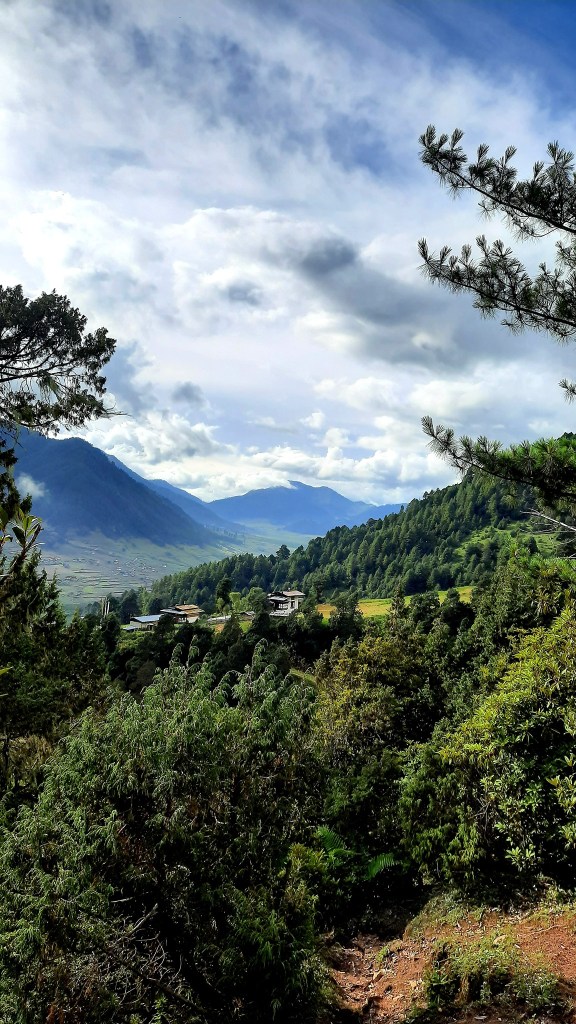
Salading stands at around 4,100m and is a three-hour uphill climb from Zizi, the last village in Phobjikha valley. It is totally an uncharted territory – except for herders and foresters. From there you could see the Gangtey-Phobji valley and the tall Himalayan peaks bordering with China. You could also walk along the ridge (for over 15 kilometers I am told) and trek to Jowo Drushing and back – or exit to Trongsa.

My daughter accompanied me on this trek. And experienced sleeping in cowherders’ smoke-filled hut and eating cheese as tea snacks  😂😂😂

Enjoy the heavenly places in the picture.

Why I do what I do?

OK. Let me get this off my chest. It is not anything important, but since there are no interesting selfies to upload and nothing exciting happening this week, apart from my routine online meetings, let me take the opportunity to share this.

It pertains to my social and spiritual works such as building temples and chortens in places like in Athang Rukha and Lamga – and in Kheng Kikhar There are many questions and comments that my friends, family and countrymen have posed. Some out of genuine concerns for me (They think I might go penniless one day), some out of curiosity (Is he trying to lay the ground works for a future in politics?) and some, I wouldn’t exclude, out of pure envy (Where does he get the money from?). We are all unenlightened souls. I understand. 

So why do I do what I do? How I do it? Meaning how I fund these things. And why don’t I invest in building assets, like doing a multi-storied castles, like everyone else?

It is age

First, as I have mentioned before, life rolls out like a video game – in stages. As you play the game of life, you pass on to the next level every couple of years, where you face new challenges, meet new opportunities and embrace new roles. I must say that I had my share of fame and fortune, for which I am forever indebted to my clan and my country. I had my share of dreams and disappointments too. And in many of the opportunities that were laid out for me, I excelled. In some, I failed, to be honest. 

All these are now behind me, though. As Bhutanese, having zoomed past the age of 50 (I also turned a grandfather recently), one normally engages in spiritual pursuits and takes a slower pace with life. That’s exactly what I am doing. There was time, in my younger days, when I worked like there was no tomorrow – or like I was going to live forever. I must be one of the few government employees who spent many nights in office, go home for breakfast and shower and come back to work. I am not making this up. Ask anyone I worked with back then. And when I look back, I am proud because I covered more ground than others. Having a Japanese wife helped, for sure. Now, of course, I need to sleep on time.

Work and balance

Second, I still work, by the way. But I do what I love and, to paraphrase Confucius, I don’t feel that I am “working” because I have chosen a third career that I love – teaching. Almost everything I do is online and can be done from anywhere – and I have been doing that even before COVID-19. Simply put, I still have an income.

Third, it is about practicing some degree of contentment – tsham tshay in Bhutanese – a balance in one’s life. How much does one really need? How long do you want to cling to power? How much do you want to accumulate? As I said, I had my time. I had my share. I even tasted power. Now, my life is minimalistic. No Prados. No buildings. No silk ghos or designer wears. I rarely buy new clothes anyway. And thanks to the coronavirus, no foreign travels either. So most of my earnings can go into my social and spiritual works. And here I must thank my wife for not only letting me do this, but also for doing her share of work and donating and contributing generously to spiritual and social causes, from time to time. 

Children? 

My late mother used to say that every child is born with a soenam (fortune/destiny/merit). As they grow up they will have their dreams. Help them to fulfil theirs – and do not impose yours on them. Most important give them a well-rounded education – and not leave them with just properties. The Chinese actor, Jackie Chan, once said, with good education, your children will build their own fortune. With bad or no education they will sell away yours. 

And also, you should not use your children as an excuse to be greedy yourself, or to accumulate wealth (typical of Asian parents).

Being human

One of my teachers tells me that being human is the best chance to get closer to enlightenment – whatever that is. Of course, you can be reborn to continue, but there is no guarantee that you will be human again. What if your rebirth is as a mosquito? Or as hungry ghost? You don’t have to be a monk to be religious, either. In fact, the Bhutanese word for charity, or social work, is gyelwa, which means “enlightenment” or “realisation”. And so if you want to get out of this samsara – you can also do it by embracing some social works. Many characterise these things as “giving back” to the society. For me, it is just being a good human being.

Being Bhutanese

One compelling reason why you should be altruistic, and be more human, is because you are a Bhutanese. I am not saying it is a national requirement. What I mean is, as a Bhutanese you have the luxury to be selfless and to be generous. Not all nationalities can do that, you know? For example, if you are an American, you have to keep a good bank balance in case you get sick. Health care in many countries costs you an entire fortune. In Bhutan it is free. Elsewhere, you could also go homeless if you forget to insure your house and a fire or an earthquake brings it to the ground. In Bhutan, if you are landless or handicapped, or you lose your house to a misfortune, you can appeal to the King. My grandfather, Gyeltshen, did after we lost ours in 1978. Furthermore, in case you go broke or hungry you can always call up a family member. The social safety net here is huge – and perhaps THE best in the world. And I pray that it remains that way because being a Bhutanese allows you to be the best human being.

In conclusion

As you dwell in this human realm, one should not miss the chance to do some gyelwa. As a donkey you can still do it, but, I guess, it will be little more difficult. And as Bhutanese, under our King, remember, we have the luxury to be selfless, generous, and compassionate. You don’t need much, either. You can do a lot with very little. It is more about pouring your heart too and less about money.

Again, I don’t want to sound patronising or paternalistic. We all do what makes us happy. Life and happiness are subjective. One could also be fine driving around a Prado, while dreaming of owning another multi-storied building – or be still overwhelmed with power or patang. It is one’s personal choice – one’s way of life.. 

As for me, I have chosen to put them all behind me. And embrace this stage of my life – of being little more human – and being little more Bhutanese. And may be as productive a citizen as ever.
Updates from Lamga

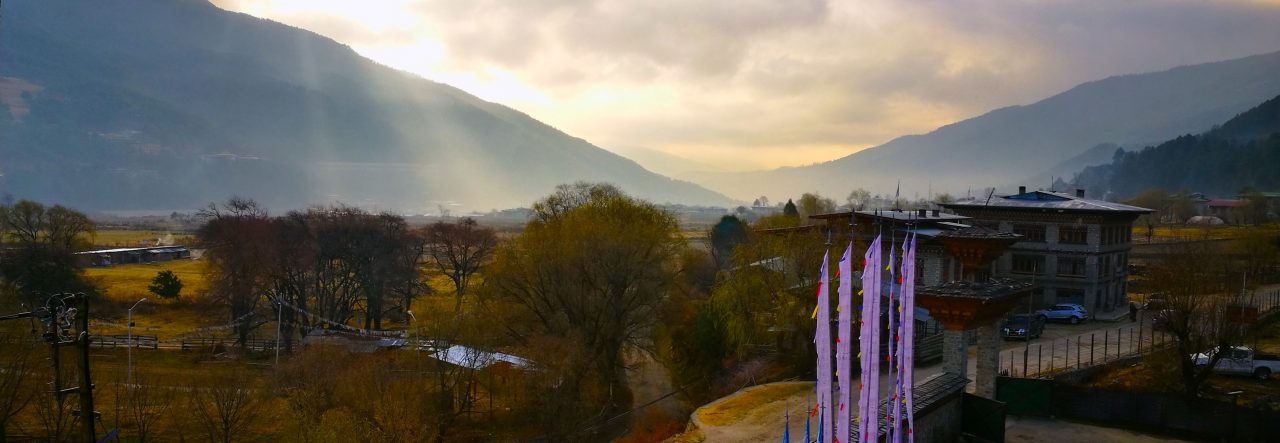
The community kitchen is done and the sacred paintings of my temple are complete too. This is the latest update from Lamga village.

For those who were not following my work there, the village is a new settlement of mainly people from Zizi in Phobjikha. Lamga is the last village along Harachu valley and beyond it is wilderness of Black Mountains of central Bhutan.

The permanent houses were built by Tarayana in 2008-10. However, the inhabitants had no place to meet or conduct their monthly rituals. They were doing religious ceremony every month, sometimes twice, under tarpaulin sheets. In monsoon season, it was a disaster. This really shocked me and I promised them that I will look into it.

In 2015, I agreed to sponsor the construction of the community temple. And in my usual way, we worked when I had money, stopped when I was broke, and resumed again. After four years we completed the works. It took some time but it is done. The temple has Tshela Namsum – Tshepamay, Namgyelma and Drolma as the main statues and place is blessed by His Eminence Gangtey Trulku, who also committed to grant the debri (mural painting).

Last March, when I had self-quarantined there, we decided to do a community kitchen, wooden flooring and bring drinking water. I also deputed a painter from Bumthang to do the sacred paintings. One important remaining work is installation of serto (golden pinnacle). Anyone wants to be the sponsor?

Unplanned tendrel

The groundbreaking and the foundation works on the temple was conducted on the day HRH The Gyalsey Jigme Namgyel was born. It was done by the villagers without any prior planning. In local belief, unplanned tendrels are the most auspicious. The villagers are very proud of this sacred coincidence.

Getting there:

From Taksha Range Office along Wangdue -Tsirang Highway, veer left and follow the farm road to Rukha. At 17km, at Dolepchen, there is bifurcation. The right one goes to Rukha. Go straight till there is no road left 😂

Where to stay:

Chorten Tshering and his family have a tourist-standard home-stay house if you want to spend a night in the village. Toilet attached to the house with shower plus hot stone bath. The Harachu is believed to have medicinal effects – known since ancient time.

The village is perfect to detox from the social media and unplug from the world. And get some mantras done at the temple. It is the quietest place on Earth. The Lamgaps are simple and generous people.

Best time to visit:

From month of October till May.